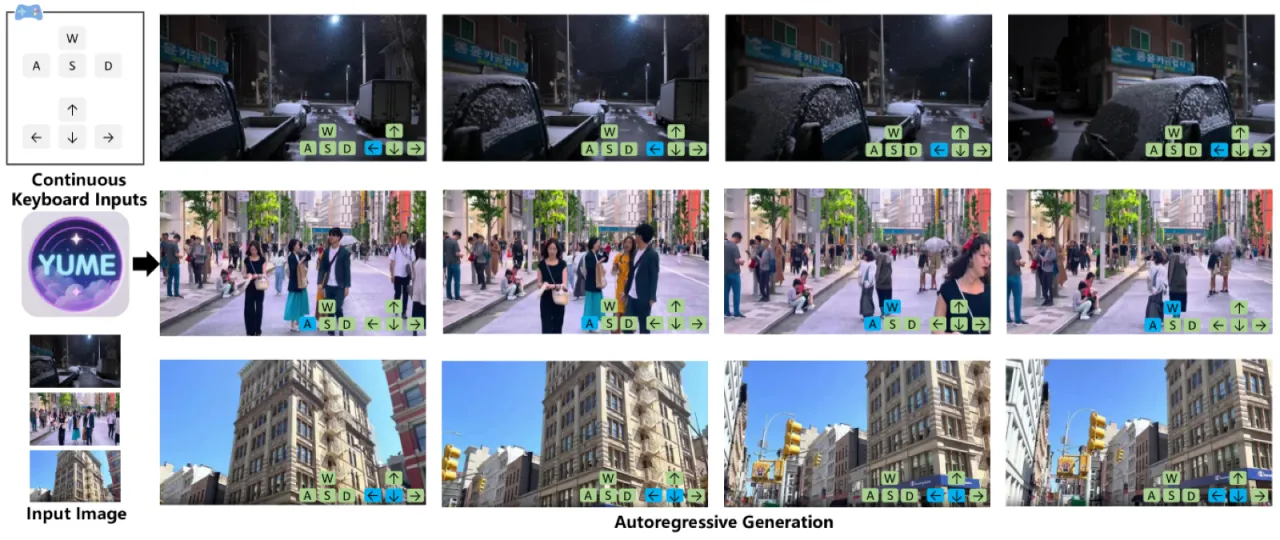
流式交互式世界生成——从一张图像出发,用键盘探索无限动态世界Streaming interactive world generation — start from a single image and explore an endless dynamic world with the keyboard
Yume 提出了一套面向交互式世界生成的完整框架,核心由四大模块组成:量化相机运动(QCM)、Masked Video Diffusion Transformer(MVDT)、无训练 Anti-Artifact Mechanism(AAM)以及 TTS-SDE 采样器。模型以单张图像为输入,通过键盘方向键控制相机运动,以自回归方式生成理论上无限时长的高质量动态场景视频,并在城市实景等复杂场景中取得显著效果。Yume presents a complete framework for interactive world generation, built on four core modules: Quantized Camera Motion (QCM), a Masked Video Diffusion Transformer (MVDT), a training-free Anti-Artifact Mechanism (AAM), and the TTS-SDE sampler. Taking a single image as input, the model controls camera motion with the keyboard arrow keys and autoregressively generates high-quality dynamic scene videos of theoretically unlimited duration, achieving notable results in complex settings such as real urban environments.
interactive world generationvideo diffusion量化相机运动 QCMQuantized Camera Motion QCMMasked Video Diffusion Transformerautoregressive video无限视频生成infinite video generationAnti-Artifact MechanismTTS-SDEmodel distillation
01动机Motivation
现有视频扩散模型在生成交互式、可导航的真实世界场景时面临三大核心挑战:合成数据与真实场景之间的领域鸿沟、依赖绝对相机姿态参数导致的标注难与训练不稳定,以及城市复杂场景中普遍存在的视觉 artifacts(闪烁、纹理异常、几何扭曲)。Existing video diffusion models face three core challenges when generating interactive, navigable real-world scenes: the domain gap between synthetic data and real scenes; the annotation cost and training instability caused by relying on absolute camera pose parameters; and the visual artifacts (flickering, texture anomalies, geometric distortion) that pervade complex urban scenes.
"Yume aims to use images, text, or videos to create an interactive, realistic, and dynamic world, which allows exploration and control using peripheral devices or neural signals."
图 1:Yume 概览。用户输入一张图像,通过键盘方向键持续控制相机运动,模型以流式方式生成可探索的动态世界视频——无论是城市街道、室内场景还是无人机航拍视角均可支持。Figure 1: Overview of Yume. The user supplies a single image and continuously steers the camera with the keyboard arrow keys, while the model streams an explorable dynamic world video — urban streets, indoor scenes, and drone aerial viewpoints are all supported.
8量化相机动作类别(前/后/左/右/转左/转右/仰/俯)Quantized camera action classes (forward / backward / left / right / turn-left / turn-right / tilt-up / tilt-down)
400hSekai-Real-HQ 训练视频时长Sekai-Real-HQ training video duration
∞理论视频生成时长(自回归)Theoretical video generation length (autoregressive)
02方法Method
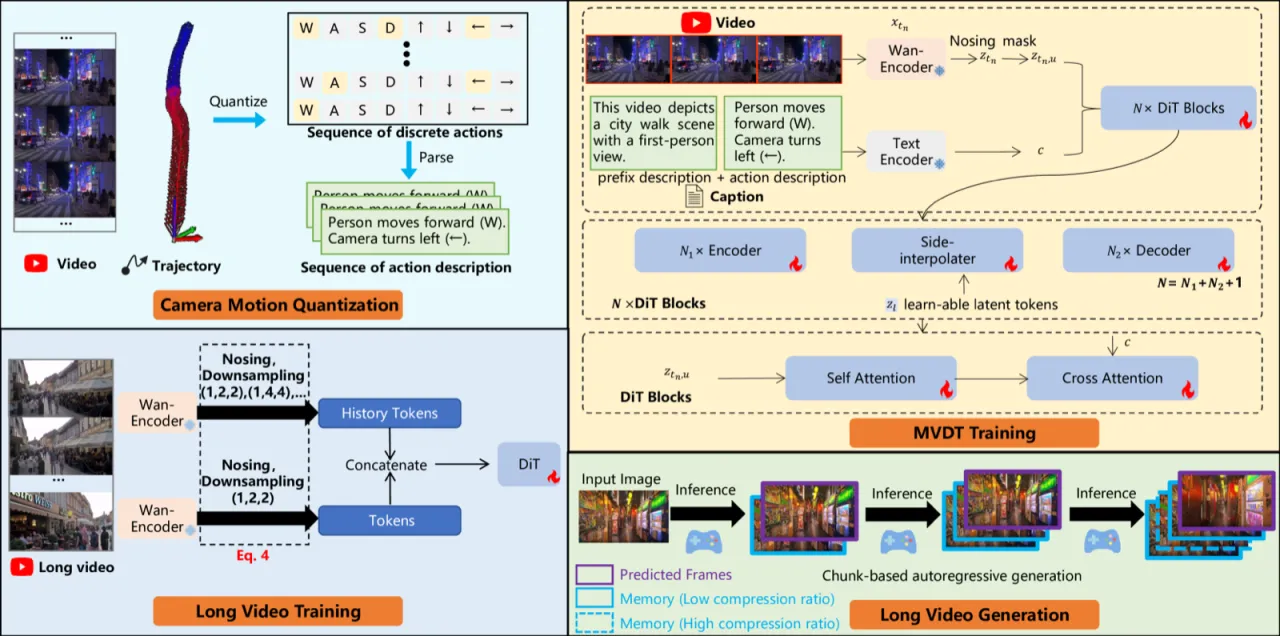
Yume 的框架由四个相互协作的核心组件构成:相机运动量化、Masked Video Diffusion Transformer 架构、无训练采样器设计、以及模型加速。这四部分分别解决了控制稳定性、计算效率、生成质量和推理速度四个维度的问题。The Yume framework comprises four cooperating core components: camera motion quantization, the Masked Video Diffusion Transformer architecture, a training-free sampler design, and model acceleration. Together they address control stability, computational efficiency, generation quality, and inference speed.
图 2:Yume 四大核心组件。左起:(1) 量化相机运动(QCM)将连续轨迹离散化为 8 种文本动作;(2) MVDT 对 30% token 应用 selective masking,通过 side-interpolator 预测遮盖内容;(3) FramePack 启发的长视频记忆压缩方案;(4) TTS-SDE 采样器与 AAM 高频精修模块。Figure 2: The four core components of Yume. From left: (1) Quantized Camera Motion (QCM) discretizes continuous trajectories into 8 textual actions; (2) MVDT applies selective masking to 30% of the tokens and predicts the masked content through a side-interpolator; (3) a FramePack-inspired memory compression scheme for long videos; (4) the TTS-SDE sampler together with the AAM high-frequency refinement module.
1. Quantized Camera Motion (QCM)
现有方法依赖逐帧绝对相机矩阵(c2w)进行控制,标注成本高且对预训练模型不友好。QCM 将连续相机轨迹量化为 8 种离散动作(forward, backward, left, right, turn-left, turn-right, tilt-up, tilt-down),通过计算相邻帧的相对变换矩阵,选取与之最近的预定义典范动作,并转换为文本条件输入——无需引入额外可学习模块,即可在预训练 I2V 基础模型上实现键盘控制。Existing methods rely on per-frame absolute camera matrices (c2w) for control, which is expensive to annotate and unfriendly to pretrained models. QCM quantizes continuous camera trajectories into 8 discrete actions (forward, backward, left, right, turn-left, turn-right, tilt-up, tilt-down): it computes the relative transformation matrix between adjacent frames, picks the closest predefined canonical action, and converts it into a text condition input — enabling keyboard control on a pretrained I2V foundation model without introducing any extra learnable module.
2. Masked Video Diffusion Transformers (MVDT)
MVDT 在去噪过程中对 30% 的 token 进行 selective masking,分三阶段处理:Encoder 仅处理可见 token,Side-interpolator 通过可学习 token + self-attention 预测被遮盖内容,Decoder 对插值特征进行精化。该设计将计算集中于可见区域,同时保持时序一致性。配合基于 FramePack 思路的记忆压缩方案(近帧 (1,2,2)、远帧 (1,8,8) 不同压缩比),实现自回归无限视频生成。During denoising MVDT applies selective masking to 30% of the tokens, processed in three stages: the Encoder handles visible tokens only, the Side-interpolator predicts the masked content with learnable tokens plus self-attention, and the Decoder refines the interpolated features. The design concentrates computation on visible regions while preserving temporal consistency. Combined with a FramePack-inspired memory compression scheme (different compression ratios for near frames (1,2,2) and far frames (1,8,8)), it enables autoregressive infinite video generation.
3. Training-Free Anti-Artifact Mechanism (AAM)
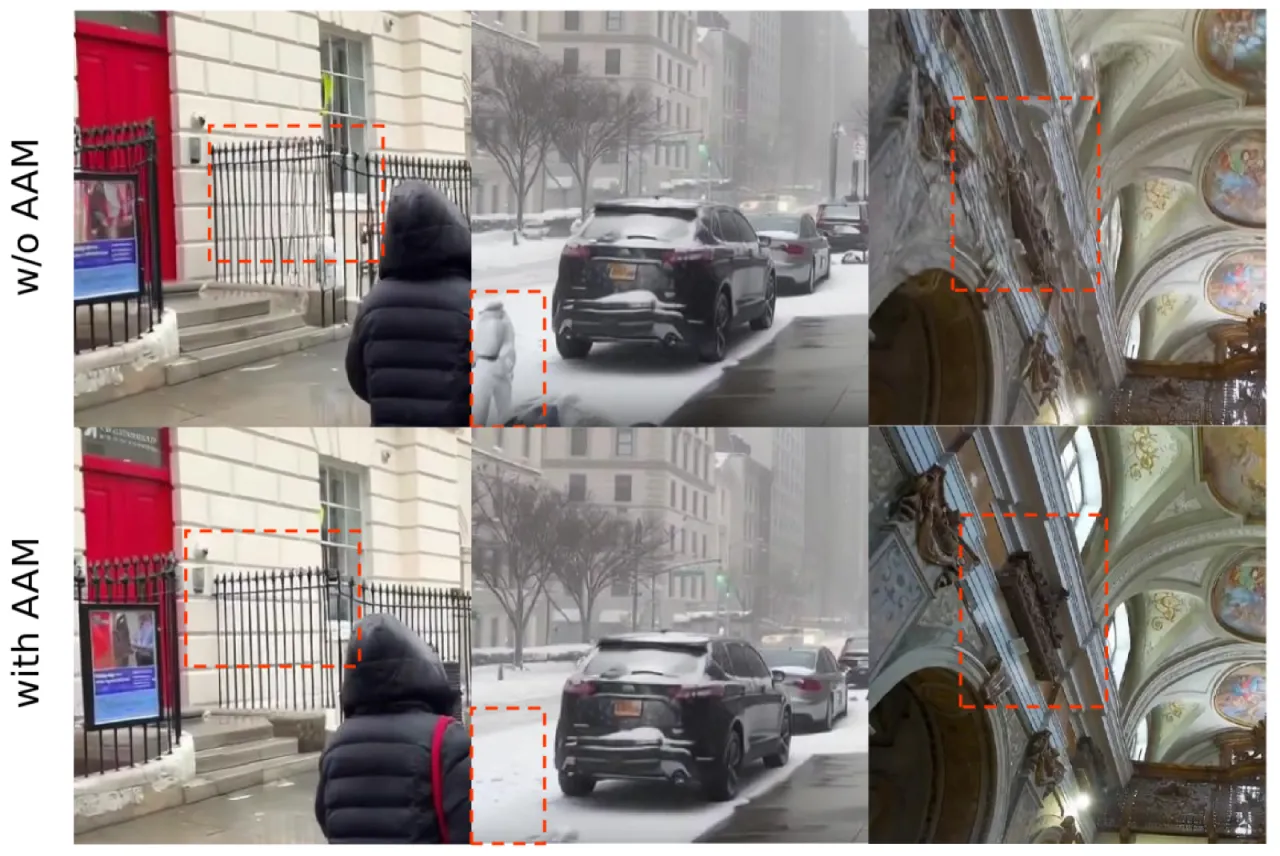
AAM 是一个无需额外训练的两阶段去噪机制:首先进行标准去噪生成初始结构 zorig,再利用 Gaussian blur 滤波将低频分量(整体结构)保留自初始生成,而高频分量(细节纹理)由精化步骤重新生成,从而在不引入训练开销的前提下大幅减少城市建筑场景中的视觉伪影。AAM is a two-stage denoising mechanism that requires no extra training: standard denoising first produces the initial structure zorig, then a Gaussian blur filter keeps the low-frequency components (overall structure) from that initial generation while the high-frequency components (fine texture) are regenerated by a refinement step, greatly reducing visual artifacts in urban architectural scenes without any training overhead.
4. Time Travel Sampling based on SDE (TTS-SDE)
受 DDNM 和 OSV 启发,TTS-SDE 利用后期去噪阶段的信息引导前期步骤,同时注入随机微分方程噪声以增强采样随机性,从而提升文本/动作可控性。消融实验证明,相比标准 ODE 采样,TTS-SDE 将 Instruction Following 从 0.657 提升至 0.743。Inspired by DDNM and OSV, TTS-SDE uses information from the later denoising stages to guide the earlier steps while injecting stochastic differential equation noise to strengthen sampling randomness, thereby improving text/action controllability. Ablations show that, compared with standard ODE sampling, TTS-SDE lifts Instruction Following from 0.657 to 0.743.
5. 模型加速Model Acceleration
通过对抗蒸馏将采样步数从 50 步压缩至 14 步,推理时间从 583.1 秒降至 158.8 秒(3.7× 加速),视觉质量指标几乎不变(Imaging Quality 0.739 保持不变,Subject Consistency 仅下降 0.005)。此外还引入基于 Cache 的加速机制协同优化。Adversarial distillation compresses the sampling schedule from 50 steps to 14 steps, cutting inference time from 583.1 s to 158.8 s (3.7× speedup) with virtually unchanged visual quality metrics (Imaging Quality stays at 0.739, Subject Consistency drops by only 0.005). A Cache-based acceleration mechanism is additionally introduced for joint optimization.
03实验Experiments
训练数据:Sekai-Real-HQ(来自 YouTube 行走视频 + 无人机视频,经过镜头检测、亮度过滤、轨迹过滤后精选 400 小时,含 139,019 个标注片段)。评测基准 Yume-Bench 覆盖六项指标:Instruction Following(人工评测)、Subject Consistency、Background Consistency、Motion Smoothness、Aesthetic Quality、Imaging Quality(后五项来自 VBench)。测试分辨率 544 × 960,帧率 16 FPS,96 帧,50 步推理。Training data: Sekai-Real-HQ (YouTube walking videos plus drone footage, curated down to 400 hours after shot detection, brightness filtering, and trajectory filtering, containing 139,019 annotated clips). The Yume-Bench benchmark covers six metrics: Instruction Following (human evaluation), Subject Consistency, Background Consistency, Motion Smoothness, Aesthetic Quality, and Imaging Quality (the last five taken from VBench). Testing uses a resolution of 544 × 960 at 16 FPS, 96 frames, and 50 inference steps.
Table 2:与 SOTA 方法的对比(质量对比)Table 2: Comparison with SOTA Methods (Quality)
Yume 的 Instruction Following(0.657)大幅领先两个 baseline,同时在 Subject Consistency、Background Consistency、Motion Smoothness、Aesthetic Quality 上均达到最优或接近最优,仅在 Imaging Quality 上略低于 MatrixGame(0.739 vs. 0.750)。Yume's Instruction Following (0.657) leads both baselines by a wide margin, and it is best or near-best on Subject Consistency, Background Consistency, Motion Smoothness, and Aesthetic Quality; only on Imaging Quality is it slightly below MatrixGame (0.739 vs. 0.750).
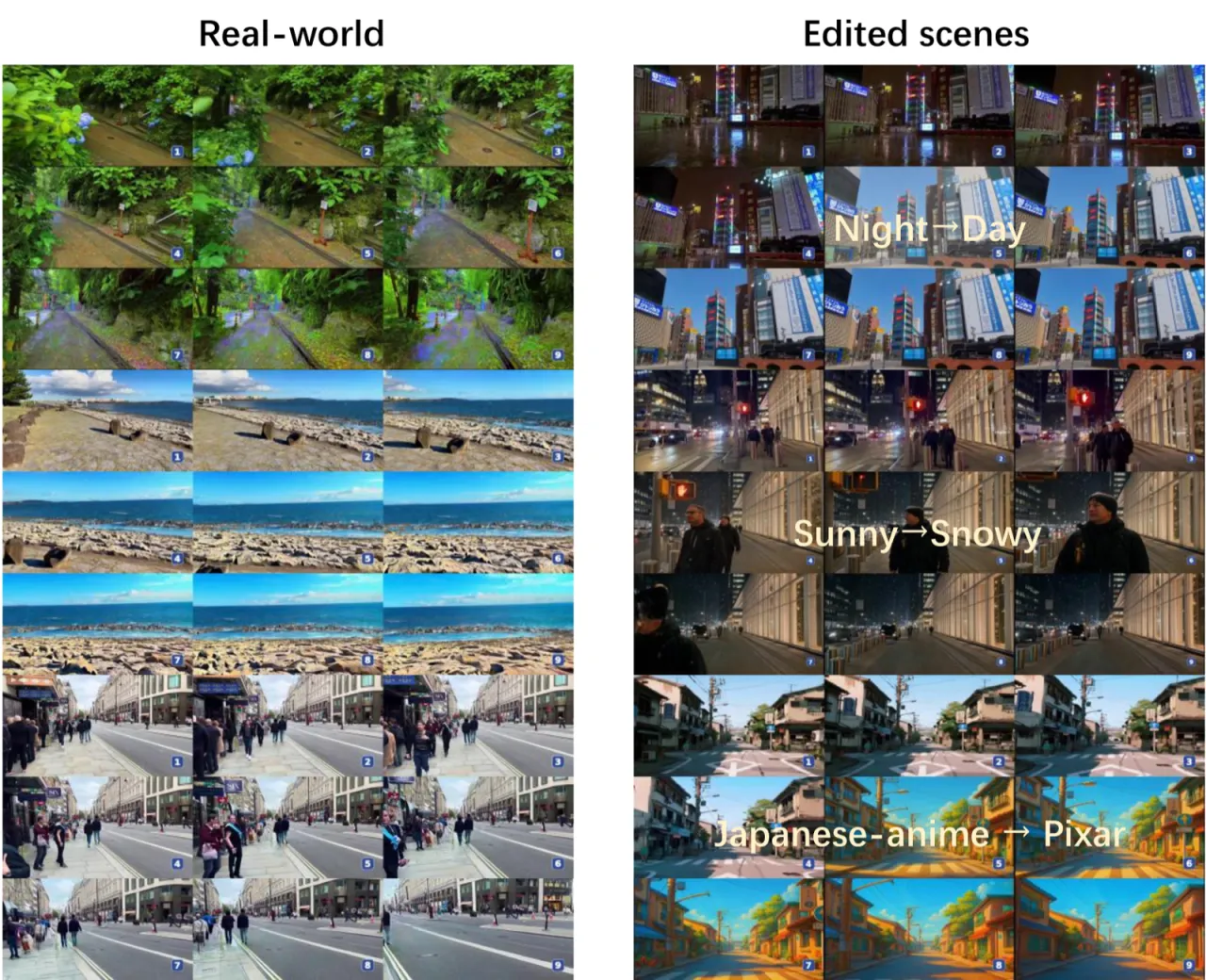
图 6:Yume 在真实场景与虚构场景中均展现出高质量视觉效果与精准的键盘控制跟随能力,优于 Wan-2.1 和 MatrixGame。Figure 6: In both real and fictional scenes Yume delivers high visual quality and accurate keyboard-control following, outperforming Wan-2.1 and MatrixGame.
长视频生成验证Long Video Generation Validation
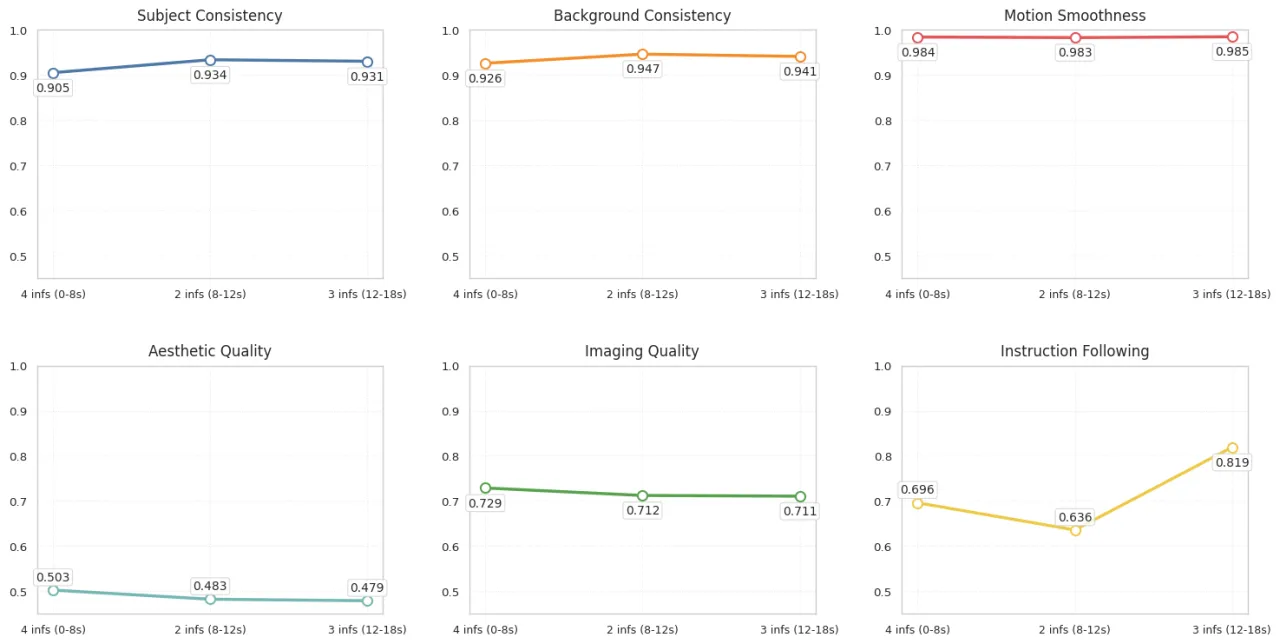
在 18 秒的长视频生成测试中(每次自回归生成 2 秒片段,共 9 次外推),前 8 秒运动与测试集一致,后 10 秒切换为持续前进(W 键)。结果显示:subject consistency 仅下降 0.5%,表明 Yume 的自回归生成机制在长时序下具备良好的时序连贯性。In an 18-second long-video generation test (each autoregressive pass produces a 2-second clip, 9 extrapolations in total), the motion of the first 8 seconds follows the test set while the last 10 seconds switch to continuous forward motion (the W key). The result: subject consistency drops by only 0.5%, showing that the autoregressive generation mechanism of Yume keeps good temporal coherence over long horizons.
图 5:长视频生成中的指标动态变化。"4 infs" 表示使用 4 次外推(共 8 秒)视频计算,"2 infs" 表示使用 2 次外推(4 秒)视频计算。TTS-SDE 在整个外推过程中保持了稳定的视觉质量。Figure 5: Metric dynamics during long video generation. "4 infs" means the metrics are computed over 4 extrapolations (8 seconds) of video, and "2 infs" over 2 extrapolations (4 seconds). TTS-SDE maintains stable visual quality throughout extrapolation.
TTS-SDE 将 Instruction Following 从 0.657(ODE baseline)提升至 0.743,代价是 Subject Consistency 和 Aesthetic Quality 略有下降。这表明 TTS-SDE 通过策略性引入噪声扰动,增强了运动轨迹的精化效果。TTS-SDE lifts Instruction Following from 0.657 (the ODE baseline) to 0.743, at the cost of slight drops in Subject Consistency and Aesthetic Quality. This indicates that by strategically injecting noise perturbations TTS-SDE strengthens the refinement of motion trajectories.
对抗蒸馏将推理时间压缩约 3.7×(583.1s → 158.8s),视觉质量几乎无损,仅 Instruction Following 下降 0.1(0.657 → 0.557),作者认为这可能因步数减少削弱了文本控制能力。Adversarial distillation compresses inference time by roughly 3.7× (583.1s → 158.8s) with almost no loss of visual quality; only Instruction Following falls by 0.1 (0.657 → 0.557), which the authors attribute to the reduced step count weakening text controllability.
图 7:AAM(Anti-Artifact Mechanism)在城市建筑场景中的效果。左侧为无 AAM 的生成结果(可见异常雪人等伪影),右侧启用 AAM 后结构细节更清晰,逻辑性伪影明显减少。Figure 7: Effect of AAM (Anti-Artifact Mechanism) in urban architectural scenes. Left, generation without AAM, where artifacts such as an anomalous snowman are visible; right, with AAM enabled, structural details are clearer and logical artifacts are markedly reduced.
04局限性Limitations
Note:以下前两点为作者在论文中明确陈述(stated),第三点为结论部分作者自评(stated),均来自原文。Note: The first two points below are explicitly stated by the authors in the paper, and the third is the authors’ own assessment in the conclusion (stated); all come from the original text.
AAM 暂不支持自回归长视频生成AAM does not yet support autoregressive long video generation
论文明确指出:"it does not perform well on autoregressive long video generation due to a lack of V2V foundation models"。AAM 的高频精修机制依赖单段视频的去噪结构,在多段自回归拼接场景下效果退化,作者计划在下一版本中解决。The paper states explicitly: "it does not perform well on autoregressive long video generation due to a lack of V2V foundation models". The high-frequency refinement of AAM depends on the denoising structure of a single video segment, so its effect degrades when multiple autoregressive segments are stitched together; the authors plan to address this in the next version.
V2V 生成对同质运动的过度依赖V2V generation over-relies on homogeneous motion
当输入的条件视频包含长时间单一运动(如持续直行)时,Video-to-Video 生成模式会"过度依赖运动特征",导致生成结果缺乏多样性。论文通过引入 30% 静态图像增强进行一定程度的缓解。When the conditioning video contains a single sustained motion (for example, continuous straight-ahead movement), the Video-to-Video generation mode "over-relies on motion features", leaving the results short of diversity. The paper mitigates this to some extent by introducing 30% static-image augmentation.
仍面临视觉质量、推理效率与控制精度的挑战Still faces challenges in visual quality, inference efficiency, and control accuracy
作者在结论中坦承:"Yume is a long-term project that has established a solid foundation, yet still faces numerous challenges to address, such as the visual quality, runtime efficiency, and control accuracy. Moreover, many functions need to be achieved, such as interaction with objects."本次发布为 preview 版本,将以月度迭代方式持续更新。The authors concede in the conclusion: "Yume is a long-term project that has established a solid foundation, yet still faces numerous challenges to address, such as the visual quality, runtime efficiency, and control accuracy. Moreover, many functions need to be achieved, such as interaction with objects." This release is a preview version and will keep being updated on a monthly iteration cycle.