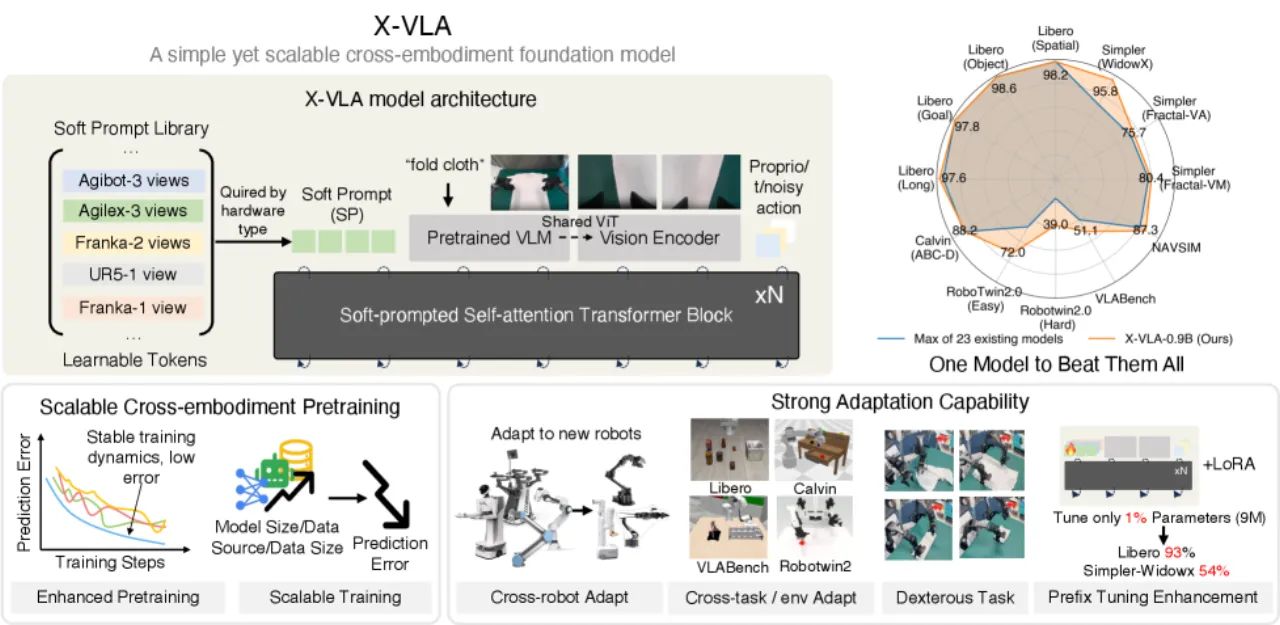
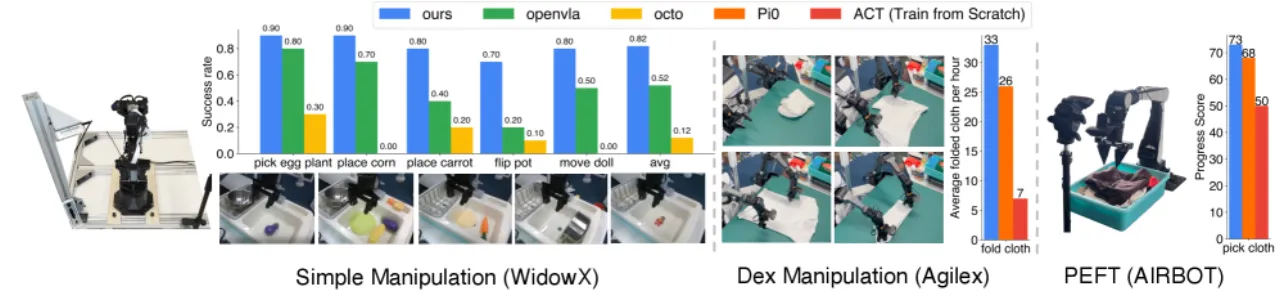
X-VLA 提出以可学习的软提示(soft prompt)作为形态标识符,解决跨形态异构数据联合训练的核心难题。仅凭 0.9B 参数,在 5 个仿真基准上全面超越现有最优方法,并以仅 1% 的参数量(9M via LoRA)实现与 3B 模型 π₀ 相当的 PEFT 性能,同时在三种真实机器人平台上验证了迁移能力。X-VLA introduces learnable soft prompts as embodiment identifiers to tackle the core difficulty of jointly training on heterogeneous cross-embodiment data. With only 0.9B parameters, it comprehensively surpasses prior state-of-the-art methods on 5 simulation benchmarks, and with just 1% of the parameters (9M via LoRA) attains PEFT performance on par with the 3B model π₀, while its transferability is validated on three real robot platforms.
当前 VLA 模型在跨平台联合训练时面临严峻的异构性挑战:不同机器人平台的观测空间、动作空间、相机配置差异显著,简单混合训练反而会损害单平台性能。如何在利用多平台数据规模优势的同时,保留各平台的专有特征,是实现真正通用机器人策略的关键瓶颈。Current VLA models face a severe heterogeneity challenge when jointly trained across platforms: observation spaces, action spaces and camera configurations differ markedly between robot platforms, and naive mixed training can instead hurt single-platform performance. Exploiting the scale advantage of multi-platform data while preserving each platform’s proprietary characteristics is the key bottleneck to a truly general-purpose robot policy.
"The success of VLA models, particularly their ability to rapidly adapt to out-of-distribution (OOD) domains, hinges on pretraining with large and diverse robotics datasets that span multiple robotic architectures and task scenarios."
Figure 1:X-VLA 利用可学习软提示(soft prompt)为每个数据源分配专属形态标识,从而在统一 Transformer 骨干上处理来自不同平台的异构数据。右侧展示了模型在跨形态预训练后对多个下游任务的适配能力。Figure 1: X-VLA uses learnable soft prompts to assign each data source a dedicated embodiment identifier, so that heterogeneous data from different platforms can be handled on a unified Transformer backbone. The right side shows the model’s ability to adapt to multiple downstream tasks after cross-embodiment pretraining.
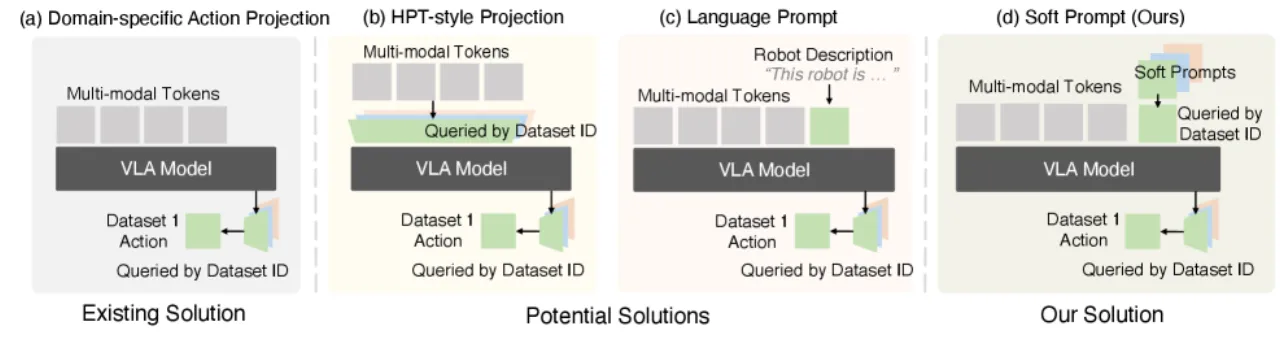
四种异构处理策略的对比Comparison of Four Heterogeneity-Handling Strategies
Figure 2:论文对比了四种处理跨形态异构性的策略:(1)硬编码模板(Hard-coded templates)、(2)语言提示(Language prompts)、(3)嵌入标记(Embedding tokens)、(4)X-VLA 的软提示(Soft prompts)。消融实验显示,软提示在验证误差和适配成功率上均表现最优。Figure 2: The paper compares four strategies for handling cross-embodiment heterogeneity: (1) hard-coded templates, (2) language prompts, (3) embedding tokens, and (4) X-VLA’s soft prompts. Ablations show that soft prompts perform best on both validation error and adaptation success rate.
论文在 Table 1 的消融路径中系统验证了各设计选择的贡献:从无预训练基线(验证误差 4.1,适配成功率 39.6%)出发,逐步引入动作对齐、意图抽象、平衡采样、Transformer encoder 替换 DiT、编码 pipeline 改进,最终加入软提示,将适配成功率提升至 73.0%,验证误差降至 0.038。Along the ablation path of Table 1, the paper systematically verifies the contribution of each design choice: starting from a no-pretraining baseline (validation error 4.1, adaptation success rate 39.6%), it progressively introduces action alignment, intent abstraction, balanced sampling, replacing DiT with a Transformer encoder, and an improved encoding pipeline, and finally adds soft prompts, raising the adaptation success rate to 73.0% and reducing the validation error to 0.038.
02方法Method
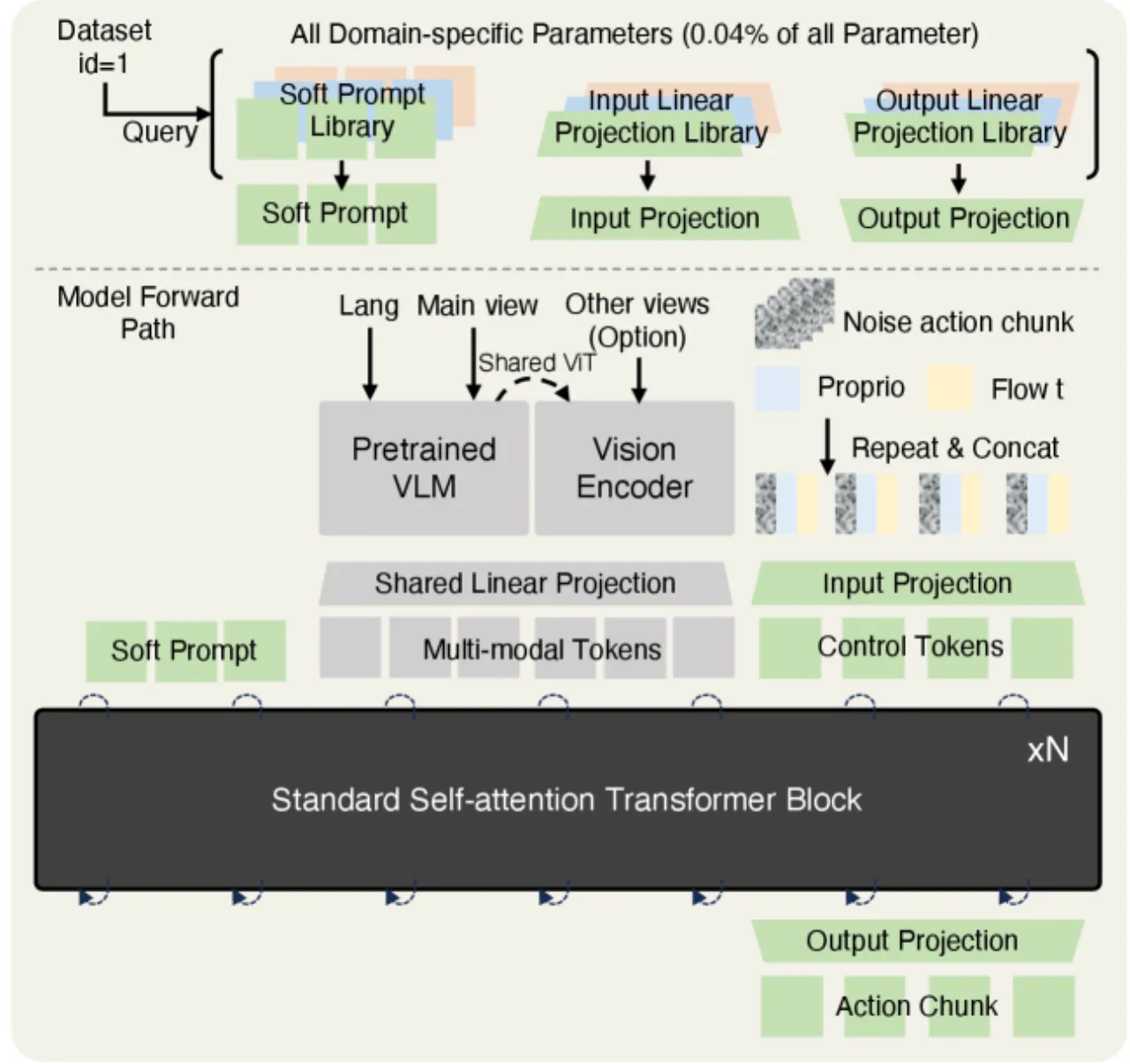
X-VLA 采用双流 Transformer 架构:高维流(多视角图像经 Florence-Large VLM 编码)与低维流(本体感知状态 + 动作 token + 时间嵌入)并行输入标准 Transformer encoder(24 层,hidden size 1024),输出通过 flow-matching 策略生成动作序列。每个数据源分配一组随机初始化的可学习软提示向量,在训练中自动捕获该平台的硬件配置差异。X-VLA adopts a dual-stream Transformer architecture: a high-dimensional stream (multi-view images encoded by the Florence-Large VLM) and a low-dimensional stream (proprioceptive state + action tokens + time embedding) are fed in parallel into a standard Transformer encoder (24 layers, hidden size 1024), whose output generates action sequences through a flow-matching policy. Each data source is assigned a set of randomly initialized learnable soft-prompt vectors that automatically capture that platform’s hardware configuration differences during training.
Figure 10:X-VLA 模型架构详图。绝大多数参数在不同形态间共享,仅软提示(soft prompts)为各数据源专属。高维流输入来自多视角图像,低维流输入来自本体感知状态,二者在 Transformer encoder 中融合,通过 flow-matching decoder 生成动作。Figure 10: Detailed architecture of the X-VLA model. The vast majority of parameters are shared across embodiments; only the soft prompts are specific to each data source. The high-dimensional stream takes multi-view images and the low-dimensional stream takes proprioceptive state; the two are fused inside the Transformer encoder, and actions are generated by a flow-matching decoder.
软提示(Soft Prompt)机制Soft Prompt Mechanism
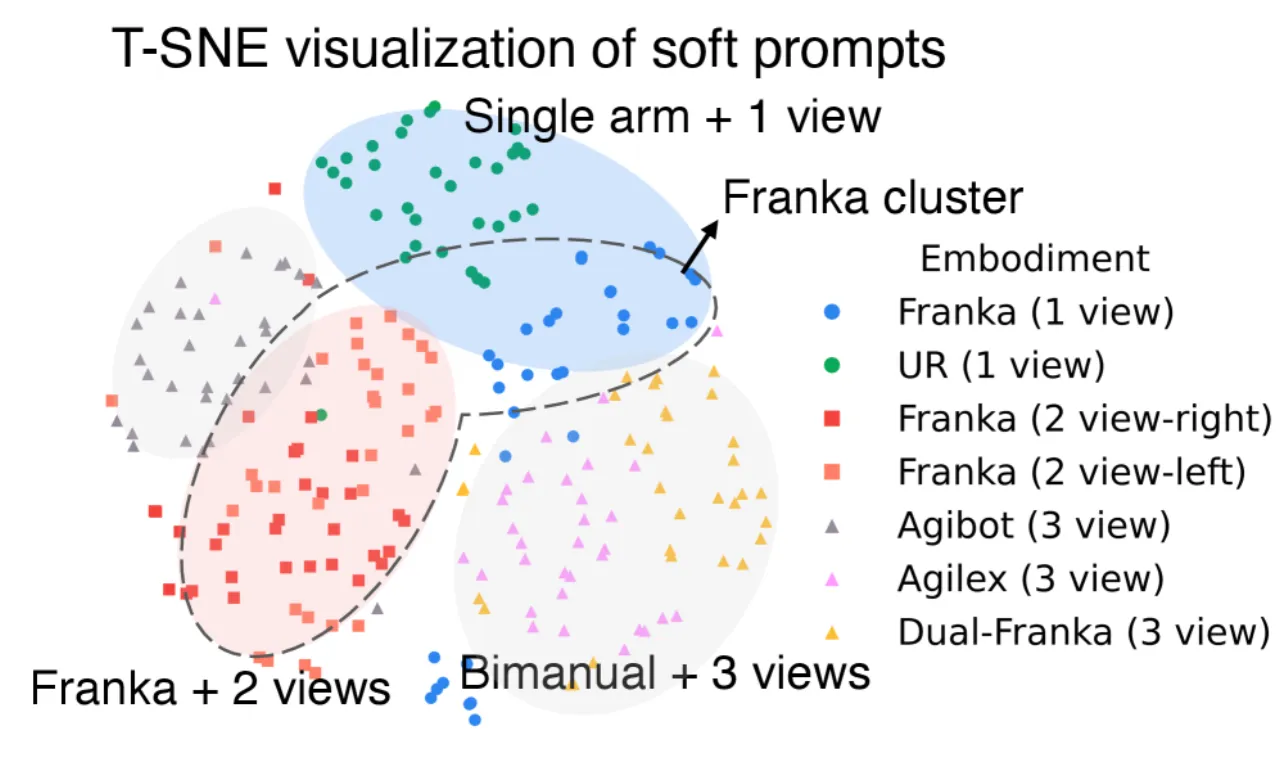
为每个数据源分配一组可学习嵌入向量,随机初始化后通过端到端训练优化,自动编码各平台的形态配置信息(硬件类型、相机布局、控制接口等)。不同于硬编码模板或语言描述,软提示无需人工设计,能在训练中自适应捕获平台差异。T-SNE 可视化(Figure 8)显示,相似平台的软提示在嵌入空间中自然聚类。Each data source is assigned a set of learnable embedding vectors that are randomly initialized and then optimized by end-to-end training, automatically encoding each platform’s embodiment configuration (hardware type, camera layout, control interface, etc.). Unlike hard-coded templates or language descriptions, soft prompts need no manual design and can adaptively capture platform differences during training. The T-SNE visualization (Figure 8) shows that soft prompts of similar platforms naturally cluster in the embedding space.
Flow-Matching 动作策略Flow-Matching Action Policy
采用 flow-matching 范式生成动作序列,训练目标为:
ℒBCFM(θ) = 𝔼t∼𝒰(0,1),(o,A)∼𝒟[‖vθ(At,o,t)−(A−A⁰)‖²]。
动作表示采用末端执行器笛卡尔坐标 + Rotate6D 旋转编码,并引入时序下采样(temporal downsampling)生成 30 个锚点覆盖 4 秒时域,以抽象动作意图,缓解异构数据的监督信号稀疏问题。A flow-matching paradigm is used to generate action sequences, with the training objective:
ℒBCFM(θ) = 𝔼t∼𝒰(0,1),(o,A)∼𝒟[‖vθ(At,o,t)−(A−A⁰)‖²].
The action representation uses end-effector Cartesian coordinates plus Rotate6D rotation encoding, and introduces temporal downsampling to produce 30 anchors covering a 4-second horizon, so as to abstract action intent and alleviate the sparse supervision signal of heterogeneous data.
两阶段训练流程Two-Stage Training Pipeline
预训练阶段:在 Droid、Robomind、Agibot 等来源的 290K episodes(7 平台 / 5 形态)上联合优化骨干网络与所有平台的软提示,采用平衡采样策略(balanced sampling)避免数据分布偏差。Pretraining stage: the backbone and the soft prompts of all platforms are jointly optimized on 290K episodes (7 platforms / 5 embodiments) from sources such as Droid, Robomind and Agibot, using a balanced sampling strategy to avoid data distribution bias.
域适配阶段:分两步执行——先冻结骨干,仅热启动目标平台的软提示(prompt warm-up);再解冻联合微调(joint policy adaptation),实现高效迁移。PEFT 场景下,仅用 9M 参数(LoRA)即可适配。Domain adaptation stage: carried out in two steps — first freeze the backbone and only warm up the soft prompts of the target platform (prompt warm-up); then unfreeze for joint policy adaptation, achieving efficient transfer. Under the PEFT setting, only 9M parameters (LoRA) are needed for adaptation.
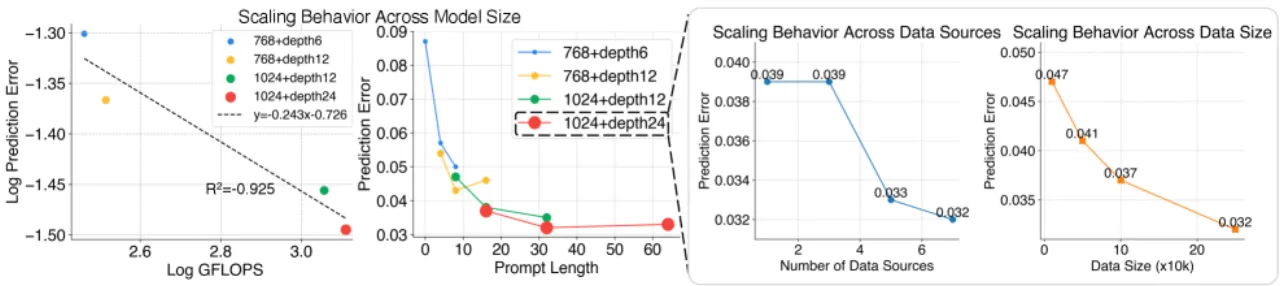
Figure 5:X-VLA 在三个维度均呈现一致的 scaling 趋势(验证误差随规模增大持续下降,无饱和迹象):(左)模型规模(参数量),(中)数据多样性(来源数量),(右)数据量(episodes 数)。这表明进一步扩展仍有提升空间。Figure 5: X-VLA exhibits a consistent scaling trend along all three dimensions (validation error keeps dropping as scale grows, with no sign of saturation): (left) model scale (parameter count), (middle) data diversity (number of sources), (right) data volume (number of episodes). This indicates that further scaling still has room for improvement.
03实验Experiments
在 6 个仿真基准(LIBERO-Spatial/Object/Goal/Long、Simpler-WidowX、Calvin、RoboTwin-2.0、VLABench、NAVSIM)和 3 种真实机器人平台上进行全面评估。主要基线包括 SpatialVLA(4B)、ThinkAct(7B)、MemoryVLA(7B)、GR00T-N1(3B)、π₀(3B)、UniVLA(9B)等。A comprehensive evaluation is carried out on 6 simulation benchmarks (LIBERO-Spatial/Object/Goal/Long, Simpler-WidowX, Calvin, RoboTwin-2.0, VLABench, NAVSIM) and 3 real robot platforms. The main baselines include SpatialVLA (4B), ThinkAct (7B), MemoryVLA (7B), GR00T-N1 (3B), π₀ (3B) and UniVLA (9B).
论文指出:"Across FIVE benchmarks, we establish a new SOTA, achieving substantial improvements over aggregated prior models." X-VLA-0.9B 在 Simpler-WidowX VM/VA 分别达到 80.4 / 75.7,超越所有对比方法,且参数量仅为最大竞争对手(9B)的 1/10。The paper notes: “Across FIVE benchmarks, we establish a new SOTA, achieving substantial improvements over aggregated prior models.” X-VLA-0.9B reaches 80.4 / 75.7 on Simpler-WidowX VM/VA respectively, surpassing all compared methods with a parameter count only 1/10 that of the largest competitor (9B).
Figure 7:X-VLA 在三种真实机器人形态上的评估结果,任务包括:桌面物体抓取与摆放、双臂协作折叠(Soft-Fold)、灵巧手操作等。Soft-Fold 任务仅使用 1,200 条训练轨迹,即实现接近 100% 的成功率,吞吐量达 33 folds/hour。Figure 7: Evaluation results of X-VLA on three real robot embodiments, with tasks including tabletop object pick-and-place, bimanual cooperative folding (Soft-Fold) and dexterous-hand manipulation. Using only 1,200 training trajectories, the Soft-Fold task reaches a success rate close to 100%, with a throughput of 33 folds/hour.
使用 LoRA 仅微调 9M 参数(骨干网络的 1%),与 π₀(3B 全参数微调)对比:Fine-tuning only 9M parameters with LoRA (1% of the backbone), compared against π₀ (3B full-parameter fine-tuning):
方法Method
可调参数Tunable params
LIBERO-Spatial
LIBERO-Object
LIBERO-Goal
LIBERO-Long
Simpler-WidowX
π₀
3B
96.8
98.8
95.8
85.2
55.7
X-VLA-LoRA
9M
95.4
96.6
96.0
84.2
54.2
论文表述:"These scores are comparable to fully finetuned models","comparable to π₀ despite requiring 300× fewer parameters."The paper states: “These scores are comparable to fully finetuned models”, “comparable to π₀ despite requiring 300× fewer parameters.”
软提示 T-SNE 可视化Soft-Prompt T-SNE Visualization
Figure 8:T-SNE 对 7 个数据源软提示的可视化。相似机器人平台(如同类机械臂)的软提示在嵌入空间中自然聚类,表明模型在无监督情况下自动学习到了形态相似性结构。Figure 9 进一步显示,在 PEFT 场景下,软提示对性能的贡献同样显著。Figure 8: T-SNE visualization of the soft prompts of 7 data sources. Soft prompts of similar robot platforms (e.g. arms of the same type) naturally cluster in the embedding space, indicating that the model automatically learns an embodiment-similarity structure without supervision. Figure 9 further shows that soft prompts contribute just as significantly under the PEFT setting.
Scaling 特性Scaling Properties
X-VLA 在模型规模(最大 0.9B)、数据多样性(7 个来源)、数据量(290K episodes)三个维度均呈现验证误差随规模增大单调下降的趋势,且未见饱和,这与大语言模型的 scaling law 现象相符,表明进一步扩展仍有明显收益空间。Along all three dimensions — model scale (up to 0.9B), data diversity (7 sources) and data volume (290K episodes) — X-VLA shows validation error decreasing monotonically as scale grows, with no saturation observed. This is consistent with the scaling-law phenomenon of large language models and indicates clear remaining gains from further scaling.
04局限性Limitations
Note:以下局限性均来自论文 Appendix N "Limitations and future works" 的明确陈述(stated by the authors)。Note: All limitations below are explicitly stated by the authors in Appendix N “Limitations and future works”.
规模仍受限于算力与数据质量约束Scale is still constrained by compute and data quality
论文指出:"X-VLA-0.9B achieves strong performance, its scale remains modest compared to large foundation models in the vision–language and language domains. This limitation stems primarily from computational constraints and the limited availability of high-quality robotics data." 当前机器人数据集的多样性和规模与语言/视觉语言领域相差悬殊,进一步扩展模型容量或骨干网络的预训练 VLM 是潜在方向,但资源需求极高。此外,VLA 模型的 scaling law 及形态多样性如何与模型容量交互,目前仍是开放问题。The paper notes: “X-VLA-0.9B achieves strong performance, its scale remains modest compared to large foundation models in the vision–language and language domains. This limitation stems primarily from computational constraints and the limited availability of high-quality robotics data.” Current robotics datasets lag far behind the language and vision-language domains in diversity and scale; further scaling model capacity or pretraining the backbone VLM is a potential direction, but the resource demands are extremely high. Moreover, the scaling law of VLA models and how embodiment diversity interacts with model capacity remain open questions.
低维动作标签提供的监督信号信息量有限Supervision from low-dimensional action labels carries limited information
论文承认:"the supervision provided by low-dimensional action labels remains inherently limited in information content. These labels, while essential for direct control, capture only a narrow view of the underlying task structure and often fail to convey higher-level reasoning, intent, or multi-step dependencies." 当前的时序下采样策略(temporal downsampling)仅是部分缓解,未能从根本上丰富监督信号。未来方向包括引入 3D 空间推理线索、物理动力学、中间子目标标注,或利用原始输入流的自监督目标辅助学习。The paper acknowledges: “the supervision provided by low-dimensional action labels remains inherently limited in information content. These labels, while essential for direct control, capture only a narrow view of the underlying task structure and often fail to convey higher-level reasoning, intent, or multi-step dependencies.” The current temporal downsampling strategy only partially mitigates this and does not fundamentally enrich the supervision signal. Future directions include introducing 3D spatial reasoning cues, physical dynamics and intermediate sub-goal annotations, or using self-supervised objectives on the raw input streams as auxiliary learning.
下游部署仍依赖形态专属适配,尚不能"即插即用"Downstream deployment still relies on embodiment-specific adaptation and is not yet plug-and-play
论文指出,尽管 X-VLA 在微调和高效特化上表现出强适应性,"realizing the vision of a truly generalist embodied model that can be seamlessly deployed to arbitrary downstream tasks without additional engineering or retraining remains an open challenge." 当前部署仍需为目标平台收集少量演示数据进行后训练(post-training),尚无法实现真正的零样本跨平台泛化。The paper notes that although X-VLA shows strong adaptability in fine-tuning and efficient specialization, “realizing the vision of a truly generalist embodied model that can be seamlessly deployed to arbitrary downstream tasks without additional engineering or retraining remains an open challenge.” Deployment still requires collecting a small amount of demonstration data on the target platform for post-training, so genuine zero-shot cross-platform generalization is not yet achievable.