FINDING 01
独立策略模块优于 token 复用A dedicated policy module beats token reuse
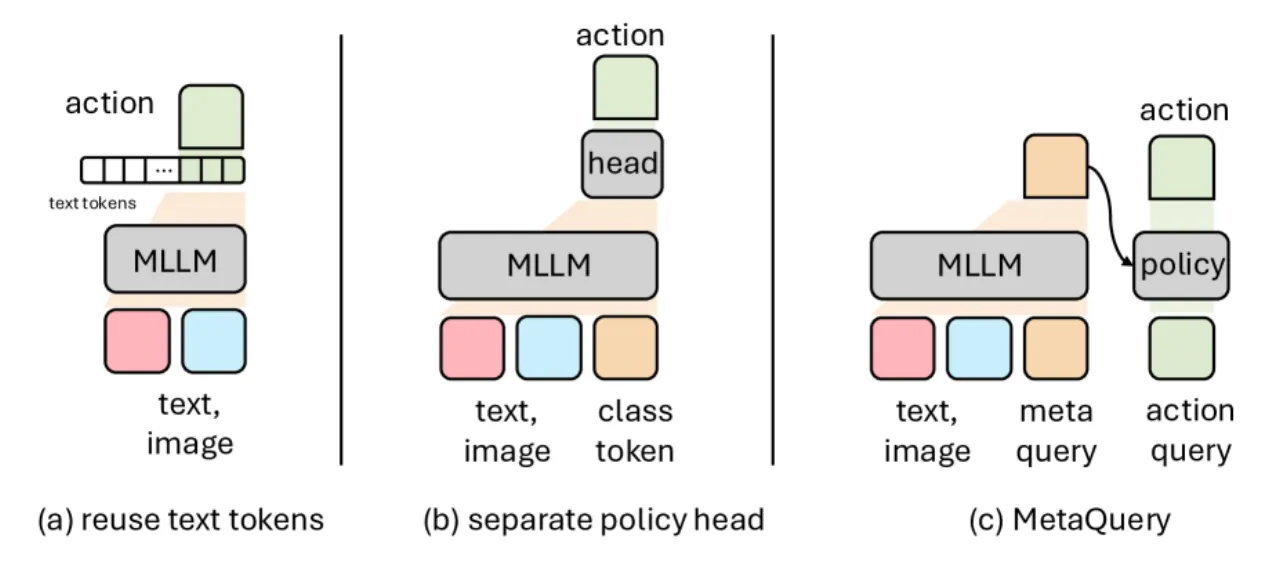
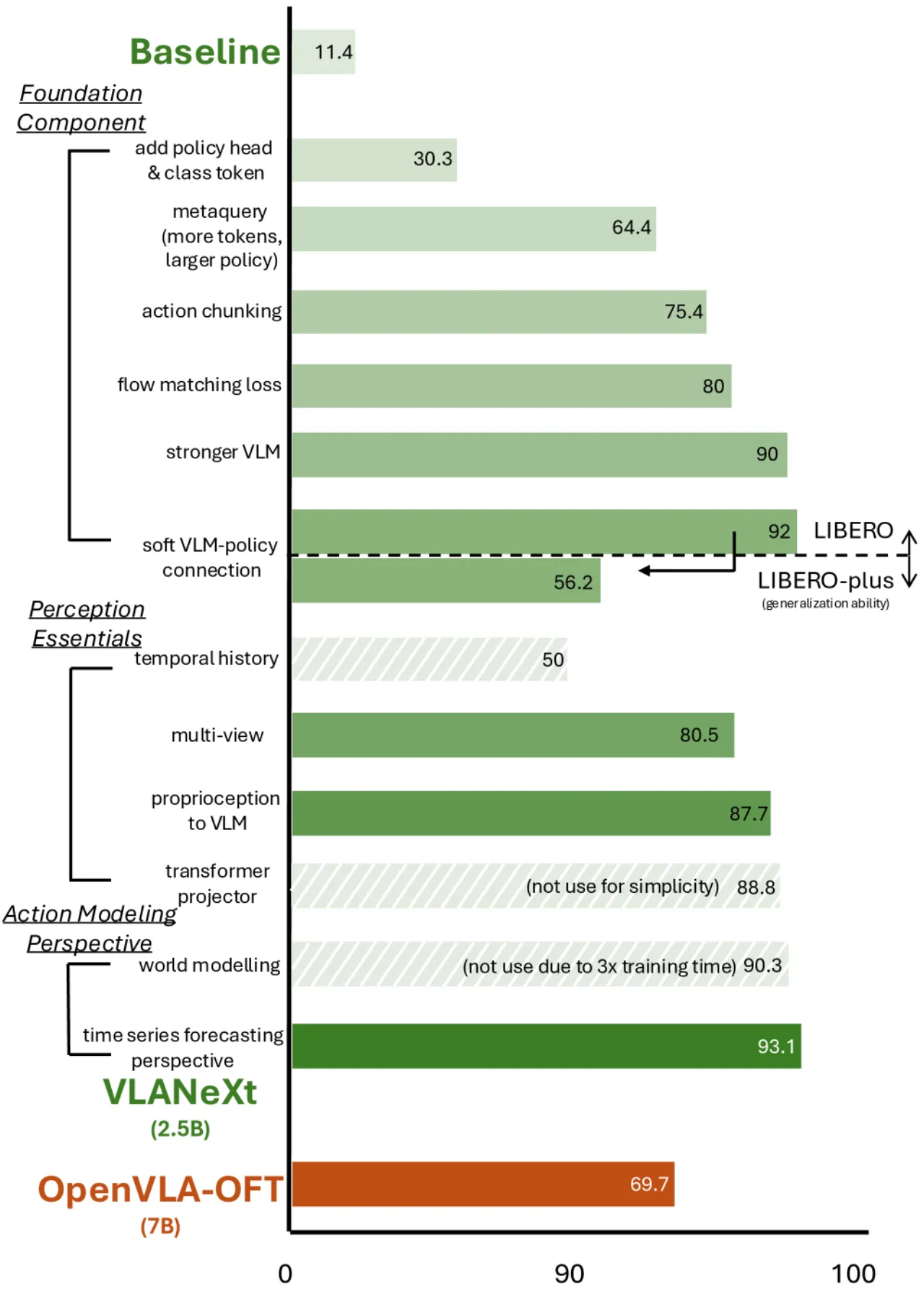
设置独立的 class token 策略头,而非复用文本 token,带来显著性能提升(19.8% → 30.2%)。Using a dedicated class token policy head instead of reusing text tokens brings a marked performance gain (19.8% → 30.2%).
FINDING 02
更大策略模块带来显著增益A larger policy module yields substantial gains
将 token 数从 1 扩展至 16、策略层数从 2 扩展至 12,性能从 30.2% 跃升至 64.4%。Scaling the number of tokens from 1 to 16 and the policy depth from 2 to 12 lifts performance from 30.2% to 64.4%.
FINDING 03
Action chunking 增强动作连贯性Action chunking improves action coherence
预测未来 8 步动作块(chunk size=8)比单步预测稳定性更高(64.4% → 74.6%)。Predicting an 8-step future action chunk (chunk size=8) is more stable than single-step prediction (64.4% → 74.6%).
FINDING 04
Flow matching 超越分类离散化Flow matching outperforms discretized classification
连续动作目标(flow matching)显著优于分箱分类方式(74.6% → 80.0%)。A continuous action objective (flow matching) clearly outperforms binned classification (74.6% → 80.0%).
FINDING 05
更强的 VLM 主干至关重要A stronger VLM backbone is critical
从 LLaMA 切换至 Qwen3-VL-2B 后,性能从 80.0% 大幅提升至 90.0%。Switching from LLaMA to Qwen3-VL-2B raises performance sharply from 80.0% to 90.0%.
FINDING 06
Soft VLM-Policy 连接微优于其他Soft VLM-policy connection is marginally the best
层间 soft connection(含可学习 query buffer)略优于 loose 和 tight 两种连接方式(90.0% → 91.8%)。Layer-wise soft connection (with a learnable query buffer) is slightly better than the loose and tight variants (90.0% → 91.8%).
FINDING 07
历史帧无益甚至有害History frames do not help and may even hurt
添加多帧历史输入并不改善性能,反而可能因主干视频预训练的不匹配而下降。Adding multi-frame history inputs does not improve performance and may even degrade it, owing to a mismatch with the video pretraining of the backbone.
FINDING 08
多视角相机提供互补线索Multi-view cameras provide complementary cues
结合第三视角与腕部相机,性能从 91.8% 跃升至 97.6%,是单一感知改动中增益最大的一项。Combining the third-person and wrist cameras lifts performance from 91.8% to 97.6%, the largest gain among the single perception changes.
FINDING 09
本体感知注入 VLM 侧效果最优Injecting proprioception on the VLM side works best
将 proprioception 输入 VLM 而非策略模块,或两者均输入,在 LIBERO-plus 上表现最优(97.6% → 98.0%)。Feeding proprioception into the VLM rather than the policy module, or into both, performs best on LIBERO-plus (97.6% → 98.0%).
FINDING 10
线性投影即可满足本体感知需求A linear projection suffices for proprioception
Linear projector 与更复杂的 Transformer-based projector 性能相当,无需额外复杂度。A linear projector matches the more complex Transformer-based projector, so the extra complexity is unnecessary.
FINDING 11
频域损失提供有效正则化Frequency-domain loss is an effective regularizer
DCT-based 频域 MSE 辅助损失带来可观的稳健性提升(98.0% → 99.0%),计算开销极小。A DCT-based frequency-domain MSE auxiliary loss brings a sizable robustness gain (98.0% → 99.0%) at negligible computational cost.
FINDING 12
World modeling 有效但代价高昂World modeling works but is costly
辅以未来帧预测的世界建模目标可改善性能,但 "substantially higher training cost makes it less practical",故未纳入最终模型。A world-modeling objective with future-frame prediction improves performance, but "substantially higher training cost makes it less practical", so it is not adopted in the final model.