← 论文海报合集← Paper Notes|
综述 · Survey · arXiv 2025Review · Survey · arXiv 2025

VLA 综述:视觉-语言-动作模型的概念、进展、应用与挑战Vision-Language-Action (VLA) Models: Concepts, Progress, Applications and Challenges

Vision-Language-Action (VLA) Models: Concepts, Progress, Applications and Challenges
Ranjan Sapkota, Yang Cao, Konstantinos I. Roumeliotis, Manoj Karkee · 2025

本综述系统梳理 80 余个 VLA 模型,揭示感知、语言理解与机器人动作执行如何在单一框架内统一。 研究覆盖 2022–2025 年四个演化阶段,从基础整合到跨形态泛化,并明确指出推理延迟、安全对齐、 跨形态迁移等核心挑战,以及九大未来研究方向。This survey systematically reviews more than 80 VLA models and shows how perception, language understanding, and robotic action execution are unified within a single framework. It covers four evolutionary stages from 2022 to 2025, from foundational integration to cross-embodiment generalization, and identifies core challenges such as inference latency, safety alignment, and cross-embodiment transfer, together with nine future research directions.

arXiv 2505.04769 综述 80+ VLA 模型Survey of 80+ VLA models 2022–2025 演化时间轴2022–2025 evolution timeline 📄 arXiv:2505.04769 PDF
VLA vision-language-action 具身智能embodied intelligence 机器人操作robot manipulation 多模态融合multimodal fusion 策略学习policy learning 自主驾驶autonomous driving 大语言模型large language models 跨形态迁移cross-embodiment transfer 综述survey

01 动机Motivation

传统机器人系统将视觉、语言和动作视为独立子系统分别处理。"机器人能够在视觉上识别物体、 理解文本指令或执行预定义动作,但将三者全部整合仍然极具挑战性。"VLA 模型正是为打破这一割裂局面而生—— 在单一计算框架内实现感知、语言理解与具身动作的统一。Traditional robotic systems treat vision, language, and action as independent subsystems handled separately. "Robots can visually recognize objects, understand textual instructions, or execute predefined actions, but integrating all of them remains extremely challenging." VLA models were created precisely to break this fragmentation — realizing perception, language understanding, and embodied action within a single computational framework.

"Integrated perception, language, and action enable adaptive, generalizable embodied intelligence." —— 论文核心主张the paper's core claim
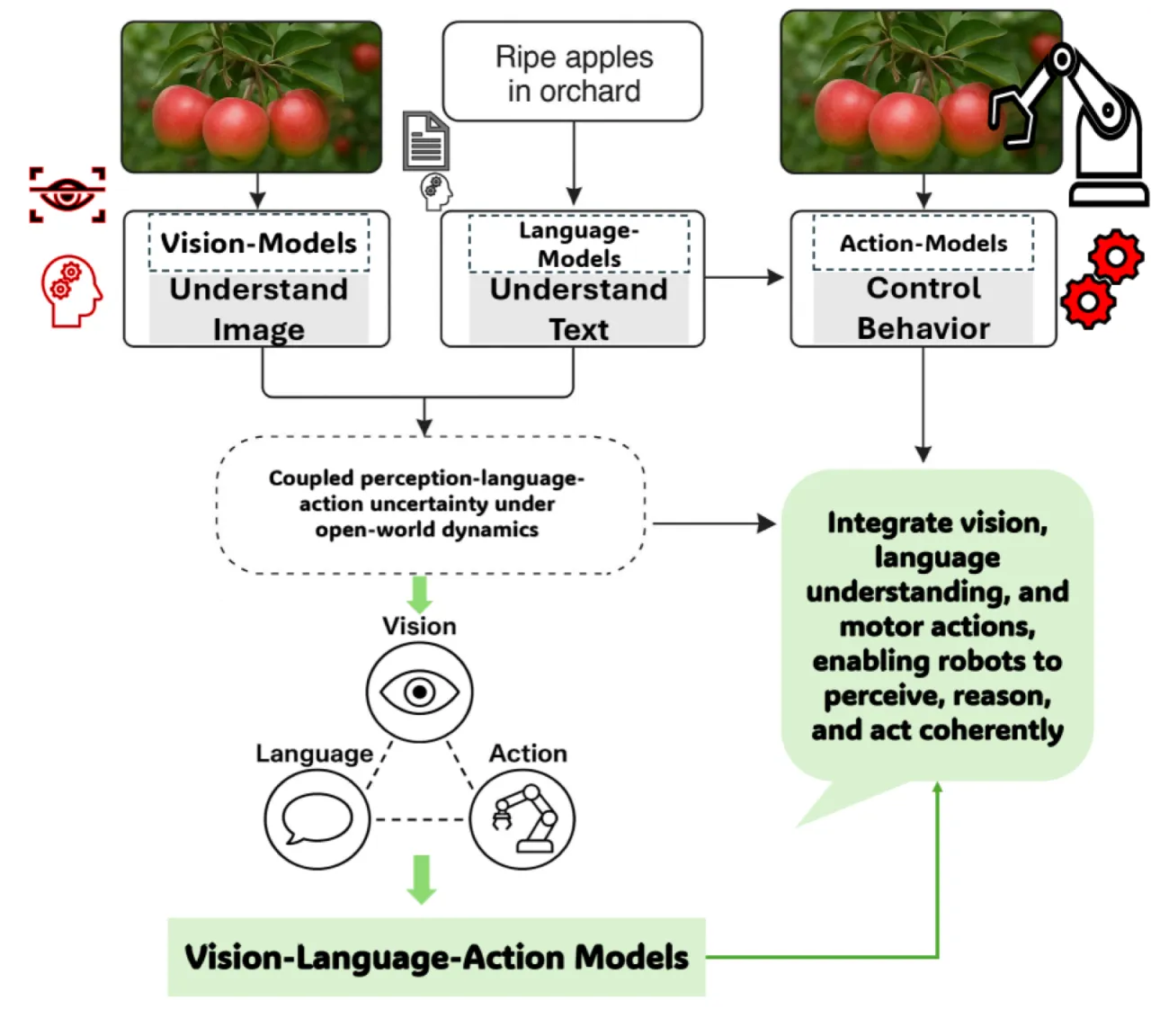
从独立模态到统一VLA模型的演化
图1:从独立模态到统一 VLA 模型的演化。 传统系统中视觉、语言与动作相互割裂;VLA 框架将三者整合为统一的感知-推理-执行闭环, 实现"自适应、可泛化的具身智能"。Figure 1: Evolution from separate modalities to a unified VLA model. In traditional systems, vision, language, and action remain fragmented; the VLA framework integrates all three into a unified perception–reasoning–execution loop, achieving "adaptive, generalizable embodied intelligence."
80+综述覆盖 VLA 模型数量(近三年)VLA models covered by the survey (past three years)
45时间轴标注模型(2022–2025)models annotated on the timeline (2022–2025)
4演化阶段(基础 → 专化 → 泛化 → 跨形态)evolutionary stages (foundational → specialized → generalized → cross-embodiment)
9未来研究方向(路线图)future research directions (roadmap)

为何需要 VLA?Why Do We Need VLA?

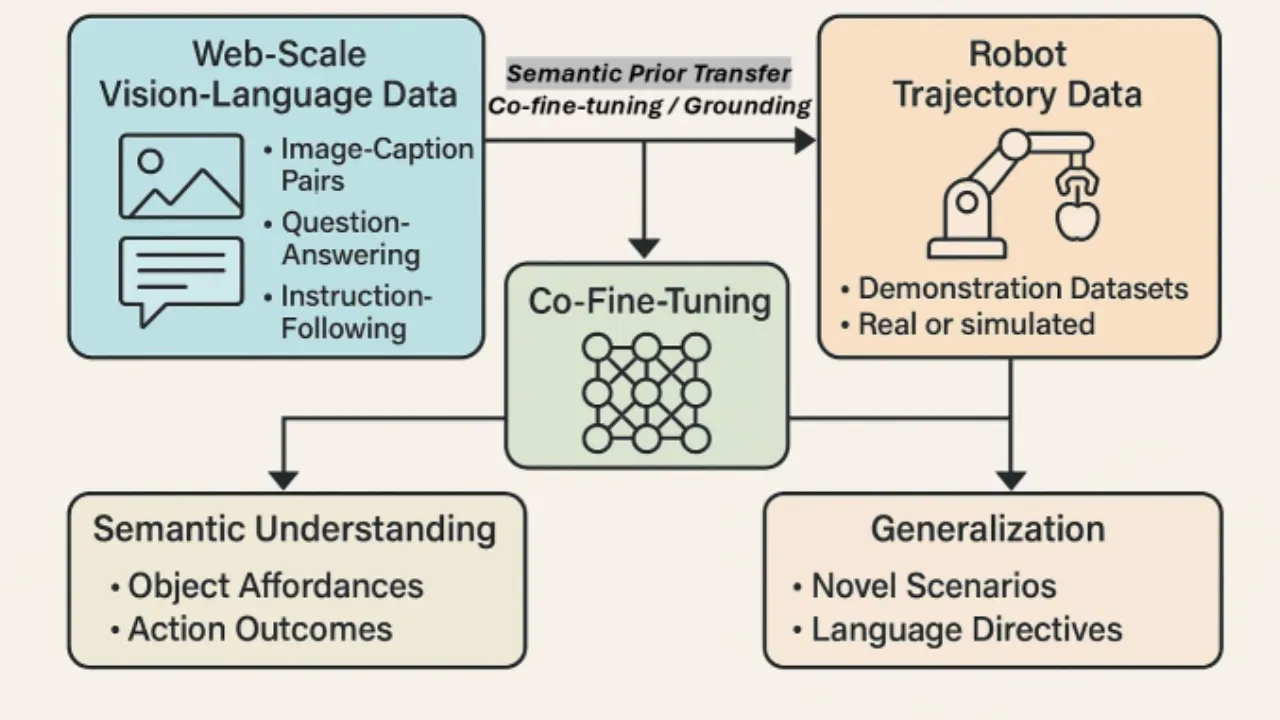
大型视觉-语言模型(VLM)的崛起使"将感知、理解与行动统一于单一框架"成为可能。 然而,从 VLM 到 VLA 并非简单扩展:机器人需要实时闭环控制跨形态泛化安全对齐,而这些在纯语言/图像生成场景中几乎不存在。本综述正是系统梳理 这一演化路径,识别已解决与尚待攻克的问题。The rise of large vision-language models (VLMs) has made it possible to "unify perception, understanding, and action within a single framework." Moving from VLM to VLA, however, is no simple extension: robots require real-time closed-loop control, cross-embodiment generalization, and safety alignment, which barely exist in purely linguistic or image-generation settings. This survey systematically traces that evolutionary path and identifies which problems are solved and which remain open.
02 方法体系Methodological Framework

本综述将 VLA 研究组织为五大主题支柱:概念基础、架构进展、应用领域、技术挑战与未来方向。 其核心是对 VLA 系统统一框架的解析——多模态输入经 tokenization 后融合,再通过自回归解码输出动作序列。This survey organizes VLA research into five thematic pillars: conceptual foundations, architectural progress, application domains, technical challenges, and future directions. At its core is an analysis of the unified VLA system framework — multimodal inputs are fused after tokenization, then decoded autoregressively into action sequences.

统一 Tokenization 框架Unified Tokenization Framework

VLA 通过三类 token 统一三种模态:VLA unifies the three modalities through three classes of tokens:

Tokenization与表征流程
图2:Tokenization 与表征流程。 视觉编码器将图像转化为 token,语言编码器处理指令, 二者经 transformer 融合后自回归预测动作 token,最终驱动执行器。Figure 2: Tokenization and representation pipeline. A visual encoder converts images into tokens and a language encoder processes instructions; the two are fused by a transformer, which then autoregressively predicts action tokens that finally drive the actuators.

三类主要架构范式Three Main Architectural Paradigms

Early Fusion(早期融合)Early Fusion

视觉-语言表征在策略模块前完成融合。代表模型 EF-VLA 在组合操作任务上展现出 "20% 性能提升"。优势在于端到端联合优化,劣势是跨模态对齐难度大。Vision-language representations are fused before the policy module. The representative model EF-VLA exhibits a "20% performance improvement" on compositional manipulation tasks. Its advantage is end-to-end joint optimization; its drawback is the difficulty of cross-modal alignment.

Dual-System(双系统架构)Dual-System

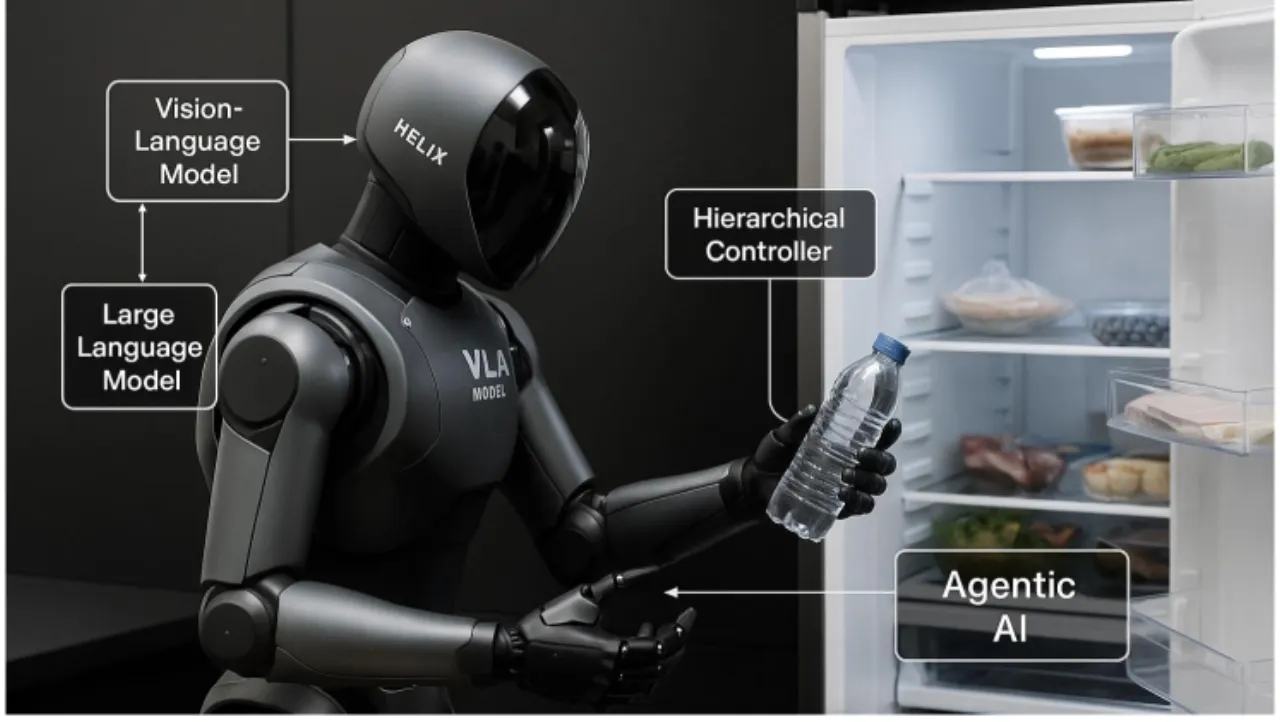
NVIDIA GR00T N1 将快速 System 1(扩散策略,10ms 延迟)与慢速 System 2(LLM 规划器)结合, 实现"比单体模型高出 17% 的成功率"和"28% 的碰撞失败率下降"。NVIDIA GR00T N1 combines a fast System 1 (diffusion policy, 10ms latency) with a slow System 2 (LLM planner), achieving "a 17% higher success rate than monolithic models" and "a 28% reduction in the collision failure rate."

Self-Correcting(自校正框架)Self-Correcting

SC-VLA 集成失败检测机制,"将任务失败率降低 35%"。通过闭环反馈在执行过程中 动态修正动作,提升鲁棒性。SC-VLA integrates a failure-detection mechanism that "reduces the task failure rate by 35%." Closed-loop feedback dynamically corrects actions during execution, improving robustness.

Parameter-Efficient(参数高效方法)Parameter-Efficient

LoRA adapter 等方法"将 GPU 训练时间减少 70%",使大规模 VLA 适配特定领域 无需全参数微调,显著降低计算成本。Methods such as LoRA adapters "reduce GPU training time by 70%," allowing large-scale VLAs to be adapted to specific domains without full-parameter fine-tuning and markedly lowering computational cost.

端到端VLA流水线
图3:端到端 VLA 流水线。 从多模态输入采集、tokenization、跨模态融合、自回归解码,到闭环执行与实时反馈, 完整展示 VLA 系统的推理-执行闭环。Figure 3: End-to-end VLA pipeline. From multimodal input capture, tokenization, cross-modal fusion, and autoregressive decoding through to closed-loop execution and real-time feedback, it fully illustrates the reasoning–execution loop of a VLA system.

应用领域覆盖Application Domain Coverage

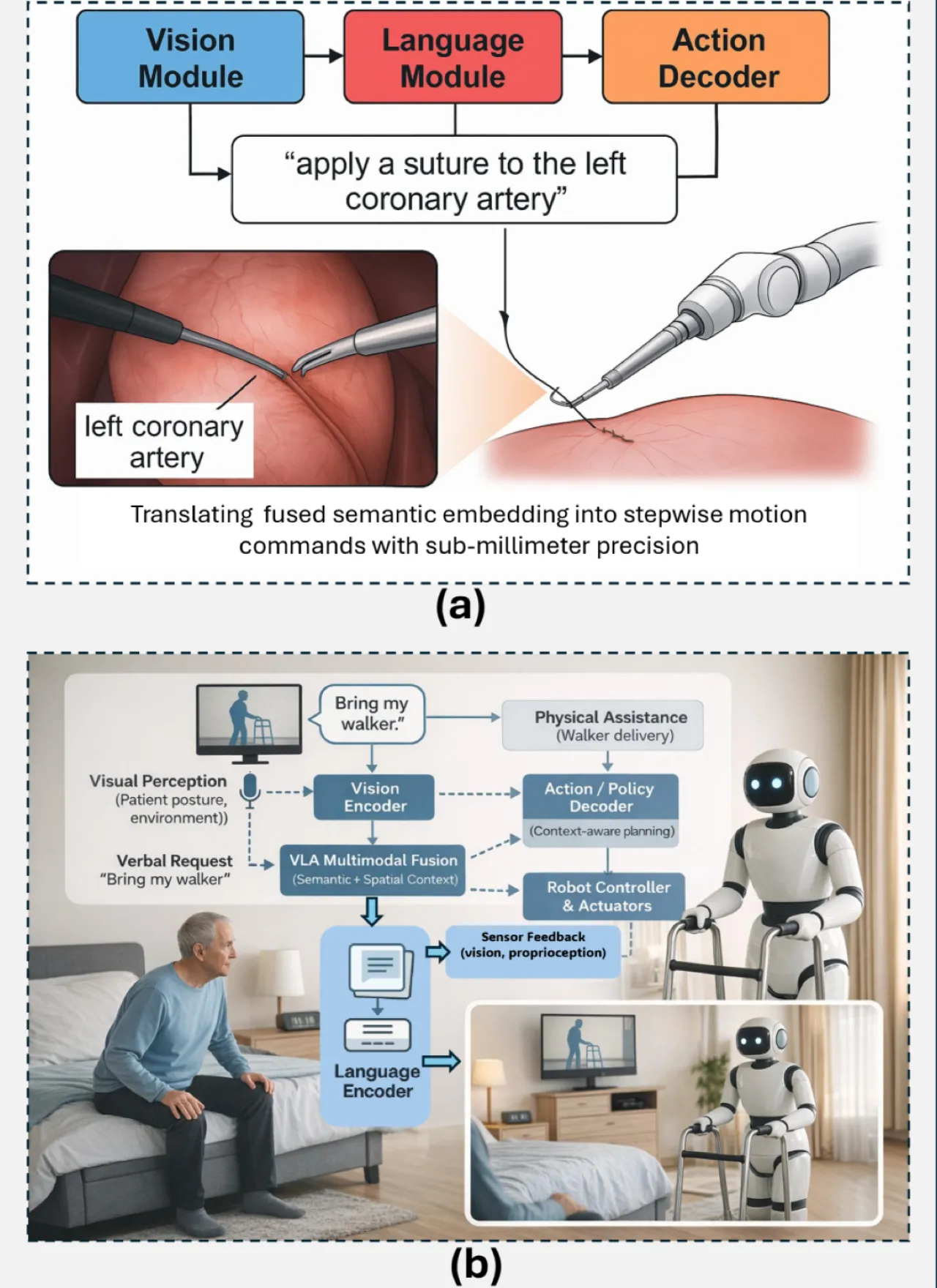
综述覆盖六大应用场景:人形机器人(全身操控与运动)、自动驾驶 (端到端驾驶、协同调度)、工业机器人(精密装配、灵巧操作)、 医疗机器人(精准干预、辅助护理)、精准农业(作物监测、选择性采摘) 和 GUI 代理(桌面自动化,如 ShowUI)。The survey covers six application areas: humanoid robots (whole-body manipulation and locomotion), autonomous driving (end-to-end driving, cooperative scheduling), industrial robots (precision assembly, dexterous manipulation), medical robots (precise intervention, assistive care), precision agriculture (crop monitoring, selective harvesting), and GUI agents (desktop automation, such as ShowUI).

03 模型进展与关键数据Model Progress and Key Data

综述系统梳理 2022–2025 年 45 个代表性 VLA 模型,划分为四个演化阶段,并汇总各模型的架构特点与实测指标。The survey systematically reviews 45 representative VLA models from 2022 to 2025, divides them into four evolutionary stages, and compiles the architectural characteristics and measured metrics of each model.

2022-2025年VLA模型演化时间轴
图4:2022–2025 年 VLA 模型演化时间轴(45 个模型)。 四个阶段依次为:基础整合(2022–2023)、专化与具身推理(2024)、 泛化与安全部署(2025)、跨形态与高级整合(新兴)。Figure 4: Timeline of VLA model evolution, 2022–2025 (45 models). The four stages are, in order: foundational integration (2022–2023), specialization and embodied reasoning (2024), generalization and safe deployment (2025), and cross-embodiment and advanced integration (emerging).

代表性模型对比Comparison of Representative Models

模型Model 参数量Parameters 训练数据规模Training Data Scale 关键指标 / 特点Key Metrics / Features
RT-1 大规模演示数据Large-scale demonstration data 97% 操作成功率(模仿学习)97% manipulation success rate (imitation learning)
RT-2 55B 互联网规模Internet-scale 新物体性能提升 63%(DCT/BPE 动作 tokenization)63% performance gain on novel objects (DCT/BPE action tokenization)
Octo 93M 80 万机器人演示(OpenX-Embodiment)Eight hundred thousand robot demonstrations (OpenX-Embodiment) 扩散解码器,多任务泛化Diffusion decoder, multi-task generalization
OpenVLA 7B 97 万真实机器人演示Nine hundred seventy thousand real-robot demonstrations 优于 RT-2-X(55B);DINOv2 + SigLIP 双编码器Outperforms RT-2-X (55B); DINOv2 + SigLIP dual encoder
GR00T N1 双系统架构;System 1 延迟 10ms;碰撞失败↓28%Dual-system architecture; System 1 latency 10ms; collision failures ↓28%
SC-VLA 自校正;任务失败率↓35%Self-correcting; task failure rate ↓35%
EF-VLA 早期融合;组合操作任务性能↑20%Early fusion; performance on compositional manipulation tasks ↑20%

四个演化阶段Four Evolutionary Stages

阶段一:基础整合(2022–2023)Stage 1: Foundational Integration (2022–2023)

建立基本视觉运动协调能力。代表模型:CLIPort、RT-1、VIMA、Diffusion Policy。 早期系统结合预训练视觉-语言表征与任务条件策略,但缺乏组合推理与可供性 grounding。Establishes basic visuomotor coordination. Representative models: CLIPort, RT-1, VIMA, Diffusion Policy. Early systems combined pretrained vision-language representations with task-conditioned policies but lacked compositional reasoning and affordance grounding.

阶段二:专化与具身推理(2024)Stage 2: Specialization and Embodied Reasoning (2024)

引入领域特定归纳偏置:检索增强训练、3D 场景图集成、可逆架构、物理感知 attention 与多传感器融合。 代表模型:Octo、OpenVLA、VoxPoser。Introduces domain-specific inductive biases: retrieval-augmented training, 3D scene-graph integration, invertible architectures, physics-aware attention, and multi-sensor fusion. Representative models: Octo, OpenVLA, VoxPoser.

阶段三:泛化与安全部署(2025)Stage 3: Generalization and Safe Deployment (2025)

优先考虑鲁棒性与人类对齐:形式化验证(SafeVLA)、全身控制(Humanoid-VLA)、 嵌入式部署优化(EdgeVLA、TinyVLA)和神经符号因果推理。Prioritizes robustness and human alignment: formal verification (SafeVLA), whole-body control (Humanoid-VLA), embedded deployment optimization (EdgeVLA, TinyVLA), and neuro-symbolic causal reasoning.

阶段四:跨形态与高级整合(新兴)Stage 4: Cross-Embodiment and Advanced Integration (Emerging)

解决仿真到现实迁移、可供性链式规划、人机接口和跨形态技能表征, 实现跨不同机器人平台的知识迁移。代表方向:Pi-0、HybridVLA。Addresses sim-to-real transfer, affordance chain planning, human-robot interfaces, and cross-embodiment skill representations, enabling knowledge transfer across different robot platforms. Representative directions: Pi-0, HybridVLA.

OpenVLA 的效率启示Efficiency Lessons from OpenVLA

OpenVLA 以 7B 参数97 万真实机器人演示训练,性能超越 RT-2-X(55B 参数), 表明开源、参数高效的 VLA 在充分数据下可媲美甚至超越大规模闭源模型—— 这对社区推进可复现研究具有重要意义。OpenVLA is trained with 7B parameters and nine hundred seventy thousand real-robot demonstrations, outperforming RT-2-X (55B parameters) — showing that open-source, parameter-efficient VLAs can match or even surpass large-scale closed-source models given sufficient data, which is of considerable significance for the community in advancing reproducible research.

04 局限性与挑战Limitations and Challenges

Note:以下挑战均为论文明确陈述(stated),部分附有作者提出的方向性建议。Note: All challenges below are explicitly stated in the paper, some accompanied by directional suggestions proposed by the authors.
实时推理约束(Real-Time Inference Constraints)Real-Time Inference Constraints

VLA 模型在动态环境中须在严格延迟约束下运行。GR00T N1 的 System 1 已实现 10ms 延迟, 但更复杂的推理路径仍面临显著的计算瓶颈,限制了在边缘设备和高速场景(如无人机竞速)的部署。VLA models must operate under strict latency constraints in dynamic environments. System 1 of GR00T N1 already achieves 10ms latency, but more complex reasoning paths still face significant computational bottlenecks, limiting deployment on edge devices and in high-speed scenarios such as drone racing.

多模态动作表征(Multimodal Action Representation)Multimodal Action Representation

将不同机器人形态的多样动作空间统一为单一表征仍是开放问题。 跨形态知识迁移需要"形态无关技能表征",当前方法在形态差异显著时泛化能力有限。Unifying the diverse action spaces of different robot embodiments into a single representation remains an open problem. Cross-embodiment knowledge transfer requires "embodiment-agnostic skill representations," and current methods generalize only to a limited extent when embodiment differences are pronounced.

泛化缺口(Generalization Gaps)Generalization Gaps

"数据集偏差、grounding 以及对未见任务的泛化"仍是持续障碍。 训练分布与真实部署场景之间的分布差距导致性能骤降, 需要"跨形态迁移与形态无关技能表征"来弥合。"Dataset bias, grounding, and generalization to unseen tasks" remain persistent obstacles. The distribution gap between the training distribution and real deployment scenarios causes sharp performance drops, and bridging it requires "cross-embodiment transfer and embodiment-agnostic skill representations."

数据效率瓶颈(Data Efficiency)Data Efficiency Bottleneck

训练高质量 VLA 同时需要大规模互联网数据和领域特定机器人演示数据, 后者的采集成本极高(Octo 使用 80 万演示,OpenVLA 使用 97 万演示)。 如何以更少的真实机器人数据达到同等性能是核心挑战之一。Training a high-quality VLA requires both large-scale internet data and domain-specific robot demonstration data, and collecting the latter is extremely costly (Octo uses eight hundred thousand demonstrations, OpenVLA nine hundred seventy thousand). Reaching comparable performance with less real-robot data is one of the core challenges.

系统集成复杂度(System Integration Complexity)System Integration Complexity

多模态处理的"高计算需求"和与现有机器人硬件的集成挑战构成部署壁垒, 尤其对于边缘设备。LoRA adapter 等方法将 GPU 训练时间减少 70%, 但完整部署流水线的集成复杂度依然较高。The "high computational demands" of multimodal processing and the challenge of integrating with existing robot hardware constitute deployment barriers, especially for edge devices. Methods such as LoRA adapters reduce GPU training time by 70%, yet the integration complexity of the complete deployment pipeline remains high.

安全与伦理对齐(Safety and Ethical Concerns)Safety and Ethical Alignment

论文强调安全、伦理与以人为中心的对齐必须作为"一等设计目标", 而非事后补丁。对抗鲁棒性、训练数据偏差传播和关键应用场景下的不可预期行为, 是尚未充分解决的核心安全隐患。The paper stresses that safety, ethics, and human-centered alignment must be treated as "first-class design goals" rather than after-the-fact patches. Adversarial robustness, the propagation of training-data bias, and unpredictable behavior in critical applications are core safety risks that remain inadequately addressed.