VLA-Adapter 提出一套轻量化 VLA 范式:通过系统性分析不同 bridging paradigm,设计出带有 Bridge Attention 的 Policy 模块,仅用 0.5B 参数骨干即可在 LIBERO、CALVIN 等主流基准上超越 7B 级别 VLA,同时推理吞吐量比 OpenVLA 快 52×,单卡 8 小时即可完成训练。VLA-Adapter proposes a lightweight VLA paradigm: through a systematic analysis of different bridging paradigms, it designs a Policy module equipped with Bridge Attention that, using only a 0.5B-parameter backbone, surpasses 7B-scale VLAs on mainstream benchmarks such as LIBERO and CALVIN, while reaching an inference throughput 52× higher than OpenVLA and completing training on a single GPU in 8 hours.
现有 VLA 模型普遍依赖数十亿参数的视觉语言骨干(如 7B LLM)与大规模机器人预训练数据,导致训练成本高、推理延迟大,难以在消费级硬件上部署。本文的核心问题是:能否仅用一个微小的 VLM 骨干(0.5B),通过设计更好的 bridging 方式,达到甚至超越大模型的操作性能?Existing VLA models generally rely on vision-language backbones with billions of parameters (e.g. a 7B LLM) together with large-scale robotic pre-training data, which makes training expensive and inference slow, and hinders deployment on consumer-grade hardware. The central question of this paper is: can a tiny VLM backbone (0.5B) alone, through a better-designed bridging scheme, match or even surpass the manipulation performance of large models?
"We propose VLA-Adapter to reduce VLA's reliance on large-scale Vision-Language Models and extensive pre-training … achieving state-of-the-art performance using only a 0.5B-parameter backbone without robotic data pre-training."
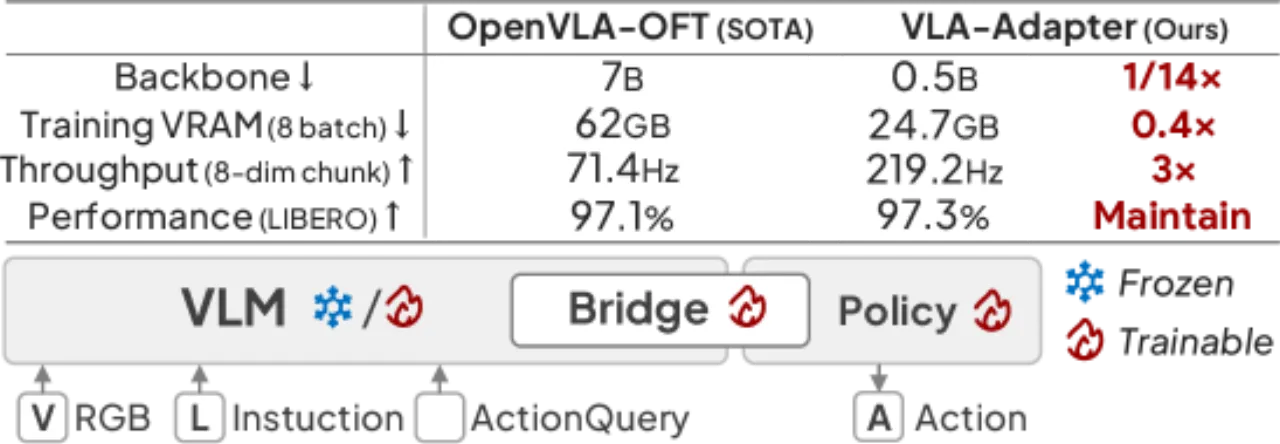
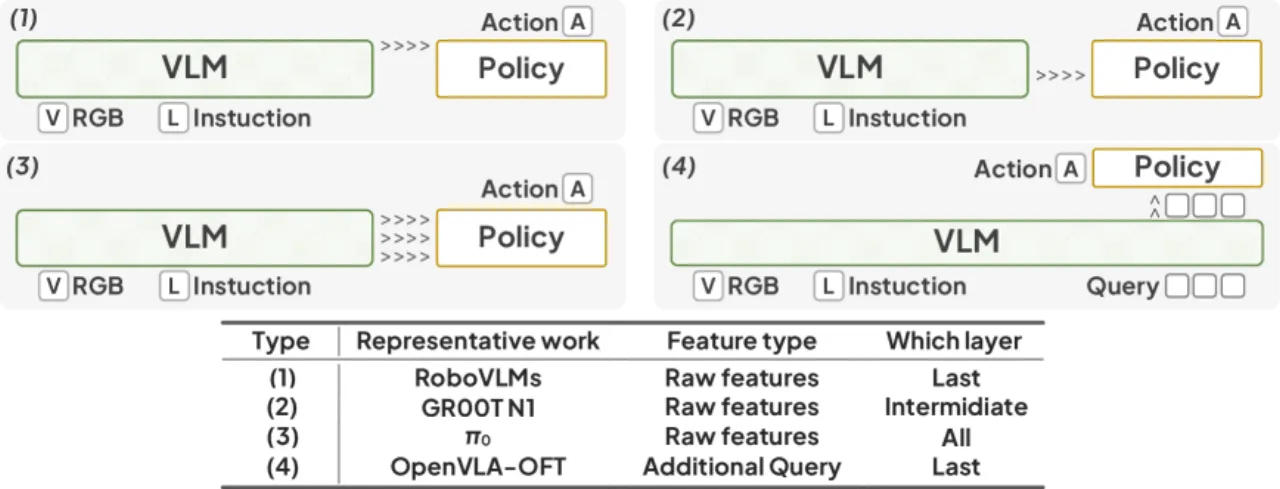
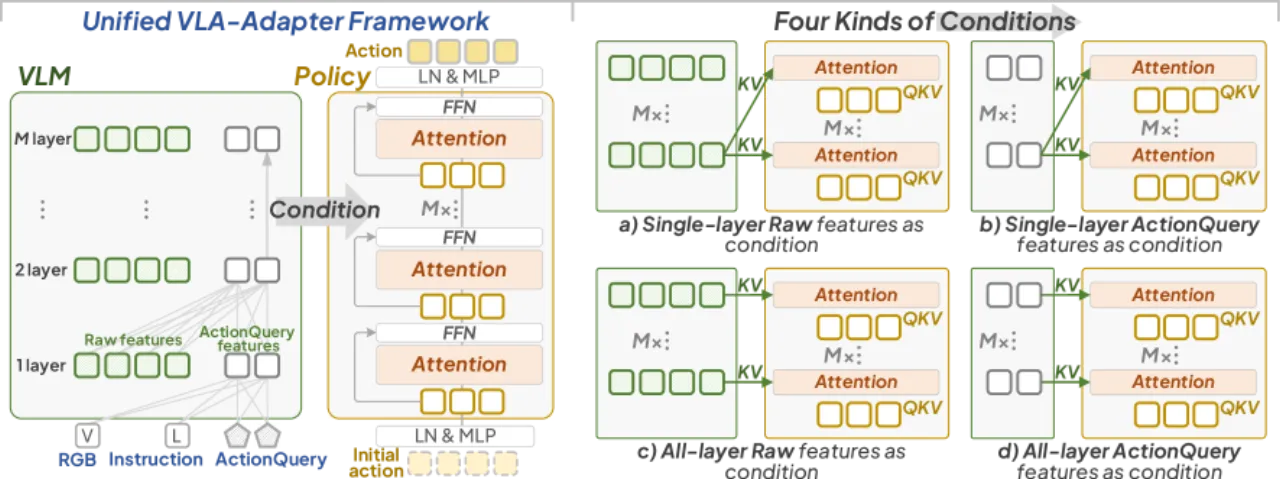
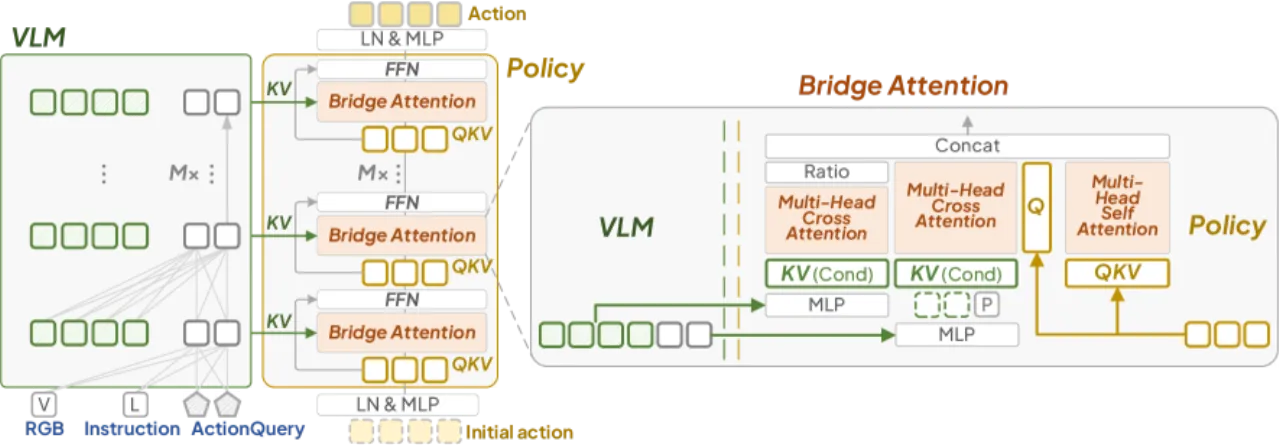
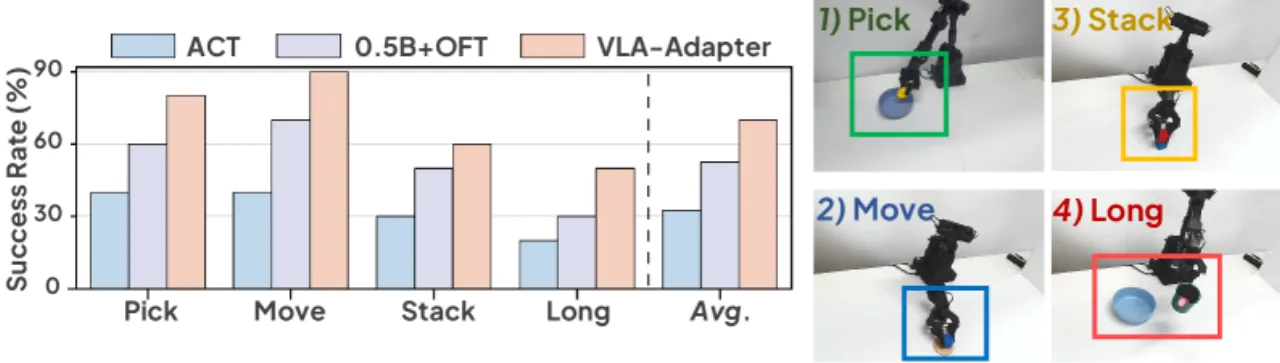
VLA-Adapter 的核心是将 VLM 产生的多模态表征以最优方式"桥接"到动作空间。论文首先系统梳理了四种 bridging paradigm(图2),随后提出包含条件探索与 Bridge Attention 设计的 Policy 模块(图3),并通过 97M 参数的轻量网络(图4)输出 H 步 action chunk。The core of VLA-Adapter is to “bridge” the multimodal representations produced by the VLM into the action space in an optimal way. The paper first systematically reviews four bridging paradigms (Figure 2), then proposes a Policy module that combines condition exploration with a Bridge Attention design (Figure 3), and finally emits an H-step action chunk through a lightweight network of 97M parameters (Figure 4).
论文对 VLM 内部特征进行系统分析,得出三个关键结论:The paper systematically analyses the internal features of the VLM and draws three key conclusions:
Bridge Attention 由两个 cross-attention 和一个 self-attention 构成。它分别处理 raw latent ℛ(多模态细节)与 ActionQuery latent AQ(聚合信息),通过 MLP 生成 key-value pair。一个可学习参数"Ratio g"以 tanh(g) ∈ [−1, 1] 控制 raw features 的注入程度,防止分布不稳定;AQ 则以固定权重 1.0 注入,从而在灵活性与稳定性间取得最优平衡。Bridge Attention consists of two cross-attention modules and one self-attention module. It processes the raw latent ℛ (multimodal detail) and the ActionQuery latent AQ (aggregated information) separately, producing key-value pairs through an MLP. A learnable parameter “Ratio g” uses tanh(g) ∈ [-1, 1] to control how strongly raw features are injected, preventing distributional instability, while AQ is injected with a fixed weight of 1.0 — striking the best balance between flexibility and stability.
实验在 LIBERO(Spatial / Object / Goal / Long 四个子集)和 CALVIN ABC→D 两大基准上与多个 SOTA VLA 对比,同时评估效率指标(吞吐量、延迟)和冻结骨干场景下的泛化能力。骨干使用 Qwen2.5-0.5B,无机器人数据预训练。Experiments compare VLA-Adapter with several SOTA VLAs on two major benchmarks — LIBERO (the Spatial / Object / Goal / Long subsets) and CALVIN ABC→D — and also evaluate efficiency metrics (throughput, latency) and generalisation under a frozen backbone. The backbone is Qwen2.5-0.5B, with no robotic-data pre-training.
| 方法Method | 参数量Params | Spatial | Object | Goal | Long | Avg. |
|---|---|---|---|---|---|---|
| π0 | 3B | 96.8% | 98.8% | 95.8% | 85.2% | 94.2% |
| SmolVLA | 2.2B | 93.0% | 94.0% | 91.0% | 77.0% | 88.8% |
| OpenVLA-OFT | 7B | 97.6% | 98.4% | 97.9% | 94.5% | 97.1% |
| VLA-Adapter(ours)VLA-Adapter (ours) | 0.5B | 97.8% | 99.2% | 97.2% | 95.0% | 97.3% |
| VLA-Adapter-Pro(ours)VLA-Adapter-Pro (ours) | 0.5B | 99.6% | 99.6% | 98.2% | 96.4% | 98.5% |
| 方法Method | 参数量Params | Task 1 | Task 2 | Task 3 | Task 4 | Task 5 | Avg. Len |
|---|---|---|---|---|---|---|---|
| OpenVLA-OFT | 7B | 96.3% | 89.1% | 82.4% | 75.8% | 66.5% | 4.10 |
| VLA-Adapter(ours)VLA-Adapter (ours) | 0.5B | 99.1% | 94.6% | 88.8% | 82.8% | 76.5% | 4.42 |
| VLA-Adapter-Pro(ours)VLA-Adapter-Pro (ours) | 0.5B | 98.5% | 95.0% | 90.5% | 85.3% | 80.0% | 4.50 |
| 方法Method | 吞吐量 (Hz)Throughput (Hz) | 延迟 (sec)Latency (sec) |
|---|---|---|
| OpenVLA | 4.2 | 0.2396 |
| VLA-Adapter(ours)VLA-Adapter (ours) | 219.2 | 0.0365 |
VLA-Adapter 的吞吐量比 OpenVLA 提升 52×,延迟降低 6.5×,满足实时控制需求。VLA-Adapter raises throughput over OpenVLA by 52× and cuts latency by 6.5×, meeting the requirements of real-time control.
消融实验(表7,LIBERO-Long)验证了各条件组合的贡献:The ablation study (Table 7, LIBERO-Long) verifies the contribution of each condition combination:
| 条件组合Condition combination | 成功率Success rate |
|---|---|
| 仅 last-layer rawlast-layer raw only | 85.8% |
| 仅 ActionQueryActionQuery only | 90.2% |
| 仅 intermediate rawintermediate raw only | 88.4% |
| 仅 all-layer rawall-layer raw only | 90.6% |
| all-layer raw + ActionQuery(ours)all-layer raw + ActionQuery (ours) | 95.0% |
注入度消融(表8)显示:raw features 采用可学习 tanh(g)、AQ 固定为 1.0 的组合最优(95.0%),优于两者均可学习(92.6%)或均固定(91.4%)的方案。ActionQuery token 数量实验(图8)表明 64 个 token 为最优平衡点,更多 token 带来冗余干扰。The injection-strength ablation (Table 8) shows that a learnable tanh(g) for raw features combined with AQ fixed at 1.0 is optimal (95.0%), beating both being learnable (92.6%) and both being fixed (91.4%). The experiment on the number of ActionQuery tokens (Figure 8) indicates that 64 tokens is the best trade-off point, since more tokens bring redundant interference.
骨干缩放实验(表2)进一步表明,VLA-Adapter 框架对骨干规模并不敏感:从 0.5B 到 7B,LIBERO-Long 成功率仅从 95.0% 提升至 95.4%,验证了框架本身的有效性而非单纯依赖骨干能力。The backbone-scaling experiment (Table 2) further shows that the VLA-Adapter framework is insensitive to backbone scale: going from 0.5B to 7B lifts the LIBERO-Long success rate only from 95.0% to 95.4%, which confirms the effectiveness of the framework itself rather than a mere reliance on backbone capacity.
"Because VLA-Adapter is not pre-trained on a large amount of embodied data and the scale is tiny, its generalization in real-world systems needs to be improved."——受限于骨干规模极小(0.5B)且未在大规模具身数据上预训练,模型在新场景、新任务上的零样本或少样本泛化能力仍有差距。“Because VLA-Adapter is not pre-trained on a large amount of embodied data and the scale is tiny, its generalization in real-world systems needs to be improved.” — constrained by an extremely small backbone (0.5B) and the absence of pre-training on large-scale embodied data, the model still falls short in zero-shot and few-shot generalisation to new scenes and new tasks.
"The quality of the actions generated depends on conditions provided by the VLM and how they are used."——Bridge Attention 的效果上限受 VLM 提供的 raw features 和 ActionQuery 特征质量约束,VLM 骨干的表达能力直接影响 Policy 能否获得足够有效的条件信号。“The quality of the actions generated depends on conditions provided by the VLM and how they are used.” — the performance ceiling of Bridge Attention is bounded by the quality of the raw features and ActionQuery features supplied by the VLM; the expressive power of the VLM backbone directly determines whether the Policy can obtain sufficiently effective conditioning signals.
"The fundamental training process is still relatively simple, and processes such as reinforcement learning can be explored."——当前仅使用模仿学习(行为克隆)范式训练,未引入 RL fine-tuning 或 RLHF 等更复杂的训练策略,存在进一步提升空间。“The fundamental training process is still relatively simple, and processes such as reinforcement learning can be explored.” — the model is currently trained under a pure imitation-learning (behaviour cloning) paradigm, without more elaborate strategies such as RL fine-tuning or RLHF, so there is room for further improvement.