VLA-0: Building State-of-the-Art VLAs with Zero Modification
无需架构改动,用纯文本动作表示打造顶级 Vision-Language-Action 模型Building top-tier Vision-Language-Action models with pure-text action representations and zero architectural changes
VLA-0 提出了一个出人意料的简单思路:将机器人连续动作归一化为整数并以空格分隔的文本输出,完全不修改 VLM 的词表、架构或解码器,即可在 LIBERO 仿真基准上超越所有同等训练数据量的方法(包括 π₀.₅-KI、OpenVLA-OFT、SmolVLA),并在真实机器人上胜过 SmolVLA 12.5 个百分点。VLA-0 proposes a surprisingly simple idea: normalize the robot's continuous actions into integers and emit them as space-separated text, leaving the VLM's vocabulary, architecture and decoder entirely unmodified. It surpasses every method trained on a comparable amount of data on the LIBERO simulation benchmark (including π₀.₅-KI, OpenVLA-OFT and SmolVLA), and beats SmolVLA by 12.5 percentage points on a real robot.
arXiv · 2025-10-15LIBERO 平均成功率 94.7%(Rank 1)LIBERO average success rate 94.7% (Rank 1)真实机器人 SO-100 测试Real-robot evaluation on SO-100📄 arXiv:2510.13054PDF
当前主流的 VLA(Vision-Language-Action)构建思路普遍需要对预训练 VLM 进行非平凡的架构改动:要么新增离散 action token(discrete token VLA),要么在 VLM 之上叠加专用 generative head,要么完全重设计网络结构。这些修改不仅复杂,还会破坏 VLM 原有的语言理解与 grounding 能力。Mainstream recipes for building VLAs (Vision-Language-Action models) generally require non-trivial architectural changes to a pretrained VLM: adding discrete action tokens (discrete token VLA), stacking a dedicated generative head on top of the VLM, or redesigning the network entirely. Such modifications are not only complex, they also damage the VLM's original language understanding and grounding abilities.
"It restricts the resolution of the action space, since fine-grained control can require thousands of bins, which conflicts with sharing the text vocabulary; and it compromises the pretrained language understanding of the VLM by repurposing its vocabulary for actions."
作者的核心问题是:能否在完全不修改模型架构的前提下,仅通过标准的 text generation fine-tuning,构建出性能领先的 VLA?VLA-0 给出了肯定答案。The authors' central question is: can a leading-performance VLA be built purely through standard text generation fine-tuning, without modifying the model architecture at all? VLA-0 answers in the affirmative.
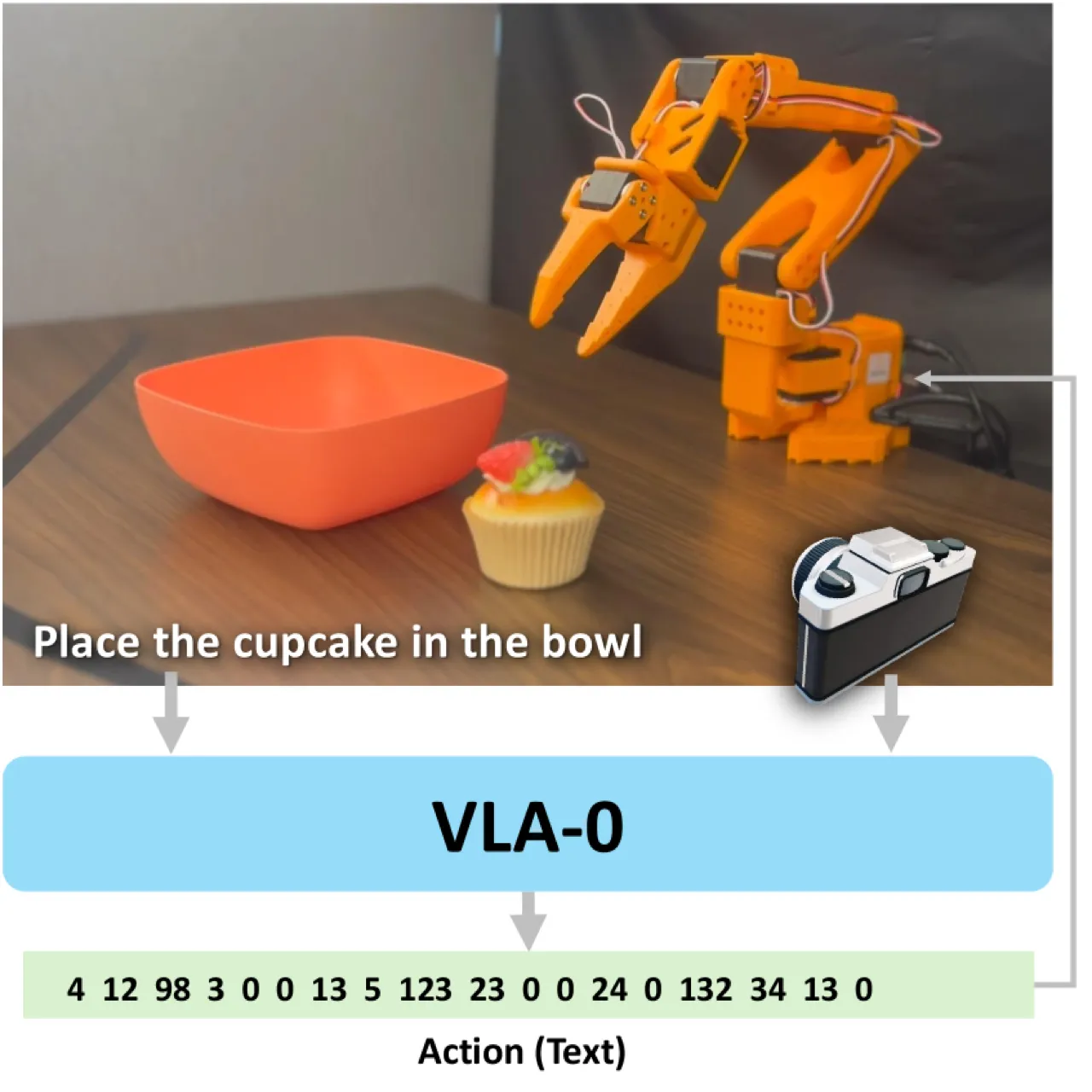
图 1:VLA-0 将 VLM 转化为 VLA 的核心思路示意图。通过将连续机器人动作归一化为整数并以文本形式输出,完全复用 VLM 的文本生成能力,无需任何架构修改。Figure 1: Illustration of how VLA-0 turns a VLM into a VLA. Continuous robot actions are normalized into integers and emitted as text, fully reusing the VLM's text generation capability without any architectural modification.
94.7%LIBERO 平均成功率(无大规模预训练,Rank 1)LIBERO average success rate (no large-scale pretraining, Rank 1)
+12.5pts真实机器人 SO-100 上超越 SmolVLAGain over SmolVLA on the real SO-100 robot
0架构修改数量(Zero Modification)Number of architectural modifications (Zero Modification)
3B基础模型参数量(Qwen-VL-2.5-3B)Base model parameter count (Qwen-VL-2.5-3B)
02方法Method
VLA-0 的核心方法极为简洁:将 7-DOF 末端执行器的连续动作归一化到整数区间(默认 [0, 1000]),以空格分隔后作为纯文本目标,用标准的因果语言建模损失(causal language modeling)对现有 VLM 进行微调。推理时,模型自回归地输出动作整数序列,再反归一化为连续控制指令。The core method of VLA-0 is extremely simple: the continuous actions of a 7-DOF end effector are normalized into an integer range (by default [0, 1000]), space-separated, and used as a plain-text target for fine-tuning an existing VLM with the standard causal language modeling loss. At inference the model autoregressively emits the integer action sequence, which is then denormalized back into continuous control commands.
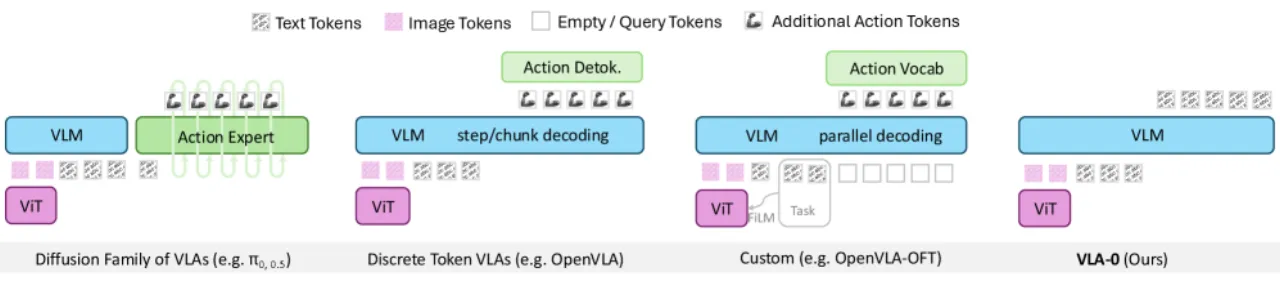
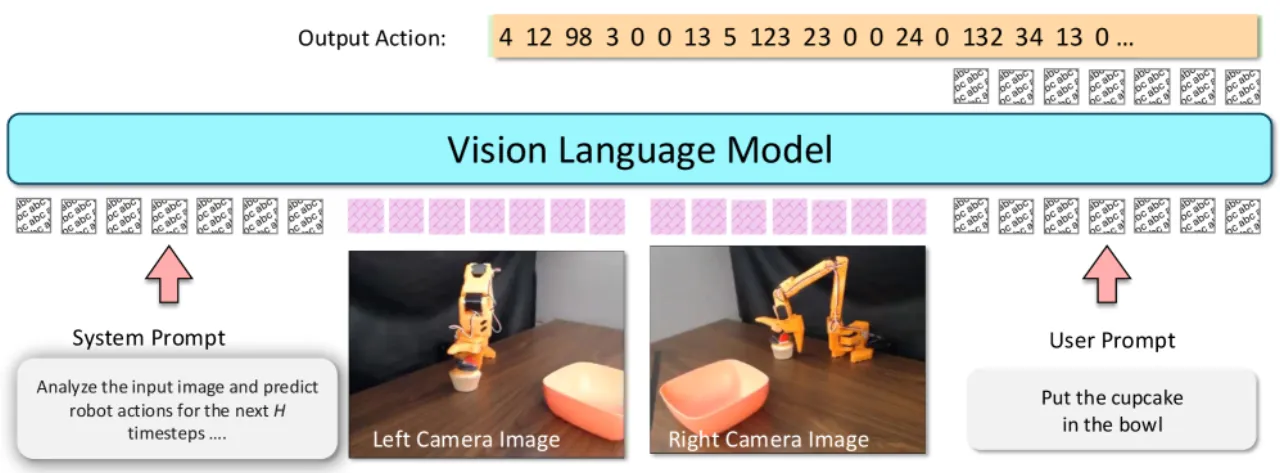
图 2(上):现有 VLA 方法分类——离散 token、generative head、自定义架构。图 3(下):VLA-0 整体架构,接收系统提示、图像与任务指令,输出以空格分隔的整数动作序列。Figure 2 (top): taxonomy of existing VLA approaches — discrete tokens, generative head, custom architectures. Figure 3 (bottom): the overall VLA-0 architecture, which takes a system prompt, images and a task instruction, and outputs a space-separated integer action sequence.
动作文本化(Action as Text)Action as Text
给定连续动作 a ∈ ℝ7,VLA-0 将每个维度线性映射至整数区间 [0, R](resolution R,默认 R=1000),并拼接成形如 "512 398 621 500 501 499 1" 的字符串作为 target token 序列。整个流程完全复用 VLM 原有词表,无需新增特殊 token 或修改 embedding。消融实验表明 R=1000 为最优精度-稳定性折衷(R=250 时性能下降 1.5%,R=4000 时下降 0.5%)。Given a continuous action a ∈ ℝ7, VLA-0 linearly maps each dimension into the integer range [0, R] (resolution R, default R=1000) and concatenates them into a string such as "512 398 621 500 501 499 1", which serves as the target token sequence. The whole procedure reuses the VLM's original vocabulary, requiring no new special tokens and no change to the embeddings. Ablations show that R=1000 is the best accuracy-stability trade-off (performance drops 1.5% at R=250 and 0.5% at R=4000).
Action Ensembling
受 diffusion policy 启发,VLA-0 在推理时维护一个滑动窗口,对多个时间步的预测动作取平均,以消除自回归模型的单步抖动。消融实验显示,关闭 ensembling 后平均成功率从 94.7% 降至 92.0%(Δ = −2.0),是全部消融因素中影响最大的一项。Inspired by diffusion policy, VLA-0 maintains a sliding window at inference time and averages the predicted actions across several time steps, eliminating the single-step jitter of an autoregressive model. Ablations show that switching ensembling off drops the average success rate from 94.7% to 92.0% (Δ = −2.0), the largest effect among all ablated factors.
Masked Action Augmentation
训练时以一定概率随机遮蔽动作文本,迫使模型学会从视觉与语言语境中预测动作,而非单纯地依赖前序动作文本做 auto-completion。去除该增强后成功率下降 1.2%(93.5%)。During training the action text is randomly masked with a certain probability, forcing the model to predict actions from the visual and linguistic context rather than simply relying on the preceding action text for auto-completion. Removing this augmentation lowers the success rate by 1.2% (93.5%).
将来自多个摄像头(腕部 + 俯视)的图像拼贴为单张大图输入 VLM,无需修改 vision encoder。消融显示该策略影响较小(−0.2%),但对真实场景的泛化有帮助。Images from multiple cameras (wrist and top-down) are tiled into a single large image fed to the VLM, requiring no change to the vision encoder. Ablations show this strategy has only a small effect (−0.2%), but it helps generalization to real-world scenes.
03实验Experiments
主要在 LIBERO 仿真基准(4 个任务套件:Spatial、Object、Goal、Long)和真实机器人平台 SO-100 上评估。基础模型选用 Qwen-VL-2.5-3B(轻量高效),与 π₀.₅-KI、OpenVLA-OFT、SmolVLA、GR00T-N1 等多个 baseline 对比。评估指标为成功率(success rate)与平均排名(Avg. Rank)。Evaluation is carried out mainly on the LIBERO simulation benchmark (4 task suites: Spatial, Object, Goal, Long) and on the real robot platform SO-100. The base model is Qwen-VL-2.5-3B (lightweight and efficient), compared against several baselines including π₀.₅-KI, OpenVLA-OFT, SmolVLA and GR00T-N1. The evaluation metrics are success rate and average rank (Avg. Rank).
LIBERO 仿真基准(无大规模动作预训练)LIBERO Simulation Benchmark (No Large-Scale Action Pretraining)
方法Method
Spatial
Object
Goal
Long
Average
Avg. Rank
Diffusion Policy
78.3
92.5
68.3
50.5
72.4
6.5
π₀-FAST (Paligemma)
87.0
63.0
89.0
48.0
71.8
6.0
SmolVLA (0.24B)
87.0
93.0
88.0
63.0
82.8
5.3
SmolVLA (2.25B)
93.0
94.0
91.0
77.0
88.8
4.0
OpenVLA-OFT
94.3
95.2
91.7
86.5
91.9
2.8
π₀.₅-KI
96.6
97.2
94.6
85.8
93.3
2.3
VLA-0(本文)VLA-0 (ours)
97.0
97.8
96.2
87.6
94.7
1.0
与大规模预训练方法对比Comparison with Large-Scale Pretrained Methods
即使与使用了大规模机器人动作预训练数据的方法相比,VLA-0(无预训练,Avg. Rank 2.8)依然超越了 Octo(8.8)、OpenVLA(8.0)、π₀-FAST(6.5)、GR00T-N1(4.5)和 π₀(3.3),仅次于 OpenVLA-OFT(1.5)。Even compared with methods that use large-scale robot action pretraining data, VLA-0 (no pretraining, Avg. Rank 2.8) still surpasses Octo (8.8), OpenVLA (8.0), π₀-FAST (6.5), GR00T-N1 (4.5) and π₀ (3.3), trailing only OpenVLA-OFT (1.5).
图 3:LIBERO 各任务成功率对比(TABLE I)。VLA-0 在无大规模预训练的方法中排名第一,在全部方法中排名第二。Figure 3: Per-task success rates on LIBERO (TABLE I). VLA-0 ranks first among methods without large-scale pretraining, and second overall.
真实机器人评估(SO-100)Real-Robot Evaluation (SO-100)
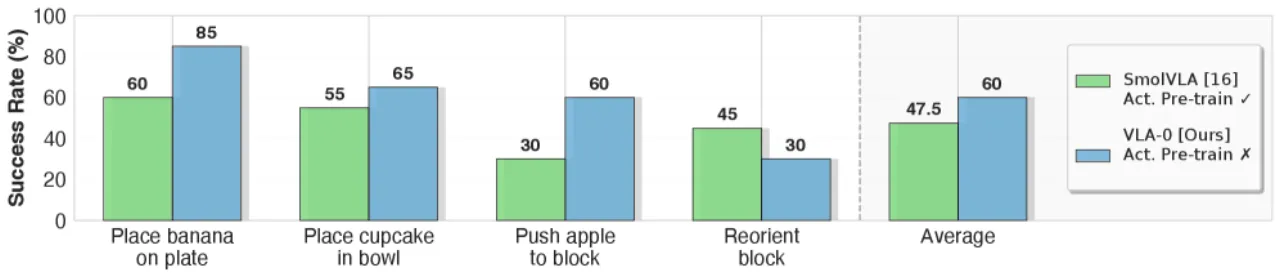
在四项真实机器人操作任务上,VLA-0 超越 SmolVLA 12.5 个百分点,尽管 SmolVLA 拥有专门的 SO-100 大规模预训练数据优势。这表明纯文本动作表示的泛化能力在真实场景中同样有效。Across four real-robot manipulation tasks, VLA-0 beats SmolVLA by 12.5 percentage points, even though SmolVLA enjoys the advantage of dedicated large-scale SO-100 pretraining data. This indicates that the generalization ability of a pure-text action representation is equally effective in real-world settings.
消融分析Ablation Analysis
图 4:消融实验结果(TABLE II)。Action Ensembling 影响最大(−2.0%),其次是 Masked Action Augmentation(−1.2%)和 Action Resolution(−1.5% at R=250)。Figure 4: Ablation results (TABLE II). Action Ensembling has the largest effect (−2.0%), followed by Masked Action Augmentation (−1.2%) and Action Resolution (−1.5% at R=250).
配置Configuration
Ensemble
Masked Aug.
Resolution
平均成功率Avg. Success Rate
Δ
完整 VLA-0Full VLA-0
✓
✓
1000
94.7
0.0
去掉 EnsembleWithout Ensemble
✗
✓
1000
92.0
−2.0
去掉 Masked Aug.Without Masked Aug.
✓
✗
1000
93.5
−1.2
降低 ResolutionLower Resolution
✓
✓
250
93.2
−1.5
提高 ResolutionHigher Resolution
✓
✓
4000
94.2
−0.5
去掉 Tiled ImagesWithout Tiled Images
✓
✓
1000
94.5
−0.2
04局限性Limitations
说明:以下局限性均为论文作者明确指出的内容(stated),部分附有 inferred 标注。Note: The limitations below are all points explicitly stated by the authors of the paper; some carry an inferred annotation.
推理速度偏低(stated)Low Inference Speed (stated)
VLA-0 当前在 RTX 5090 GPU 上的推理频率仅为约 4 Hz,低于部分专用 VLA 方法。作者指出未来可通过量化(quantization)和蒸馏(distillation)等优化手段提升推理速度,但目前尚未完成。VLA-0 currently runs at an inference frequency of only about 4 Hz on an RTX 5090 GPU, lower than that of some specialized VLA methods. The authors note that inference speed could be improved in the future through optimizations such as quantization and distillation, but this has not been done yet.
论文仅评估了在 LIBERO 同等数据量下的性能,未实验 VLA-0 结合大规模跨实体机器人数据集(如 OpenX-Embodiment)预训练后的效果。作者将此列为重要的未来研究方向:"A key area to explore is how VLA-0 would perform when trained with large-scale action data."The paper only evaluates performance under the same data budget as LIBERO, and does not experiment with pretraining VLA-0 on large-scale cross-embodiment robot datasets (such as OpenX-Embodiment). The authors list this as an important direction for future research: "A key area to explore is how VLA-0 would perform when trained with large-scale action data."
Long-Horizon 任务仍有差距(inferred)A Gap Remains on Long-Horizon Tasks (inferred)
在 LIBERO-Long 子集(最长任务序列)上,VLA-0 成功率为 87.6%,低于其他三个子集(Spatial 97.0%、Object 97.8%、Goal 96.2%),且与使用大规模预训练的 OpenVLA-OFT(94.5%)相比仍有差距。这可能反映文本自回归方式在长序列动作累积误差上的固有挑战(inferred)。On the LIBERO-Long subset (the longest task sequences), VLA-0 reaches a success rate of 87.6%, lower than on the other three subsets (Spatial 97.0%, Object 97.8%, Goal 96.2%), and still behind OpenVLA-OFT (94.5%), which uses large-scale pretraining. This may reflect an inherent challenge of the text autoregressive approach: accumulated action error over long sequences (inferred).