本文针对工业中普遍存在的无纹理物体(缺乏可靠视觉特征)的视觉伺服控制难题, 提出了一种将感知与控制紧密耦合的闭环框架:以扩展卡尔曼滤波器(EKF)融合 基于关键点的位姿估计与运动先验,同时引入概率控制律计算速度不确定度,实现安全可靠的 Pose-Based Visual Servoing(PBVS)。This paper tackles the difficulty of visual servoing control for textureless objects (which lack reliable visual features) that are pervasive in industry, and proposes a closed-loop framework that tightly couples perception and control: an Extended Kalman Filter (EKF) fuses keypoint-based pose estimation with a motion prior, while a probabilistic control law computes velocity uncertainty, enabling safe and reliable Pose-Based Visual Servoing (PBVS).
视觉伺服是机器人精确定位与控制的基础技术。然而,无纹理物体(textureless objects) ——工业场景中大量存在的表面均匀、缺乏特征点的零件——令传统方法举步维艰: 手工设计的特征无法建立稳定的视觉对应,深度学习方法又多依赖单帧预测, 遭遇遮挡或光照突变时极易失稳。Visual servoing is a foundational technique for precise robot positioning and control. Yet textureless objects — the uniform-surfaced, feature-poor parts that abound in industrial scenes — leave traditional methods struggling: hand-crafted features cannot establish stable visual correspondences, and deep learning methods mostly rely on single-frame prediction, becoming highly unstable under occlusion or abrupt illumination change.
"Visual servoing is fundamental to robotic applications, enabling precise positioning and control. However, applying it to textureless objects remains a challenge due to the absence of reliable visual features. Moreover, adverse visual conditions, such as occlusions, often corrupt visual feedback, leading to reduced accuracy and instability in visual servoing."
— 论文摘要原文— from the paper abstract
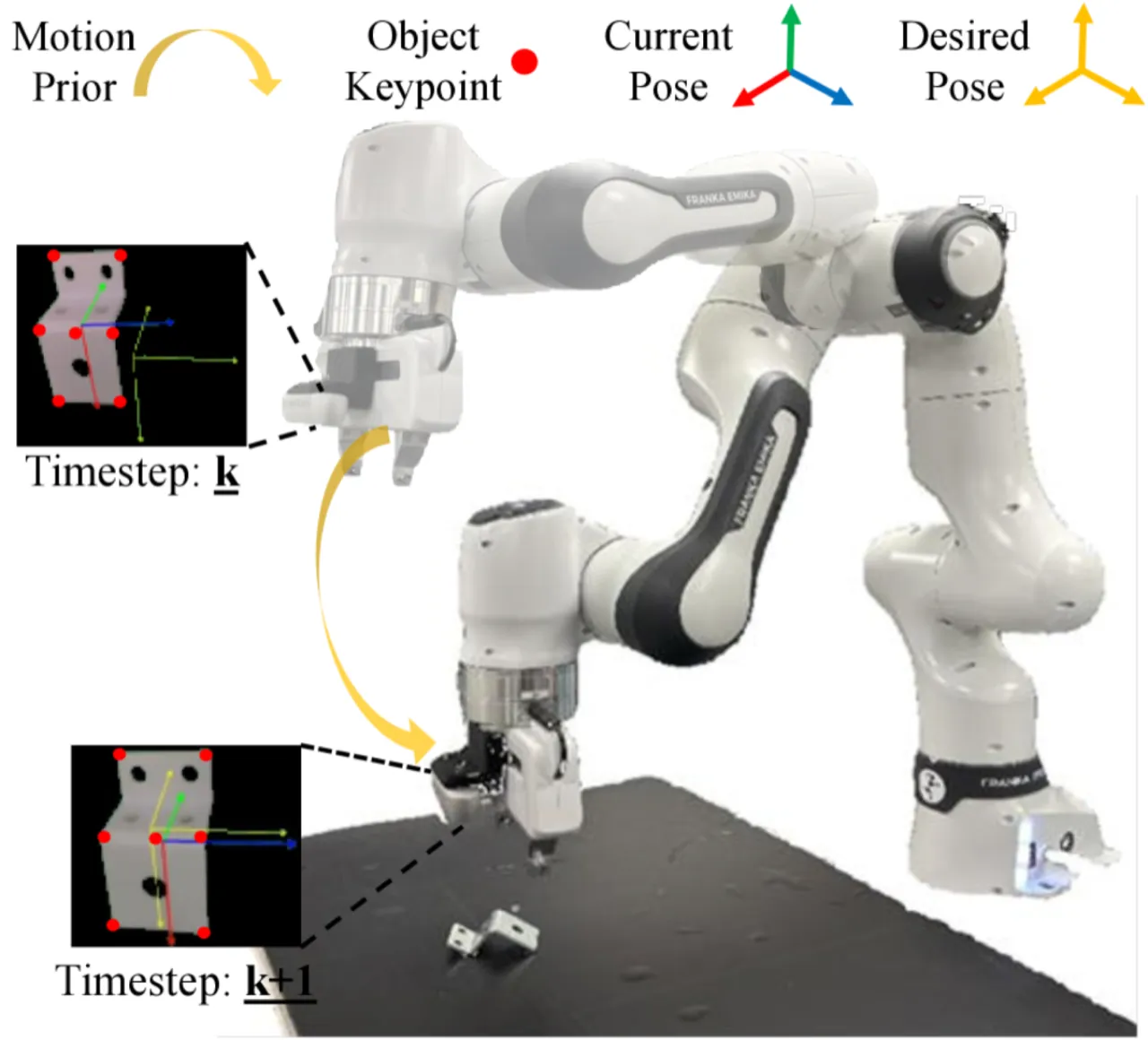
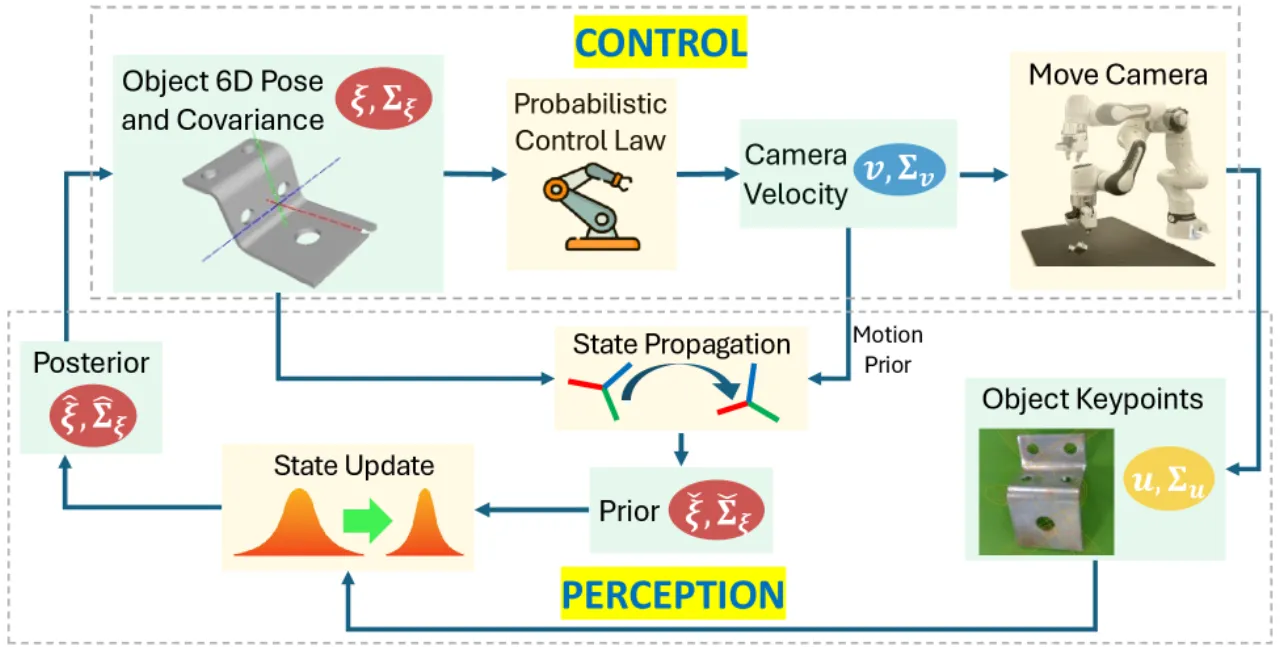
本文核心是将感知与控制形成双向闭环: 感知阶段用 EKF 融合关键点与运动先验估计 6D 位姿; 控制阶段用概率控制律生成相机速度并评估其不确定度; 该速度再作为下一帧感知的运动先验,完成闭环。The core idea of this paper is to form a bidirectional closed loop between perception and control: in the perception stage, an EKF fuses keypoints with the motion prior to estimate the 6D pose; in the control stage, a probabilistic control law generates the camera velocity and evaluates its uncertainty; that velocity then serves as the motion prior for the next perception frame, closing the loop.
感知主干采用 PVNet 从 RGB 图像中提取每帧 2D 关键点及其不确定度。 EKF 以 离散时间恒速运动模型(discrete-time constant-velocity motion model)传播状态, 状态向量包含 6-DOF 物体位姿(位置 + 旋转)。 旋转采用李代数(Lie algebra)参数化的误差状态线性化, 通过 Jacobian 将 2D–3D 关键点对应关系融合进测量更新步骤。 即使某些帧关键点完全遮挡,EKF 仍能利用运动先验维持稳健估计。The perception backbone uses PVNet to extract per-frame 2D keypoints and their uncertainties from RGB images. The EKF propagates the state with a discrete-time constant-velocity motion model, and the state vector contains the 6-DOF object pose (position + rotation). Rotation is linearized in an error-state form parameterized on the Lie algebra, and 2D–3D keypoint correspondences are fused into the measurement update step through the Jacobian. Even when keypoints are fully occluded in some frames, the EKF can still maintain a robust estimate using the motion prior.
区别于标准 PBVS,本文提出的概率控制律(probabilistic control law)不仅输出相机速度指令, 还输出一个 6×6 速度协方差矩阵,用微分熵(differential entropy)量化控制置信度。 当熵值超过安全阈值时,速度指令将被显著降低:Unlike standard PBVS, the probabilistic control law proposed here outputs not only a camera velocity command but also a 6×6 velocity covariance matrix, quantifying control confidence with the differential entropy. When the entropy exceeds a safety threshold, the velocity command is significantly reduced:
"When the entropy exceeds this threshold, the velocity is significantly reduced to ensure safety."
协方差传播通过对 PBVS 控制方程进行 Jacobian 线性化来实现,将 EKF 状态协方差 传递至最终速度指令的不确定度中,形成端到端的不确定度感知控制链路。Covariance propagation is realized by Jacobian linearization of the PBVS control equations, carrying the EKF state covariance through to the uncertainty of the final velocity command and forming an end-to-end uncertainty-aware control chain.
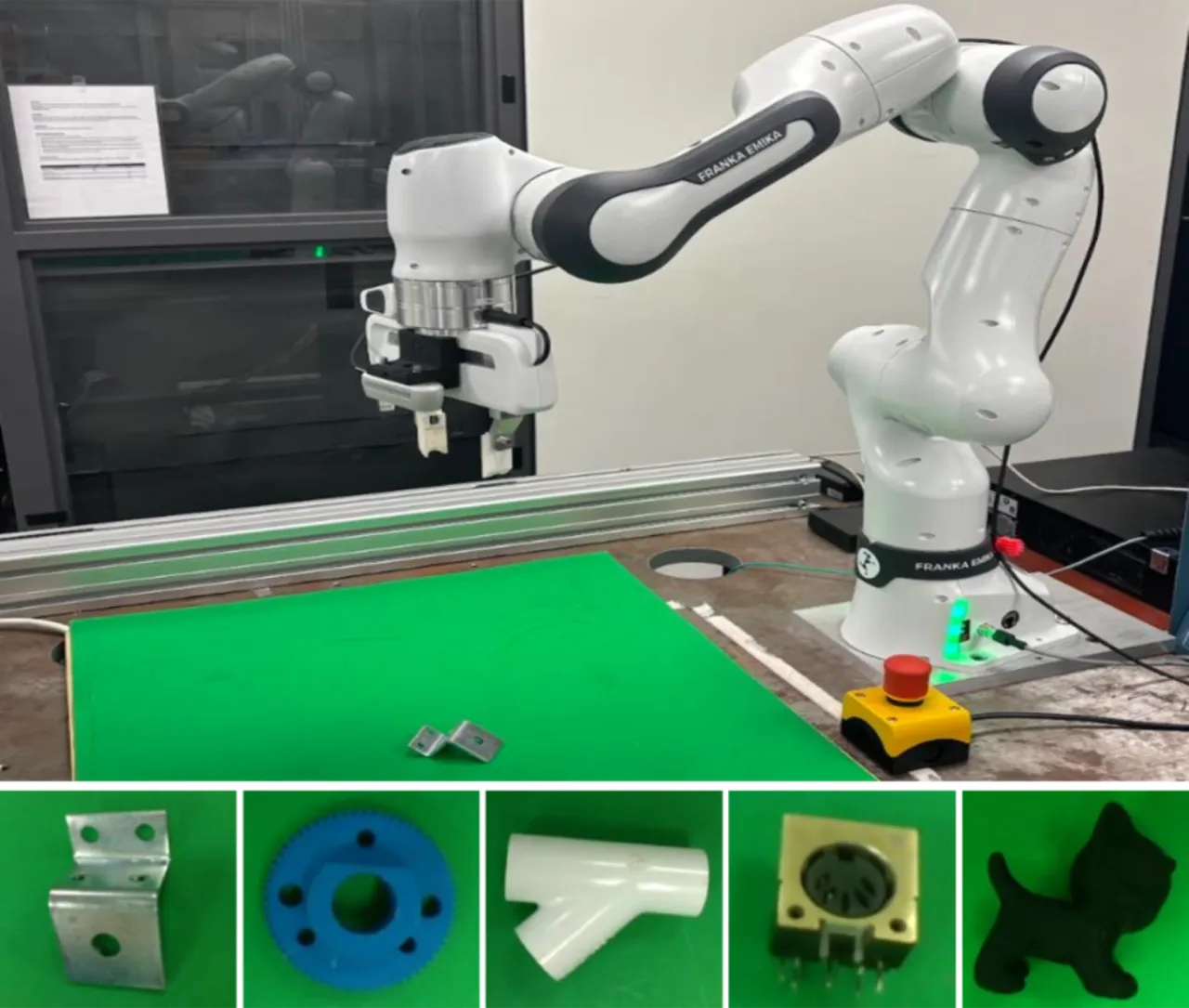
在真实的 7-DOF Franka Emika 机械臂平台上,针对 5 种无纹理物体, 与 IBVS+PVNet 和 PBVS+PVNet 基准方法进行对比, 评估指标包括伺服成功率(SR)、末端平移误差(TE)、旋转误差(RE)和轨迹长度比(LR)。On a real 7-DOF Franka Emika manipulator platform, the method is compared with the IBVS+PVNet and PBVS+PVNet baselines on 5 textureless objects. Evaluation metrics include servoing success rate (SR), end-effector translation error (TE), rotation error (RE) and trajectory length ratio (LR).
| 方法Method | 成功率 SR (%)Success rate SR (%) | 平移误差 TE (mm)Translation error TE (mm) | 旋转误差 RE (°)Rotation error RE (°) | 轨迹长度比 LRTrajectory length ratio LR |
|---|---|---|---|---|
| 正常条件 (Normal Conditions)Normal Conditions | ||||
| IBVS + PVNet | 87.81 | 3.27 ± 1.72 | 3.91 ± 2.69 | 1.25 ± 0.36 |
| PBVS + PVNet | 84.15 | 3.66 ± 1.76 | 3.98 ± 3.81 | 1.29 ± 0.58 |
| 本文方法(Proposed)Ours (Proposed) | 95.12 | 3.17 ± 1.45 | 3.81 ± 2.68 | 1.11 ± 0.15 |
| 不利条件 (Adverse Conditions — 遮挡、光变、复杂背景)Adverse Conditions — occlusion, illumination change, cluttered background | ||||
| IBVS + PVNet | 52.17 | 4.91 ± 4.09 | 6.15 ± 3.98 | 1.68 ± 0.78 |
| PBVS + PVNet | 40.58 | 5.53 ± 4.08 | 6.44 ± 4.16 | 1.92 ± 1.02 |
| 本文方法(Proposed)Ours (Proposed) | 82.61 | 3.99 ± 2.72 | 5.70 ± 3.98 | 1.18 ± 0.23 |
| 物体Object | IBVS + PVNet (%) | PBVS + PVNet (%) | 本文方法 (%)Ours (%) |
|---|---|---|---|
| Zigzag | — | — | 95.8 |
| Pipe | — | — | 78.3 |
| Gear | — | — | 95.6 |
| Cat | — | — | 90.5 |
| Connector | — | — | 89.5 |
| 平均Average | — | — | 89.9 |
"Our approach consistently outperforms both IBVS and PBVS for all objects, achieving the highest average success rate of 89.9%."
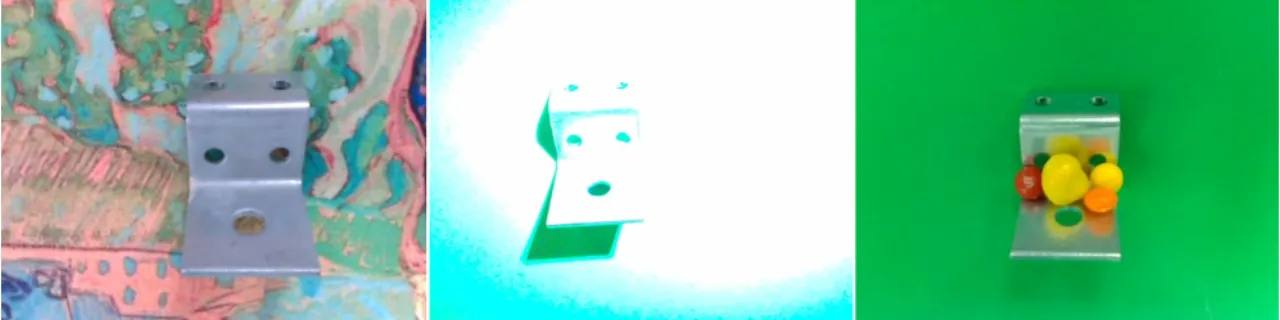
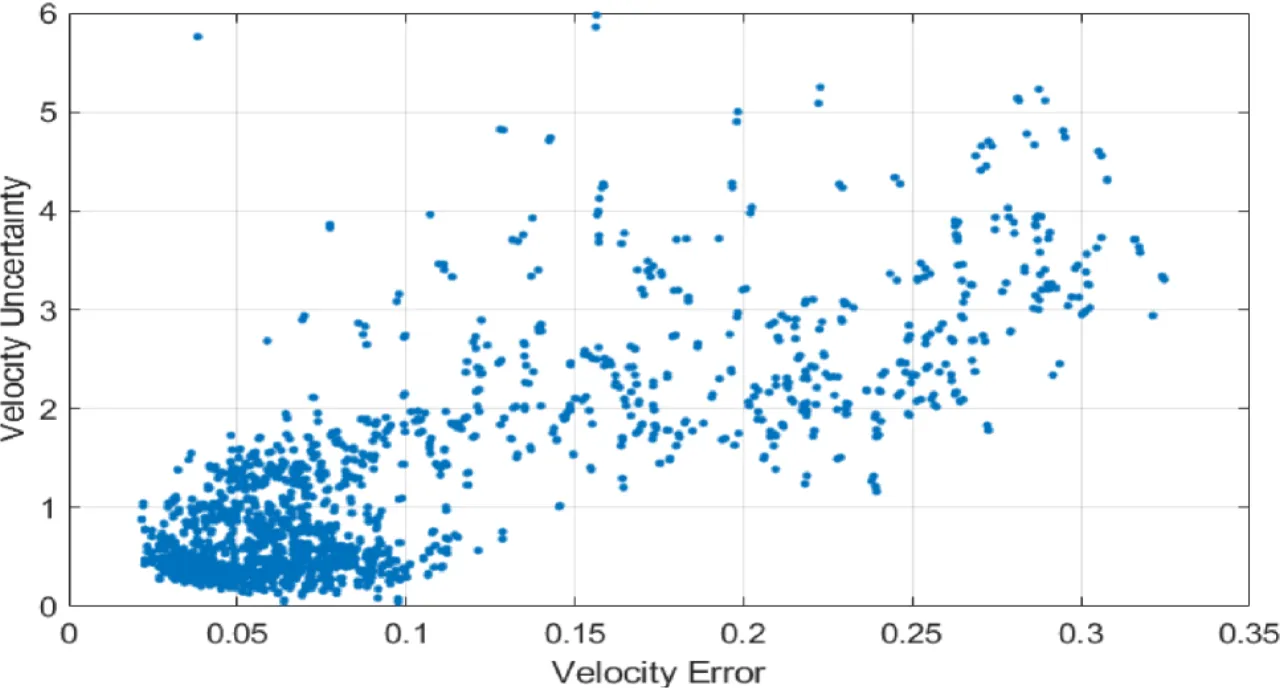
实验表明 EKF 时序融合对在不利条件下维持高成功率至关重要: PBVS+PVNet 在不利条件下成功率仅 40.58%,而本文方法达到 82.61%, 提升幅度超过 42 个百分点。 概率控制律输出的不确定度(Pearson r = 0.81)能有效预测控制误差, 支持自适应安全降速,进一步提升系统鲁棒性。The experiments show that EKF temporal fusion is essential for maintaining a high success rate under adverse conditions: PBVS+PVNet reaches only 40.58% under adverse conditions, whereas our method attains 82.61%, an improvement of more than 42 percentage points. The uncertainty output by the probabilistic control law (Pearson r = 0.81) effectively predicts control error and supports adaptive safety slow-down, further improving system robustness.
当前框架假设目标物体静止,EKF 的恒速运动模型难以适应动态目标。 作者明确指出"extending the framework to dynamic environments"为重要未来方向。The current framework assumes the target object is stationary, and the constant-velocity motion model of the EKF adapts poorly to dynamic targets. The authors explicitly point to "extending the framework to dynamic environments" as an important future direction.
PVNet 关键点检测和 EKF 测量更新均需要物体预先建立的 3D 模型。 作者指出未来需"generalizing to more challenging object types such as CAD-less or deformable objects"。Both PVNet keypoint detection and the EKF measurement update require a pre-built 3D model of the object. The authors note that future work needs "generalizing to more challenging object types such as CAD-less or deformable objects".
PVNet 通常在合成渲染数据上训练,存在域差距(sim-to-real gap), 可能在真实环境外观差异较大时泛化能力下降。 论文未直接量化此问题,属推断局限。PVNet is usually trained on synthetically rendered data, so a domain gap (sim-to-real gap) exists and generalization may degrade when real-world appearance differs substantially. The paper does not directly quantify this issue, so it is an inferred limitation.
当前方法被动跟随相机运动,缺乏主动选择最优视角以减少遮挡的机制。 作者明确将"incorporating active viewpoint selection"列为未来工作。The current method passively follows camera motion and lacks a mechanism for actively choosing the optimal viewpoint to reduce occlusion. The authors explicitly list "incorporating active viewpoint selection" as future work.