VPP(Video Prediction Policy)将视频扩散模型(Video Diffusion Model, VDM)中蕴含的预测性视觉表征用于机器人策略学习,使 policy 同时感知当前状态与未来动态。在 CALVIN ABC→D 泛化基准上,VPP 比先前 SOTA 提升 18.6%;在真实灵巧手操作任务中成功率提升 31.6%。VPP (Video Prediction Policy) applies the predictive visual representations embedded in video diffusion models (Video Diffusion Model, VDM) to robot policy learning, so that the policy perceives both the current state and the future dynamics. On the CALVIN ABC→D generalization benchmark, VPP improves over the prior SOTA by 18.6%; on real-world dexterous-hand manipulation tasks the success rate improves by 31.6%.
当前机器人视觉表征方法主要依赖单帧图像或两帧图像学习,忽视了具身任务中至关重要的动态信息。视频扩散模型(VDM)在大规模互联网视频上预训练,隐含地理解了物理世界的演化规律,但如何将这种"未来预见"能力转化为 robot policy 的视觉表征,尚无有效方案。Current robot visual representation methods learn mainly from single-frame or two-frame images, overlooking the dynamic information that is critical for embodied tasks. Video diffusion models (VDM), pretrained on large-scale internet video, implicitly capture how the physical world evolves, yet there is still no effective way to turn this "foresight of the future" into visual representations for a robot policy.
"We hypothesize that VDMs contain both current static information and predicted future dynamics, which can provide more comprehensive guidance for robot policy learning."
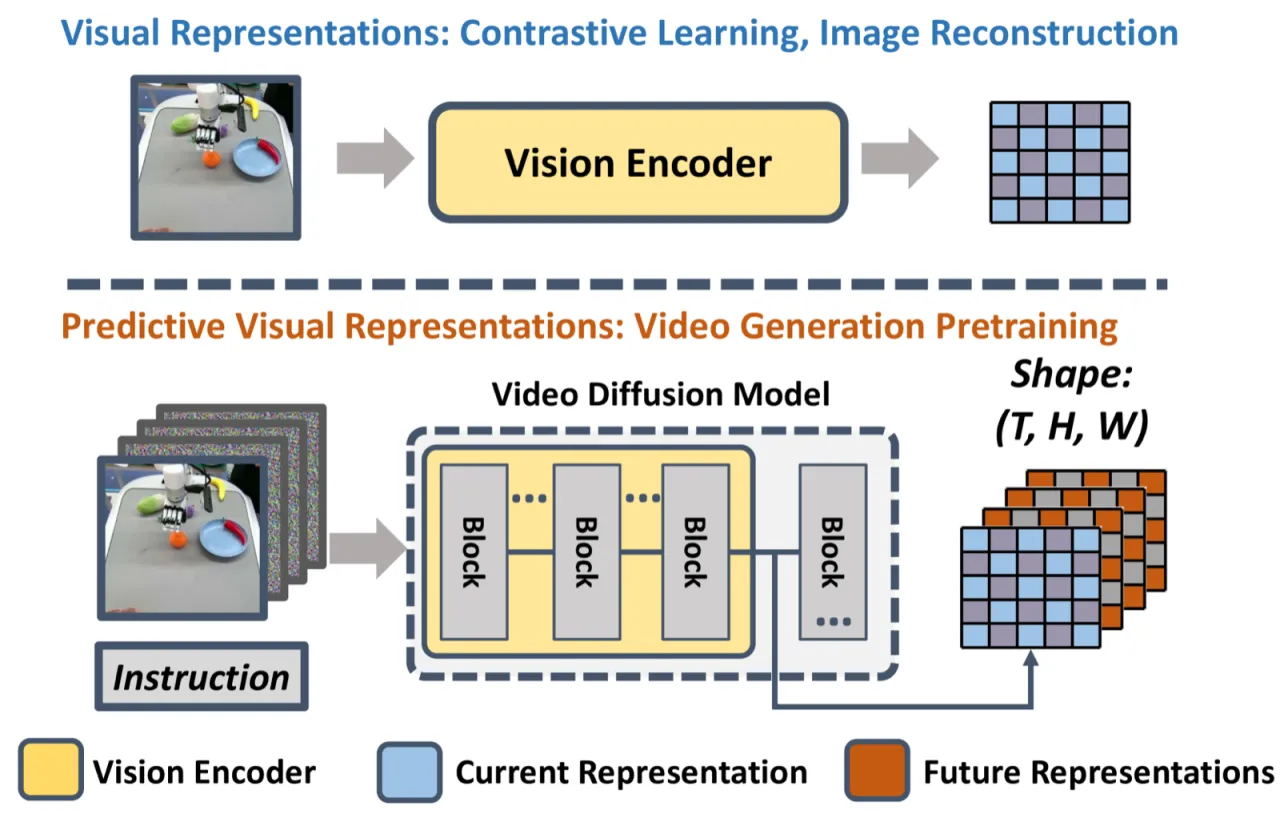
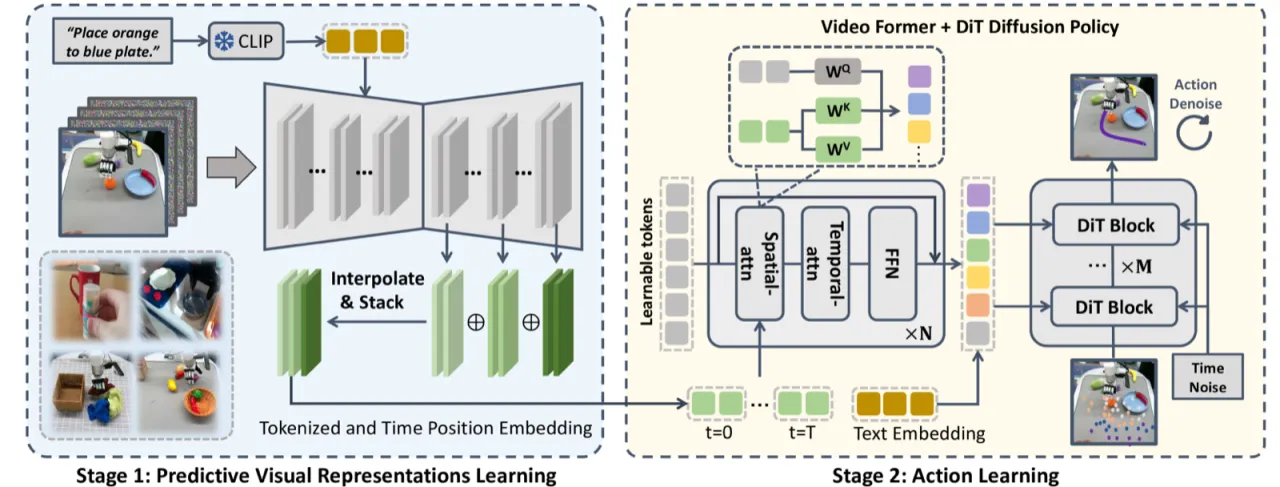
VPP 分两阶段:首先在机器人与人类操作数据上微调视频扩散模型,使其具备文本引导的视频预测能力(TVP);然后以 TVP 的内部 latent 特征作为视觉编码器,通过 Video Former 聚合时空信息,最终由 Diffusion Policy 输出动作序列。VPP proceeds in two stages: a video diffusion model is first fine-tuned on robot and human manipulation data so that it acquires text-guided video prediction (TVP) ability; the internal latent features of the TVP model then serve as the visual encoder, Video Former aggregates the spatio-temporal information, and a Diffusion Policy finally outputs the action sequence.
以 Stable Video Diffusion(1.5B 参数)为基础,通过 cross-attention 引入语言条件,在三类数据集上联合训练:Built on Stable Video Diffusion (1.5B parameters), language conditioning is introduced through cross-attention and the model is trained jointly on three kinds of datasets:
TVP 充当"视觉编码器",约 140ms 完成一次前向推理,提取多个 up-sampling layers 的 latent 特征并拼接为 F_p。TVP acts as the "visual encoder", completing one forward pass in about 140ms and extracting the latent features of several up-sampling layers, which are concatenated into F_p. Video Former 利用可学习 token 通过 spatial attention 与 temporal attention 对 F_p 进行时空聚合,压缩多视角信息,无需逐帧生成完整视频(相比 SuSIE 快 3.2×)。Video Former uses learnable tokens to aggregate F_p over space and time via spatial attention and temporal attention, compressing multi-view information without generating the complete video frame by frame (3.2× faster than SuSIE). Diffusion Policy Head 通过 cross-attention 将聚合表征与语言指令结合,生成连续的动作序列,以去噪扩散过程输出 6-DoF 末端执行器轨迹。Diffusion Policy Head combines the aggregated representation with the language instruction via cross-attention to produce a continuous action sequence, outputting 6-DoF end-effector trajectories through a denoising diffusion process.
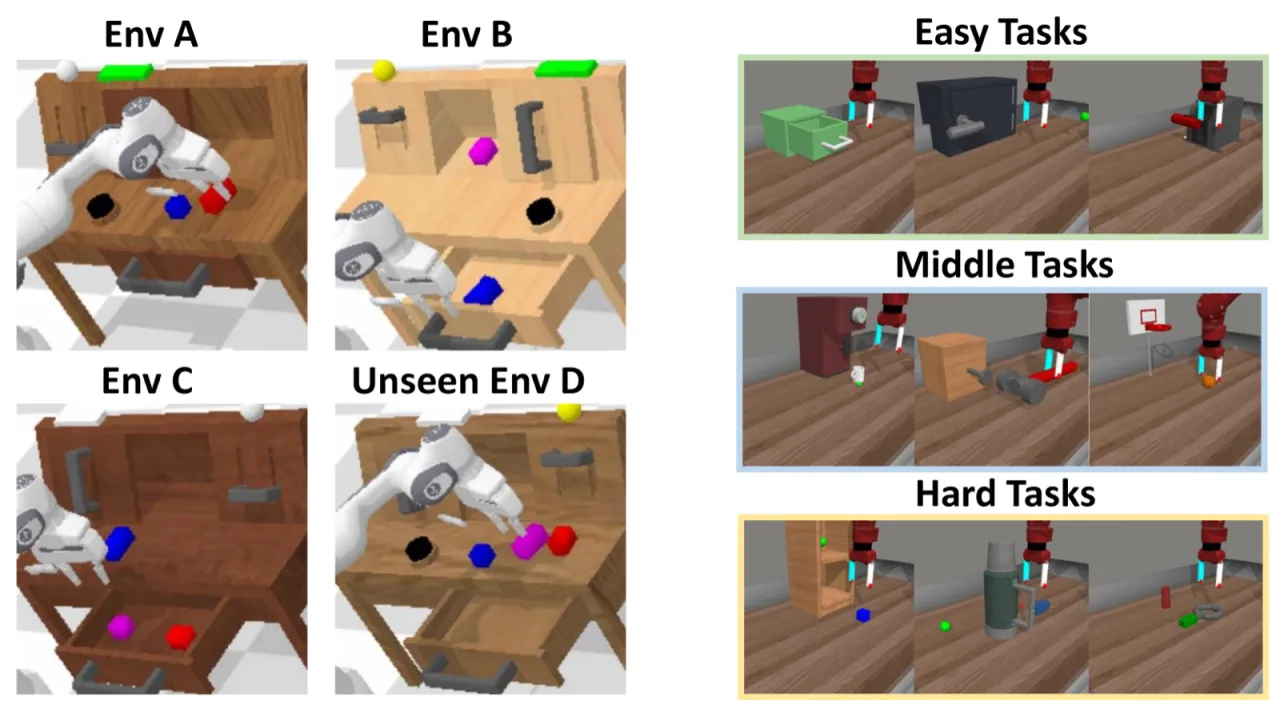
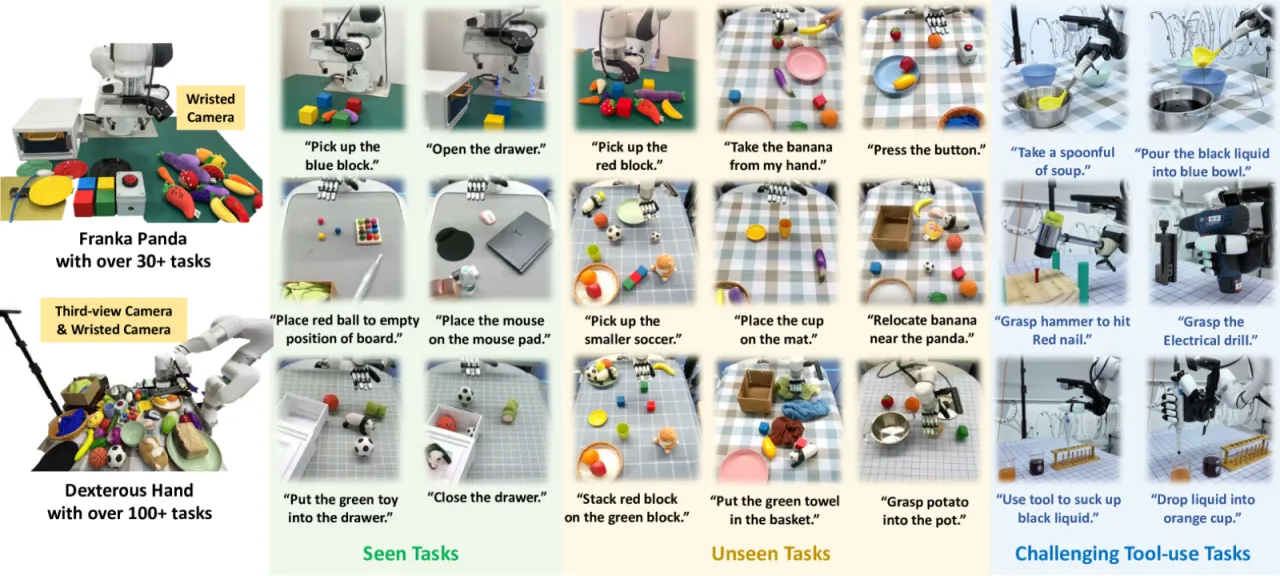
在四类平台上系统评估 VPP:仿真基准 CALVIN(跨环境泛化)与 MetaWorld(50 任务多任务操作),以及真实硬件 Franka Panda 机械臂(30+ 任务)和灵巧手(100+ 任务)。与 RT-1、Diffusion Policy、GR-1、RoboUniview、SuSIE、Vidman 等基线对比。VPP is evaluated systematically on four kinds of platforms: the simulation benchmarks CALVIN (cross-environment generalization) and MetaWorld (multi-task manipulation over 50 tasks), plus real hardware — a Franka Panda arm (30+ tasks) and a dexterous hand (100+ tasks). It is compared against baselines such as RT-1, Diffusion Policy, GR-1, RoboUniview, SuSIE and Vidman.
| Benchmark | Prior SOTA | VPP(本文)VPP (ours) | 相对提升Relative gain |
|---|---|---|---|
| CALVIN ABC→D 平均完成任务数CALVIN ABC→D avg. tasks completed | 3.35 (RoboUniview) | 4.33 | +29.3% |
| CALVIN 10% 数据CALVIN with 10% of the data | 1.41 (GR-1) | 3.25 | +130.5% |
| MetaWorld 平均成功率MetaWorld average success rate | 57.4% (GR-1) | 68.2% | +10.8% |
| Franka 已见任务成功率Franka seen-task success rate | 52% (GR-1) | 85.6% | +64.6% |
| 灵巧手 已见任务成功率Dexterous hand, seen-task success rate | 32% (GR-1) | 74.9% | +134.1% |
| 灵巧手 工具使用任务Dexterous hand, tool-use tasks | 15% (GR-1) | 68% | +353.3% |
在 CALVIN 基准上的关键消融(以平均完成任务数衡量):Key ablations on the CALVIN benchmark (measured by the average number of tasks completed):
| 配置Setting | CALVIN 平均任务数CALVIN avg. tasks | 相对完整版本Relative to the full model |
|---|---|---|
| 完整 VPPFull VPP | 4.33 | — |
| 去掉互联网数据w/o internet data | 3.97 | −8.3% |
| 去掉 SVD 预训练(随机初始化)w/o SVD pretraining (random initialization) | 1.63 | −62.4% |
| 去掉 Video Former(改用所有帧特征)w/o Video Former (use features of all frames) | 3.86 | −10.9%,推理速度慢 3.2×−10.9%, inference 3.2× slower |
| 以 VAE 替换 VDMReplace VDM with a VAE | 2.58 | −40.4% |
| 以 VC-1 编码器替换Replace the encoder with VC-1 | 1.23 | −71.6% |
| 仅用最后一层特征Use only last-layer features | 3.60 | −16.9% |
消融结果揭示:SVD 大规模预训练是最关键的性能来源(去掉后性能下降 62.4%);Video Former 对效率与性能均有重要贡献;多层特征融合优于只用最后一层。The ablations reveal that large-scale SVD pretraining is the most critical source of performance (removing it drops performance by 62.4%); Video Former contributes substantially to both efficiency and performance; and fusing multi-layer features outperforms using only the last layer.
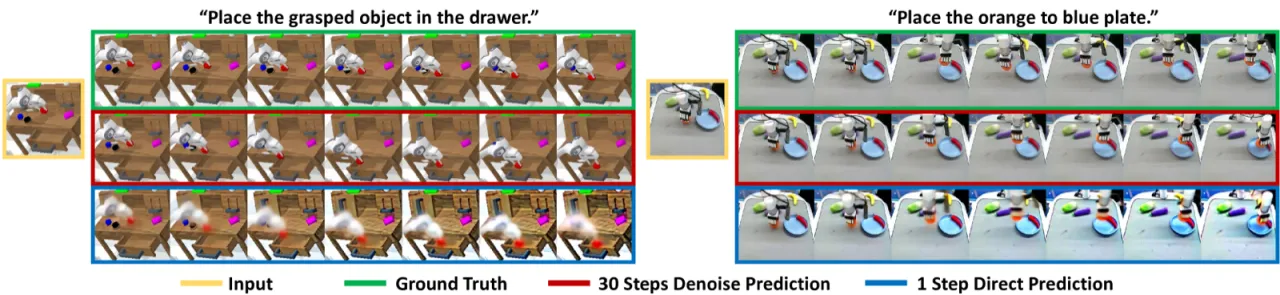
作者指出,单步前向预测"do not yield clear video",生成的预测帧较为模糊。尽管如此,实验表明其 latent 特征已足够编码物理演化信息,对策略学习仍有指导价值。但若任务需要高精度视觉预测,此局限可能影响表现。The authors point out that single-step forward prediction "do not yield clear video": the generated frames are rather blurry. Even so, experiments show that the latent features already encode enough information about physical evolution to guide policy learning. Yet for tasks that require high-precision visual prediction, this limitation may affect performance.
TVP 单次前向推理约需 140ms,对控制频率有影响。虽然相比 SuSIE 等需要多步去噪的方法快 3.2×,但对于需要高频控制(>10Hz)的任务(如高速避障、接触丰富操作)仍是瓶颈。A single TVP forward pass takes about 140ms, which constrains the control frequency. Although it is 3.2× faster than multi-step denoising methods such as SuSIE, it remains a bottleneck for tasks that need high-frequency control (>10Hz), such as high-speed obstacle avoidance and contact-rich manipulation.
VPP 的性能高度依赖 Stable Video Diffusion 在海量互联网视频上的预训练(消融去掉 SVD 预训练后性能下降 62.4%)。这意味着方法对计算资源要求较高,难以在资源受限场景下从头训练或快速迁移到全新领域。VPP's performance relies heavily on the pretraining of Stable Video Diffusion over massive internet video (ablating SVD pretraining drops performance by 62.4%). This means the method is demanding in computational resources, and is hard to train from scratch in resource-constrained settings or to transfer quickly to entirely new domains.