TwinVLA: Data-Efficient Bimanual Manipulation with Twin Single-Arm Vision-Language-Action Models
用两个预训练单臂 VLA 模型的孪生组合实现高效双臂操作Efficient bimanual manipulation from a twin composition of two pretrained single-arm VLA models
Hokyun Im · Euijin Jeong · Andrey Kolobov · Jianlong Fu · Youngwoon Lee
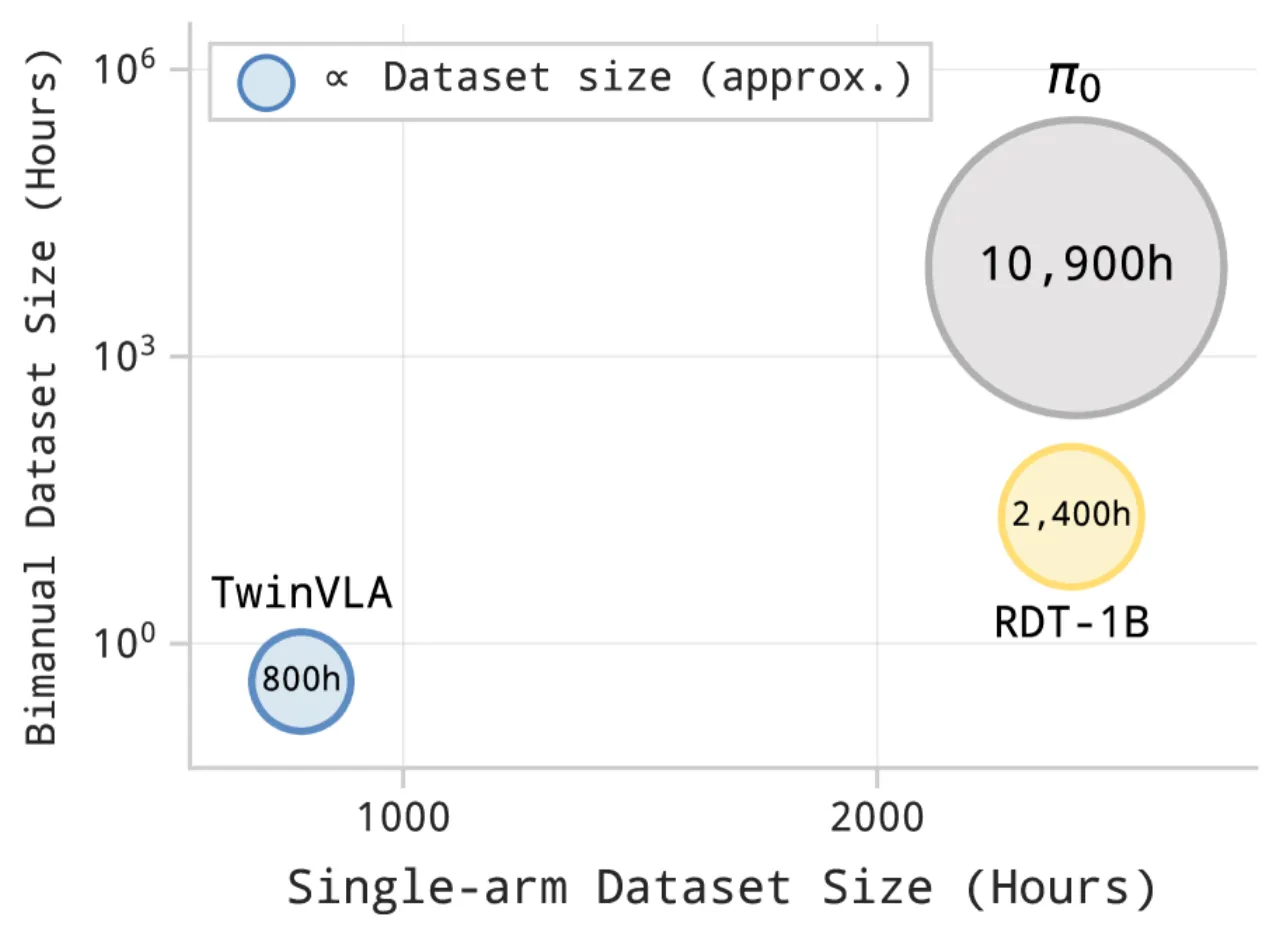
TwinVLA 提出了一种模块化框架:将两个预训练单臂 VLA 模型通过轻量级 Joint Attention 机制组合,无需大规模双臂数据预训练即可实现高质量双臂协作操作。相比 RDT-1B(需 1,440 H100 GPU-days)和 π₀(依赖 10,900+ 小时专有数据),TwinVLA 仅需 25 H100 GPU-days 和 ~800h 单臂数据 + 50 条双臂演示,实现了显著的数据与计算效率优势。TwinVLA proposes a modular framework: two pretrained single-arm VLA models are composed through a lightweight Joint Attention mechanism, achieving high-quality coordinated bimanual manipulation without large-scale bimanual pretraining. Compared with RDT-1B (which needs 1,440 H100 GPU-days) and π₀ (which relies on 10,900+ hours of proprietary data), TwinVLA needs only 25 H100 GPU-days plus ~800h of single-arm data and 50 bimanual demonstrations, yielding a marked advantage in data and compute efficiency.
双臂操作是机器人研究的重要挑战,但大规模双臂数据集极为稀缺。现有的整体式(monolithic)双臂 VLA 模型需要海量数据与算力预训练,制约了实际应用。Bimanual manipulation is a major challenge in robotics research, yet large-scale bimanual datasets are extremely scarce. Existing monolithic bimanual VLA models require pretraining on massive data and compute, which constrains practical use.
"RDT-1B required massive pretraining and fine-tuning (reportedly a month on 48 H100 GPUs)... π₀ relies on a 10,000-hour proprietary dataset."
论文的核心洞察来自神经科学:"human bimanual manipulation is the coordination of arm-specific motor primitives rather than a single monolithic controller",人类双臂由专用神经回路协调同步。TwinVLA 基于此,将两个独立的单臂 VLA 模型通过轻量 Joint Attention 连接,利用公开丰富的单臂数据完成迁移,"eliminating the need for large-scale bimanual pretraining"。The core insight of the paper comes from neuroscience: "human bimanual manipulation is the coordination of arm-specific motor primitives rather than a single monolithic controller", i.e. the two human arms are coordinated and synchronized by arm-specific neural circuits. Building on this, TwinVLA links two independent single-arm VLA models through lightweight Joint Attention and transfers from abundant public single-arm data, "eliminating the need for large-scale bimanual pretraining".
数据效率对比:TwinVLA(~800h 单臂数据 + 50 条双臂演示,25 H100 GPU-days)相比 RDT-1B(~2,400h,1,440 GPU-days)和 π₀(~10,900h,>1,000 GPU-days)具有压倒性的数据与计算效率优势。Data-efficiency comparison: TwinVLA (~800h of single-arm data + 50 bimanual demonstrations, 25 H100 GPU-days) holds an overwhelming data and compute efficiency advantage over RDT-1B (~2,400h, 1,440 GPU-days) and π₀ (~10,900h, >1,000 GPU-days).
50条双臂演示即可超越 RDT-1Bbimanual demonstrations suffice to surpass RDT-1B
1.3B参数(与 RDT-1B 1.2B 相当)parameters (on par with RDT-1B at 1.2B)
+26%真实世界相对 RDT-1B 成功率提升real-world success-rate gain over RDT-1B
02方法Method
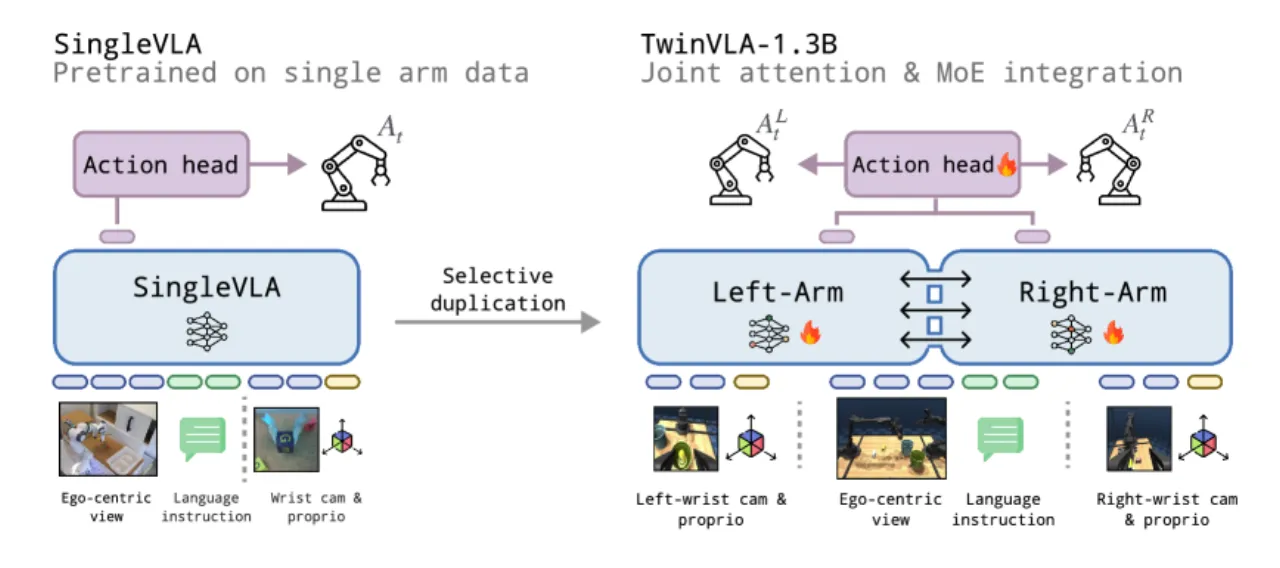
TwinVLA 复用两个预训练的 0.8B SingleVLA 的 VLM backbone,共享视觉编码器和 DiT action head,通过三个轻量组件实现跨臂协作:Joint Attention、Mixture-of-Experts(MoE)和 Attention Re-weighting。TwinVLA reuses the VLM backbones of two pretrained 0.8B SingleVLA models, shares the vision encoder and the DiT action head, and achieves cross-arm collaboration through three lightweight components: Joint Attention, Mixture-of-Experts (MoE) and Attention Re-weighting.
TwinVLA 架构总览:两个单臂 VLM backbone(左臂 / 右臂)通过 Joint Attention 连接,共享视觉编码器(Vision Encoder)和 DiT Action Head。共享的语言与图像 token 由 MoE 模块处理,降低显存开销。Overview of the TwinVLA architecture: two single-arm VLM backbones (left arm / right arm) are linked by Joint Attention and share the Vision Encoder and the DiT Action Head. Shared language and image tokens are processed by the MoE module, reducing memory overhead.
Joint Attention —— 跨臂信息交互Joint Attention — Cross-Arm Information Exchange
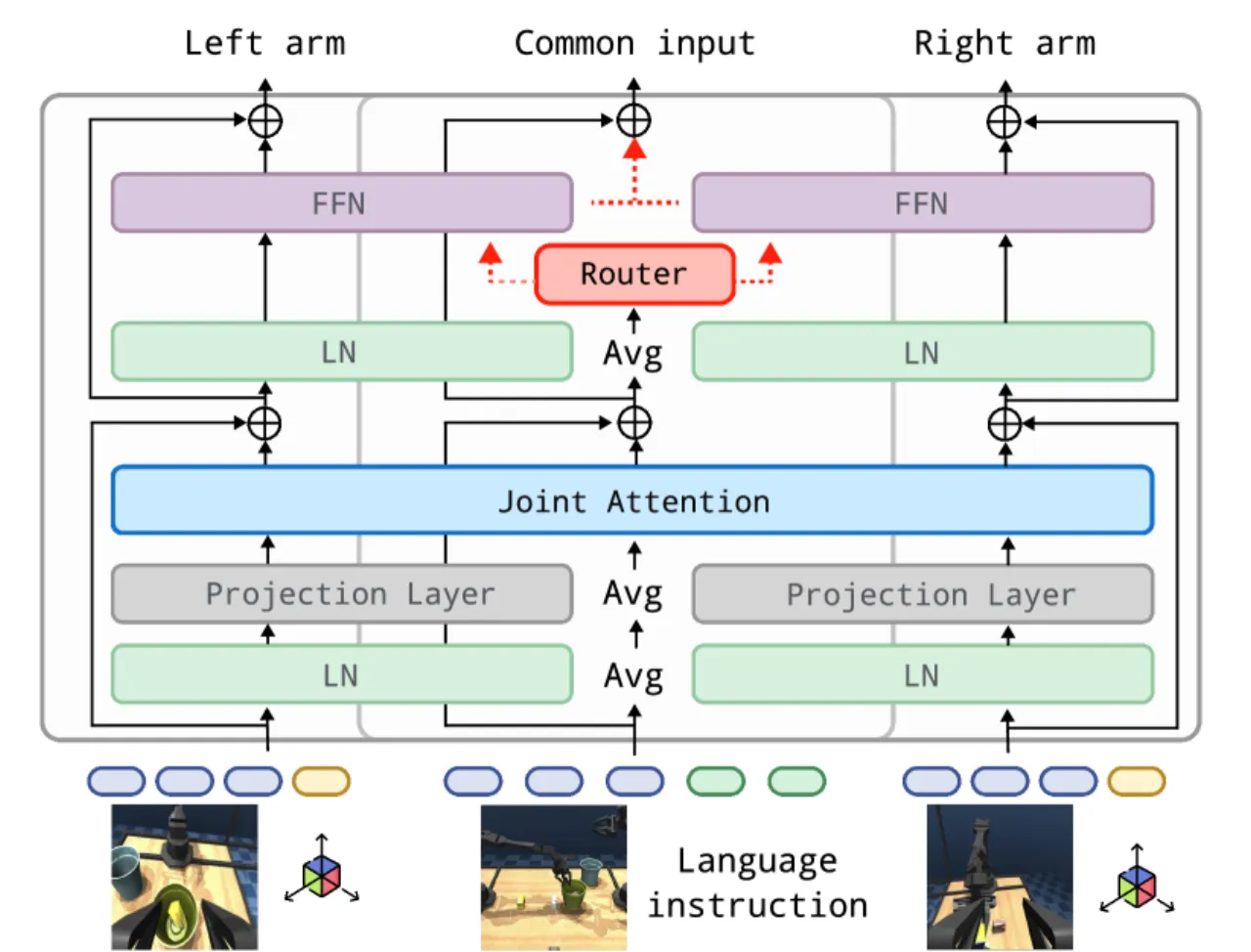
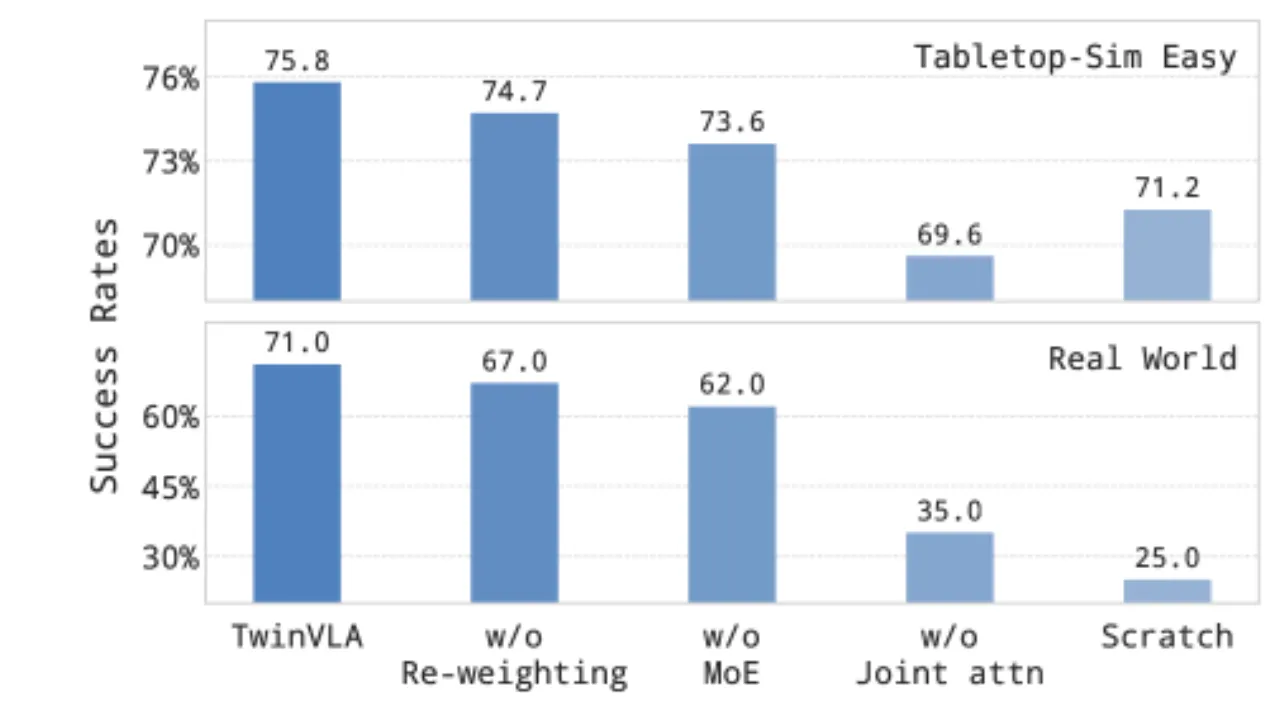
每个 Transformer 块中,将两个 backbone 的 Q、K、V 拼接后做统一 self-attention,再拆分回各自流:"Concatenate the Q, K, V from both backbones, perform self-attention, and subsequently split the outputs back to their respective streams." 这使得左右臂 token 可直接相互感知,实现双臂协调。消融实验表明,去掉 Joint Attention 后真实环境性能下降 27%。In each Transformer block, the Q, K, V of the two backbones are concatenated for a unified self-attention and then split back into their respective streams: "Concatenate the Q, K, V from both backbones, perform self-attention, and subsequently split the outputs back to their respective streams." This lets left-arm and right-arm tokens perceive each other directly and enables bimanual coordination. Ablations show that removing Joint Attention drops real-world performance by 27%.
TwinVLA Transformer block 细节:共享模态(语言、图像)经 MoE 处理;左右臂专属 token 经 Joint Attention 拼接融合,再分别回流;Attention Re-weighting 保留预训练知识。Details of a TwinVLA Transformer block: shared modalities (language, image) are processed by MoE; arm-specific tokens of the left and right arms are concatenated and fused by Joint Attention before flowing back separately; Attention Re-weighting preserves pretrained knowledge.
Mixture-of-Experts(MoE)Mixture-of-Experts (MoE)
对共享输入(语言、图像),两个 backbone 的 FFN 以可学习权重加权融合:wleft·FFNleft(x) + (1−wleft)·FFNright(x),替代重复计算,VRAM 节省 21%。For shared inputs (language, image), the FFNs of the two backbones are fused with learnable weights: wleft·FFNleft(x) + (1−wleft)·FFNright(x), replacing duplicated computation and saving 21% VRAM.
Attention Re-weighting
微调时对注意力权重引入正则项,使模型在学习双臂协调的同时保留单臂预训练知识,避免灾难性遗忘。去掉该组件导致真实环境成功率下降 4%。A regularization term on the attention weights during fine-tuning lets the model learn bimanual coordination while retaining single-arm pretrained knowledge, avoiding catastrophic forgetting. Removing this component lowers the real-world success rate by 4%.
共享的 DiT Action Head 以 conditional flow matching 为训练目标,从带噪声动作 chunk 预测参考流(reference flow)至目标动作 chunk,生成左右臂的协同动作序列。训练数据仅使用公开单臂数据集(OXE)+ 少量双臂演示。The shared DiT Action Head is trained with a conditional flow matching objective, predicting the reference flow from a noised action chunk toward the target action chunk and generating coordinated action sequences for the left and right arms. Training uses only public single-arm datasets (OXE) plus a small number of bimanual demonstrations.
03实验Experiments
在真实世界(5 任务,每任务 20 次 rollout)和两个模拟基准(RoboTwin 2.0 共 50 任务、Tabletop-Sim 共 5 任务)上与 RDT-1B、π₀、DP 对比,同时测试数据效率、鲁棒性和语言跟随能力。Comparison against RDT-1B, π₀ and DP in the real world (5 tasks, 20 rollouts per task) and on two simulation benchmarks (RoboTwin 2.0 with 50 tasks, Tabletop-Sim with 5 tasks), together with tests of data efficiency, robustness and language-following ability.
真实世界任务Real-World Tasks
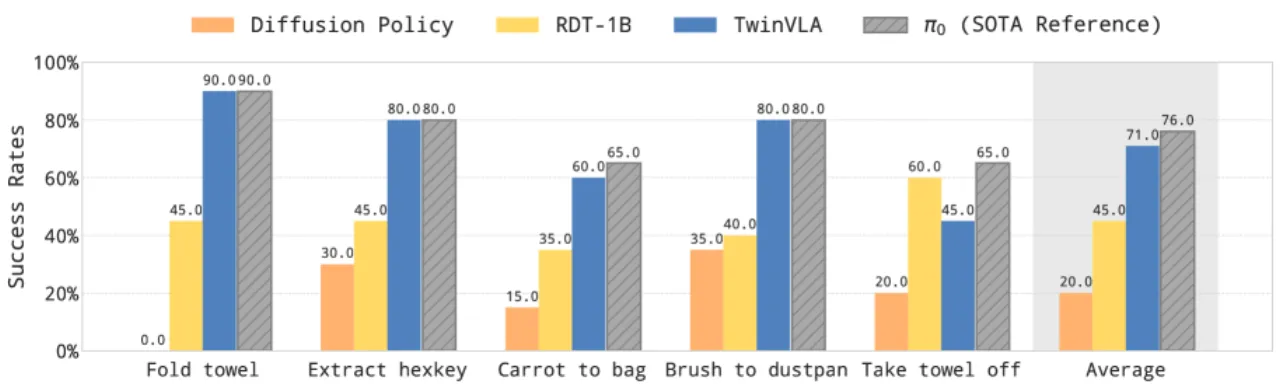
使用 Anubis 双臂机器人执行折叠毛巾(fold towel)、提取六角扳手、放胡萝卜入袋等 5 个任务,各任务 20 次 rollout。An Anubis bimanual robot performs 5 tasks such as fold towel, picking out a hex wrench and placing a carrot into a bag, with 20 rollouts per task.
真实世界各任务成功率对比(Figure 5)。TwinVLA 在大多数任务上超越 RDT-1B 和 DP,整体与 π₀ 相当,而训练仅依赖目标域数据(无专有大规模数据)。Per-task real-world success rates (Figure 5). TwinVLA surpasses RDT-1B and DP on most tasks and is overall on par with π₀, while its training relies only on target-domain data (no proprietary large-scale data).
模拟基准Simulation Benchmarks
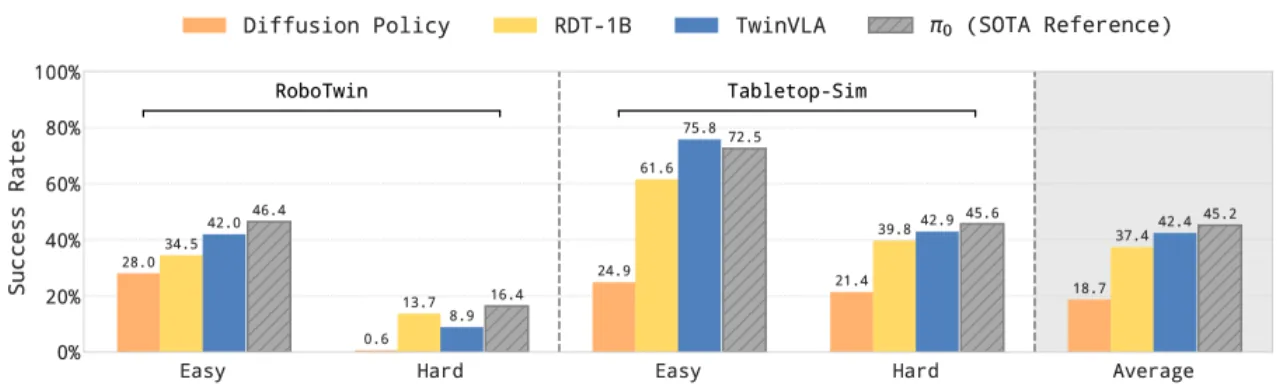
RoboTwin 2.0 与 Tabletop-Sim 平均成功率(Figure 6)。TwinVLA 在 Tabletop-Sim Hard 上比 RDT-1B 高 3.3%;在 RoboTwin Easy 上比 RDT-1B 高 7.48%;RoboTwin Hard 上比 RDT-1B 低 3.72%,但比 DP 高 9.38%。Average success rates on RoboTwin 2.0 and Tabletop-Sim (Figure 6). TwinVLA is 3.3% above RDT-1B on Tabletop-Sim Hard and 7.48% above RDT-1B on RoboTwin Easy; on RoboTwin Hard it is 3.72% below RDT-1B but 9.38% above DP.
在低光照条件下 TwinVLA(45.0%)超越 π₀(40.0%);在有干扰物情况下 π₀ 表现最佳(60.0%),TwinVLA 表现(25.0%)优于 RDT-1B(15.0%)。Under low light TwinVLA (45.0%) surpasses π₀ (40.0%); with distractors π₀ performs best (60.0%), while TwinVLA (25.0%) outperforms RDT-1B (15.0%).
消融实验Ablation Study
消融结果(Figure 8b):依次去掉 Attention Re-weighting、MoE 和 Joint Attention,性能递减;从头训练(Scratch)相比完整 TwinVLA 真实环境性能下降 46%,验证了预训练迁移的关键价值。Ablation results (Figure 8b): removing Attention Re-weighting, MoE and Joint Attention in turn degrades performance progressively; training from scratch (Scratch) drops real-world performance by 46% relative to the full TwinVLA, confirming the critical value of pretraining transfer.
Joint Attention 对真实环境影响最大(−27%),说明跨臂信息交互是双臂协调的核心;从头训练剧烈下降(−46%)印证了预训练知识迁移的不可或缺性。Joint Attention has the largest real-world impact (−27%), showing that cross-arm information exchange is the core of bimanual coordination; the steep drop of training from scratch (−46%) confirms that transferring pretrained knowledge is indispensable.
04局限性Limitations
说明:以下局限性来自论文明确陈述,并结合设计特点补充标注。Note: The limitations below are taken from statements made explicitly in the paper, supplemented with annotations based on its design characteristics.
视觉分布偏移(stated)Visual distribution shift (stated)
论文明确指出:"Generalization remains limited due to the visual disparity of two arms, which differs from the single-arm pretraining distribution." 双臂摄像头视角与单臂预训练数据存在视觉域差异,限制了模型在新场景中的泛化能力。The paper states explicitly: "Generalization remains limited due to the visual disparity of two arms, which differs from the single-arm pretraining distribution." The bimanual camera viewpoints differ visually from the single-arm pretraining data, which limits generalization to new scenes.
依赖绝对末端执行器位姿(stated)Reliance on absolute end-effector poses (stated)
论文指出未来工作应"explore action representations beyond absolute end-effector poses",当前动作表示为绝对末端位姿,在不同机器人或任务空间下适应性有限。The paper notes that future work should "explore action representations beyond absolute end-effector poses"; the current action representation is the absolute end-effector pose, whose adaptability across different robots or task spaces is limited.
有干扰物时性能劣于 π₀(inferred)Worse than π₀ under distractors (inferred)
在有干扰物的鲁棒性测试中,TwinVLA(25.0%)明显低于 π₀(60.0%),说明视觉分心鲁棒性仍有提升空间,可能与双臂视野的数据稀缺性有关。In the distractor robustness test, TwinVLA (25.0%) falls clearly below π₀ (60.0%), indicating room for improvement in robustness to visual distraction, possibly related to the scarcity of data covering bimanual viewpoints.
双臂数据仍不可或缺(inferred)Bimanual data remain indispensable (inferred)
虽然 TwinVLA 大幅降低了双臂数据需求(仅需 50 条演示),但仍需目标双臂数据进行 fine-tuning,完全 zero-shot 双臂迁移尚未实现。Although TwinVLA greatly reduces the bimanual data requirement (only 50 demonstrations), fine-tuning on target bimanual data is still needed, and fully zero-shot bimanual transfer has not been achieved.