← 论文海报合集← Paper Notes|
NeurIPS 2025 · 机器人 · RoboticsNeurIPS 2025 · Robotics

ThinkAct

Vision-Language-Action Reasoning via Reinforced Visual Latent Planning
Chi-Pin Huang · Yueh-Hua Wu · Min-Hung Chen · Yu-Chiang Frank Wang · Fu-En Yang

ThinkAct 提出一个双系统框架,将多模态大语言模型(MLLM)的高层推理与下游动作模型的低层执行联结起来:MLLM 通过强化学习生成动作对齐的视觉推理计划,计划被压缩为视觉潜变量(visual plan latent)后条件化动作模型,从而在复杂具身 AI 任务中实现少样本自适应、长时域规划与自我纠错。ThinkAct proposes a dual-system framework that bridges the high-level reasoning of a multimodal large language model (MLLM) with the low-level execution of a downstream action model: the MLLM generates action-aligned visual reasoning plans through reinforcement learning, and these plans are compressed into a visual plan latent that conditions the action model, thereby enabling few-shot adaptation, long-horizon planning and self-correction on complex embodied AI tasks.

NeurIPS 2025Qwen2.5-VL 7B · DiT-based Action (432M)SimplerEnv · LIBERO · EgoPlan-Bench2 📄 arXiv:2507.16815 PDF
VLA vision-language-action embodied reasoning reinforcement learning visual plan latent dual-system framework 机器人操作robot manipulation long-horizon planning few-shot adaptation self-correction

01 动机Motivation

现有 VLA 模型通常以端到端方式将多模态输入直接映射到低层动作,缺乏显式推理过程,导致在多步规划和复杂任务变体上表现不足。尽管思维链(Chain-of-Thought, CoT)方法有所改进,但依赖昂贵的人工标注;基于问答(QA)风格的强化学习奖励则难以支撑具身规划的视觉基础。Existing VLA models typically map multimodal inputs directly to low-level actions in an end-to-end fashion, without an explicit reasoning process, which leaves them underperforming on multi-step planning and complex task variations. Chain-of-Thought (CoT) methods bring improvements but rely on expensive human annotation, while QA-style reinforcement learning rewards struggle to supply the visual grounding that embodied planning requires.

"Existing approaches typically train VLA models in an end-to-end fashion, directly mapping inputs to actions without explicit reasoning, which hinders their ability to plan over multiple steps or adapt to complex task variations."
ThinkAct teaser
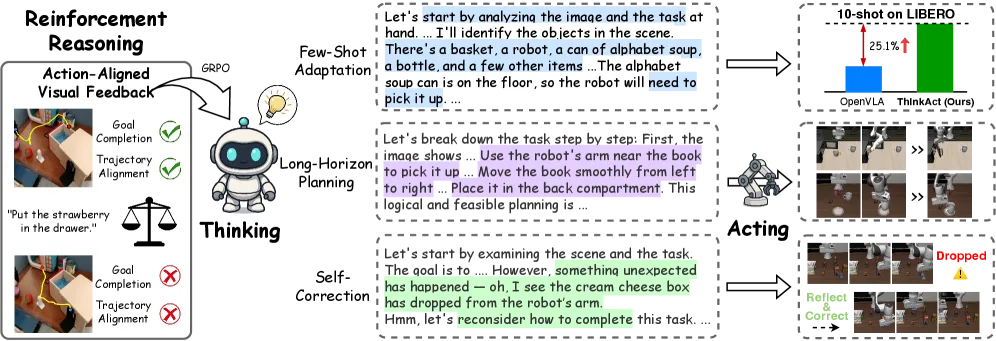
图 1:ThinkAct 的"先思考,后行动"双系统框架概览。通过动作对齐的视觉反馈进行强化,使模型具备少样本自适应、长时域规划与自我纠错三大关键能力。Figure 1: Overview of the “think before acting” dual-system framework of ThinkAct. Reinforcement with action-aligned visual feedback endows the model with three key capabilities: few-shot adaptation, long-horizon planning and self-correction.
71.5%SimplerEnv Google-VM 成功率
(DiT-Policy:56.0%)
SimplerEnv Google-VM success rate
(DiT-Policy: 56.0%)
84.4%LIBERO 综合成功率
(DiT-Policy:76.8%)
LIBERO overall success rate
(DiT-Policy: 76.8%)
48.2%EgoPlan-Bench2 准确率
(Qwen2.5-VL*:45.7%)
EgoPlan-Bench2 accuracy
(Qwen2.5-VL*: 45.7%)
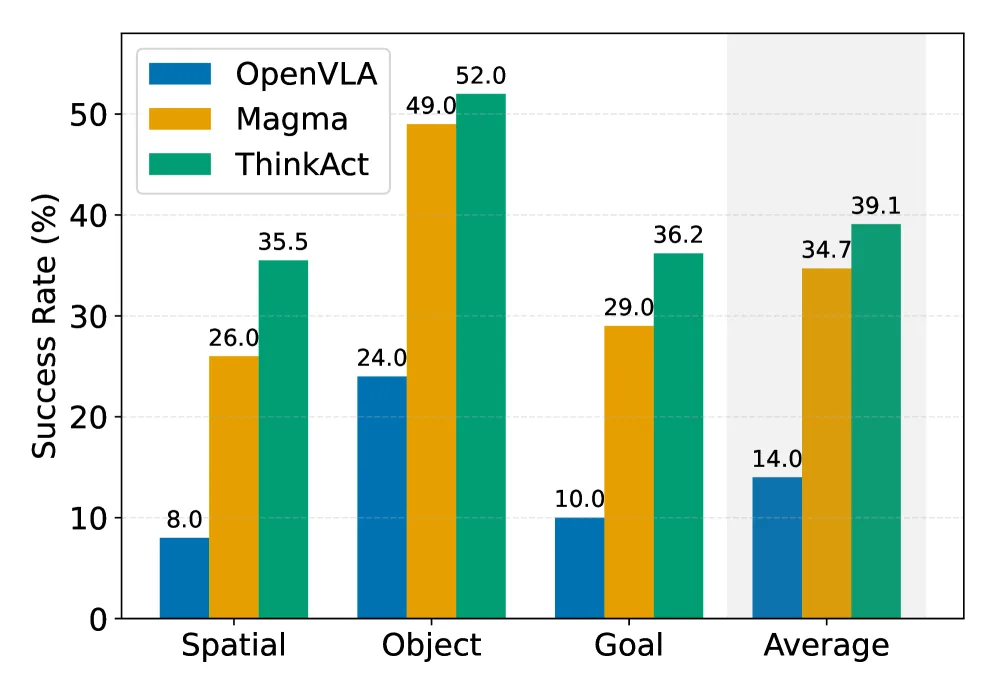
+9.5%LIBERO-Spatial 10-shot
超越 Magma 的提升幅度
LIBERO-Spatial 10-shot
gain over Magma
02 方法Method

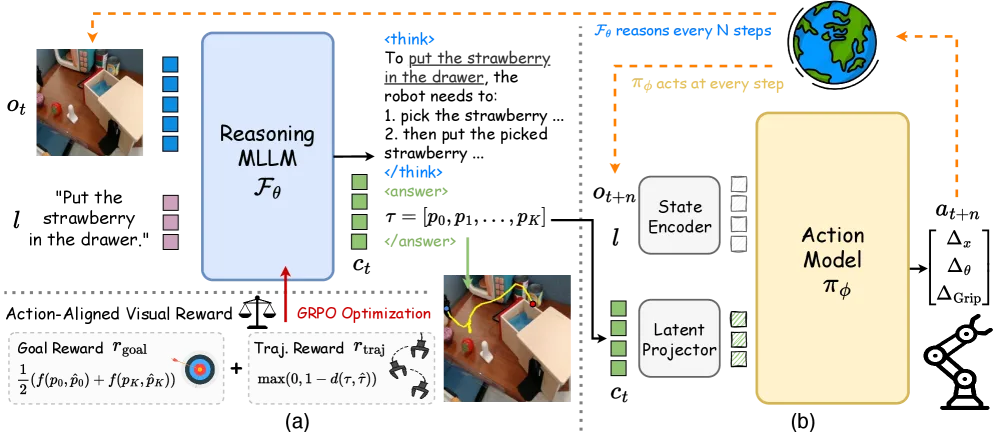
ThinkAct 包含两个协同工作的子系统:推理 MLLM(Qwen2.5-VL 7B)负责在视觉观测与语言指令输入下生成具身推理计划,并通过动作对齐的视觉奖励进行强化训练;DiT-based Action Model(432M 参数)以视觉计划潜变量为条件,在目标环境中预测可执行动作序列。ThinkAct consists of two cooperating subsystems: the reasoning MLLM (Qwen2.5-VL 7B) generates embodied reasoning plans from visual observations and language instructions and is reinforced with action-aligned visual rewards; the DiT-based Action Model (432M parameters) is conditioned on the visual plan latent and predicts executable action sequences in the target environment.

ThinkAct architecture
图 2:ThinkAct 架构总览。(a) 推理 MLLM 接收观测与指令,预测轨迹计划,通过基于目标完成度和轨迹一致性的视觉奖励进行 GRPO 强化训练;(b) DiT-based 动作模型以视觉计划潜变量为条件,输出可执行的低层动作序列。Figure 2: Overview of the ThinkAct architecture. (a) The reasoning MLLM takes observations and instructions, predicts a trajectory plan and is reinforced with GRPO using visual rewards based on goal completion and trajectory consistency; (b) the DiT-based action model is conditioned on the visual plan latent and outputs executable low-level action sequences.

动作对齐的视觉奖励(Action-Aligned Visual Rewards)Action-Aligned Visual Rewards

ThinkAct 设计了两类视觉奖励取代传统 QA-style 奖励:ThinkAct designs two kinds of visual rewards to replace conventional QA-style rewards:

综合奖励公式为:r = 0.9·rvisual + 0.1·rformat,其中 rvisual = 0.5·rgoal + 0.5·rtrajThe overall reward is given by r = 0.9·rvisual + 0.1·rformat, where rvisual = 0.5·rgoal + 0.5·rtraj.

训练策略(Training Strategy)Training Strategy

训练分两阶段进行:Training proceeds in two stages:

03 实验Experiments

实验涵盖机器人操作基准(SimplerEnv、LIBERO)和具身推理基准(EgoPlan-Bench2、RoboVQA、OpenEQA),与 DiT-Policy、CoT-VLA、Magma 等基线对比,并考察少样本自适应(10-shot)和自我纠错能力。The experiments cover robot manipulation benchmarks (SimplerEnv, LIBERO) and embodied reasoning benchmarks (EgoPlan-Bench2, RoboVQA, OpenEQA), compare against baselines such as DiT-Policy, CoT-VLA and Magma, and examine few-shot adaptation (10-shot) and self-correction ability.

机器人操作(SimplerEnv)Robot Manipulation (SimplerEnv)

场景SceneDiT-PolicyCoT-VLAThinkAct(本文)ThinkAct (ours)
Google-VM56.0%71.5%
Google-VA48.2%65.1%
Bridge-VM32.4%43.8%

LIBERO 综合成功率LIBERO Overall Success Rate

子集SubsetDiT-PolicyCoT-VLAThinkAct(本文)ThinkAct (ours)
Spatial88.3%
Object91.4%
Goal87.1%
Long70.9%
Overall76.8%83.9%84.4%

具身推理基准Embodied Reasoning Benchmarks

基准BenchmarkQwen2.5-VL*(基线)Qwen2.5-VL* (baseline)ThinkAct(本文)ThinkAct (ours)
EgoPlan-Bench2(Acc.)EgoPlan-Bench2 (Acc.)45.7%48.2%
RoboVQA(BLEU-4)RoboVQA (BLEU-4)55.759.8
OpenEQA(Overall%)OpenEQA (Overall%)52.0%56.2%
qualitative results
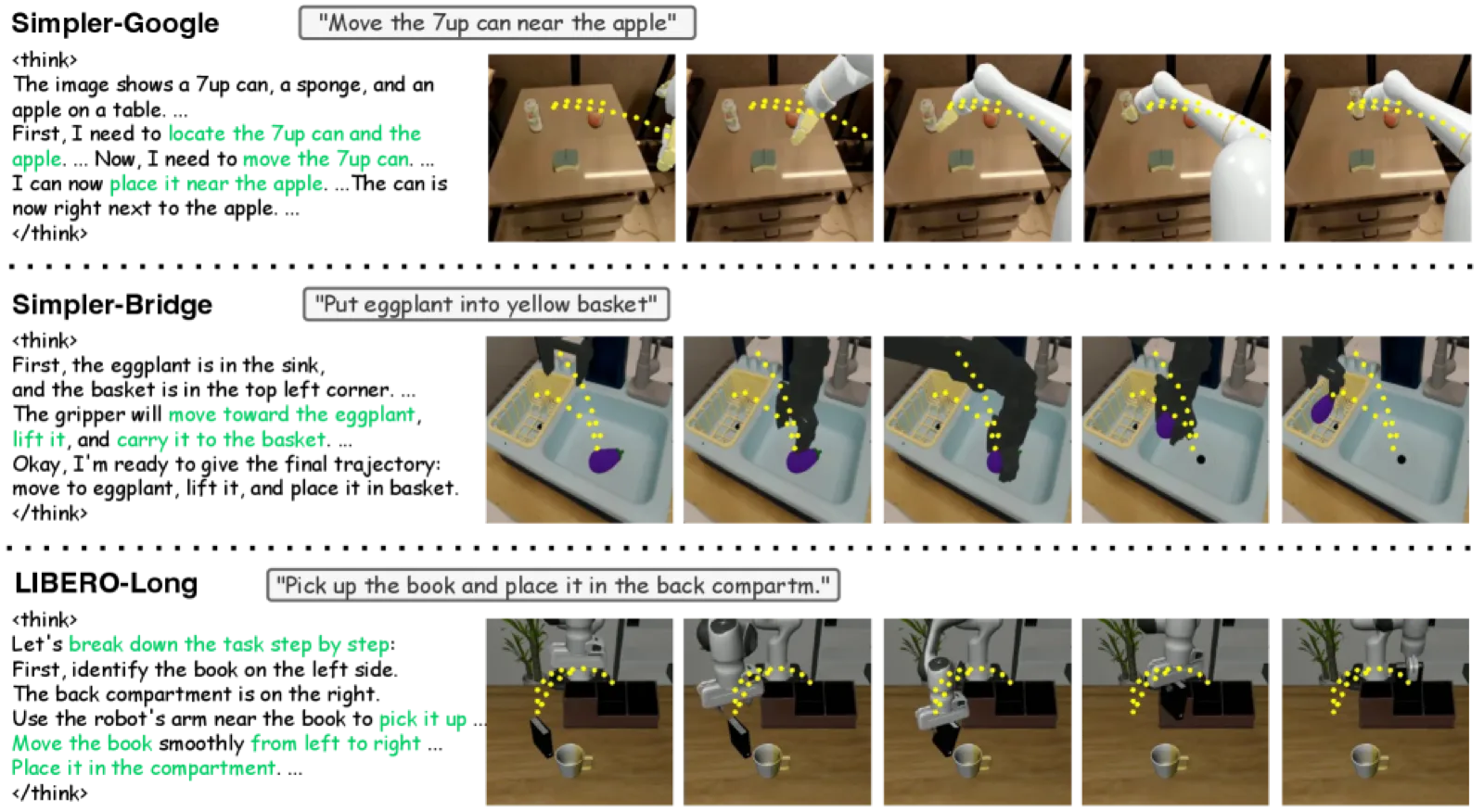
图 3:在 SimplerEnv 和 LIBERO 上的定性操作示例,展示中间推理分解(intermediate reasoning decomposition)和任务执行过程中的轨迹可视化。Figure 3: Qualitative manipulation examples on SimplerEnv and LIBERO, showing the intermediate reasoning decomposition and the trajectory visualization during task execution.

少样本自适应(10-shot)Few-Shot Adaptation (10-shot)

few-shot adaptation results
图 4:在 LIBERO 任务上使用每任务 10 个演示的少样本自适应性能。ThinkAct 在 LIBERO-Spatial 上比 Magma 高 +9.5%,在 LIBERO-Goal 上高 +7.3%。Figure 4: Few-shot adaptation performance on LIBERO tasks with 10 demonstrations per task. ThinkAct exceeds Magma by +9.5% on LIBERO-Spatial and by +7.3% on LIBERO-Goal.

消融实验(Ablations,SimplerEnv)Ablations (SimplerEnv)

配置Configuration综合得分Overall score
ThinkAct(Full)ThinkAct (Full)60.1
w/o rtraj59.2
w/o rgoal59.1
w/o both rewards56.9
SFT baseline56.4

消融结果表明,目标奖励和轨迹奖励均对最终性能有正向贡献;移除任一奖励均导致性能下降,完全去除视觉奖励后性能下降最为明显(60.1 → 56.9)。The ablations show that both the goal reward and the trajectory reward contribute positively to the final performance; removing either one degrades results, and removing the visual rewards altogether causes the largest drop (60.1 → 56.9).

04 局限性Limitations

Note: 以下局限性中,第一条为论文作者明确陈述(stated),第二和第三条为基于设计的推断(inferred from the design)。Among the limitations below, the first is explicitly stated by the authors, while the second and third are inferred from the design.
MLLM 幻觉(Hallucination)问题(stated)MLLM Hallucination (stated)

论文明确指出,该框架"inherits limitations from pretrained MLLMs, particularly hallucinations in visual or spatial reasoning",即预训练 MLLM 在视觉或空间推理中存在幻觉,可能生成引用"incorrect object attributes or spatial relationships"的计划,从而影响下游动作执行质量。The paper explicitly notes that the framework “inherits limitations from pretrained MLLMs, particularly hallucinations in visual or spatial reasoning”: a pretrained MLLM may hallucinate in visual or spatial reasoning and generate plans that refer to “incorrect object attributes or spatial relationships”, which degrades the quality of downstream action execution.

对演示数据的依赖(inferred)Dependence on Demonstration Data (inferred)

虽然 ThinkAct 展示了 10-shot 适应能力,但动作模型的训练仍依赖 OXE 等大规模机器人数据集进行预训练,在全新形态或环境中的零样本泛化能力尚不明确。Although ThinkAct demonstrates 10-shot adaptation, training the action model still relies on pretraining with large-scale robot datasets such as OXE, and its zero-shot generalization to entirely new embodiments or environments remains unclear.

计算开销较大(inferred)Substantial Computational Overhead (inferred)

推理阶段需要先运行 Qwen2.5-VL 7B 生成视觉推理计划,再驱动 432M 参数的 DiT-based 动作模型,双系统的串联推理对实时控制场景的延迟要求构成挑战;GRPO fine-tuning(batch 64,rollout 5)的训练成本也不可忽视。At inference time the system must first run Qwen2.5-VL 7B to produce the visual reasoning plan and then drive the 432M-parameter DiT-based action model; this serial two-system inference challenges the latency requirements of real-time control, and the training cost of GRPO fine-tuning (batch 64, rollout 5) is far from negligible.