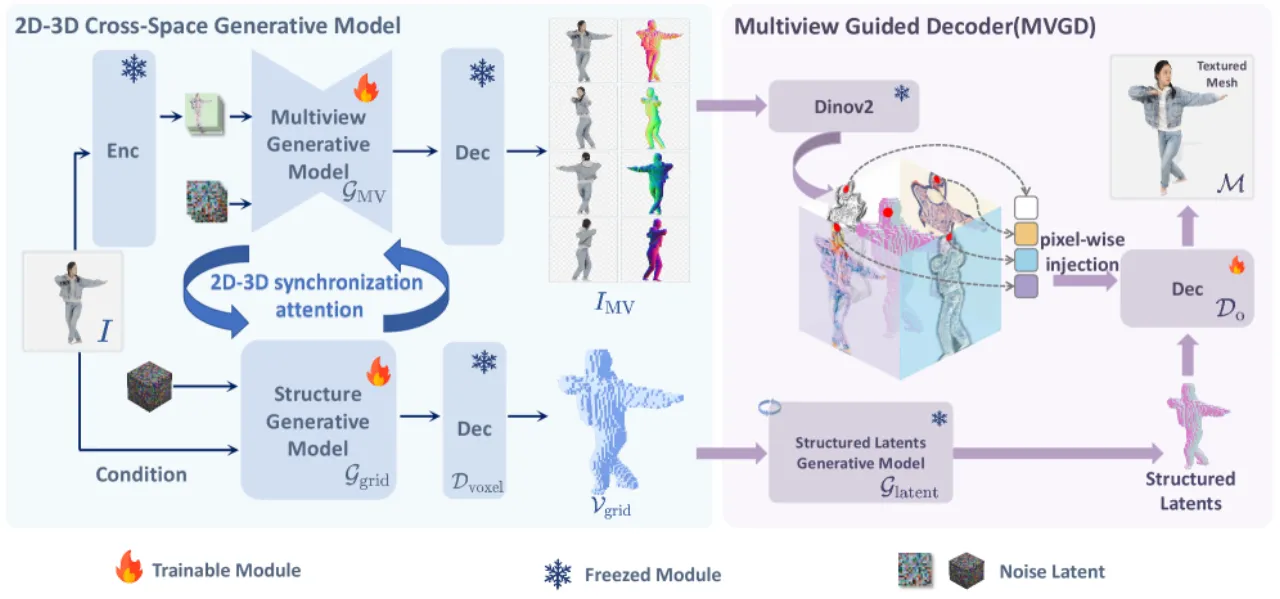
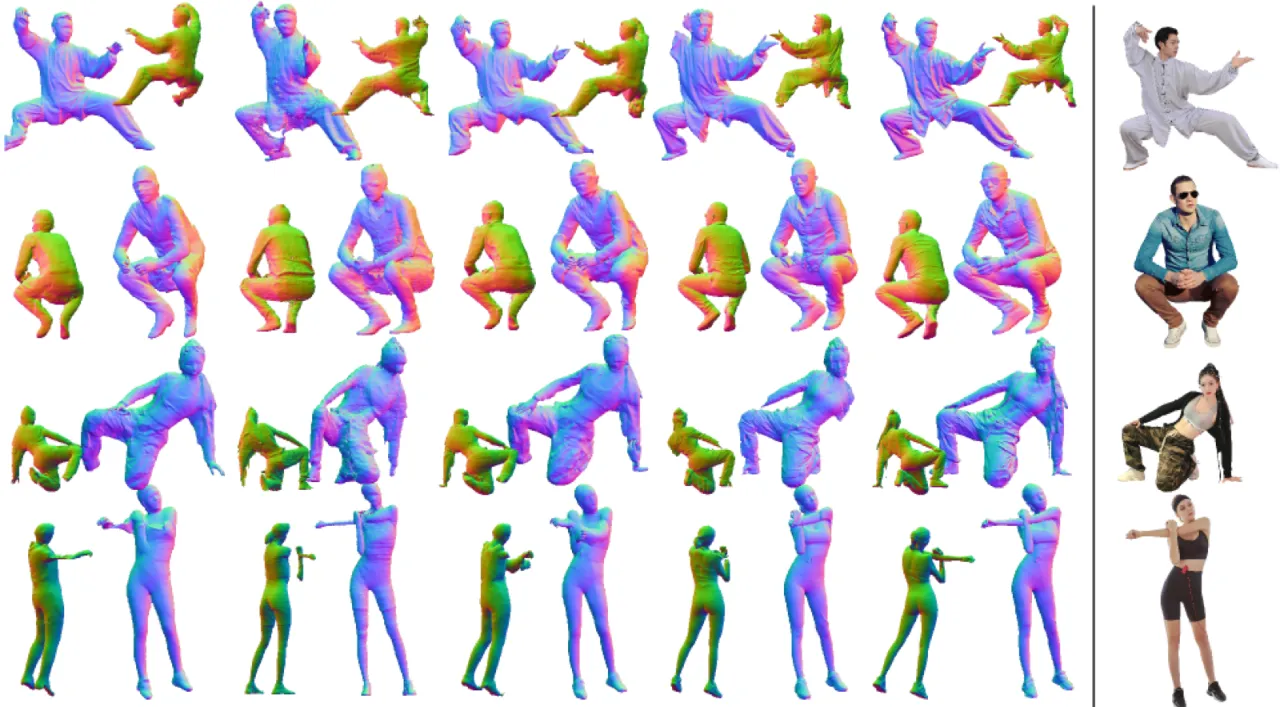
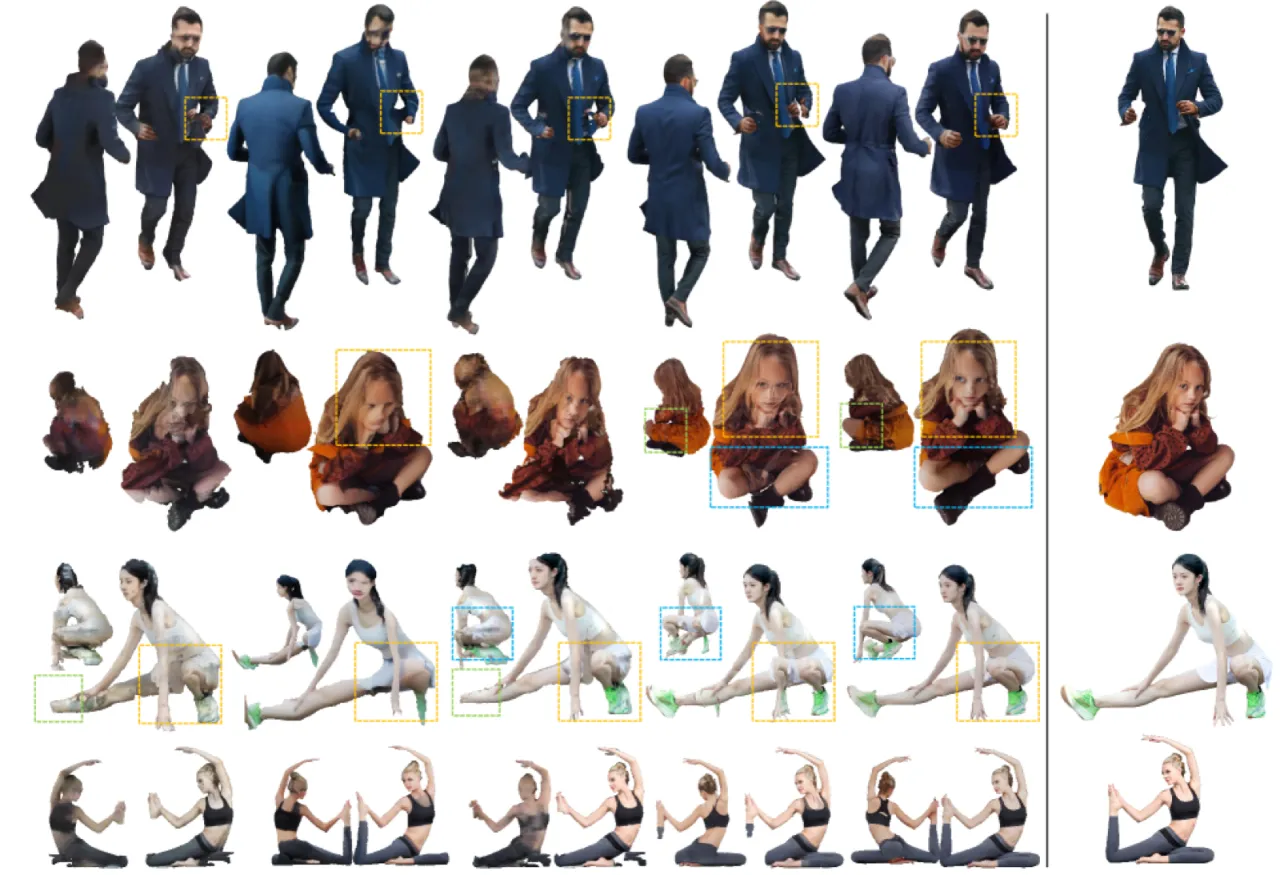
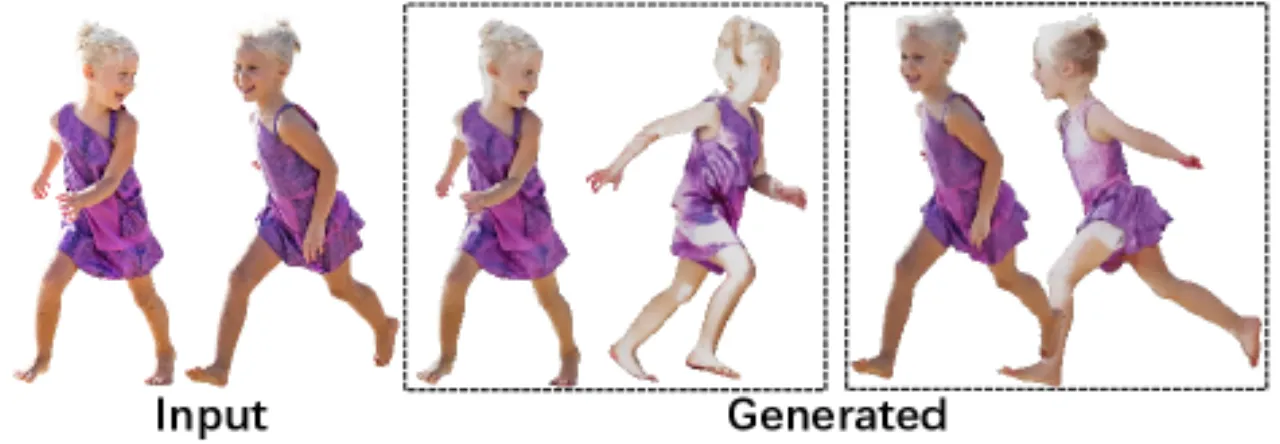
SyncHuman 将多视图 2D 生成模型与 3D 原生生成模型联合训练,通过像素对齐的双向同步注意力机制,使二者在扩散过程中互相校正,从单张图像重建出几何精确、纹理丰富的着装人体三维模型。SyncHuman jointly trains a multi-view 2D generative model together with a 3D native generative model. Through a pixel-aligned bidirectional synchronization attention mechanism, the two branches correct each other during diffusion, reconstructing geometrically accurate and richly textured 3D clothed human models from a single image.
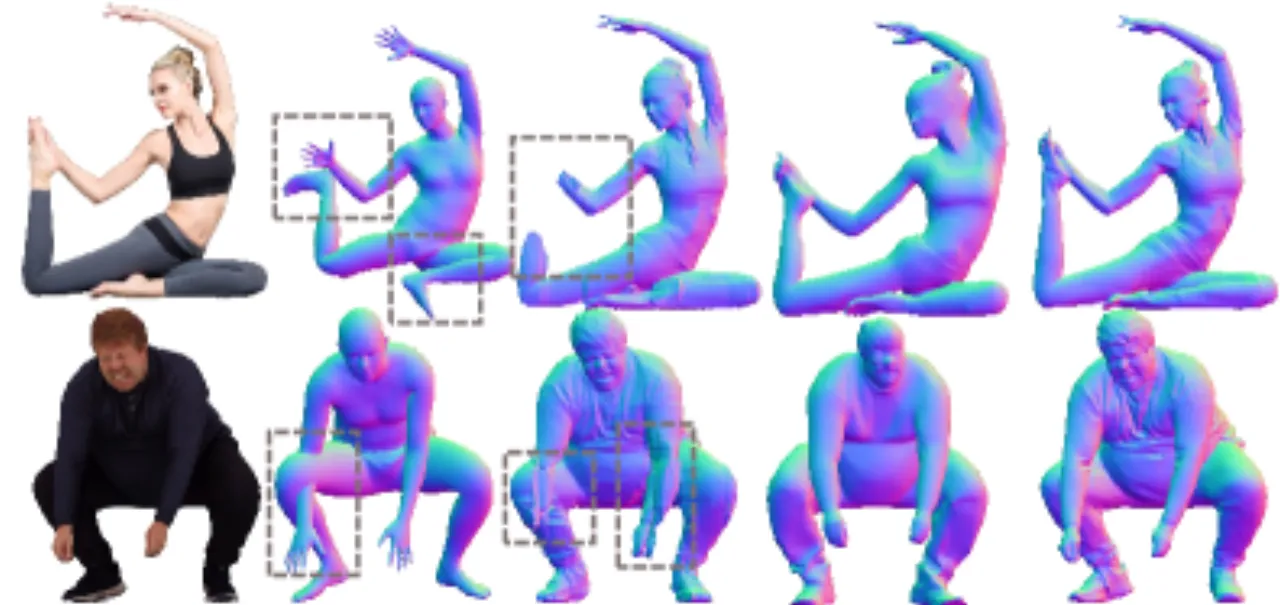
从单张图像重建穿衣人体的三维模型,是计算机视觉中的核心难题。现有方法面临两难困境:多视图 2D 生成模型(如 PSHuman)能捕捉精细纹理细节,但生成的多视图图像与三维结构缺乏一致性;而 3D 原生生成模型(如 Trellis)能生成连贯的几何形状,却缺乏精细细节,且严重依赖不准确的 SMPL 姿态估计。Reconstructing a 3D model of a clothed human from a single image is a core challenge in computer vision. Existing methods face a dilemma: multi-view 2D generative models (such as PSHuman) capture fine texture details, but the generated multi-view images lack consistency with the 3D structure; whereas 3D native generative models (such as Trellis) produce coherent geometry yet lack fine details and depend heavily on inaccurate SMPL pose estimation.
"我们提出了一种新型框架,联合利用多视图和 3D 原生生成模型的优势,同时克服各自的局限性。""We propose a novel framework that jointly exploits the strengths of multi-view and 3D native generative models while overcoming the limitations of each."
SyncHuman 由两个核心模块构成:2D-3D 跨空间生成模型(通过双向同步注意力联合微调多视图与 3D 生成器)和多视图引导解码器(MVGD)(将 DINOv2 特征从生成的多视图图像注入 3D 解码过程),二者共同实现从单张图像到高保真三维人体的重建。SyncHuman consists of two core modules: a 2D-3D cross-space generative model (which jointly fine-tunes the multi-view and 3D generators through bidirectional synchronization attention) and a multi-view guided decoder (MVGD) (which injects DINOv2 features from the generated multi-view images into the 3D decoding process); together they reconstruct a high-fidelity 3D human from a single image.
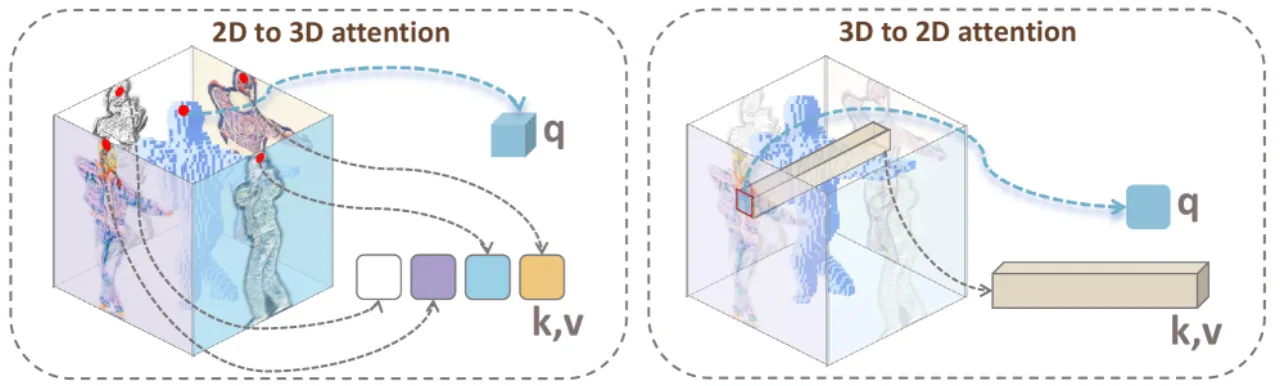
在扩散去噪过程中,本文设计了双向的像素对齐同步注意力,使 2D 多视图分支与 3D 体素分支在每个时间步互相感知:During diffusion denoising, the paper designs a bidirectional pixel-aligned synchronization attention that lets the 2D multi-view branch and the 3D voxel branch perceive each other at every timestep:
训练采用结合 2D 和 3D 分支的 Flow Matching 损失。整体框架无需 SMPL 作为条件,仅以输入图像的 DINOv2 特征为条件进行生成。Training uses a Flow Matching loss that combines the 2D and 3D branches. The overall framework needs no SMPL condition and generates conditioned only on the DINOv2 features of the input image.
在生成阶段结束后,MVGD 从生成的多视图彩色图和法线图中提取 DINOv2 特征,通过拼接(concatenation)和 MLP 层注入 FlexiCubes 解码器,将精细的视觉细节从 2D 图像域提升到三维几何域,显著提升表面法线一致性和纹理保真度。After the generation stage, MVGD extracts DINOv2 features from the generated multi-view color and normal maps and injects them into the FlexiCubes decoder through concatenation and MLP layers, lifting fine visual details from the 2D image domain into the 3D geometry domain and markedly improving surface normal consistency and texture fidelity.
在 CAPE-NFP、CAPE-FP 和 X-Humans 三个测试集上(共 250 个扫描样本)评估几何精度(Chamfer Distance、P2S、Normal Consistency)和渲染质量(PSNR、SSIM、LPIPS)指标,与 ICON、ECON、GTA、SIFU、SiTH、Human3Diff、PSHuman、Trellis 等基线比较。Geometric accuracy (Chamfer Distance, P2S, Normal Consistency) and rendering quality (PSNR, SSIM, LPIPS) are evaluated on the three test sets CAPE-NFP, CAPE-FP and X-Humans (250 scan samples in total), and compared with baselines such as ICON, ECON, GTA, SIFU, SiTH, Human3Diff, PSHuman and Trellis.
| 方法Method | Cham. Dist ↓ | P2S ↓ | NC ↑ | PSNR ↑ | SSIM ↑ | LPIPS ↓ |
|---|---|---|---|---|---|---|
| ICON | 1.4971 | 1.3920 | 0.8133 | — | — | — |
| ECON | 1.6425 | 1.4398 | 0.8054 | — | — | — |
| GTA | 1.5050 | 1.4662 | 0.8044 | 20.0084 | 0.8502 | 0.1129 |
| SIFU | 1.5391 | 1.4331 | 0.8093 | 20.6747 | 0.8455 | 0.1104 |
| SiTH | 1.5104 | 1.4345 | 0.7972 | 19.8245 | 0.8204 | 0.1182 |
| Human3Diff | 1.5034 | 1.4219 | 0.7468 | 19.7181 | 0.8065 | 0.1334 |
| PSHuman | 1.4377 | 1.1385 | 0.8393 | 20.8405 | 0.8523 | 0.0980 |
| Trellis | 2.0043 | 1.5053 | 0.7718 | 17.0786 | 0.7238 | 0.1529 |
| SyncHuman(Ours)SyncHuman (Ours) | 0.8353 | 0.7593 | 0.8872 | 21.8385 | 0.8741 | 0.0786 |
Table 2 验证了 2D-3D 跨空间同步模型的有效性:单独使用 Trellis(PSNR 17.079)或 PSHuman(PSNR 20.840),加入双向同步注意力后提升至 PSNR 21.838,Chamfer Distance 从 1.438 降至 0.835。Table 3 验证 MVGD 的贡献:相比原始解码器(微调后 PSNR 21.362),MVGD 将 PSNR 进一步提升至 21.838,并将 Chamfer Distance 从 0.887 降至 0.835。Table 2 verifies the effectiveness of the 2D-3D cross-space synchronization model: starting from Trellis alone (PSNR 17.079) or PSHuman alone (PSNR 20.840), adding bidirectional synchronization attention raises PSNR to 21.838 and lowers Chamfer Distance from 1.438 to 0.835. Table 3 verifies the contribution of MVGD: compared with the original decoder (PSNR 21.362 after fine-tuning), MVGD further raises PSNR to 21.838 and lowers Chamfer Distance from 0.887 to 0.835.
| 消融配置Ablation Setting | PSNR ↑ | SSIM ↑ | LPIPS ↓ | Cham. ↓ | P2S ↓ |
|---|---|---|---|---|---|
| Trellis(原始)Trellis (original) | 17.079 | 0.724 | 0.153 | 2.004 | 1.505 |
| Trellis(微调)Trellis (fine-tuned) | 20.344 | 0.844 | 0.101 | 1.135 | 1.041 |
| PSHuman | 20.840 | 0.852 | 0.098 | 1.438 | 1.138 |
| 原始解码器(微调)Original decoder (fine-tuned) | 21.362 | 0.866 | 0.090 | 0.887 | 0.810 |
| 完整 SyncHumanFull SyncHuman | 21.838 | 0.874 | 0.079 | 0.835 | 0.759 |
论文明确指出:"由于训练数据集使用均匀光照渲染,重建纹理在极端光照条件下可能出现伪影。"该问题源于训练集(THuman2.1 等)的渲染设置,导致模型对非均匀光照场景泛化能力有限。The paper states explicitly: "Since the training dataset is rendered with uniform lighting, the reconstructed texture may show artifacts under extreme lighting conditions." The problem originates in the rendering setup of the training sets (THuman2.1 and others), which limits the model's generalization to non-uniformly lit scenes.
论文明确指出:"多视图生成模型仅从约 5,000 个人体扫描中微调自 SD 2.1,因此生成质量仍受到限制。"与通用扩散模型的数十亿图像训练相比,人体领域特定数据的稀缺制约了模型的泛化上限。The paper states explicitly: "The multi-view generative model is fine-tuned from SD 2.1 on only about 5,000 human scans, so the generation quality is still limited." Compared with the billions of images used to train general diffusion models, the scarcity of human-domain-specific data constrains the model's generalization ceiling.
方法使用 FlexiCubes 进行网格提取,该方法不强制水密(watertight)约束,可能导致生成网格出现表面孔洞,影响下游应用(如物理模拟、3D 打印)的适用性。The method uses FlexiCubes for mesh extraction, which does not enforce a watertight constraint, so the generated mesh may contain surface holes, affecting its suitability for downstream applications such as physical simulation and 3D printing.
由于需要同时运行 2D 多视图分支和 3D 体素分支,并加入双向注意力交互,SyncHuman 的推理时间(38.57 秒/张)约为 Trellis(15.68 秒/张)的 2.5 倍,在实时或高吞吐量场景下存在明显瓶颈。Because the 2D multi-view branch and the 3D voxel branch must run at the same time with bidirectional attention interaction, the inference time of SyncHuman (38.57 s per image) is about 2.5 times that of Trellis (15.68 s per image), a clear bottleneck in real-time or high-throughput settings.