SymSkill:符号与技能协同发明,用于数据高效的反应式长视野操作SymSkill: Symbol and Skill Co-Invention for Data-Efficient and Reactive Long-Horizon Manipulation
Symbol and Skill Co-Invention for Data-Efficient and Reactive Long-Horizon Manipulation
Yifei Simon Shao, Yuchen Zheng, Sunan Sun, Pratik Chaudhari, Vijay Kumar, Nadia Figueroa · GRASP Laboratory, University of Pennsylvania
SymSkill 从无标签、未分段的演示数据中联合学习符号谓词、算子和运动技能,将模仿学习的反应性与任务与运动规划(TAMP)的组合性有机结合,仅需 1–10 条演示即可完成多步骤操作任务,并支持实时故障恢复。SymSkill jointly learns symbolic predicates, operators and motion skills from unlabeled, unsegmented demonstration data, uniting the reactivity of imitation learning with the compositionality of task and motion planning (TAMP). It completes multi-step manipulation tasks from only 1–10 demonstrations and supports real-time failure recovery.
当前机器人操作领域的两大主流范式——模仿学习与任务规划——分别存在根本性缺陷:前者缺乏可组合性,后者规划延迟高达数十秒,无法在动态环境中实时恢复故障。SymSkill 旨在融合两者的优势。The two dominant paradigms in robot manipulation — imitation learning and task planning — each suffer from a fundamental defect: the former lacks compositionality, while the latter incurs planning latency of tens of seconds and cannot recover from failures in real time in dynamic environments. SymSkill aims to fuse the strengths of both.
"Recent imitation learning approaches excel at reproducing skills from large datasets but tend to learn monolithic policies rather than reusable skills and predicates that compose into multi-step plans."
模仿学习的问题Problems with imitation learning
学习的是单块式策略(monolithic policy),难以跨任务复用It learns a monolithic policy, which is hard to reuse across tasks
缺乏符号结构,无法通过规划组合成多步骤计划It lacks symbolic structure and cannot be composed into multi-step plans by a planner
依赖大量标注演示(如 NSIL 需要 200 条)It relies on large numbers of annotated demonstrations (NSIL, for instance, needs 200)
任务与运动规划(TAMP)的问题Problems with task and motion planning (TAMP)
规划延迟极高(>50 秒),无法实时应对动态变化Planning latency is extremely high (>50 s), so it cannot react to dynamic changes in real time
需要人工设计谓词和算子,工程量大Predicates and operators must be hand-designed, which is engineering-heavy
低层运动规划器对扰动鲁棒性不足Low-level motion planners are insufficiently robust to disturbances
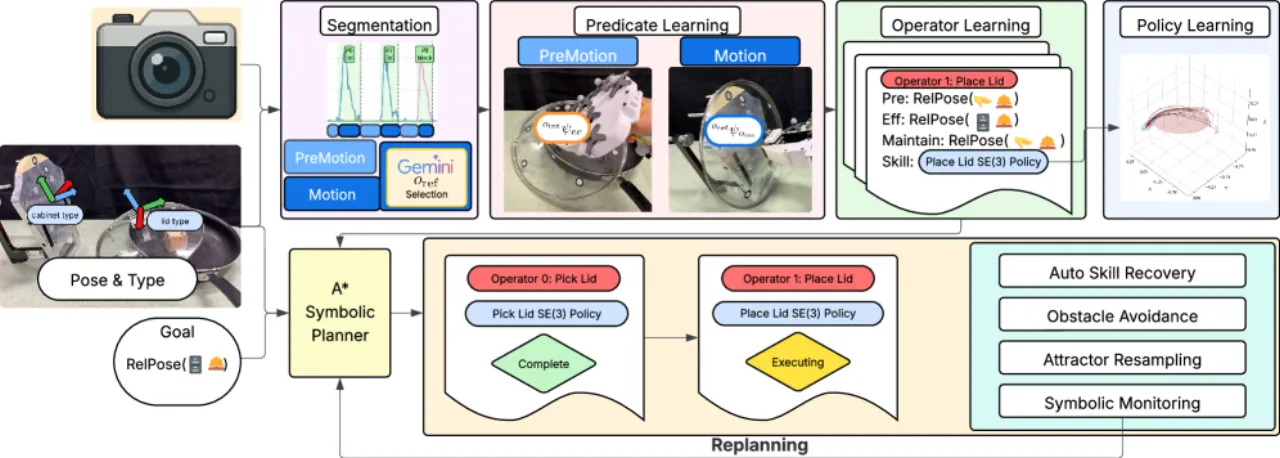
图1:SymSkill 离线与在线流程概览。 离线阶段从无标签演示中联合学习符号谓词、算子和 SE(3) LPV-DS 技能;在线阶段执行符号规划(<100ms)并通过三重监控机制实时恢复故障。Figure 1: Overview of the SymSkill offline and online pipelines. The offline stage jointly learns symbolic predicates, operators and SE(3) LPV-DS skills from unlabeled demonstrations; the online stage runs symbolic planning (<100ms) and recovers from failures in real time through a triple monitoring mechanism.
1–10所需演示条数(对比 NSIL/LAMP 的 200 条)Demonstrations required (vs. 200 for NSIL/LAMP)
85%RoboCasa 12 任务平均成功率Average success rate over the 12 RoboCasa tasks
<100ms符号规划延迟(对比 LAMP/NOD-TAMP 的 >50s)Symbolic planning latency (vs. >50s for LAMP/NOD-TAMP)
5 分钟5 min真实机器人所需 play data 时长Play data needed on the real robot
02方法Method
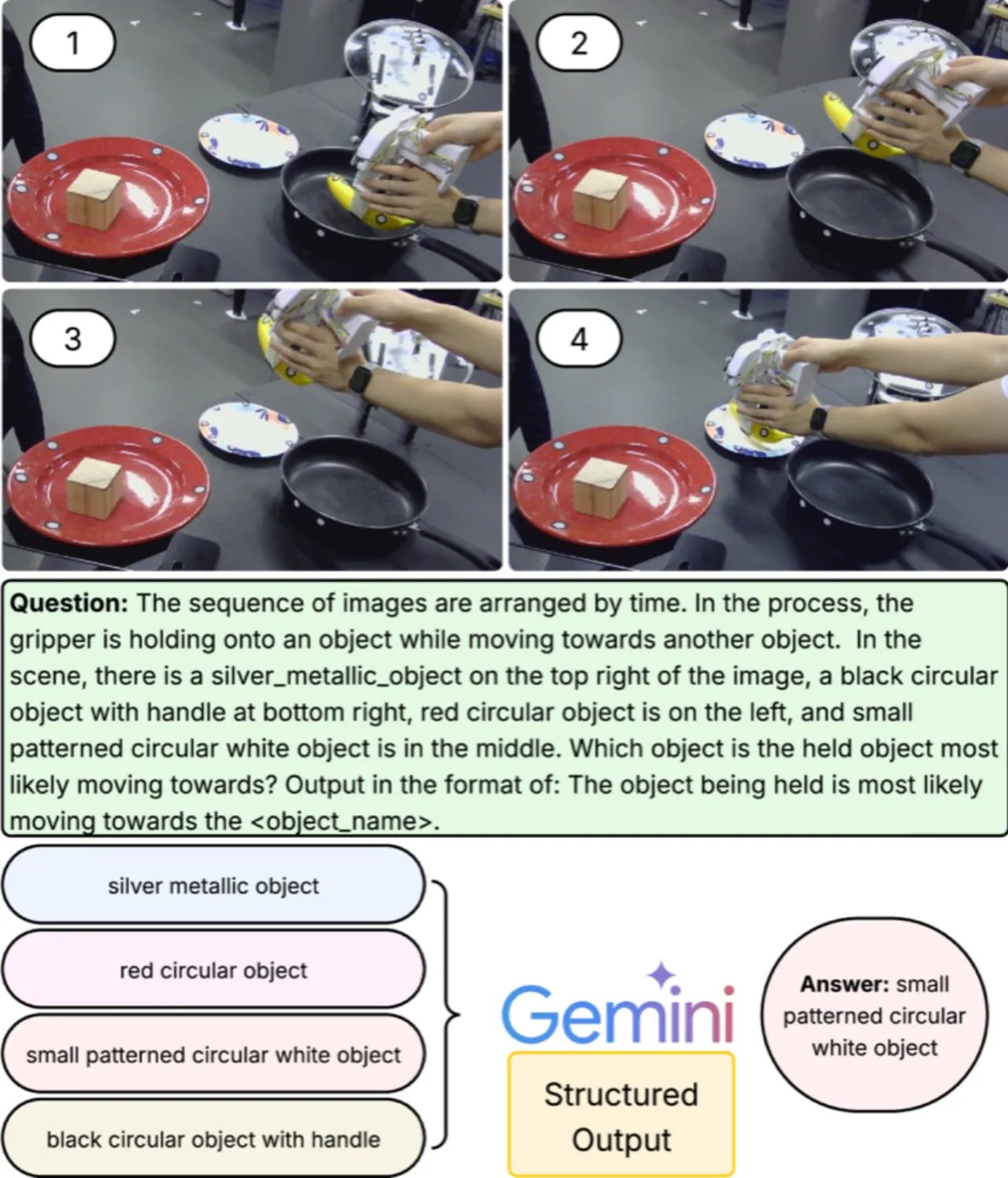
SymSkill 的核心思想是利用操作任务中普遍存在的以物体为中心的相对位姿结构。系统在相对坐标系下学习谓词和技能,仅离线调用视觉语言模型(VLM)确定参考物体,从而同时保证数据效率和在线反应速度。The core idea of SymSkill is to exploit the object-centric relative pose structure that pervades manipulation tasks. Predicates and skills are learned in relative frames, and a vision-language model (VLM) is queried offline only, to determine the reference object, so that data efficiency and online reactivity are secured at the same time.
图2:SymSkill 详细方法流程。 五个阶段:(A) 演示分段与参考系选择;(B) 相对位姿谓词学习;(C) 算子学习;(D) SE(3) 技能学习;(E) 在线执行监控与自适应恢复。VLM(Gemini 2.5-Pro)仅用于离线识别参考物体,避免在线推理瓶颈。Figure 2: Detailed SymSkill method pipeline. Five stages: (A) demonstration segmentation and reference frame selection; (B) relative pose predicate learning; (C) operator learning; (D) SE(3) skill learning; (E) online execution monitoring and adaptive recovery. The VLM (Gemini 2.5-Pro) is used only offline to identify the reference object, avoiding an online inference bottleneck.
阶段一:演示分段与参考系选择Stage 1: demonstration segmentation and reference frame selection
根据速度阈值将每条演示分为预运动段(premotion,仅末端执行器运动)和运动段(motion,末端执行器 + 操作物体同时运动)。对运动段,使用 VLM(Gemini 2.5-Pro)在 n 个均匀采样帧上查询参考物体 o_ref,输出限制为已知场景物体集合,最大程度抑制幻觉。A velocity threshold splits each demonstration into a premotion segment (premotion, end-effector motion only) and a motion segment (motion, end-effector and manipulated object moving together). For motion segments, a VLM (Gemini 2.5-Pro) is queried over n uniformly sampled frames for the reference object o_ref, with its output restricted to the set of known scene objects so as to suppress hallucination as far as possible.
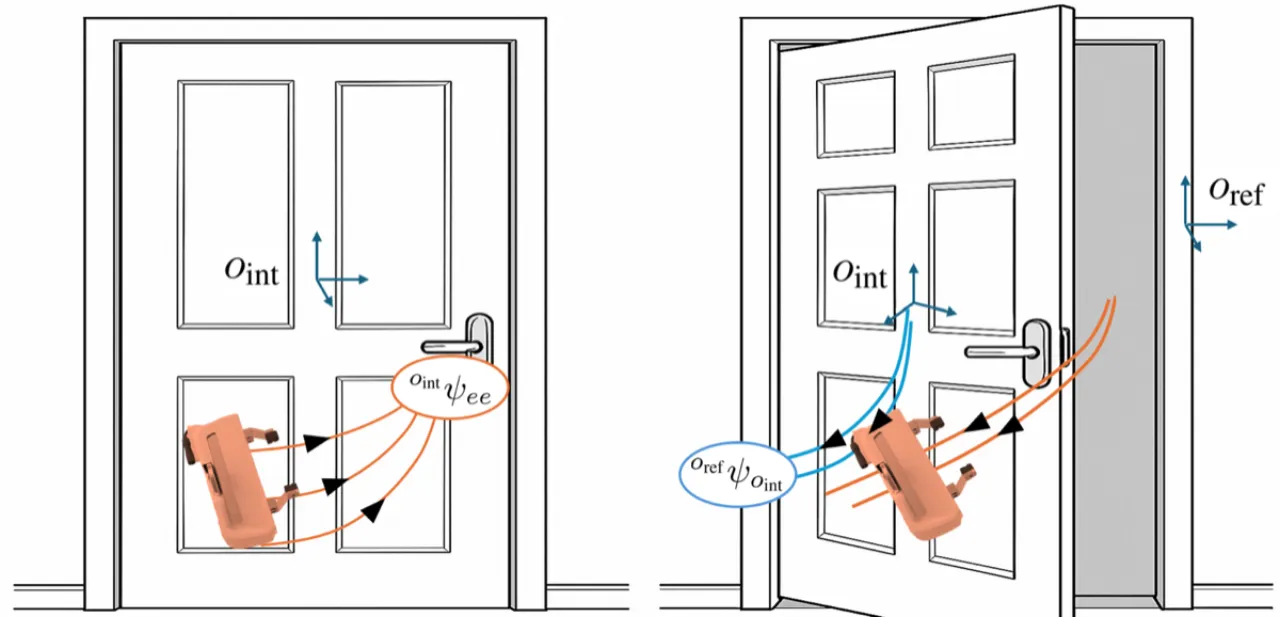
谓词 ψ 建模为相对位姿的正态分布:平移分量 p_ee^o ~ N(μ_pos, Σ_pos),旋转分量用对数映射 log(R) ~ N(μ_ori, Σ_ori) 表示。当 Mahalanobis 距离低于阈值 ε_pos 和 ε_ori 时谓词激活。运动段还额外学习物体-物体相对位姿谓词 ψ_o_int^o_ref,并在运动结束后约 2 秒的稳定窗口内增强鲁棒性。A predicate ψ is modeled as a normal distribution over relative pose: the translation component p_ee^o ~ N(μ_pos, Σ_pos), and the rotation component expressed through the log map log(R) ~ N(μ_ori, Σ_ori). The predicate activates when the Mahalanobis distance falls below the thresholds ε_pos and ε_ori. Motion segments additionally learn an object-object relative pose predicate ψ_o_int^o_ref, and robustness is strengthened over a stabilization window of about 2 seconds after the motion ends.
阶段三:算子学习Stage 3: operator learning
通过在分段边界处评估谓词,将演示转化为抽象状态序列,识别具有相同效果的重复转换组。算子 α = <params, pre, eff, maintain, skill> 的前条件、效果和维持条件分别通过集合交集运算自动提取,无需人工标注。Evaluating predicates at segment boundaries turns demonstrations into abstract state sequences and identifies repeated transition groups with identical effects. The preconditions, effects and maintain conditions of an operator α = <params, pre, eff, maintain, skill> are each extracted automatically by set intersection, with no manual annotation.
每个算子关联一个在相对坐标系下的 SE(3) Linear Parameter Varying Dynamical Systems(LPV-DS)技能。位置控制使用线性时不变系统的混合 v = Σ γ_k(x) A_k(x - x*),稳定性约束通过半正定规划(SDP)保证。技能的收敛反馈场使其对大范围初始位姿仍能鲁棒追踪目标。Each operator is associated with an SE(3) Linear Parameter Varying Dynamical Systems (LPV-DS) skill expressed in the relative frame. Position control uses a mixture of linear time-invariant systems v = Σ γ_k(x) A_k(x - x*), and stability constraints are guaranteed through semidefinite programming (SDP). The convergent feedback field of the skill lets it track the target robustly even from a wide range of initial poses.
图3:SE(3) LPV-DS 策略可视化(Op3,抓取任务)。 学习到的动力系统展示了从各种初始位姿向目标汇聚的流场,体现了策略的全局稳定性和强鲁棒性。Figure 3: Visualization of the SE(3) LPV-DS policy (Op3, grasping task). The learned dynamical system shows a flow field converging to the target from a variety of initial poses, reflecting the global stability and strong robustness of the policy.
阶段五:在线执行监控与三重恢复机制Stage 5: online execution monitoring and a triple recovery mechanism
在线执行时系统持续检查维持条件和预期效果。故障触发以下三种恢复机制之一:During online execution the system continuously checks maintain conditions and expected effects. A failure triggers one of the following three recovery mechanisms:
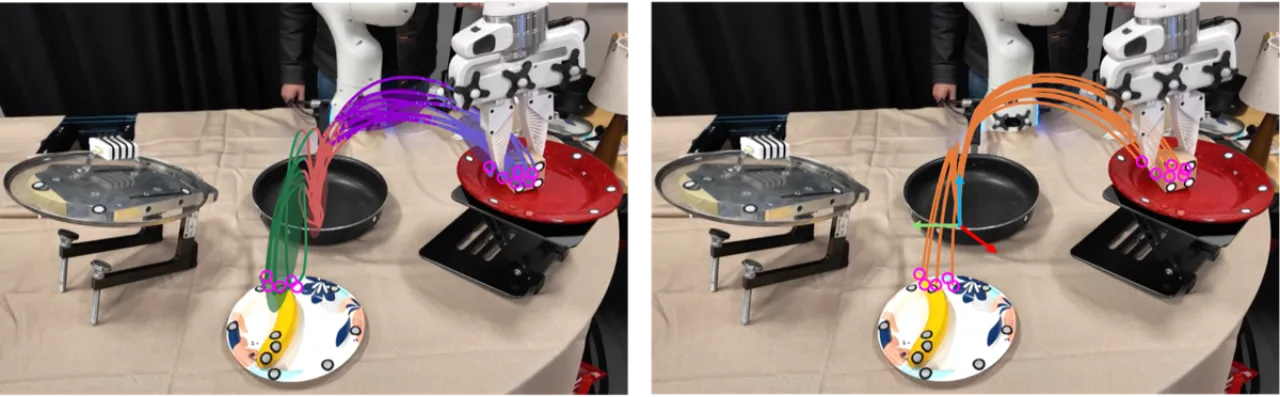
障碍物规避(Obstacle Avoidance):通过特征值分解对策略进行调制,绕过非操作物体Obstacle Avoidance: the policy is modulated through eigenvalue decomposition in order to detour around non-manipulated objects
失败后重采样(Resampling after Failure):当目标效果未满足(如物体掉落),从效果分布中重新采样策略吸引子并变换策略Resampling after Failure: when the target effect is not satisfied (for example the object is dropped), the policy attractor is resampled from the effect distribution and the policy is transformed accordingly
实时符号重规划(Real-Time Replanning):在符号层进行 A* 重规划,延迟 <100ms,使机器人能响应动态环境变化Real-Time Replanning: A* replanning is carried out at the symbolic level with <100ms latency, letting the robot respond to dynamic environment changes
03实验Experiments
实验在两个平台上验证:(1) RoboCasa 仿真环境中的 12 个单步任务及多步骤组合;(2) 真实 Franka 机械臂,仅从 5 分钟无结构 play data 中学习。每个任务仅使用 5–10 条演示,并与多个基线方法对比。The experiments are validated on two platforms: (1) 12 single-step tasks and their multi-step compositions in the RoboCasa simulator; (2) a real Franka arm, learning from only 5 minutes of unstructured play data. Each task uses only 5–10 demonstrations and is compared against several baseline methods.
表一:与相关工作的对比(Table I,论文原始数据)Table 1: comparison with related work (Table I, original data from the paper)
方法Method
谓词类型Predicate type
技能类型Skill type
演示数量Number of demos
规划延迟Planning latency
SymSkill(本文)SymSkill (ours)
Relative Pose Cluster (Start/End Motion)
SE(3) LPV-DS
1–10
<100ms
NSIL
Relative Pose Cluster (Low Relative Velocity)
MLP BC
200
<100ms
LAMP
Relational Critical Regions
Motion Planning (MP)
200
>50s
NOD-TAMP
NDF Features
Optimization + MP
1–10
>50s
表二:RoboCasa 单步仿真结果(Table II,每任务 10 次测试)Table 2: RoboCasa single-step simulation results (Table II, 10 trials per task)
OpenSingleDoor(开单扇门)OpenSingleDoor (open a single door)
100%
100%
0%
CloseSingleDoor(关单扇门)CloseSingleDoor (close a single door)
100%
80%
0%
PnPCounterToCab(台面→橱柜抓放)PnPCounterToCab (pick and place, counter → cabinet)
80%
70%
0%
PnPCabToCounter(橱柜→台面抓放)PnPCabToCounter (pick and place, cabinet → counter)
100%
40%
0%
PnPStoveToCounter(灶台→台面抓放)PnPStoveToCounter (pick and place, stove → counter)
70%
30%
0%
PnPCounterToStove(台面→灶台抓放)PnPCounterToStove (pick and place, counter → stove)
20%
0%
0%
OpenDrawer(开抽屉)OpenDrawer (open the drawer)
100%
100%
0%
CloseDrawer(关抽屉)CloseDrawer (close the drawer)
70%
50%
40%
TurnOnStove(打开燃气灶)TurnOnStove (turn on the gas stove)
100%
100%
0%
TurnOffStove(关闭燃气灶)TurnOffStove (turn off the gas stove)
80%
30%
0%
TurnOnSinkFaucet(打开水龙头)TurnOnSinkFaucet (turn on the sink faucet)
100%
100%
0%
TurnOffSinkFaucet(关闭水龙头)TurnOffSinkFaucet (turn off the sink faucet)
100%
90%
0%
平均Average
85.0%
65.0%
3.3%
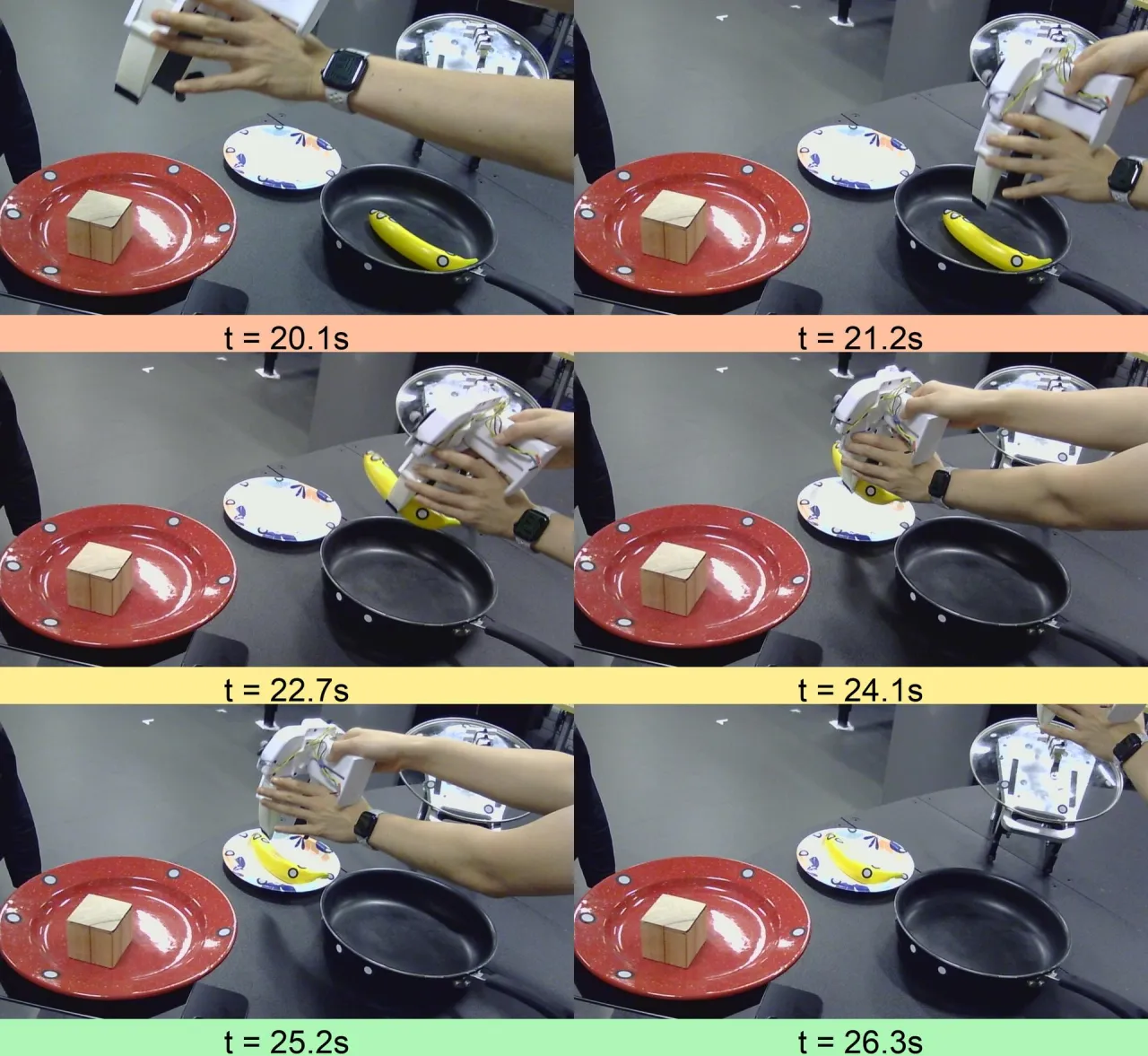
图4:DoorOpen 任务谓词与技能学习示意。 系统在相对坐标系下学习末端执行器到门把手的相对位姿谓词(绿色高亮区域),以及对应的 LPV-DS 运动策略。Figure 4: Predicate and skill learning on the DoorOpen task. In the relative frame the system learns the relative pose predicate from the end-effector to the door handle (green highlighted region), together with the corresponding LPV-DS motion policy.图5:真实机器人 play data 采集流程。 仅需 5 分钟无结构演示数据(包含积木、香蕉、盘子、碗架、锅盖等多种物体),即可完成离线阶段的谓词与技能发现。Figure 5: Play data collection procedure on the real robot. Only 5 minutes of unstructured demonstration data (containing blocks, a banana, plates, a dish rack, a pot lid and other objects) suffice for predicate and skill discovery in the offline stage.
在 RoboCasa 中定义新任务 "StoreCheese",由四步组成:开门 → 抓起奶酪 → 放到台面 → 关门,共串联六个技能。无需任何额外数据,直接复用已学谓词/算子/技能完成多步规划,并在执行过程中成功触发多次符号层错误恢复。A new task "StoreCheese" is defined in RoboCasa, composed of four steps: open the door → pick up the cheese → place it on the counter → close the door, chaining six skills in all. Without any additional data, the already-learned predicates/operators/skills are reused directly for multi-step planning, and symbolic-level error recovery is triggered successfully several times during execution.
真实机器人实验Real-robot experiments
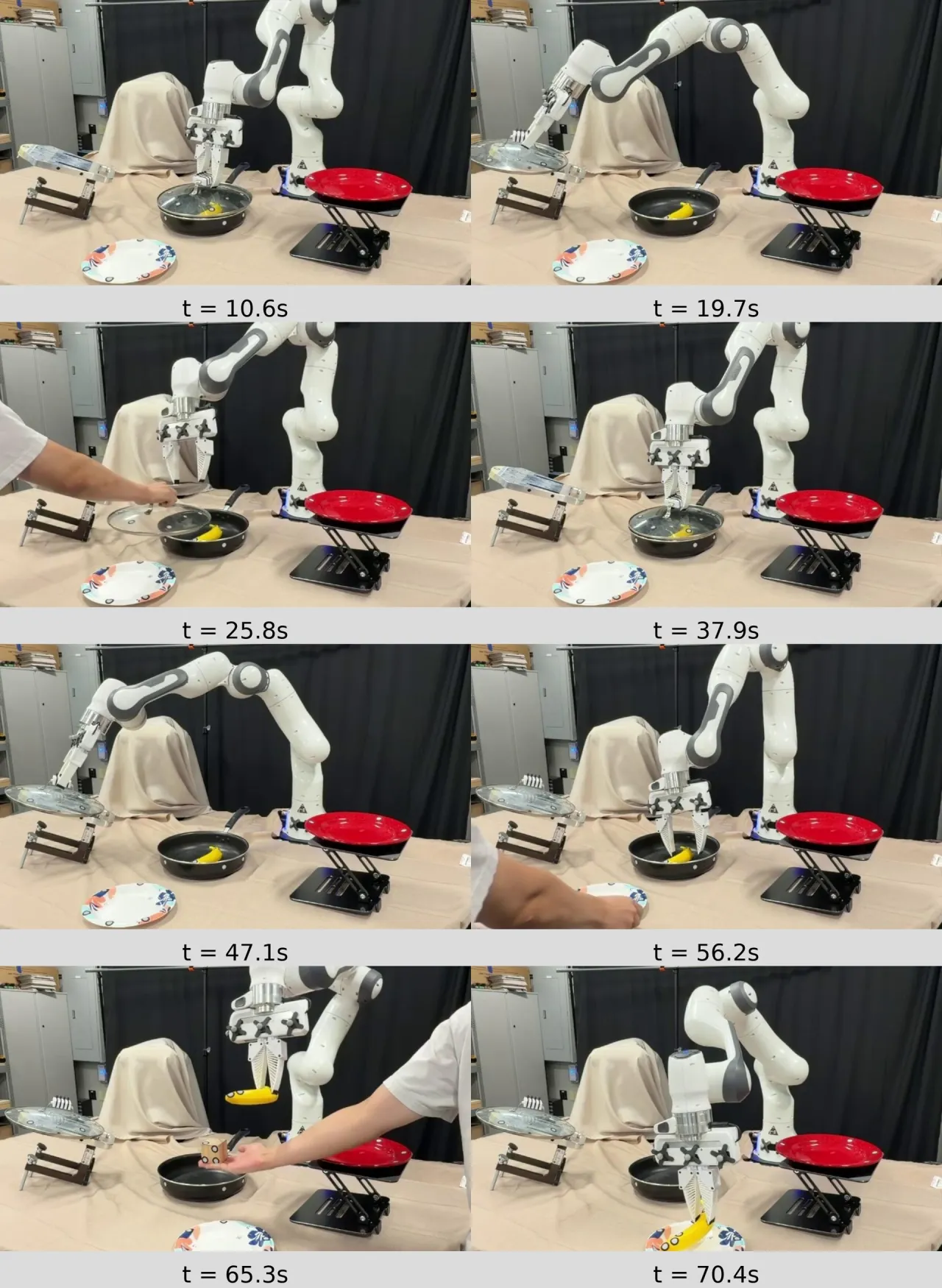
在真实 Franka 机械臂上,从 5 分钟 play data 中发现 11 个算子(Op1–Op11),涵盖拿放积木、操作锅盖、移动盘子等语义上有意义的操作原语。系统自动发现了诸如 "Thing-in-container"(物体在容器内)此类数据集特有的前条件结构,展示了无监督符号发现的能力。实验验证了三种恢复机制均有效工作。On a real Franka arm, 11 operators (Op1–Op11) are discovered from 5 minutes of play data, covering semantically meaningful manipulation primitives such as picking and placing blocks, manipulating a pot lid and moving plates. The system automatically discovered dataset-specific precondition structures such as "Thing-in-container", demonstrating the capacity for unsupervised symbol discovery. The experiments verify that all three recovery mechanisms work effectively.
图6:真实 Franka 机械臂执行多步骤操作并恢复扰动。 图示展示了关锅盖触发符号重规划、移动盘子由 DS 反馈处理、以及通过障碍物规避调制绕过干扰物体的完整过程。Figure 6: A real Franka arm executing multi-step manipulation and recovering from disturbances. The figure shows the full process: closing the pot lid triggers symbolic replanning, moving the plate is handled by DS feedback, and distractor objects are bypassed through obstacle-avoidance modulation.
消融实验分析Ablation analysis
关键消融结论:Key ablation findings:
监控机制的重要性:去掉监控后平均成功率从 85.0% 下降至 65.0%,证明实时故障检测与恢复的价值Importance of the monitoring mechanism: removing monitoring drops the average success rate from 85.0% to 65.0%, proving the value of real-time failure detection and recovery
SE(3) LPV-DS 远优于 Diffusion Policy:在相同少量数据条件下,Diffusion Policy 平均成功率仅 3.3%,因为"预运动技能从宽泛初始位姿出发但测试状态迅速落出分布",而 LPV-DS 的收敛反馈场克服了这一问题SE(3) LPV-DS far outperforms Diffusion Policy: under the same small-data setting, Diffusion Policy attains an average success rate of only 3.3%, because "premotion skills start from broad initial poses but test states quickly fall out of distribution", whereas the convergent feedback field of LPV-DS overcomes this problem
NSIL 基线失效:重新实现的 NSIL 由于"频繁选择能解释演示但对规划无语义意义的伪相对位姿谓词"而失败,在包含干扰物体时尤为明显Failure of the NSIL baseline: the reimplemented NSIL fails because it "frequently selects spurious relative pose predicates that explain the demonstrations but carry no semantic meaning for planning", which is especially pronounced when distractor objects are present
04局限性Limitations
说明:论文无单独的"Limitations"章节,以下各点来源标注:已在结论或讨论中明确提及的标为作者陈述,由方法设计合理推断的标为推断(inferred)。Note: The paper has no standalone "Limitations" section; the provenance of each point below is labeled: items explicitly mentioned in the conclusion or discussion are marked author-stated, and those reasonably inferred from the method design are marked inferred.
未来扩展方向:自我中心视频学习(作者陈述)Future extension: learning from egocentric video (author-stated)
论文结论明确指出:"As future work, we plan to extend our framework to learn directly from egocentric video"。当前系统依赖精确的 6DoF 物体位姿,这在无标记、无结构环境中难以获取,限制了部署通用性。The conclusion of the paper states explicitly: "As future work, we plan to extend our framework to learn directly from egocentric video". The current system depends on accurate 6DoF object poses, which are hard to obtain in unmarked, unstructured environments, limiting the generality of deployment.
未来扩展方向:移动操作的规模化(作者陈述)Future extension: scaling toward mobile manipulation (author-stated)
论文明确提出计划"scale toward mobile manipulation scenarios"。当前方法聚焦于桌面操作,固定基座机械臂场景;移动操作引入的运动基座自由度和更复杂的环境交互尚未处理。The paper explicitly proposes to "scale toward mobile manipulation scenarios". The current method focuses on tabletop manipulation with a fixed-base arm; the mobile-base degrees of freedom and the more complex environment interactions introduced by mobile manipulation are not yet handled.
依赖预定义的物体类型(推断 inferred)Dependence on predefined object types (inferred)
问题定义(Section II)假设物体具有预定义类型 λ(o),且场景中的物体需事先已知。这使得系统无法泛化到未见过类型的物体,限制了开放世界部署能力。The problem definition (Section II) assumes that objects have predefined types λ(o) and that the objects in the scene are known in advance. This prevents the system from generalizing to objects of unseen types, limiting open-world deployment.
单一固定装置变体(推断 inferred)A single fixture variant (inferred)
仿真实验中通过"过滤到每个任务仅一种装置变体"来减少场景变化。现实中厨房、家具等装置存在大量几何和外观多样性,系统对此类变化的鲁棒性尚未充分验证。The simulation experiments reduce scene variation by "filtering to a single fixture variant per task". Real kitchens, furniture and similar fixtures exhibit substantial geometric and appearance diversity, and the robustness of the system to such variation has not been fully validated.
VLM 用于参考系识别存在局限(推断 inferred)Limitations of using a VLM for reference frame identification (inferred)
尽管 VLM(Gemini 2.5-Pro)的输出被约束到已知场景物体以减少幻觉,但其识别质量仍依赖提示工程,且在物体遮挡严重或外观相似时可能出错。此外,VLM 为闭源模型,存在可重复性和版本依赖问题。Although the output of the VLM (Gemini 2.5-Pro) is constrained to known scene objects in order to reduce hallucination, its recognition quality still depends on prompt engineering and can go wrong under heavy occlusion or similar appearances. Moreover, the VLM is a closed-source model, which raises reproducibility and version-dependence issues.