StarVLA: A Lego-like Codebase for Vision-Language-Action Model Developing
像搭积木一样构建 VLA 模型的开源统一研究框架An open-source unified research framework for building VLA models like assembling Lego bricks
StarVLA Community · Von Neumann Institute, HKUST
具身智能研究中 VLA 方法繁多、框架各异、评测不统一,导致比较和复现极为困难。
StarVLA 提出一套模块化的 backbone–action head 架构,将骨干网络(VLM 或世界模型)与动作解码头解耦,
并通过统一 I/O 接口接入 LIBERO、SimplerEnv、RoboTwin 2.0、RoboCasa-GR1、BEHAVIOR-1K 五大评测基准,
实现了"换 backbone、换动作头"均无需改动训练/推理主干代码的灵活组合。In embodied AI research, VLA methods are numerous, frameworks differ from one another, and evaluation is not unified, which makes comparison and reproduction extremely difficult. StarVLA proposes a modular backbone-action head architecture that decouples the backbone network (a VLM or a world model) from the action decoding head, and connects through a unified I/O interface to five major evaluation benchmarks — LIBERO, SimplerEnv, RoboTwin 2.0, RoboCasa-GR1 and BEHAVIOR-1K — achieving flexible composition in which "swapping the backbone or swapping the action head" requires no modification of the training/inference trunk code.
当前 VLA 研究面临严重的"碎片化"问题:现有方法在模型结构、训练流程和推理假设上差异显著,
导致跨方法的系统比较几乎不可能,使得"究竟是数据、架构还是训练技巧带来的提升"难以厘清。Current VLA research suffers from severe "fragmentation": existing methods differ markedly in model architecture, training pipeline and inference assumptions, which makes systematic cross-method comparison nearly impossible and leaves it unclear "whether an improvement comes from the data, the architecture or the training tricks".
"We attribute this fragmentation to the lack of a unified abstraction for VLA systems. Existing codebases
are largely method-specific and do not support (i) modular composition across action-decoding paradigms,
(ii) reusable training approaches across heterogeneous data sources, or (iii) standardized evaluation
and deployment across benchmarks and embodiments."
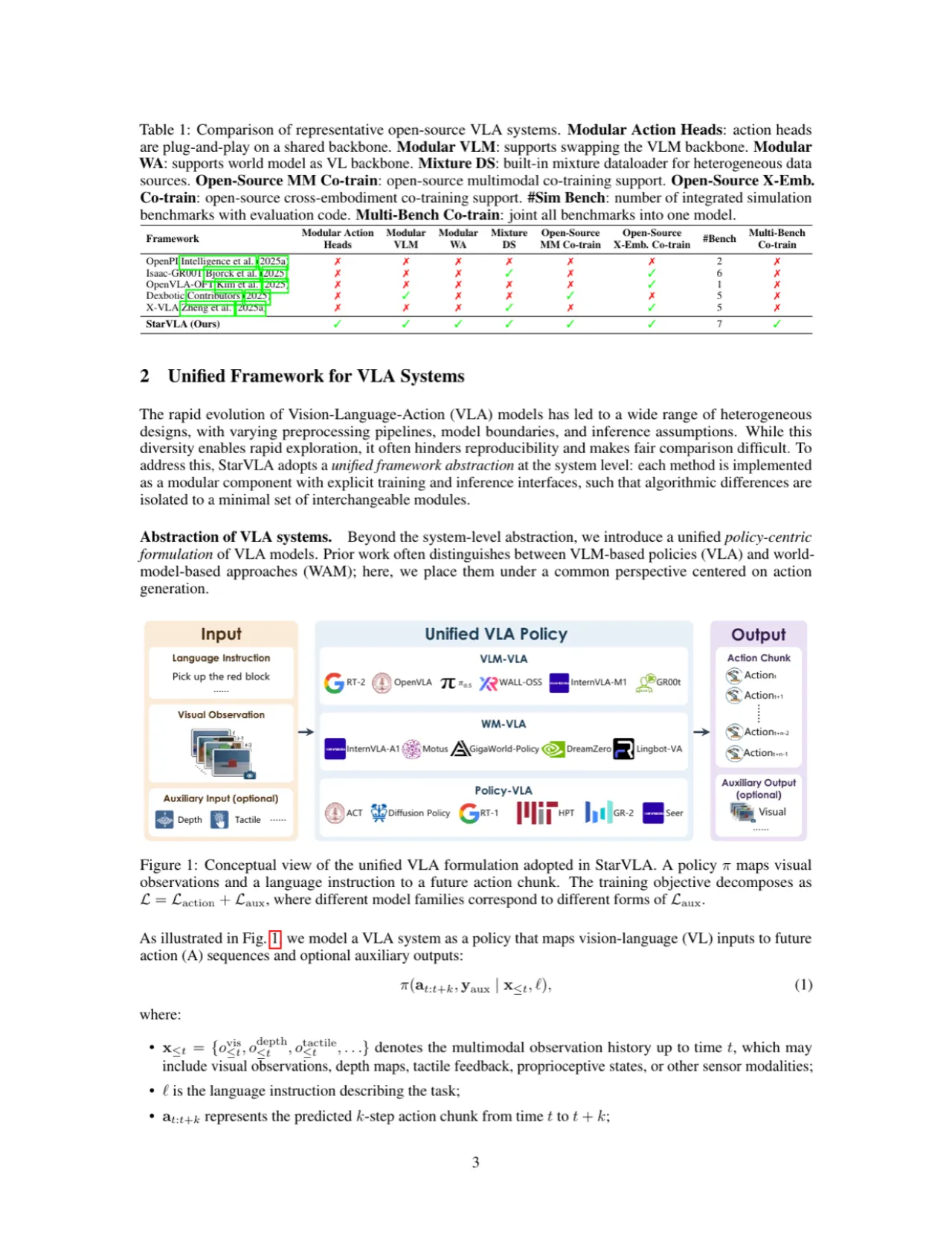
图 1:StarVLA 统一 VLA 策略示意。
策略 π 以多模态观测历史 x≤t 和语言指令 ℓ 为输入,输出动作序列
at:t+k 及辅助输出 yaux。
训练目标分解为 ℒ = ℒaction + ℒaux,
将动作预测损失与语言/视觉辅助监督解耦,使不同范式的 VLA 方法均可在同一接口下实例化。Figure 1: Illustration of the StarVLA unified VLA policy. The policy π takes the multimodal observation history x≤t and the language instruction ℓ as input, and outputs the action sequence at:t+k together with the auxiliary output yaux. The training objective decomposes as ℒ = ℒaction + ℒaux, decoupling the action prediction loss from the language/visual auxiliary supervision, so that VLA methods of different paradigms can all be instantiated under the same interface.
5集成主流评测基准数量Mainstream benchmarks integrated
4支持的动作解码范式Action-decoding paradigms supported
30K训练步数即可媲美竞品 175K+ 步Training steps, on par with competitors at 175K+ steps
2,200256 GPU 下最大样本吞吐量(samples/s)Peak sample throughput on 256 GPUs (samples/s)
02方法Method
StarVLA 的核心是 backbone–action head 双向模块化:骨干网络(VLM 或世界模型)与动作解码头
各自遵守统一的 I/O 协议,可独立替换而不影响另一侧。训练、推理与部署共用同一套代码,
配置通过 YAML 声明式指定。The core of StarVLA is bidirectional modularity of backbone and action head: the backbone network (a VLM or a world model) and the action decoding head each obey a unified I/O protocol and can be replaced independently without affecting the other side. Training, inference and deployment share one and the same codebase, and configurations are specified declaratively through YAML.
策略被形式化为 π(at:t+k, yaux | x≤t, ℓ),
将多模态观测历史映射到 k 步动作序列。训练损失为 ℒ = ℒaction + ℒaux,
其中 ℒaux 作为归纳偏置,可为零(纯行为克隆)或语言对齐/空间感知损失。
不同 VLA 范式均可理解为该公式在不同归纳偏置下的实例化。The policy is formalized as π(at:t+k, yaux | x≤t, ℓ), mapping the multimodal observation history to a k-step action sequence. The training loss is ℒ = ℒaction + ℒaux, in which ℒaux serves as an inductive bias and may be zero (pure behavior cloning) or a language-alignment / spatial-awareness loss. Different VLA paradigms can all be understood as instantiations of this formulation under different inductive biases.
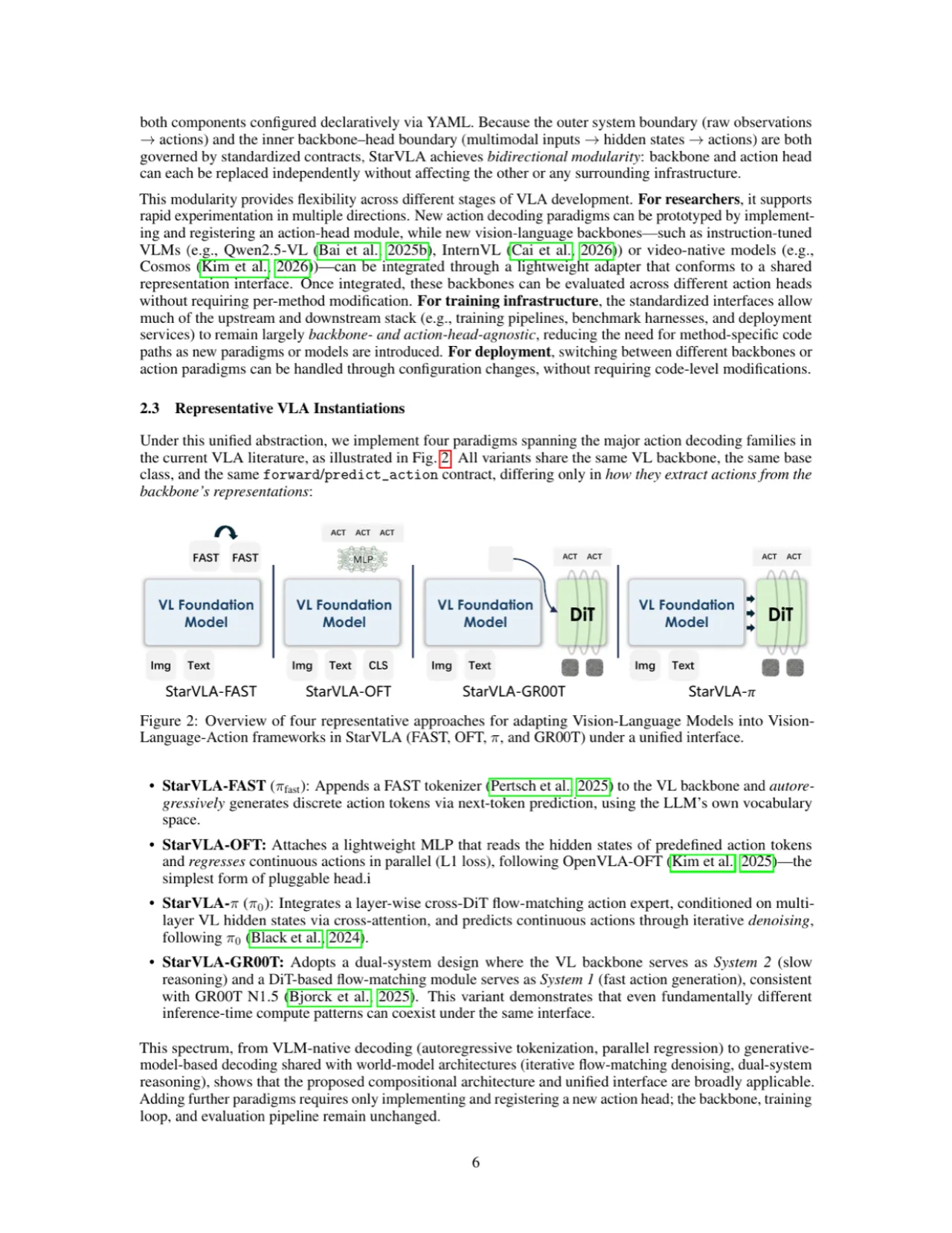
图 2:四种代表性动作解码范式。StarVLA-FAST:自回归生成离散动作 token(基于 FAST tokenizer);
StarVLA-OFT:通过轻量 MLP 直接回归连续动作;
StarVLA-π (π₀):flow matching 迭代去噪;
StarVLA-GR00T:双系统推理(System 1 快速反应 + System 2 慢速规划)。
四种变体共享相同的训练/推理接口,仅动作头实现不同。Figure 2: Four representative action-decoding paradigms.StarVLA-FAST: autoregressively generates discrete action tokens (based on the FAST tokenizer); StarVLA-OFT: directly regresses continuous actions through a lightweight MLP; StarVLA-π (π₀): iterative denoising with flow matching; StarVLA-GR00T: dual-system inference (System 1 for fast reaction + System 2 for slow planning). The four variants share the same training/inference interface and differ only in the action head implementation.
统一 I/O 接口与 Server-Client 评测Unified I/O interface and server-client evaluation
StarVLA 为所有框架组件定义了两个核心方法:forward(raw_images, str, ...) 作为训练入口,
predict_action(raw_images, str, ...) 作为推理入口。
推理接口接受"归一化动作(均值=0,标准差=1)"并返回预测动作块(minus ground-truth 均值后的预测)。
这一设计与真实机器人传感器流镜像对应,使同一 checkpoint 可直接用于仿真评测和真实部署,
无需修改代码。评测基准代码通过 server-client 模式与模型推理解耦,benchmark 代码无需感知模型内部。StarVLA defines two core methods for all framework components: forward(raw_images, str, ...) as the training entry point and predict_action(raw_images, str, ...) as the inference entry point. The inference interface accepts "normalized actions (mean=0, standard deviation=1)" and returns the predicted action chunk (the prediction after subtracting the ground-truth mean). This design mirrors real robot sensor streams, so that the same checkpoint can be used directly for simulation evaluation and real-world deployment without modifying code. Benchmark code is decoupled from model inference through a server-client pattern, so the benchmark code needs no awareness of model internals.
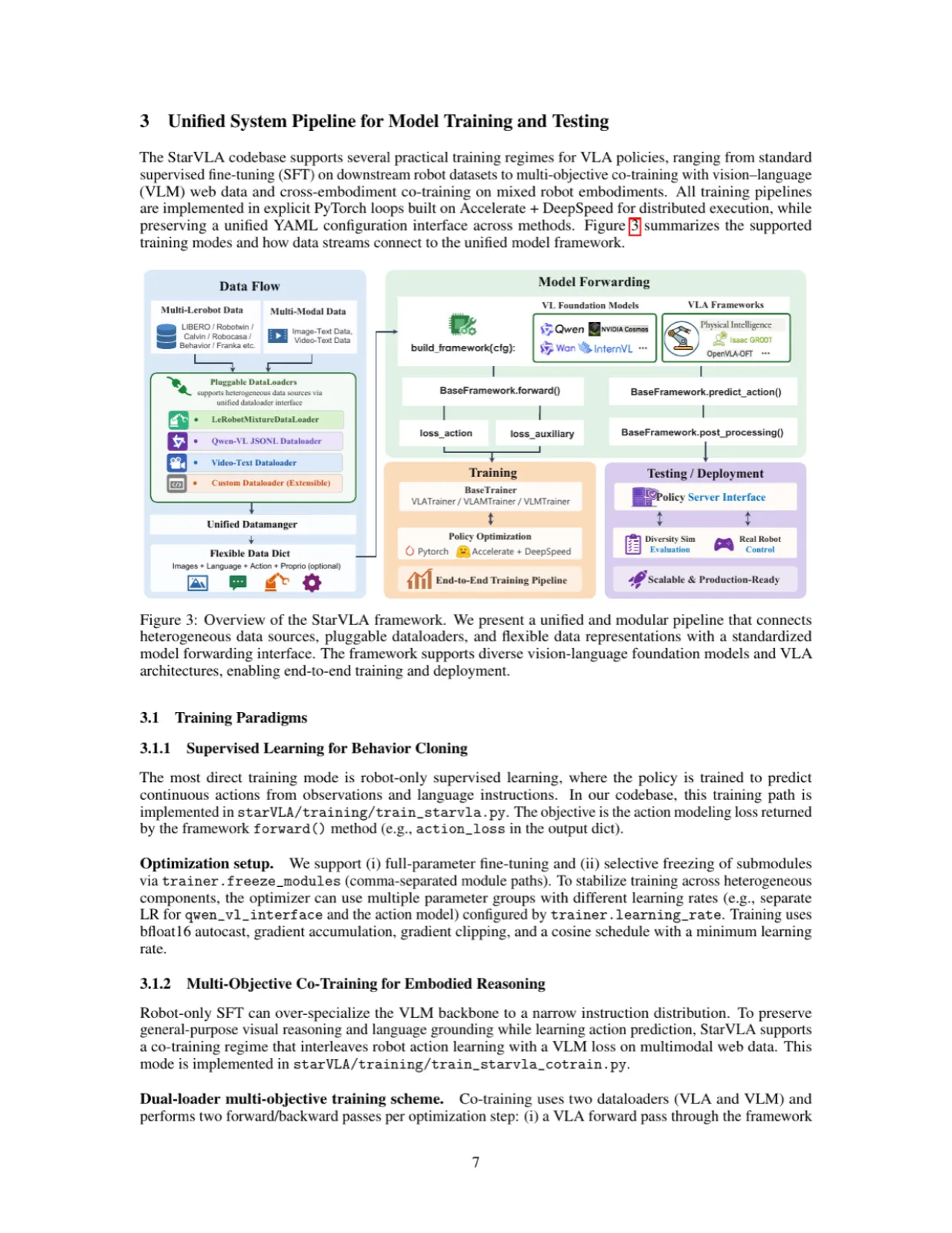
图 3:StarVLA 统一系统流水线。
左侧:统一数据流,连接异构机器人数据集、pluggable dataloader 与标准化数据表示;
右侧:模型前向传播路径,VL Foundation Model 骨干网络经 action head 输出动作,
再经 Server-Client 接口用于仿真评测(LIBERO、SimplerEnv、RoboTwin 等)和真实机器人部署。
整个流水线由 YAML 配置驱动,支持 Unified Hamiltonians、Co-train 和 Multi-Bench 训练策略。Figure 3: The StarVLA unified system pipeline. Left: the unified data flow, connecting heterogeneous robot datasets, a pluggable dataloader and a standardized data representation; right: the model forward path, in which the VL Foundation Model backbone emits actions through the action head, which are then used via the server-client interface for simulation evaluation (LIBERO, SimplerEnv, RoboTwin, etc.) and for real robot deployment. The whole pipeline is driven by YAML configuration and supports the Unified Hamiltonians, Co-train and Multi-Bench training strategies.
灵活训练范式Flexible training paradigms
监督行为克隆(SFT)Supervised behavior cloning (SFT)
最直接的训练方式,ℒaux = 0,仅优化动作预测损失。
StarVLA 将此作为建立单基准可复现基线的标准起点,
并提供了 benchmark 特定的训练/评测脚本。The most direct training scheme, with ℒaux = 0, optimizing only the action prediction loss. StarVLA takes this as the standard starting point for establishing reproducible single-benchmark baselines, and provides benchmark-specific training/evaluation scripts.
多目标协同训练(Co-training)Multi-objective co-training
在动作预测的同时引入 VLM 辅助目标(如空间感知 grounding 损失),
保留模型的语言/视觉推理能力。
实验表明,空间引导协同训练可将 Google Robot 成功率从 66.1% 提升至 86.2%,
同时维持 RefCOCO-g 上 71.2 IoU@0.5 的空间感知精度。VLM auxiliary objectives (such as a spatial-awareness grounding loss) are introduced alongside action prediction, preserving the language/visual reasoning ability of the model. Experiments show that spatially guided co-training raises the Google Robot success rate from 66.1% to 86.2%, while maintaining a spatial-awareness accuracy of 71.2 IoU@0.5 on RefCOCO-g.
跨体态训练(Cross-embodiment)Cross-embodiment training
通过 mixture dataloader 混合来自不同机器人平台的数据,
训练单一泛化模型,实现跨 LIBERO、SimplerEnv、RoboTwin、RoboCasa-GR1 的联合训练。A mixture dataloader blends data from different robot platforms to train a single generalist model, enabling joint training across LIBERO, SimplerEnv, RoboTwin and RoboCasa-GR1.
计划中的功能,目前仍在持续集成中("an ongoing integration effort",论文明确说明)。A planned capability that is still being integrated ("an ongoing integration effort", as the paper explicitly states).
03实验Experiments
StarVLA 在五大主流仿真评测基准上报告了单基准专家模型(Specialist)和跨基准泛化模型(Generalist)的性能,
所有结果均基于官方评测协议,以最终任务成功率为主要指标。StarVLA reports the performance of single-benchmark specialist models and cross-benchmark generalist models on five mainstream simulation benchmarks. All results follow the official evaluation protocols, taking the final task success rate as the primary metric.
仅 30K 训练步,媲美竞品 175K+ 步Only 30K training steps, on par with competitors at 175K+ steps
SimplerEnv WidowX
StarVLA-GR00T
65.3%
success rate
RoboCasa-GR1(平均)RoboCasa-GR1 (average)
StarVLA-OFT
48.8%
average success rate
RoboTwin 2.0 clean
StarVLA-GR00T
88.0%
clean setting
RoboTwin 2.0 random
StarVLA-GR00T
88.5%
random setting
泛化模型(Generalist)vs 专家模型对比Generalist vs. specialist comparison
跨 LIBERO、SimplerEnv、RoboTwin 和 RoboCasa-GR1 联合训练的单一泛化模型:A single generalist model jointly trained across LIBERO, SimplerEnv, RoboTwin and RoboCasa-GR1:
Benchmark
Specialist
Generalist
差距Gap
LIBERO(平均)LIBERO (average)
98.8%
97.8%
-1.0%
RoboCasa-GR1(平均)RoboCasa-GR1 (average)
48.8%
57.3%
+8.5%(泛化反超!)+8.5% (generalist ahead!)
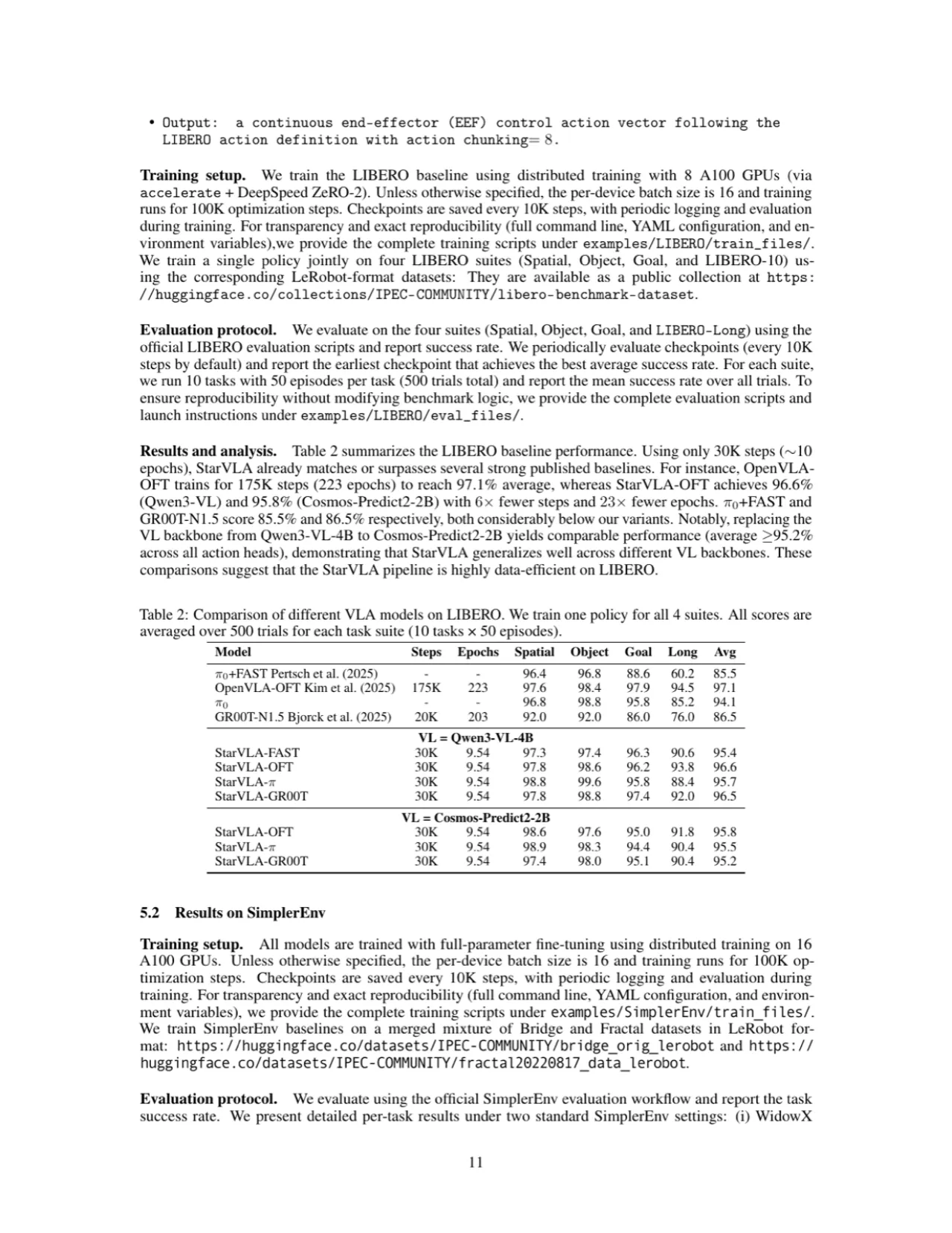
表 2:LIBERO 基准各变体详细结果。
StarVLA 各变体(FAST、OFT、π、GR00T)在 LIBERO-Spatial、LIBERO-Object、LIBERO-Goal、LIBERO-Long 四个子集上的成功率,
与已发布的强基线进行对比。StarVLA-OFT 在平均成功率上达到 96.6%,
训练开销显著低于竞争对手(30K 步 vs. 175K+ 步)。Table 2: Detailed per-variant results on the LIBERO benchmark. Success rates of the StarVLA variants (FAST, OFT, π, GR00T) on the four subsets LIBERO-Spatial, LIBERO-Object, LIBERO-Goal and LIBERO-Long, compared with published strong baselines. StarVLA-OFT reaches 96.6% average success rate, with training cost markedly lower than that of competitors (30K steps vs. 175K+ steps).
计算效率与多节点扩展Computational efficiency and multi-node scaling
单节点(8×A100)测试:batch size 16 时每步 0.703 秒(72.2 samples/s);
batch size 192 时每步 2.404 秒(79.9 samples/s);GPU 利用率 74–96%。
多节点扩展(最高 256 GPU):单步延迟在 32 GPU 以上趋于饱和(约 0.93 秒/步);
样本吞吐量从 87 samples/s 线性扩展至 2,200 samples/s;
并行效率在 32 GPU 以上稳定于约 79–80%。Single-node (8×A100) tests: at batch size 16, 0.703 seconds per step (72.2 samples/s); at batch size 192, 2.404 seconds per step (79.9 samples/s); GPU utilization 74-96%. Multi-node scaling (up to 256 GPUs): per-step latency saturates beyond 32 GPUs (about 0.93 seconds per step); sample throughput scales linearly from 87 samples/s to 2,200 samples/s; parallel efficiency stabilizes at about 79-80% beyond 32 GPUs.
04局限性Limitations
说明:以下局限性部分为作者在论文中明确陈述(标注"stated"),
部分为从系统设计中推断(标注"inferred")。Note: Some of the limitations below are explicitly stated by the authors in the paper (marked "stated"), while others are inferred from the system design (marked "inferred").
RL 微调尚未完成集成(stated)RL fine-tuning is not yet fully integrated (stated)
论文明确指出强化学习微调是"an ongoing integration effort",当前版本不支持端到端 RL 训练。
这意味着在需要在线环境交互优化的任务上,StarVLA 目前仍仅限于离线行为克隆范式。The paper explicitly states that reinforcement learning fine-tuning is "an ongoing integration effort"; the current version does not support end-to-end RL training. This means that on tasks requiring optimization through online environment interaction, StarVLA is for now confined to the offline behavior cloning paradigm.
跨基准泛化模型在部分任务上略弱于专家模型(stated)The cross-benchmark generalist is slightly weaker than specialists on some tasks (stated)
Generalist 模型在 LIBERO 上比 Specialist 低约 1.0%(97.8% vs 98.8%),
表明"all-in-one 多基准训练"可行但仍存在小幅性能折损,
尤其在各基准数据分布差异较大时。On LIBERO the generalist model is about 1.0% below the specialist (97.8% vs 98.8%), indicating that "all-in-one multi-benchmark training" is feasible but still incurs a small performance loss, especially when the data distributions of the individual benchmarks differ substantially.
多节点扩展存在通信开销(stated)Multi-node scaling incurs communication overhead (stated)
在 8–32 GPU 区间,多节点通信开销显著,导致扩展效率低于线性。
32 GPU 以上每步延迟趋于平稳,但并行效率稳定在 79–80%,
意味着约 20% 的计算资源消耗在通信同步上。In the 8-32 GPU range, multi-node communication overhead is significant, making scaling efficiency sub-linear. Beyond 32 GPUs the per-step latency levels off, but parallel efficiency stays at 79-80%, meaning that about 20% of the compute is consumed by communication and synchronization.
真实机器人验证有限(inferred)Real-robot validation is limited (inferred)
论文的实验结果均来自仿真环境(LIBERO、SimplerEnv、RoboTwin 等),
对真实机器人的验证仅限于部署接口设计层面的讨论,
缺乏大规模真实场景的定量评测。sim-to-real 转移能力尚未系统验证。All experimental results in the paper come from simulation environments (LIBERO, SimplerEnv, RoboTwin, etc.); validation on real robots is limited to a discussion at the level of deployment interface design, without large-scale quantitative evaluation in real scenes. Sim-to-real transfer ability has not been systematically verified.
评测基准覆盖以操作任务为主(inferred)Benchmark coverage is dominated by manipulation tasks (inferred)
当前集成的五大基准(LIBERO、SimplerEnv、RoboTwin 2.0、RoboCasa-GR1、BEHAVIOR-1K)
侧重桌面操作和室内场景,移动操作、户外导航等任务尚未纳入统一评测框架。The five currently integrated benchmarks (LIBERO, SimplerEnv, RoboTwin 2.0, RoboCasa-GR1, BEHAVIOR-1K) emphasize tabletop manipulation and indoor scenes; mobile manipulation, outdoor navigation and similar tasks are not yet covered by the unified evaluation framework.