Jinhui Ye, Ning Gao, Senqiao Yang, Jinliang Zheng, Zixuan Wang, Yuxin Chen, Pengguang Chen, Yilun Chen, Shu Liu, Jiaya Jia | HKUST · SJTU · CLINK · THU · Tencent Lab · Alibaba Group · SmartMore Ltd.
VLA(Vision-Language-Action)研究领域正快速扩张,但方法之间在架构、训练数据、体现配置和 benchmark 特定工程方面差异极大,难以公平比较。StarVLA-α 提出一个刻意最小化复杂度的简洁基线,在 LIBERO、SimplerEnv、RoboTwin、RoboCasa 四个基准上统一训练,以受控方式系统研究 VLA 设计选择,证明"强大 VLM 主干 + 最少设计"已足够强大。VLA (Vision-Language-Action) research is expanding rapidly, but methods differ substantially in architecture, training data, embodiment configuration, and benchmark-specific engineering, which makes fair comparison difficult. StarVLA-α proposes a deliberately minimal-complexity baseline, trained jointly on the four benchmarks LIBERO, SimplerEnv, RoboTwin and RoboCasa, to study VLA design choices systematically in a controlled way, showing that “a strong VLM backbone + minimal design” is already strong enough.
VLA 领域正高速发展,但存在严重的方法碎片化问题:不同方法在架构、训练数据、体现配置(embodiment configuration)和 benchmark 特定工程(benchmark-specific engineering)方面差异极大,导致难以判断哪些设计决策真正驱动了性能提升。The VLA field is advancing rapidly, but suffers from severe methodological fragmentation: approaches differ substantially in architecture, training data, embodiment configuration and benchmark-specific engineering, making it hard to tell which design decisions actually drive performance gains.
"The VLA landscape remains highly fragmented and complex: as existing approaches vary substantially in architectures, training data, embodiment configurations, and benchmark-specific engineering."
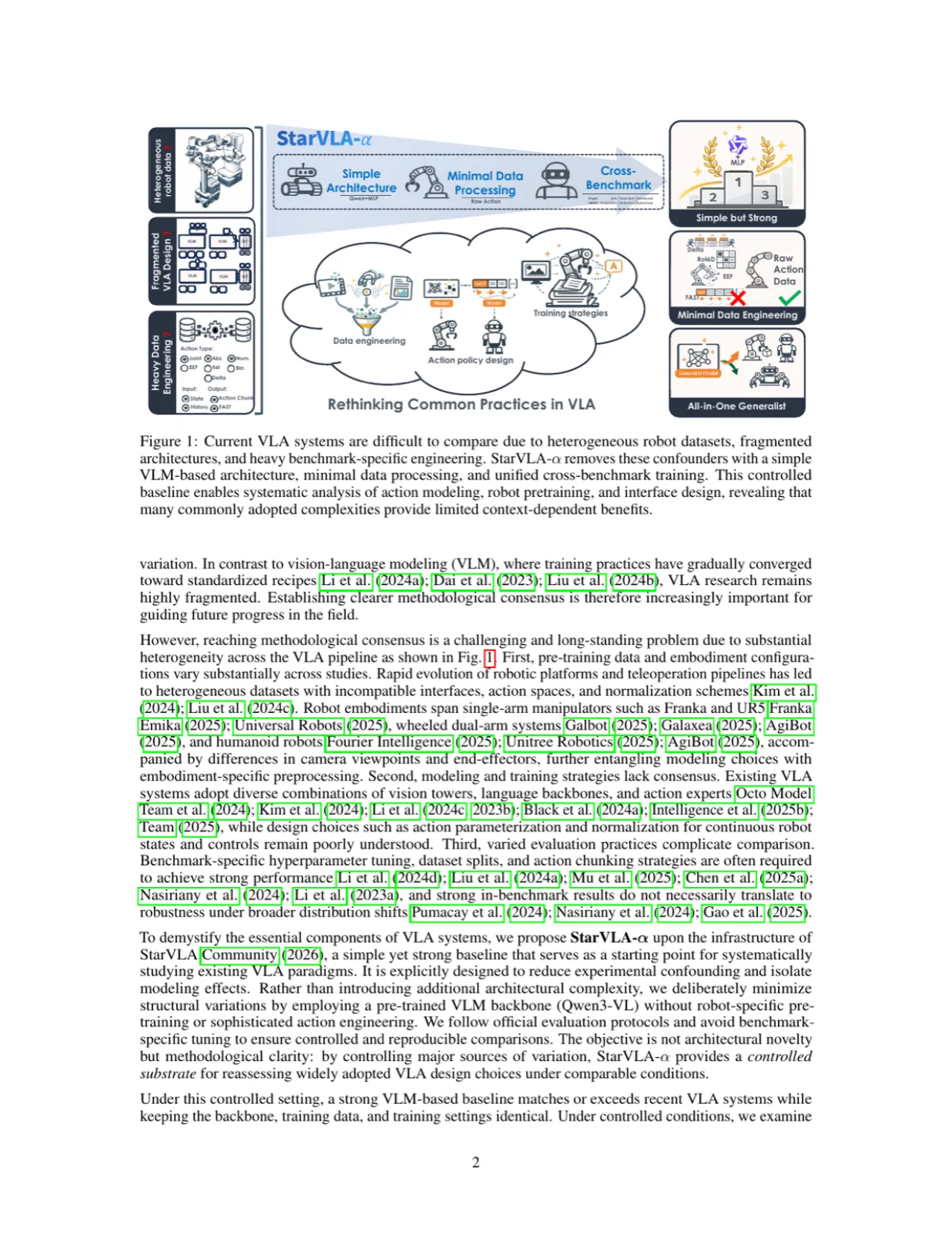
图 1:当前 VLA 系统(左)依赖异构架构与大量 benchmark 专属工程;StarVLA-α(右)通过简单架构、极简数据处理和统一 benchmark 训练,证明"Simple but Strong"。核心发现:许多被广泛采用的复杂性设计仅提供有限的情境相关收益。Figure 1: Current VLA systems (left) rely on heterogeneous architectures and heavy benchmark-specific engineering; StarVLA-α (right) demonstrates “Simple but Strong” through a simple architecture, minimal data processing and unified benchmark training. Key finding: many widely adopted complexity-adding designs deliver only limited, context-dependent benefits.
+20%单一泛化模型在 real-world RoboChallenge 上超越 π₀.₅A single generalist model surpasses π₀.₅ on real-world RoboChallenge
Qwen2-VL轻量级 MLP action head,无需任何 benchmark 特定工程Lightweight MLP action head, with no benchmark-specific engineering
当前 VLA 研究的三大核心难题:Three core difficulties in current VLA research:
设计混淆(Confounders):不同方法同时改变多个因素,无法分离各因素对性能的独立贡献。Confounders: different methods change several factors at once, so the independent contribution of each factor to performance cannot be isolated.
Benchmark 特定适配:为某个 benchmark 定制的优化技巧,在其他 benchmark 或真实机器人上往往失效。Benchmark-specific adaptation: optimization tricks tailored to one benchmark often fail on other benchmarks or on real robots.
再现性差:训练设置、数据来源、评估协议各异,使横向比较几乎不可能。Poor reproducibility: training setups, data sources and evaluation protocols all differ, making horizontal comparison nearly impossible.
StarVLA-α 的核心假设是:通过刻意减少实验变量(confounders),可以系统地评估哪些设计选择真正有效,哪些只是特定场景下的过度工程。The core hypothesis of StarVLA-α is: by deliberately reducing experimental confounders, one can systematically assess which design choices are genuinely effective and which are merely over-engineering for particular scenarios.
02方法 MethodMethod
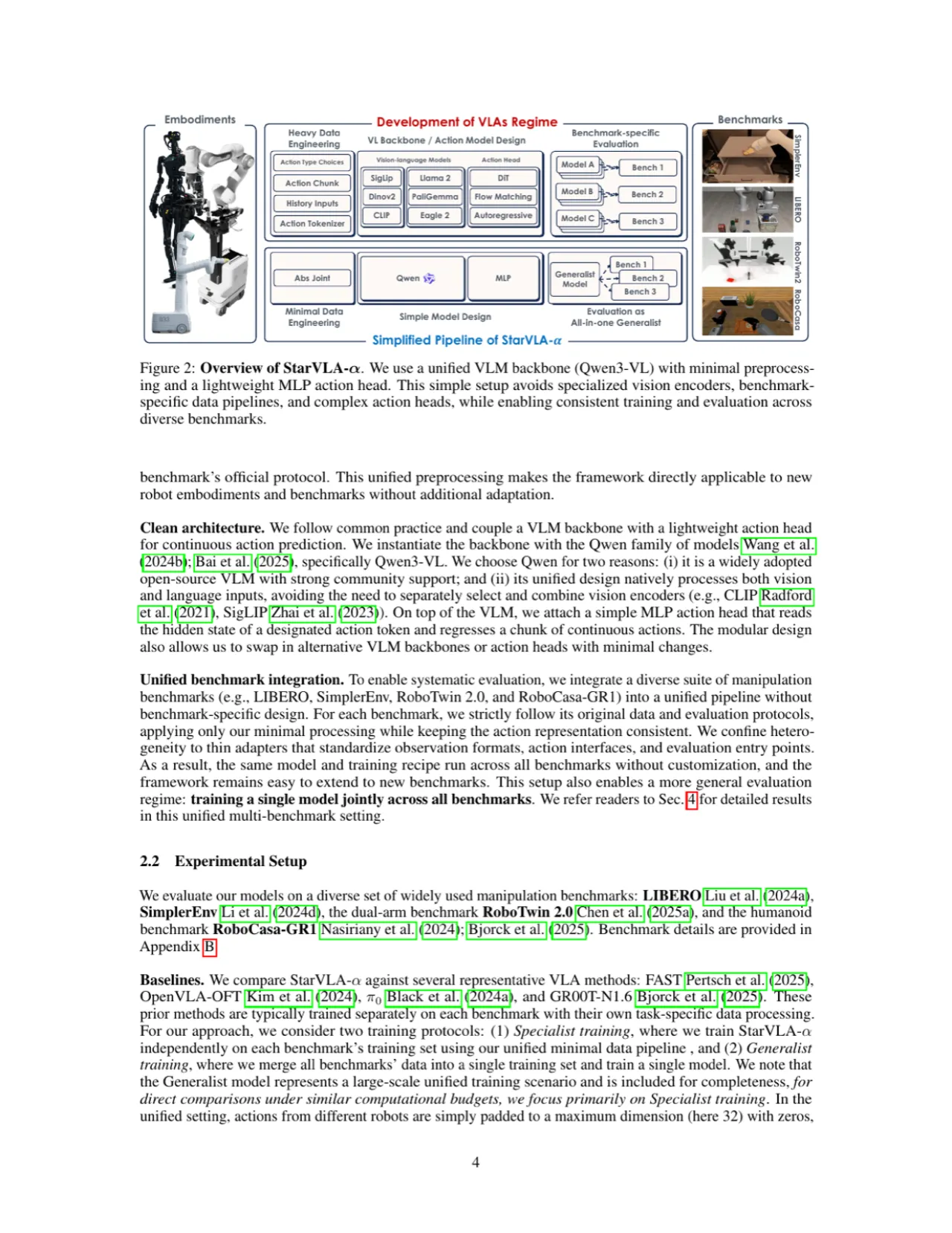
StarVLA-α 建立在最小充分性(minimal-sufficiency)假设之上:强大的 VLM 配合轻量 action head,不需要任何 benchmark 专属预处理,即可学到可迁移的策略。框架在 StarVLA Community 基础设施上构建,核心组成包括:Unified I/O Interface、Compositional Framework 和 VL Foundation Models。StarVLA-α is built on a minimal-sufficiency hypothesis: a strong VLM paired with a lightweight action head can learn transferable policies without any benchmark-specific preprocessing. The framework is built on the StarVLA Community infrastructure, and its core components are the Unified I/O Interface, the Compositional Framework and VL Foundation Models.
图 2:StarVLA-α 整体框架。VL Foundation Model 负责从 RGB 图像和自然语言指令提取特征;Compositional Framework 将 action head 解耦为可插拔模块;Unified I/O Interface 保证推理时对不同体现(embodiment)的兼容性,无需修改核心代码。Figure 2: The overall StarVLA-α framework. The VL Foundation Model extracts features from RGB images and natural-language instructions; the Compositional Framework decouples the action head into a pluggable module; the Unified I/O Interface guarantees compatibility with different embodiments at inference time without modifying core code.
所有框架模块从同一 VL backbone 继承,通过两种方法支持统一接口:
forward(raw_images, atr, ...) 作为训练入口,接收多视角 RGB 图像、自然语言指令,并以字典形式返回 action chunk;predict_action(raw_images, atr, ...) 作为推理入口,接受归一化动作(对连续动作减均值、除单位方差)并返回预测动作。
这一设计使任何 VL Foundation Model 只要能处理 raw observations,无需额外适配即可直接接入 StarVLA-α。All framework modules inherit from the same VL backbone and support a unified interface through two methods: forward(raw_images, atr, ...) is the training entry point, taking multi-view RGB images and natural-language instructions and returning an action chunk as a dictionary; predict_action(raw_images, atr, ...) is the inference entry point, accepting normalized actions (continuous actions are mean-subtracted and divided by unit variance) and returning predicted actions. This design lets any VL Foundation Model plug straight into StarVLA-α with no extra adaptation, as long as it can process raw observations.
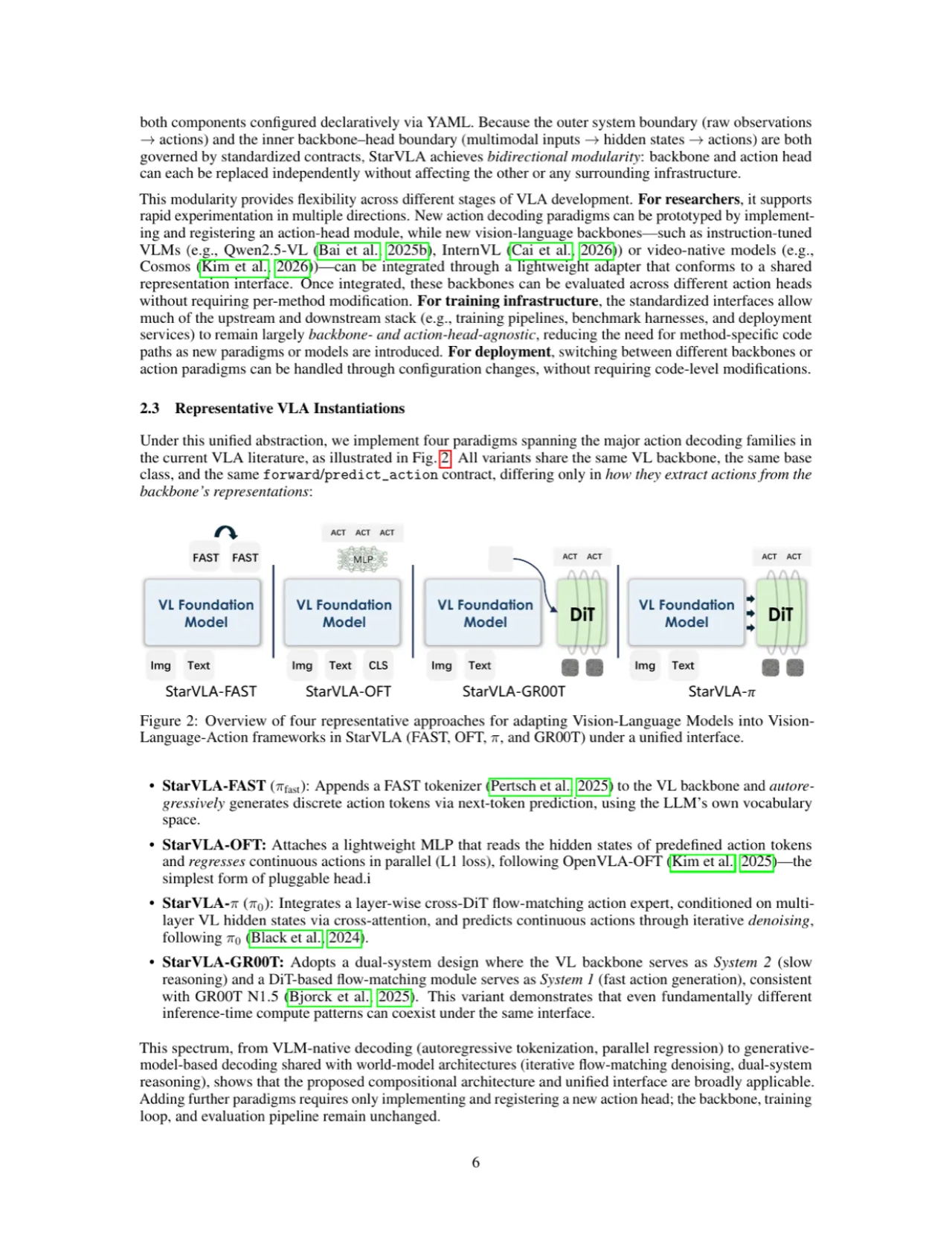
StarVLA-α 将策略分解为两个显式组件:VL backbone(视觉-语言表征)与 action head(动作解码)。四种代表性配置:StarVLA-α decomposes the policy into two explicit components: VL backbone (vision-language representation) and action head (action decoding). Four representative configurations:
StarVLA-FAST:在 VL backbone 后追加 FAST tokenizer(Patrick et al., 2025)进行离散动作预测;StarVLA-FAST: appends a FAST tokenizer (Patrick et al., 2025) after the VL backbone for discrete action prediction;
StarVLA-OFT:使用轻量 MLP head 做直接连续动作回归(τ-style);StarVLA-OFT: uses a lightweight MLP head for direct continuous action regression (τ-style);
StarVLA-GR00T:整合层级式跨帧 cross-DiT action expert,专为连续操作;StarVLA-GR00T: integrates a hierarchical cross-frame cross-DiT action expert, designed for continuous manipulation;
StarVLA-α(主要基线):在 System 1 类 flow-matching 解码器上构建,以 VL backbone 隐状态为条件,在多个基准上表现最为一致。StarVLA-α (main baseline): built on a System 1-style flow-matching decoder conditioned on the VL backbone hidden states; it is the most consistent performer across benchmarks.
图 3:四种 StarVLA 框架变体(StarVLA-FAST / OFT / GR00T / StarVLA-α)共享相同的 VL backbone 和 I/O 接口,仅在 action decoding 策略上不同。这种组合式设计允许在受控条件下公平比较不同解码头。Figure 3: The four StarVLA framework variants (StarVLA-FAST / OFT / GR00T / StarVLA-α) share the same VL backbone and I/O interface and differ only in their action decoding strategy. This compositional design allows a fair comparison of different decoding heads under controlled conditions.
极简数据处理(Minimal Data Processing)Minimal Data Processing
为提升跨体现泛化,StarVLA-α 采用极简数据 pipeline:输入为 RGB 图像(无任何 benchmark 专属预处理),语言指令作为提示。动作归一化遵循 zero-mean、unit-variance。模型使用训练-测试对齐的 split only(不使用 history stacking 或 image augmentation),确保实验可复现性。To improve cross-embodiment generalization, StarVLA-α adopts a minimal data pipeline: the inputs are RGB images (without any benchmark-specific preprocessing), with language instructions as prompts. Action normalization follows zero-mean, unit-variance. The model uses only train-test aligned splits (no history stacking or image augmentation), ensuring experimental reproducibility.
03实验 ExperimentsExperiments
在 LIBERO、SimplerEnv、RoboTwin 2.0、RoboCasa-GR1 四大主流 benchmark 上进行统一多 benchmark 训练,使用各自官方评估协议。以 LIBERO 为例,每个任务集 10 个任务,每任务 500 次训练演示,50 次 episodes per task 评估。Unified multi-benchmark training is carried out on the four mainstream benchmarks LIBERO, SimplerEnv, RoboTwin 2.0 and RoboCasa-GR1, using each benchmark's official evaluation protocol. Taking LIBERO as an example, each task suite has 10 tasks, with 500 training demonstrations per task and 50 episodes per task for evaluation.
LIBERO 性能对比LIBERO Performance Comparison
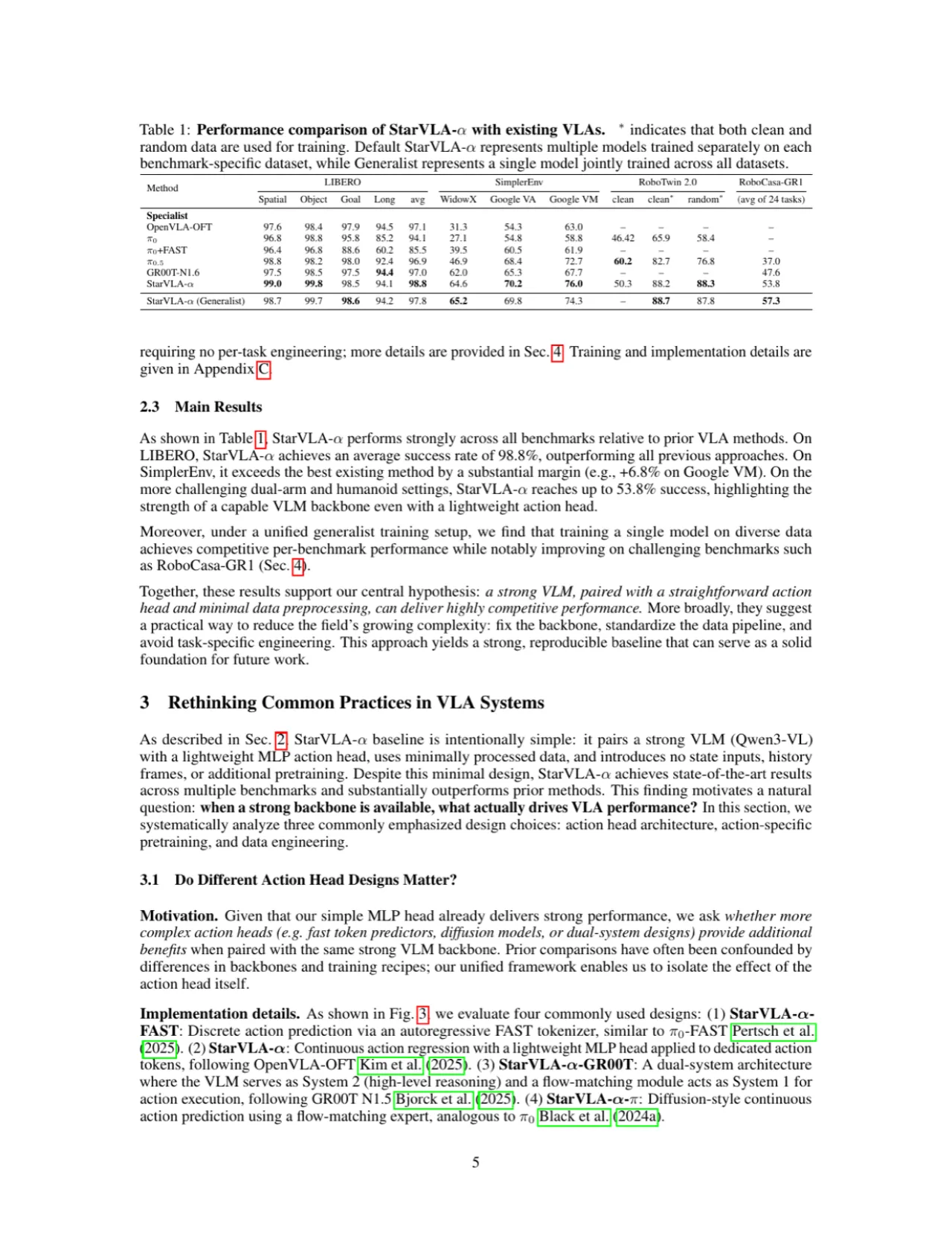
表 2:StarVLA-α 与现有 VLA 方法在 LIBERO 各任务集(Spatial、Object、Goal、Long)的性能对比。StarVLA-α 仅使用 30K steps,在 Spatial 89.4、Object 94.4、Goal 91.8、Long 87.6 的成绩(平均 90.8%)下显著优于 GR00T N1.5-score 63.5 和 85.9%。注意 StarVLA-α 在统一多 benchmark 训练下无需任何任务特定工程。Table 2: Performance comparison between StarVLA-α and existing VLA methods on the LIBERO task suites (Spatial, Object, Goal, Long). Using only 30K steps, StarVLA-α reaches Spatial 89.4, Object 94.4, Goal 91.8 and Long 87.6 (average 90.8%), clearly outperforming GR00T N1.5-score 63.5 and 85.9%. Note that StarVLA-α needs no task-specific engineering under unified multi-benchmark training.
在公开 real-world RoboChallenge benchmark 上,单一泛化模型(StarVLA-α)以 20% 优势超越 π₀.₅。这是本文最突出的结果,表明极简设计在真实机器人部署中同样有效。On the public real-world RoboChallenge benchmark, a single generalist model (StarVLA-α) surpasses π₀.₅ by a 20% margin. This is the paper's most striking result, indicating that the minimal design is equally effective in real-robot deployment.
数据工程消融Data Engineering Ablation
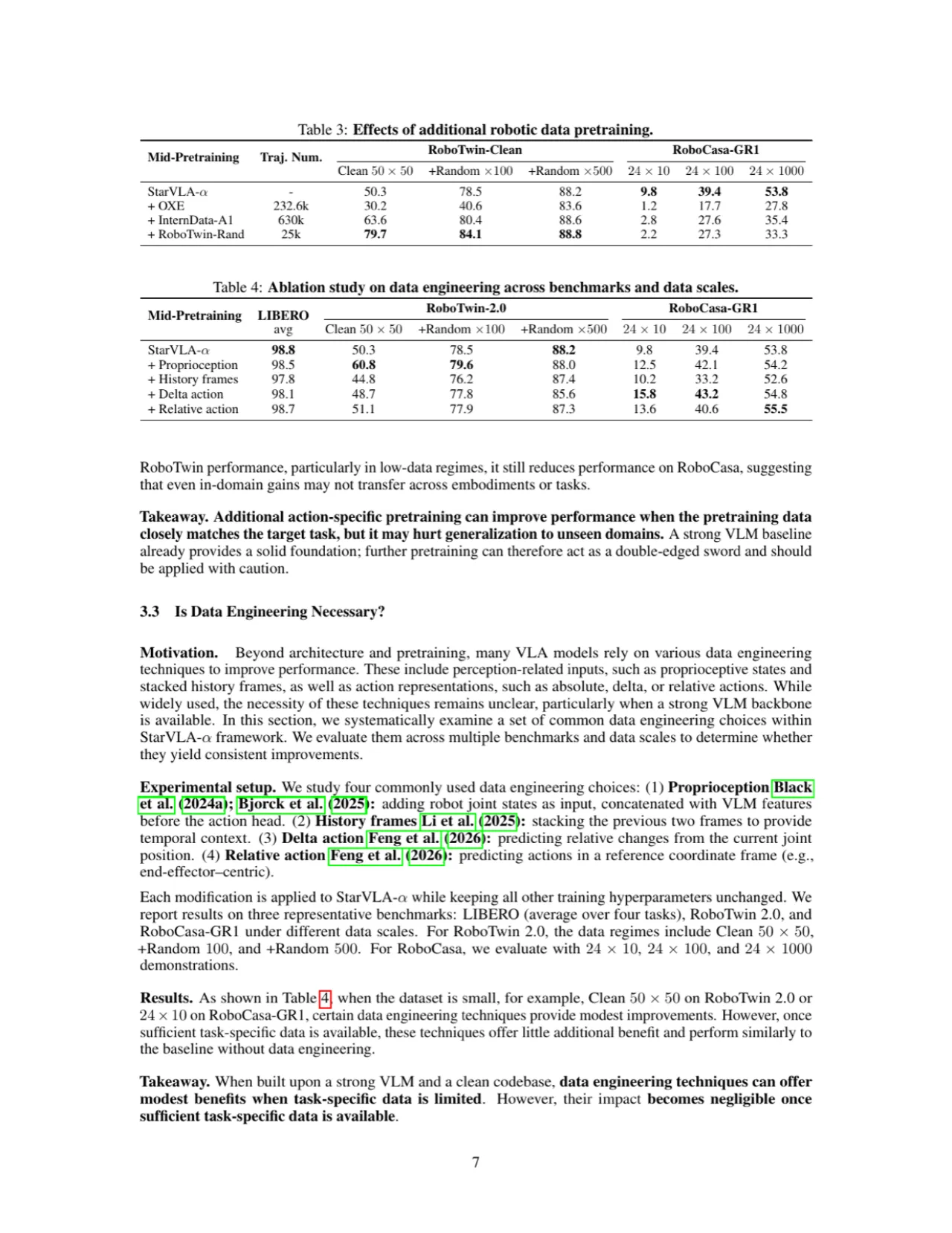
表 3(节选):数据工程消融实验。在 RoboTwin 2.0 和 RoboCasa-GR1 benchmark 上评估 history stacking、proprioception inputs 和 relative actions 等常用技巧的影响。结果显示,数据特定工程在 RoboTwin 2.0 上收益有限(StarVLA-α base ≈ 90.8,+all data eng. ≈ 90.8),而在 RoboCasa-GR1 上可带来一定提升,但对于统一训练设置效果不一致。Table 3 (excerpt): Data engineering ablation. The effect of common tricks such as history stacking, proprioception inputs and relative actions is evaluated on the RoboTwin 2.0 and RoboCasa-GR1 benchmarks. The results show that data-specific engineering brings limited gains on RoboTwin 2.0 (StarVLA-α base ≈ 90.8, +all data eng. ≈ 90.8), while it does help somewhat on RoboCasa-GR1, though the effect is inconsistent under the unified training setting.
核心发现总结Summary of Key Findings
跨多 benchmark 统一训练,同一极简基线仍高度竞争,不依赖额外架构复杂度或工程技巧。Under unified training across multiple benchmarks, the same minimal baseline remains highly competitive without relying on extra architectural complexity or engineering tricks.
Action-specific robot pretraining 通过整合大规模机器人数据(如 pi-data)可带来提升,但领域对齐数据的质量比数量更关键。Action-specific robot pretraining can bring gains by incorporating large-scale robot data (such as pi-data), but the quality of domain-aligned data matters more than its quantity.
数据工程技巧(history stacking、proprioception、relative actions)提供的增益呈现任务/数据尺度依赖性,在统一 benchmark 训练设置下收益往往有限。The gains from data engineering tricks (history stacking, proprioception, relative actions) are task- and data-scale-dependent, and are often limited under a unified benchmark training setup.
架构和流水线复杂度(auxiliary inputs、复杂 action 表示、多阶段训练)提供的收益小于预期,常常是 context-dependent 而非普适的。The gains from architectural and pipeline complexity (auxiliary inputs, complex action representations, multi-stage training) are smaller than expected, and are frequently context-dependent rather than universal.
04局限性 LimitationsLimitations
说明:以下局限性综合来自论文明确陈述(stated)与设计推断(inferred),已逐条标注。Note: The limitations below combine points explicitly stated in the paper with ones inferred from its design; each is labelled accordingly.
StarVLA-α 主要在仿真 benchmark(LIBERO、SimplerEnv、RoboTwin、RoboCasa)上评估,真实机器人实验仅限于 RoboChallenge 公开榜单。仿真到真实的迁移(sim-to-real gap)问题并未系统研究。StarVLA-α is evaluated mainly on simulation benchmarks (LIBERO, SimplerEnv, RoboTwin, RoboCasa), and its real-robot experiments are limited to the public RoboChallenge leaderboard. The sim-to-real gap is not studied systematically.
泛化能力在分布外场景中的局限(inferred)Limited generalization in out-of-distribution settings (inferred)
作者证明统一训练可以跨体现泛化,但实验设置仍局限于论文所选的四个 benchmark 内分布。对于全新物体、新场景或开放世界任务,当前框架的泛化能力尚未验证。The authors show that unified training can generalize across embodiments, but the experimental setup stays within the in-distribution range of the four benchmarks chosen in the paper. For entirely new objects, new scenes or open-world tasks, the framework's generalization has not been verified.
数据工程效果的复杂性(stated)Complexity of data engineering effects (stated)
论文揭示数据工程技巧(history stacking、proprioception、relative actions)的效果具有高度任务和数据尺度依赖性。这意味着在新任务或新体现上,用户仍需进行 benchmark 特定的消融实验,无法直接套用"最优"配置。The paper reveals that the effects of data engineering tricks (history stacking, proprioception, relative actions) are highly dependent on task and data scale. This means that on new tasks or new embodiments, users still have to run benchmark-specific ablations and cannot simply reuse an “optimal” configuration.
仅评估有限的 action modeling 策略(inferred)Only a limited set of action modeling strategies evaluated (inferred)
尽管比较了 FAST、OFT、GR00T 和 StarVLA-α 四种解码头,但仍未覆盖所有主流策略(如 diffusion policy、ACT 等),结论的普适性受限于所选设计空间。Although four decoding heads (FAST, OFT, GR00T and StarVLA-α) are compared, not all mainstream strategies are covered (for example diffusion policy and ACT), so the generality of the conclusions is limited by the chosen design space.