机器人 · Robotics · cs.RO · Jun 2026Robotics · cs.RO · Jun 2026
Spline Policy: 机器人策略的结构化表示Spline Policy: A Structured Representation for Robot Policies
用样条参数替代动作块——在不改变策略主干的前提下,赋予策略连续轨迹、流场与不确定性感知能力Replacing action chunks with spline parameters — endowing a policy with continuous trajectories, flow fields and uncertainty awareness without altering its backbone
Mengze Tian · Yiming Li · Sichao Liu · Auke Ijspeert · Sylvain Calinon EPFL · Idiap Research Institute
现代模仿学习策略通常以固定分辨率的动作块(action chunks)为输出,丧失了轨迹的几何与时序结构。本文提出 Spline Policy(SP):将策略输出替换为样条参数,在保持主干网络不变的同时,使预测对象从离散序列升级为紧凑的连续轨迹,并自然支持多时间分辨率解码、参数空间约束处理、不确定性传播,以及基于解析距离场的闭环流场执行。Modern imitation-learning policies typically output fixed-resolution action chunks, discarding the geometric and temporal structure of the trajectory. This work proposes Spline Policy (SP): the policy output is replaced by spline parameters so that, with the backbone network left unchanged, the predicted object is upgraded from a discrete sequence to a compact continuous trajectory, naturally supporting multi-resolution temporal decoding, constraint handling in parameter space, uncertainty propagation, and closed-loop flow-field execution based on an analytical distance field.
现有的模仿学习策略(ACT、Diffusion Policy、FMP、VLA 等)以固定长度的动作序列(action chunk)为输出。这种设计简洁有效,但缺乏几何连续性、时序结构与控制接口:输出的点序列无法直接表达速度、加速度约束,也无法在参数空间内完成轨迹修正或不确定性量化。Existing imitation-learning policies (ACT, Diffusion Policy, FMP, VLA and others) output fixed-length action sequences (action chunks). The design is simple and effective, but it lacks geometric continuity, temporal structure and a control interface: the emitted point sequence cannot directly express velocity or acceleration constraints, nor can it support trajectory correction or uncertainty quantification in parameter space.
"Modern imitation-learning policies for robot manipulation often represent actions as fixed-resolution action chunks, which are simple and effective but expose limited geometric and temporal structure before execution."
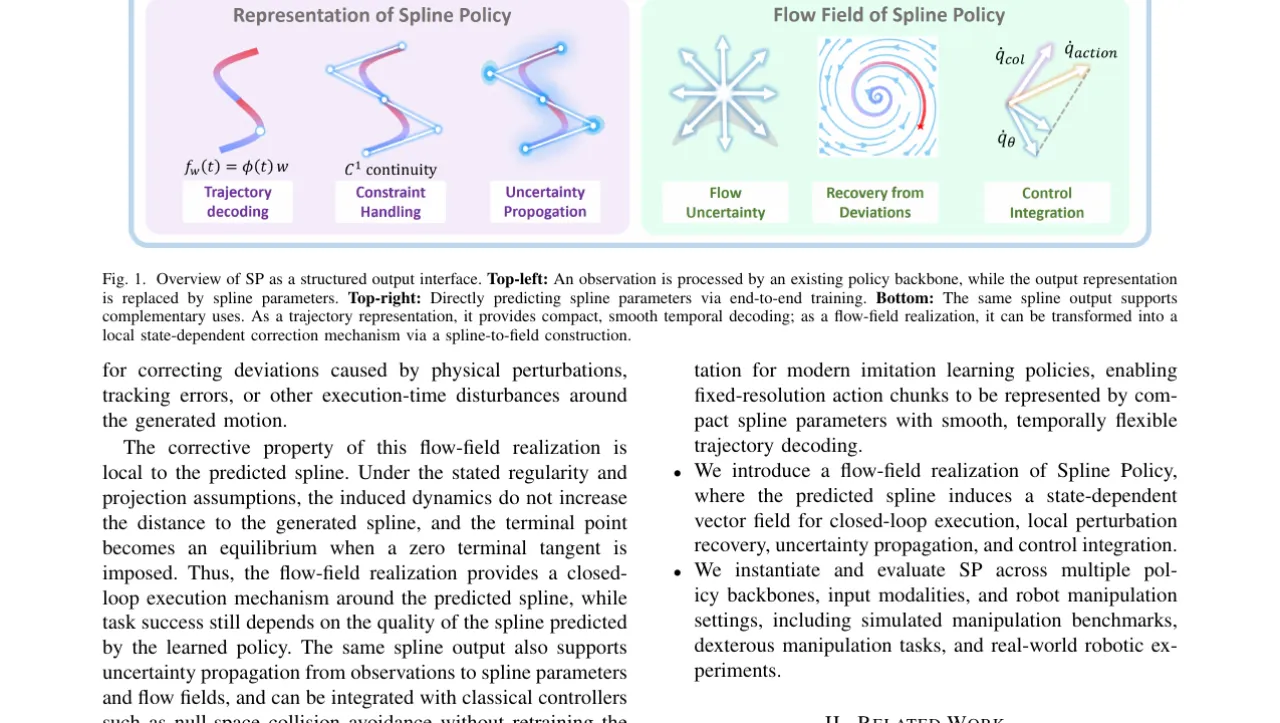
图 1:SP 系统概览。 左上:策略主干不变,输出接口替换为样条参数,经 Spline Layer 解码为连续轨迹。右上:端到端训练直接对样条参数求导,损失可穿透解码层反传至主干。下:同一样条输出既可作为轨迹解码(Trajectory decoding),也可通过样条到流场的变换(Spline-to-Field)用于闭环执行,提供扰动恢复与控制器兼容性。Figure 1: SP system overview. Top left: the policy backbone is unchanged and only the output interface is replaced by spline parameters, decoded into a continuous trajectory by the Spline Layer. Top right: end-to-end training differentiates directly with respect to the spline parameters, and the loss back-propagates through the decoding layer into the backbone. Bottom: the same spline output serves either as trajectory decoding, or, through the Spline-to-Field transform, for closed-loop execution, providing perturbation recovery and controller compatibility.
10/10SP-PI05 在 PushT 真实任务 成功率success rate of SP-PI05 on the real-world PushT task
C¹样条连续性保证 跨 replanning 边界spline continuity guaranteed across replanning boundaries
02方法Method
SP 的核心思想是只改变输出接口,不改变感知主干。给定观测 o,策略主干输出样条参数 w_θ(o),由拼接样条基函数 φ(t) 解码为连续轨迹 f_{w_θ(o)}(t) = φ(t) w_θ(o)。在此基础上,SP 提供三类结构化操作:轨迹解码、参数空间约束处理,以及不确定性传播。对于二次样条,还可进一步将轨迹转化为基于解析距离场的向量流场(flow field),支持闭环执行。The core idea of SP is to change only the output interface, not the perception backbone. Given an observation o, the policy backbone outputs spline parameters w_θ(o), which the concatenated spline basis φ(t) decodes into a continuous trajectory f_{w_θ(o)}(t) = φ(t) w_θ(o). On this basis SP provides three kinds of structured operation: trajectory decoding, constraint handling in parameter space, and uncertainty propagation. For quadratic splines the trajectory can further be turned into a vector flow field derived from an analytical distance field, which supports closed-loop execution.
策略主干保持感知编码与序列建模能力,Spline Layer 在推理时将样条参数实时解码为任意分辨率轨迹;训练时梯度通过 ∂L_s/∂θ → ∂L_s/∂f_{w_θ} → ∂w_θ/∂θ 链式反传。The policy backbone retains its perceptual encoding and sequence-modelling capacity, while the Spline Layer decodes the spline parameters into trajectories of arbitrary resolution at inference time; during training the gradient back-propagates along the chain ∂L_s/∂θ → ∂L_s/∂f_{w_θ} → ∂w_θ/∂θ.
结构化轨迹解码(Structured Decoding)Structured Decoding
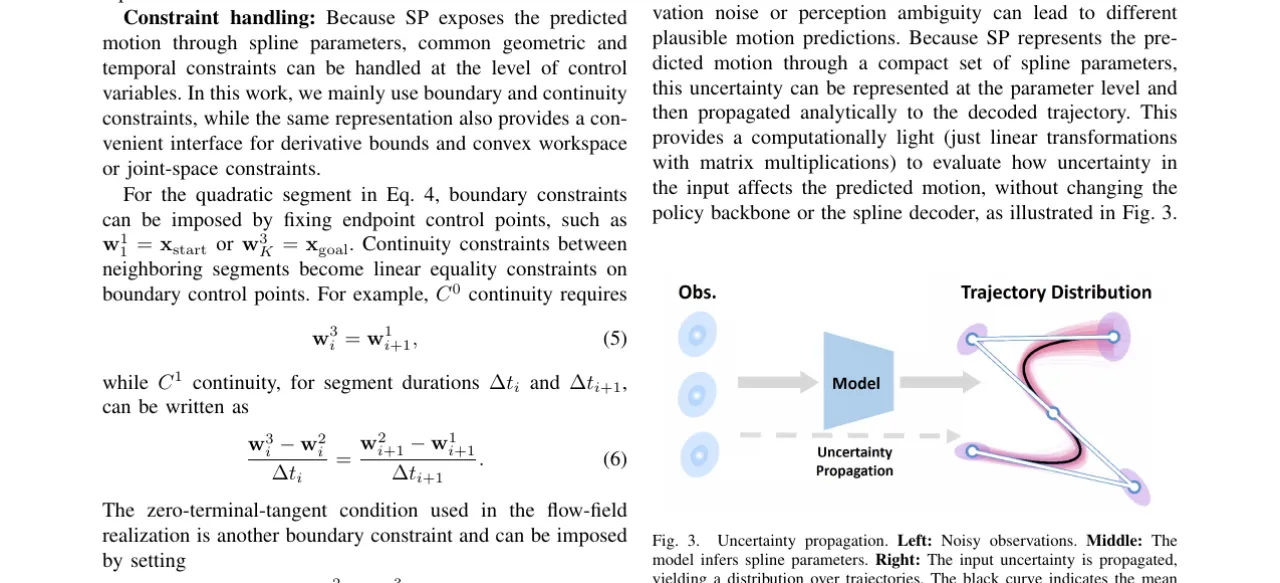
策略输出 K 段拼接二次 Bernstein 样条,每段由 3 个控制点参数化。连续性约束(C⁰、C¹、C²)通过相邻段端点的线性等式约束施加,无需修改网络结构。同一套样条参数可在不同控制频率下解码,解耦了策略学习频率与下游控制器频率。The policy outputs K concatenated quadratic Bernstein spline segments, each parameterised by 3 control points. Continuity constraints (C⁰, C¹, C²) are imposed as linear equality constraints on the endpoints of adjacent segments, requiring no change to the network architecture. The same set of spline parameters can be decoded at different control frequencies, decoupling the policy learning frequency from the frequency of the downstream controller.
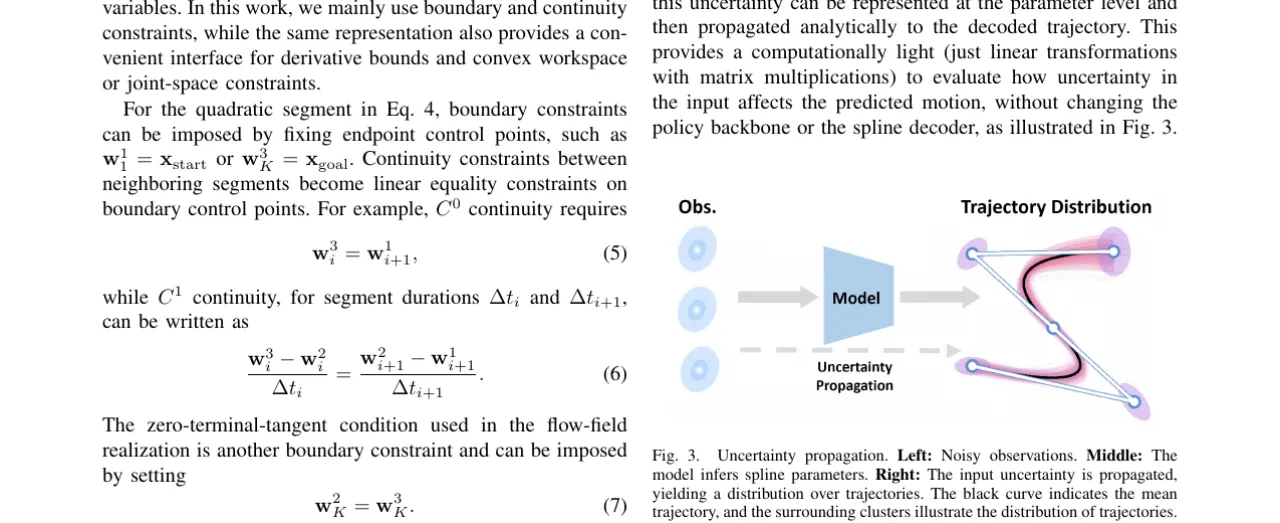
图 2:连续性约束。 左:无约束;中:C⁰ 连续(位置连接相邻段);右:C¹ 连续(额外保证速度连续),使重规划时轨迹更平滑。Figure 2: Continuity constraints. Left: unconstrained; middle: C⁰ continuity (positions join adjacent segments); right: C¹ continuity (velocity continuity additionally guaranteed), which makes trajectories smoother under replanning.图 3:不确定性传播。 观测噪声通过样条参数分布 w_θ(o) ~ N(μ_w, Σ_w) 线性传播到轨迹分布,只需矩阵乘法,无需修改主干或解码器。Figure 3: Uncertainty propagation. Observation noise propagates linearly into the trajectory distribution through the spline-parameter distribution w_θ(o) ~ N(μ_w, Σ_w), requiring only matrix multiplication and no modification of the backbone or the decoder.
对于二次样条,样条到距离场的解析变换 [文献23] 给出从任意状态 x 到样条的有符号距离 d_θ(x) 及法向量 n_θ(x)。SP 流场由两项叠加构成:For quadratic splines, the analytical spline-to-distance-field transform [Ref. 23] gives the signed distance d_θ(x) from an arbitrary state x to the spline, together with the normal vector n_θ(x). The SP flow field is the superposition of two terms:
吸引项 v_att(x) = α(x) n_θ(x):将偏离状态拉回样条曲线(α ≤ 0)。Attraction term v_att(x) = α(x) n_θ(x): pulls a deviating state back onto the spline curve (α ≤ 0).
推进项 v_prog(x) = β(x) f̂_θ(x):沿切线方向推动机器人前进(β ≥ 0)。Progression term v_prog(x) = β(x) f̂_θ(x): drives the robot forward along the tangent direction (β ≥ 0).
可以证明,在正则性与投影假设下,该流场的诱导动力学不增加到样条的距离(Lyapunov 分析见附录 VII-B),终点处切线为零时终点成为吸引子,提供原则上的局部修正机制。It can be shown that, under regularity and projection assumptions, the dynamics induced by this flow field never increase the distance to the spline (Lyapunov analysis in Appendix VII-B); when the tangent vanishes at the terminal point, that point becomes an attractor, giving a principled local correction mechanism.
SP 流场可映射至配置空间:q̇_θ = J^†_ψ(q) F_θ(ψ(q))。当障碍物靠近时,基于机器人有符号距离场 Γ_SDF 的碰撞回避速度 q̇_col 被赋予更高优先级,SP 速度投影至其零空间:q̇_θ,proj = (I − ∇_q Γ^† ∇_q Γ) q̇_θ,最终命令 q̇_action = q̇_col + q̇_θ,proj。全程无需重训练策略主干。The SP flow field can be mapped into configuration space: q̇_θ = J^†_ψ(q) F_θ(ψ(q)). When an obstacle comes close, the collision-avoidance velocity q̇_col derived from the robot signed distance field Γ_SDF is given higher priority and the SP velocity is projected into its null space: q̇_θ,proj = (I − ∇_q Γ^† ∇_q Γ) q̇_θ, with the final command q̇_action = q̇_col + q̇_θ,proj. Throughout, no retraining of the policy backbone is required.
03实验Experiments
实验分三个层次:低维 LASA 基准(分析流场机制)、仿真操控基准(SP 作为轨迹输出接口与动作块基线对比)、以及真实机器人案例研究(展示部署层面的兼容性)。主要使用 Diffusion Policy(DP)和 Flow Matching Policy(FMP)作为对齐主干,对应变体分别标记为 SP-Diff / BL-Diff、SP-Flow / BL-Flow。The experiments span three levels: the low-dimensional LASA benchmark (analysing the flow-field mechanism), simulated manipulation benchmarks (SP as a trajectory output interface compared with action-chunk baselines), and real-robot case studies (showing deployment-level compatibility). Diffusion Policy (DP) and Flow Matching Policy (FMP) are mainly used as aligned backbones, with the corresponding variants labelled SP-Diff / BL-Diff and SP-Flow / BL-Flow.
流场机制:扰动恢复与观测不确定性Flow-Field Mechanism: Perturbation Recovery and Observation Uncertainty
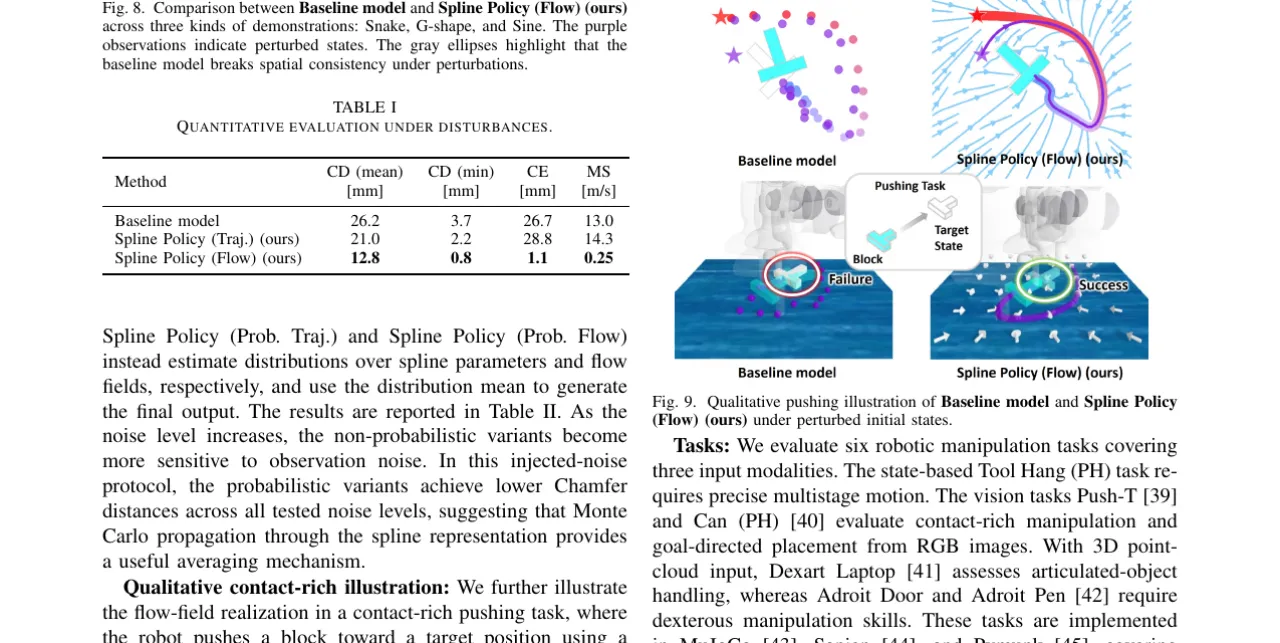
图 8:扰动恢复对比。 基线模型(Baseline model)在扰动初始状态下轨迹不一致(灰色椭圆高亮区域);Spline Policy (Flow) 通过状态依赖流场将扰动状态引导回示范轨迹。Figure 8: Perturbation recovery comparison. The baseline model produces inconsistent trajectories from perturbed initial states (grey highlighted ellipses); Spline Policy (Flow) steers the perturbed state back onto the demonstrated trajectory through a state-dependent flow field.
在 LASA 数据集(Snake、G-Shape、Sine 三种演示)的 25 次扰动实验中,Spline Policy (Flow) 在 Chamfer Distance (CD)、Convergence Error (CE)、Maximum Speed (MS) 三项指标均优于基线与 SP (Traj.)。Over 25 perturbation trials on the LASA dataset (three demonstrations: Snake, G-Shape and Sine), Spline Policy (Flow) outperforms both the baseline and SP (Traj.) on all three metrics: Chamfer Distance (CD), Convergence Error (CE) and Maximum Speed (MS).
方法
CD mean [mm]
CD min [mm]
CE [mm]
MS [m/s]Method
Baseline model
26.2
3.7
26.7
13.0
Spline Policy (Traj.) ours
21.0
2.2
28.8
14.3
Spline Policy (Flow) ours
12.8
0.8
1.1
0.25
表 I:扰动条件下的定量评估。CD = Chamfer Distance;CE = Convergence Error;MS = Maximum Speed。数据来自论文 Table I。Table I: quantitative evaluation under perturbation. CD = Chamfer Distance; CE = Convergence Error; MS = Maximum Speed. Data from Table I of the paper.
在注入高斯观测噪声(σ = 10–40 mm)的实验中,概率变体 Spline Policy (Prob. Traj.) ours 在所有噪声水平下 CD 均最低,Spline Policy (Prob. Flow) ours 次之,均优于基线。具体数值见论文 Table II:σ=10 时 SP(Prob.Traj.) 达 0.7 mm,σ=40 时达 6.1 mm(基线为 20.4 mm)。In experiments injecting Gaussian observation noise (σ = 10–40 mm), the probabilistic variant Spline Policy (Prob. Traj.) ours attains the lowest CD at every noise level, with Spline Policy (Prob. Flow) ours second, both better than the baseline. For exact values see Table II of the paper: SP(Prob.Traj.) reaches 0.7 mm at σ=10 and 6.1 mm at σ=40 (baseline 20.4 mm).
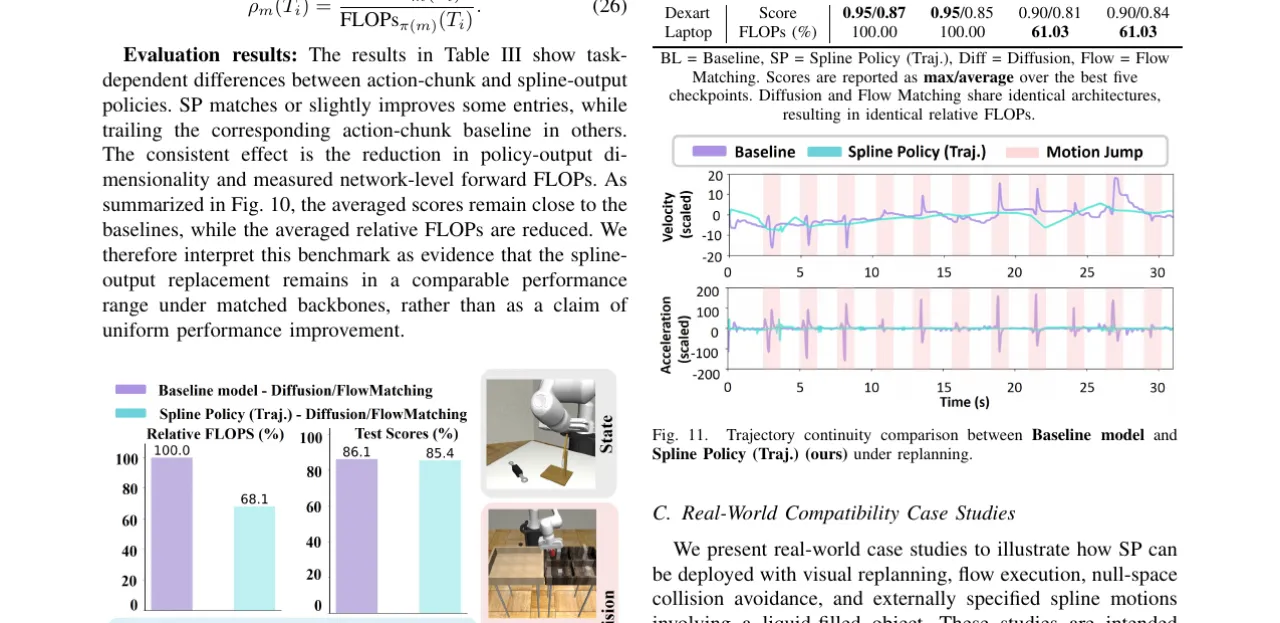
图 10:仿真基准对比。 SP 在 State / Vision / Point Cloud 三类输入上与 BL-Diff / BL-Flow 对齐主干对比。任务得分基本持平,而 SP 的 Relative FLOPs 降低至 68.1%(State)、86.1%(Vision)、85.4%(Point Cloud),即在相当性能下网络前向计算量更少。Figure 10: Simulation benchmark comparison. SP is compared with the aligned BL-Diff / BL-Flow backbones on three input types: State, Vision and Point Cloud. Task scores are essentially on par, while the Relative FLOPs of SP drop to 68.1% (State), 86.1% (Vision) and 85.4% (Point Cloud), i.e. fewer network forward operations at comparable performance.
SP 在六个任务上(Tool Hang、Can、Push-T、Adroit Door、Adroit Pen、Dexart Laptop)的平均得分与基线相当,"consistent effect is the reduction in policy-output dimensionality and measured network-level forward FLOPs"(引自论文),不作为性能均匀提升的主张,而是等效性能下更高效的证据。The average score of SP on the six tasks (Tool Hang, Can, Push-T, Adroit Door, Adroit Pen, Dexart Laptop) is comparable to the baseline; the "consistent effect is the reduction in policy-output dimensionality and measured network-level forward FLOPs" (quoted from the paper). This is not claimed as a uniform performance gain, but as evidence of greater efficiency at equivalent performance.
在 Push-T 任务的重规划实验中,Spline Policy (Traj.) 可施加跨 replanning 边界的 C¹ 连续性,使速度曲线平滑;基线动作块在 replanning 边界处出现速度不连续("Motion Jump"),加速度更剧烈。In the replanning experiment on the Push-T task, Spline Policy (Traj.) can enforce C¹ continuity across replanning boundaries, giving a smooth velocity profile; the action-chunk baseline shows velocity discontinuities at replanning boundaries ("Motion Jump") with more violent accelerations.
真实机器人案例(ALOHA 平台)Real-Robot Case Studies (ALOHA Platform)
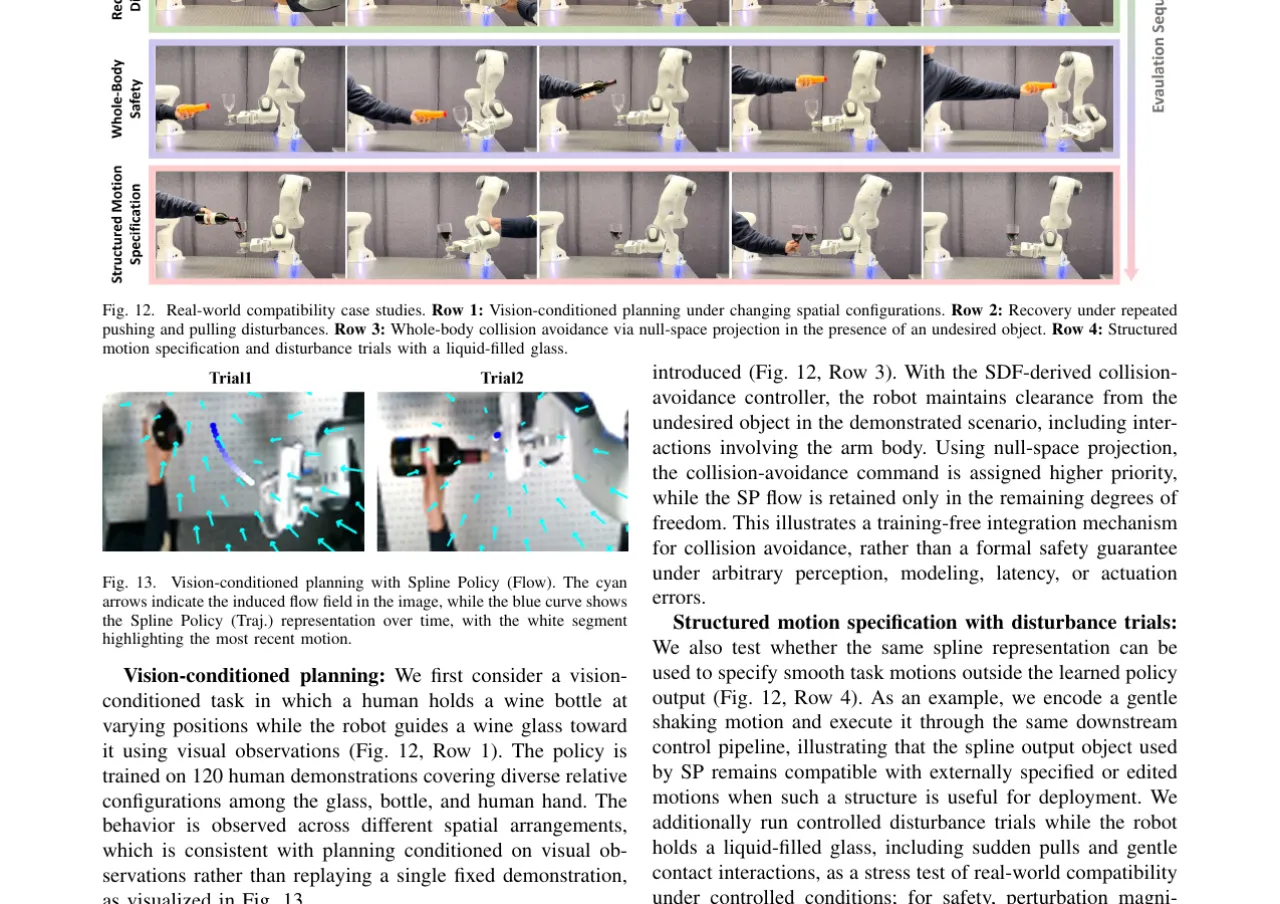
图 12:真实机器人兼容性案例。 Row 1:视觉条件规划(视野变化下追踪酒瓶位置);Row 2:推拉扰动下恢复;Row 3:null-space 碰撞回避(未重训练主干);Row 4:外部指定样条运动(盛满液体的玻璃杯扰动测试)。Figure 12: real-robot compatibility case studies. Row 1: vision-conditioned planning (tracking the bottle position under a changing field of view); Row 2: recovery under push-and-pull perturbation; Row 3: null-space collision avoidance (backbone not retrained); Row 4: externally specified spline motion (perturbation test with a glass full of liquid).
真实机器人成功率(Table V,SP-Traj. 不同主干,10 次试验):Real-robot success rates (Table V, SP-Traj. with different backbones, 10 trials):
任务
SP-ACT
SP-Diff
SP-PI05Task
PushT
0/10
6/10
10/10
Toy packing
5/10
8/10
9/10
注:三种主干(ACT 52M、Diffusion 270M、PI05 VLA 4B)共用 SP 轨迹接口,主干规模差异导致性能差异,非 SP 接口本身对比。数据来自论文 Table V。Note: the three backbones (ACT 52M, Diffusion 270M, PI05 VLA 4B) share the same SP trajectory interface; the performance gap follows from the difference in backbone scale and is not a comparison of the SP interface itself. Data from Table V of the paper.
04局限性Limitations
说明:以下局限性均由作者在论文结论部分(Section VI)明确陈述,标记为 stated。Note: All limitations below are explicitly stated by the authors in the conclusion of the paper (Section VI) and are marked stated.
策略主干质量仍是决定因素(stated)The quality of the policy backbone remains the decisive factor (stated)
SP 更改的是预测动作对象的表示,而非策略主干。"It does not remove the need for an accurate and expressive policy backbone. If the policy predicts an inappropriate spline, the structured decoder or the induced flow field cannot by itself guarantee task success."(引自原文)What SP changes is the representation of the predicted action, not the policy backbone. "It does not remove the need for an accurate and expressive policy backbone. If the policy predicts an inappropriate spline, the structured decoder or the induced flow field cannot by itself guarantee task success." (quoted from the paper)
流场修正仅为局部保证,不适用于高度不连续任务(stated)Flow-field correction is only a local guarantee and does not suit highly discontinuous tasks (stated)
"The distance-to-spline corrective property applies to the generated motion under the assumptions of the analytical construction, not to arbitrary task objectives or arbitrary off-manifold states. SP may also be less suitable for highly discontinuous or dynamic interactions, such as hitting a moving object, where additional task-specific modeling or engineering may be required."(引自原文)"The distance-to-spline corrective property applies to the generated motion under the assumptions of the analytical construction, not to arbitrary task objectives or arbitrary off-manifold states. SP may also be less suitable for highly discontinuous or dynamic interactions, such as hitting a moving object, where additional task-specific modeling or engineering may be required." (quoted from the paper)
解析流场仅限于拼接二次样条(stated)The analytical flow field is restricted to concatenated quadratic splines (stated)
当前解析距离场与流场构建依赖拼接二次样条的 C⁰/C¹ 连续性。"Extending the construction to broader spline families and evaluating uncertainty-aware or constraint-aware execution policies are important directions for future work."(引自原文)The present analytical distance field and flow-field construction rely on the C⁰/C¹ continuity of concatenated quadratic splines. "Extending the construction to broader spline families and evaluating uncertainty-aware or constraint-aware execution policies are important directions for future work." (quoted from the paper)
真实机器人实验非受控对比(stated)The real-robot experiments are not controlled comparisons (stated)
真实机器人实验为兼容性案例研究,"intended as system-level demonstrations of compatibility, rather than controlled comparisons against action-chunk policies"(引自原文)。不同主干的模型规模、预训练、优化器与训练时长均不同,成功率差异不能单独归因于主干架构。The real-robot experiments are compatibility case studies, "intended as system-level demonstrations of compatibility, rather than controlled comparisons against action-chunk policies" (quoted from the paper). Model scale, pre-training, optimiser and training length all differ across backbones, so the differences in success rate cannot be attributed to backbone architecture alone.