SONIC: Supersizing Motion Tracking for Natural Humanoid Whole-Body Control
通过规模化运动跟踪,构建通用 humanoid 控制基础模型Scaling up motion tracking toward a general-purpose foundation model for humanoid control
Zhengyi Luo, Ye Yuan, Tingwu Wang, Chenran Li, Fernando Castañeda, Sirui Chen, Zi-Ang Cao, Jiefeng Li, David Minor, 等 · NVIDIAZhengyi Luo, Ye Yuan, Tingwu Wang, Chenran Li, Fernando Castañeda, Sirui Chen, Zi-Ang Cao, Jiefeng Li, David Minor, et al. · NVIDIA
SONIC 将 motion tracking 定位为 humanoid 控制的核心可扩展任务,通过同时放大网络规模、数据量和计算量,训练出能够自然、稳健地执行全身运动的基础模型。
系统核心是一个统一 token 空间(unified token space),将机器人运动、人体运动和混合运动统一编码,支持 VR teleoperation、视频遥控、VLA 模型等多种控制接口。SONIC positions motion tracking as the core scalable task of humanoid control, and by simultaneously scaling up network size, data volume and compute it trains a foundation model that performs whole-body motion naturally and robustly. At the heart of the system lies a unified token space that jointly encodes robot motion, human motion and hybrid motion, supporting control interfaces such as VR teleoperation, video teleoperation and VLA models.
大语言模型已证明"规模即能力",但 humanoid 控制领域至今未能复现这一增益:现有神经控制器参数规模有限、行为种类单一、训练资源匮乏。
SONIC 的出发点正是弥合这一差距——证明在 humanoid 控制上同样存在清晰的 scaling law。Large language models have already proven that "scale is capability", yet the field of humanoid control has so far failed to reproduce such gains: existing neural controllers are modest in parameter size, cover a narrow set of behaviors, and are trained with scarce resources. SONIC sets out precisely to close this gap, showing that a clear scaling law holds for humanoid control as well.
"Despite the rise of billion-parameter foundation models trained across thousands of GPUs, similar scaling gains have not been shown for humanoid control. Current neural controllers for humanoids remain modest in size, target a limited set of behaviors, and are trained on a handful of GPUs."
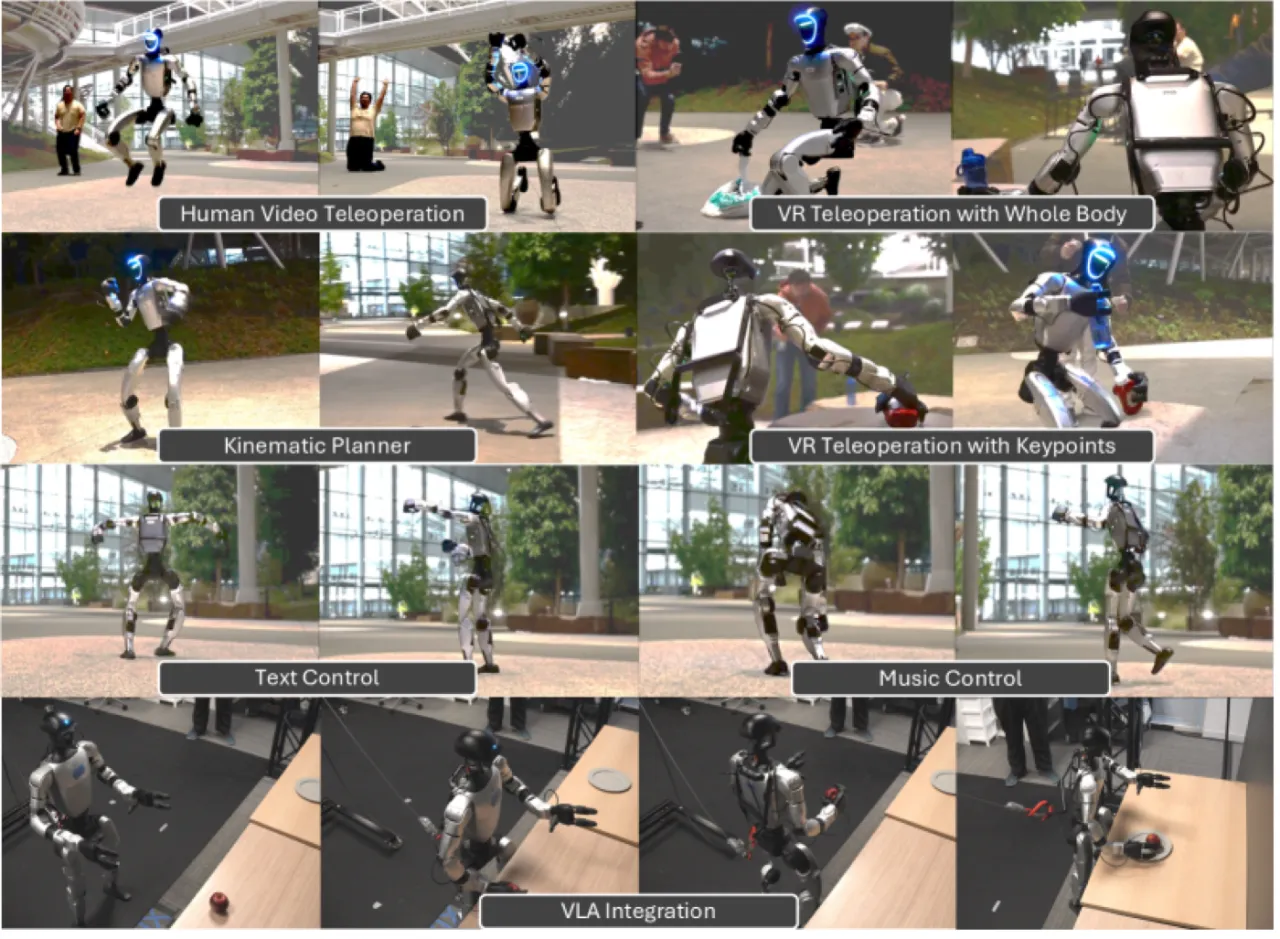
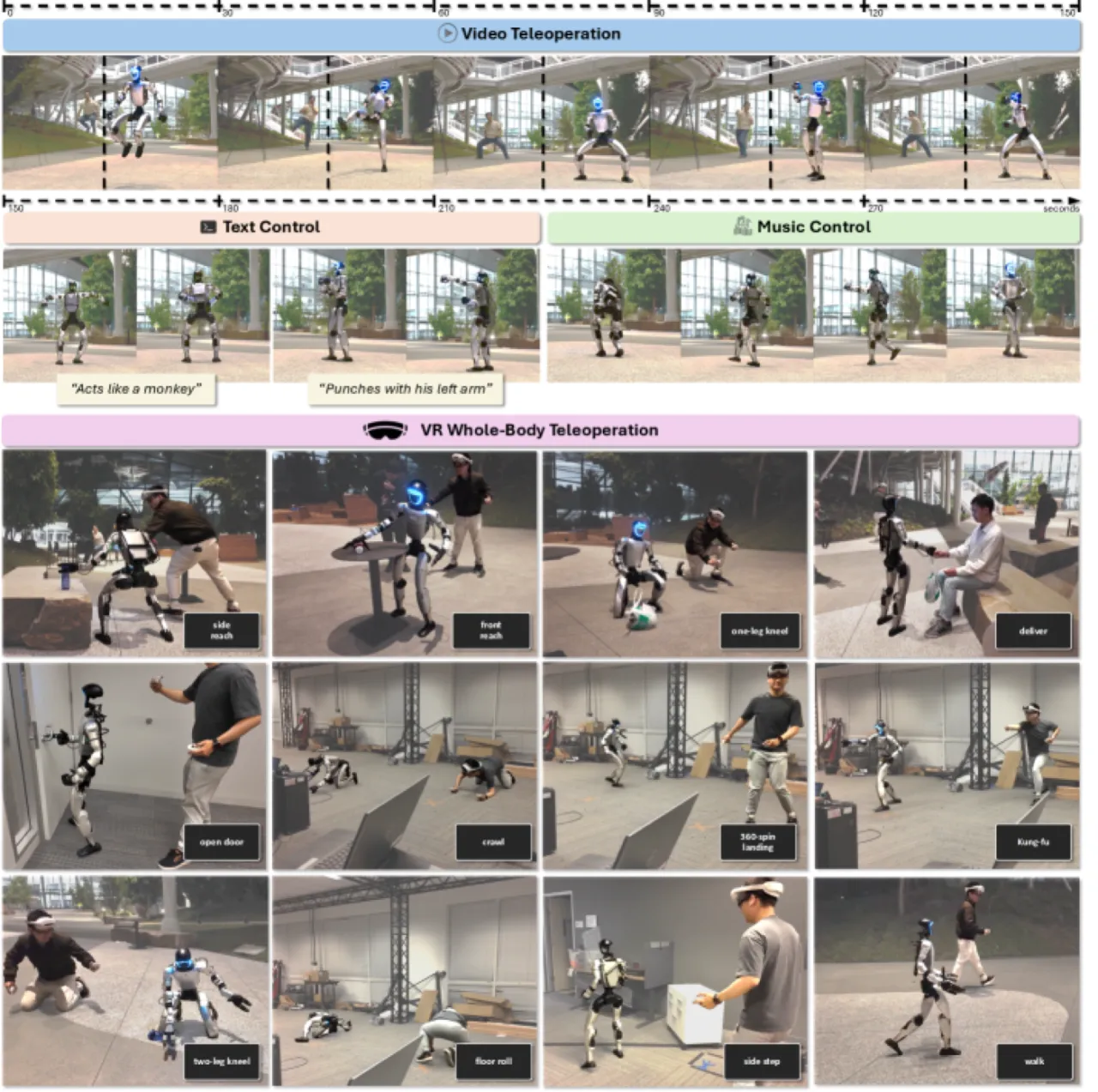
图 1:SONIC 多模态控制能力总览。
同一套通用控制策略支持跑步、跳跃、爬行、双臂操作、VR 遥控、文本/音乐驱动等多种任务,全部通过 unified token space 统一接入。Figure 1: Overview of SONIC's multimodal control capabilities. A single general-purpose control policy supports running, jumping, crawling, bimanual manipulation, VR teleoperation and text/music-driven motion, all routed through the unified token space.
42M最大模型参数量Largest model parameter count
700h运动捕捉数据(100M+ 帧)Motion capture data (100M+ frames)
21kGPU 小时训练计算量GPU-hours of training compute
95%VLA 自主操作任务成功率(20 次试验)Success rate of the VLA autonomous manipulation task (20 trials)
Motion tracking 天然适合 scaling:运动捕捉数据提供密集的监督信号,无需手工设计奖励函数;多样化数据集隐式赋予策略人体运动先验(human motion prior)。
SONIC 同时在三个维度上扩展:网络容量(1.2M → 42M 参数)、数据量(100M+ 帧,700 小时高质量 mocap)、计算量(21,000 GPU 小时)。Motion tracking is naturally suited to scaling: motion capture data provides a dense supervision signal without hand-designed reward functions, and diverse datasets implicitly endow the policy with a human motion prior. SONIC scales along three axes at once: network capacity (1.2M → 42M parameters), data volume (100M+ frames, 700 hours of high-quality mocap) and compute (21,000 GPU-hours).
02方法Method
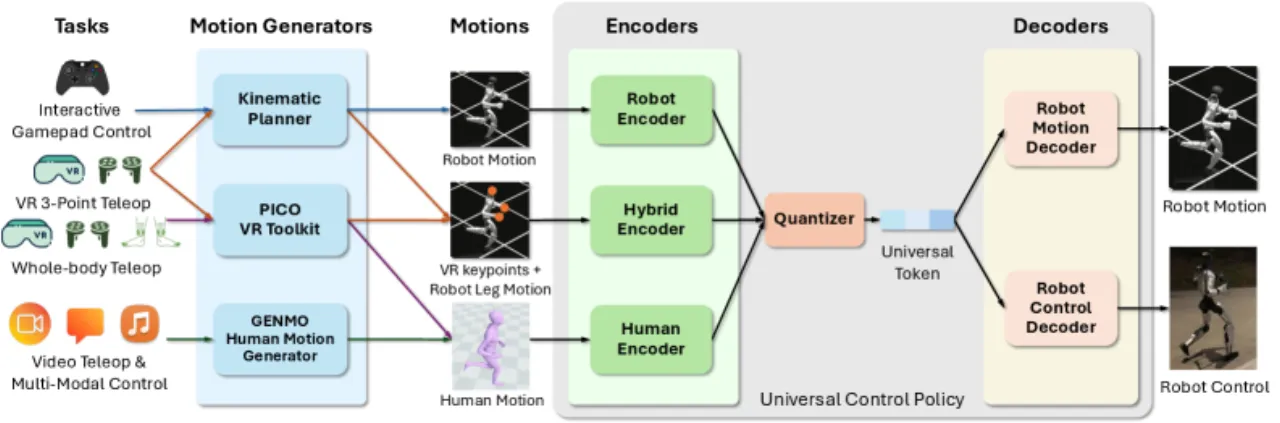
SONIC 的核心是一个编解码框架,配备三种专用编码器,将异构控制信号(机器人关节、人体 SMPL 关节、稀疏关键点)统一映射到共享 latent 空间,
再经 Finite Scalar Quantization(FSQ)量化为 universal token,最终由统一解码器输出 29 维关节位置目标。At the core of SONIC is an encoder-decoder framework equipped with three dedicated encoders that map heterogeneous control signals (robot joints, human SMPL joints, sparse keypoints) into a shared latent space; the latent is then quantized by Finite Scalar Quantization (FSQ) into a universal token, and a unified decoder finally outputs 29-dimensional joint position targets.
图 2:统一控制策略架构。
三条编码器路径分别处理机器人运动(robot encoder ℰr)、人体运动(human encoder ℰh)和混合运动(hybrid encoder ℰm),
共同输出 universal token,送入控制解码器 𝒟c 和辅助重建解码器 𝒟r。Figure 2: Architecture of the unified control policy. Three encoder paths handle robot motion (robot encoder ℰr), human motion (human encoder ℰh) and hybrid motion (hybrid encoder ℰm) respectively, jointly emitting a universal token that is fed into the control decoder 𝒟c and the auxiliary reconstruction decoder 𝒟r.
Unified Token Space(统一 token 空间)Unified Token Space
三条编码器各有分工:The three encoders divide the labor as follows:
Robot Motion Encoder(ℰr):接收未来 10 帧(0.1s 间隔)机器人关节位置/速度,适用于直接机器人运动跟踪。Robot Motion Encoder (ℰr): takes the next 10 frames (0.1s interval) of robot joint positions/velocities, and is suited to direct robot motion tracking.
Human Motion Encoder(ℰh):编码未来 10 帧(0.02s 间隔)人体 3D SMPL 关节位置,无需显式 retargeting。Human Motion Encoder (ℰh): encodes the next 10 frames (0.02s interval) of human 3D SMPL joint positions, without explicit retargeting.
所有编码器通过多层感知机(隐藏层:[2048, 1024, 512, 512])映射至共享 latent,经 FSQ 量化为 universal token。
辅助重建解码器 𝒟r 重建机器人运动,隐式实现 human-to-robot retargeting 与特征对齐。All encoders map into the shared latent through a multilayer perceptron (hidden layers: [2048, 1024, 512, 512]) and are quantized by FSQ into a universal token. The auxiliary reconstruction decoder 𝒟r reconstructs robot motion, implicitly realizing human-to-robot retargeting and feature alignment.
训练目标:四项联合损失Training Objective: Four Joint Losses
训练损失由四项组成:The training loss consists of four terms:
ℒppo:标准 Proximal Policy Optimization 强化学习损失。ℒppo: the standard Proximal Policy Optimization reinforcement learning loss.
ℒrecon:重建损失,使模型学习 human→robot 的隐式 retargeting。ℒrecon: a reconstruction loss that lets the model learn implicit human→robot retargeting.
ℒtoken:对齐损失,"measures the discrepancy between the robot token and the human motion token",驱动跨 embodiment 的表征对齐。ℒtoken: an alignment loss that "measures the discrepancy between the robot token and the human motion token", driving representation alignment across embodiments.
ℒcycle:循环一致性损失,确保跨模态转换的保真度。ℒcycle: a cycle-consistency loss ensuring the fidelity of cross-modal conversion.
为将 motion tracking 能力桥接到实际任务(如导航),SONIC 额外引入实时运动规划器:在标准笔记本上延迟 <5 ms,在 Jetson Orin GPU 上 12 ms;
每 100 ms 或接到新指令时重新规划;每段运动时长 0.8–2.4s 自动确定。速度指令范围 0.0–6.0 m/s,支持 0–360° 任意方向。To bridge motion tracking capability to practical tasks such as navigation, SONIC additionally introduces a real-time kinematic planner: latency is <5 ms on a standard laptop and 12 ms on a Jetson Orin GPU; replanning happens every 100 ms or whenever a new command arrives, and the duration of each motion segment, 0.8–2.4s, is determined automatically. Velocity commands range over 0.0–6.0 m/s and support arbitrary directions in 0–360°.
Scaling 配置Scaling Setup
训练使用 4,096 个并行环境/GPU,每环境 24 步,5 epochs,actor 学习率 2×10⁻⁵。
领域随机化涵盖摩擦系数(μs: 0.3–1.6,μa: 0.3–1.2)、质心偏移、外力扰动和运动扰动。
数据采用自适应运动采样(Adaptive Motion Sampling),以失败率为权重(β=200,混合参数 α=0.1)动态分配训练难度。Training uses 4,096 parallel environments per GPU, 24 steps per environment, 5 epochs, and an actor learning rate of 2×10⁻⁵. Domain randomization covers friction coefficients (μs: 0.3–1.6, μa: 0.3–1.2), center-of-mass offsets, external force perturbations and motion perturbations. The data uses Adaptive Motion Sampling, weighting by failure rate (β=200, mixing parameter α=0.1) to dynamically allocate training difficulty.
03实验Experiments
评测基准:9 小时重新定向的 AMASS 数据(1,602 条轨迹),规模显著大于此前工作。
核心指标:轨迹成功率 + MPJPE(Mean Per-Joint Position Error,mm)。
基线方法:Any2Track、BeyondMimic、GMT。Evaluation benchmark: 9 hours of retargeted AMASS data (1,602 trajectories), substantially larger than prior work. Core metrics: trajectory success rate and MPJPE (Mean Per-Joint Position Error, mm). Baselines: Any2Track, BeyondMimic, GMT.
Scaling 效果Scaling Results
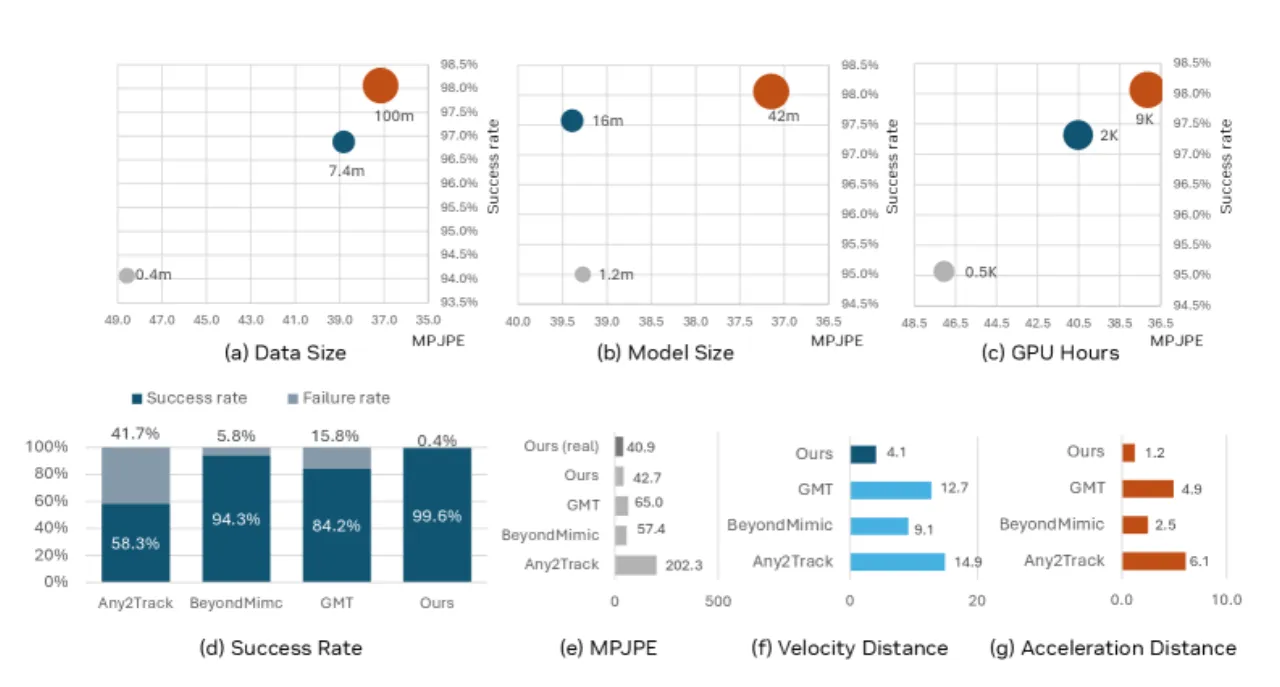
SONIC 在三个维度上均呈现单调性能提升:网络规模(1.2M → 42M 参数)、数据量(到 100M+ 帧)、计算量(到 21k GPU 小时),
其中数据多样性带来的增益最为显著。性能随计算量稳定提升,表明 motion tracking 具备良好的 scaling law 特性。SONIC shows monotone performance improvements along all three axes: network size (1.2M → 42M parameters), data volume (up to 100M+ frames) and compute (up to 21k GPU-hours), with the gain from data diversity being the most significant. Performance improves steadily with compute, indicating that motion tracking possesses favorable scaling-law behavior.
图 3:三轴 Scaling 分析。
左→右分别为数据集规模、模型参数量、计算量对 motion imitation 性能(MPJPE)的影响,以及与 Any2Track、BeyondMimic、GMT 等基线的对比。所有曲线均呈单调改善。Figure 3: Three-axis scaling analysis. From left to right: the effect of dataset size, model parameter count and compute on motion imitation performance (MPJPE), together with comparisons against baselines such as Any2Track, BeyondMimic and GMT. All curves improve monotonically.
运动跟踪性能Motion Tracking Performance
指标Metric
结果Result
说明Notes
真实世界 50 条轨迹成功率Success rate on 50 real-world trajectories
100%
涵盖舞蹈、跳跃、移动操作Covers dancing, jumping and mobile manipulation
超越基线Beats the baselines
全部指标All metrics
vs. Any2Track, BeyondMimic, GMT:成功率 + MPJPE 均优vs. Any2Track, BeyondMimic, GMT: better on both success rate and MPJPE
策略泛化Policy generalization
通过Pass
可泛化到训练集外的未见运动Generalizes to unseen motions outside the training set
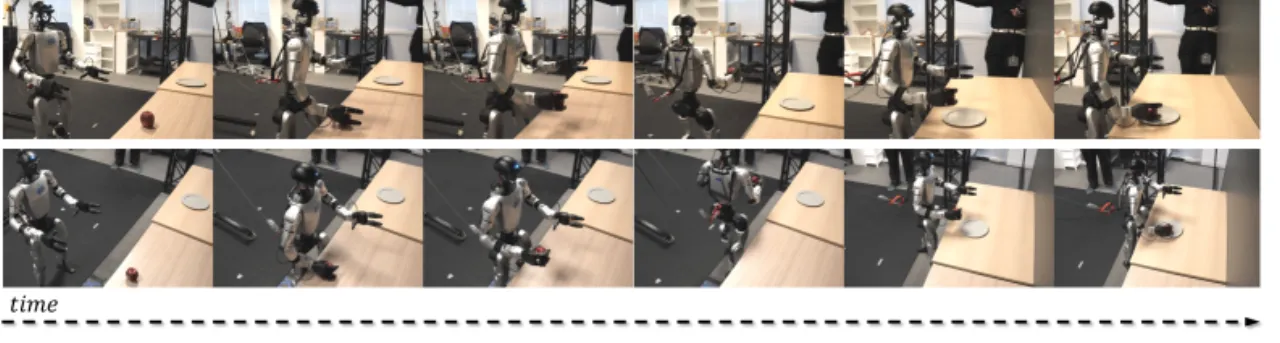
在 VR teleoperation 采集的 300 条轨迹上微调 GR00T N1.5 视觉-语言-动作模型(vision-language-action model),
然后通过 unified token space 直接将 VLA 输出的运动指令送入 SONIC 控制器,无需任何额外适配器。A GR00T N1.5 vision-language-action model is fine-tuned on the 300 trajectories collected through VR teleoperation; the motion commands output by the VLA are then fed directly into the SONIC controller through the unified token space, without any additional adapter.
图 5:苹果→盘子移动双臂操作任务。
GR00T N1.5 在 20 次试验中达到 95% 成功率,要求机器人协调双臂与双腿实现移动抓取与放置。Figure 5: Apple-to-plate mobile bimanual manipulation task. GR00T N1.5 reaches a 95% success rate over 20 trials, requiring the robot to coordinate both arms and both legs to achieve mobile grasping and placing.
消融实验Ablations
消融验证了 unified token space 各组件的必要性:去掉 ℒtoken 对齐损失后,跨 embodiment 跟踪精度显著下降;
去掉 ℒcycle 循环一致性损失后,模态转换保真度下降。数据规模是 scaling 的最大贡献因素(文中明确指出"dataset size providing the most substantial gains")。The ablations verify the necessity of each component of the unified token space: removing the ℒtoken alignment loss markedly degrades cross-embodiment tracking accuracy, and removing the ℒcycle cycle-consistency loss degrades the fidelity of modality conversion. Dataset size is the largest contributor to scaling (the paper explicitly notes "dataset size providing the most substantial gains").
04局限性Limitations
Note:以下限制部分为论文作者明确陈述(标注"stated"),部分为从设计推断(标注"inferred")。Note: Some of the limitations below are explicitly stated by the authors (marked "stated"), while others are inferred from the design (marked "inferred").
安全性、合规性与能效问题尚未正式处理(stated)Safety, compliance and energy efficiency not yet formally addressed (stated)
论文原文指出:"formal treatment of safety, compliance, and energy efficiency for extended deployments" 是尚待解决的问题。
当前系统在长期部署场景中的安全边界和能耗表现尚不明确。The paper states that a "formal treatment of safety, compliance, and energy efficiency for extended deployments" remains an open problem. The safety boundaries and energy behavior of the current system in long-term deployment scenarios are still unclear.
部署中噪声输入的鲁棒性(stated)Robustness to noisy input during deployment (stated)
作者明确提及"combating noisy input during deployments"是待解决的挑战。
视频遥控路径下,实时姿态估计(≥60 fps)在光照、遮挡等不利条件下的鲁棒性仍有改善空间。The authors explicitly mention "combating noisy input during deployments" as an open challenge. Along the video teleoperation path, the robustness of real-time pose estimation (≥60 fps) under adverse conditions such as poor lighting and occlusion still leaves room for improvement.
模态间隙与联合训练(stated)Modality gaps and joint training (stated)
论文将"exploring joint training of planner, tokenizers, and policy to reduce modality gaps"列为未来工作,
说明当前分阶段训练管线存在模态对齐误差的累积问题。The paper lists "exploring joint training of planner, tokenizers, and policy to reduce modality gaps" as future work, indicating that the current staged training pipeline suffers from accumulated modality alignment error.
Scaling law 覆盖范围有限(inferred)Limited coverage of the scaling law (inferred)
当前 scaling 实验在单一机器人平台(Unitree H1)上进行。跨机器人体型(embodiment morphology)的 scaling 规律是否成立,论文尚未验证。
作者将"scaling laws across more diverse datasets"列为未来方向。The current scaling experiments are conducted on a single robot platform (Unitree H1). Whether the scaling law holds across robot morphologies (embodiment morphology) has not been verified in the paper. The authors list "scaling laws across more diverse datasets" as a future direction.