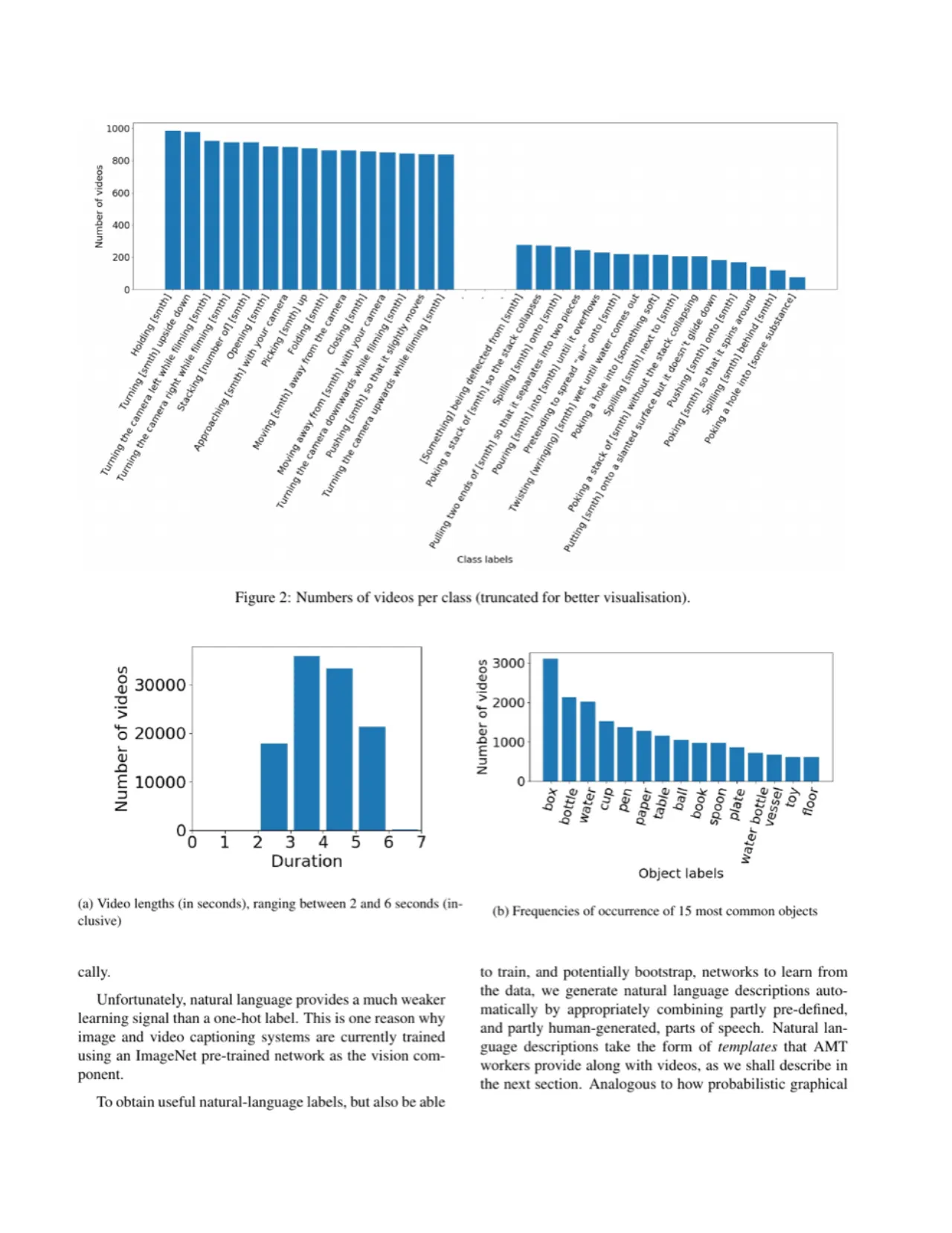
Something-Something 是一个大规模众包视频数据集,包含 108,499 条 2–6 秒的短视频、174 个动作类别,专注于捕捉人类与物体之间的细粒度物理交互,旨在推动视觉常识推理研究。与以往动作识别数据集不同,本数据集强迫模型学习物体属性、时序动态和直觉物理,而非依赖单帧特征或场景偏见。Something-Something is a large-scale crowd-sourced video dataset comprising 108,499 short videos of 2–6 seconds across 174 action categories, focused on capturing fine-grained physical interactions between humans and objects, with the aim of advancing research on visual common sense reasoning. Unlike earlier action recognition datasets, it forces models to learn object properties, temporal dynamics and intuitive physics rather than relying on single-frame features or scene bias.
现有大规模视频数据集(如 Sports-1M、ActivityNet)以高层动作识别为目标,使得模型可以依赖单帧特征或场景线索作弊,而无需真正理解物体的物理属性与因果关系。这一缺陷导致神经网络缺乏类似人类的"视觉常识"(visual common sense)。Existing large-scale video datasets (such as Sports-1M and ActivityNet) target high-level action recognition, which lets models cheat by relying on single-frame features or scene cues without genuinely understanding the physical properties of objects or their causal relations. This shortcoming leaves neural networks without human-like "visual common sense".
"One obstacle that prevents networks from reasoning more deeply about complex scenes and situations, and from integrating visual knowledge with natural language, like humans do, is their lack of common sense knowledge about the physical world."
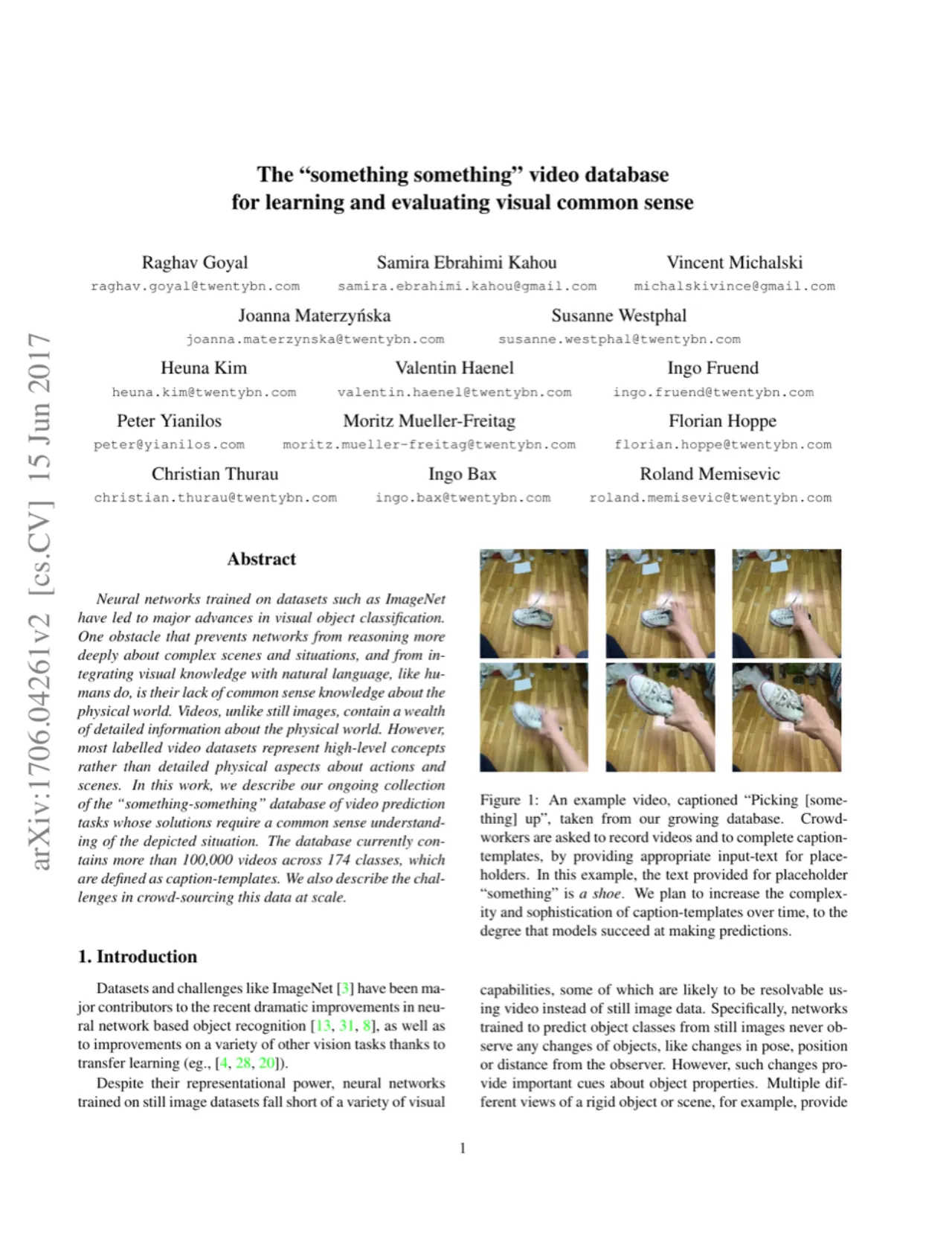
视频(而非静态图像)天然包含物体运动、形变、遮挡等信息,是学习直觉物理(intuitive physics)和空间关系的理想载体。作者认为,要真正学习"opening"这一概念,网络必须能跨越"opening a door"、"opening a zipper"、"opening a mouth"等不同场景进行泛化——而这正是 Something-Something 数据集的设计初衷:提供高度细粒度、专注于基础物理概念的视频-标签对。Video (rather than static imagery) naturally carries object motion, deformation and occlusion, making it an ideal medium for learning intuitive physics and spatial relations. The authors argue that to truly learn the concept of "opening", a network must generalise across settings such as "opening a door", "opening a zipper" and "opening a mouth" — which is precisely the design intent of the Something-Something dataset: to provide highly fine-grained video-label pairs focused on basic physical concepts.
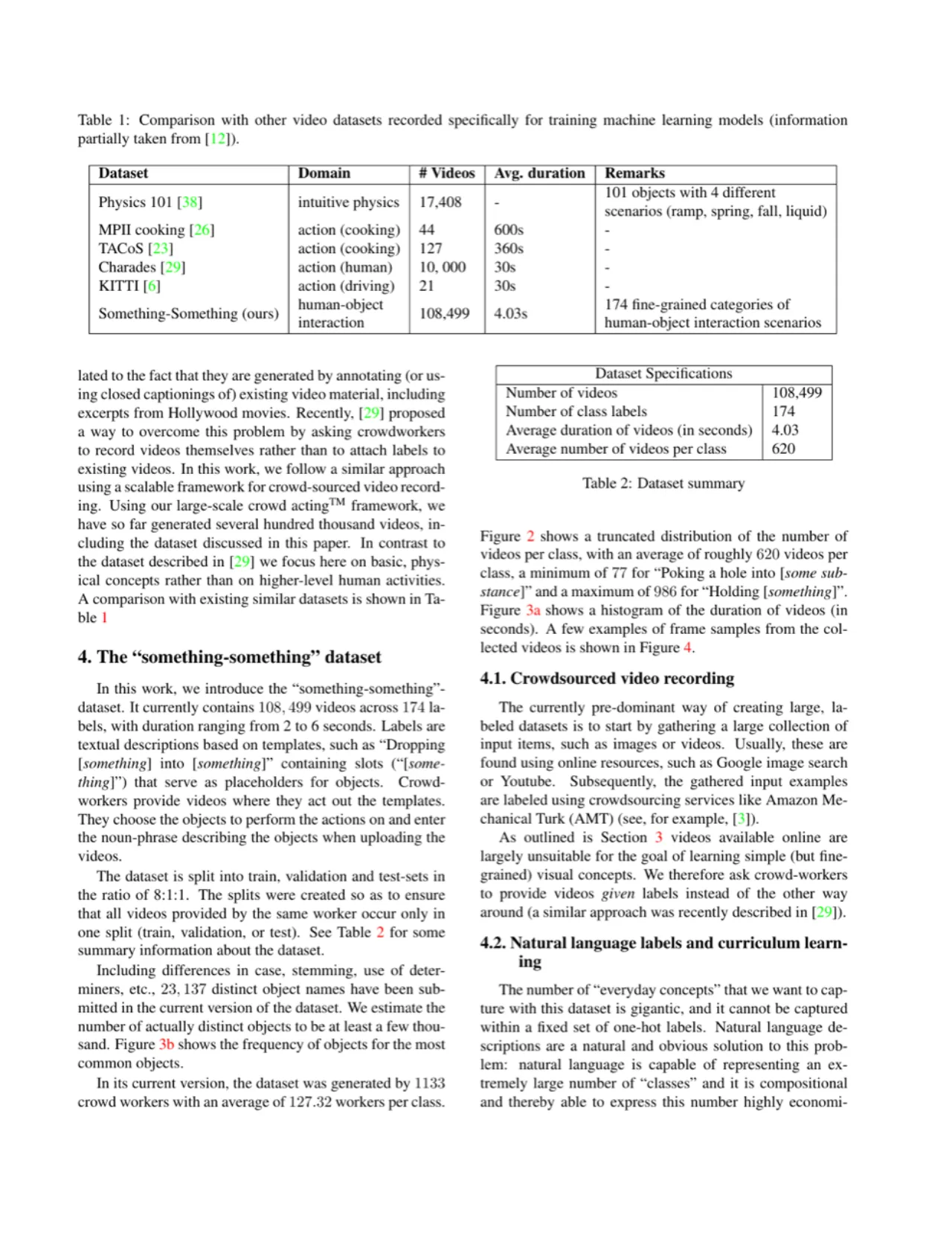
与现有数据集的对比(Table 1)显示,Something-Something 视频数量(108,499)远超其他专注于物理交互的数据集(如 Physics 101:17,408),且视频更短(平均 4.03 秒),时序标注更精确。The comparison with existing datasets (Table 1) shows that the number of Something-Something videos (108,499) far exceeds that of other datasets devoted to physical interaction (such as Physics 101: 17,408), while the videos are shorter (4.03 seconds on average) and the temporal annotation is more precise.
Something-Something 数据集通过"大规模众包表演"(large-scale crowd acting)框架构建:不是从网上爬取视频再打标签,而是让众包工作者根据动作模板主动录制视频并填写占位词,从而确保视频内容与标签的高度一致性与时序对应。The Something-Something dataset is built with a "large-scale crowd acting" framework: rather than crawling videos from the web and labelling them afterwards, crowd workers actively record videos following action templates and fill in the placeholder words, which ensures a tight correspondence in both content and time between video and label.
标签采用含占位符(placeholder)的动作模板形式,如 "Dropping [something] into [something]"。工作者录制视频后需填写 "something" 对应的具体物体名词。当前版本共有 23,137 个不同的物体名称(含大小写、词形变化等),估计实际不同物体至少有几千个。这种标注方式兼具自然语言的表达力与结构化标签的可训练性,且支持"课程学习"(curriculum learning)——随着模型性能提升,逐步增加标签复杂度。Labels take the form of action templates containing placeholders, e.g. "Dropping [something] into [something]". After recording a video, the worker fills in the concrete object noun for "something". The current version contains 23,137 distinct object names (including case and inflectional variants); the number of genuinely distinct objects is estimated to be at least a few thousand. This scheme combines the expressiveness of natural language with the trainability of structured labels, and supports "curriculum learning" — label complexity can be raised gradually as model performance improves.
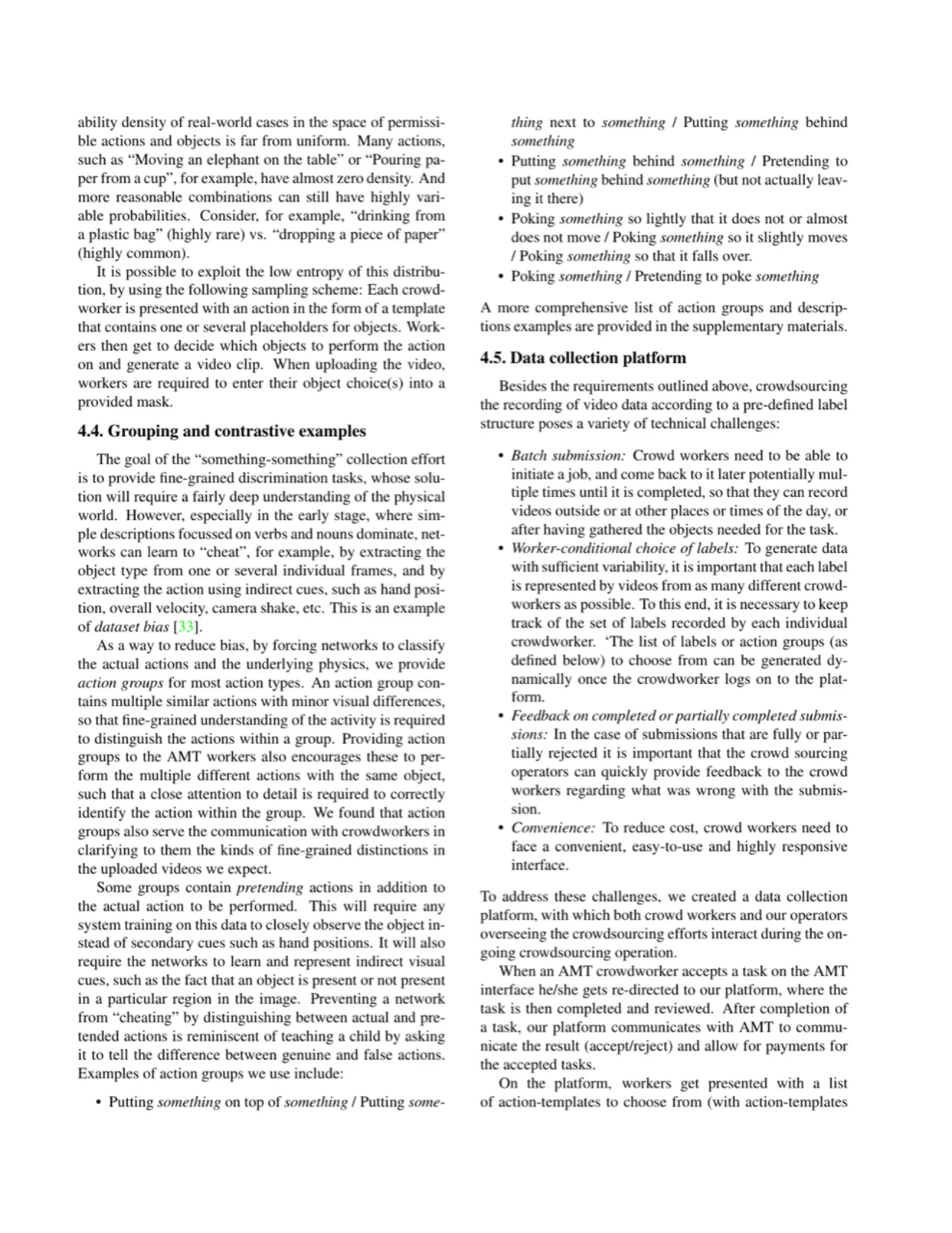
为减少数据集偏见、强迫网络区分细微动作差异,作者引入了动作分组机制:每个分组包含多个视觉上相近但语义有别的动作。例如:To reduce dataset bias and force networks to discriminate subtle differences between actions, the authors introduce an action grouping mechanism: each group contains several actions that look alike but differ in meaning. For example:
作者为工作者专门开发了众包平台,支持批次提交、动态分配动作类别(维持类别平衡)、视频上传与回放、自动质量检查(视频长度、唯一性)以及人工审核流程。工作者在 Amazon Mechanical Turk(AMT)接受任务后被重定向至该平台,完成后系统自动与 AMT 通信完成支付。数据集按 8:1:1 分割为训练/验证/测试集,确保同一工作者的视频只出现在同一分割中。The authors developed a dedicated crowd-sourcing platform for the workers, supporting batch submission, dynamic assignment of action categories (to keep the categories balanced), video upload and playback, automatic quality checks (video length, uniqueness) and a manual review workflow. Workers accept a task on Amazon Mechanical Turk (AMT) and are then redirected to this platform; on completion the system communicates with AMT automatically to settle payment. The dataset is split 8:1:1 into training/validation/test sets, ensuring that videos from the same worker appear only within the same split.
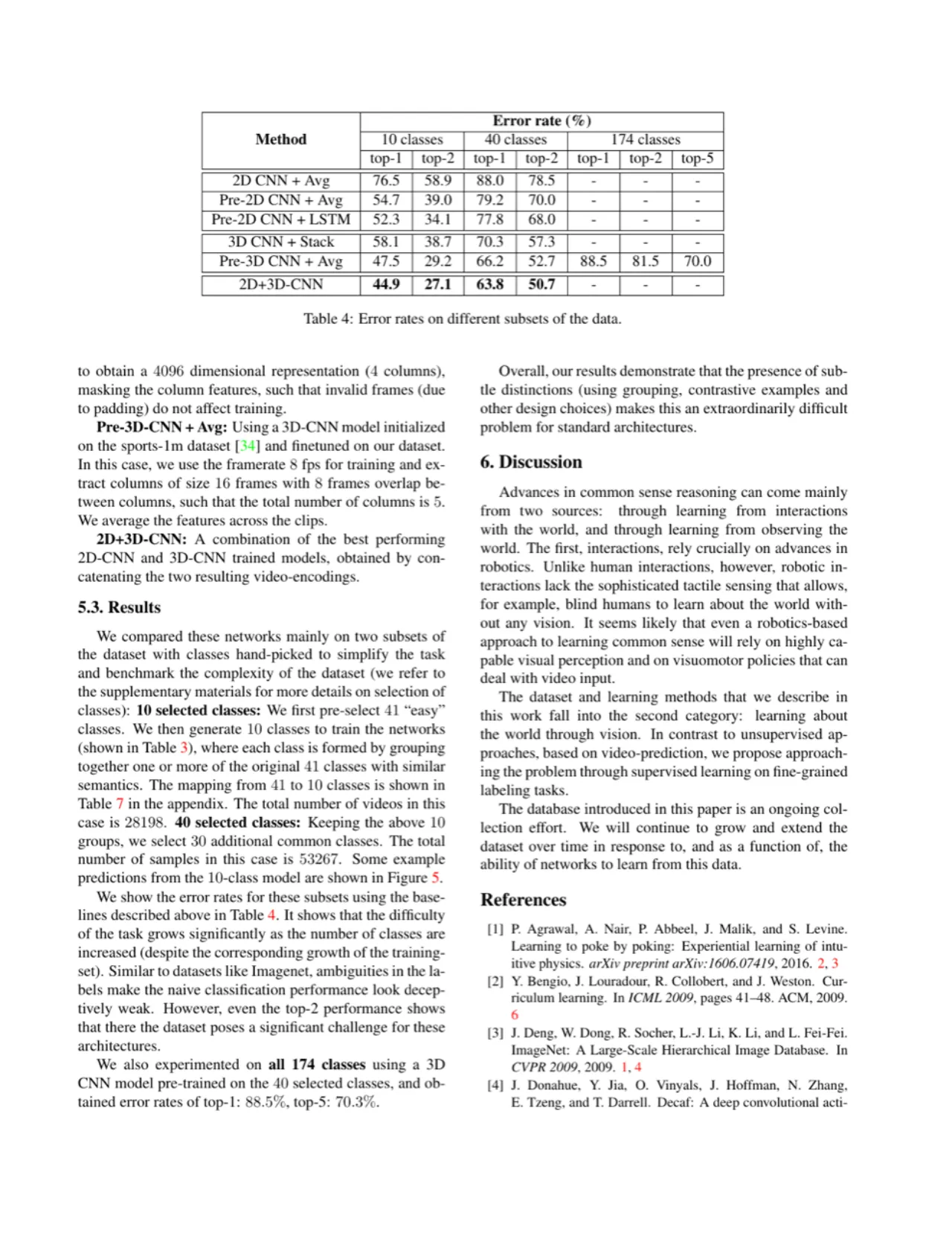
作者在 10 类、40 类、174 类三个子集上分别评估了多种标准视频理解架构的误差率(error rate),以量化数据集的难度并为社区提供参考基准。The authors evaluate the error rates of a range of standard video understanding architectures on three subsets — 10, 40 and 174 categories — in order to quantify the difficulty of the dataset and to provide reference baselines for the community.
预处理:以 24 fps 采样帧,resize 到 84×84 像素(使用预训练模型时按对应分辨率),时域 Gaussian 低通滤波(variance=48 pixels),有效帧率为 6 fps。训练时随机时域增强(random temporal offset 0–4)。Preprocessing: frames are sampled at 24 fps and resized to 84×84 pixels (pre-trained models use their corresponding resolution), with temporal Gaussian low-pass filtering (variance=48 pixels), giving an effective frame rate of 6 fps. Random temporal augmentation is applied during training (random temporal offset 0–4).
测试了以下五种编码方法:The following five encoding methods were tested:
| 方法Method | 10 类 top-1 (%)10 classes top-1 (%) | 40 类 top-1 (%)40 classes top-1 (%) | 174 类 top-1 (%)174 classes top-1 (%) | 174 类 top-5 (%)174 classes top-5 (%) |
|---|---|---|---|---|
| 2D CNN + Avg | 76.5 | 88.0 | — | — |
| Pre-2D CNN + Avg | 58.9 | 78.5 | — | — |
| Pre-2D CNN + LSTM | 54.7 | 79.2 | — | — |
| 3D CNN + Stack | 39.0 | 70.0 | — | — |
| Pre-3D CNN + Avg | 52.3 | 77.8 | — | — |
| 2D+3D-CNN(最优)2D+3D-CNN (best) | 34.1 | 68.0 | 88.5 | 70.3 |
实验结果揭示了若干重要现象:首先,3D-CNN 总体优于 2D-CNN,说明时序信息对本任务至关重要;其次,ImageNet 预训练的权重反而可能带来负迁移(Pre-2D-CNN 性能弱于从零训练的 2D-CNN on 10 classes),表明 Something-Something 所需特征与静态图像分类特征存在本质差异;第三,即便是最复杂的组合模型,在全部 174 类上 top-1 误差率仍达 88.5%,"这些细微区别(通过分组、对抗样本等设计选择)使这对标准架构而言成为一个极其困难的问题"("makes this an extraordinarily difficult problem for standard architectures")。The results reveal several important phenomena. First, 3D-CNNs are on the whole better than 2D-CNNs, showing that temporal information is essential for this task. Second, ImageNet pre-trained weights may even bring negative transfer (Pre-2D-CNN performs worse than the 2D-CNN trained from scratch on 10 classes), indicating that the features required by Something-Something differ fundamentally from those of static image classification. Third, even the most complex combined model still reaches a top-1 error rate of 88.5% over all 174 categories; these subtle distinctions, produced by design choices such as grouping and contrastive examples, "makes this an extraordinarily difficult problem for standard architectures".
作者明确指出,当前数据集聚焦简单物理概念,"the level of complexity of the current version of the dataset may be viewed approximately as 'teaching a one-year-old child'"。更复杂的语言描述和高层概念被留给未来版本通过课程学习逐步引入。The authors state explicitly that the current dataset focuses on simple physical concepts: "the level of complexity of the current version of the dataset may be viewed approximately as 'teaching a one-year-old child'". More complex linguistic descriptions and higher-level concepts are left to future versions, to be introduced gradually through curriculum learning.
作者指出 "a difficulty for both training and interpreting results is the presence of ambiguities in the labels"。即使是人类标注者,对部分细粒度类别也难以达成共识。论文建议使用 top-K 误差率来缓解这一问题,但并未根本解决。The authors note that "a difficulty for both training and interpreting results is the presence of ambiguities in the labels". Even human annotators struggle to reach consensus on some fine-grained categories. The paper suggests using top-K error rates to mitigate the issue, but does not solve it fundamentally.
基线实验将视频 resize 到 84×84 像素,这与真实部署场景相差甚远。更高分辨率与更复杂时序建模的实验效果留待后续工作。The baseline experiments resize videos to 84×84 pixels, far from a realistic deployment setting. Experiments with higher resolution and more sophisticated temporal modelling are left to follow-up work.
作者明确表示 "The database introduced in this paper is an ongoing collection effort. We will continue to grow and extend the dataset over time",论文中的数字(108,499 视频,174 类)仅代表当时状态,非最终版本。The authors state explicitly that "The database introduced in this paper is an ongoing collection effort. We will continue to grow and extend the dataset over time"; the figures in the paper (108,499 videos, 174 categories) reflect only the state at that time, not a final version.
从数据收集平台描述可以推断,尽管有自动质量检查(长度、唯一性),每份提交最终仍需人工操作员审核,随着规模扩大,这一流程的成本和效率将成为制约因素。It can be inferred from the description of the data collection platform that, despite the automatic quality checks (length, uniqueness), every submission still has to be reviewed by a human operator; as the scale grows, the cost and efficiency of this process will become a limiting factor.