Yuankai Luo · Woping Chen · Tong Liang · Baiqiao Wang · Zhenguo Li
VLA(Vision-Language-Action)模型正快速演进,但复杂的架构创新往往伴随不一致的训练细节,令人难以判断性能提升的真正来源。SimVLA 通过严格解耦感知与控制、标准化关键训练动态,以仅 0.5B 参数的极简设计,在标准仿真基准上超越数十亿参数的模型,并在真实机械臂任务中达到与 π₀.₅ 相当的水平。Vision-Language-Action (VLA) models are evolving rapidly, but elaborate architectural innovations are often accompanied by inconsistent training details, making it hard to judge where performance gains truly come from. By strictly decoupling perception from control and standardizing key training dynamics, SimVLA uses a minimalist design with only 0.5B parameters to surpass models with billions of parameters on standard simulation benchmarks, and matches π₀.₅ on real robot-arm tasks.
VLA 领域快速发展,新方法不断引入空间先验、多视角感知、复杂 action representation 等创新,但这些进展往往伴随着不同的训练 recipe 和实现细节。这使得研究者难以区分"是架构创新带来了提升,还是训练技巧的差异"。The VLA field is developing fast, and new methods keep introducing spatial priors, multi-view perception, complex action representations and other innovations, yet these advances are usually accompanied by different training recipes and implementation details. This makes it hard for researchers to distinguish "whether the gains come from architectural innovation or from differences in training tricks".
"These advancements are often accompanied by varying training recipes and implementation details, which can make it challenging to disentangle the precise source of empirical gains."
SimVLA 的核心主张是:The core claim of SimVLA is:一个经过精心规范化的极简设计,足以达到当前最优水平。a carefully standardized minimalist design is enough to reach current state-of-the-art performance.它为未来的架构创新提供了一个透明、可复现的参考基线,使研究者能够将性能归因于具体的架构改进,而非隐藏的训练技巧。It provides a transparent, reproducible reference baseline for future architectural innovation, letting researchers attribute performance to concrete architectural improvements rather than to hidden training tricks.
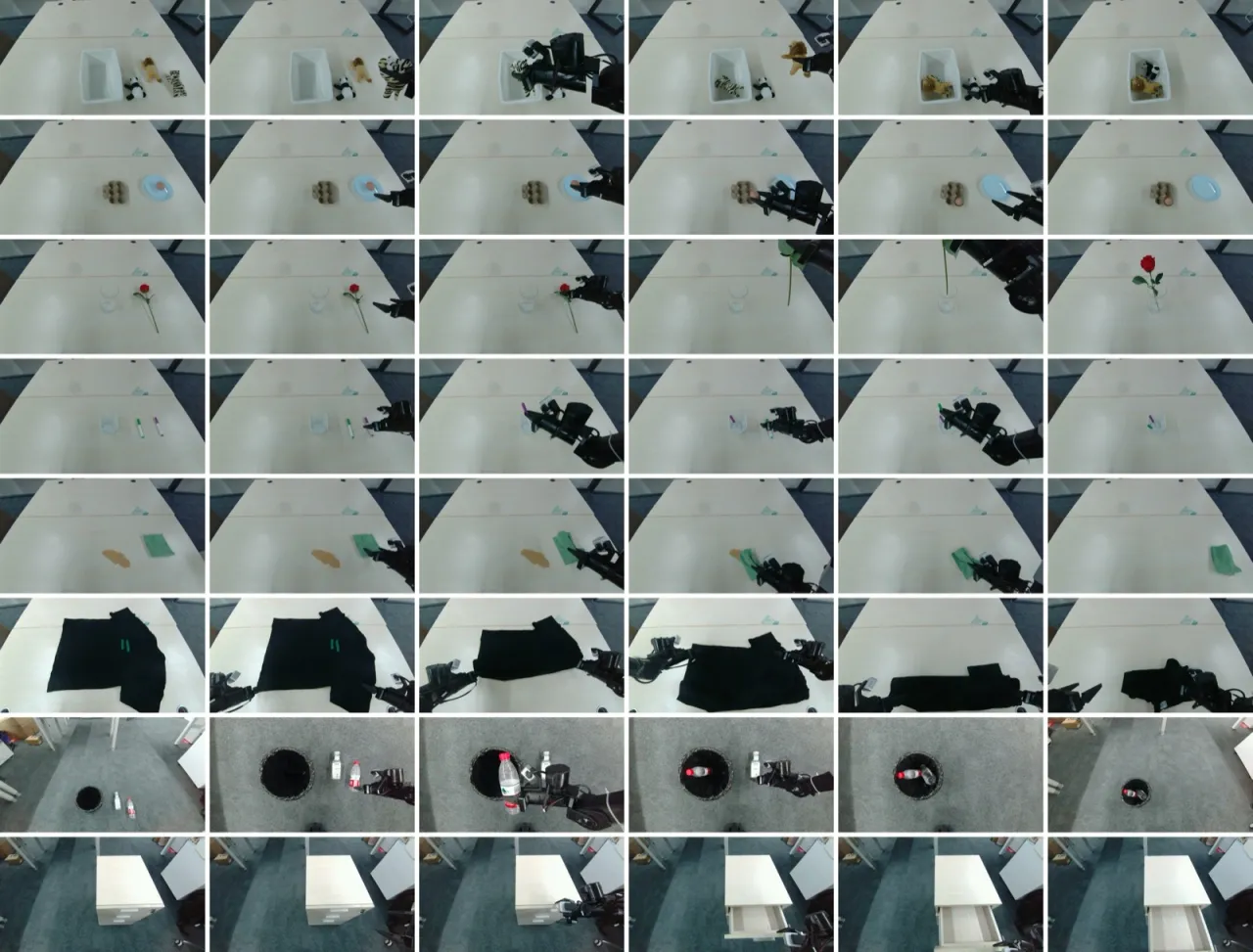
图 1:真实机器人的开箱即用任务示例。Figure 1: Out-of-the-box task examples on a real robot.SimVLA 无需任何额外微调,在 held-out 场景中直接部署,评估一系列同时需要灵巧操作与语义理解的多阶段任务。(原文 Figure 1 caption)SimVLA is deployed directly in held-out scenes without any additional fine-tuning, and is evaluated on a series of multi-stage tasks that require both dexterous manipulation and semantic understanding. (Figure 1 caption in the original paper)
98.6%LIBERO 平均成功率LIBERO average success rate
0.5B模型参数量Model parameters
9.3 GB训练所需 VRAMVRAM required for training
95.8%SimplerEnv WidowX 均值SimplerEnv WidowX average
02方法Method
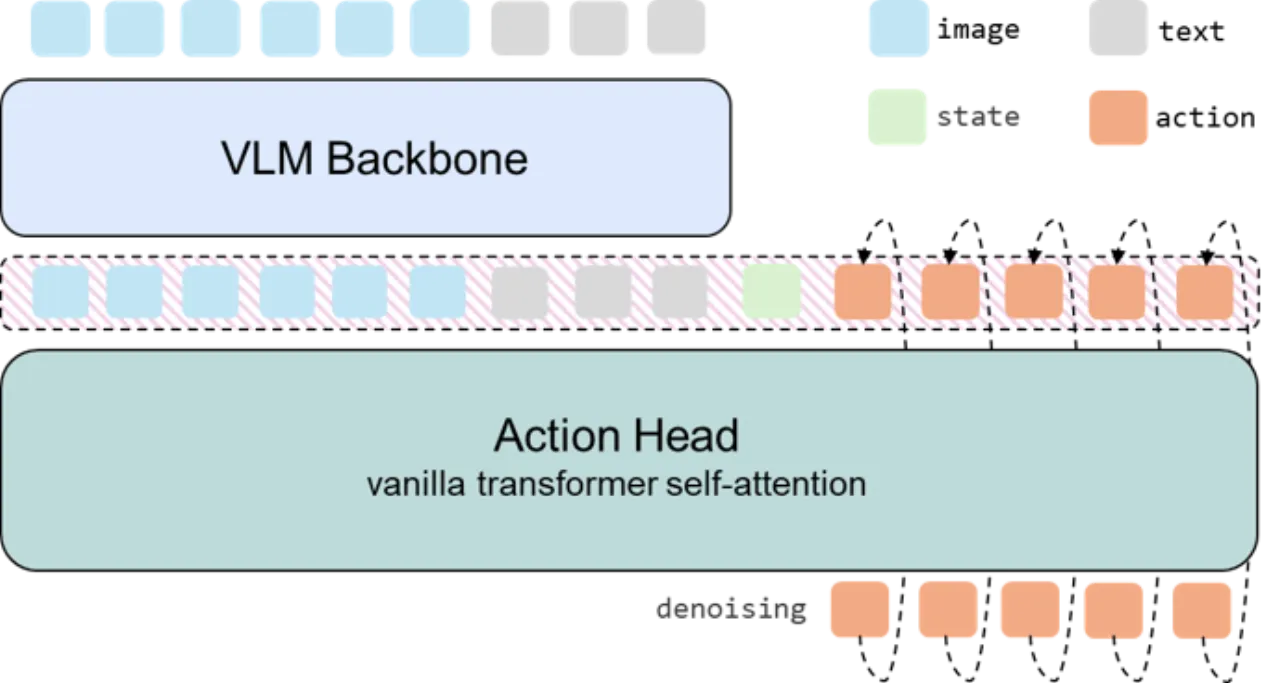
SimVLA 是一个模块化的极简 VLA 框架:将预训练 VLM 作为感知编码器,以轻量 Transformer action head 执行 conditional flow matching,生成连续的 action chunk。整体流程遵循"encode-once, denoise-in-the-head"原则,每个控制步骤 VLM backbone 仅运行一次。SimVLA is a modular, minimalist VLA framework: a pretrained VLM serves as the perception encoder, and a lightweight Transformer action head performs conditional flow matching to generate continuous action chunks. The overall pipeline follows an "encode-once, denoise-in-the-head" principle, running the VLM backbone only once per control step.
图 2:SimVLA 整体架构。Figure 2: Overall architecture of SimVLA.VLM encoder 每个控制步骤执行一次,将多视角 RGB 图像与语言指令融合为 token 表示;轻量 action transformer 通过 flow-matching 去噪生成连续 action chunk。(原文 Figure 2 caption)The VLM encoder runs once per control step, fusing multi-view RGB images and the language instruction into token representations; a lightweight action transformer then generates continuous action chunks through flow-matching denoising. (Figure 2 caption in the original paper)
SimVLA 使用预训练的 vision-language backbone(默认为 InternVL2-2B,约 0.5B 有效参数)处理多视角 RGB 图像与语言任务指令,输出融合的视觉-语言 token 表示。感知模块与控制模块严格解耦,VLM 学习率乘子默认设为 0.1,以保护预训练权重。SimVLA uses a pretrained vision-language backbone (InternVL2-2B by default, about 0.5B effective parameters) to process multi-view RGB images and the language task instruction, and outputs fused vision-language token representations. The perception module and the control module are strictly decoupled, and the VLM learning-rate multiplier defaults to 0.1 in order to protect the pretrained weights.
控制头是一个轻量 vanilla Transformer encoder,接收 VLM 输出的 token 与噪声 action,通过 conditional flow matching 学习将噪声映射为连续 action chunk(动作序列长度 H 测试范围:{10, 20, 30})。推理时在 action head 内高效去噪,无需逐步调用 VLM。The control head is a lightweight vanilla Transformer encoder that receives the tokens output by the VLM together with noisy actions, and learns through conditional flow matching to map noise into continuous action chunks (action sequence length H tested over {10, 20, 30}). At inference, denoising is performed efficiently inside the action head, without invoking the VLM step by step.
"Silent" 训练动态——被低估的关键因素"Silent" Training Dynamics — The Underestimated Key Factor
SimVLA 的核心贡献之一是识别并规范化了若干One of the core contributions of SimVLA is identifying and standardizing a number of训练中的隐性变量implicit variables in training("silent" training dynamics),这些因素对性能的影响甚至超过了架构选择:("silent" training dynamics), whose impact on performance even exceeds that of architectural choices:
Action Normalization:Action Normalization:基于训练数据逐维度统计计算归一化参数,缺失时平均成功率从 98.6% 骤降至 12.3%。Normalization parameters are computed from per-dimension statistics of the training data; without them the average success rate plunges from 98.6% to 12.3%.
Data Shuffling:Data Shuffling:对优化稳定性和长时序泛化至关重要,禁用后平均成功率降至 9.9%。Crucial for optimization stability and long-horizon generalization; once disabled, the average success rate drops to 9.9%.
Learning Rate Tuning:Learning Rate Tuning:全局学习率测试范围 {5×10⁻⁵, 10⁻⁴, 2×10⁻⁴, 5×10⁻⁴};设为 5×10⁻⁴ 时均值降至 72.7%。The global learning rate is tested over {5×10⁻⁵, 10⁻⁴, 2×10⁻⁴, 5×10⁻⁴}; setting it to 5×10⁻⁴ lowers the mean to 72.7%.
VLM LR Multiplier:VLM LR Multiplier:默认 0.1;若设为 1.0(即与主干同速更新),成功率骤降至 44.2%。Defaults to 0.1; if set to 1.0 (i.e. updated as fast as the backbone), the success rate collapses to 44.2%.
03实验Experiments
实验在三类基准上评估:仿真基准 LIBERO(含 Spatial / Object / Goal / Long 四个子任务集)与 LIBERO-PRO(鲁棒性评估)、SimplerEnv(WidowX 与 Google Robot)、以及 Galaxea R1 Lite 真实机械臂上的八项多阶段任务。Experiments are evaluated on three kinds of benchmarks: the simulation benchmark LIBERO (with the four task suites Spatial / Object / Goal / Long) and LIBERO-PRO (robustness evaluation), SimplerEnv (WidowX and Google Robot), and eight multi-stage tasks on the real Galaxea R1 Lite robot arm.
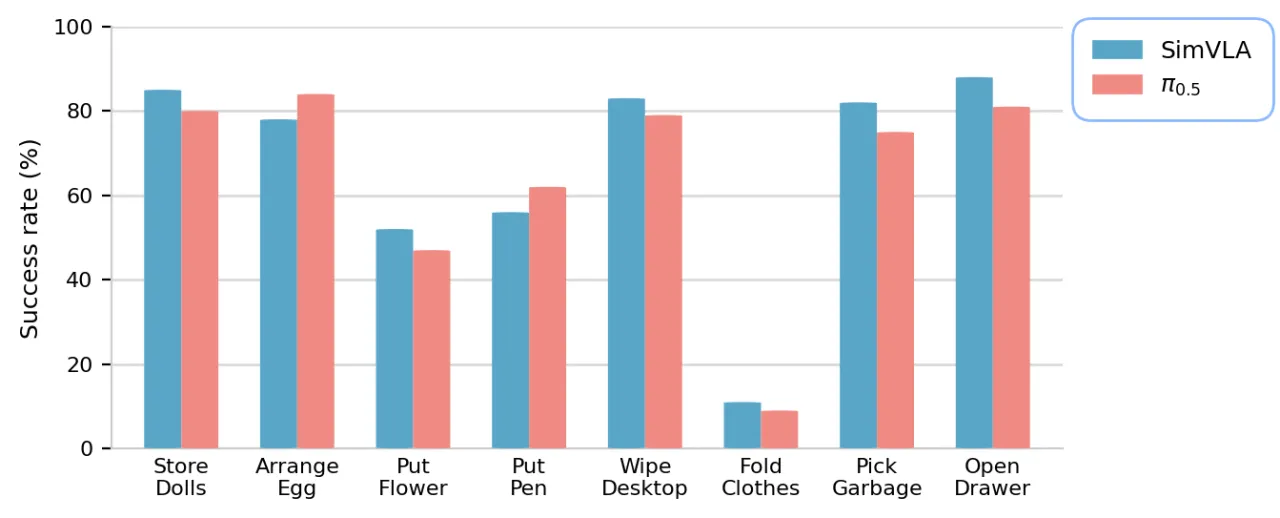
图 3:Galaxea R1 Lite 上的真实机器人零样本结果。Figure 3: Real-robot zero-shot results on Galaxea R1 Lite.SimVLA 在 held-out 场景上直接部署,无需额外微调,评估八项多阶段操作任务,总体性能与 π₀.₅ 基线相当。(原文 Figure 3 caption)SimVLA is deployed directly in held-out scenes without extra fine-tuning, evaluated on eight multi-stage manipulation tasks, with overall performance comparable to the π₀.₅ baseline. (Figure 3 caption in the original paper)
八项评估任务包括:整理玩偶(store dolls)、排列鸡蛋(arrange eggs)、插花(put flowers in vase)、放笔(put pen in holder)、擦桌面(wipe desktop)、折叠衣物(fold clothes)、捡垃圾(pick up garbage)、开抽屉(open drawer)。大多数任务在零样本跨场景设置下取得约 80% 的成功率。The eight evaluation tasks are: store dolls, arrange eggs, put flowers in vase, put pen in holder, wipe desktop, fold clothes, pick up garbage, and open drawer. Most tasks achieve about 80% success rates under the zero-shot cross-scene setting.
消融实验Ablation Studies
消融分析将每项因素独立移除后在 LIBERO 上评估,揭示了哪些是决定性因素、哪些影响有限:The ablation analysis removes each factor independently and evaluates on LIBERO, revealing which factors are decisive and which have limited impact:
消融结果显示:The ablation results show thatdata shuffling 和 action normalization 是最关键的因素data shuffling and action normalization are the most critical factors,禁用任意一项都会导致性能崩溃至接近 10%。相比之下,架构细节(如 action transformer 规模、backbone 选型)的影响相对次要,充分支持了"训练动态比架构创新更重要"的核心论点。, and disabling either one causes performance to collapse to nearly 10%. By contrast, architectural details (such as the action transformer size or the backbone choice) matter relatively little, which strongly supports the core argument that "training dynamics matter more than architectural innovation".
04局限性Limitations
注:Note:论文未设专门的 Limitations 章节。以下条目中,标注"原文陈述"者来自论文正文;标注"设计推断"者为基于方法设计的合理推断。The paper has no dedicated Limitations section. Among the items below, those marked "stated in the paper" come from the paper's text, while those marked "design inference" are reasonable inferences based on the method design.
位置鲁棒性不足(原文陈述)Insufficient positional robustness (stated in the paper)
在 LIBERO-PRO 的位置扰动评估中,SimVLA 在 Object、Goal、Long 子任务集上的位置鲁棒性较差,论文指出这是"a key direction for future work",需要额外研究。语义鲁棒性(98–100%)表现优异,但空间布局扰动场景仍然是挑战。In the positional-perturbation evaluation of LIBERO-PRO, SimVLA shows weaker positional robustness on the Object, Goal and Long task suites; the paper notes that this is "a key direction for future work" and requires further study. Semantic robustness (98-100%) is excellent, but scenarios with spatial-layout perturbations remain a challenge.
部分真实任务仍具挑战性(原文陈述)Some real-world tasks remain challenging (stated in the paper)
在 Galaxea R1 Lite 的零样本跨场景评估中,折叠衣物(fold clothes)、放笔(put pen in holder)、插花(put flowers in vase)等任务成功率相对较低,说明在无微调的情况下,细粒度操作与长时序任务仍有提升空间。In the zero-shot cross-scene evaluation on the Galaxea R1 Lite, tasks such as fold clothes, put pen in holder and put flowers in vase have relatively low success rates, indicating that fine-grained manipulation and long-horizon tasks still have room for improvement without fine-tuning.
训练数据规模与多样性依赖(设计推断)Dependence on training-data scale and diversity (design inference)
SimVLA 的强性能高度依赖于规范化的训练细节(data shuffling、action normalization)和学习率配置,这些超参数可能需要针对不同数据集和任务重新调优。论文中的实验基于固定数据源,对于数据规模极小或分布迥异的场景,其鲁棒性尚未验证。The strong performance of SimVLA relies heavily on standardized training details (data shuffling, action normalization) and the learning-rate configuration, and these hyperparameters may need re-tuning for different datasets and tasks. The experiments in the paper are based on a fixed data source, and robustness has not yet been verified for scenarios with extremely small data scale or very different distributions.
所有真实机器人实验均在 Galaxea R1 Lite 上进行,尚未在不同机器人形态(如双臂、移动底座等)上系统验证跨形态迁移能力。All real-robot experiments are conducted on the Galaxea R1 Lite, and cross-embodiment transfer has not yet been systematically verified on different robot embodiments (such as dual-arm platforms or mobile bases).