04 局限性Limitations
Note:以下限制均为论文作者在 "Conclusions and Future Work" 及正文中明确陈述(stated),非推断。Note: all limitations below are explicitly stated by the authors in "Conclusions and Future Work" and in the main text, not inferred.
渐近性能低于 model-free SOTA(stated)Asymptotic performance below model-free SOTA (stated)
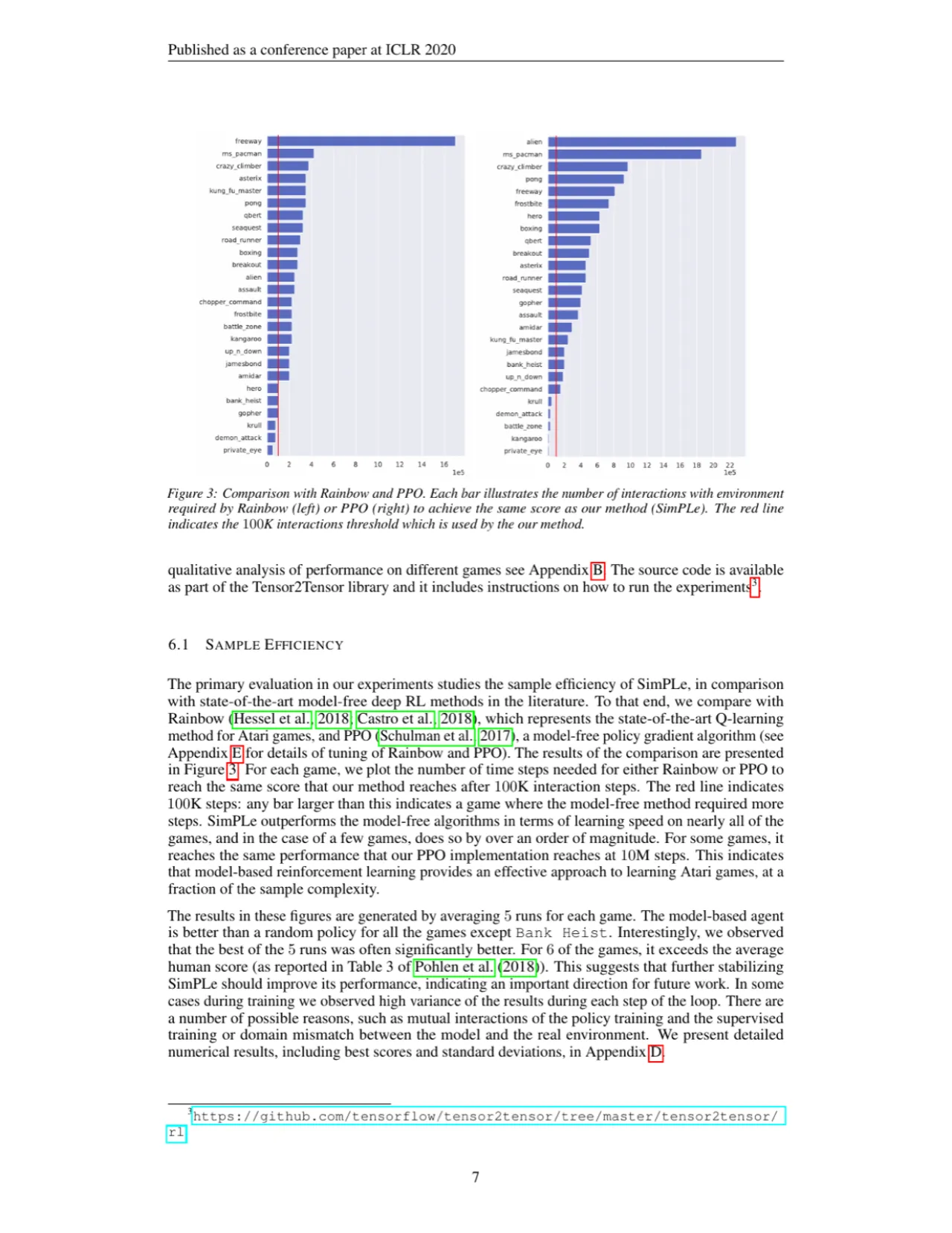
"The final scores are on the whole lower than the best state-of-the-art model-free methods." 论文作者指出这在 model-based RL 中普遍存在,需要更好的 dynamics model 来弥补。在极高样本量时,PPO 等方法的最终得分仍超过 SimPLe。"The final scores are on the whole lower than the best state-of-the-art model-free methods." The authors note that this is common in model-based RL and has to be made up for by a better dynamics model. With very large sample budgets, the final scores of methods such as PPO still exceed those of SimPLe.
训练方差大、稳定性差(stated)Large training variance and poor stability (stated)
"The performance of our method generally varied substantially between different runs on the same game." 多轮训练的互相影响(policy 训练、world model 训练和数据收集之间的耦合)以及 world model 与真实环境之间的 domain shift 是高方差的主因。作者建议未来使用 Bayesian 参数后验或 ensemble 方法提升鲁棒性。"The performance of our method generally varied substantially between different runs on the same game." The mutual influence across training rounds (the coupling between policy training, world model training and data collection), together with the domain shift between the world model and the real environment, is the main cause of the high variance. The authors suggest using a Bayesian posterior over parameters or ensemble methods in the future to improve robustness.
计算代价高昂(stated)High computational cost (stated)
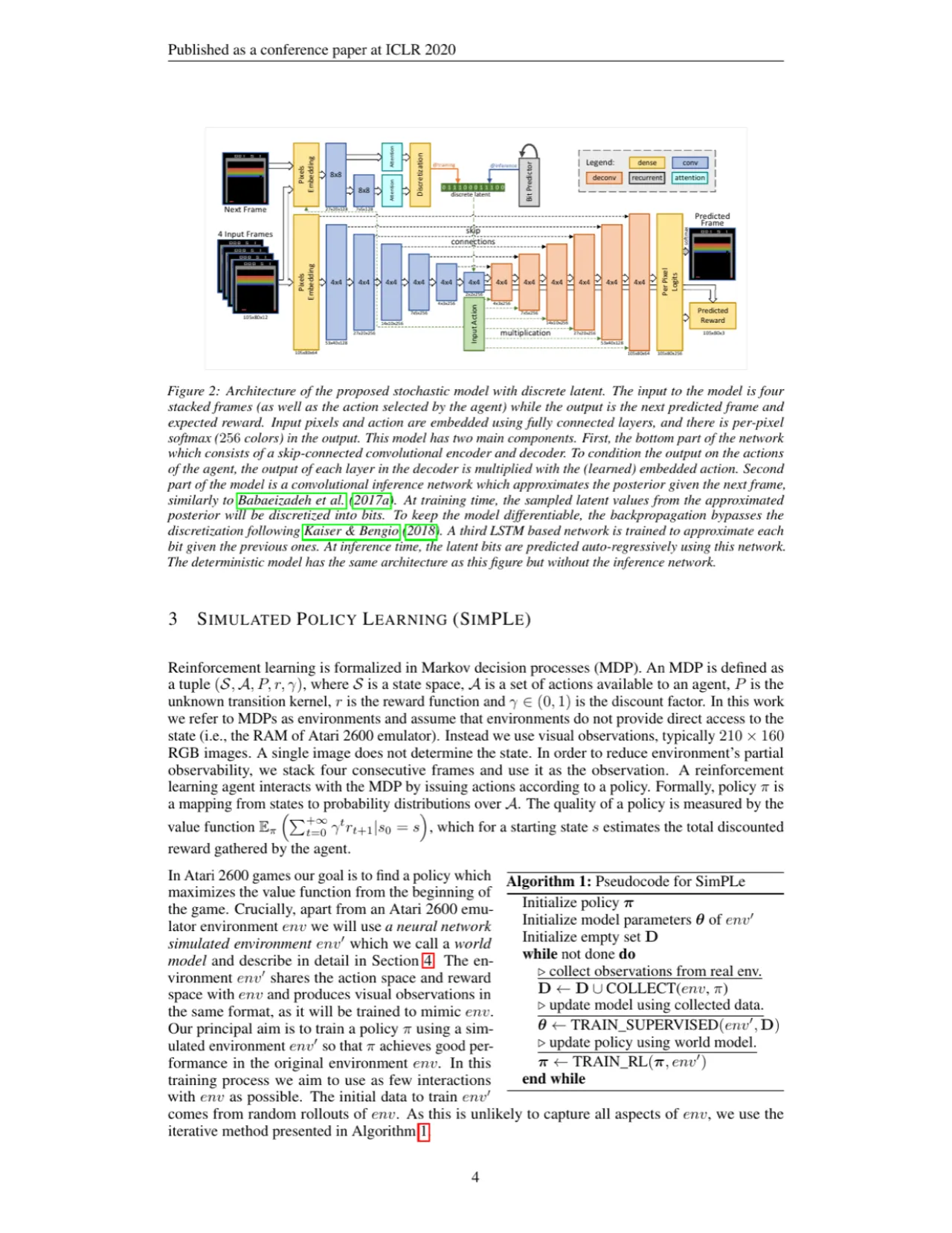
"The computational and time requirement of training inside world model are substantial." World model(约 74M 参数)的推理约 32ms/帧(batch size=16,NVIDIA Tesla P100),而真实 ALE 模拟器仅约 0.4ms/步——相差约 80 倍。这使得开发更轻量的 world model 成为重要研究方向。"The computational and time requirement of training inside world model are substantial." Inference with the world model (about 74M parameters) takes roughly 32ms per frame (batch size=16, NVIDIA Tesla P100), whereas the real ALE simulator needs only about 0.4ms per step — a gap of roughly 80 times. This makes developing lighter world models an important research direction.
对小物体和全局变化场景预测失败(stated)Prediction fails for small objects and globally changing scenes (stated)
在 Atlantis 和 Battle Zone 等游戏中,子弹等极小但重要的物体容易从模型预测帧中消失。在 Private Eye 等需要场景切换(大范围全局变化)的游戏中,模型同样难以捕捉。这类游戏上的最终得分接近随机。In games such as Atlantis and Battle Zone, tiny but important objects such as bullets tend to disappear from the model's predicted frames. In games such as Private Eye that require scene transitions (large-scale global changes), the model likewise struggles to capture them. Final scores on such games are close to random.
低数据量时优势显著,高数据量时消失(stated)A clear advantage in the low data regime that vanishes with more data (stated)
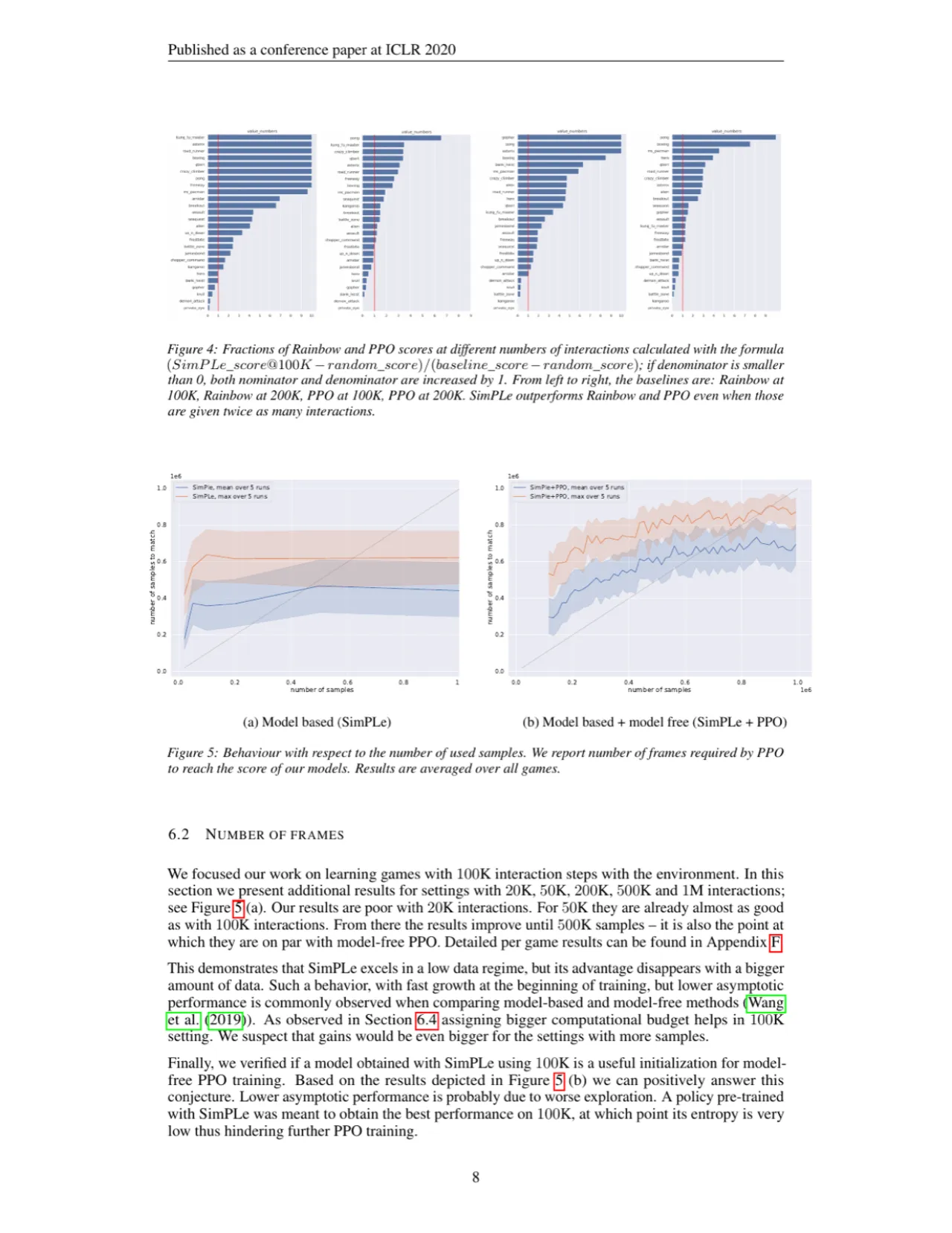
"This demonstrates that SimPLe excels in a low data regime, but its advantage disappears with a bigger amount of data." 在约 500K 样本时 SimPLe 与 PPO 打平,之后 model-free 方法反超。作者将此归因于 SimPLe policy 熵过低导致的探索不足,制约了后续 PPO 微调的潜力。"This demonstrates that SimPLe excels in a low data regime, but its advantage disappears with a bigger amount of data." At about 500K samples SimPLe ties with PPO, after which the model-free method overtakes it. The authors attribute this to insufficient exploration caused by the overly low entropy of the SimPLe policy, which limits the potential of subsequent PPO fine-tuning.