一步扩散生成:Shortcut Models(捷径模型)One Step Diffusion via Shortcut Models
One Step Diffusion via Shortcut Models
Kevin Frans · Danijar Hafner · Sergey Levine · Pieter Abbeel
扩散模型需要数十至数百次神经网络前向传播才能生成样本,推理缓慢且计算代价高昂。
Shortcut Models 通过让网络同时感知噪声水平和目标步长,实现了在单个或少数步骤内生成高质量样本,
且无需单独的蒸馏阶段,仅需约 16% 的额外训练计算开销。Diffusion models need tens to hundreds of neural network forward passes to produce a sample, making inference slow and computationally expensive. By making the network aware of both the noise level and a target step size, Shortcut Models generate high-quality samples in a single step or a few steps, without a separate distillation stage and at only about 16% extra training compute.
图像生成 · CelebA-HQ · ImageNet-256Image generation · CelebA-HQ · ImageNet-256机器人控制 · Push-T · TransportRobot control · Push-T · Transport训练额外开销仅 +16% 计算量Only +16% extra training compute📄 arXiv:2410.12557PDF 全文Full PDF
扩散模型和流匹配模型在图像生成中取得了显著成果,但其迭代去噪过程需要数十到数百次神经网络前向传播,
导致推理极为缓慢。现有的加速方案(如蒸馏、一致性模型)往往需要复杂的两阶段训练流程,或在少步生成时质量大幅下降。Diffusion and flow matching models have achieved remarkable results in image generation, but their iterative denoising requires tens to hundreds of neural network forward passes, making inference extremely slow. Existing acceleration schemes (such as distillation and consistency models) usually need a complex two-stage training pipeline, or suffer a large quality drop under few-step generation.
"Sampling from these models involves iterative denoising over many neural network passes, making generation slow and expensive."
——论文引言— from the paper's introduction
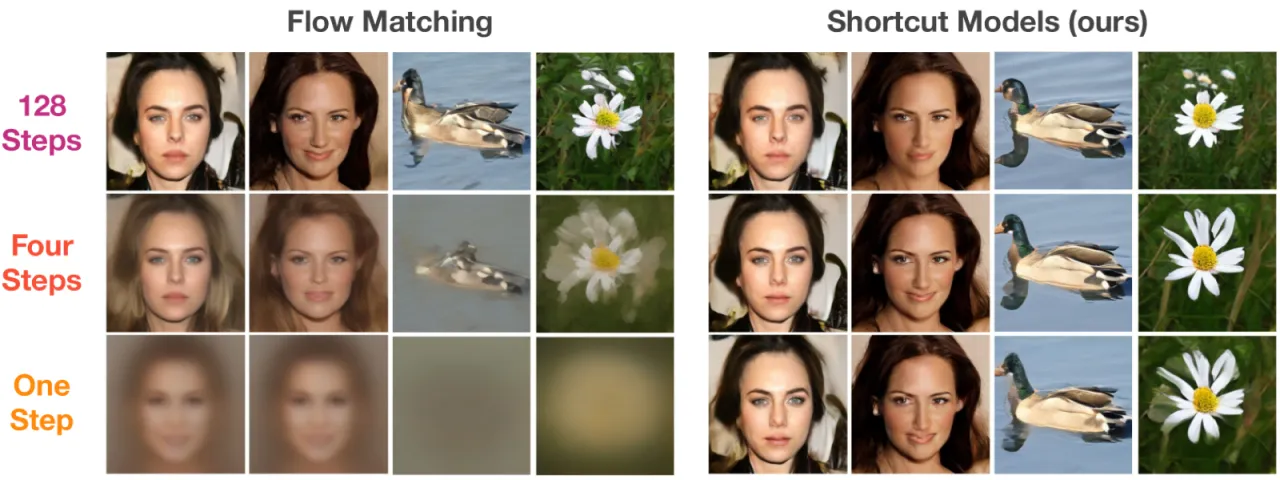
图1:在不同推理步数预算下,Flow Matching(上)与 Shortcut Models(下)的生成质量对比。
每列使用相同的初始噪声。数据集:CelebA-HQ(左)和 ImageNet-256(右)。
可以看出,Flow Matching 在 4 步或 1 步时质量急剧下降,而 Shortcut Models 在所有步数预算下都保持了较高质量。Figure 1: Generation quality of Flow Matching (top) and Shortcut Models (bottom) under different inference step budgets. Each column uses the same initial noise. Datasets: CelebA-HQ (left) and ImageNet-256 (right). Flow Matching degrades sharply at 4 steps or 1 step, whereas Shortcut Models keep high quality across all step budgets.
1步1 step仅需单次前向传播即可生成高质量样本A single forward pass suffices to generate high-quality samples
FID 3.8DiT-XL 128步最优结果Best result of DiT-XL at 128 steps
+16%相比基础扩散模型的额外训练计算开销Extra training compute compared with the base diffusion model
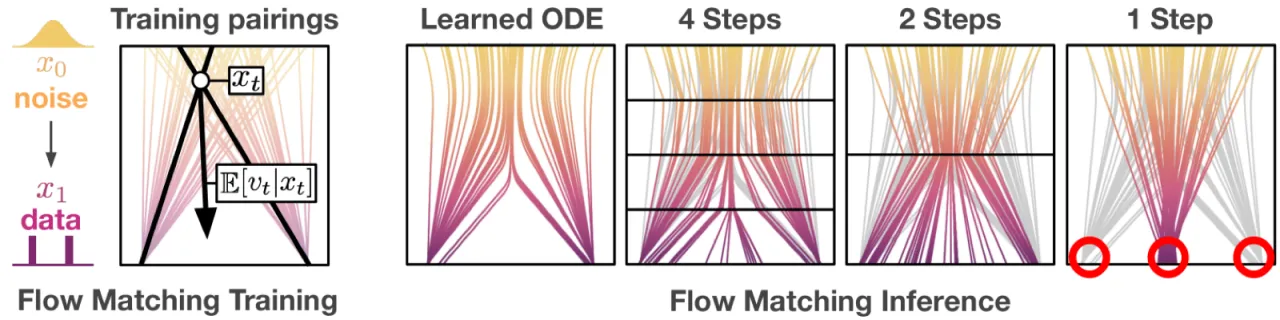
图2:朴素扩散/流匹配模型在少步生成时失败的根本原因——训练路径在中间时间步交叉重叠,
导致模型输出趋向数据集均值("模糊"效应)。Shortcut Models 通过学习能"跳跃"到未来状态的方向向量来解决这一问题。Figure 2: The root cause of why naive diffusion / flow matching models fail under few-step generation: training paths cross and overlap at intermediate timesteps, driving the model output toward the dataset mean (the "blurring" effect). Shortcut Models solve this by learning direction vectors that can "jump" to future states.
一致性蒸馏 (Consistency Distillation):需要两阶段训练,先训基础模型再做蒸馏Consistency Distillation: requires two-stage training — first train the base model, then distill
Reflow:需要构建(噪声, 数据)配对数据集,额外 pipeline 复杂Reflow: requires building a paired (noise, data) dataset, adding pipeline complexity
渐进式蒸馏 (Progressive Distillation):多轮迭代蒸馏,工程复杂度高Progressive Distillation: multiple rounds of iterative distillation, high engineering complexity
Shortcut Models 的核心主张Core claims of Shortcut Models
单一网络、单阶段训练,无需蒸馏A single network, single-stage training, no distillation needed
网络在任意步数预算下均可高质量采样The network samples with high quality under any step budget
"自蒸馏":训练时自动从自身较优的中间结果中学习"Self-distillation": during training the model automatically learns from its own better intermediate results
无需特殊训练时间表或预热策略(warmup)No special training schedule or warmup strategy is required
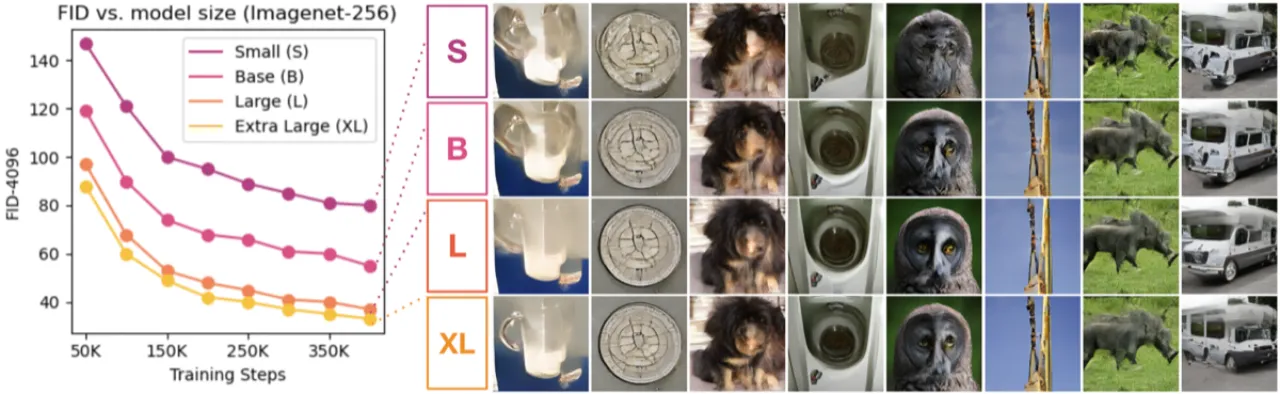
支持多步 FID 持续优化,可随模型规模扩展Multi-step FID keeps improving, and the method scales with model size
02方法Method
Shortcut Models 在标准流匹配框架基础上,对网络输入增加了"目标步长" d。
网络不仅预测当前时刻的去噪方向(速度场),还学习如何"跨越"多个小步,
直接预测从当前状态跳跃到 t − d 位置所需的归一化方向。
训练结合两个目标:流匹配损失(精细步骤监督)和自一致性目标(粗粒度步骤监督)。On top of the standard flow matching framework, Shortcut Models add a "target step size" d to the network input. The network predicts not only the denoising direction at the current time (the velocity field) but also learns how to "span" many small steps, directly predicting the normalized direction needed to jump from the current state to position t − d. Training combines two objectives: the flow matching loss (fine-grained step supervision) and the self-consistency target (coarse-grained step supervision).
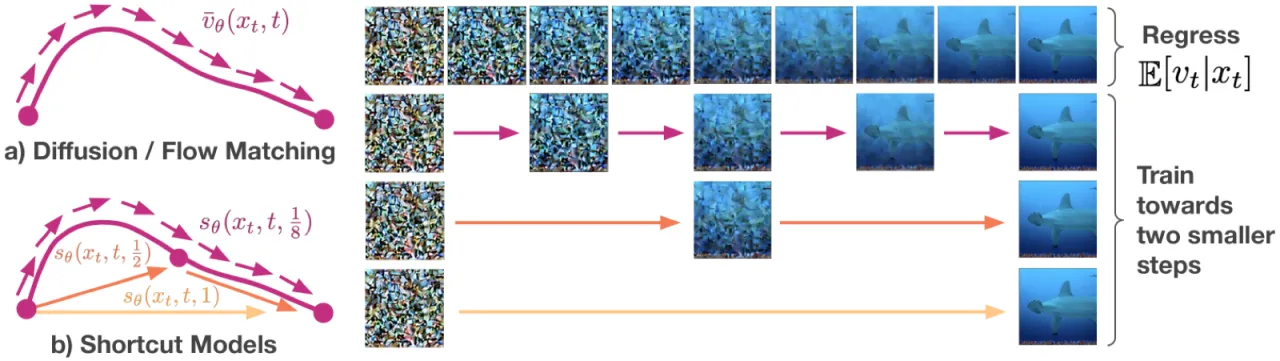
图3:训练流程总览。
左侧:标准流匹配,以小步长 d≈0 作为监督信号(绿色箭头);
右侧:自一致性目标,将一个大步长 d 的预测与两个连续的 d/2 步(通过停止梯度的"教师"网络计算)对齐(蓝色箭头)。
两路损失在同一网络、同一训练阶段中联合优化。Figure 3: Overview of the training procedure. Left: standard flow matching, using a small step size d≈0 as the supervision signal (green arrows). Right: the self-consistency target, aligning the prediction of one large step size d with two consecutive d/2 steps (computed by a stop-gradient "teacher" network) (blue arrows). The two losses are optimized jointly in the same network and the same training stage.
核心思想:Shortcut 函数Core idea: the shortcut function
定义 shortcut 函数v(x, t, d):给定当前状态 x、噪声时间步 t 和目标步长 d,
输出一个方向向量,使得沿该方向走一步即可到达 t − d 时刻对应的状态。Define the shortcut functionv(x, t, d): given the current state x, the noise timestep t and the target step size d, it outputs a direction vector such that a single step along it reaches the state corresponding to time t − d.
x_{t-d} = x_t + d · v(x_t, t, d)
当 d → 0 时,v 退化为标准流匹配的速度场;当 d 较大时,v 学习如何跳过中间曲折路径,
预测考虑了"未来曲率"的综合方向。When d → 0, v reduces to the velocity field of standard flow matching; when d is large, v learns to skip the winding intermediate path and predicts a combined direction that accounts for "future curvature".
训练的核心约束来自自一致性:一个步长为 d 的大步等价于两个连续的步长 d/2 的小步。
即:The core training constraint is self-consistency: one large step of size d is equivalent to two consecutive small steps of size d/2. That is:
训练时,用当前网络的停止梯度(stop-gradient)版本计算两个 d/2 步的目标,
作为对大步长预测的监督信号。这使得模型能够从自身的中间预测中"自举"(bootstrapping),
无需外部教师网络,实现了训练时的自蒸馏。During training, a stop-gradient copy of the current network computes the target of two d/2 steps, which serves as the supervision signal for the large-step prediction. This lets the model "bootstrap" from its own intermediate predictions, needing no external teacher network and realizing self-distillation during training.
推理策略Inference strategy
推理时,步数 N 可以任意选择:At inference the number of steps N can be chosen arbitrarily:
1步:d=1,单次前向传播直接生成1 step: d=1, generated directly by a single forward pass
4步:d=0.25,四次前向传播4 steps: d=0.25, four forward passes
128步:d≈0,接近标准流匹配质量128 steps: d≈0, close to standard flow matching quality
同一个训练好的模型可以以任意步数运行,无需针对特定步数重新训练。The same trained model can run with any number of steps, with no need to retrain for a specific step count.
大模型实验:DiT-XL on ImageNet-256Large-model experiment: DiT-XL on ImageNet-256
Classifier-Free Guidance (CFG):在 d=0 时使用;大步长时不使用(线性近似不适用)Classifier-Free Guidance (CFG): used at d=0; not used at large step sizes (the linear approximation does not apply)
训练额外开销约 16%(自一致性目标的额外前向传播)About 16% extra training cost (the additional forward passes of the self-consistency target)
03实验Experiments
实验在两类任务上验证:(1)图像生成——CelebA-HQ-256(无条件)和 ImageNet-256(类别条件),
使用 FID-50k 指标(越低越好);(2)机器人控制——Push-T 和 Transport 任务,使用成功率评估。
基线包括:Progressive Distillation、Consistency Distillation、Reflow、Consistency Training、Live Reflow、标准 Flow Matching 等。The experiments cover two families of tasks: (1) image generation — CelebA-HQ-256 (unconditional) and ImageNet-256 (class-conditional), measured by FID-50k (lower is better); (2) robot control — the Push-T and Transport tasks, measured by success rate. Baselines include Progressive Distillation, Consistency Distillation, Reflow, Consistency Training, Live Reflow and standard Flow Matching.
主要结果:图像生成 FID(FID-50k,越低越好)Main results: image generation FID (FID-50k, lower is better)
括号内为降质严重、质量不具竞争力的结果。Shortcut Models 各列均标注。Results in parentheses are severely degraded and not competitive. Shortcut Models are marked in every column.
Shortcut Models 在 4 步和 1 步设置下优于所有单阶段端到端方法(Consistency Training、Live Reflow 等),
且在多步设置下与两阶段蒸馏方法相当甚至更优。In the 4-step and 1-step settings Shortcut Models outperform all single-stage end-to-end methods (Consistency Training, Live Reflow, etc.), and in the multi-step setting they match or even surpass two-stage distillation methods.
大模型扩展:DiT-XL on ImageNet-256Scaling up: DiT-XL on ImageNet-256
模型Model
128步 FID128-step FID
4步 FID4-step FID
1步 FID1-step FID
Shortcut Models (DiT-XL)
3.8
7.8
10.6
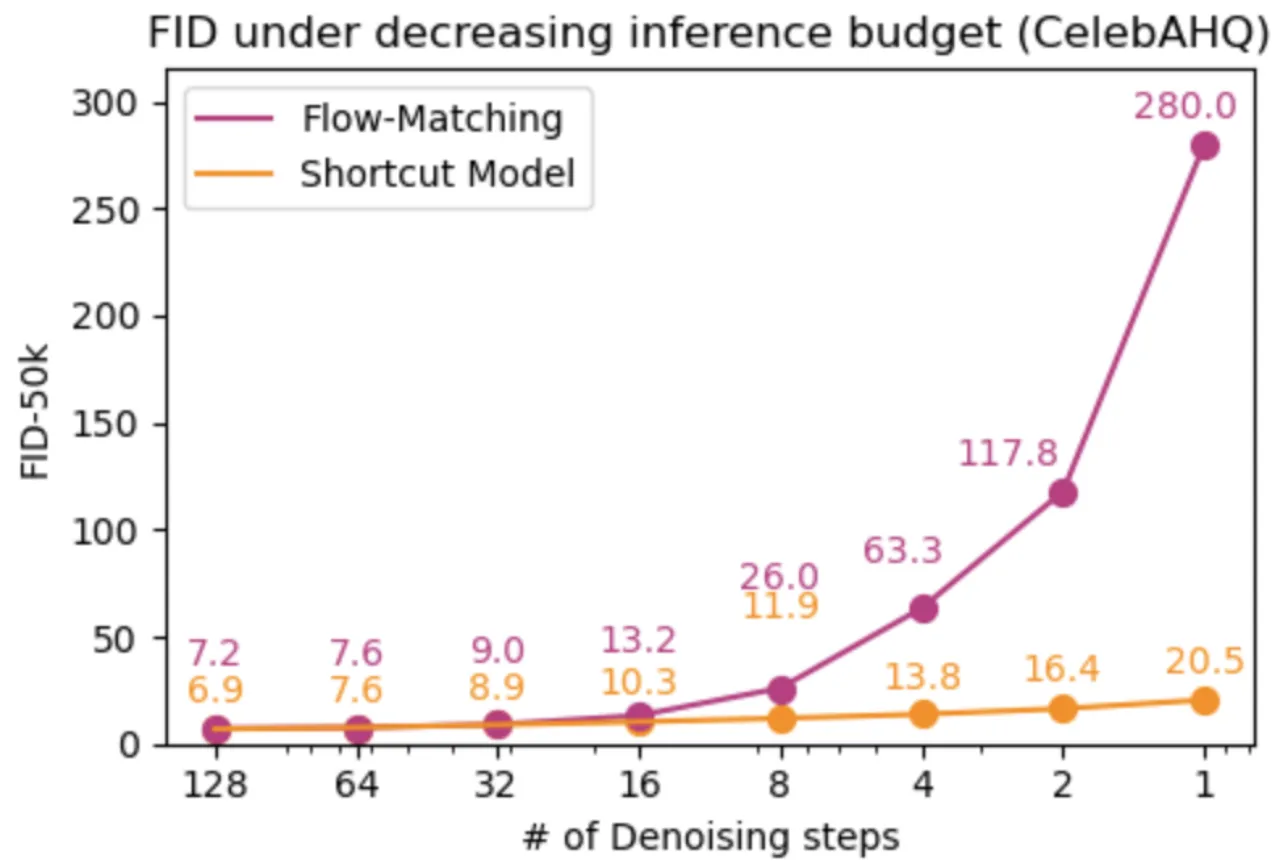
图4:不同推理步数下各方法的 FID 对比。Flow Matching 在步数减少时性能急剧退化,
而 Shortcut Models 在少步至多步全范围内均保持稳定的生成质量分布。Figure 4: FID of each method under different numbers of inference steps. Flow Matching degrades sharply as the step count drops, whereas Shortcut Models keep a stable generation-quality profile across the whole range from few steps to many steps.图5:随着模型参数量增加,Shortcut Models 的 1 步生成质量持续提升,
表明该方法具备良好的模型规模可扩展性(scaling)。这与部分基于 bootstrapping 的强化学习方法不同。Figure 5: As the number of model parameters grows, the 1-step generation quality of Shortcut Models keeps improving, indicating that the method scales well with model size. This differs from some bootstrapping-based reinforcement learning methods.
生成样本质量展示Showcase of sample quality
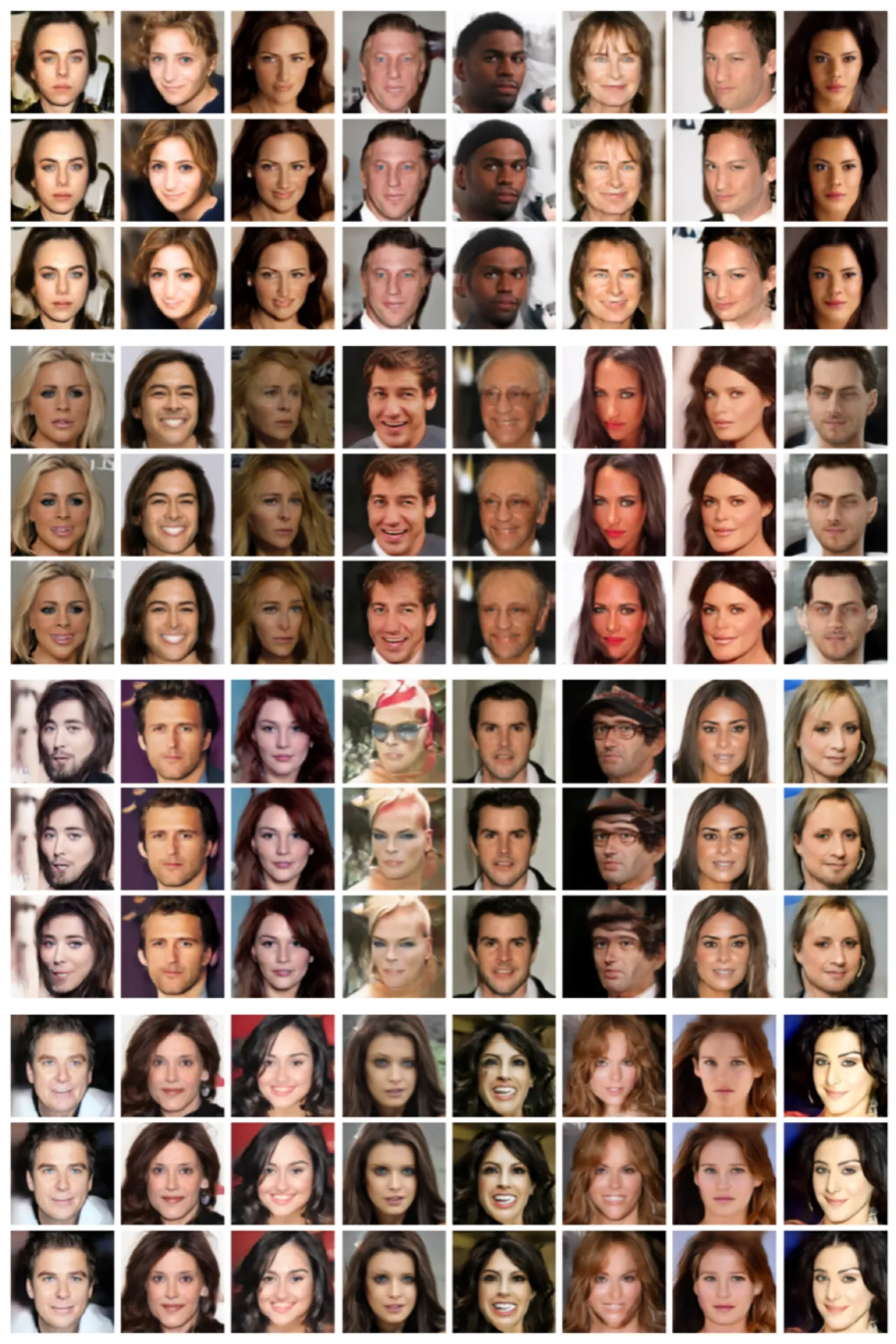
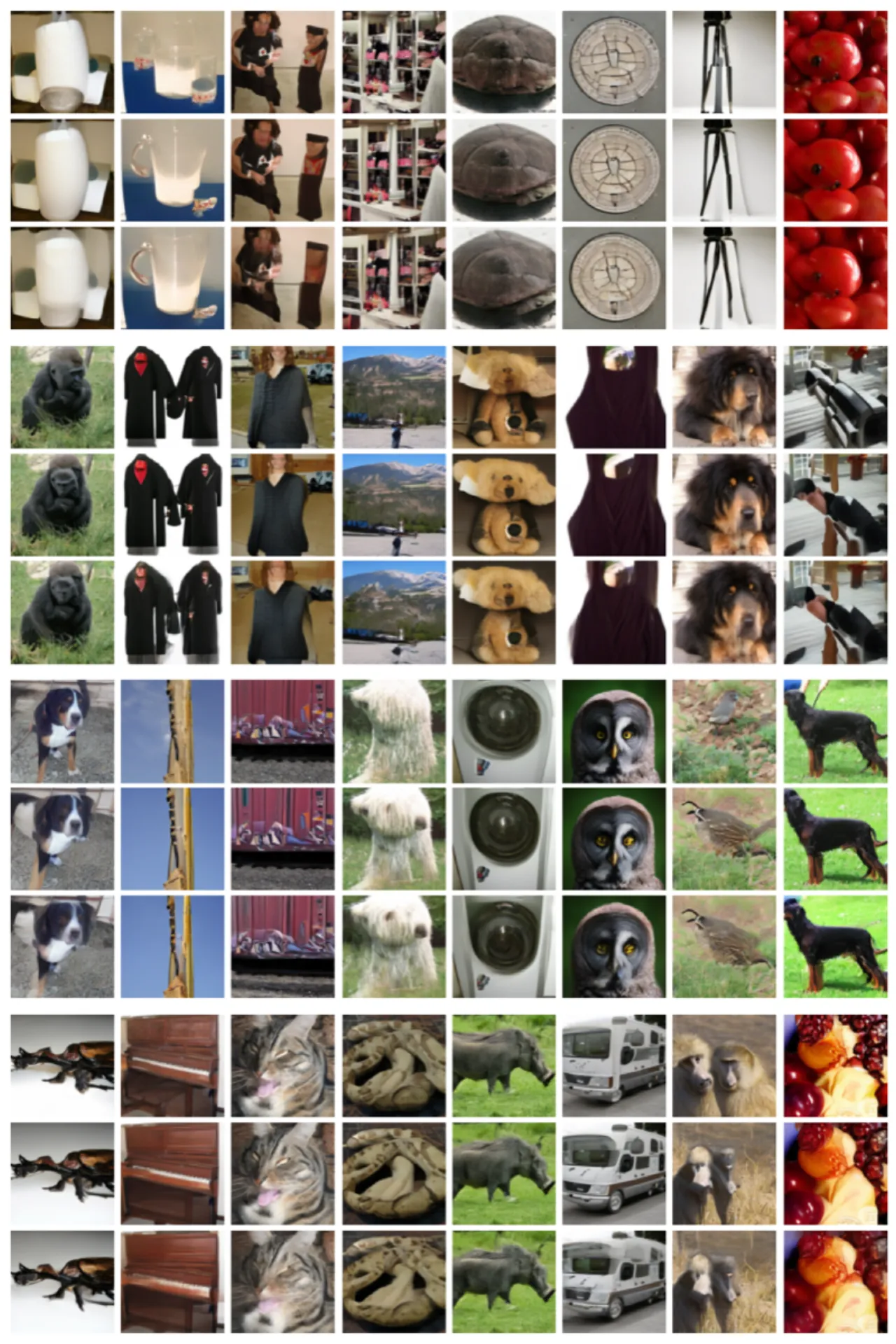
图8:CelebA-HQ 256×256 无条件生成样本,从上至下分别为 128 步、4 步、1 步。Figure 8: Unconditional samples on CelebA-HQ 256×256; from top to bottom, 128 steps, 4 steps and 1 step.图9:ImageNet-256 类别条件生成样本,从上至下分别为 128 步、4 步、1 步。Figure 9: Class-conditional samples on ImageNet-256; from top to bottom, 128 steps, 4 steps and 1 step.
机器人控制任务Robot control tasks
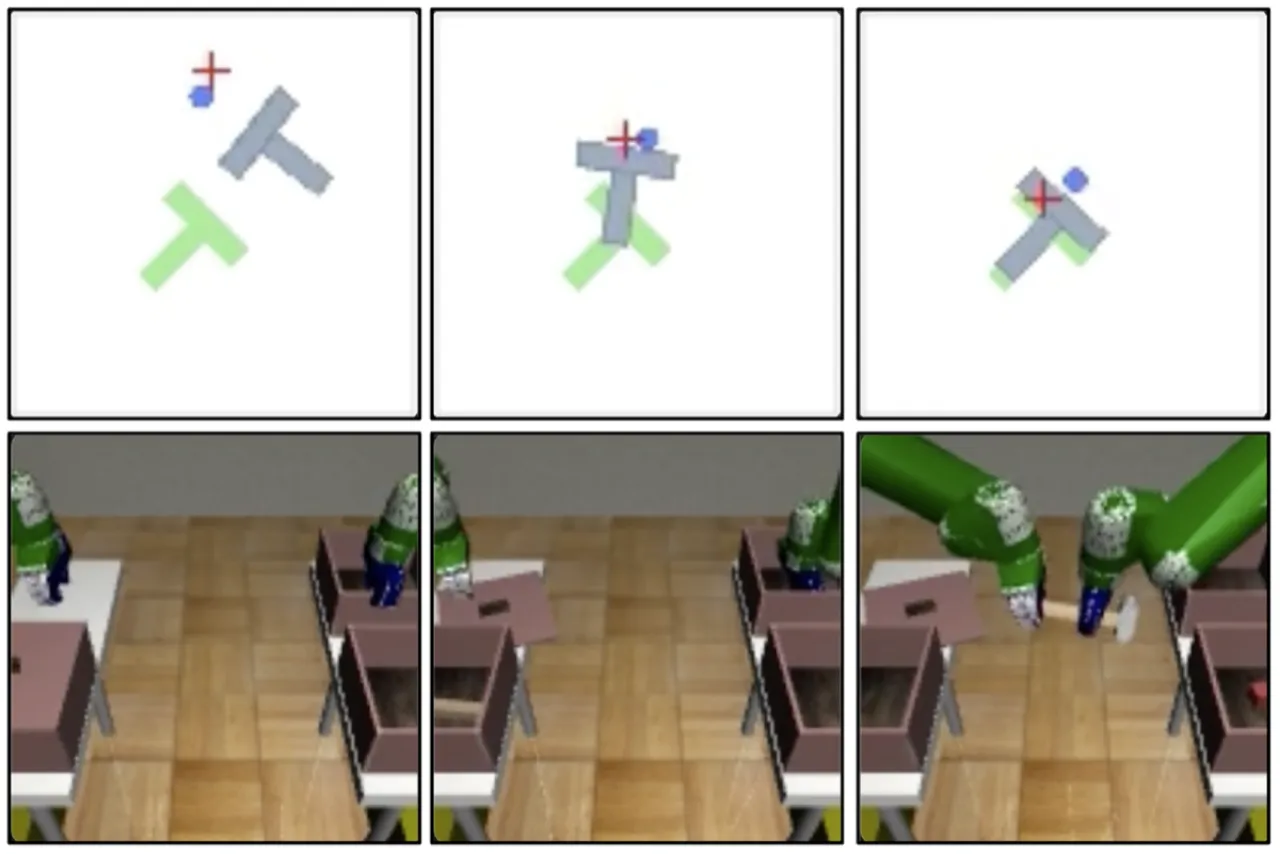
将 Shortcut Models 应用于扩散策略(Diffusion Policy)的机器人控制任务,
在 Push-T 和 Transport 两个连续控制基准上与标准 100 步扩散策略对比:Shortcut Models are applied to the robot control tasks of Diffusion Policy and compared with the standard 100-step diffusion policy on two continuous-control benchmarks, Push-T and Transport:
方法Method
步数Steps
Push-T 成功率Push-T success rate
Transport 成功率Transport success rate
Diffusion Policy(基线)Diffusion Policy (baseline)
100步100 steps
~0.85
~0.80
Diffusion Policy(基线)Diffusion Policy (baseline)
1步1 step
0.12
0.00
Shortcut Models(本文)Shortcut Models (ours)
1步1 step
0.87
0.80
Shortcut 策略在仅用 1 步推理时,达到与 100 步基线相当的成功率,
而标准扩散策略在 1 步时几乎完全失效(Transport 成功率为 0.00)。Using only 1 inference step, the shortcut policy reaches a success rate comparable to the 100-step baseline, whereas the standard diffusion policy almost completely fails at 1 step (Transport success rate 0.00).
图7:Push-T 和 Transport 机器人任务的成功率曲线。Shortcut 策略(橙色)在所有步数下均优于或持平于 Diffusion Policy(蓝色),
在 1 步时差距最为显著。Figure 7: Success-rate curves on the Push-T and Transport robot tasks. The shortcut policy (orange) matches or beats Diffusion Policy (blue) at every step count, with the largest gap at 1 step.
潜空间插值Latent space interpolation
图6:在两个采样噪声点之间进行插值,生成的图像呈现出"qualitatively smooth transitions"(论文原文),
语义平滑过渡。这表明 Shortcut Models 学到了结构化的生成式潜空间。Figure 6: Interpolating between two sampled noise points yields images with "qualitatively smooth transitions" (the paper's wording), i.e. smooth semantic transitions. This indicates that Shortcut Models learn a structured generative latent space.
消融分析Ablation analysis
论文通过消融实验验证了自一致性训练目标的必要性:去掉自一致性损失后,模型仅能在多步模式下正常工作,
在 1 步时质量退化到 Flow Matching 同等水平。
此外,实验表明不需要特别设计的训练时间表(schedule)或预热(warmup),训练过程稳定。Ablation experiments in the paper confirm that the self-consistency training target is necessary: without the self-consistency loss the model only works in multi-step mode, and at 1 step its quality degrades to the level of Flow Matching. The experiments also show that no specially designed training schedule or warmup is needed, and that training is stable.
04局限性Limitations
说明:以下局限性中,前两条为论文第 6 节(讨论)中作者明确陈述的;第三条及后续为根据论文设计推断(推断 / inferred)。Note: Among the limitations below, the first two are explicitly stated by the authors in Section 6 (Discussion); the third and the following ones are inferred from the paper's design (inferred).
噪声-数据映射依赖于数据集期望(作者明确陈述)The noise-to-data mapping depends on an expectation over the dataset (explicitly stated by the authors)
"The mapping between noise and data is entirely dependent on an expectation over the dataset."(论文原文)
与 GAN 或 VAE 不同,Shortcut Models 无法对噪声到数据的映射做独立的干预或调整,
生成的多样性上限受限于训练数据的分布。"The mapping between noise and data is entirely dependent on an expectation over the dataset." (quoted from the paper) Unlike GANs or VAEs, Shortcut Models cannot independently intervene in or adjust the noise-to-data mapping, and the upper bound on sample diversity is limited by the distribution of the training data.
多步与单步生成质量仍存在差距(作者明确陈述)A gap remains between many-step and one-step generation quality (explicitly stated by the authors)
"In our shortcut model implementation there remains a gap between many-step generation quality and one-step generation quality."(论文原文)
尽管 Shortcut Models 的差距远小于标准扩散模型,但 1 步的 FID 仍明显高于 128 步,
完全消除该差距仍是开放问题。"In our shortcut model implementation there remains a gap between many-step generation quality and one-step generation quality." (quoted from the paper) Although the gap of Shortcut Models is far smaller than that of standard diffusion models, the FID at 1 step is still clearly higher than at 128 steps, and closing it completely remains an open problem.
Classifier-Free Guidance (CFG) 仅适用于小步长(作者明确陈述)Classifier-Free Guidance (CFG) applies only to small step sizes (explicitly stated by the authors)
论文指出,CFG 在大步长时不能直接使用,因为"linear approximation is not appropriate"(论文原文)。
实现中只在 d=0(极小步长)时使用 CFG,大步长时必须放弃 CFG 加成,
这在一定程度上限制了 1 步生成的可控性。
此外,CFG 的比例(scale)需要在训练前指定,不能在推理时灵活调整。The paper notes that CFG cannot be used directly at large step sizes, because the "linear approximation is not appropriate" (quoted from the paper). The implementation uses CFG only at d=0 (extremely small step sizes) and has to give up the CFG boost at large step sizes, which to some extent limits the controllability of 1-step generation. In addition, the CFG scale must be specified before training and cannot be adjusted flexibly at inference time.
训练中的自一致性目标使用当前网络的停止梯度版本作为"教师"。若当前网络在某些状态下预测质量差,
则自举目标本身也可能含有噪声,形成累积误差——这是所有 bootstrapping 方法共有的理论风险,
论文中对此未作详细分析。The self-consistency target used during training takes a stop-gradient copy of the current network as the "teacher". If the current network predicts poorly in some states, the bootstrap target itself may be noisy and errors accumulate — a theoretical risk shared by all bootstrapping methods, which the paper does not analyze in detail.
仅在较小规模数据集上充分验证(推断 / inferred)Thoroughly validated only on relatively small datasets (inferred)
主要实验集中在 CelebA-HQ-256 和 ImageNet-256 两个数据集。
在更大规模(如 LAION-级别)或更复杂的条件生成(如文本到图像)场景下的性能表现,
论文未作系统性验证。The main experiments focus on two datasets, CelebA-HQ-256 and ImageNet-256. Performance at a larger scale (such as LAION-level data) or in more complex conditional generation settings (such as text-to-image) is not systematically validated in the paper.