← 论文海报合集← Paper Notes|
机器人操作 · 3D场景理解 · arXiv 2410.23643Robot Manipulation · 3D Scene Understanding · arXiv 2410.23643

SceneComplete: 面向机器人操作的开放世界杂乱场景3D补全SceneComplete: Open-World 3D Scene Completion in Cluttered Real World Environments for Robot Manipulation

从单张RGB-D图像重建完整、分割的三维场景模型Reconstructing complete, segmented 3D scene models from a single RGB-D image
Aditya Agarwal, Gaurav Singh, Bipasha Sen, Tomás Lozano-Pérez, Leslie Pack Kaelbling  ·  MIT CSAIL & Brown University

SceneComplete 是一个将多个通用预训练感知模块(VLM、分割、图像修复、Image-to-3D、视觉描述符、位姿估计)串联组合的流水线系统,能够从单张RGB-D图像生成场景中所有可见物体的完整3D网格,包括被大量遮挡的新颖物体,从而为机器人抓取和放置提供精确的三维依据。SceneComplete is a pipeline system that composes multiple general-purpose pre-trained perception modules (VLM, segmentation, image inpainting, Image-to-3D, visual descriptors, pose estimation) in sequence, producing complete 3D meshes of every visible object in the scene from a single RGB-D image, including heavily occluded novel objects, and thereby providing precise 3D grounding for robotic grasping and placement.

IEEE RA-L 2025 MIT CSAIL · Brown University 代码开源Code Available arXiv 2410.23643 ↗ 项目主页Project Page
关键词Keywords3D scene completionrobot manipulationopen-world reconstructionImage-to-3Dimage inpainting6D pose estimation场景补全scene completion遮挡恢复occlusion recoveryRGB-D重建RGB-D reconstruction模块化感知流水线modular perception pipeline

01 动机Motivation

机器人在日常杂乱环境中操作,需要对三维场景进行精确理解,才能稳定可靠地抓取和放置物体,并避免碰撞。然而现实中往往只能获得单张RGB-D图像,场景中物体相互遮挡,且多为训练数据之外的新颖物体——这是当前三维场景重建方法面临的核心挑战。Robots operating in everyday cluttered environments need an accurate understanding of the 3D scene in order to grasp and place objects stably and reliably and to avoid collisions. In practice, however, often only a single RGB-D image is available, the objects in the scene occlude one another, and most of them are novel objects outside the training data — this is the core challenge facing current 3D scene reconstruction methods.

"Careful robot manipulation in every-day cluttered environments requires an accurate understanding of the 3D scene, in order to grasp and place objects stably and reliably and to avoid colliding with other objects. In general, we must construct such a 3D interpretation of a complex scene based on limited input, such as a single RGB-D image."
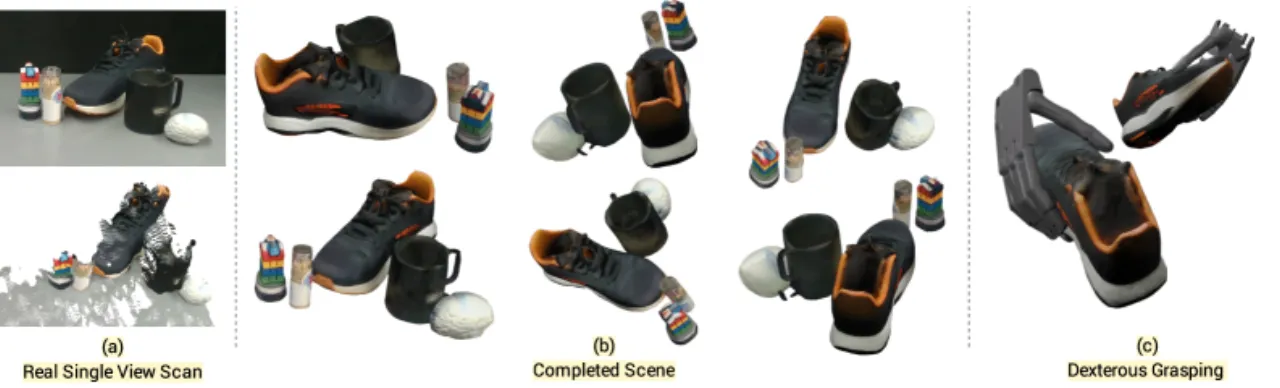
SceneComplete Teaser
图1:SceneComplete 系统概览。 (a) 输入单张RGB-D图像(以点云形式可视化);(b) 输出高质量、完整分割的物体网格,能处理大量遮挡和新颖物体;(c) 使下游精细化操作成为可能,包括需要完整形状信息的灵巧手抓取。Figure 1: Overview of the SceneComplete system. (a) Input: a single RGB-D image (visualized as a point cloud); (b) Output: high-quality, fully segmented object meshes that handle heavy occlusion and novel objects; (c) Enabling downstream fine-grained manipulation, including dexterous-hand grasping that requires complete shape information.

先前方法的不足Shortcomings of Prior Methods

现有方法(如 PartialDecomp、OctMAE、ZeroGrasp)在开放世界场景下存在明显局限:要么仅能预测场景级占据值而无法给出精确物体网格,要么依赖有限的物体类别,难以泛化到真实杂乱环境中的新颖物体。SceneComplete 的核心思路是组合(composing)已有的大型预训练视觉模型,而非端到端训练一个新模型,从而天然具备开放词汇泛化能力,并能随基础模型的改进而不断提升。Existing methods (such as PartialDecomp, OctMAE and ZeroGrasp) have clear limitations in open-world settings: they either predict only scene-level occupancy without yielding precise object meshes, or depend on a limited set of object categories and generalize poorly to novel objects in real cluttered environments. The core idea of SceneComplete is to compose existing large pre-trained vision models rather than train a new model end-to-end, which gives open-vocabulary generalization for free and lets the system keep improving as its foundation models improve.

0.478MIoU↑ (GraspNet-1B)
高于所有基线
MIoU↑ (GraspNet-1B)
Highest among all baselines
77%总体抓取成功率
(YCB-V, vs. 32% 基线)
Overall grasp success rate
(YCB-V, vs. 32% baseline)
73.3%真实机器人
抓取放置成功率
Real-robot
pick-and-place success rate
1.54CD↓ (Chamfer Distance)
最低几何误差
CD↓ (Chamfer Distance)
Lowest geometric error
02 方法Method

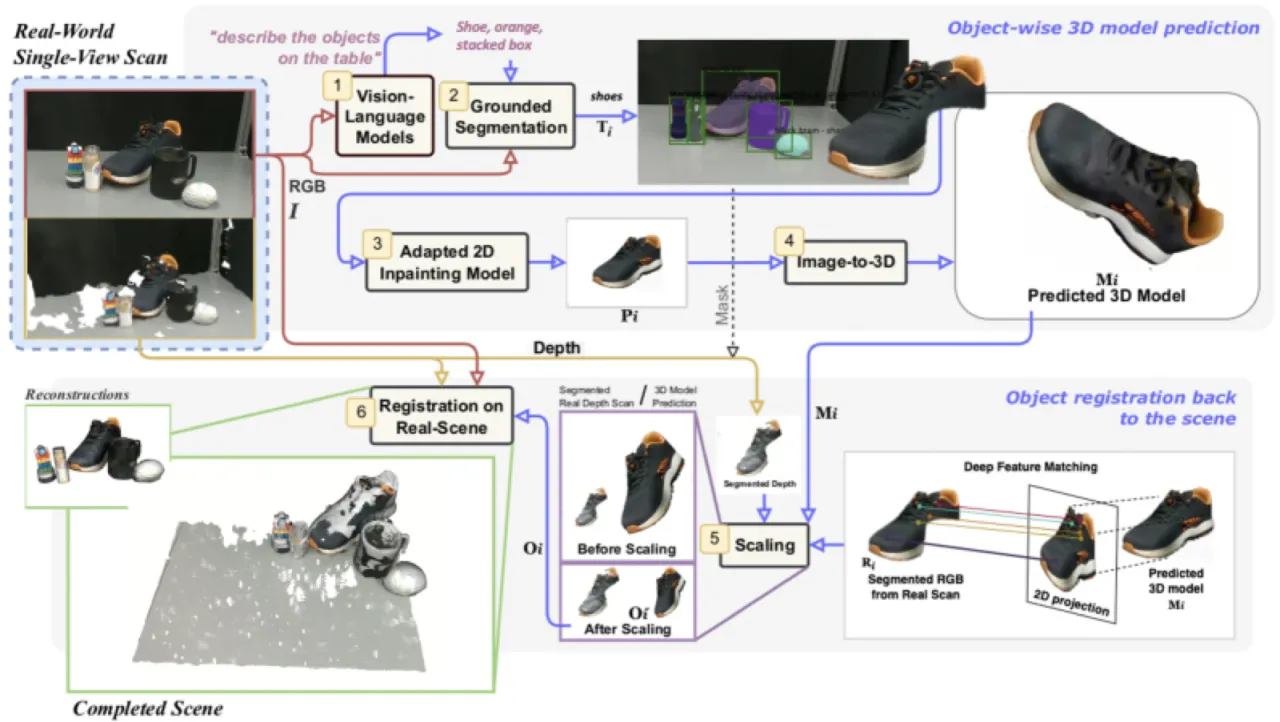
SceneComplete 流水线由六个顺序模块组成,每个模块均调用独立的预训练大型视觉模型。从单张RGB-D输入出发,逐步完成:物体识别 → 分割 → 图像修复 → Image-to-3D → 尺度估计 → 6D位姿配准,最终输出完整场景的物体网格集合。The SceneComplete pipeline consists of six sequential modules, each invoking an independent pre-trained large vision model. Starting from a single RGB-D input, it proceeds step by step: object recognition → segmentation → image inpainting → Image-to-3D → scale estimation → 6D pose registration, finally outputting the set of object meshes for the complete scene.

SceneComplete Pipeline
图2:SceneComplete 流水线总览。 从单张RGB-D输入,经过六个核心阶段生成与输入3D扫描对齐的物体网格集合:(1) VLM枚举并描述物体;(2) GroundedSAM2生成分割掩码;(3) BrushNet(LoRA适配)图像修复;(4) InstantMesh生成3D网格;(5) 基于视觉Transformer的密集对应估计尺度;(6) FoundationPose 6D位姿估计。Figure 2: Overview of the SceneComplete pipeline. From a single RGB-D input, six core stages produce a set of object meshes aligned with the input 3D scan: (1) a VLM enumerates and describes the objects; (2) GroundedSAM2 generates segmentation masks; (3) BrushNet (LoRA-adapted) performs image inpainting; (4) InstantMesh generates 3D meshes; (5) dense correspondences based on a vision Transformer estimate scale; (6) FoundationPose performs 6D pose estimation.

① VLM 提示 + Grounded 分割① VLM Prompting + Grounded Segmentation

输入RGB图像送入 ChatGPT-4o,生成场景中物体的文字描述列表;描述和图像再送入 GroundedSAM2 生成每个物体的分割掩码。采用多策略提示(全局描述 + 部分扩展)并通过 IoU 去重,应对 VLM 漏检和过度分割的情况。The input RGB image is fed to ChatGPT-4o to produce a list of textual descriptions of the objects in the scene; the descriptions and the image are then fed to GroundedSAM2 to generate a segmentation mask for each object. Multi-strategy prompting (global description + partial expansion) combined with IoU-based deduplication handles VLM misses and over-segmentation.

② 图像修复(Image Inpainting)② Image Inpainting

对每个分割出的(可能被遮挡的)物体,用 BrushNet(含 LoRA 适配)进行图像修复,将其转化为白色背景上的单个完整可见物体图像。通过边界框扩展保留上下文信息,适配训练使输出符合后续 Image-to-3D 模型的输入要求。For every segmented (possibly occluded) object, BrushNet (with LoRA adaptation) performs image inpainting, turning it into an image of a single, fully visible object on a white background. Bounding-box expansion preserves contextual information, and adaptation training makes the output match the input requirements of the downstream Image-to-3D model.

③ Image-to-3D 重建③ Image-to-3D Reconstruction

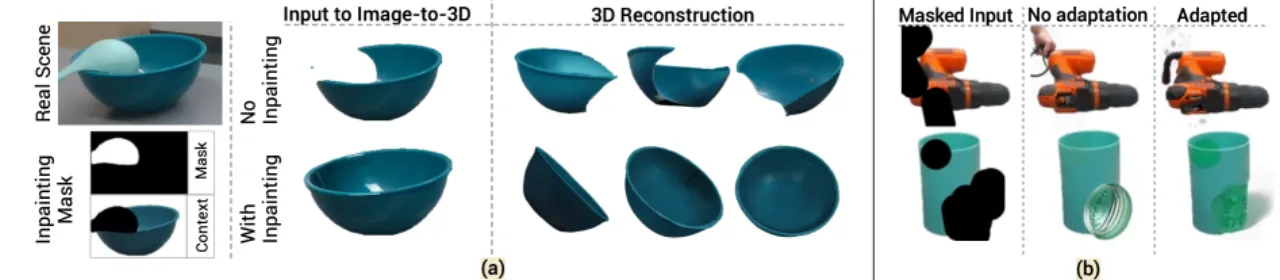
将修复后的2D图像送入 InstantMesh,生成带纹理的3D网格。修复步骤对该模块至关重要:未经修复时,Image-to-3D 模型会生成不完整的网格;修复后则能产生准确的3D重建结果(见图4)。The inpainted 2D image is fed to InstantMesh to generate a textured 3D mesh. The inpainting step is critical for this module: without it the Image-to-3D model produces incomplete meshes; with it, accurate 3D reconstructions are obtained (see Figure 4).

④ 尺度估计 + 6D位姿配准④ Scale Estimation + 6D Pose Registration

利用视觉 Transformer 的密集对应匹配,将预测网格与观测点云对齐,估计各向同性尺度因子。最后用 FoundationPose 进行6自由度位姿估计,将每个网格配准到原始扫描的3D坐标系中,完成场景拼装。Dense correspondence matching from a vision Transformer aligns the predicted mesh with the observed point cloud and estimates an isotropic scale factor. Finally, FoundationPose performs 6-DoF pose estimation, registering every mesh into the 3D coordinate frame of the original scan to assemble the scene.

Inpainting Effect
图4:修复对 Image-to-3D 的影响。 (a) 无修复(上)时 Image-to-3D 生成不完整网格;修复(下)后遮挡部分被填充,产生准确的3D重建。(b) 未适配的 BrushNet(中)会引入伪影,适配后版本(右)能正确修复遮挡区域,生成完整可见物体。Figure 4: Effect of inpainting on Image-to-3D. (a) Without inpainting (top), Image-to-3D generates incomplete meshes; with inpainting (bottom), the occluded parts are filled in and accurate 3D reconstructions are produced. (b) The unadapted BrushNet (middle) introduces artifacts, while the adapted version (right) correctly inpaints the occluded regions and yields a fully visible object.

03 实验Experiments

在 GraspNet-1B 大型基准数据集上进行定量评估(场景重建质量 + 抓取指标),并在 YCB-V 数据集和真实机器人平台上验证抓取成功率。基线包括 PartialDecomp、OctMAE 和 ZeroGrasp。Quantitative evaluation is carried out on the large-scale GraspNet-1B benchmark (scene reconstruction quality + grasp metrics), and grasp success rates are validated on the YCB-V dataset and on a real robot platform. Baselines include PartialDecomp, OctMAE and ZeroGrasp.

表I:GraspNet-1B 场景重建与抓取质量对比Table I: Scene reconstruction and grasp quality on GraspNet-1B

方法MethodMIoU ↑CD ↓MMD-EMD ↓GC ↓
PartialDecomp0.1663.163.3253.5
OctMAE0.4451.733.1120.3
ZeroGrasp0.4401.863.0718.9
SceneComplete(本文)SceneComplete (ours)0.4781.543.0616.4

MIoU: Mean Intersection over Union;CD: Chamfer Distance;MMD-EMD: Modified Maximum Distance using Earth Mover's Distance;GC: Grasp Collision率。SceneComplete 在所有四项指标上均优于所有基线。MIoU: Mean Intersection over Union; CD: Chamfer Distance; MMD-EMD: Modified Maximum Distance using Earth Mover's Distance; GC: Grasp Collision rate. SceneComplete outperforms all baselines on all four metrics.

表II:YCB-V 数据集抓取成功率(Grasp Success Rate)Table II: Grasp success rate on the YCB-V dataset

方法MethodContact-GraspNet GSRAntipodal GSR总体 GSR ↑Overall GSR ↑
PartialDecomp0.46 ± 0.340.17 ± 0.130.32
SceneComplete(本文)SceneComplete (ours)0.81 ± 0.20.73 ± 0.180.77

表III:真实机器人抓取放置成功率Table III: Real-robot pick-and-place success rate

方法Method成功率 ↑Success rate ↑
Partial Point Cloud(仅部分点云)Partial Point Cloud (partial point cloud only)36.7 ± 9.9%
OctMAE59.6 ± 15.3%
SceneComplete(本文)SceneComplete (ours)73.3 ± 15.2%
Qualitative Results GraspNet-1B
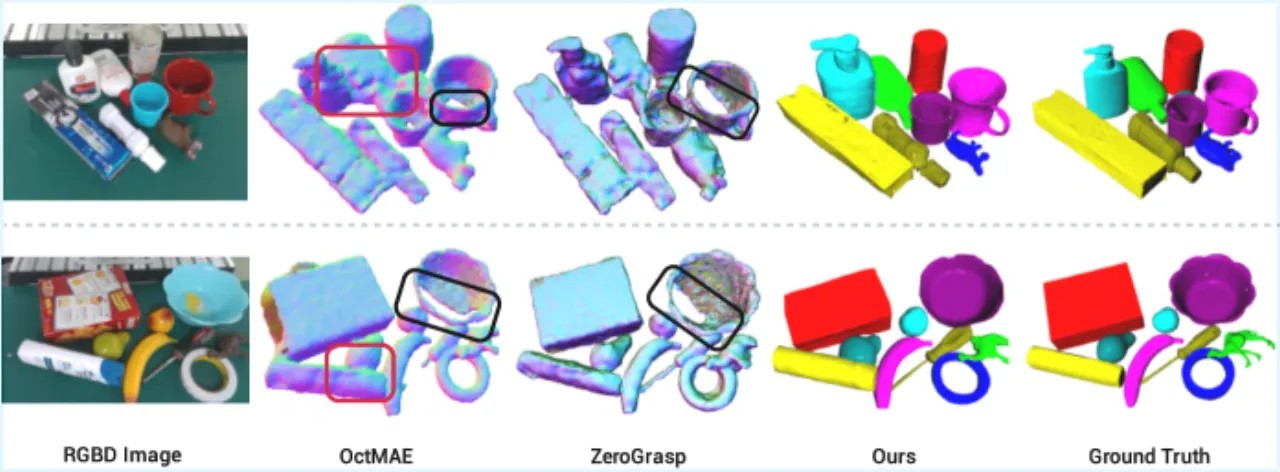
图5:GraspNet-1B 数据集场景重建定性对比。 每组展示:输入RGB-D图像、OctMAE重建(法线图)、ZeroGrasp重建(法线图)、SceneComplete重建(逐物体网格,颜色与真值匹配)、真值网格。高亮区域标记缺失区域(黑色)或错误连接相邻物体的伪影(红色)。Figure 5: Qualitative comparison of scene reconstruction on the GraspNet-1B dataset. Each group shows: the input RGB-D image, the OctMAE reconstruction (normal map), the ZeroGrasp reconstruction (normal map), the SceneComplete reconstruction (per-object meshes, colors matched to ground truth), and the ground-truth meshes. Highlighted regions mark missing areas (black) or artifacts that wrongly connect neighboring objects (red).
Real Robot Results
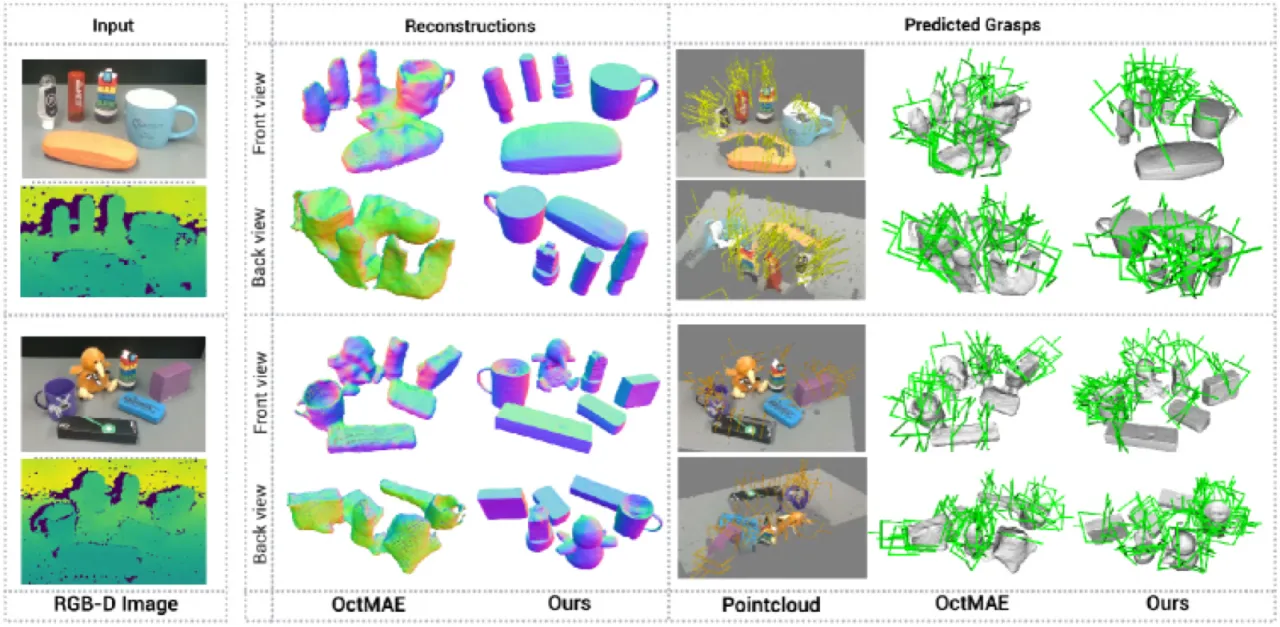
图8:实验室真实场景重建定性对比。 每组展示:输入RGB-D图像、OctMAE重建、SceneComplete重建、基于部分点云的抓取方案、基于OctMAE重建的抓取方案、基于SceneComplete重建的抓取方案(前后两视角)。SceneComplete 的完整重建显著改善了抓取方案的质量。Figure 8: Qualitative comparison of reconstruction on real laboratory scenes. Each group shows: the input RGB-D image, the OctMAE reconstruction, the SceneComplete reconstruction, the grasp plan based on the partial point cloud, the grasp plan based on the OctMAE reconstruction, and the grasp plan based on the SceneComplete reconstruction (front and back views). The complete reconstructions of SceneComplete markedly improve the quality of the grasp plans.

消融实验Ablation Study

图4 展示了修复(inpainting)模块的关键作用:去掉修复步骤后,Image-to-3D 模型只能生成残缺网格;未适配的 BrushNet 会引入伪影,而经过 LoRA 适配的版本能正确恢复遮挡区域,生成完整可见物体图像。消融验证了流水线中每个模块(尤其是修复和尺度估计)对最终重建质量的不可替代性。Figure 4 illustrates the critical role of the inpainting module: with the inpainting step removed, the Image-to-3D model can only produce incomplete meshes; the unadapted BrushNet introduces artifacts, whereas the LoRA-adapted version correctly recovers the occluded regions and produces images of fully visible objects. The ablation confirms that every module in the pipeline — inpainting and scale estimation in particular — is indispensable to the final reconstruction quality.

Dexterous Grasping
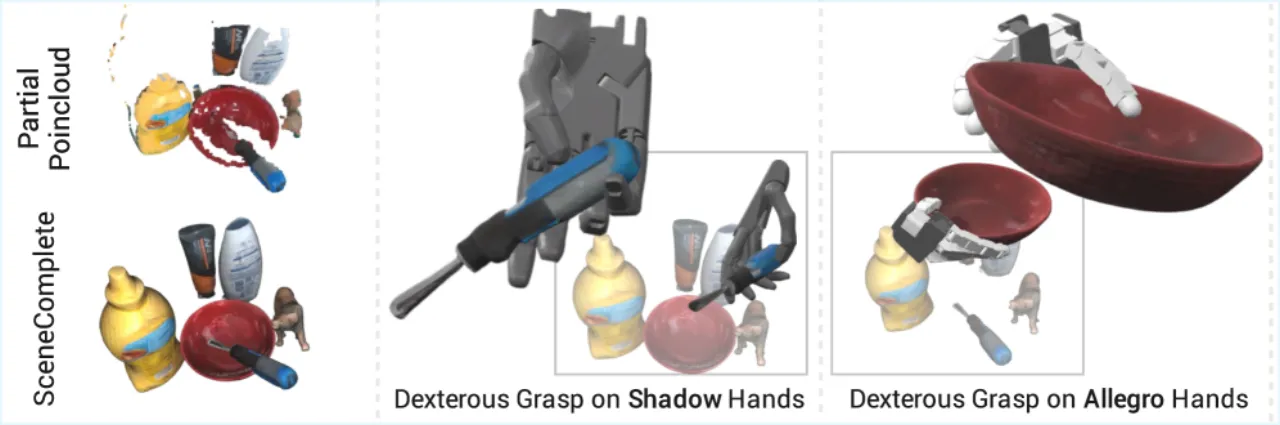
图7:基于SceneComplete的灵巧手抓取演示。 使用 Shadow Hand 和 Allegro Hand 对 GraspNet-1B 数据集中的物体进行抓取,展示了完整3D重建对复杂操作任务的提升效果。Figure 7: Dexterous-hand grasping demonstration built on SceneComplete. A Shadow Hand and an Allegro Hand grasp objects from the GraspNet-1B dataset, showing how complete 3D reconstruction improves complex manipulation tasks.

04 局限性Limitations

说明:以下局限性均由作者在论文中明确陈述(stated),对应流水线中各模块可能的失效模式。Note: All limitations below are explicitly stated by the authors in the paper and correspond to possible failure modes of the individual modules in the pipeline.
VLM 提示阶段:偶发漏检VLM prompting stage: occasional missed detections

视觉语言模型(VLM)偶尔会遗漏场景中的物体,尤其是外观不典型或被高度遮挡的物体。论文采用多策略提示(multi-strategy prompting)加以缓解,但无法完全消除。The vision-language model (VLM) occasionally misses objects in the scene, especially those with atypical appearance or under heavy occlusion. The paper mitigates this with multi-strategy prompting, but cannot eliminate it entirely.

分割阶段:过度分割同一物体Segmentation stage: over-segmentation of a single object

GroundedSAM 有时会将单个物体的不同部分分开分割。论文通过基于 IoU 的去重(deduplication)部分解决,但仍可能导致下游网格重复或残缺。GroundedSAM sometimes segments different parts of one object separately. The paper partially resolves this through IoU-based deduplication, but it can still lead to duplicated or incomplete meshes downstream.

图像修复阶段:上下文信息丢失Image inpainting stage: loss of contextual information

当前修复方法会移除物体周围的场景上下文信息。通过边界框扩展和模型适配(LoRA)可部分缓解,但对极端遮挡情况效果有限。The current inpainting method removes the scene context surrounding the object. Bounding-box expansion and model adaptation (LoRA) partially mitigate this, but help little under extreme occlusion.

Image-to-3D 阶段:极端视角下重建失败Image-to-3D stage: reconstruction failure under extreme viewpoints

Image-to-3D 模型在处理"highly unusual viewpoints"(极端非常规视角)时会产生失真或不完整的网格,这是当前生成式3D模型的固有局限。The Image-to-3D model produces distorted or incomplete meshes for "highly unusual viewpoints", an inherent limitation of current generative 3D models.

尺度估计:各向同性假设过于简化Scale estimation: the isotropic assumption is oversimplified

当前方法假设各向同性(isotropic)缩放,对非均匀形状的物体可能不准确。此外,6D位姿配准在"uniformly-textured objects"(纹理均匀的物体)上会失败,因为缺乏可用的区分性特征点。The current method assumes isotropic scaling, which can be inaccurate for non-uniformly shaped objects. In addition, 6D pose registration fails on "uniformly-textured objects", because no usable distinctive feature points are available.

随机种子敏感性:输出不稳定Random-seed sensitivity: unstable outputs

Image-to-3D 和修复模型的输出对随机种子(seed)敏感,相同输入可能产生质量差异较大的结果,影响系统的可重复性。The outputs of the Image-to-3D and inpainting models are sensitive to the random seed; identical inputs can yield results of widely varying quality, which hurts the reproducibility of the system.