SanD-Planner: Sample-Efficient Diffusion Planner in B-Spline Space for Robust Local Navigation
用夹持三次 B 样条控制点空间做扩散式局部规划,500 条演示即达 SOTADiffusion-based local planning in the control-point space of clamped cubic B-splines; SOTA with only 500 demonstrations
Jincheng Wang, Lingfan Bao, Tong Yang, Diego Martinez Plasencia, Jianhao Jiao*, Dimitrios Kanoulas — University College London
SanD-Planner 是一个样本高效的、基于扩散模型的局部导航规划器,在夹持三次 B 样条(clamped cubic B-spline)控制点空间中直接对深度图像做模仿学习。仅用 500 条专家轨迹(约为基线 NavDP 演示规模的 0.25%),SanD-Planner 就在 InternRobotics 开放基准上取得了 SOTA 表现,并在真实四足机器人上实现了 2D/3D 场景下的 zero-shot sim-to-real 迁移。SanD-Planner is a sample-efficient, diffusion-based local navigation planner that performs imitation learning directly on depth images in the control-point space of a clamped cubic B-spline. Using only 500 expert trajectories (about 0.25% of the demonstration scale of the NavDP baseline), it attains SOTA performance on the InternRobotics open benchmark and achieves zero-shot sim-to-real transfer in 2D/3D scenes on a real quadruped robot.
在杂乱、动态的环境中生成可靠的局部规划一直是移动机器人落地的关键瓶颈。核心难点在于:获取跨多样场景的大规模专家演示成本高,且如何在有限数据下提升学习效率仍是开放问题。近期的模仿学习(IL)方法(如 NavDP)依赖聚合大规模真实/仿真数据集来提升泛化,但这种“数据扩张”路线带来巨大的算力和采集开销。Generating reliable local plans in cluttered, dynamic environments has long been a key bottleneck for deploying mobile robots. The core difficulty is twofold: collecting large-scale expert demonstrations across diverse scenes is expensive, and how to raise learning efficiency under limited data remains an open problem. Recent imitation learning (IL) methods such as NavDP rely on aggregating large-scale real/simulated datasets to improve generalization, but this "data scaling" route incurs enormous compute and collection cost.
“In this paper, we explore a complementary direction by asking whether local navigation can achieve high performance in a ‘data desert’ of limited expert demonstrations.”
作者认为,与其继续扩大演示规模,不如通过更强的结构化归纳偏置(inductive bias)来提升样本效率——这正是 SanD-Planner 用 B 样条(B-spline)参数化轨迹的出发点:B 样条天然具有 C² 连续性与局部支撑(local support)特性,能让噪声/遮挡带来的远端预测误差被局限在远端控制点,不会传播到近端执行段。The authors argue that rather than further scaling up demonstrations, sample efficiency should be improved through a stronger structural inductive bias — which is precisely the motivation for SanD-Planner's B-spline parameterization of trajectories: B-splines are inherently C² continuous and have local support, so far-field prediction errors caused by noise or occlusion stay confined to the distal control points and do not propagate into the near-term executed segment.
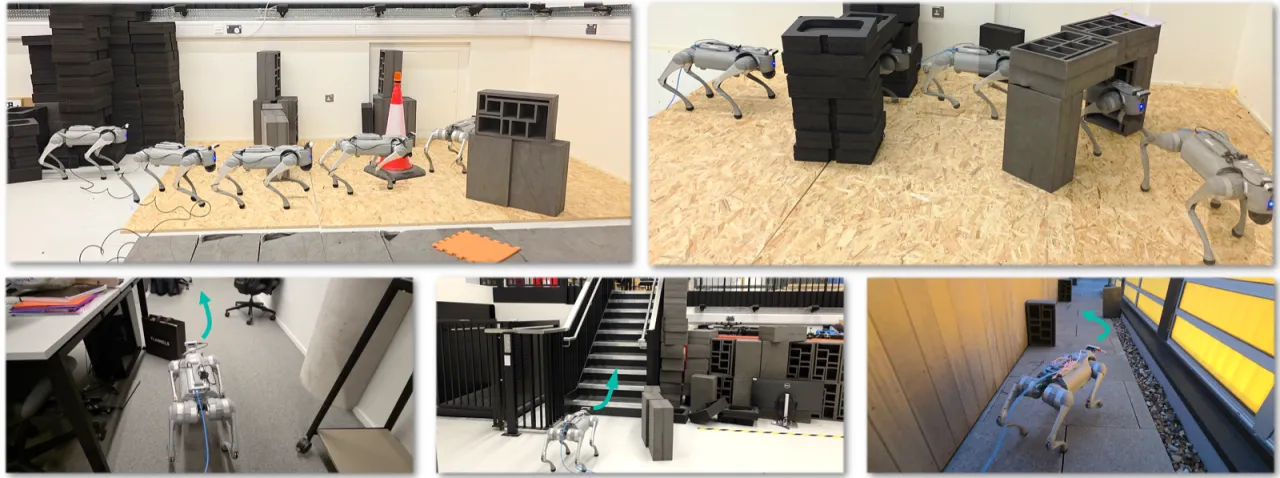
Figure 1:SanD-Planner 在真实场景中的演示。机器人可在紧凑空间中穿越狭窄通道、避障并完成爬楼梯等 3D 导航任务("Real-world demonstrations of SanD-Planner... navigating narrow passages, avoiding obstacles, and climbing stairs.")。Figure 1: Real-world demonstrations of SanD-Planner. The robot traverses narrow passages in tight spaces, avoids obstacles, and completes 3D navigation tasks such as stair climbing ("Real-world demonstrations of SanD-Planner... navigating narrow passages, avoiding obstacles, and climbing stairs.").
≈5h单张 RTX 4080 训练时长Training time on a single RTX 4080
02 Method
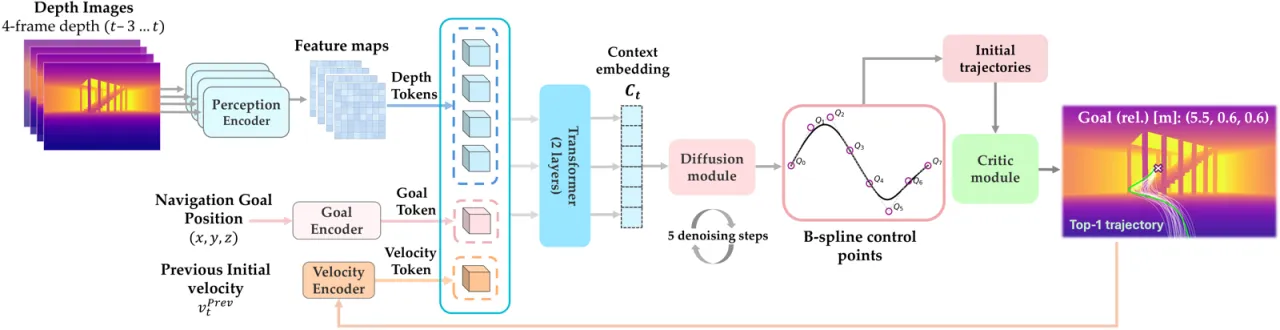
在每个规划步 t,模型接收 4 帧历史深度图像、相对目标点 g_t 与上一步的运动上下文(motion context)v_t^prev,经域专用编码器(domain-specific encoders)与两层 Transformer 融合成统一潜在上下文 C_t;扩散策略在该上下文条件下,通过迭代去噪生成一组固定数量(8 个)的 B 样条控制点,再由几何 critic 模块从候选中选出最优、可行的轨迹执行,并将其初始速度反馈回下一步以维持时序一致性。At each planning step t, the model takes 4 historical depth frames, the relative goal point g_t, and the previous motion context v_t^prev; domain-specific encoders and a two-layer Transformer fuse them into a unified latent context C_t. Conditioned on that context, the diffusion policy generates a fixed number (8) of B-spline control points by iterative denoising; a geometric critic module then selects the best feasible trajectory among the candidates for execution and feeds its initial velocity back to the next step to maintain temporal consistency.
Figure 2:SanD-Planner 总览。管线将历史深度图、相对目标点、上一步速度经两层 Transformer 编码融合,条件化扩散策略以迭代去噪生成 B 样条控制点;几何 critic 模块从候选中选出最优规划执行,并把其初始速度反馈给下一步以维持时序一致性。Figure 2: Overview of SanD-Planner. The pipeline encodes and fuses historical depth images, the relative goal point, and the previous-step velocity through a two-layer Transformer; the conditioned diffusion policy generates B-spline control points by iterative denoising; a geometric critic module picks the best plan among the candidates for execution and feeds its initial velocity back to the next step to maintain temporal consistency.
B 样条轨迹参数化(Trajectory Parameterization via B-Spline Control Points)Trajectory Parameterization via B-Spline Control Points
不同于按规划时域线性增长输出维度的 waypoint 方法,SanD-Planner 只预测固定的 8 个 B 样条控制点,把几何先验作为归纳偏置嵌入表示中,在不增加学习复杂度的前提下扩展有效规划时域,缓解“近视”(myopic)行为。B 样条构造上保证 C² 连续,因此平滑性是表示本身自带的属性而非需要学习的特征;同时其局部支撑特性使远端感知噪声/遮挡只影响远端控制点,不会破坏近端执行段的稳定性。Unlike waypoint methods whose output dimension grows linearly with the planning horizon, SanD-Planner predicts only a fixed set of 8 B-spline control points, embedding a geometric prior into the representation as an inductive bias; this extends the effective planning horizon without adding learning complexity and mitigates "myopic" behavior. B-splines are C² continuous by construction, so smoothness is an intrinsic property of the representation rather than a feature that must be learned; meanwhile their local support makes far-field perception noise and occlusion affect only the distal control points, without undermining the stability of the near-term executed segment.
轨迹生成与安全评估被显式解耦:一个可解释的在线 critic 模块集成了基于 ESDF(Euclidean Signed Distance Field)的安全检查器,配合显式的 clearance(净空)与 time-to-completion(完成时间)指标,对扩散策略生成的候选轨迹做折扣安全代价(discounted safety cost)与路径效率(path efficiency)打分,从而免去为可行性评估单独学习价值函数(value function)的训练负担,让策略只需专注于拟合专家轨迹分布。此外,previous-velocity token v_t^prev 被用于跨步的时序一致性调节。Trajectory generation and safety assessment are explicitly decoupled: an interpretable online critic module integrates an ESDF-based (Euclidean Signed Distance Field) safety checker together with explicit clearance and time-to-completion metrics, scoring the candidate trajectories produced by the diffusion policy on discounted safety cost and path efficiency. This removes the training burden of separately learning a value function for feasibility assessment, letting the policy focus solely on fitting the expert trajectory distribution. In addition, the previous-velocity token v_t^prev is used to regulate temporal consistency across steps.
03 Experiments
在 InternNav Benchmark(提供逼真室内场景,最小化 sim-to-real gap)上评估,包含 ClutteredEnv(杂乱几何障碍,2020 episodes)与 InternScenes(照片级室内场景,4040 episodes)两个子基准,指标为 Success Rate (SR) 与 Success weighted by Path Length (SPL)。对比基线为 iPlanner、ViPlanner 与 NavDP(三者结果取自基准论文 [5])。Evaluation is carried out on the InternNav Benchmark, which provides photorealistic indoor scenes that minimize the sim-to-real gap. It comprises two sub-benchmarks: ClutteredEnv (cluttered geometric obstacles, 2020 episodes) and InternScenes (photorealistic indoor scenes, 4040 episodes). The metrics are Success Rate (SR) and Success weighted by Path Length (SPL). The baselines are iPlanner, ViPlanner, and NavDP, whose results are taken from the benchmark paper [5].
Benchmark
Method
SR ↑
SPL ↑
ClutteredEnv
iPlanner
84.8
83.6
ViPlanner
72.4
72.3
NavDP
89.8
87.7
SanD-Planner (Ours)
90.1
84.0
InternScenes
iPlanner
48.8
46.7
ViPlanner
54.3
52.5
NavDP
65.7
60.7
SanD-Planner (Ours)
72.0
63.7
在 InternScenes 上,SanD-Planner 大幅超越 NavDP("+6.3% SR and 3.0% SPL"),仅用 NavDP 约 0.25%(500 vs 200k 条轨迹)的训练数据,单张 RTX 4080 训练约 5 小时(NavDP 需 32×A100 训练 24 小时)。在 ClutteredEnv 上 SanD-Planner SR 最高(90.1%),但 SPL(84.0%)略低于 NavDP(87.7%)——论文指出这部分归因于 B 样条参数化偏向更安全但更保守的绕行策略,并认为该差距源于数据规模有限而非方法本身的局限。On InternScenes, SanD-Planner substantially outperforms NavDP ("+6.3% SR and 3.0% SPL") while using only about 0.25% of NavDP's training data (500 vs 200k trajectories), trained in about 5 hours on a single RTX 4080 (NavDP requires 24 hours on 32×A100). On ClutteredEnv, SanD-Planner attains the highest SR (90.1%), but its SPL (84.0%) is slightly below NavDP (87.7%) — the paper attributes this partly to the B-spline parameterization favoring safer but more conservative detours, and argues the gap stems from the limited data scale rather than from a limitation of the method itself.
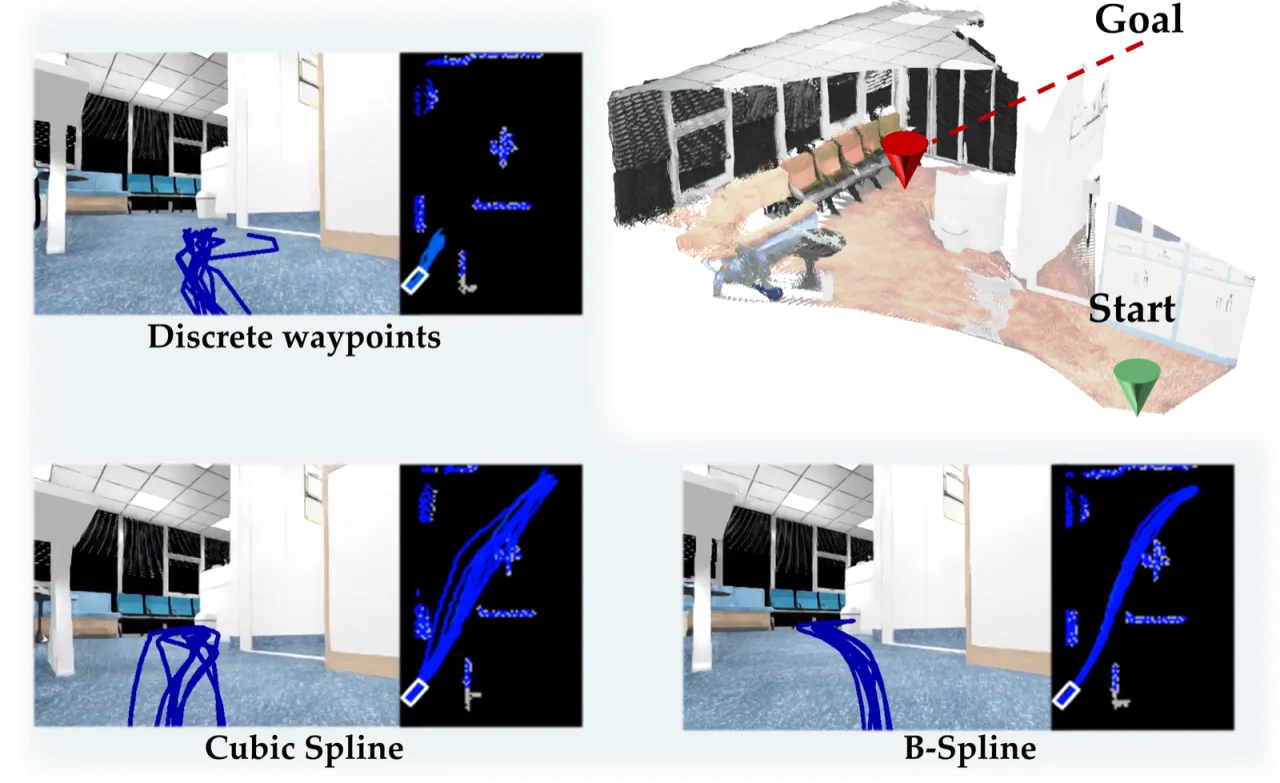
Figure 6:仿真中三种轨迹表示(discrete waypoints、cubic spline、B-spline)的定性对比,展示自车视角图像与 10 条候选轨迹的鸟瞰雷达可视化。B 样条给出的候选轨迹更一致、局部扰动更小,对感知不确定性更不敏感。Figure 6: Qualitative comparison of three trajectory representations (discrete waypoints, cubic spline, B-spline) in simulation, showing the ego-view image alongside a bird's-eye radar visualization of 10 candidate trajectories. The candidates produced by B-splines are more consistent, show smaller local perturbations, and are less sensitive to perception uncertainty.
Ablations
轨迹表示消融(Table III):在保持流水线其余部分不变、统一预测 8 个锚点的前提下对比三种表示。B 样条在 ClutterEnv 上取得 93.0% SR / 83.8% SPL,显著优于 waypoints(75.5% / 65.8%)和 cubic spline(75.0% / 70.6%);在 InternScenes 上同样最优(83.5% / 72.1% vs. 75.5%/67.8% 与 72.0%/65.8%)。论文将其归因于 B 样条的局部支撑特性能隔离远场不确定性,而插值三次样条是全局耦合的,遮挡区域的预测误差会向后传播、破坏近场执行段的稳定性。Trajectory representation ablation (Table III): Three representations are compared with the rest of the pipeline unchanged and 8 anchor points predicted in all cases. On ClutterEnv the B-spline reaches 93.0% SR / 83.8% SPL, clearly ahead of waypoints (75.5% / 65.8%) and cubic spline (75.0% / 70.6%); it is likewise the best on InternScenes (83.5% / 72.1% vs. 75.5%/67.8% and 72.0%/65.8%). The paper attributes this to the local support of B-splines isolating far-field uncertainty, whereas an interpolating cubic spline is globally coupled, so prediction errors in occluded regions propagate backwards and undermine the stability of the near-field executed segment.
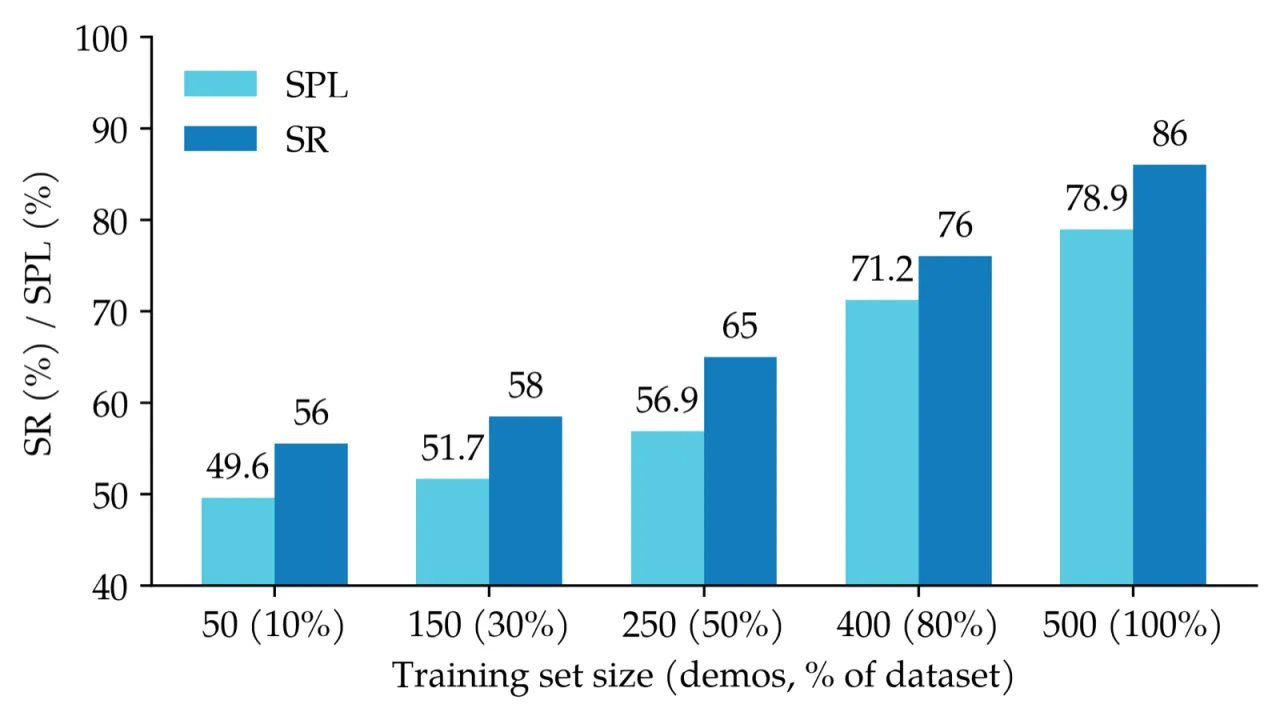
Figure 7:ClutterEnv 上训练数据规模的消融——SR/SPL 随训练轨迹数量增加而单调提升。仅用 50 条轨迹(10% 数据)即达到 55.5% SR;250 条(50% 数据)达到 65.0% SR,恢复了峰值性能的 76%;而 SPL 从 49.6% 持续提升到 78.9%,说明小数据集足以学到基本的安全避障,但更大规模数据对于减少不必要绕行、提升路径效率仍然重要。Figure 7: Ablation on training-data scale on ClutterEnv — SR/SPL improve monotonically as the number of training trajectories grows. With only 50 trajectories (10% of the data) it already reaches 55.5% SR; 250 trajectories (50% of the data) reach 65.0% SR, recovering 76% of peak performance; meanwhile SPL rises steadily from 49.6% to 78.9%. This indicates that a small dataset suffices to learn basic safe obstacle avoidance, but larger-scale data remains important for cutting unnecessary detours and improving path efficiency.
速度 token 消融(Table IV):去掉 previous-velocity token v_t^prev 后,ClutteredEnv 平均 SR 从 93.0% 降至 86.0%,SPL 从 0.84 降至 0.80。论文分析:缺少该时序条件时,在几何对称障碍物(如立柱)附近容易产生双模态的绕行候选,critic 逐步独立选择会导致绕行模式在连续重规划间反复切换,产生振荡转向甚至碰撞;加入速度 token 后候选更集中、朝向更稳定。Velocity token ablation (Table IV): Removing the previous-velocity token v_t^prev drops the average SR on ClutteredEnv from 93.0% to 86.0% and the SPL from 0.84 to 0.80. The paper's analysis: without this temporal conditioning, bimodal detour candidates easily arise near geometrically symmetric obstacles such as pillars, and the critic's independent step-by-step selection makes the detour mode flip repeatedly between consecutive replans, producing oscillatory steering and even collisions; adding the velocity token makes the candidates more concentrated and the heading more stable.
Real-world Experiments
真实实验部署在 Unitree Go2 四足机器人上,搭载带 IR 滤光片的 Intel RealSense D435 深度相机,算法在有线连接的笔记本上以约 10Hz 运行,采用 warm-start 策略(从上一步解的第 6/10 步开始部分去噪)实现高频重规划,每步并行采样 K=16 条候选轨迹。作者在静态/动态行人、狭窄迷宫、杂乱办公室、室外光照变化场景以及爬楼梯任务中验证了零样本迁移能力,未做任何微调或域适应。The real-world experiments are deployed on a Unitree Go2 quadruped robot carrying an Intel RealSense D435 depth camera with an IR filter. The algorithm runs at roughly 10Hz on a tethered laptop and uses a warm-start strategy (partial denoising starting from step 6/10 of the previous solution) for high-frequency replanning, sampling K=16 candidate trajectories in parallel at each step. The authors validate zero-shot transfer with static/dynamic pedestrians, narrow mazes, a cluttered office, outdoor scenes with changing illumination, and stair-climbing tasks, without any fine-tuning or domain adaptation.
04 Limitations
Note:第一条为论文原文明确陈述(stated);第二条基于论文实验分析文字(stated, from analysis);第三条为根据方法设计推断(inferred from the design),论文未明确列为局限。The first item is explicitly stated in the paper (stated); the second is based on the paper's experimental analysis (stated, from analysis); the third is inferred from the design and is not explicitly listed as a limitation in the paper.
对深度传感器的依赖(stated)Dependence on depth sensors (stated)
论文原话:“Despite its competitive performance, SanD-Planner is limited by depth sensors regarding small or specular objects.” 即对小物体或高反光/镜面表面的深度感知能力有限。作者计划未来引入视觉基础模型(visual foundation models)以获得更鲁棒的度量深度估计。The paper states: "Despite its competitive performance, SanD-Planner is limited by depth sensors regarding small or specular objects." That is, depth sensing of small objects and highly reflective or specular surfaces is limited. The authors plan to introduce visual foundation models in future work to obtain more robust metric depth estimation.
ClutteredEnv 上 SPL 略逊于 NavDP(stated, from analysis)SPL on ClutteredEnv slightly below NavDP (stated, from analysis)
SanD-Planner 在 ClutteredEnv 的 SPL(84.0%)低于 NavDP(87.7%)。论文将其归因于 B 样条参数化带来的“更安全但更保守”的绕行偏置,并认为这一差距源自训练数据规模有限(仅 500 条轨迹),而非方法本身的结构性限制——数据扩展实验(Fig. 7)显示该差距有望随数据量增加而缩小。SanD-Planner's SPL on ClutteredEnv (84.0%) is lower than NavDP's (87.7%). The paper attributes this to the "safer but more conservative" detour bias induced by the B-spline parameterization, and argues the gap comes from the limited training-data scale (only 500 trajectories) rather than a structural limitation of the method itself — the data-scaling experiment (Fig. 7) suggests the gap should narrow as data grows.
仅依赖深度、不含语义信息(inferred from the design)Depth-only input without semantic information (inferred from the design)
SanD-Planner 的感知输入仅为深度图像序列,不像 ViPlanner 那样引入语义信息。论文实验表明这种设计在几何为主的场景(ClutteredEnv)中反而更鲁棒(语义方法 ViPlanner 在该场景性能明显下降),但在需要语义级可通行性判断的场景中,纯深度输入的局限性可能会显现——这一点论文并未直接讨论,为基于方法设计的推断。SanD-Planner's perceptual input is only a sequence of depth images; unlike ViPlanner it does not incorporate semantic information. The paper's experiments show this design is in fact more robust in predominantly geometric scenes (ClutteredEnv), where the semantic method ViPlanner degrades markedly; but in scenes that require semantic-level traversability judgment, the limits of purely depth-based input may surface. The paper does not discuss this directly; it is inferred from the method design.