将 Vision-Language-Action (VLA) 模型与 World Model 统一于同一个 Chameleon 式自回归主干中,使两者在共享 token 空间内相互增强:VLA 提升视觉理解以改善图像生成质量,World Model 赋予 VLA "想象力"从而提高动作精度。无需大规模机器人预训练,在 LIBERO 仿真基准上即达到 97.4% 成功率,真实机器人实验成功率提升 50%。Unifies a Vision-Language-Action (VLA) model and a World Model within a single Chameleon-style autoregressive backbone, letting the two reinforce each other in a shared token space: the VLA sharpens visual understanding and thus improves image generation quality, while the World Model endows the VLA with "imagination" and thereby raises action precision. Without large-scale robot pretraining, it reaches a 97.4% success rate on the LIBERO simulation benchmark, and lifts the success rate of real-robot experiments by 50%.
VLA 模型与 World Model 各有所长,却长期相互割裂:前者能生成动作,却缺乏对世界物理动态的内部"想象";后者能预测未来视觉状态,却无法直接输出控制指令。这种"功能鸿沟"限制了两类模型在真实机器人场景中的潜力。VLA models and World Models each have their own strengths, yet have long remained separated from one another: the former can generate actions but lacks an internal "imagination" of the physical dynamics of the world; the latter can predict future visual states but cannot directly output control commands. This "functional gap" limits the potential of both families of models in real robot scenarios.
"RynnVLA-002 internalizes the VLA objective and the action-conditioned world-modeling objective in one Chameleon-style autoregressive backbone with a shared token space."
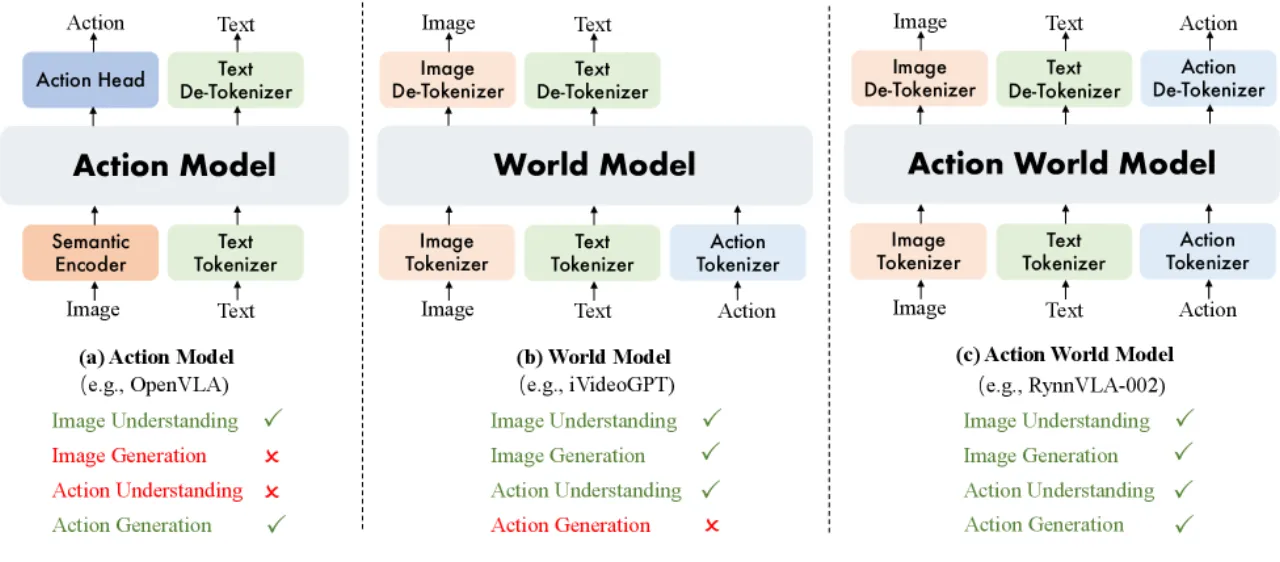
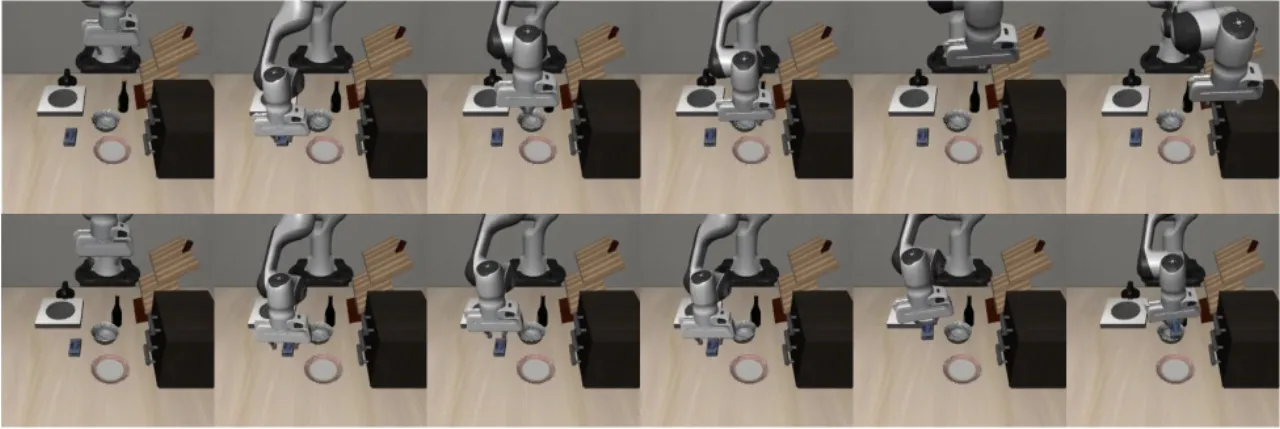
现有 VLA 方法(如 RT-2)将动作仅置于输出端,模型内部无法建立对动作效果的推理;而现有 World Model(如 Genie)只预测视觉状态,缺乏直接的机器人控制能力。RynnVLA-002 的核心洞察是:VLA 的精准动作能力可以改善 World Model 的视觉一致性,World Model 的预见性又能反哺 VLA 的动作决策,两者在同一主干内协同训练即可实现"1+1>2"的效果。Existing VLA methods (such as RT-2) place actions only at the output end, so the model cannot internally reason about the effects of its actions; existing World Models (such as Genie) predict only visual states and lack direct robot control capability. The core insight of RynnVLA-002 is that the precise action capability of the VLA can improve the visual consistency of the World Model, while the foresight of the World Model in turn feeds back into the action decisions of the VLA, so that training both jointly inside one backbone yields a "1+1>2" effect.
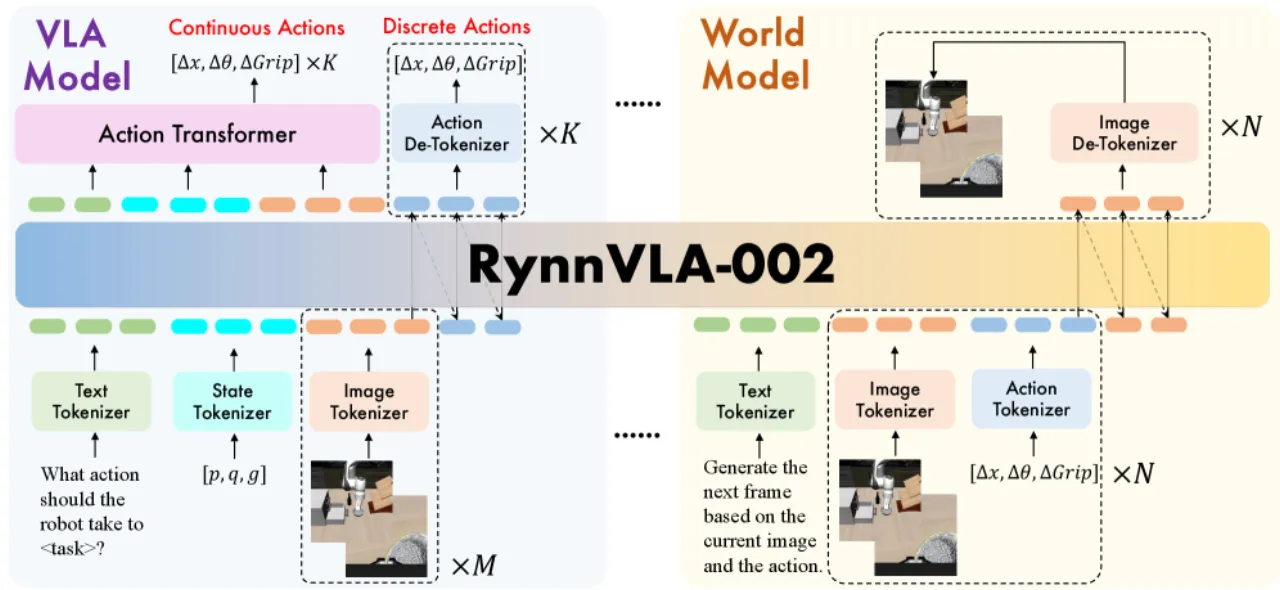
RynnVLA-002 采用共享自回归 Transformer 主干,将视觉 token(VQ-GAN 编码)、文本 token(BPE)、状态/动作 token(连续值离散化为 256 bins)统一到 65,536 大小的词汇表中,分别以两种序列格式进行训练:VLA 序列生成动作,World Model 序列预测下一帧图像。RynnVLA-002 adopts a shared autoregressive Transformer backbone that unifies visual tokens (encoded by VQ-GAN), text tokens (BPE) and state/action tokens (continuous values discretized into 256 bins) into a vocabulary of size 65,536, and is trained under two sequence formats: the VLA sequence generates actions, and the World Model sequence predicts the next image frame.
图像通过 VQ-GAN 压缩(压缩比 16,codebook 大小 8192)编码为离散视觉 token;文本采用 BPE;连续状态与动作值均离散化为 256 bins 后编码。Images are compressed by VQ-GAN (compression ratio 16, codebook size 8192) and encoded into discrete visual tokens; text uses BPE; continuous state and action values are both discretized into 256 bins before encoding.
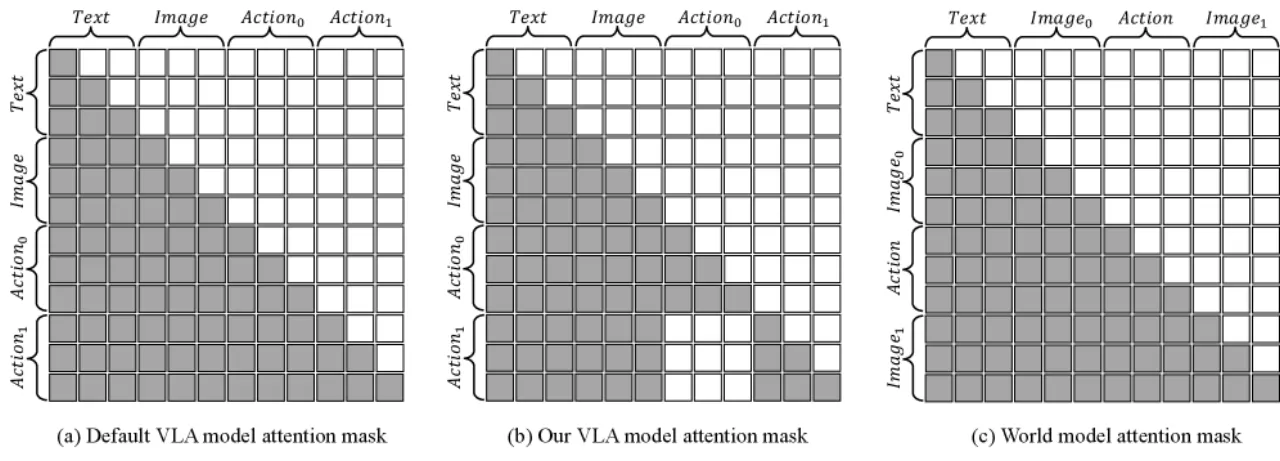
{text} {state} {image-front-wrist}×M {action}×K{images-front-wrist} {action} {images-front-wrist} [重复 N 次]在标准自回归生成中,动作 chunk 内的前一个动作 token 会影响后续动作 token,导致误差累积。本文提出修改注意力掩码,使当前动作仅依赖文本与视觉输入,禁止访问前序动作 token,从而显著缓解误差传播(尤其在 K=10 的长动作块中效果明显)。In standard autoregressive generation, an earlier action token inside an action chunk influences the subsequent action tokens, which leads to error accumulation. This paper proposes to modify the attention mask so that the current action depends only on the text and visual inputs and is forbidden to access preceding action tokens, which markedly mitigates error propagation (the effect is especially clear for long action chunks with K=10).
在离散自回归主干之上,额外引入轻量级连续 Action Transformer,利用双向注意力并行生成平滑连续动作序列,具有以下优势:On top of the discrete autoregressive backbone, a lightweight continuous Action Transformer is additionally introduced, which uses bidirectional attention to generate smooth continuous action sequences in parallel. It offers the following advantages:
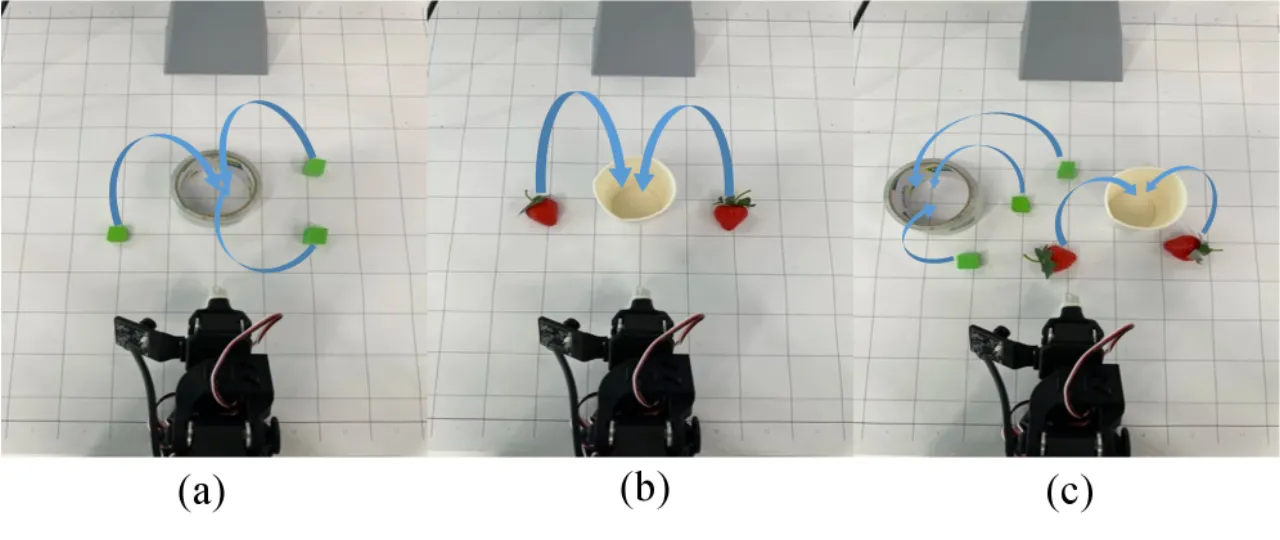
在 LIBERO 仿真基准(四个子任务:Spatial / Object / Goal / Long)和真实 LeRobot SO100 机械臂(两类 pick-and-place 任务,各约 248-249 条示范)上进行评测,与有/无预训练的多个 VLA baseline 对比。Evaluation is carried out on the LIBERO simulation benchmark (four subtasks: Spatial / Object / Goal / Long) and on a real LeRobot SO100 arm (two kinds of pick-and-place tasks, each with roughly 248-249 demonstrations), and compared against several VLA baselines with and without pretraining.
| 方法Method | 预训练Pretraining | LIBERO-Spatial | LIBERO-Object | LIBERO-Goal | LIBERO-Long | 平均Average |
|---|---|---|---|---|---|---|
| OpenVLA | ✓ | 84.7 | 88.4 | 79.2 | 53.7 | 76.5 |
| π₀ | ✓ | 98.6 | 98.8 | 98.2 | 98.8 | 98.6 |
| RynnVLA-002-Discrete | ✗ | 91.2 | 97.4 | 93.4 | 91.2 | 93.3 |
| RynnVLA-002-Continuous | ✗ | 96.4 | 99.8 | 96.4 | 94.4 | 97.4 |
"RynnVLA-002 remains competitive with these pretrained baselines and outperforms most non-pretrained methods",在无任何大规模机器人预训练的条件下达到 97.4% 平均成功率。"RynnVLA-002 remains competitive with these pretrained baselines and outperforms most non-pretrained methods", reaching a 97.4% average success rate without any large-scale robot pretraining.
| 任务Task | 场景Setting | RynnVLA-002(无预训练)RynnVLA-002 (no pretraining) |
|---|---|---|
| Place block inside circle | 单目标Single object | 90.0% |
| Place block inside circle | 多目标Multiple objects | 90.0% |
| Place block inside circle | 有干扰物With distractors | 80.0% |
| Place strawberries into cup | 多目标Multiple objects | 80.0% |
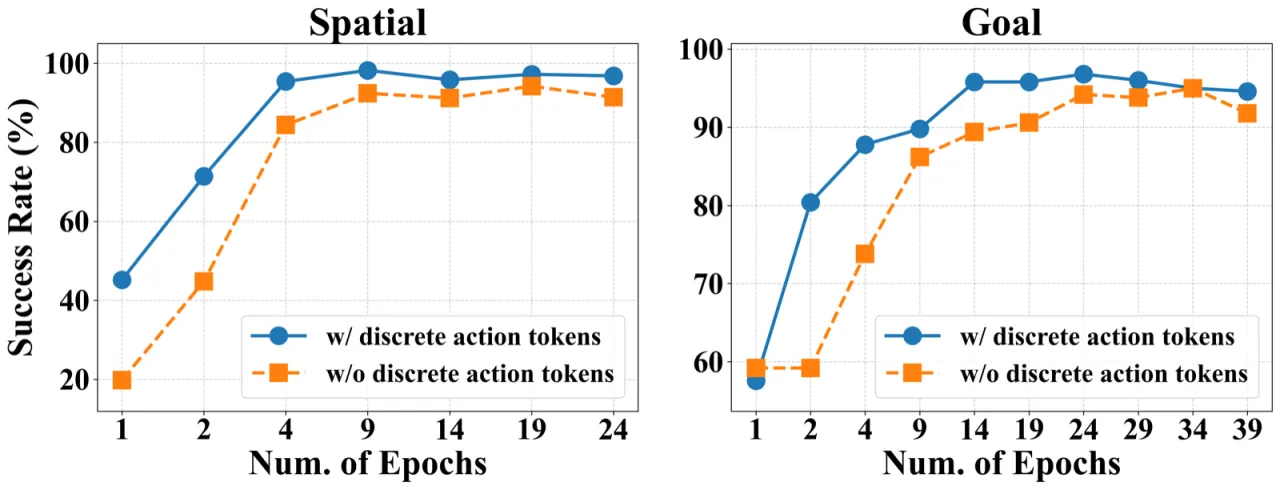
通过系统消融验证了核心设计的有效性:Systematic ablations verify the effectiveness of the core designs:
"Current real-world evaluation focuses on SO100 pick-and-place manipulation",仅测试了两类抓放任务,尚未在更广泛的机器人平台(如双臂、移动机器人)或更复杂操作任务(如工具使用、精细装配)上进行验证。作者明确表示需要"more robot platforms, more sophisticated manipulation tasks"。"Current real-world evaluation focuses on SO100 pick-and-place manipulation": only two kinds of pick-and-place tasks were tested, and no validation has yet been carried out on broader robot platforms (such as bimanual or mobile robots) or on more complex manipulation tasks (such as tool use or fine assembly). The authors explicitly state the need for "more robot platforms, more sophisticated manipulation tasks".
"training a single real-world task currently takes roughly four days",计算开销较大,限制了快速迭代与大规模部署。"training a single real-world task currently takes roughly four days": the computational overhead is considerable, which limits rapid iteration and large-scale deployment.
当前采用逐 token 自回归方式生成图像,推理效率受限(离散动作模式下最低仅 2.5 Hz)。作者指出未来需探索"more efficient image-token generation"方案,如并行解码或连续表示。Images are currently generated token by token in an autoregressive manner, so inference efficiency is limited (as low as 2.5 Hz in the discrete-action mode). The authors point out that future work needs to explore "more efficient image-token generation" schemes, such as parallel decoding or continuous representations.