Real-Time Execution of Action Chunking Flow Policies
RTC:让 action-chunking 策略真正做到实时无卡顿RTC: making action-chunking policies truly real-time and stall-free
Kevin Black, Manuel Y. Galliker, Sergey Levine · Physical Intelligence & UC Berkeley · 2025
本文提出 Real-Time Chunking (RTC),一种纯推断时算法,
让基于 diffusion / flow matching 的视觉-语言-动作模型(VLA)能够在执行当前 action chunk 的同时生成下一个 chunk,
彻底消除块边界处的停顿与跳变。无需重训练,适用于任意 diffusion- 或 flow-based 策略。This paper proposes Real-Time Chunking (RTC), a purely inference-time algorithm that lets vision-language-action models (VLA) based on diffusion / flow matching generate the next chunk while the current action chunk is still being executed, completely removing the pauses and jumps at chunk boundaries. No retraining is needed, and it applies to any diffusion- or flow-based policy.
Kinetix 仿真 12 任务12 Kinetix simulation tasks6 项真实双臂操作任务6 real-world bimanual manipulation tasksπ0.5 VLA 作为基础模型π0.5 VLA as the base model📄 arXiv:2506.07339Project Page / Videos
大规模 VLA 的高推断延迟与 action chunking 的固有缺陷共同造成了实时控制的瓶颈:
策略推断期间机器人要么完全暂停(synchronous),要么在 chunk 边界处出现模式跳变(naive async),
两者都会导致明显的卡顿或抖动,对动态任务尤其有害。The high inference latency of large-scale VLAs and the inherent flaw of action chunking together form the bottleneck of real-time control: during policy inference the robot either halts completely (synchronous) or shows a mode jump at the chunk boundary (naive async); both produce visible stalls or jitter, which is especially harmful for dynamic tasks.
"While action chunking has enabled temporal consistency in high-frequency control tasks,
it does not fully address the latency problem, leading to pauses or out-of-distribution jerky
movements at chunk boundaries."
Figure 1(下):RTC 与各 baseline 在真实点火任务(lighting a match)中的肩关节位置、速度、加速度对比。
RTC 比 synchronous inference 完成相同动作快 20%,且比所有 competing methods(包括 temporal ensembling)更平滑。
曲线来自真实自主点火任务前 10 秒的数据。Figure 1 (bottom): Shoulder joint position, velocity and acceleration of RTC versus the baselines on the real-world task of lighting a match. RTC completes the same motion 20% faster than synchronous inference, and is smoother than all competing methods (including temporal ensembling). The curves come from the first 10 seconds of a real autonomous match-lighting run.
20%RTC 比 synchronous inference 快的幅度(真实实验,相同任务)How much faster RTC is than synchronous inference (real-world, same task)
>300 msRTC 在超过此推断延迟下仍可成功点火(占预测 horizon >30%)RTC can still light the match above this inference latency (>30% of the prediction horizon)
12Kinetix 仿真动态任务(涵盖抛接、平衡、操作)Dynamic tasks in the Kinetix simulator (throwing/catching, balancing, manipulation)
6真实双臂灵巧操作任务(累计 28 小时机器人执行时间)Real-world bimanual dexterous manipulation tasks (28 hours of robot execution time in total)
Action chunking 策略在推断时会输出一段连续的动作序列(chunk,长度 H),并执行其中前 s ≤ H 步。
问题在于:下一次推断必须等当前 chunk 执行完才能开始(synchronous),或者新旧 chunk 之间存在模式不连续(naive async)。
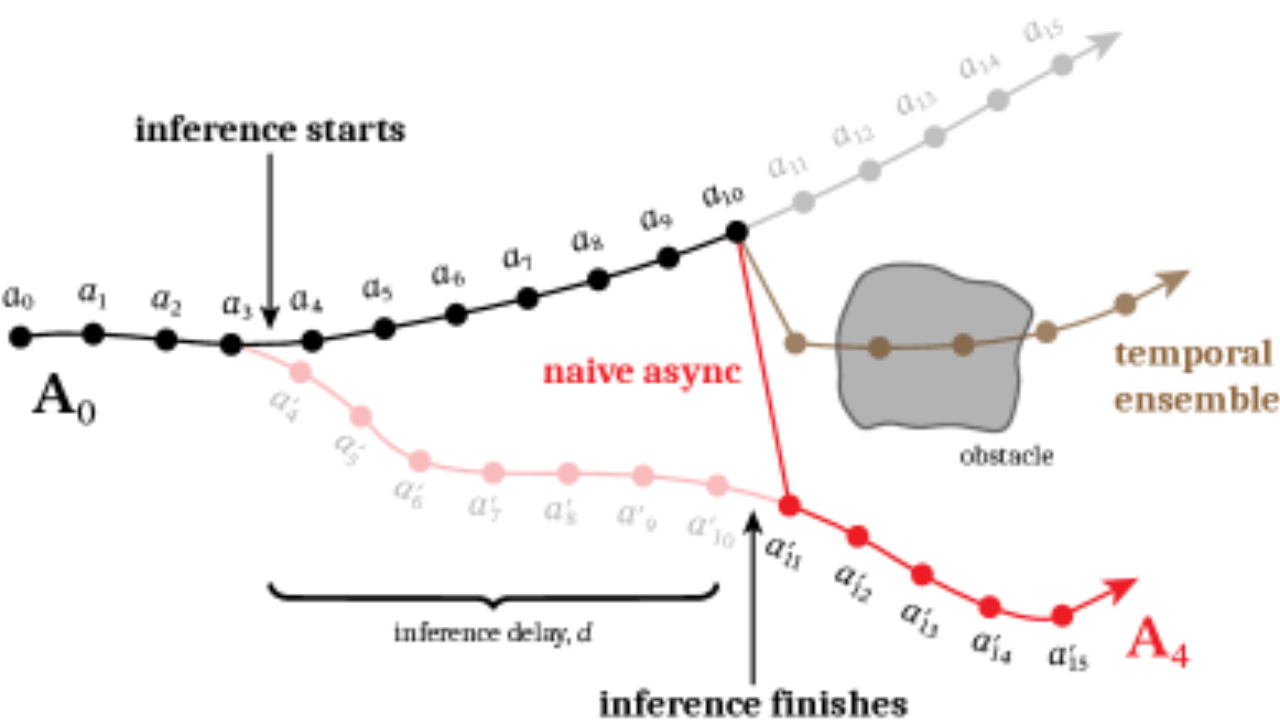
如图所示,temporal ensembling 等朴素平均方案在多模态分布下甚至可能产生比原始 chunk 更差的动作序列(如图 2 中的"bifurcation"现象)。At inference time an action chunking policy emits a continuous action sequence (a chunk of length H) and executes its first s ≤ H steps. The problem: the next inference can only start once the current chunk has finished executing (synchronous), or a mode discontinuity appears between the old and the new chunk (naive async). As the figures show, naive averaging schemes such as temporal ensembling may under multimodal distributions even yield an action sequence worse than the original chunk (the "bifurcation" phenomenon in Figure 2).
Figure 2:相邻两个 chunk 之间的典型模式分叉(bifurcation)。
推断在第 3 步与第 5 步之间的某个时刻开始;新旧 chunk 可能对应不同的运动策略,
在过渡点产生跳变。Temporal ensembling 对多模态分布取平均,可能加剧而非缓解这一问题。Figure 2: A typical mode bifurcation between two adjacent chunks. Inference starts at some moment between step 3 and step 5; the old and the new chunk may correspond to different motion strategies, producing a jump at the transition point. Temporal ensembling averages over a multimodal distribution, which may aggravate rather than alleviate this issue.
02方法Method
RTC 将异步 action chunking 重新表述为一个 inpainting 问题:
"冻结"(freeze)那些在下一次推断完成前必然已执行的动作(prefix),
并对其余部分进行"修复"(inpaint suffix),从而生成与当前执行序列在物理上连续的下一个 chunk。
整个流程在推断时运行,无需任何重训练。RTC recasts asynchronous action chunking as an inpainting problem: it "freezes" the actions that are bound to have been executed before the next inference completes (the prefix) and "inpaints" the remainder (the suffix), thereby producing a next chunk that is physically continuous with the sequence currently being executed. The whole procedure runs at inference time and needs no retraining.
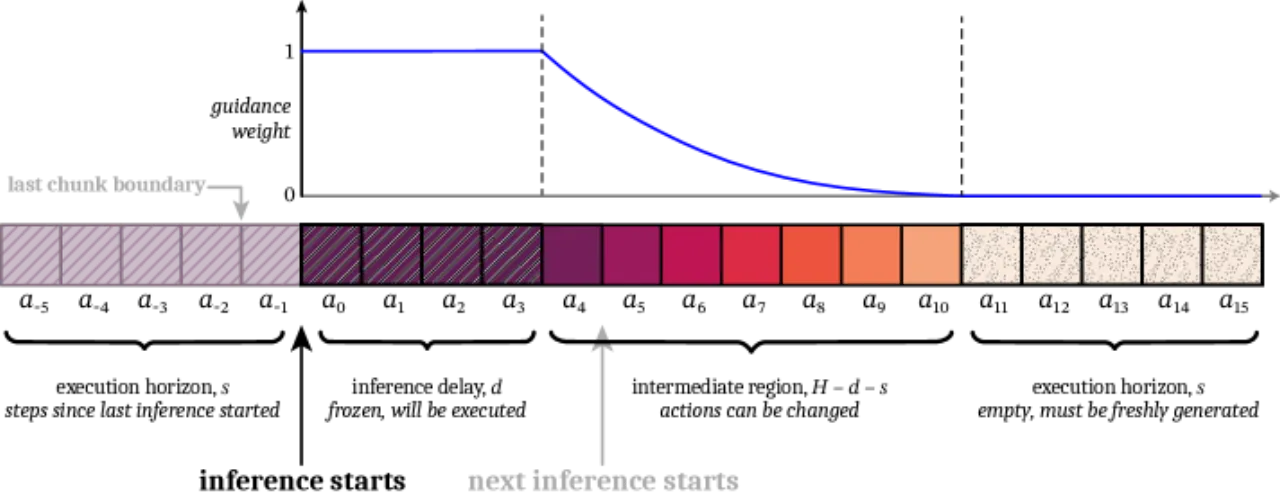
Figure 3:RTC 中动作生成如何 attend 到前一个 action chunk。
若推断延迟为 d 步,则新 chunk 的前 d 步(必然被执行的部分)被"冻结"为已知的 prefix;
flow matching 的 inpainting 机制在 denoising 过程中将其作为条件,生成在语义和动力学上与之连续的 suffix。Figure 3: How action generation in RTC attends to the previous action chunk. If the inference delay is d steps, the first d steps of the new chunk (the part that is certain to be executed) are "frozen" as a known prefix; the inpainting mechanism of flow matching conditions on it during denoising to produce a suffix that is continuous with it both semantically and dynamically.
3.1 Inference-Time Inpainting with Flow Matching
Flow matching(以及 diffusion)天然支持 inpainting:在去噪迭代中,
将已知的 prefix 动作(带噪版本)直接注入对应位置,引导模型生成与之一致的 suffix。
目标是让新 chunk 的其余部分在条件上与这段"frozen prefix"保持一致,
就像图像修复中补全被遮挡的区域一样。Flow matching (and diffusion) supports inpainting naturally: during the denoising iterations the known prefix actions (in their noised form) are injected directly at the corresponding positions, steering the model to generate a suffix consistent with them. The goal is to keep the rest of the new chunk conditionally consistent with this "frozen prefix", just as image inpainting fills in an occluded region.
3.2 Soft Masking — 跨 chunk 连续性的关键3.2 Soft Masking — the key to cross-chunk continuity
朴素 inpainting(hard masking)直接将 prefix 位置替换为带噪的已知动作,
忽略了 prefix 与 suffix 之间的平滑过渡需求,容易在边界处产生更快的方向变化。
RTC 引入 soft masking:对 prefix 内的动作以一个随 timestep 增长的权重
逐渐混入噪声,使模型在 denoising 时得到更自然的梯度信号,生成更平滑的过渡。
论文给出的引导权重裁剪值 β 用于防止在某些参数区间出现数值不稳定(详见 A.2 消融实验)。Naive inpainting (hard masking) simply replaces the prefix positions with the noised known actions, ignoring the need for a smooth transition between prefix and suffix and easily producing faster changes of direction at the boundary. RTC introduces soft masking: noise is gradually blended into the actions inside the prefix with a weight that grows with the timestep, so that the model receives a more natural gradient signal during denoising and generates a smoother transition. The guidance-weight clipping value β given in the paper prevents numerical instability in certain parameter ranges (see the A.2 ablation).
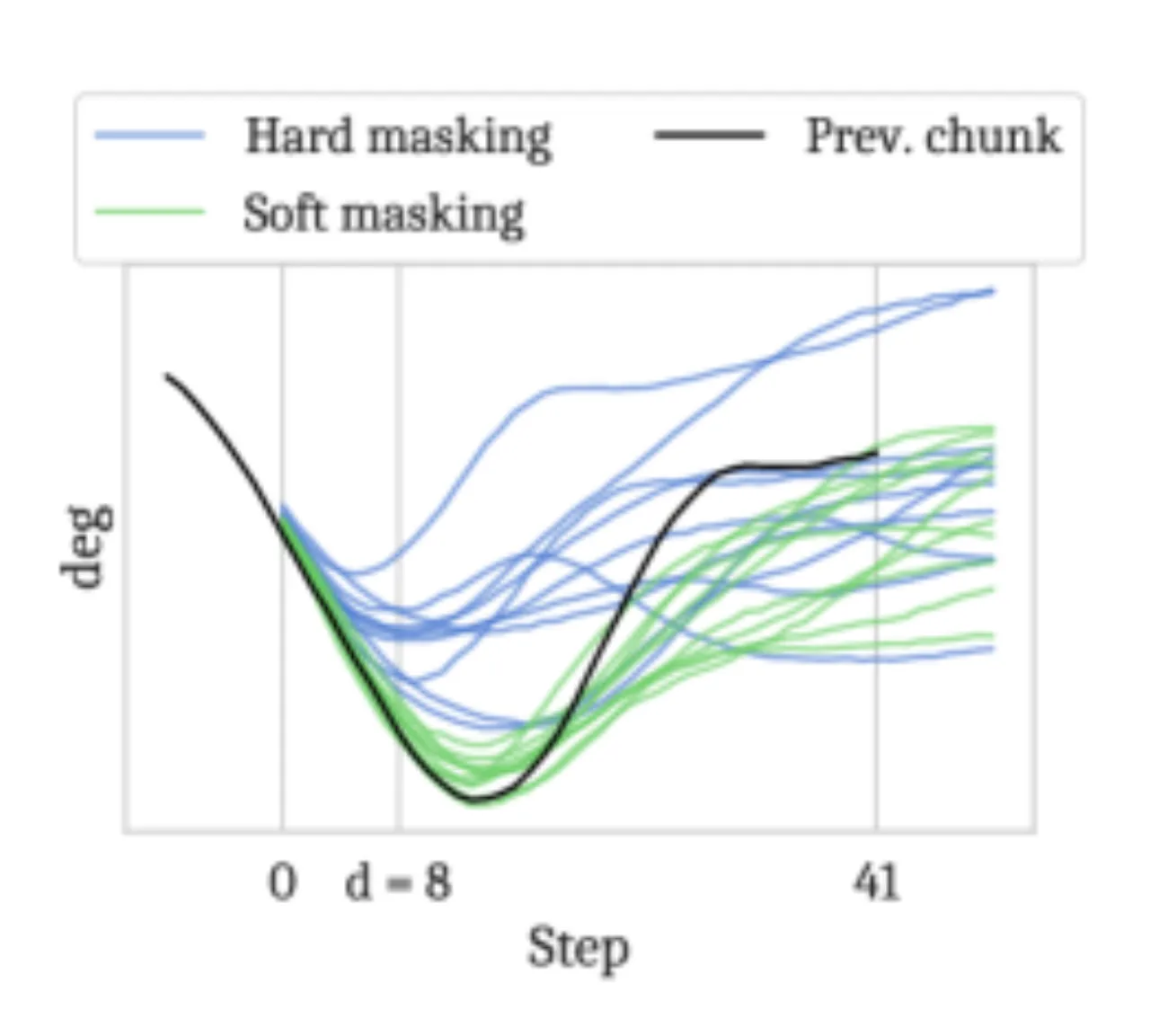
Figure 4:naive inpainting(hard masking)与 soft masking 的对比。
Hard masking 在 frozen prefix 处拟合较差,且产生更快的方向变化;
soft masking 与 frozen 区域吻合更好,整体曲线更为平滑。Figure 4: Naive inpainting (hard masking) versus soft masking. Hard masking fits the frozen prefix poorly and produces faster changes of direction; soft masking agrees better with the frozen region and gives an overall smoother curve.
3.3 完整 RTC 系统3.3 The complete RTC system
完整系统将上述两个组件结合:在执行第 k 个 chunk 的同时,
以其前 d 步作为 frozen prefix 启动第 k+1 个 chunk 的推断(soft-masked inpainting)。
推断完成后立即无缝切换,机器人从不暂停。
RTC 的唯一额外开销是需要在每个 denoising step 中对 prefix 做反向传播以计算引导梯度,
导致单次推断延迟略高于 baseline(π0.5 上:76 ms → 97 ms,RTX 4090,bfloat16,n=5 denoising steps)。The complete system combines the two components above: while the k-th chunk is being executed, its first d steps serve as the frozen prefix to launch inference of the (k+1)-th chunk (soft-masked inpainting). The switch is seamless and immediate once inference finishes, so the robot never pauses. RTC's only extra cost is the backpropagation through the prefix needed at every denoising step to compute the guidance gradient, which makes a single inference slightly slower than the baseline (on π0.5: 76 ms → 97 ms, RTX 4090, bfloat16, n=5 denoising steps).
03实验Experiments
实验分两部分:(1)基于 Kinetix 仿真器构建的 12 个高度动态任务的新 benchmark,
在可控推断延迟下系统对比各方法;(2)在真实 π0.5 VLA 上的 6 项双臂操作任务,
共 480 次实验,28 小时机器人执行时间。The experiments come in two parts: (1) a new benchmark of 12 highly dynamic tasks built on the Kinetix simulator, systematically comparing methods under controllable inference latency; (2) 6 bimanual manipulation tasks on a real π0.5 VLA, 480 trials in total and 28 hours of robot execution time.
数据集:每个环境用 RPO 训练 6 个专家策略,生成 1M 转移数据集;
训练具有预测 horizon H=8、4 层 MLP-Mixer 架构的 action chunking flow 策略。
评测指标:binary success rate,每个数据点 2048 次 rollout,95% Wilson score 置信区间。
仿真推断延迟 d 从 0(完全闭环)到 4(H=8 时支持的最大值)。Dataset: 6 expert policies are trained per environment with RPO, yielding a 1M-transition dataset; an action chunking flow policy with prediction horizon H=8 and a 4-layer MLP-Mixer architecture is trained on it. Metric: binary success rate, 2048 rollouts per data point, 95% Wilson score confidence intervals. The simulated inference delay d ranges from 0 (fully closed-loop) to 4 (the maximum supported at H=8).
对比方法:Methods compared:
Naive async:新 chunk 生成完立即切换,完全不考虑前一个 chunk。Naive async: switch over as soon as the new chunk is generated, disregarding the previous chunk entirely.
BID(Bidirectional Decoding):用拒绝采样保持跨 chunk 连续性,batch size N=32,mode size K=3,计算量显著高于 RTC。BID (Bidirectional Decoding): keeps cross-chunk continuity via rejection sampling, with batch size N=32 and mode size K=3; markedly more compute than RTC.
Temporal Ensembling (TE):维护历史 chunk 缓冲,对当前 timestep 的所有预测取平均。Temporal Ensembling (TE): maintains a buffer of past chunks and averages all predictions for the current timestep.
结果(Figure 5 右侧延迟曲线):
TE 在所有延迟下表现均差,即便 d=0 亦然——反映了 benchmark 的多模态性(多个有效动作的平均未必是有效动作)。
RTC 对推断延迟最为鲁棒,全面超越 BID;随延迟增大,RTC 的优势进一步扩大。
BID 使用的计算量远超 RTC(采样 64 个 action chunk,32 来自强模型,32 来自弱模型)。
执行 horizon 曲线(Figure 5 左侧)显示:只有 RTC 和 BID 能充分利用更短执行周期带来的闭环增益,
随执行 horizon 减小而单调提升,而 soft masking 在较小 d 下进一步提升了性能。Results (the latency curves on the right of Figure 5):
TE performs poorly at every latency, even at d=0 — a reflection of the multimodality of the benchmark (the average of several valid actions need not be a valid action). RTC is the most robust to inference latency and outperforms BID across the board; its advantage widens further as latency grows. BID uses far more compute than RTC (sampling 64 action chunks, 32 from the strong model and 32 from the weak model). The execution horizon curves (left of Figure 5) show that only RTC and BID can fully exploit the closed-loop gains of a shorter execution period, improving monotonically as the execution horizon shrinks, while soft masking further improves performance at smaller d.
真实世界实验(π0.5 VLA)Real-World Experiments (π0.5 VLA)
使用 π0.5(H=50,Δt=20 ms,n=5 denoising steps)在双臂系统(两个 6-DoF 臂 + 并联夹爪)上评测。
基准推断延迟约 d≈6(LAN 推断含 10–20 ms 网络延迟);
额外注入 +100 ms 和 +200 ms 延迟,分别对应 d≈11 和 d≈16,模拟更大模型或远程云推断场景。Evaluation uses π0.5 (H=50, Δt=20 ms, n=5 denoising steps) on a bimanual system (two 6-DoF arms plus parallel-jaw grippers). The baseline inference delay is about d≈6 (LAN inference including 10–20 ms of network latency); an extra +100 ms and +200 ms of latency are injected, corresponding to d≈11 and d≈16, simulating larger models or remote cloud inference.
任务Task
说明Description
Synchronous
TE (dense)
RTC
Light candle
点火(5 子步,40s 限时,无重试)Lighting a match (5 sub-steps, 40s limit, no retries)
最低成功率Lowest success rate
+100/+200ms 触发 protective stop+100/+200ms trigger a protective stop
最高最终得分,显著优势Highest final score, by a clear margin
Plug ethernet
插以太网线(6 子步,120s)Plugging in an ethernet cable (6 sub-steps, 120s)
线性降级Degrades linearly
+100/+200ms 不可运行+100/+200ms not runnable
完全不受延迟影响Entirely unaffected by latency
Make bed (mobile)
移动床上毯子和枕头(3 子步,200s)Moving the blanket and pillow on a bed (3 sub-steps, 200s)
移动 4 件餐具进水槽(8 步,300s)Moving 4 pieces of tableware into the sink (8 steps, 300s)
基线Baseline
+100/+200ms 不可运行+100/+200ms not runnable
任务吞吐最佳Best task throughput
综合指标为 average throughput(任务完成比例/总时长的均值)。
RTC 在所有推断延迟下均达到最佳 throughput,且在 +100 ms 和 +200 ms 条件下差异具有统计显著性。
RTC 对注入延迟完全鲁棒,无性能下降;synchronous 随延迟线性退化;
两种 TE 变体在 +100 ms / +200 ms 注入延迟下因震荡过大触发机器人 protective stop,完全无法运行。The aggregate metric is average throughput (the mean of task completion fraction over total duration). RTC attains the best throughput at every inference latency, and the differences are statistically significant at +100 ms and +200 ms. RTC is fully robust to injected latency with no performance drop; synchronous degrades linearly with latency; both TE variants oscillate so violently at +100 ms / +200 ms injected latency that they trigger the robot protective stop and cannot run at all.
Figure 6(右):推断延迟 vs. 平均任务吞吐量(所有真实任务汇总)。
RTC 在全部延迟条件下均为最优,且完全不随延迟增加而退化。
两种 TE 变体在 +100 ms 和 +200 ms 时因激烈振荡触发 protective stop 而无法执行(标注为缺失)。
Error bars ± 1 SEM。Figure 6 (right): Inference latency vs. average task throughput (aggregated over all real-world tasks). RTC is best under every latency condition and does not degrade at all as latency increases. Both TE variants trigger a protective stop through violent oscillation at +100 ms and +200 ms and therefore cannot run (marked as missing). Error bars ± 1 SEM.
在 GPU 神经网络推断部分(不含网络传输),RTC 因在每个 denoising step 中需反向传播,
推断时间从 baseline 的 96.89 ± 0.16 ms 升至 97.43 ± 0.28 ms(non-mobile 模式)。
BID(无 forward contrast)延迟显著高于 RTC;full BID 需要两份完整模型拷贝,代价最高。For the GPU neural-network inference part (excluding network transport), because RTC has to backpropagate at every denoising step, inference time rises from the baseline 96.89 ± 0.16 ms to 97.43 ± 0.28 ms (non-mobile mode). BID (without forward contrast) has markedly higher latency than RTC; full BID needs two complete copies of the model and is the most expensive.
消融实验Ablations
仿真消融(Figure 5 右)证实:soft masking 在较低推断延迟和较短执行 horizon 下优于 hard masking,
支持了方法设计的理论动机。A.4 中的额外消融进一步验证了 β 裁剪对稳定性的必要性。The simulation ablation (right of Figure 5) confirms that soft masking outperforms hard masking at lower inference latency and shorter execution horizons, supporting the theoretical motivation behind the design. Additional ablations in A.4 further verify that β clipping is necessary for stability.
04局限性Limitations
Note:以下局限性均为论文作者在 Section 6(Discussion and Future Work)中明确陈述(stated by authors)。All limitations below are explicitly stated by the authors in Section 6 (Discussion and Future Work).
RTC 需要在每个 denoising step 中对 frozen prefix 做反向传播以计算引导梯度,
"it adds significant computational overhead compared to methods that sample directly from the base policy."
尽管绝对延迟增幅较小(约 0.5 ms),但对资源受限的边缘设备或更大模型而言仍是挑战。RTC has to backpropagate through the frozen prefix at every denoising step to compute the guidance gradient: "it adds significant computational overhead compared to methods that sample directly from the base policy." Although the absolute latency increase is small (about 0.5 ms), it remains a challenge for resource-constrained edge devices or larger models.
仅适用于 diffusion- 和 flow-based 策略Applicable only to diffusion- and flow-based policies
"it is applicable only to diffusion- and flow-based policies."
基于自回归解码(如 OpenVLA)或向量量化(如 RT-2、ARP)的策略无法直接使用 RTC 的 inpainting 机制。"it is applicable only to diffusion- and flow-based policies." Policies built on autoregressive decoding (e.g. OpenVLA) or vector quantization (e.g. RT-2, ARP) cannot directly use the inpainting mechanism of RTC.
真实世界实验未覆盖腿足式移动场景Real-world experiments do not cover legged locomotion settings
"while our real-world experiments cover a variety of challenging manipulation tasks,
there are more dynamic settings that could benefit even more from real-time execution.
One example is legged locomotion, which is represented in our simulated benchmark but not our real-world results."
当前真实世界评测局限于双臂操作,对步行机器人等需要更高频率闭环控制的平台尚未验证。"while our real-world experiments cover a variety of challenging manipulation tasks, there are more dynamic settings that could benefit even more from real-time execution. One example is legged locomotion, which is represented in our simulated benchmark but not our real-world results." The current real-world evaluation is confined to bimanual manipulation; platforms such as walking robots that need higher-frequency closed-loop control have not yet been validated.