RT-2 提出了一类新型模型——视觉-语言-动作模型(Vision-Language-Action, VLA):将机器人动作表示为文本 token,与互联网规模的视觉-语言任务联合微调,使单一端到端模型既能执行操作任务,又能从网络预训练中继承突现式语义推理与强泛化能力。在超过 6,000 次真实机器人评估中,RT-2 相比先前基线实现了约 2× 的泛化提升,以及超过 3× 的突现能力提升。RT-2 introduces a new class of models — Vision-Language-Action models (VLA): robot actions are represented as text tokens and co-fine-tuned together with internet-scale vision-language tasks, so that a single end-to-end model can both execute manipulation tasks and inherit emergent semantic reasoning and strong generalization from web pre-training. Across more than 6,000 real-robot evaluations, RT-2 achieves roughly 2× the generalization of prior baselines and more than 3× their emergent capabilities.
现有机器人控制方法往往将视觉-语言模型(VLM)仅用于高层规划,底层动作执行依赖独立的控制器,无法享受互联网规模预训练带来的丰富语义知识。另一方面,直接用海量机器人数据追赶 VLM 的训练量几乎不可能实现。那么,能否将大规模预训练 VLM 直接整合进闭环机器人控制,从而提升泛化能力并使突现式语义推理成为可能?Existing robotic control methods typically use vision-language models (VLM) only for high-level planning, while low-level action execution relies on a separate controller, so they cannot benefit from the rich semantic knowledge of internet-scale pre-training. On the other hand, matching the training scale of VLMs with massive robot data alone is close to infeasible. Can large-scale pre-trained VLMs therefore be integrated directly into closed-loop robotic control, so as to improve generalization and make emergent semantic reasoning possible?
"can large pretrained vision-language models be integrated directly into low-level robotic control to boost generalization and enable emergent semantic reasoning?"
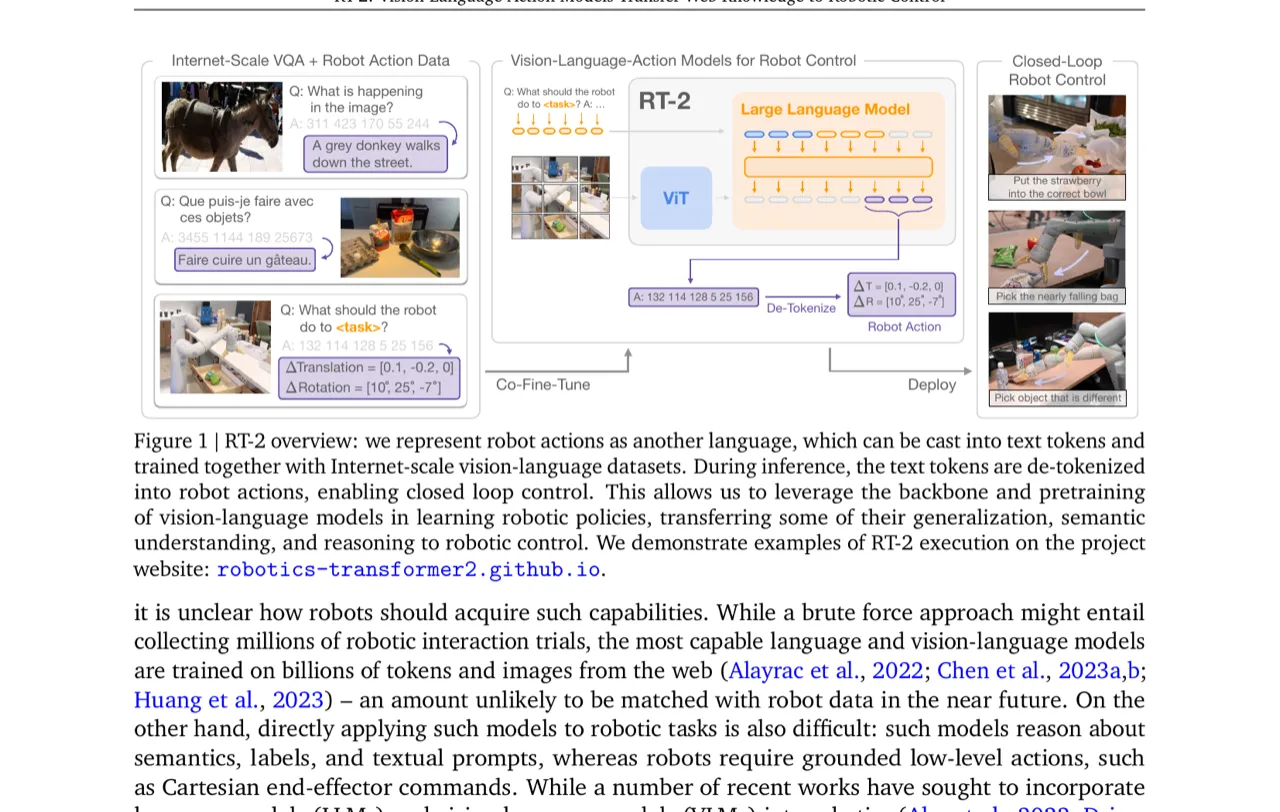
RT-2 的核心思路极为简洁:将机器人动作表示为文本 token,并将其以与自然语言 token 完全相同的方式加入 VLM 的训练集,实现"动作即语言"的统一输出空间。在此基础上,通过联合微调(co-fine-tuning)同时使用机器人轨迹数据与原始互联网视觉-语言数据,防止灾难性遗忘并保留 VLM 预训练知识。The core idea of RT-2 is remarkably simple: represent robot actions as text tokens and add them to the VLM training set in exactly the same way as natural-language tokens, yielding a unified output space in which "action is language". On top of this, co-fine-tuning uses robot trajectory data together with the original internet vision-language data, preventing catastrophic forgetting and preserving the pre-trained knowledge of the VLM.
机器人动作空间包含 6-DoF 末端执行器位移/旋转、夹爪开合和终止命令,共 8 个维度。连续维度被均匀离散化为 256 个 bin,整个动作向量拼接为一串整数字符串,例如:"1 128 91 241 5 101 127"。对于 PaLI-X,直接复用表示整数的已有 token;对于 PaLM-E,则将 256 个使用频率最低的 token 覆写为动作词表——这本质上是一种 symbol tuning。VLM 以标准 VQA 格式接受输入:"Q: what action should the robot take to [task instruction]? A:",输出对应动作 token 串。The robot action space covers 6-DoF end-effector translation/rotation, gripper opening and a termination command, 8 dimensions in total. The continuous dimensions are uniformly discretized into 256 bins, and the whole action vector is concatenated into a string of integers, for example "1 128 91 241 5 101 127". For PaLI-X the existing tokens that represent integers are reused directly; for PaLM-E the 256 least frequently used tokens are overwritten to form the action vocabulary — essentially a form of symbol tuning. The VLM takes its input in the standard VQA format "Q: what action should the robot take to [task instruction]? A:" and outputs the corresponding action token string.
实验表明,仅用机器人数据微调(naive fine-tuning)会导致 VLM 遗忘预训练语义知识,泛化能力下降。RT-2 的关键训练细节是在每个 batch 中混合机器人数据与原始互联网视觉-语言数据,并通过上采样机器人数据集来平衡比例。这使模型在低层次机器人动作与抽象视觉概念之间保持双向兼容。Experiments show that fine-tuning on robot data alone (naive fine-tuning) makes the VLM forget its pre-trained semantic knowledge and degrades generalization. The key training detail of RT-2 is to mix robot data with the original internet vision-language data within every batch, balancing the ratio by up-sampling the robot dataset. This keeps the model compatible in both directions, between low-level robot actions and abstract visual concepts.
55B 参数的 RT-2-PaLI-X 无法在桌面 GPU 上实时运行。论文采用多 TPU 云服务部署模型,机器人通过网络查询该服务。RT-2-PaLI-X-55B 控制频率为 1–3 Hz;5B 版本约 5 Hz。据作者所述,这是目前直接用于闭环机器人控制的最大模型,超过此前同类方法达一个数量级以上。The 55B-parameter RT-2-PaLI-X cannot run in real time on a desktop GPU. The paper deploys the model on a multi-TPU cloud service that the robot queries over the network. RT-2-PaLI-X-55B reaches a control frequency of 1–3 Hz; the 5B version about 5 Hz. According to the authors this is the largest model so far used directly for closed-loop robotic control, exceeding earlier comparable methods by more than an order of magnitude.
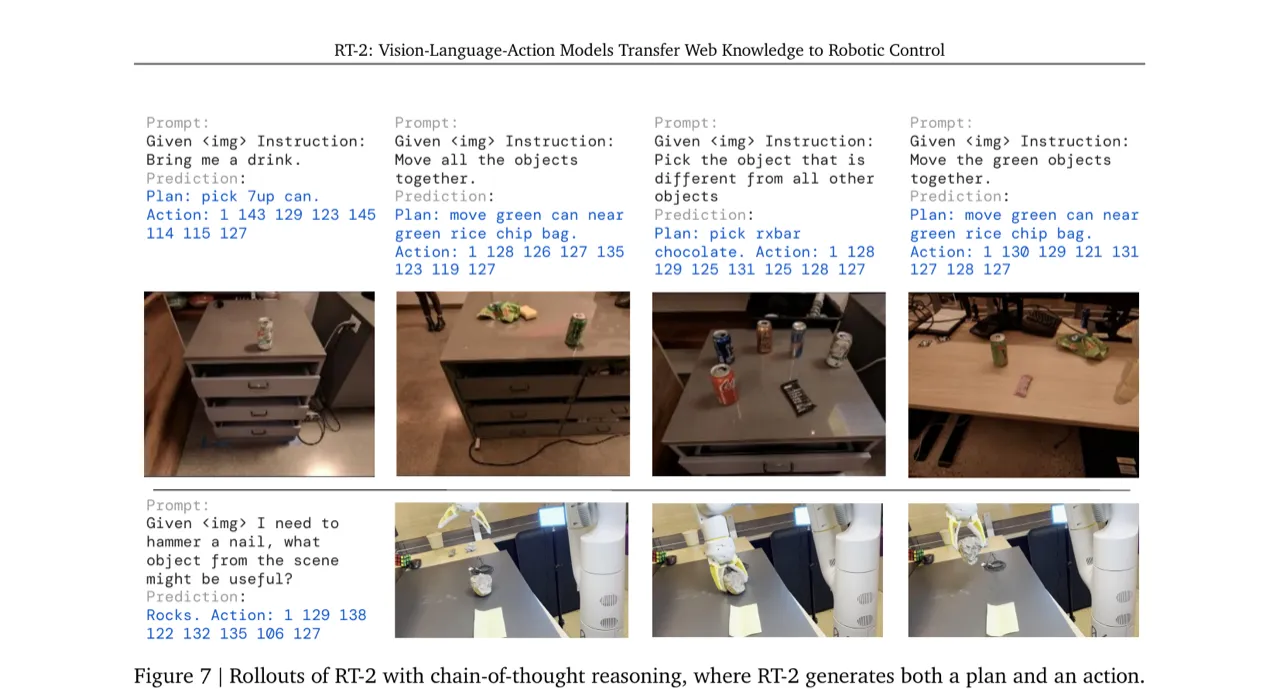
在 RT-2-PaLM-E 上,仅用数百步梯度更新的数据增强,即可让模型先以自然语言生成"Plan"步骤,再输出动作 token,例如:"Instruction: I'm hungry. Plan: pick rxbar chocolate. Action: 1 128 124 136 121 158 111 255."这一扩展使模型能应对更复杂的多步语义推理指令。On RT-2-PaLM-E, data augmentation with only a few hundred gradient steps is enough to let the model first generate a "Plan" step in natural language and then output action tokens, for example "Instruction: I'm hungry. Plan: pick rxbar chocolate. Action: 1 128 124 136 121 158 111 255." This extension enables the model to handle more complex multi-step semantic reasoning instructions.
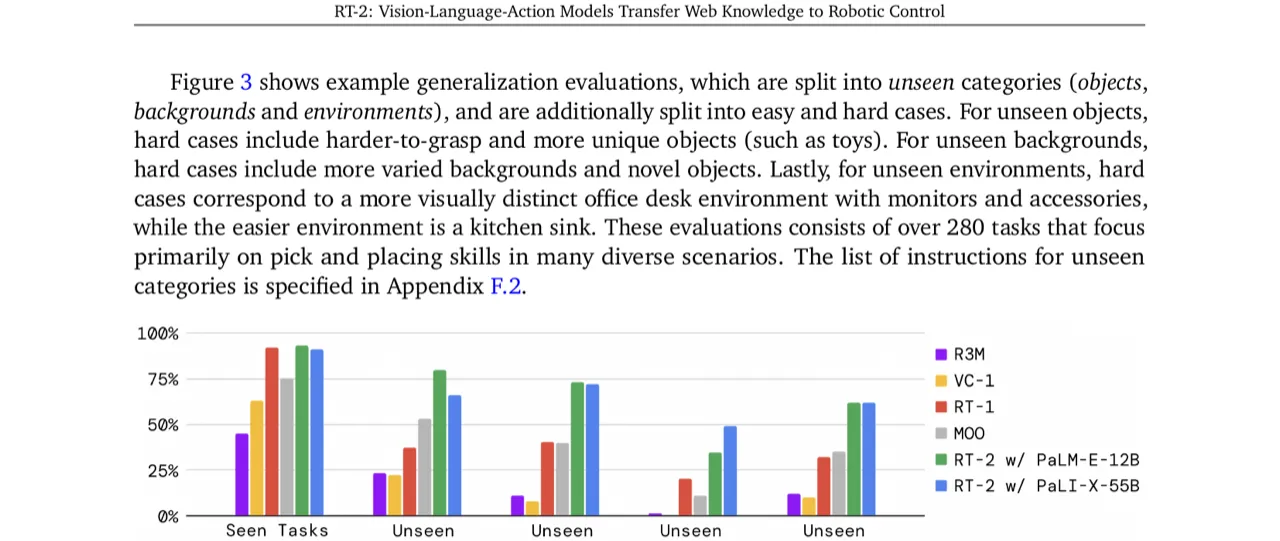
实验在真实 7-DoF 移动机械臂上进行,共完成约 6,000 条评估轨迹。基线包括:RT-1(35M 参数 Transformer)、VC-1(预训练表征 + RT-1 骨干)、R3M(预训练表征)、MOO(VLM 生成语义地图后接 RT-1)。评估分为两大类:(1) 在见过/未见过的物体、背景、环境中的泛化;(2) 突现能力(symbol understanding / reasoning / human recognition)。Experiments are carried out on a real 7-DoF mobile manipulator, completing about 6,000 evaluation trajectories in total. Baselines include RT-1 (a 35M-parameter Transformer), VC-1 (pre-trained representation + RT-1 backbone), R3M (pre-trained representation) and MOO (a VLM that produces a semantic map feeding RT-1). The evaluation falls into two categories: (1) generalization to seen/unseen objects, backgrounds and environments; (2) emergent capabilities (symbol understanding / reasoning / human recognition).
| 模型Model | Language-Table 成功率Language-Table success rate |
|---|---|
| BC-Zero (Jang et al., 2021) | 72 ± 3 |
| RT-1 (Brohan et al., 2022) | 74 ± 13 |
| LAVA (Lynch et al., 2022) | 77 ± 4 |
| RT-2-PaLI-3B(本文)RT-2-PaLI-3B (ours) | 90 ± 10 |
在开源 Language-Table 仿真环境中,RT-2-PaLI-3B 达到 90 ± 10% 成功率,远超此前最佳的 LAVA(77 ± 4%)。In the open-source Language-Table simulation environment, RT-2-PaLI-3B reaches a 90 ± 10% success rate, far beyond the previous best LAVA (77 ± 4%).
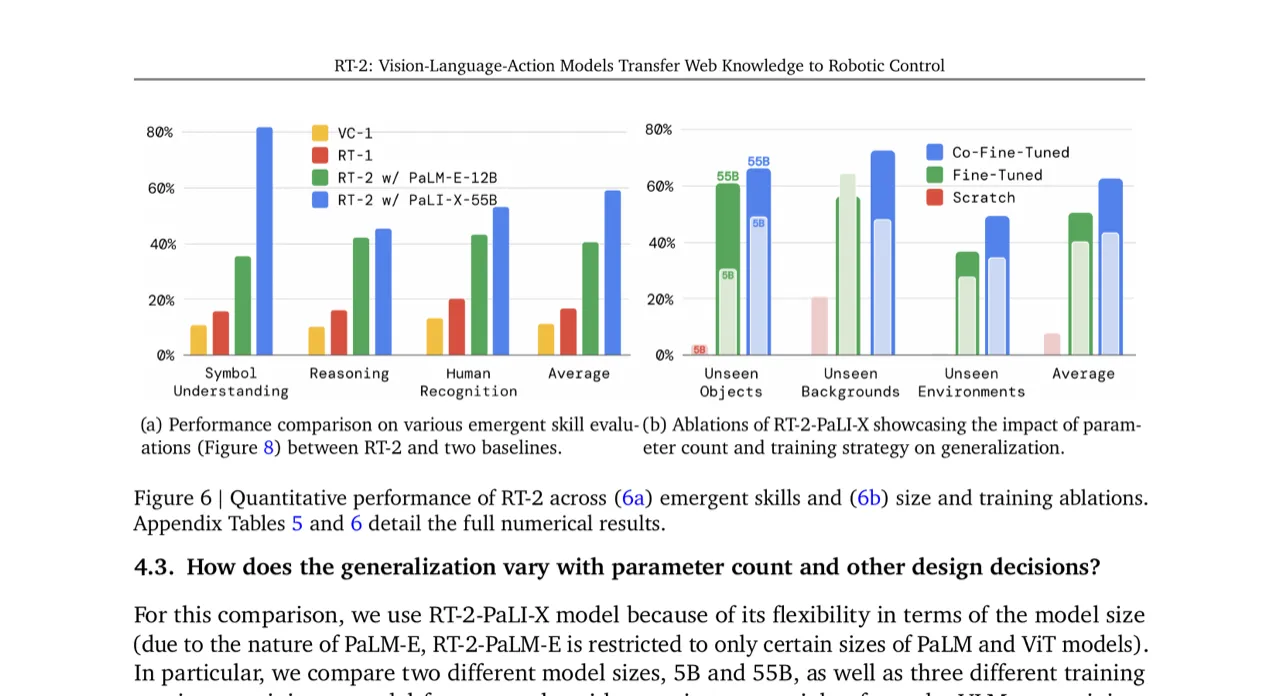
针对 RT-2-PaLI-X,论文比较了三种训练方案:从零开始训练(scratch)、仅机器人数据微调(fine-tune)、联合微调(co-fine-tune);以及两种规模:5B 和 55B。主要结论:For RT-2-PaLI-X the paper compares three training schemes — training from scratch, fine-tuning on robot data only, and co-fine-tuning — as well as two scales, 5B and 55B. The main conclusions:
RT-2 虽然能以新方式部署已有操作技能,但不会从 VLM 预训练中习得全新的运动能力。模型的物理技能仍局限于机器人数据所覆盖的技能分布(如拾取、放置等)。作者指出,一个有前景的方向是通过人类视频等新数据范式扩展技能多样性。Although RT-2 can deploy existing manipulation skills in new ways, it does not acquire entirely new motor capabilities from VLM pre-training. The physical skills of the model remain confined to the skill distribution covered by the robot data (picking, placing and so on). The authors point out that a promising direction is to expand skill diversity through new data paradigms such as human videos.
55B 参数模型需要多 TPU 云服务支撑,控制频率仅 1–3 Hz,无法满足要求高频控制的任务。论文指出,量化(quantization)和蒸馏(distillation)是值得探索的方向,以期在更低成本硬件上实现更高频率推理。The 55B-parameter model needs a multi-TPU cloud service to support it, and its control frequency of only 1–3 Hz cannot meet the needs of tasks that require high-frequency control. The paper notes that quantization and distillation are directions worth exploring, in the hope of higher-frequency inference on lower-cost hardware.
构建 VLA 模型需要对 VLM 进行微调,而目前可公开微调的大型 VLM 数量非常有限。论文表达了对更多开源 VLM(如 LLaVA)出现以及商业模型开放微调 API 的期待,认为这是推广 VLA 方法的必要前提。Building a VLA model requires fine-tuning a VLM, yet the number of large VLMs that can currently be fine-tuned publicly is very limited. The paper expresses its hope for more open-source VLMs (such as LLaVA) to appear and for commercial models to open fine-tuning APIs, regarding this as a necessary precondition for spreading the VLA approach.