用感知运动预训练赋能机器人学习Empowering robot learning with sensorimotor pre-training
Ilija Radosavovic, Baifeng Shi, Letian Fu, Ken Goldberg, Trevor Darrell, Jitendra Malik · UC Berkeley
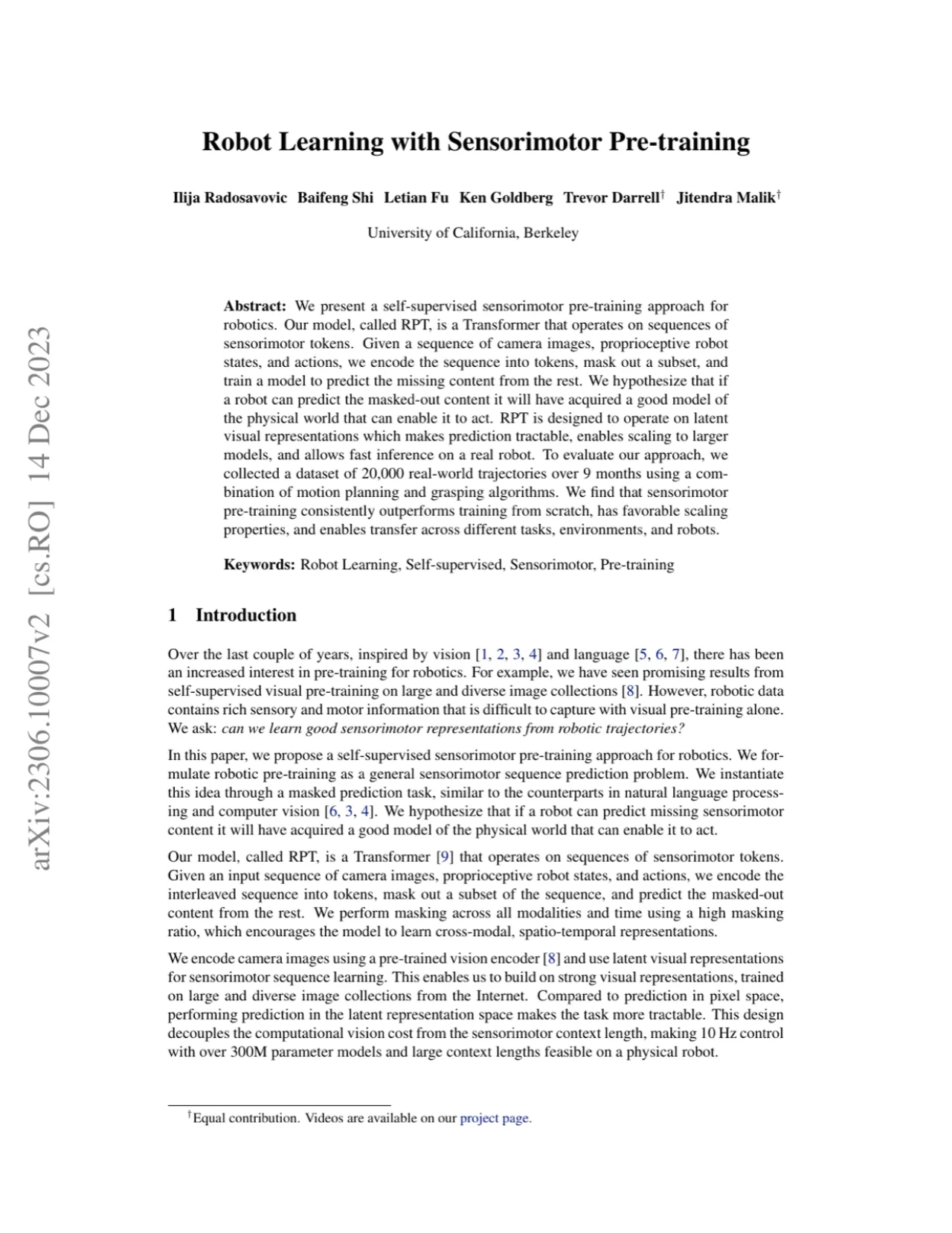
本文提出 RPT(Robotic Pre-trained Transformer),一种针对机器人操作的自监督感知运动预训练方法。模型将多视角图像、本体感知状态与动作编码为 sensorimotor tokens,通过掩码预测任务在 2 万条真实机器人轨迹上预训练,再以 behavior cloning fine-tune 到下游任务。实验证明预训练在所有任务上持续优于从零训练,堆积任务成功率提升约 2×,且具备良好的跨任务、跨机器人迁移能力。This paper presents RPT (Robotic Pre-trained Transformer), a self-supervised sensorimotor pre-training method for robotic manipulation. The model encodes multi-view images, proprioceptive states and actions as sensorimotor tokens, pre-trains on 20000 real robot trajectories with a masked prediction task, and is then fine-tuned to downstream tasks via behavior cloning. Experiments show that pre-training consistently outperforms training from scratch on all tasks, raises the success rate of the stacking task by about 2×, and transfers well across tasks and across robots.
自监督预训练在视觉和语言领域带来了巨大突破,但在机器人学习领域尚未得到充分探索。机器人操作需要同时处理多模态感知(图像、本体感知)和动作序列,直接从零训练样本效率低、难以在任务间迁移。Self-supervised pre-training has produced major breakthroughs in vision and language, yet it remains under-explored in robot learning. Robotic manipulation has to handle multimodal perception (images, proprioception) and action sequences at the same time; training directly from scratch is sample-inefficient and transfers poorly between tasks.
"We ask: can we learn good sensorimotor representations from robotic trajectories? Our key hypothesis is that if the robot can predict the missing content it has acquired a good model of the physical world."
图1:RPT 概览。左:采集包含多视角 RGB 图像、本体感知状态与动作的真实轨迹数据集(20,000 条,历时 9 个月)。中:在感知运动序列上进行自监督预训练。右:将预训练表示迁移至下游操作任务。Figure 1: RPT overview. Left: collecting a real-robot trajectory dataset containing multi-view RGB images, proprioceptive states and actions (20,000 trajectories, gathered over 9 months). Middle: self-supervised pre-training on sensorimotor sequences. Right: transferring the pre-trained representation to downstream manipulation tasks.
2×堆积任务成功率相对从零训练的提升Gain in stacking task success rate over training from scratch
300M模型参数量(可在真实机器人 10 Hz 推理)Model parameters (10 Hz inference on the real robot)
9 mo.数据采集历时月数Months spent collecting the data
在机器人操作这一数据稀缺场景中,预训练能否帮助模型学到可迁移的物理世界模型?这是 RPT 试图回答的核心问题。与视觉预训练(ViT、MAE)不同,RPT 预训练的对象是跨模态、跨时间步的感知运动序列,旨在捕捉动作与感知之间的因果依赖关系。In robotic manipulation, a data-scarce setting, can pre-training help the model learn a transferable model of the physical world? This is the core question RPT sets out to answer. Unlike visual pre-training (ViT, MAE), RPT pre-trains on sensorimotor sequences that span modalities and time steps, aiming to capture the causal dependencies between action and perception.
02方法 MethodMethod
RPT 分为两个阶段:(1)在大规模真实轨迹上进行感知运动掩码预训练;(2)以 behavior cloning fine-tune 到特定下游任务。整个流水线无需任务标签或语言监督,仅依赖机器人自身采集的轨迹数据。RPT has two stages: (1) sensorimotor masked pre-training on large-scale real trajectories; (2) fine-tuning to a specific downstream task with behavior cloning. The whole pipeline requires no task labels or language supervision, relying only on trajectory data collected by the robot itself.
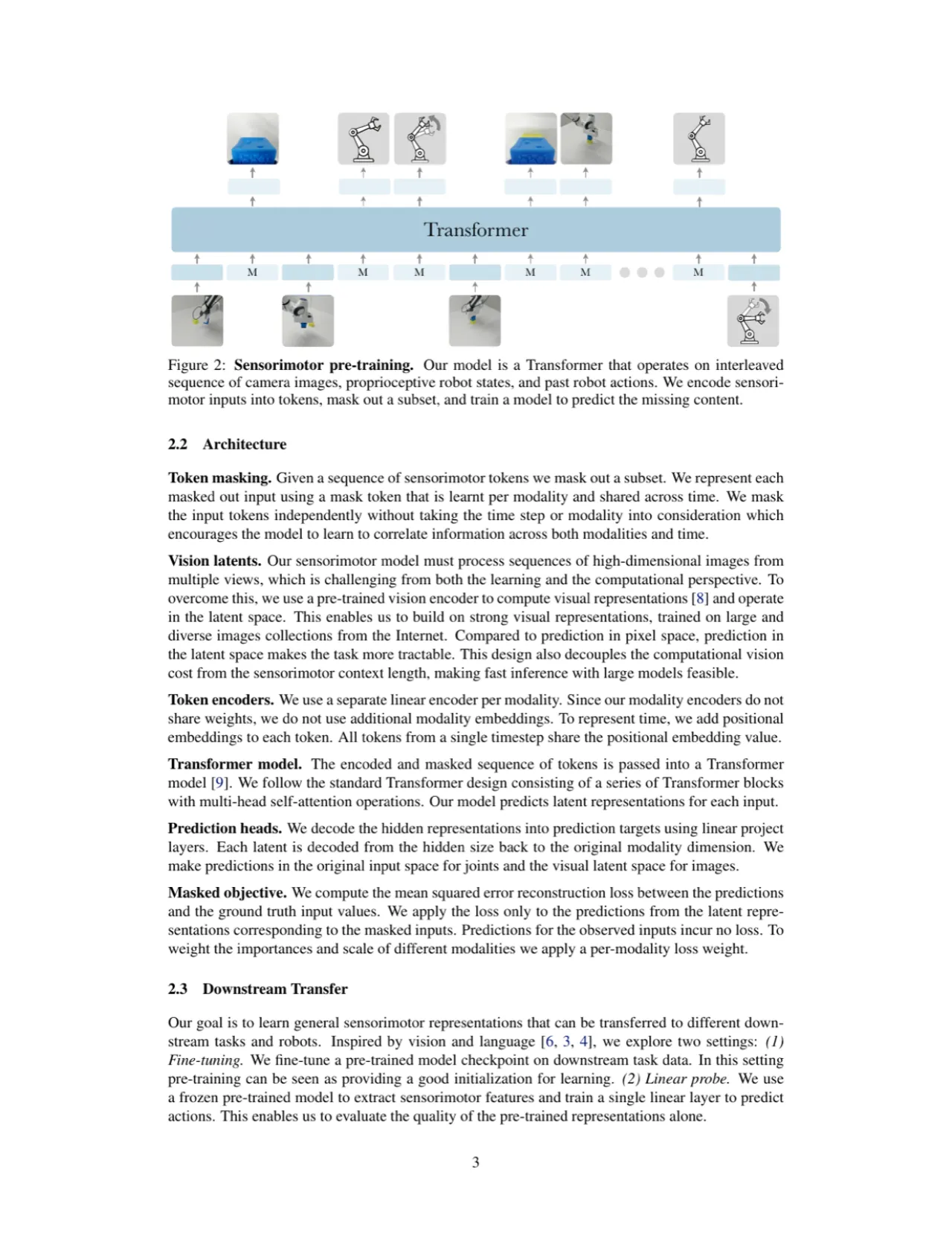
图2:感知运动预训练框架。模型以交错方式接收来自 3 个相机视角的图像、本体感知状态和动作,通过冻结的视觉编码器提取视觉 latent,再编码为 sensorimotor tokens,随机掩码后训练 Transformer 重建缺失内容。预训练阶段无需动作标签;fine-tune 阶段以 behavior cloning 学习动作预测。Figure 2: the sensorimotor pre-training framework. The model receives, in an interleaved fashion, images from 3 camera views together with proprioceptive states and actions; a frozen visual encoder extracts visual latents, which are encoded into sensorimotor tokens, randomly masked, and used to train a Transformer to reconstruct the missing content. The pre-training stage needs no action labels; the fine-tuning stage learns action prediction with behavior cloning.
每个时间步包含三个模态:多视角图像、本体感知状态(关节角度等)、动作。图像经预训练视觉编码器(ViT)提取 latent 表示,与状态、动作分别线性映射为固定维度 token,按时间步交错拼接为序列输入 Transformer。这一设计将视觉编码器从感知运动上下文长度中解耦,使模型可使用 10× 更大的 context 而不增加视觉计算量。Each time step contains three modalities: multi-view images, proprioceptive state (joint angles, etc.) and action. Images pass through a pre-trained visual encoder (ViT) to yield latent representations, which — like states and actions — are linearly mapped to fixed-dimensional tokens and interleaved by time step into a sequence fed to the Transformer. This design decouples the visual encoder from the sensorimotor context length, letting the model use a 10× larger context without increasing visual computation.
"We predict in the latent representation space rather than the pixel space, which enables 10 times larger models."
对跨模态、跨时间步的 tokens 进行随机掩码(默认比例 0.9),训练模型从可见 tokens 预测被掩盖内容。对掩码 tokens,模型基于每个 token 的 hidden state 预测对应的原始值;对可见 tokens,直接重构原始输入以鼓励跨模态信息整合。掩码策略同时覆盖所有模态和时间步,迫使模型理解感知与动作之间的时序因果关系。Tokens across modalities and time steps are randomly masked (default ratio 0.9), and the model is trained to predict the masked content from the visible tokens. For masked tokens, the model predicts the corresponding original value from each token's hidden state; for visible tokens, it directly reconstructs the original input so as to encourage cross-modal information integration. The masking strategy covers all modalities and all time steps at once, forcing the model to understand the temporal causal relationship between perception and action.
Fine-tuning via Behavior Cloning(行为克隆微调)Fine-tuning via Behavior Cloning
预训练完成后,将 Transformer 作为特征提取骨干,顶部接一线性层预测 10 步动作(自回归推理)。以 behavior cloning 在下游演示数据上微调,可选冻结或解冻视觉编码器。推理时模型以 10 Hz 运行在真实机器人,context 保持 300 tokens。After pre-training, the Transformer serves as a feature-extraction backbone, with a linear layer on top predicting 10 action steps (autoregressive inference). It is fine-tuned with behavior cloning on downstream demonstration data, optionally freezing or unfreezing the visual encoder. At inference the model runs at 10 Hz on the real robot, keeping a context of 300 tokens.
03实验 ExperimentsExperiments
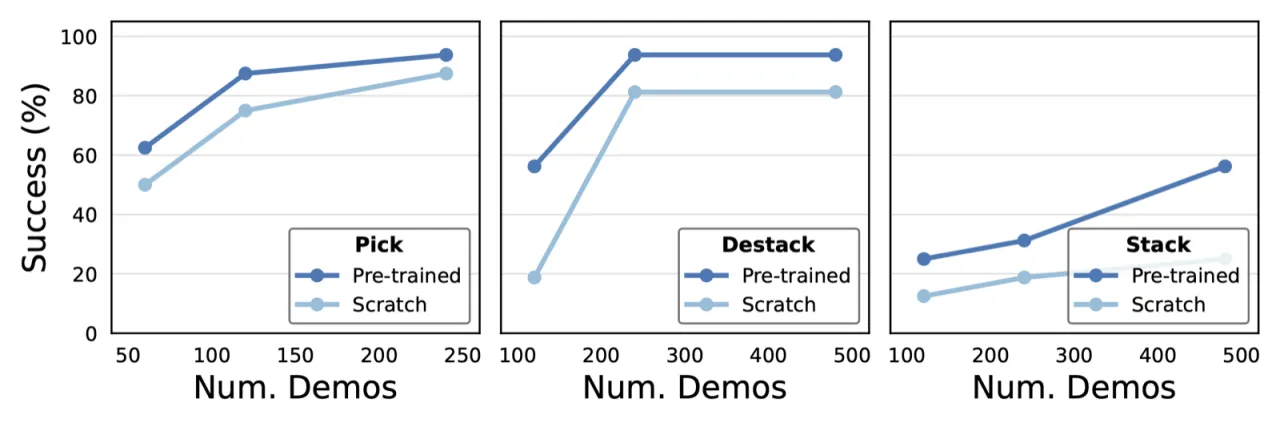
实验在 7-DoF 机械臂上进行,任务包括 Pick(单物体抓取)、Destack(拆叠)、Stack(堆积),涵盖物体位姿、形状、外观变化。评估指标为真实机器人执行成功率(%),与从零训练基线对比。Experiments are run on a 7-DoF robotic arm; the tasks are Pick (grasping a single object), Destack (unstacking) and Stack (stacking), covering variation in object pose, shape and appearance. The evaluation metric is the execution success rate (%) on the real robot, compared against a train-from-scratch baseline.
图3:预训练 vs. 从零训练的 fine-tuning 曲线(三个任务)。横轴为演示数量,纵轴为成功率(%)。预训练在所有任务和所有数据量级上均持续领先,且难度越高(Stack)提升越显著。Figure 3: fine-tuning curves for pre-training vs. training from scratch (three tasks). The horizontal axis is the number of demonstrations, the vertical axis the success rate (%). Pre-training leads consistently across all tasks and all data scales, and the harder the task (Stack), the larger the gain.
任务 TaskTask
Scratch(从零训练)Scratch (trained from scratch)
RPT Pre-trained
备注Notes
Pick(~240 demos)Pick (~240 demos)
~78%
~92%
较易任务,相对增益适中Easier task; moderate relative gain
Destack(~480 demos)Destack (~480 demos)
~78%
~92%
中等难度,增益明显Medium difficulty; clear gain
Stack(~480 demos)Stack (~480 demos)
~60%
~93%
"2x improvements in the block stacking task"
注:表中数值从论文 Figure 5 曲线估读(最终数据点),原文以图表形式呈现,未给出精确小数点数字。引号内为原文表述。Note: The values in the table are read off the Figure 5 curves of the paper (final data points); the original work presents them as plots and gives no exact decimal numbers. Text in quotation marks is the paper's own wording.
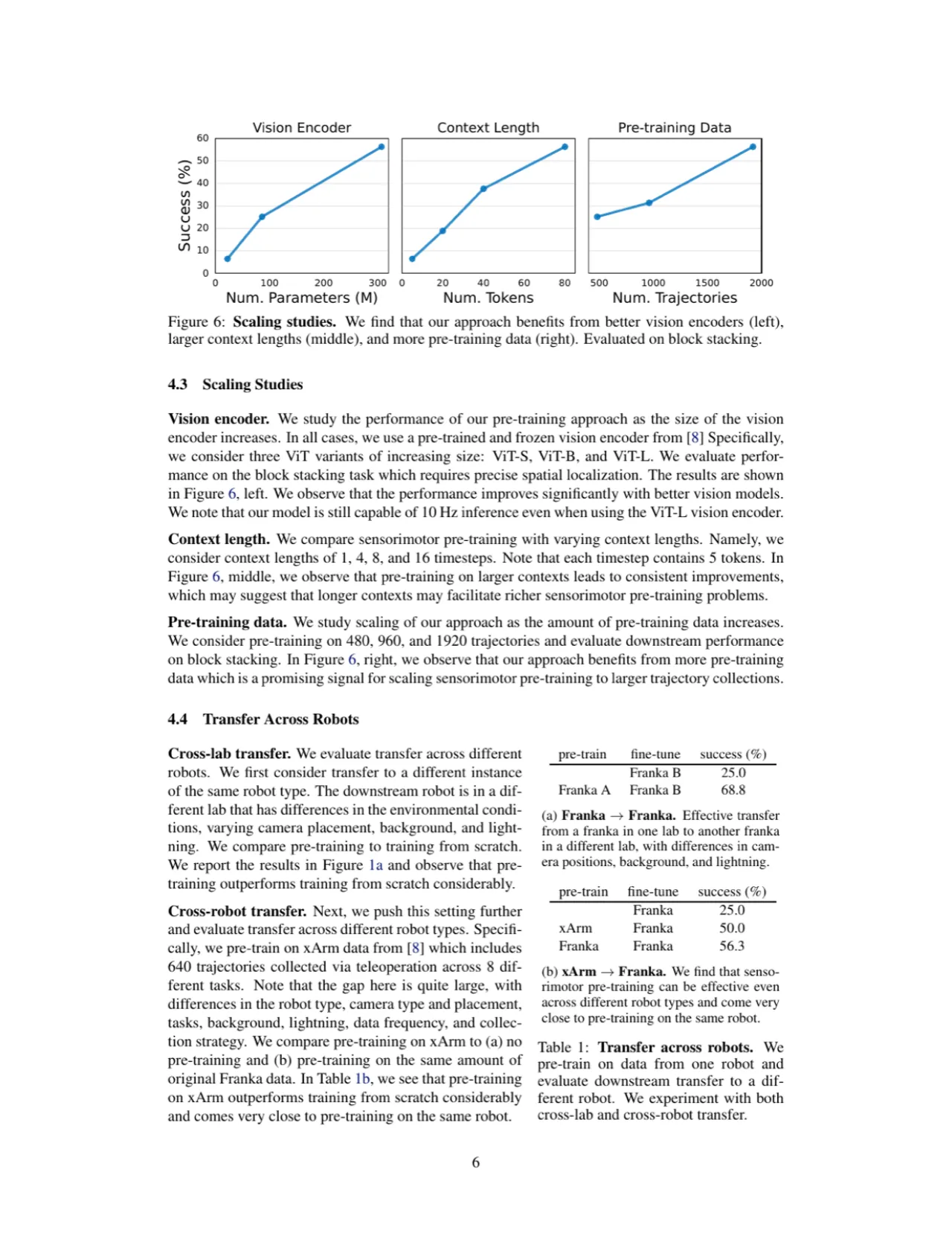
图4:缩放研究。左:更大的视觉编码器(Vision Encoder 参数量)带来持续性能提升。中:更长的感知运动 context(Num. Tokens)带来更高成功率。右:更多预训练轨迹数据(Pre-training Data)进一步提升下游性能,体现 favorable scaling properties。评估均在 Stack 任务上进行。Figure 4: scaling studies. Left: a larger visual encoder (Vision Encoder parameter count) brings steady performance gains. Middle: a longer sensorimotor context (Num. Tokens) brings a higher success rate. Right: more pre-training trajectory data (Pre-training Data) further improves downstream performance, showing favorable scaling properties. All evaluations are performed on the Stack task.
视觉编码器缩放:使用在 Ego4D 上预训练的 ViT(从 ViT-S 到 ViT-H),更大编码器带来持续收益。Visual encoder scaling: using ViTs pre-trained on Ego4D (from ViT-S to ViT-H), larger encoders bring steady gains.
Context 长度缩放:context 从 1 到 300 tokens,更长上下文持续改善性能(300 tokens ≈ 30 时间步)。Context length scaling: going from 1 to 300 tokens, a longer context steadily improves performance (300 tokens ≈ 30 time steps).
预训练数据量缩放:从 480 到 20,000 条轨迹,数据越多性能越高,体现良好的 data scaling。Pre-training data scaling: going from 480 to 20,000 trajectories, more data yields higher performance, showing good data scaling.
跨任务与跨机器人迁移 TransferCross-task and Cross-robot Transfer
论文还验证了两种迁移场景:The paper further validates two transfer settings:
Cross-task transfer(跨任务):在 xArm 机器人上,以其他任务数据预训练再 fine-tune 到 Stack,优于从零训练基线(成功率提升 ~24%)。Cross-task transfer: on the xArm robot, pre-training on data from other tasks and then fine-tuning to Stack beats the train-from-scratch baseline (success rate up by ~24%).
Cross-robot transfer(跨机器人):在 Franka 机器人(训练)→ xArm 机器人(部署),预训练模型明显优于从零训练,展示跨机器人平台的泛化能力。Cross-robot transfer: from the Franka robot (training) to the xArm robot (deployment), the pre-trained model clearly outperforms training from scratch, demonstrating generalization across robot platforms.
Ablations 消融实验Ablations
掩码比例(Masking Ratio):0.9 的高掩码比例最优(从 0.1 到 0.9 逐渐提升);感知运动预训练需要更高掩码比例才能学到有效表示。Masking Ratio: a high masking ratio of 0.9 is optimal (performance rises gradually from 0.1 to 0.9); sensorimotor pre-training needs a higher masking ratio to learn effective representations.
掩码策略(Masking Type):统一随机掩码优于仅掩码某一模态或某一时间步;跨模态跨时序联合掩码对性能至关重要。Masking Type: uniform random masking beats masking only one modality or only one time step; joint masking across modalities and across time is critical for performance.
Partial vs. Full fine-tuning:更多演示数据下,全量 fine-tune 略优;少量演示下 partial fine-tuning 更鲁棒。Partial vs. Full fine-tuning: with more demonstration data, full fine-tuning is slightly better; with few demonstrations, partial fine-tuning is more robust.
Linear probing:线性探针无法取得非平凡性能,说明下游任务需要特征适应(fine-tuning 必要)。Linear probing: linear probes cannot reach non-trivial performance, showing that downstream tasks require feature adaptation (fine-tuning is necessary).
04局限性 LimitationsLimitations
注:论文未设专门的 Limitations 章节,以下局限性部分来自作者在论文中的陈述(stated),部分为从设计层面推断(inferred)。Note: The paper has no dedicated Limitations section; some of the limitations below come from the authors' own remarks in the paper (stated), while others are inferred from the design (inferred).
典型失败案例(stated)Typical failure cases (stated)
作者在项目页面中列举了四类典型失败:imprecise picking(抓取不精准)、imprecise stacking(堆叠不精准)、misaligned closures(闭合错位)、object slippage during manipulation(操作中物体滑落)。这些失败说明模型在精细操作方面仍有提升空间。On the project page the authors list four typical failure modes: imprecise picking, imprecise stacking, misaligned closures, and object slippage during manipulation. These failures show that the model still has room for improvement on fine-grained manipulation.
数据来源单一(inferred)Single data source (inferred)
预训练数据全部来自同一实验室的单一机械臂平台(7-DoF 臂),任务仅涵盖 Pick / Bin Pick / Stack / Destack 四类桌面操作。尽管跨机器人实验展示了一定泛化能力,但数据多样性的不足可能限制更广泛场景下的迁移效果。All pre-training data comes from a single robotic-arm platform (a 7-DoF arm) in one lab, and the tasks cover only four kinds of tabletop manipulation: Pick / Bin Pick / Stack / Destack. Although the cross-robot experiments show a degree of generalization, the limited data diversity may restrict transfer to broader settings.
语言/任务条件化缺失(inferred)No language / task conditioning (inferred)
RPT 不使用语言指令或任务 ID,每次 fine-tune 对应单一任务。在需要语言理解或多任务调度的场景下,需要额外设计任务条件化机制。RPT uses neither language instructions nor task IDs, and each fine-tuning run corresponds to a single task. Settings that require language understanding or multi-task scheduling would need an additional task-conditioning mechanism.
计算成本(inferred)Computational cost (inferred)
300M 参数模型在真实机器人上以 10 Hz 运行,推理效率已属可接受范围,但预训练阶段的计算资源需求较高。此外,视觉编码器使用在 Ego4D(人类第一人称视频)上预训练的 ViT,与机器人操控场景仍存在域差距,未来可用更多机器人数据专门预训练视觉编码器以进一步提升性能。The 300M-parameter model runs at 10 Hz on the real robot, so inference efficiency is within an acceptable range, but the pre-training stage is computationally demanding. In addition, the visual encoder is a ViT pre-trained on Ego4D (egocentric human video), which still leaves a domain gap with robot manipulation; future work could pre-train the visual encoder specifically on more robot data to improve performance further.