Kun Wu, Chengkai Hou, Jiaming Liu, Zhengping Che, Xiaozhu Ju, Zhuqin Yang, Meng Li, Yinuo Zhao, Zhiyuan Xu, Guang Yang, et al. · 北京人形机器人创新中心 / 北京大学 / 北京人工智能研究院Beijing Innovation Center of Humanoid Robotics / Peking University / Beijing Academy of Artificial Intelligence
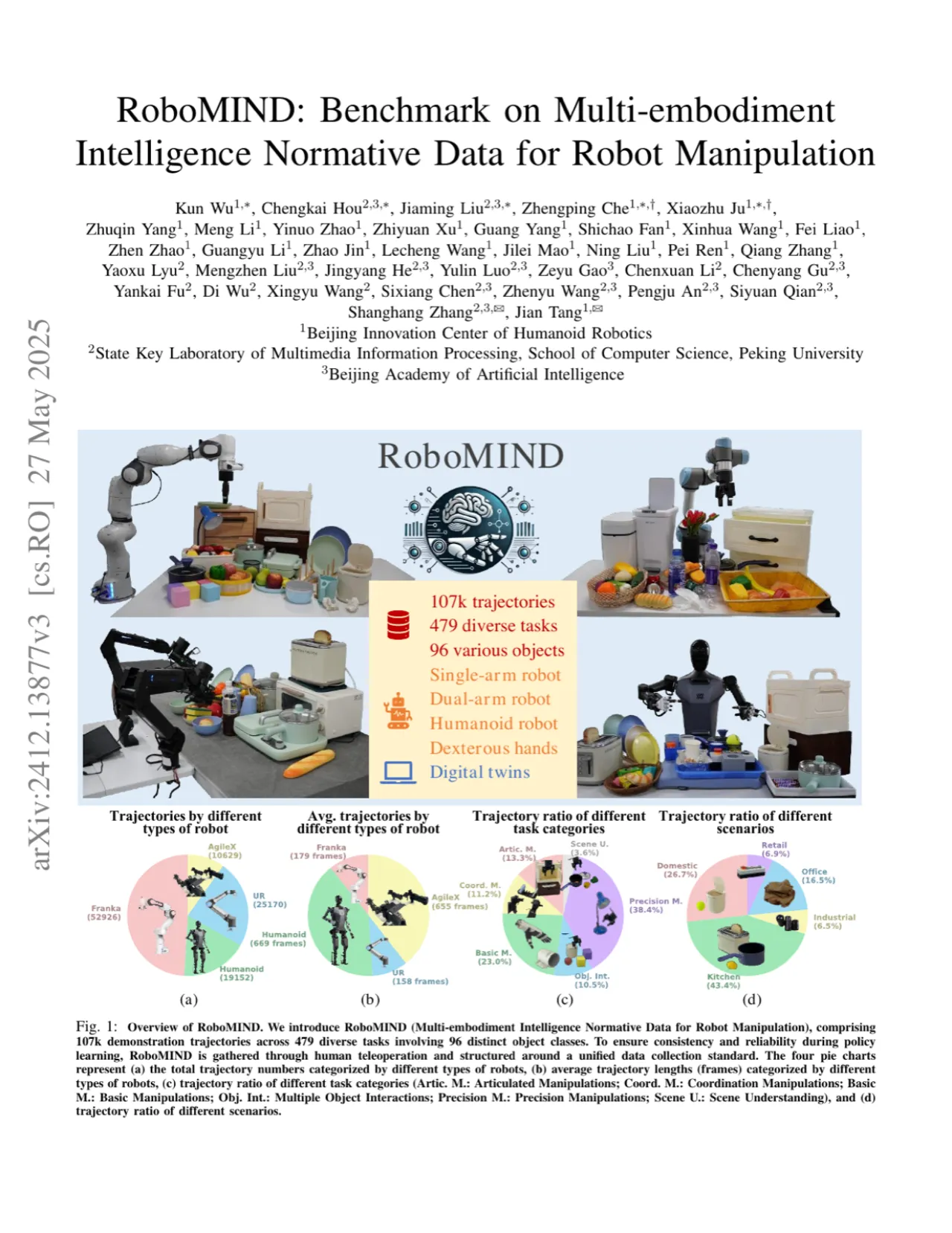
RoboMIND(Multi-embodiment Intelligence Normative Data)是一个包含 107k 条示范轨迹、479 种任务、96 类物体的大规模机器人操作数据集,覆盖单臂、双臂、人形及桌面四类机器人,并引入统一数据采集标准、5k 条真实失败轨迹,以及 Isaac Sim 数字孪生环境,为通用操作策略研究提供坚实基础。RoboMIND (Multi-embodiment Intelligence Normative Data) is a large-scale robot manipulation dataset containing 107k demonstration trajectories, 479 tasks and 96 object categories, covering four robot embodiments -- single-arm, dual-arm, humanoid and tabletop -- and introducing a unified data collection standard, 5k real-world failure trajectories and an Isaac Sim digital-twin environment, providing a solid foundation for research on general-purpose manipulation policies.
通用机器人操作策略的训练需要大量多样化、高质量的示范数据。然而现有数据集普遍存在规模有限、机体单一、采集标准不统一等问题,严重制约了策略的泛化能力。Training general-purpose robot manipulation policies requires large amounts of diverse, high-quality demonstration data. Existing datasets, however, commonly suffer from limited scale, a single embodiment and inconsistent collection standards, which severely constrains the generalization ability of the learned policies.
"Unlike language or vision datasets that can often be sourced through web-based collection methods, collecting robotic data is difficult because each robot requires controlled environments where the joints and end-effector information of robotic systems are meticulously recorded."
此前大多数工作仅专注于单一机器人类型(如 Open X-Embodiment 以单臂为主),任务多样性和跨机体迁移能力严重受限。RoboMIND 提出了一套统一数据采集与标注流程,汇聚 4 类机体的真实遥操作数据,并额外收录失败案例和仿真数字孪生,以满足当代大模型训练的数据需求。Most prior work focuses on a single robot type (e.g. Open X-Embodiment is dominated by single-arm platforms), which severely limits task diversity and cross-embodiment transfer. RoboMIND proposes a unified data collection and annotation pipeline that aggregates real teleoperation data from 4 embodiments, and additionally includes failure cases and a simulated digital twin, so as to meet the data demands of training contemporary large models.
图 1:RoboMIND 数据集总览。数据集包含 107k 条轨迹、479 种任务、96 类物体,覆盖 (a) 单臂机器人(Franka Emika Panda)、(b) 双臂机器人(AgileX Cobot Magic V2.0)、(c) 人形机器人(Tien Kung)和 (d) 桌面机器人(URS)四类机体。饼图分别展示不同机体的轨迹数量分布、平均轨迹长度、任务类别比例及场景类型比例。Figure 1: Overview of the RoboMIND dataset. The dataset contains 107k trajectories, 479 tasks and 96 object categories, covering four embodiments: (a) a single-arm robot (Franka Emika Panda), (b) a dual-arm robot (AgileX Cobot Magic V2.0), (c) a humanoid robot (Tien Kung) and (d) a tabletop robot (URS). The pie charts show, respectively, the distribution of trajectory counts across embodiments, the average trajectory length, the proportion of task categories and the proportion of scene types.
107k示范轨迹总数Demonstration trajectories in total
479多样化任务种类Diverse task categories
96物体类别Object categories
5k真实失败轨迹Real-world failure trajectories
与现有工作相比,RoboMIND 的优势体现在:(1) 覆盖的任务和机体类型最多;(2) 采集标准统一,数据质量可控;(3) 提供失败轨迹以支持 Reinforcement Learning from Human Feedback (RLHF) 类研究;(4) 提供 Isaac Sim 数字孪生环境,支持合成数据生成与策略评测。论文 Table I 与 Open X-Embodiment、BridgeData V2、RoboSet、DROID 等代表性数据集进行了详细对比。Compared with existing work, RoboMIND offers: (1) the broadest coverage of tasks and embodiment types; (2) a unified collection standard with controllable data quality; (3) failure trajectories that support Reinforcement Learning from Human Feedback (RLHF) style research; (4) an Isaac Sim digital-twin environment supporting synthetic data generation and policy evaluation. Table I of the paper gives a detailed comparison with representative datasets such as Open X-Embodiment, BridgeData V2, RoboSet and DROID.
02方法 MethodMethod
RoboMIND 的核心贡献是一套端到端的数据采集、处理与标注流程,以及配套的数字孪生评测环境,确保跨机体数据的一致性与可用性。The core contribution of RoboMIND is an end-to-end pipeline for data collection, processing and annotation, together with a matching digital-twin evaluation environment, ensuring the consistency and usability of data across embodiments.
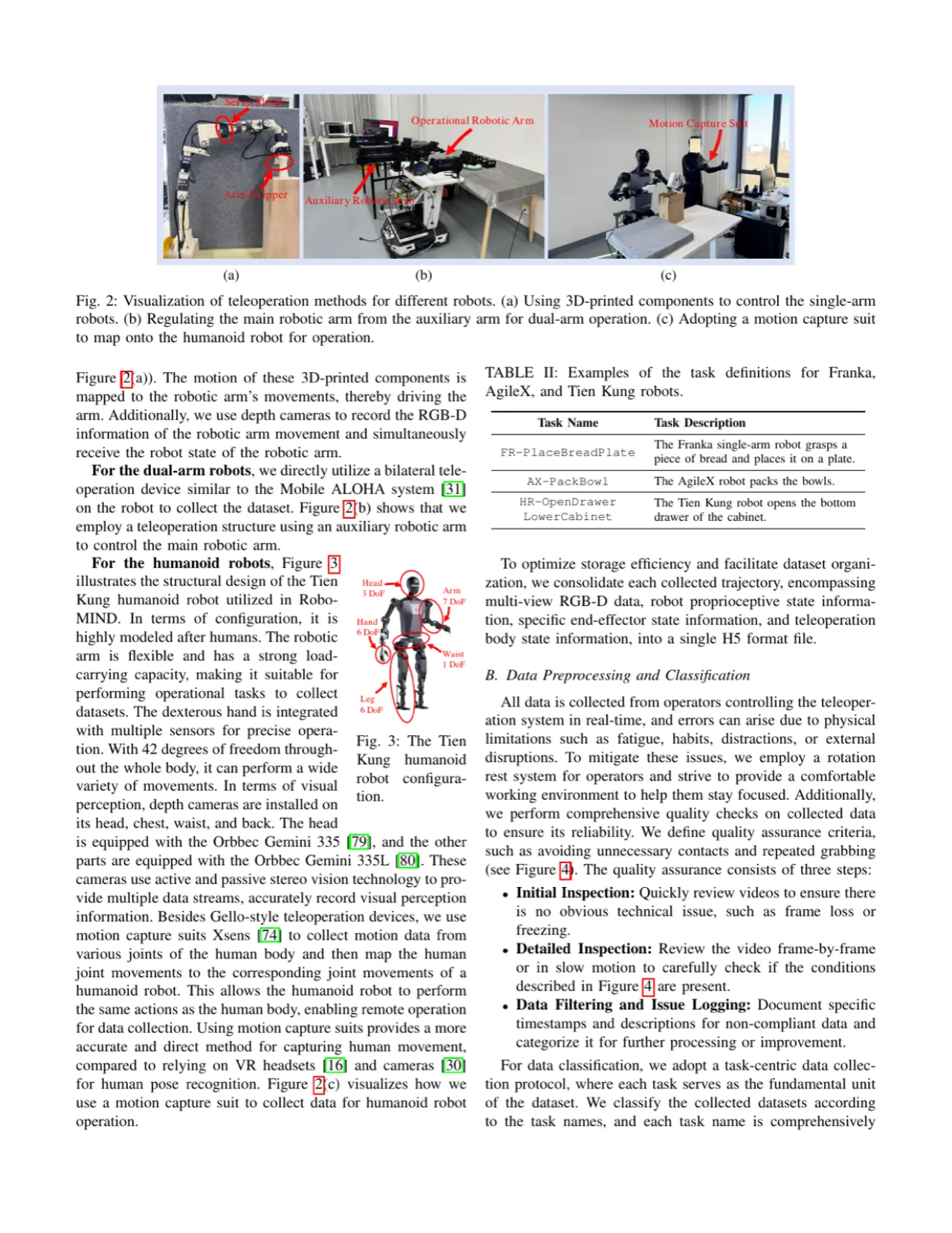
图 2:四类机器人平台与遥操作装置。(a) 使用 3D 打印组件还原主机械臂运动,控制 Franka 单臂;(b) 通过双侧遥操作结构驱动 AgileX 双臂;(c) 利用动捕套装捕捉人体全身运动,映射至 Tien Kung 人形机器人;(d) 采用运动捕捉套装采集 URS 桌面机器人数据。多视角 RGB-D 相机提供视觉观测,深度相机额外记录机械臂运动信息。Figure 2: The four robot platforms and their teleoperation devices. (a) 3D-printed components reproduce the motion of a leader arm to control the Franka single-arm robot; (b) a bilateral teleoperation rig drives the AgileX dual-arm robot; (c) a motion-capture suit records whole-body human motion and maps it onto the Tien Kung humanoid; (d) a motion-capture suit is used to collect data for the URS tabletop robot. Multi-view RGB-D cameras provide the visual observations, and the depth cameras additionally record arm motion information.
所有数据均通过人工遥操作采集,遵循统一的 H5 格式存储:每条轨迹包含多视角 RGB-D 图像、本体感知机器人状态(关节角度、末端执行器位姿)和自然语言任务描述。四类机体使用各自定制化的遥操作装置:Franka 使用 3D 打印主臂(39.2% 轨迹总量),Tien Kung 使用动捕套装(15,187 条),AgileX 使用双侧主臂(25,170 条),URS 使用仿真(500 条)。All data are collected by human teleoperation and stored in a unified H5 format: each trajectory contains multi-view RGB-D images, proprioceptive robot states (joint angles, end-effector poses) and a natural-language task description. The four embodiments use their own customized teleoperation devices: Franka uses a 3D-printed leader arm (39.2% of all trajectories), Tien Kung uses a motion-capture suit (15,187 trajectories), AgileX uses bilateral leader arms (25,170 trajectories) and URS uses simulation (500 trajectories).
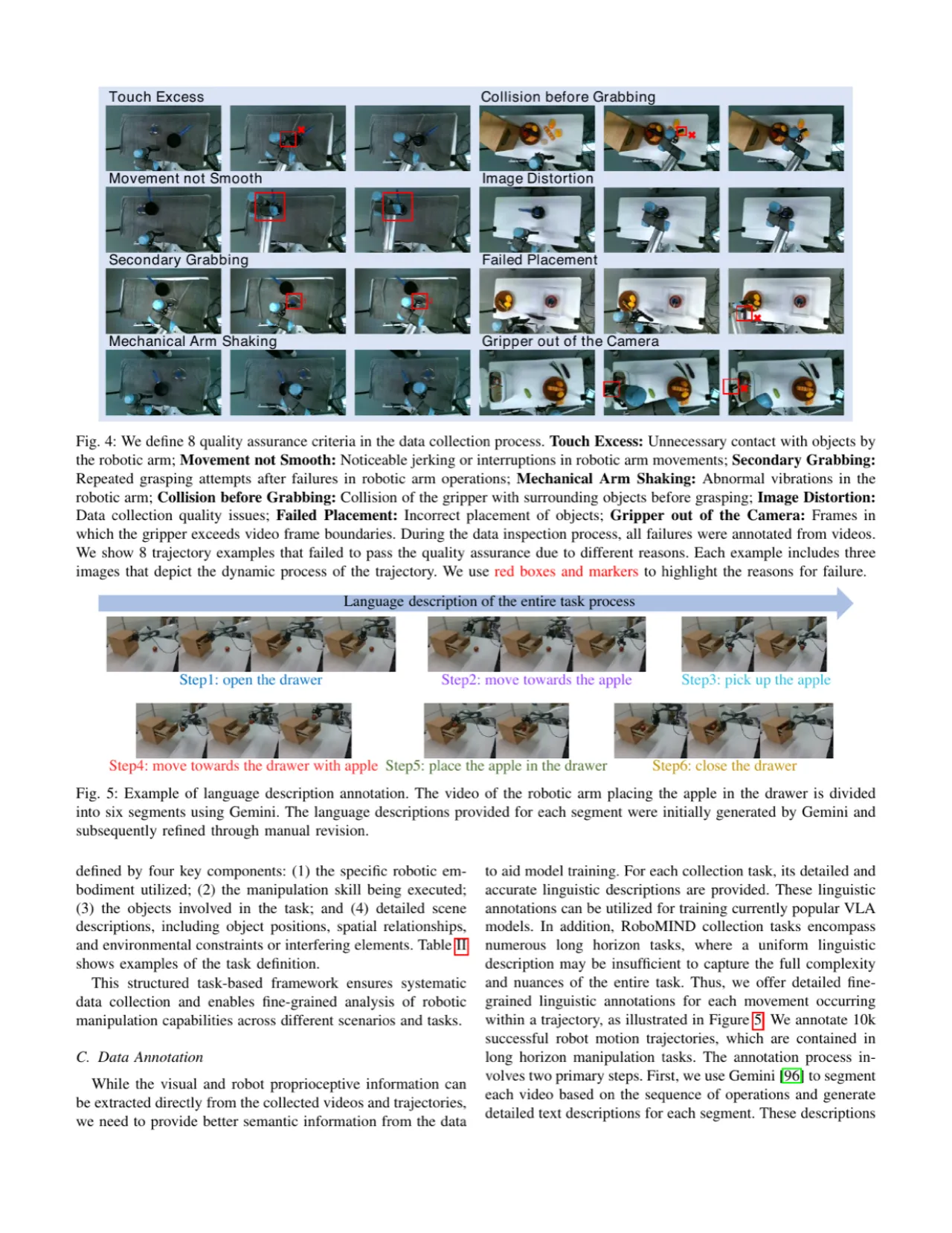
采集后的数据经过三阶段质检:(1) 快速检视——确认无明显技术问题(帧丢失、冻结);(2) 详细检视——逐帧回放确认操作质量;(3) 类别标注——在时间戳上标注不合规数据并分类原因。论文定义了 8 类质量缺陷(如 Touch Excess、Movement not Smooth、Collision before Grabbing、Image Distortion 等),所有不合格片段均标注上下文和原因供后续分析。The collected data pass a three-stage quality check: (1) quick inspection -- confirming there is no obvious technical problem (dropped or frozen frames); (2) detailed inspection -- frame-by-frame playback to confirm manipulation quality; (3) category annotation -- marking non-compliant data on the timeline and classifying the cause. The paper defines 8 categories of quality defect (such as Touch Excess, Movement not Smooth, Collision before Grabbing and Image Distortion), and every non-compliant segment is annotated with its context and cause for later analysis.
图 3(左):失败案例可视化。展示 8 类质量问题的典型示例,红框标注关键失败帧(如 Touch Excess、Collision before Grabbing、Image Distortion、Failed Placement、Gripper out of Camera 等),每个示例包含 3 帧图像以展示动态过程。Figure 3 (left): Visualization of failure cases. Typical examples of the 8 quality-issue categories; red boxes mark the key failure frames (such as Touch Excess, Collision before Grabbing, Image Distortion, Failed Placement and Gripper out of Camera), and each example contains 3 frames to show the dynamic process. 图 3(右):语言描述标注示意。以 FR-OpenDrawer 任务为例,整个任务被 Gemini 自动分段生成 6 个步骤描述(如 "Step1: open the drawer"),经人工校验后形成细粒度语言标注,支持 VLA 模型训练。Figure 3 (right): Illustration of the language annotation. Taking the FR-OpenDrawer task as an example, the whole task is automatically segmented by Gemini into 6 step descriptions (such as "Step1: open the drawer"); after human verification these become fine-grained language annotations that support VLA model training.
任务分类与语言标注(Task Classification & Language Annotation)Task Classification & Language Annotation
所有任务按语义分为 6 大类:Articulated Manipulations(Artic. M.)(如开关抽屉)、Coordination Manipulations(Coord. M.)(双臂协调)、Basic Manipulations(Basic M.)(抓放)、Multiple Object Interactions(Obj. Int.)、Precision Manipulations(M. Precision)、Scene Understandings(Scene U.)。每条轨迹都配备由 Gemini 初步生成、人工精修的分步式语言描述,精确描述每个动作段落。All tasks are grouped into 6 semantic categories: Articulated Manipulations (Artic. M.) (e.g. opening and closing drawers), Coordination Manipulations (Coord. M.) (dual-arm coordination), Basic Manipulations (Basic M.) (pick and place), Multiple Object Interactions (Obj. Int.), Precision Manipulations (M. Precision) and Scene Understandings (Scene U.). Every trajectory comes with a step-wise language description first generated by Gemini and then refined by humans, describing each action segment precisely.
数字孪生环境(Isaac Sim Digital Twin)Isaac Sim Digital Twin
论文同步构建了 Isaac Sim 仿真数字孪生,复现真实机器人平台的外观、动力学及相机配置,支持合成数据生成(500 条 URS 仿真轨迹)和策略在仿真中的系统性评测,降低真实环境部署成本。The paper also builds an Isaac Sim digital twin that reproduces the appearance, dynamics and camera configuration of the real robot platforms, supporting synthetic data generation (500 simulated URS trajectories) and systematic evaluation of policies in simulation, lowering the cost of real-world deployment.
03实验 ExperimentsExperiments
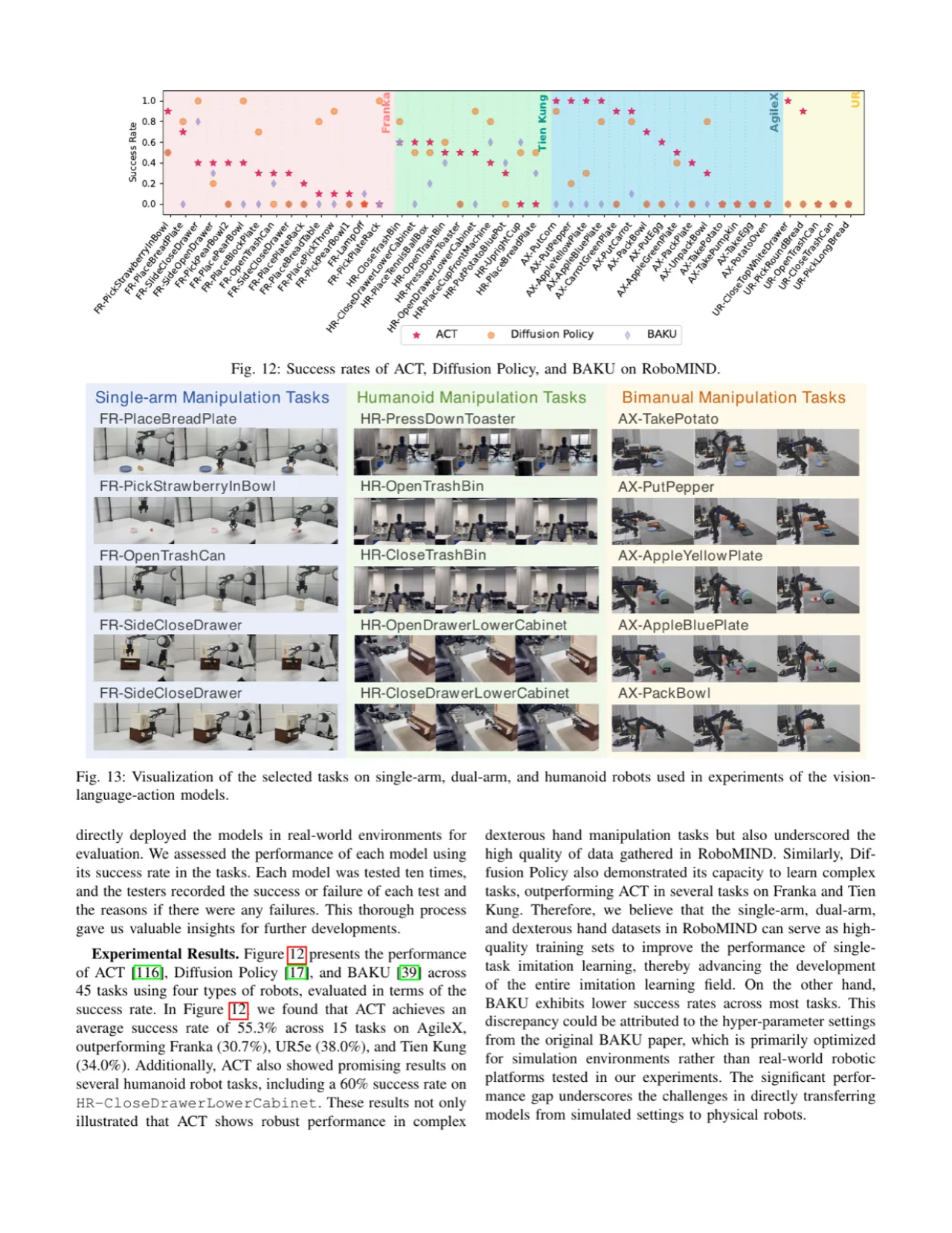
论文通过两大实验系列验证 RoboMIND 的价值:(1) 在单任务模仿学习算法上的 benchmark 评测;(2) 将 RoboMIND 用于微调大型 VLA 模型的泛化性验证。共选取 45 项任务(含单臂、双臂、人形)进行真实机器人测试,每项任务运行 10 次取成功率。The paper validates the value of RoboMIND through two series of experiments: (1) a benchmark evaluation of single-task imitation learning algorithms; (2) a generalization study that uses RoboMIND to fine-tune large VLA models. In total 45 tasks (single-arm, dual-arm and humanoid) are tested on real robots, each task being run 10 times to obtain a success rate.
每类算法在各机体上的 15 个任务进行测试,评估指标为任务成功率(success rate)。结果显示 ACT 在大多数任务上表现最优,平均成功率达 55.3%(跨 45 任务)。Each algorithm is tested on 15 tasks per embodiment, with task success rate as the evaluation metric. ACT performs best on most tasks, reaching an average success rate of 55.3% (across 45 tasks).
图 4:ACT、Diffusion Policy 和 BAKU 在 RoboMIND 上各任务的成功率曲线。x 轴为各任务(按机体颜色区分),y 轴为成功率(0–1.0)。ACT 在多数任务上超越其他基线,Diffusion Policy 在部分复杂任务上也展示出较强能力,而 BAKU 在长时程任务中表现相对较弱。Figure 4: Per-task success rates of ACT, Diffusion Policy and BAKU on RoboMIND. The x axis lists the tasks (colored by embodiment) and the y axis is the success rate (0-1.0). ACT surpasses the other baselines on most tasks, Diffusion Policy also shows strong ability on some complex tasks, while BAKU is relatively weak on long-horizon tasks.
任务类别Task category
ACT(成功率)ACT (success rate)
Diffusion Policy
BAKU
Franka 单臂(15 tasks)Franka single-arm (15 tasks)
~55%(多任务均值)~55% (multi-task mean)
~38%
~40%
Tien Kung 人形(15 tasks)Tien Kung humanoid (15 tasks)
~60%(多任务均值)~60% (multi-task mean)
—
—
AgileX 双臂(15 tasks)AgileX dual-arm (15 tasks)
多任务优势明显Clear advantage on most tasks
部分超越Better on some tasks
较弱Weaker
注:上表数值为论文 Fig. 12 可视化图中读取的近似值。精确的逐任务成功率请参见原文 Table IV–VI。Note: The values in the table above are approximations read off the visualization in Fig. 12 of the paper. See Tables IV-VI of the original paper for the exact per-task success rates.
VLA 模型微调与泛化性验证VLA Fine-tuning and Generalization Study
论文选取三种 VLA 大模型:OpenVLA、RDT-1B、CrossFormer,分别在 RoboMIND 全量数据上微调,并在 Franka 单臂的 45 个任务上测试成功率。The paper selects three large VLA models -- OpenVLA, RDT-1B and CrossFormer -- fine-tunes each of them on the full RoboMIND data, and measures success rates on 45 Franka single-arm tasks.
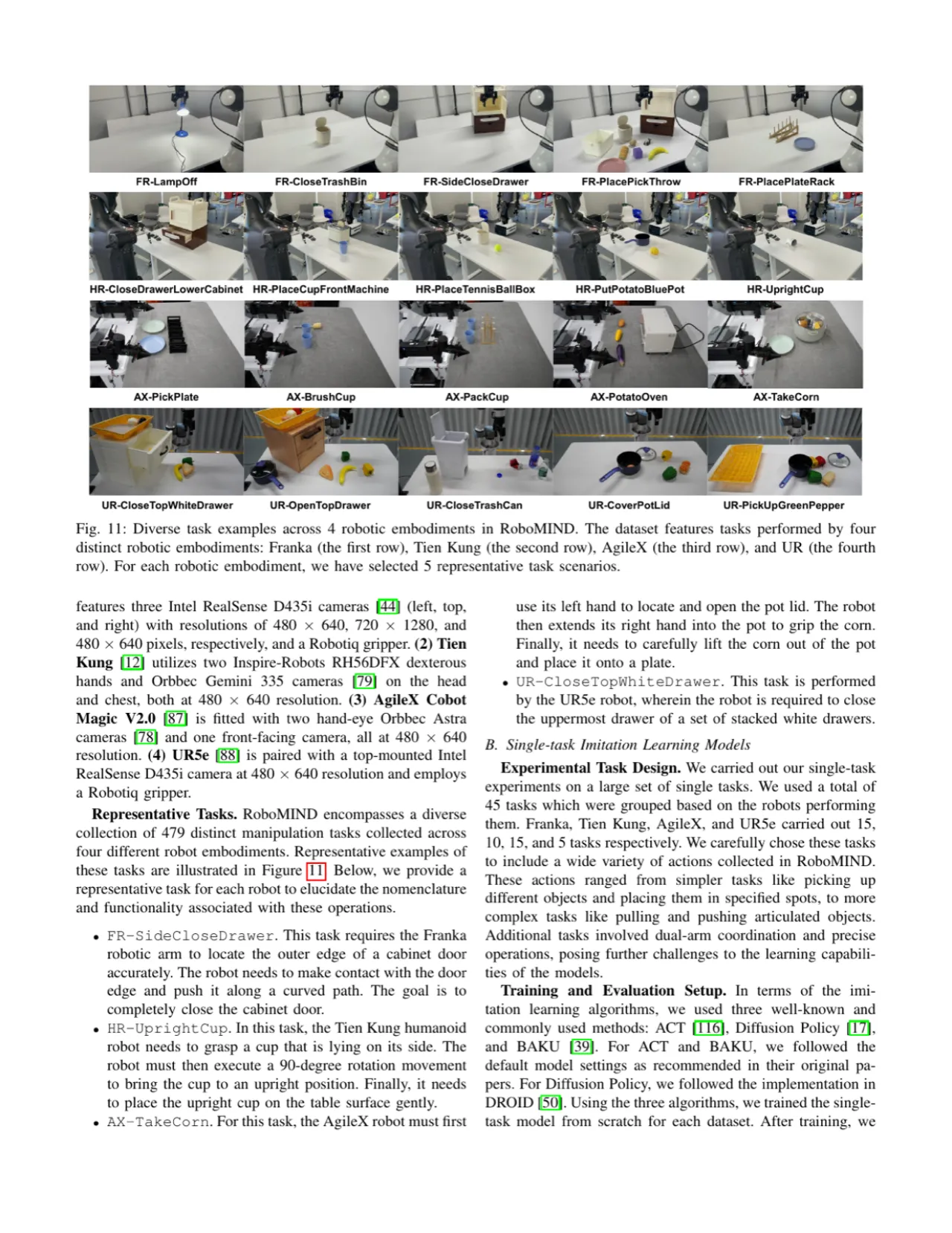
图 5:RoboMIND 跨机体代表性任务。展示四类机体上 5 个典型任务的图像序列(每行)。行 1–4 分别对应 Franka 单臂、AgileX 双臂、Tien Kung 人形和 URS 桌面机器人,涵盖 FR-LampOff、FR-PlaceTrashBin、HR-SideCloseDrawer、FR-PlacePickThrow、FR-PlacePotatoRack 等多类任务,展示数据集的任务多样性。Figure 5: Representative cross-embodiment tasks in RoboMIND. Image sequences of 5 typical tasks on each of the four embodiments (one per row). Rows 1-4 correspond to the Franka single-arm, AgileX dual-arm, Tien Kung humanoid and URS tabletop robots respectively, covering tasks such as FR-LampOff, FR-PlaceTrashBin, HR-SideCloseDrawer, FR-PlacePickThrow and FR-PlacePotatoRack, illustrating the task diversity of the dataset.
实验结论(论文 Table IV–VI):Experimental findings (Tables IV-VI of the paper):
使用完整 RoboMIND 微调后,RDT-1B 和 CrossFormer 在单臂操作任务上相比原始预训练权重取得显著提升。After fine-tuning on the complete RoboMIND, RDT-1B and CrossFormer improve significantly over their original pre-trained weights on single-arm manipulation tasks.
OpenVLA 直接在专项多任务数据集上微调,在 FR-PlaceBreadPlate 等复杂任务上成功率超过 Franka(70% vs. 50%)。OpenVLA, fine-tuned directly on the dedicated multi-task dataset, exceeds Franka on complex tasks such as FR-PlaceBreadPlate (70% vs. 50%).
人形数据(Tien Kung)的加入有助于提升模型对双臂协调任务(Bimanual Tasks)的理解,跨机体迁移显示出初步可行性。Adding humanoid data (Tien Kung) helps the model understand dual-arm coordination tasks (Bimanual Tasks) better, and cross-embodiment transfer shows preliminary feasibility.
仿真-真实联合训练实验(Co-training with Real and Simulation Data)显示:在 EM-UprightCup 等复杂任务上,加入 100 条真实轨迹 + 500 条仿真轨迹可接近单纯使用 200 条真实轨迹的效果,验证了数字孪生的辅助价值。The co-training experiments (Co-training with Real and Simulation Data) show that on complex tasks such as EM-UprightCup, adding 100 real trajectories plus 500 simulated trajectories approaches the performance of using 200 real trajectories alone, confirming the auxiliary value of the digital twin.
泛化测试(unseen objects & backgrounds)中 ACT 在未见物体上平均成功率约 40.0%(F2),未见背景上约 48.0%(F2),表明仍有较大提升空间。In the generalization tests (unseen objects & backgrounds), ACT reaches an average success rate of about 40.0% (F2) on unseen objects and about 48.0% (F2) on unseen backgrounds, showing that there is still considerable room for improvement.
失败原因分析(Failure Case Analysis)Failure Case Analysis
对 ACT 在 45 项任务的失败进行分类(论文 Fig. 15),最常见的前 5 类失败原因包括:Inaccurate Positioning(~48%,人形机体最高)、Early Release、Cannot Close Gripper、Object Drop、Cannot Return to Home Pose。失败案例分析数据有助于指导后续数据采集和策略改进方向。Classifying ACT's failures across the 45 tasks (Fig. 15 of the paper), the 5 most common causes are: Inaccurate Positioning (~48%, highest on the humanoid embodiment), Early Release, Cannot Close Gripper, Object Drop and Cannot Return to Home Pose. This failure analysis helps guide future data collection and directions for improving policies.
04局限性 LimitationsLimitations
说明:以下局限性部分为论文作者在讨论和数据分析章节中明确指出,部分为从数据集设计中推断(标注为 inferred)。Note: Some of the limitations below are explicitly stated by the authors in the discussion and data analysis sections; others are inferred from the dataset design (marked inferred).
仿真到真实的迁移差距(Sim-to-Real Gap)Sim-to-Real Gap
尽管提供了 Isaac Sim 数字孪生,仿真与真实机器人之间的物理差距依然存在。论文实验表明,单纯依赖仿真数据训练的策略在真实环境中表现明显下降,仍需与真实数据联合训练。(stated by authors)Although an Isaac Sim digital twin is provided, the physical gap between simulation and real robots remains. The experiments show that policies trained on simulation data alone degrade markedly in the real world and still need to be co-trained with real data. (stated by authors)
人形机器人数据规模偏小Limited scale of the humanoid robot data
Tien Kung 人形机器人仅贡献 15,187 条轨迹,远少于 Franka 的 56,854 条,且任务种类相对受限(主要为双臂协调和长时程操作)。人形机体的数据规模制约了大模型在人形操作上的微调效果。(stated by authors)The Tien Kung humanoid contributes only 15,187 trajectories, far fewer than Franka's 56,854, and its task variety is relatively limited (mainly dual-arm coordination and long-horizon manipulation). This data scale limits how well large models can be fine-tuned for humanoid manipulation. (stated by authors)
语言标注依赖 LLM 自动生成,存在细节误差Language annotation relies on LLM auto-generation and contains fine-grained errors
分步语言描述由 Gemini 初步生成后经人工校验,但自动化标注流程难以完全规避细节错误(如步骤分界不准确、动作描述粒度不一致)。这可能影响依赖语言条件的 VLA 模型的训练效果。(inferred from design)The step-wise language descriptions are first generated by Gemini and then verified by humans, but an automated annotation pipeline can hardly avoid errors in detail (inaccurate step boundaries, inconsistent granularity of action descriptions). This may affect the training of language-conditioned VLA models. (inferred from design)
任务成功率指标较为粗粒度The task success rate metric is rather coarse-grained
当前评测以二值成功率(0/1)为主要指标,未能精细度量策略的中间步骤完成质量(如抓握稳定性、路径平滑度)。更细粒度的评测指标有助于更准确反映策略能力。(inferred from design)The current evaluation uses the binary success rate (0/1) as its main metric and does not finely measure the quality with which intermediate steps are completed (grasp stability, path smoothness). More fine-grained metrics would reflect policy capability more accurately. (inferred from design)
泛化能力仍有较大提升空间Generalization still has considerable room for improvement
论文泛化测试(未见物体和背景)中,ACT 的平均成功率在 ~40–48% 区间,说明当前数据规模和多样性仍不足以支撑高泛化能力的操作策略。(stated by authors in analysis)In the paper's generalization tests (unseen objects and backgrounds), ACT's average success rate lies in the ~40-48% range, indicating that the current data scale and diversity are still insufficient to support highly generalizable manipulation policies. (stated by authors in analysis)