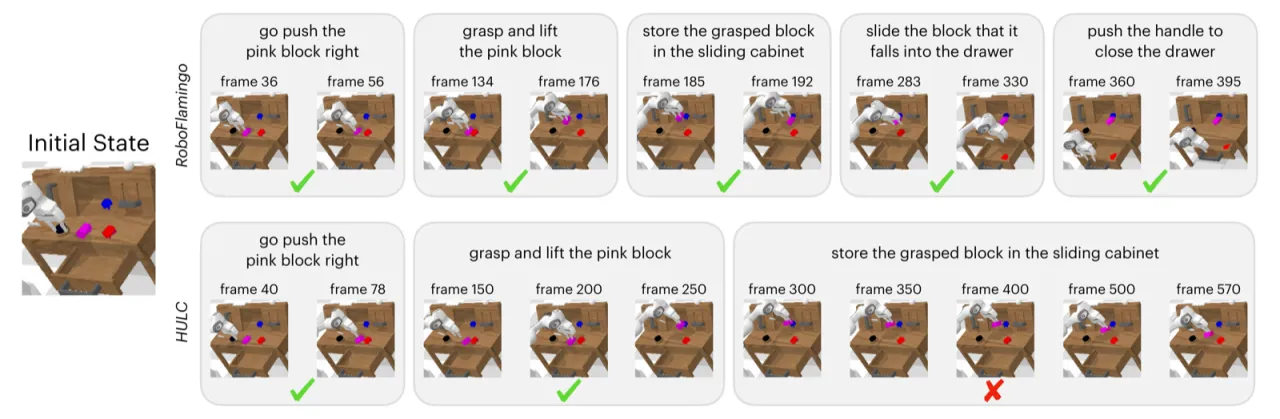
RoboFlamingo 在开源视觉-语言模型 OpenFlamingo 之上,通过解耦感知与决策、添加轻量 policy head,仅用语言标注的机器人演示数据进行模仿学习微调,便在 CALVIN 长视野操作基准上以 Avg Len 4.09 的成绩大幅超越此前最优方法(HULC,3.06),同时支持单卡 GPU 训练与推理。Built on the open-source vision-language model OpenFlamingo, RoboFlamingo decouples perception from decision-making, adds a lightweight policy head, and fine-tunes by imitation learning on language-annotated robot demonstrations alone; on the CALVIN long-horizon manipulation benchmark it reaches Avg Len 4.09, far surpassing the previous best method (HULC, 3.06), while supporting training and inference on a single GPU.
视觉-语言大模型(VLM)已展现出强大的多模态理解能力,但将其直接用于机器人低层控制仍面临三大挑战:① VLM 在静态图像-文本对上预训练,难以处理视频时序观测;② VLM 输出语言 token,而机器人需要连续动作信号;③ 现有高性能方案(如 RT-2)依赖私有模型与海量数据,无法被普通研究者复用。本文提出 RoboFlamingo,探索一种低成本、开源、可单卡运行的 VLM 机器人操作方案。Vision-language models (VLMs) have shown strong multimodal understanding, yet applying them directly to low-level robot control still faces three challenges: (i) VLMs are pre-trained on static image-text pairs and struggle with temporal video observations; (ii) VLMs emit language tokens, whereas robots require continuous action signals; (iii) existing high-performance solutions (e.g. RT-2) rely on proprietary models and massive data, and cannot be reused by ordinary researchers. This paper proposes RoboFlamingo, exploring a low-cost, open-source, single-GPU VLM solution for robot manipulation.
"We seek a straightforward way of making use of existing vision-language models (VLMs) with simple fine-tuning on robotics data. ... RoboFlamingo can be an effective and competitive alternative to adapt VLMs to robot control."
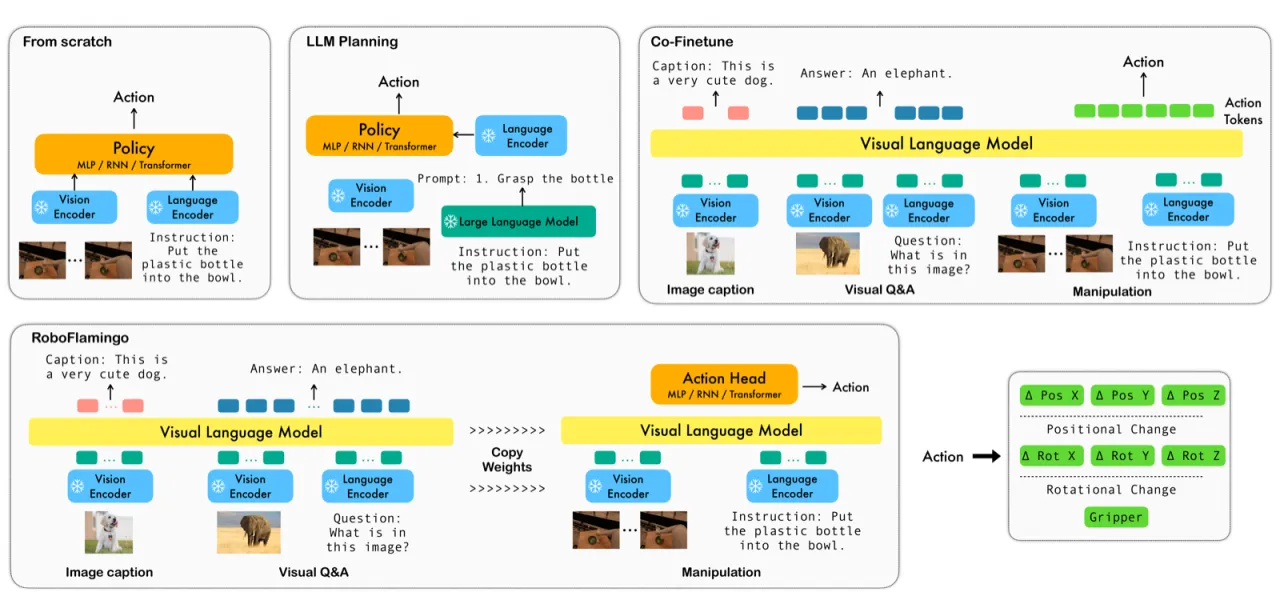
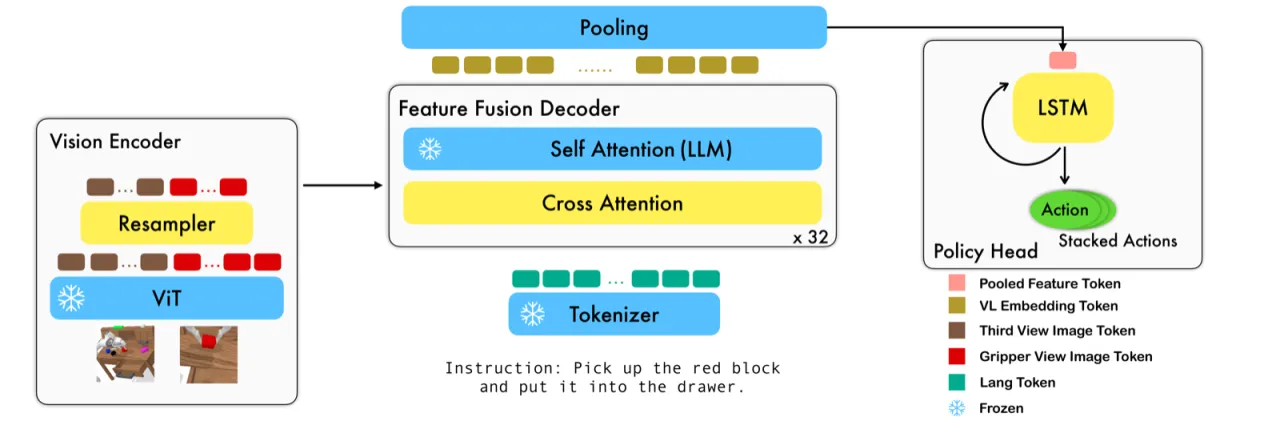
RoboFlamingo 的核心设计是感知与决策解耦:以 OpenFlamingo 作为视觉-语言主干(perception),负责在每一决策步对当前图像观测与语言指令进行单步理解;再附加一个轻量 policy head(decision-making),对历史特征进行建模并输出机器人动作。整个框架仅微调 resampler、gated cross-attention 模块与 policy head,其余参数冻结。The core design of RoboFlamingo is decoupling perception from decision-making: OpenFlamingo serves as the vision-language backbone (perception), performing single-step understanding of the current image observation and the language instruction at every decision step; a lightweight policy head (decision-making) is then attached to model historical features and output robot actions. The whole framework fine-tunes only the resampler, the gated cross-attention modules and the policy head, keeping all remaining parameters frozen.
视觉编码器由 ViT 和 perceiver resampler 组成:ViT 将双视角图像编码为视觉 token 序列,resampler 通过可学习查询向量将 token 数从 N 压缩到 Nr,大幅降低后续计算量。特征融合解码器含 L 层交叉注意力(cross-attention)层与冻结 LLM(LLaMA / GPT-Neox / MPT)层:LLM 层参数全程冻结,仅微调 cross-attention 与 resampler 参数。每层解码器输出为视觉-语言联合嵌入,通过带可学习门控参数 α 的 gated cross-attention 控制视觉信息混入比例,保证训练稳定性。The vision encoder consists of a ViT and a perceiver resampler: the ViT encodes the dual-view images into a sequence of visual tokens, and the resampler compresses the token count from N to Nr with learnable query vectors, greatly reducing downstream computation. The feature-fusion decoder contains L cross-attention layers and frozen LLM (LLaMA / GPT-Neox / MPT) layers: the LLM parameters stay frozen throughout, and only the cross-attention and resampler parameters are fine-tuned. Each decoder layer outputs a joint vision-language embedding, and a gated cross-attention with a learnable gating parameter α controls how much visual information is mixed in, ensuring training stability.
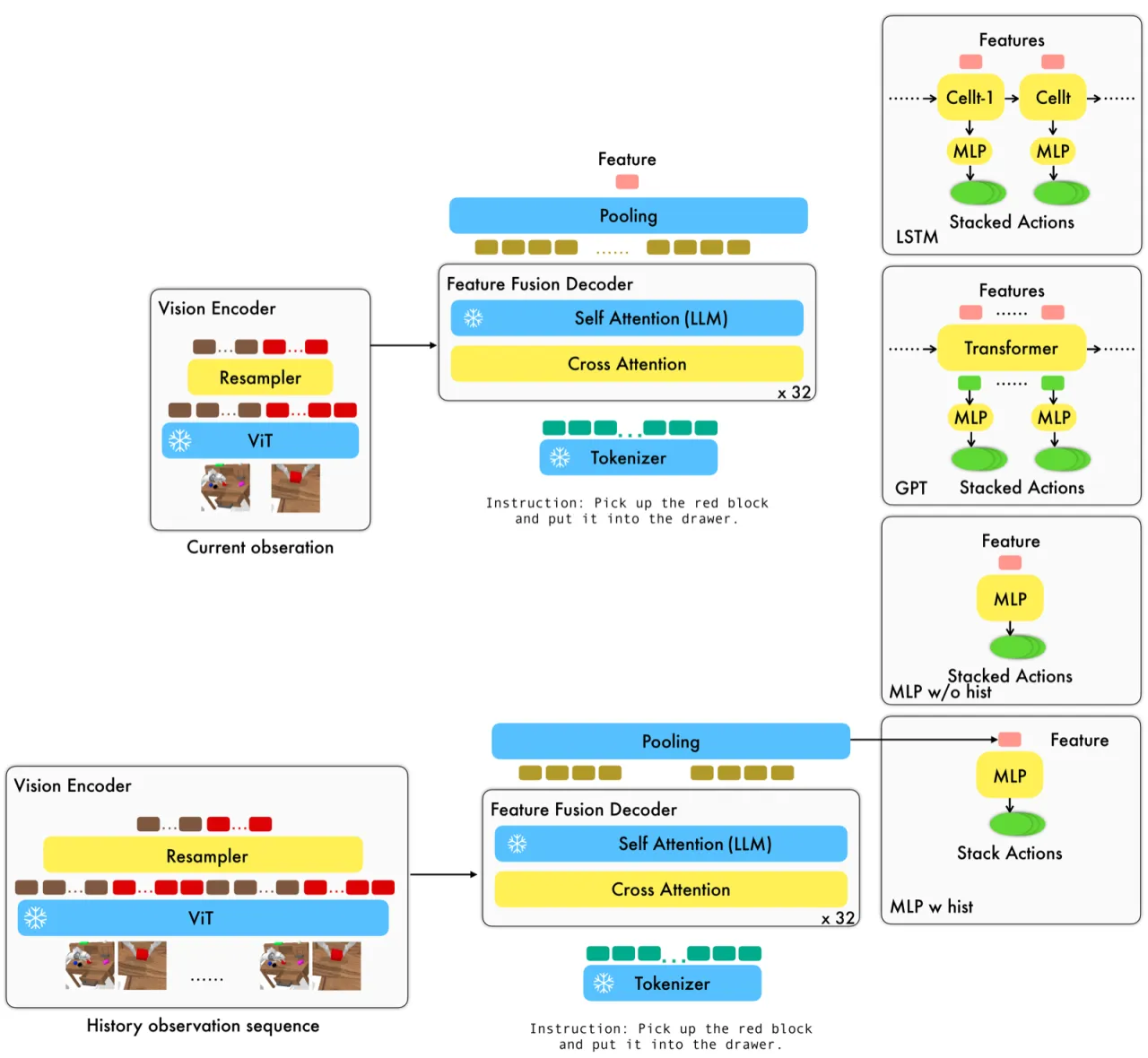
论文测试了四种 policy head 变体:MLP w/o hist(仅当前帧)、MLP w hist(将历史帧送入视觉编码器)、GPT(显式 token 序列)和 LSTM(隐式记忆)。消融实验表明 GPT 与 LSTM 性能相近,最终选择 LSTM 作为默认配置(简洁高效)。以 LSTM 为例,policy head 对 XtL 进行 max-pooling 聚合后输入 LSTM,并通过 MLP 分别预测末端位姿增量(MSE 损失回归)与夹爪状态(BCE 分类损失)。The paper tests four policy head variants: MLP w/o hist (current frame only), MLP w hist (history frames fed into the vision encoder), GPT (explicit token sequence) and LSTM (implicit memory). Ablations show that GPT and LSTM perform comparably, so LSTM is chosen as the default configuration for its simplicity and efficiency. Taking LSTM as an example, the policy head aggregates XtL by max-pooling before feeding it into the LSTM, and uses MLPs to predict the end-effector pose delta (regression with an MSE loss) and the gripper state (BCE classification loss) separately.
实验基准为 CALVIN(Composing Actions from Language and Vision):包含 34 个操作任务,评估 1000 条指令链,每条链要求机器人连续完成最多 5 步语言指令,仅当前任务成功才进入下一步。训练数据为带语言标注的演示(仅 Lang 分割,约 1% 全量数据)。主要对比基线:MCIL、HULC、RT-1。The benchmark is CALVIN (Composing Actions from Language and Vision): 34 manipulation tasks evaluated over 1000 instruction chains, where each chain requires the robot to complete up to 5 language instructions in a row and only advances when the current task succeeds. Training data are the language-annotated demonstrations (the Lang split only, about 1% of the full data). The main baselines are MCIL, HULC and RT-1.
| 方法Method | 训练数据Training Data | 步骤1Step 1 | 步骤2Step 2 | 步骤3Step 3 | 步骤4Step 4 | 步骤5Step 5 | Avg Len |
|---|---|---|---|---|---|---|---|
| MCIL | ABCD (Full) | 0.373 | 0.027 | 0.002 | 0.000 | 0.000 | 0.40 |
| HULC | ABCD (Full) | 0.889 | 0.733 | 0.587 | 0.475 | 0.383 | 3.06 |
| HULC | ABCD (Lang) | 0.892 | 0.701 | 0.548 | 0.420 | 0.335 | 2.90 |
| RT-1 | ABCD (Lang) | 0.844 | 0.617 | 0.438 | 0.323 | 0.227 | 2.45 |
| RoboFlamingo (Ours) | ABCD (Lang) | 0.964 | 0.896 | 0.824 | 0.740 | 0.660 | 4.09 |
| 方法Method | 训练数据Training Data | 步骤1Step 1 | 步骤2Step 2 | 步骤3Step 3 | 步骤4Step 4 | 步骤5Step 5 | Avg Len |
|---|---|---|---|---|---|---|---|
| HULC | ABC (Full) | 0.418 | 0.165 | 0.057 | 0.019 | 0.011 | 0.67 |
| RT-1 | ABC (Lang) | 0.533 | 0.222 | 0.094 | 0.038 | 0.013 | 0.90 |
| RoboFlamingo (Ours) | ABC (Lang) | 0.824 | 0.619 | 0.466 | 0.331 | 0.235 | 2.48 |
| Backbone | LLM 架构LLM Architecture | 总参数Total Params | 指令微调Instruction Tuning | COCO CIDEr (4-shot) | VQAv2 Acc (4-shot) | Best Avg Len | Mean Avg Len |
|---|---|---|---|---|---|---|---|
| M-3B | MPT | 3B | 否No | 77.3 | 45.8 | 3.94 | 3.81 |
| M-3B-IFT | MPT | 3B | 是Yes | 82.7 | 45.7 | 4.09 | 4.02 |
| G-4B | GPT-Neox | 4B | 否No | 81.8 | 49.0 | 3.67 | 3.53 |
| G-4B-IFT | GPT-Neox | 4B | 是Yes | 85.8 | 49.0 | 3.79 | 3.72 |
| L-9B | LLaMA | 9B | 否No | 74.3 | 44.0 | 2.79 | 2.71 |
| M-9B | MPT | 9B | 否No | 89.0 | 54.8 | 3.97 | 3.87 |
消融实验主要揭示以下结论:The ablations mainly reveal the following conclusions:
"Due to the lack of real-robot data, this paper does not deploy on real-world robotics." 所有实验均在 CALVIN 仿真环境中进行。作者也指出,近期大规模真实机器人数据(如 Open X-Embodiment)的出现有望解决这一问题。"Due to the lack of real-robot data, this paper does not deploy on real-world robotics." All experiments are conducted in the CALVIN simulation environment. The authors also note that the recent arrival of large-scale real-robot data (such as Open X-Embodiment) is likely to resolve this issue.
实验显示,在 enriched instructions(同义替换)设置下,RoboFlamingo 后续任务成功率的相对下降比 HULC 更明显。论文推断这是因为 RoboFlamingo 直接以 word token 作为输入,对同义表述更敏感;冻结 embedding 层(freeze-emb)可部分缓解,但整体语言泛化与未微调的 VLM 相比仍有差距。Experiments show that under the enriched instructions (synonym substitution) setting, the relative drop in RoboFlamingo's success rate on later tasks is more pronounced than for HULC. The paper infers that this is because RoboFlamingo takes word tokens directly as input and is therefore more sensitive to synonymous phrasings; freezing the embedding layer (freeze-emb) partially mitigates it, but overall language generalization still lags behind an un-fine-tuned VLM.
直接对已训练模型执行 open-loop control(预测动作序列而不每步重新推理)会导致性能明显下降;需要用跳步演示数据(jump step demonstration)重新训练才能恢复性能,增加了部署灵活性的使用门槛。Running open-loop control directly on a trained model (predicting action sequences instead of re-inferring at every step) causes a clear performance drop; recovering performance requires retraining with jump step demonstration data, which raises the barrier to using this deployment flexibility.