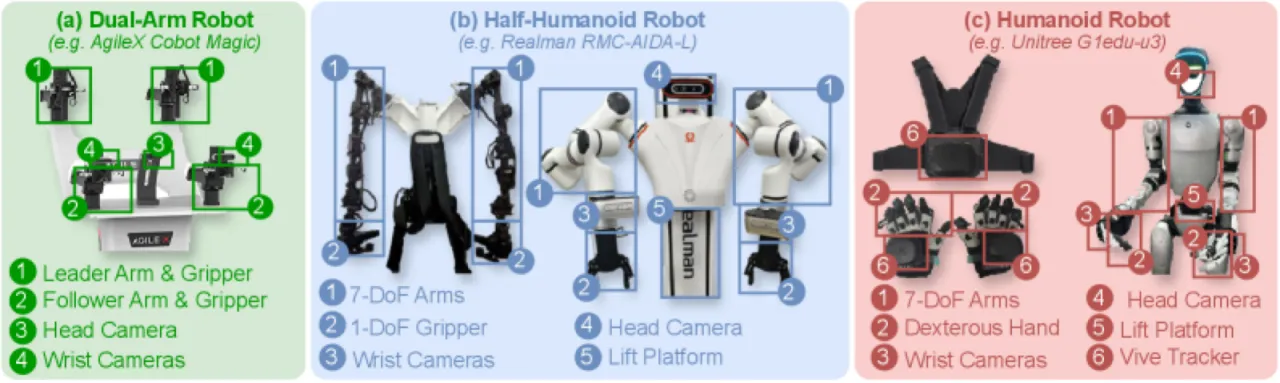
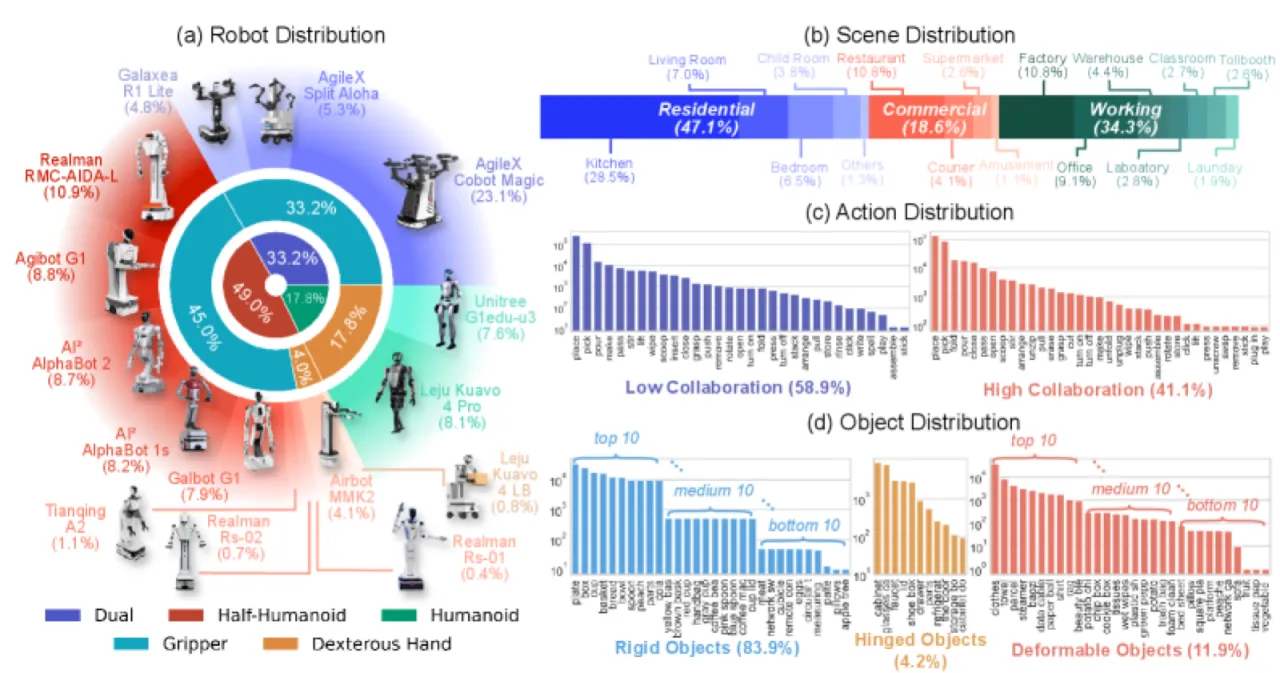
RoboCOIN 是首个覆盖 15 种机器人平台、收录超过 18 万条人类遥操作示教的开源大规模双臂操作数据集。配套分层标注体系(Capability Pyramid)与 RTML 质量过滤框架,在 RoboTwin 2.0 仿真基准及真实机器人上均取得显著性能提升。RoboCOIN is the first open-sourced large-scale bimanual manipulation dataset covering 15 robot platforms and collecting more than 180000 human teleoperated demonstrations. It ships with a hierarchical annotation scheme (Capability Pyramid) and the RTML quality-filtering framework, and yields significant performance gains on both the RoboTwin 2.0 simulation benchmark and real robots.
双臂协作操作(bimanual manipulation)是机器人迈向通用操作能力的关键一步,却面临严重的数据瓶颈:现有数据集大多针对单一机器人平台、任务类型单一、缺乏高质量标注,且规模远不足以支撑大模型预训练。Bimanual manipulation is a key step toward general-purpose robotic manipulation, yet it faces a severe data bottleneck: existing datasets mostly target a single robot platform, cover a single task type, lack high-quality annotation, and are far too small to support large-model pre-training.
"Existing datasets are often limited in scale, diversity, or quality, failing to capture the breadth of bimanual manipulation tasks required for general robot learning."
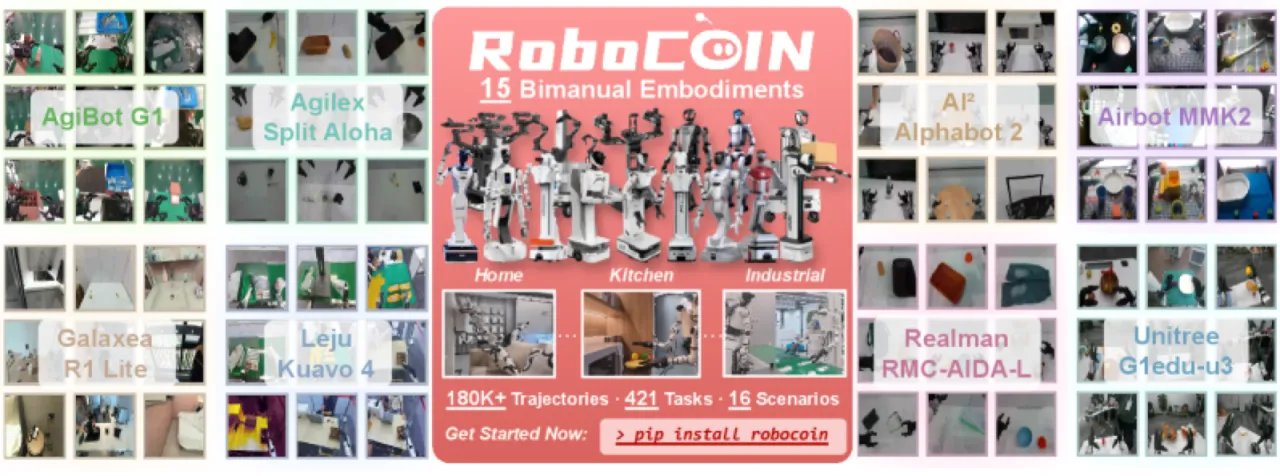
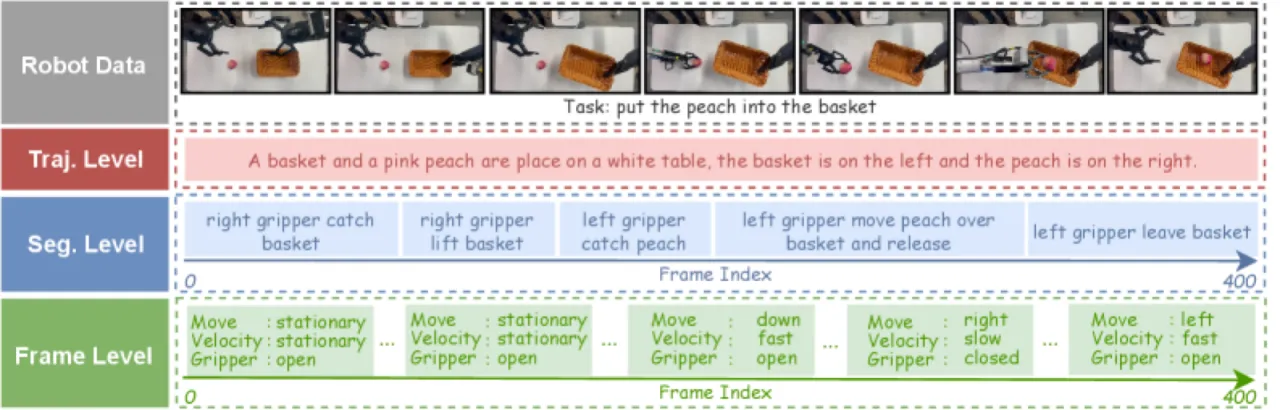
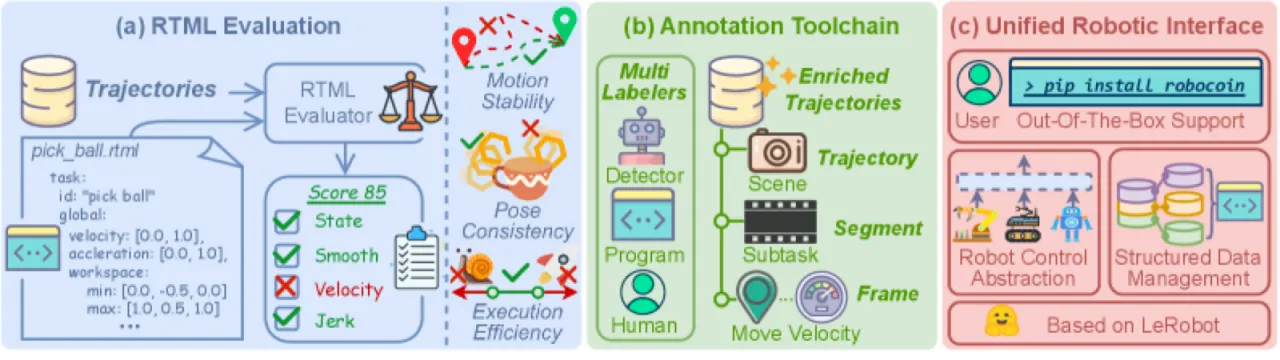
RoboCOIN 由三部分构成:大规模多平台双臂数据集本身、层级能力金字塔(Capability Pyramid)标注体系,以及 CoRobot 数据处理管线——其核心是机器人轨迹标记语言(Robot Trajectory Markup Language, RTML),用于自动化质量验证与过滤。RoboCOIN consists of three parts: the large-scale multi-platform bimanual dataset itself, the hierarchical Capability Pyramid annotation scheme, and the CoRobot data processing pipeline, whose core is the Robot Trajectory Markup Language (RTML) for automated quality verification and filtering.
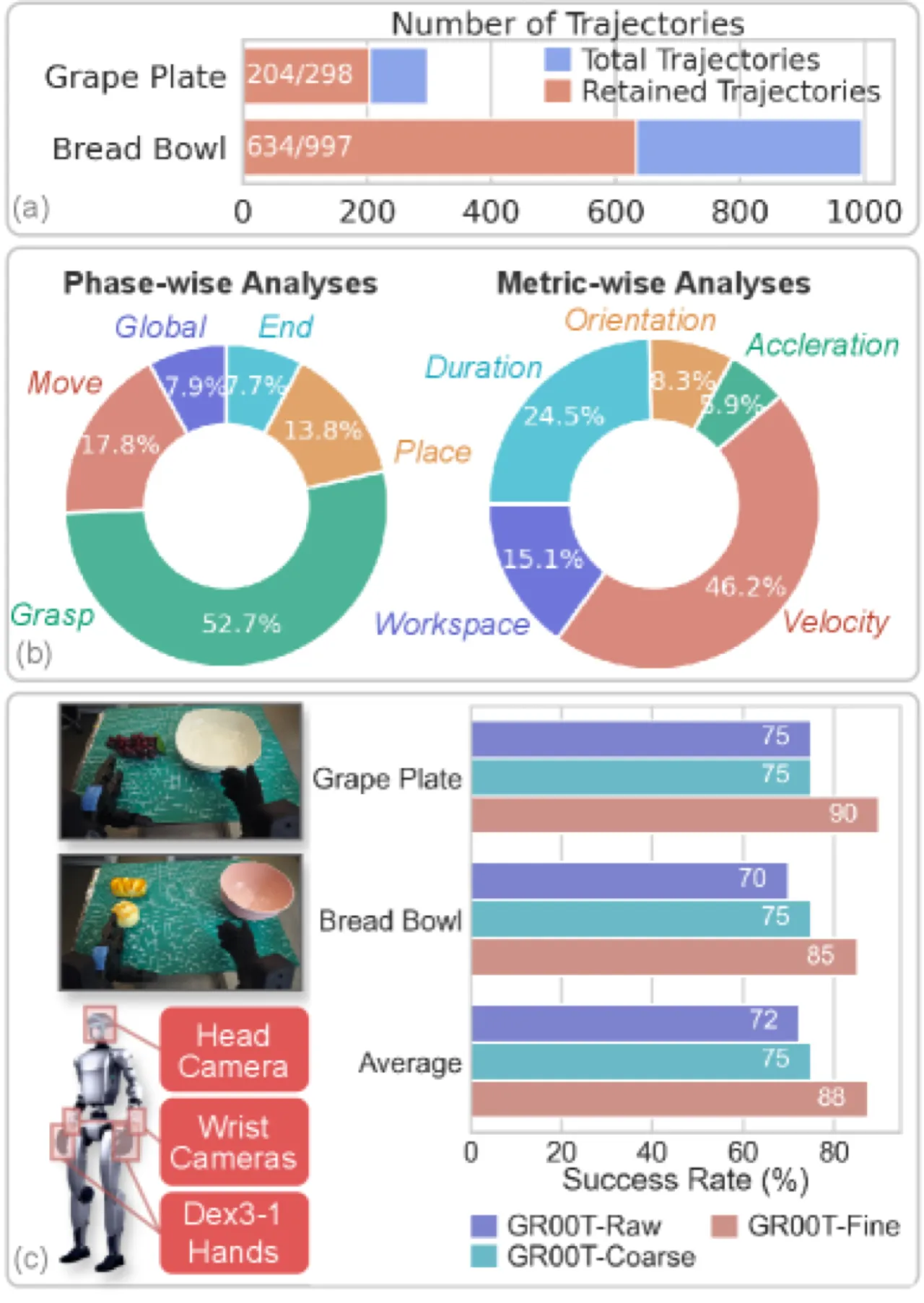
RTML 以 YAML 格式定义两类约束,对每条轨迹进行自动化验证:RTML defines two classes of constraints in YAML format and validates every trajectory automatically:
39 种双臂协作动作归为两大类:The 39 bimanual collaborative actions fall into two major categories:
动作按功能分为四类:通用操作(General Manipulation)10 种、对象状态改变(Object State Change)9 种、对象关系改变(Object Relation Change)9 种、任务特定动作(Task-Specific)11 种。By function the actions fall into four groups: General Manipulation (10), Object State Change (9), Object Relation Change (9), and Task-Specific (11).
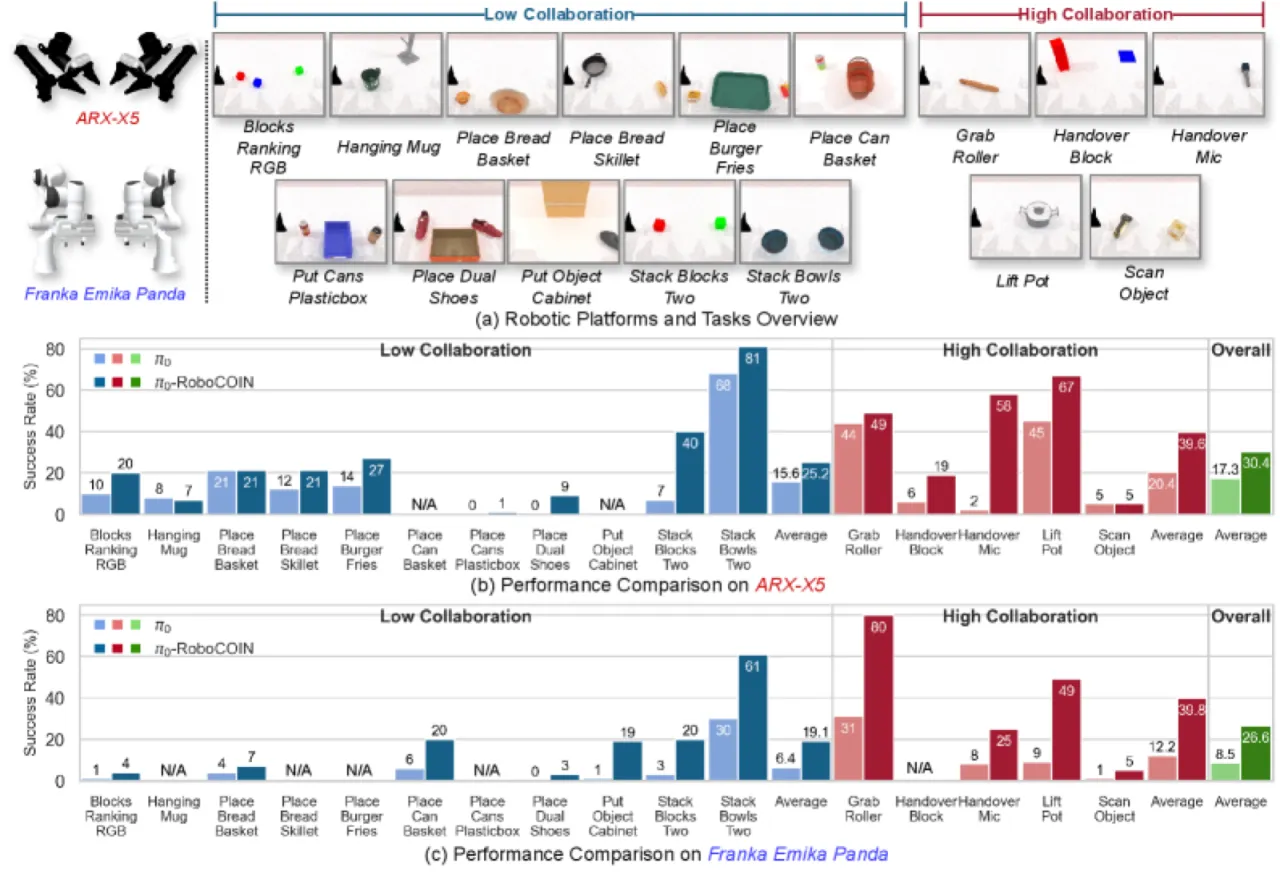
实验在三类场景下验证 RoboCOIN 的价值:(1)RoboTwin 2.0 仿真基准上的跨本体策略迁移,(2)Realman RMC-AIDA-L 真实机器人上的分层标注收益,(3)Unitree G1edu-u3 上的 RTML 数据质量过滤效果。基准策略均为 π₀ 或 GR00T N1.5。Experiments validate the value of RoboCOIN in three settings: (1) cross-embodiment policy transfer on the RoboTwin 2.0 simulation benchmark, (2) the benefit of hierarchical annotation on the Realman RMC-AIDA-L real robot, and (3) the effect of RTML data quality filtering on Unitree G1edu-u3. The baseline policies are π₀ and GR00T N1.5.
| 平台 / PlatformPlatform | 基线(π₀)Baseline (π₀) | +RoboCOIN(π₀-RoboCOIN)+RoboCOIN (π₀-RoboCOIN) | 相对提升Relative gain |
|---|---|---|---|
| ARX-X5(全部任务)ARX-X5 (all tasks) | 17.3% | 30.4% | +75.7% |
| ARX-X5(高协作任务)ARX-X5 (high-collaboration tasks) | — | — | +94.1% |
| Franka Emika Panda(全部任务)Franka Emika Panda (all tasks) | 8.5% | 26.6% | +212.9% |
| 测试条件Test condition | 基线(无 Pyramid)Baseline (no Pyramid) | +Capability Pyramid | 相对提升Relative gain |
|---|---|---|---|
| 分布内(In-distribution)In-distribution | 28% | 43% | +53.6% |
| 分布外(Out-of-distribution)Out-of-distribution | 22.5% | 57.5% | +155.6% |
| OOD 性能下降幅度OOD performance drop | -43.8% | -17.9% | 鲁棒性显著提升Robustness clearly improved |
| 数据设置Data setting | 任务成功率(相对原始数据)Task success rate (relative to raw data) |
|---|---|
| 原始数据(Raw data)Raw data | 基准baseline |
| RTML 过滤后After RTML filtering | 提升(移除 35.3% 低质量轨迹)improved (35.3% of low-quality trajectories removed) |
| GR00T-Fine(相位级约束)GR00T-Fine (phase-level constraints) | +22.2% |
消融结果表明:(1)Capability Pyramid 的三级标注均有独立贡献,去掉任一层级均会导致性能下降;(2)RTML 过滤对 OOD 泛化的帮助尤为明显,说明数据质量比数据数量更重要;(3)跨平台预训练(cross-embodiment pre-training)的收益在高协作任务上更为突出,表明复杂协调动作更依赖大规模先验。The ablations show that: (1) all three levels of the Capability Pyramid contribute independently, and removing any level degrades performance; (2) RTML filtering is especially helpful for OOD generalization, indicating that data quality matters more than data quantity; (3) the gains of cross-embodiment pre-training are more pronounced on high-collaboration tasks, suggesting that complex coordinated actions rely more heavily on large-scale priors.
作者指出:"Reliance on teleoperation may introduce inherent operator biases, leading to inter-operator variability in trajectory patterns." 不同操作员风格各异,导致同一任务的示教轨迹之间存在较大方差,可能影响策略学习的稳定性与泛化能力。The authors note: "Reliance on teleoperation may introduce inherent operator biases, leading to inter-operator variability in trajectory patterns." Operator styles differ, so demonstrations of the same task vary considerably, which may affect the stability and generalization of policy learning.
"Manual annotation presents a scalability bottleneck due to its high labor costs and potential for subjectivity, which may impact data consistency." 尽管采用了半自动标注管线,人工精修环节仍然是扩展数据规模的主要瓶颈,且主观性难以完全消除。"Manual annotation presents a scalability bottleneck due to its high labor costs and potential for subjectivity, which may impact data consistency." Although a semi-automatic annotation pipeline is used, manual refinement remains the main bottleneck for scaling up the data, and subjectivity cannot be fully eliminated.
"The current RTML framework depends heavily on expert-defined heuristics, potentially constraining its flexibility when applied to niche tasks or novel robotic platforms." RTML 的约束规则由专家手工设计,对新型机器人平台或非常规任务的适用性有限,需要额外的专家介入来定义新规则。"The current RTML framework depends heavily on expert-defined heuristics, potentially constraining its flexibility when applied to niche tasks or novel robotic platforms." The RTML constraint rules are hand-crafted by experts, so their applicability to novel robot platforms or unconventional tasks is limited and additional expert effort is needed to define new rules.