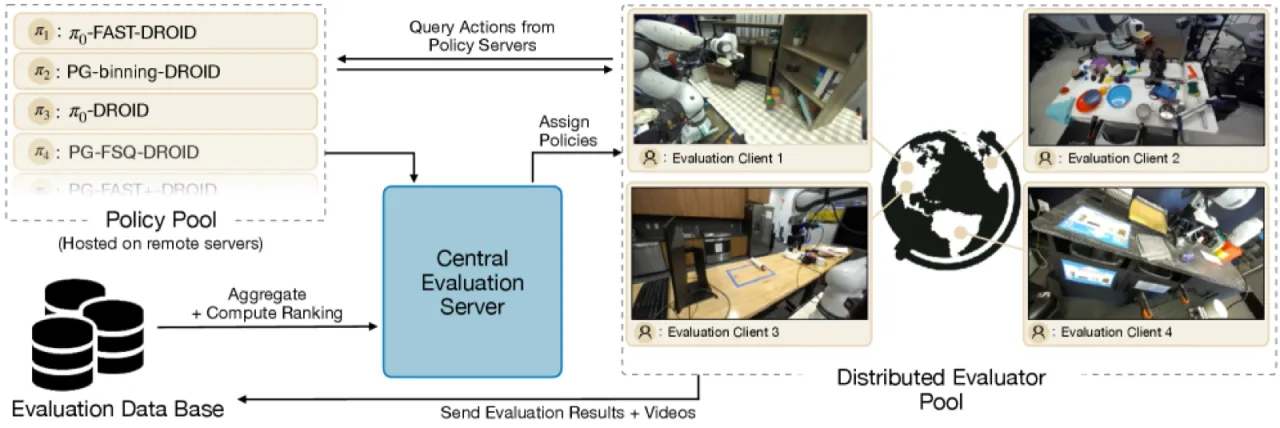
RoboArena 借鉴语言模型评测中的 Chatbot Arena 思路,通过分布式、双盲的成对策略比较,在真实机器人上对通用策略进行可扩展评估。跨越七个机构超过 600 次成对真实机器人评测,RoboArena 的排名结果比传统集中式评测方法更准确地反映策略的真实能力。Drawing on the Chatbot Arena paradigm used for language model evaluation, RoboArena performs scalable evaluation of generalist policies on real robots through distributed, double-blind pairwise policy comparisons. Across more than 600 pairwise real-robot evaluations spanning seven institutions, the RoboArena ranking reflects the true capability of policies more accurately than conventional centralized evaluation protocols.
现有机器人评测范式要求对任务和环境进行严格标准化,难以全面衡量具备广泛能力的通用机器人策略。随着机器人策略越来越"通用",标准化评测反而成为瓶颈——任务覆盖窄、场景固定、无法反映真实部署多样性。Existing robot evaluation paradigms demand strict standardization of tasks and environments, which makes it hard to comprehensively measure generalist robot policies with broad capabilities. As robot policies become ever more "general", standardized evaluation turns into the bottleneck instead: narrow task coverage, fixed scenes, and an inability to reflect the diversity of real deployment.
"Tightly standardized sets of environments and tasks are not well-suited to provide comprehensive performance evaluations for policies designed for broad capability."
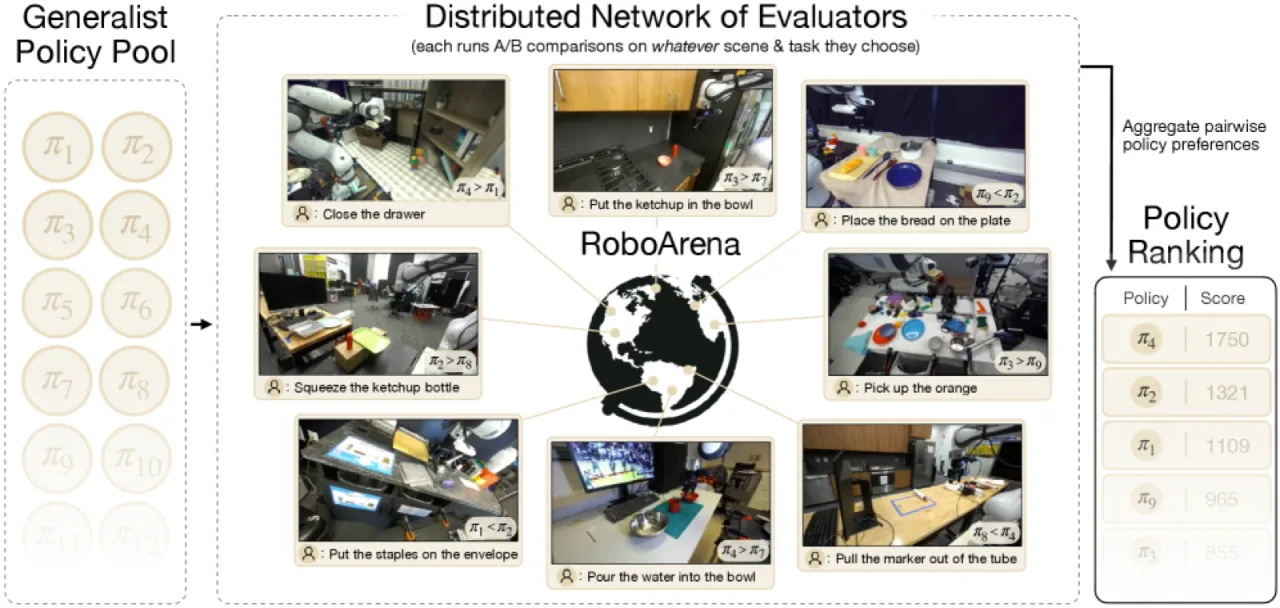
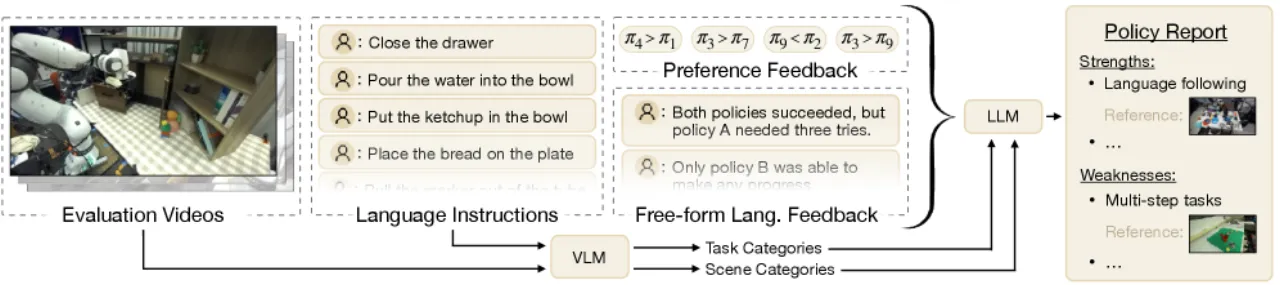
RoboArena 将评测分为三个核心模块:分布式评测协议(双盲成对实验)、任务感知排名算法(扩展 Bradley-Terry 模型)、定性分析流水线(VLM + LLM 自动生成策略特征报告)。RoboArena decomposes evaluation into three core modules: a distributed evaluation protocol (double-blind pairwise experiments), a task-aware ranking algorithm (an extended Bradley-Terry model), and a qualitative analysis pipeline (VLM + LLM automatically generating policy characterization reports).
评测者在自选的场景和任务中对两个匿名策略(πA 和 πB)依次执行 rollout,双盲设计防止评测者对特定策略产生偏见。反馈包含三个维度:连续进度分、二元偏好以及自由文本说明,三种信号相互印证,提升排名可靠性。In scenes and tasks of their own choosing, evaluators execute rollouts of two anonymized policies (πA and πB) in turn; the double-blind design keeps evaluators from developing a bias toward a particular policy. Feedback covers three dimensions: a continuous progress score, a binary preference, and a free-form explanation. The three signals corroborate one another and improve the reliability of the ranking.
标准 Bradley-Terry 模型仅建模策略绝对能力,忽略任务难度差异。RoboArena 引入三类参数:策略对数能力 θ、任务难度 τ、以及策略-任务偏置 ψ,将胜出概率建模为:The standard Bradley-Terry model captures only the absolute capability of a policy and ignores differences in task difficulty. RoboArena introduces three kinds of parameters: policy log-capability θ, task difficulty τ, and a policy-task bias ψ, and models the winning probability as:
"p(πA > πB) = ∑t=1T νt · σ(θA + ψAt − τt) · (1 − σ(θB + ψBt − τt))"
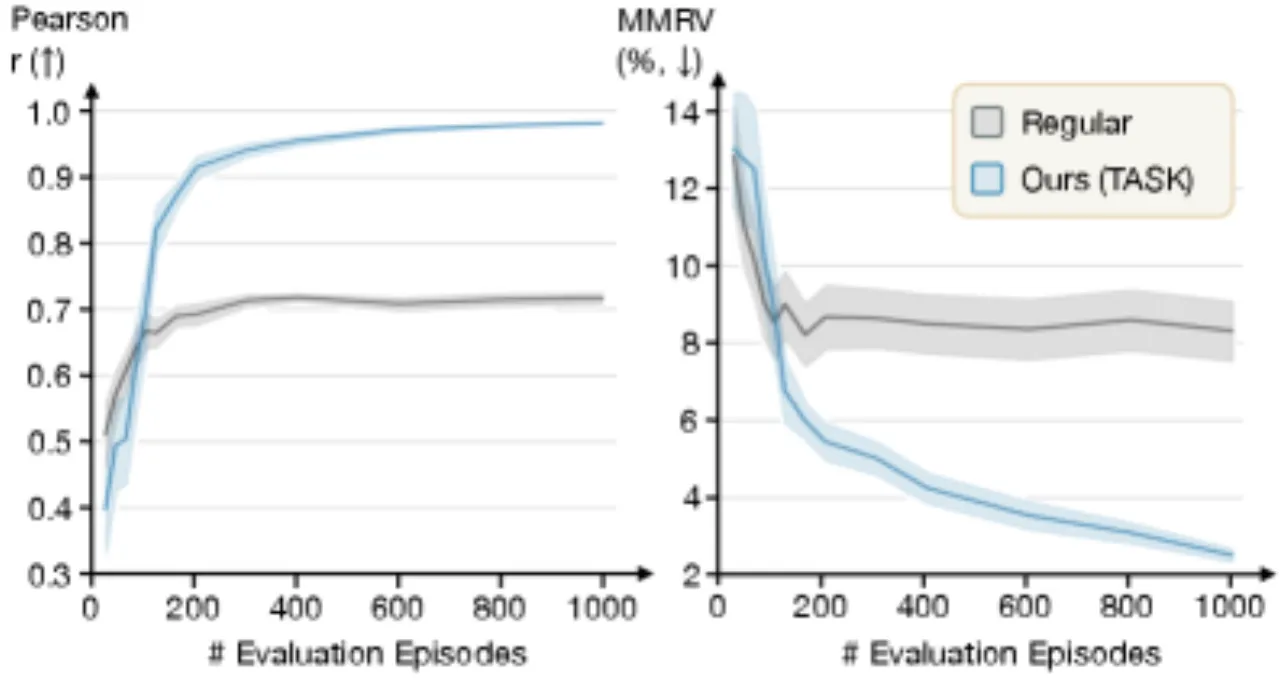
参数通过近似最大似然期望最大化(approximate maximum likelihood expectation-maximization, EM)算法拟合,能够在样本稀疏时显著提升排名质量。The parameters are fit with an approximate maximum likelihood expectation-maximization (EM) algorithm, which substantially improves ranking quality when samples are sparse.
本次评测以 DROID 平台(Franka 机械臂 + Robotiq 夹爪 + 双目相机)为基础,评测七个通用策略变体,涵盖 π0-flow、π0-FAST、PG-flow、PG-FAST、PG-FAST+、PG-FSQ、PG-Bin,系统性覆盖了不同 action tokenization 和 flow matching 配置。This evaluation is built on the DROID platform (a Franka arm + a Robotiq gripper + a stereo camera) and assesses seven generalist policy variants, covering π0-flow, π0-FAST, PG-flow, PG-FAST, PG-FAST+, PG-FSQ, and PG-Bin, so as to systematically span different action tokenization and flow matching configurations.
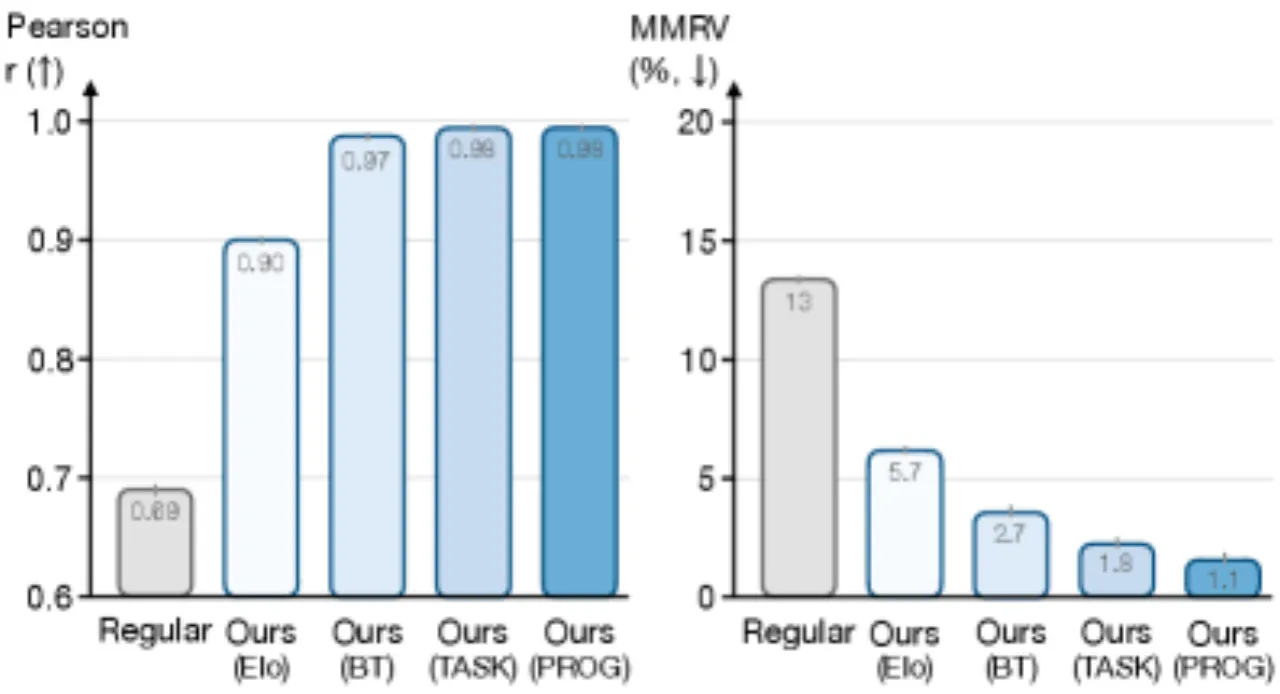
在七所机构收集共 4284 个 evaluation episodes,其中超过 600 个为成对双盲对比。将 Oracle 排名(由全量 episode 得出)作为参考标准,与传统集中式方法和多种排名算法对比。A total of 4284 evaluation episodes were collected at seven institutions, of which more than 600 are pairwise double-blind comparisons. The Oracle ranking, derived from the full set of episodes, serves as the reference standard for comparison against conventional centralized evaluation and a range of ranking algorithms.
| 排名方法Ranking method | 与 Oracle 相关性Correlation with Oracle | MMRV ↓ |
|---|---|---|
| 传统集中式评测(平均成功率)Conventional centralized evaluation (average success rate) | 较低Lower | 较高Higher |
| Elo 在线更新Elo online update | 中等Moderate | 中等Moderate |
| Bradley-Terry(标准)Bradley-Terry (standard) | 中等Moderate | 中等Moderate |
| RoboArena(任务感知 BT)RoboArena (task-aware BT) | 最高Highest | 最低Lowest |
对 LLM 自动生成的策略报告进行人工校验:对于报告中声称"π0-FAST-DROID 优于、持平或劣于其他策略"的大多数类别,这些结论均与评测数据中的实际胜率一致,证明了定性分析流水线的可靠性。The policy reports generated automatically by the LLM were verified manually: for most of the categories in which a report claims that "π0-FAST-DROID is better than, on par with, or worse than another policy", the conclusions agree with the actual win rates in the evaluation data, which attests to the reliability of the qualitative analysis pipeline.
实验对比了四种排名算法(Elo、标准 Bradley-Terry MLE、基于进度分的 PROG 排名、任务感知 Bradley-Terry),发现任务感知扩展在各指标上均优于其他变体;进度分排名(PROG)也有一定效果,但精细程度不及任务感知方法。The experiments compare four ranking algorithms (Elo, standard Bradley-Terry MLE, progress-score-based PROG ranking, and task-aware Bradley-Terry) and find that the task-aware extension outperforms the other variants on every metric; progress-score ranking (PROG) is also effective to a degree, but is less fine-grained than the task-aware method.
当前评测集中在 DROID 平台(Franka 机械臂),尚未覆盖跨体态通用策略。作者将跨平台扩展列为未来工作。The current evaluation is concentrated on the DROID platform (a Franka arm) and does not yet cover cross-embodiment generalist policies. The authors list cross-platform extension as future work.
去中心化设计使"单变量对照实验"变得困难——不同机构使用不同场景和任务,无法像集中式评测那样精确控制实验条件。The decentralized design makes "single-variable controlled experiments" difficult: different institutions use different scenes and tasks, so experimental conditions cannot be controlled as precisely as in centralized evaluation.
作者坦言"尚未研究该系统对故意对抗性评测者的鲁棒性(have not investigated its robustness to intentionally adversarial evaluators)",系统在恶意操纵下的表现有待进一步分析。The authors state frankly that they "have not investigated its robustness to intentionally adversarial evaluators"; how the system behaves under malicious manipulation awaits further analysis.
当评测指标本身成为优化目标时,它可能不再是真实能力的良好代理("a measure ceases to be a good measure when it becomes a target")。作者认为当前策略性能有限使得过度优化不太可能,但随着策略能力提升,这一风险会增大。Once an evaluation metric itself becomes an optimization target, it may cease to be a good proxy for true capability ("a measure ceases to be a good measure when it becomes a target"). The authors argue that the limited performance of current policies makes over-optimization unlikely, but the risk grows as policy capability improves.