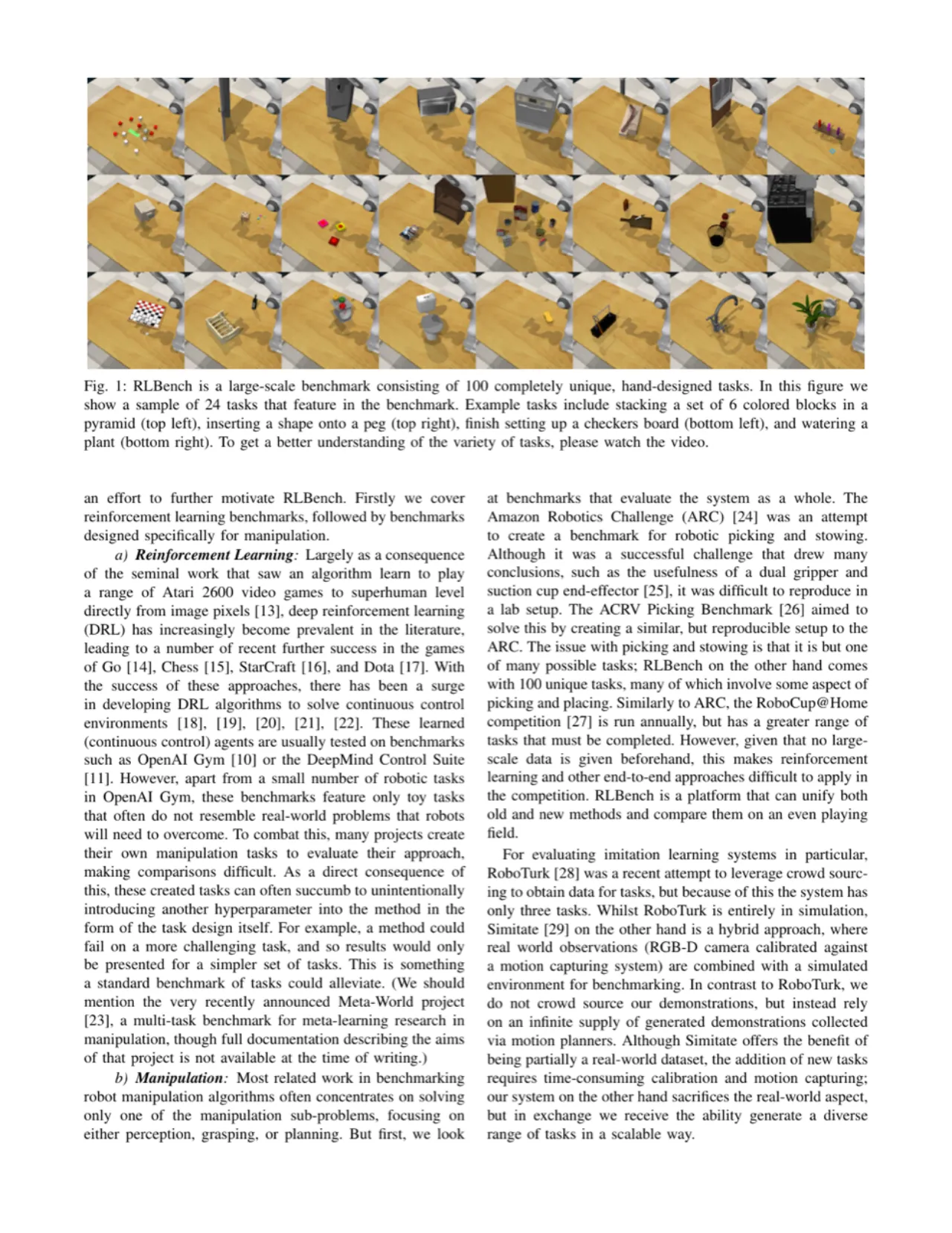
RLBench 是一个雄心勃勃的大规模机器人操作基准与学习环境,包含 100 个完全独特的手工设计任务, 难度从简单的抓取、到达,一直延伸到复杂的多步操作(如烹饪、清洁)。 平台内置运动规划器,可无限生成专家演示,同时提供 RGB、深度、分割掩码等多模态视觉观测, 旨在统一评估强化学习、模仿学习、多任务学习、视觉几何感知与小样本学习等多个研究方向。 RLBench is an ambitious large-scale robot manipulation benchmark and learning environment containing 100 completely unique, hand-designed tasks, ranging in difficulty from simple grasping and reaching all the way to complex multi-step manipulation (such as cooking and cleaning). The platform ships with a built-in motion planner that can generate an unlimited supply of expert demonstrations, and provides multi-modal visual observations including RGB, depth and segmentation masks. It aims to offer a unified evaluation setting for reinforcement learning, imitation learning, multi-task learning, geometric visual perception and few-shot learning.
机器人操作算法的研究面临严峻的评估碎片化问题:现有基准要么任务数量有限(如 RoboTurk 仅 3 个任务)、 要么缺乏视觉观测、要么演示数据极难获取。研究者往往各自定义私有评估集,导致方法间横向对比几乎不可能。 与此同时,小样本学习、多任务学习等新兴范式也缺乏专门的机器人操作测试平台。 Research on robot manipulation algorithms suffers from severe evaluation fragmentation: existing benchmarks either contain very few tasks (RoboTurk, for instance, offers only 3), lack visual observations, or make demonstration data extremely hard to obtain. Researchers therefore tend to define their own private evaluation sets, which makes cross-method comparison nearly impossible. At the same time, emerging paradigms such as few-shot learning and multi-task learning have no dedicated robot manipulation testbed.
"We present RLBench, an ambitious large-scale benchmark and learning environment designed to facilitate research in a number of areas, including: reinforcement learning, imitation learning, multi-task learning, geometric computer vision, and in particular, few-shot learning. We believe it is important to find the potential and limits of these methods in a controlled, reproducible environment."
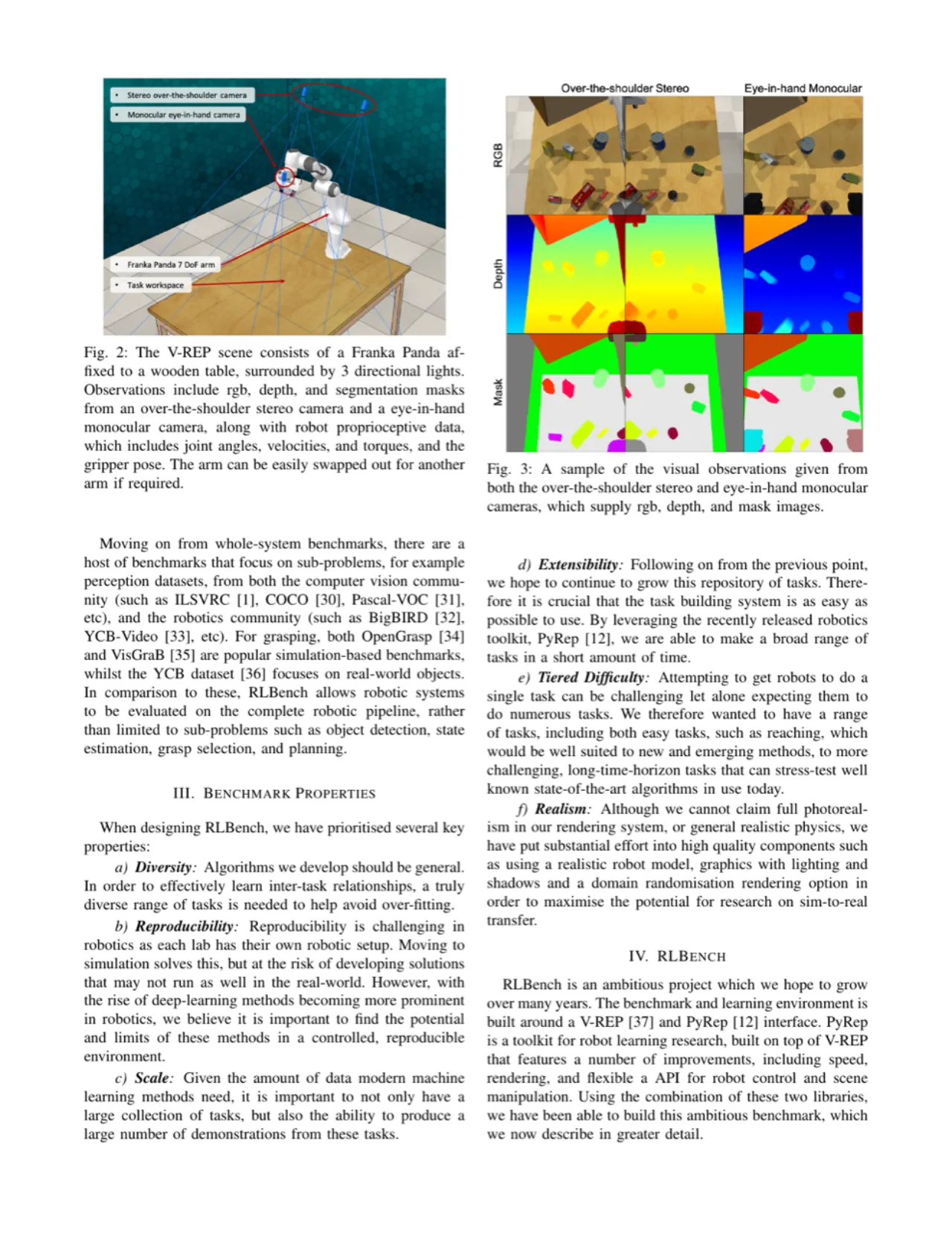
RLBench 以 V-REP 仿真器与 PyRep Python API 为基础,构建了统一的机器人操作基准平台。 Franka Panda 机械臂被固定在中央工作台上,配备两路视觉传感器,并通过运动规划器自动生成高质量专家演示。 整个系统围绕三个核心概念展开:Task(任务定义)、Variation(参数变体)、Episode(执行片段)。 Built on the V-REP simulator and the PyRep Python API, RLBench provides a unified robot manipulation benchmark platform. A Franka Panda arm is mounted at the centre of a workspace table, equipped with two visual sensors, and high-quality expert demonstrations are generated automatically by a motion planner. The whole system revolves around three core concepts: Task (the task definition), Variation (parameter variants) and Episode (an execution rollout).
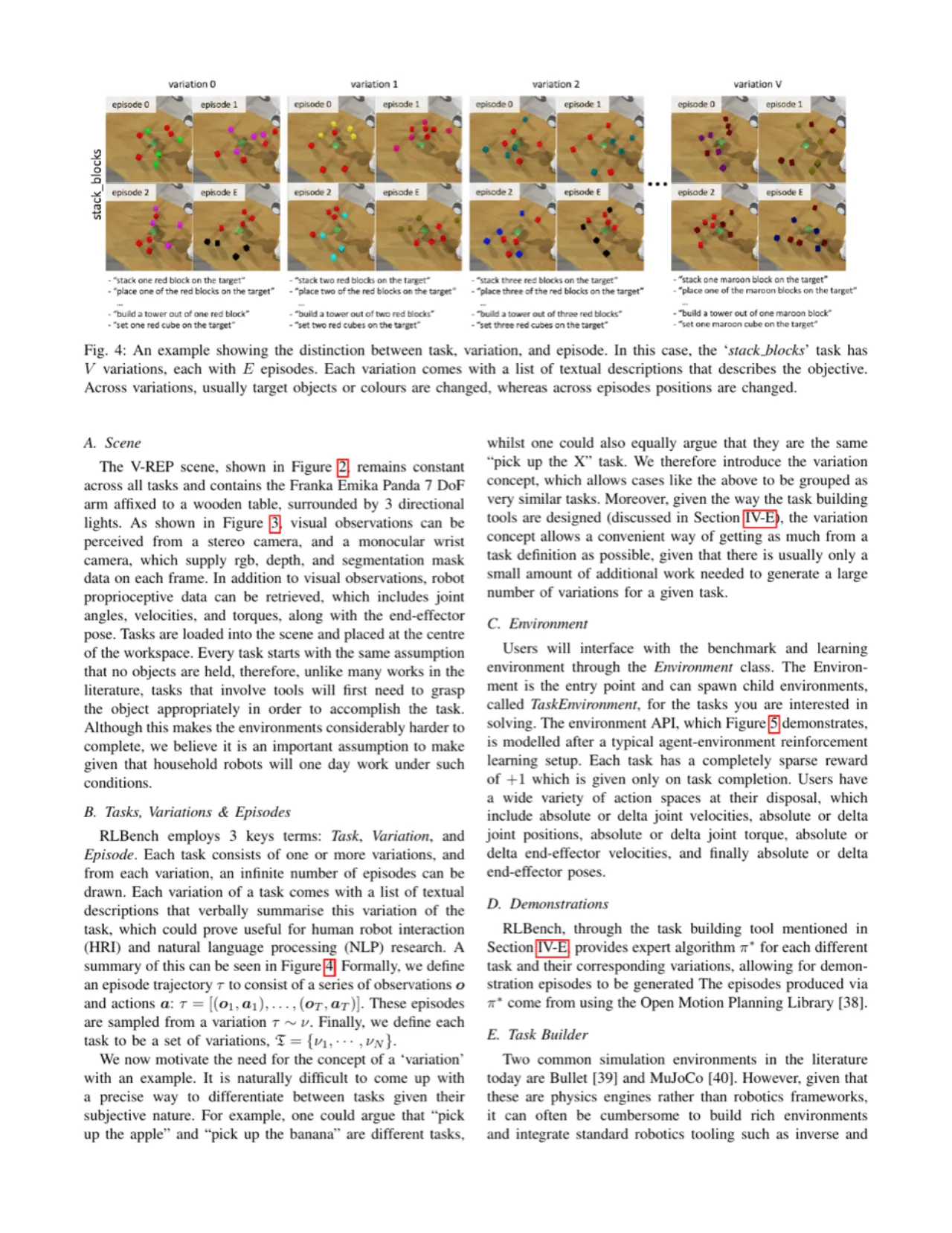
V-REP 场景包含 Franka Panda 机械臂,固定于工作台中央。视觉观测来自两路摄像头: over-the-shoulder stereo camera(俯视立体摄像头,提供全局视角) 和 eye-in-hand monocular camera(手眼摄像头,提供局部精细视角)。 每帧观测可包含 RGB 图像、深度图、分割掩码,并附带本体感知数据(joint angles、velocities、torques、 gripper pose、end-effector pose)。机械臂末端执行器可快速替换,适配不同抓取需求。 The V-REP scene contains a Franka Panda arm fixed at the centre of the table. Visual observations come from two cameras: an over-the-shoulder stereo camera (a global viewpoint) and an eye-in-hand monocular camera (a close-up, fine-grained viewpoint). Each observation may include an RGB image, a depth map and a segmentation mask, together with proprioceptive data (joint angles, velocities, torques, gripper pose, end-effector pose). The end effector can be swapped quickly to accommodate different grasping requirements.
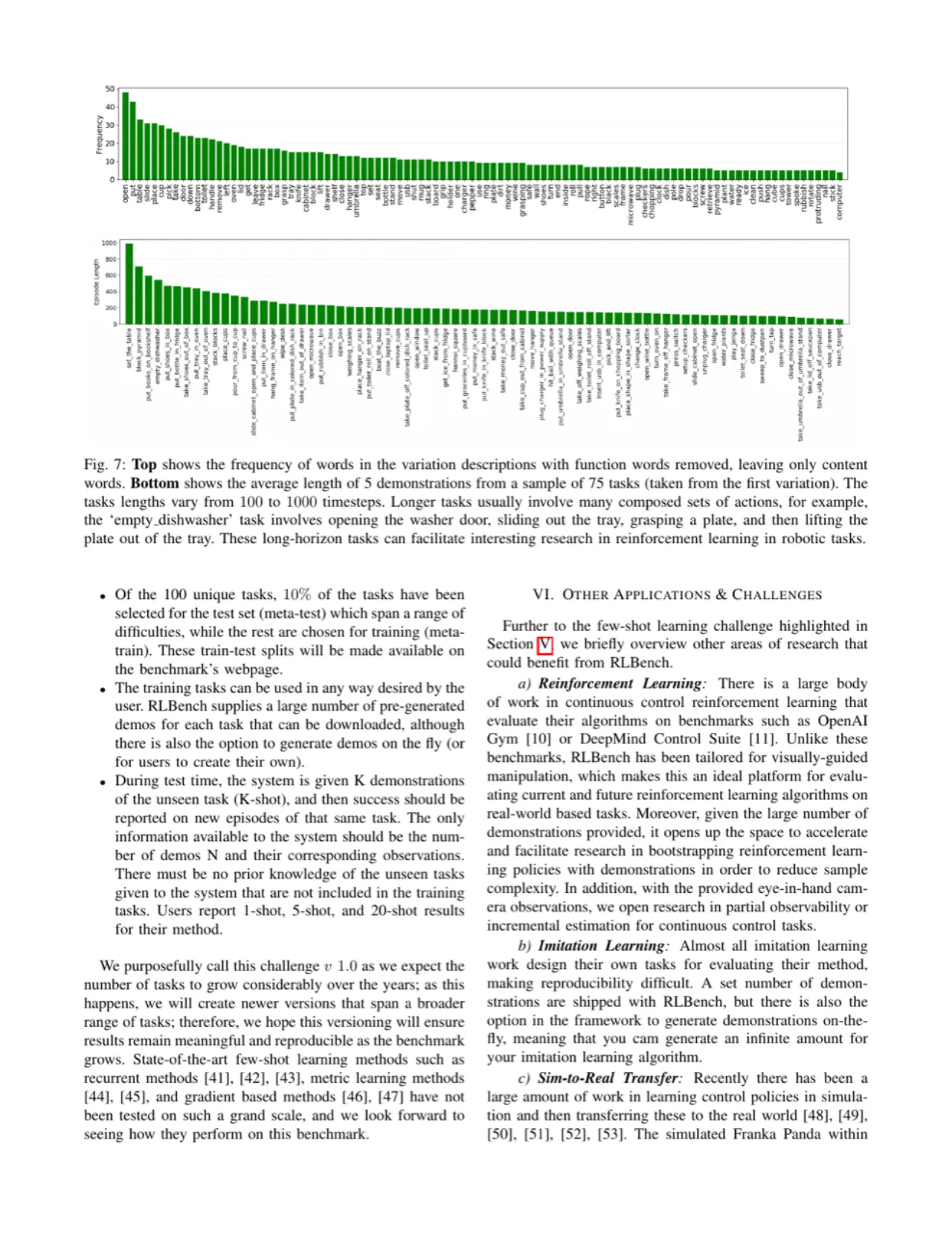
RLBench 将每个任务分为三个层级: RLBench decomposes every task into three levels:
.ttt 场景 + .py 脚本)描述。Task: defines the success condition and the motion-planning waypoints, specified through Python files (a .ttt scene plus a .py script).
RLBench 通过内置运动规划器(Open Motion Planning Library,OMPL)可以无限生成专家演示,
无需人工遥控。每个演示(Demo)由一系列(观测, 动作)对组成,训练时用户可按需抽取任意数量的演示。
API 遵循强化学习标准接口:env.reset()、env.step(action),动作空间支持绝对或相对的
关节速度、末端执行器速度与位姿。
任务构建工具(Task Building Tool)允许社区用户通过简单的 Python 文件贡献新任务,有望持续扩展基准规模。
Through a built-in motion planner (the Open Motion Planning Library, OMPL), RLBench can
generate expert demonstrations without limit, requiring no human teleoperation. Each Demo consists of a
sequence of (observation, action) pairs, and users may draw as many demonstrations as they wish for training.
The API follows the standard reinforcement learning interface — env.reset() and env.step(action) — and the
action space supports absolute or relative joint velocities as well as end-effector velocities and poses.
A Task Building Tool lets community users contribute new tasks through simple Python files, so the benchmark can keep growing.
论文将 RLBench 定位为评估平台,本身不提出新算法,而是在基准上运行若干代表性基线, 为模仿学习、强化学习与小样本学习研究提供参照点。 The paper positions RLBench as an evaluation platform: it proposes no new algorithm, but instead runs a set of representative baselines on the benchmark to provide reference points for imitation learning, reinforcement learning and few-shot learning research.
论文在多个任务上评估了以下基线方法,使用 K 个演示进行训练(K=1、5、20),并报告测试时 25 个 episode 的成功率: The following baselines are evaluated across several tasks, trained with K demonstrations (K = 1, 5, 20), with success rates reported over 25 test episodes:
| 方法Method | 观测类型Observation type | 代表性任务成功率Success rate on representative tasks | 说明Notes |
|---|---|---|---|
| BC(Behavioral Cloning)BC (Behavioral Cloning) | RGB + proprioception | 部分简单任务可达到较高成功率Reaches a fairly high success rate on some simple tasks | 直接监督克隆,复合型任务成功率低Direct supervised cloning; low success rate on compound tasks |
| LSTM-BC | RGB + proprioception | 序列任务略优于 BCSlightly better than BC on sequential tasks | 循环网络捕捉时序依赖The recurrent network captures temporal dependencies |
| Imitation(state-based)Imitation (state-based) | 关节状态Joint states | state-based 成功率明显高于 RGBState-based success rate is markedly higher than RGB | 揭示视觉感知仍是主要瓶颈Shows that visual perception remains the main bottleneck |
实验结果表明:训练演示数量(K)对成功率影响显著——K=20 时多数任务成功率明显优于 K=1; 复杂多步任务(如 "put_groceries_in_cupboard")对所有基线仍极具挑战性。 The results show that the number of training demonstrations (K) has a substantial effect on success rate — with K = 20 most tasks clearly outperform K = 1 — while complex multi-step tasks such as "put_groceries_in_cupboard" remain extremely challenging for every baseline.
论文提出了 RLBench Few-Shot Challenge v1.0,构建机器人领域首个大规模小样本基准: The paper introduces the RLBench Few-Shot Challenge v1.0, the first large-scale few-shot benchmark in robotics:
评估 MAML [25]、ProtoNets [26] 等元学习基线,发现现有方法在机器人小样本操作上成功率普遍较低, 说明该挑战仍具有巨大研究空间。 Evaluating meta-learning baselines such as MAML [25] and ProtoNets [26] reveals that existing methods achieve generally low success rates on few-shot robot manipulation, indicating that the challenge leaves ample room for research.
论文提供了多任务学习的评估框架:系统同时在 M 个训练任务上学习, 测试时需在全部 100 个任务(含未见任务)上达到目标成功率。 实验显示现有多任务学习方法在任务数量增大后性能下降明显, 为未来研究提供了清晰的性能参考基线。 The paper also supplies an evaluation framework for multi-task learning: the system learns on M training tasks simultaneously and must reach a target success rate on all 100 tasks (including unseen ones) at test time. Experiments show that existing multi-task learning methods degrade noticeably as the number of tasks grows, which provides a clear performance reference point for future work.
论文明确指出,RLBench 虽可生成照片级渲染,但仿真渲染与真实相机图像之间仍存在域差距。 作者提及使用高质量渲染系统并鼓励研究 sim-to-real 迁移,但 gap 本身无法在仿真内消除。 (stated by authors) The authors note explicitly that although RLBench can produce photorealistic renderings, a domain gap remains between simulated renderings and real camera images. They mention the use of a high-quality rendering system and encourage research on sim-to-real transfer, but the gap itself cannot be eliminated inside simulation. (stated by authors)
当前平台仅支持固定底座的 Franka Panda 单臂机器人,不支持双臂协作或移动机器人场景。 所有任务都假设工作台固定、物体在工作台范围内,排除了导航、全身运动控制等更广泛的操作场景。 (inferred from design) The platform currently supports only a fixed-base, single-arm Franka Panda robot, with no bimanual collaboration or mobile-robot scenarios. Every task assumes a fixed table with objects within its reach, excluding broader settings such as navigation and whole-body motion control. (inferred from design)
RLBench 的无限演示依赖 OMPL 运动规划器成功找到路径。对于极度复杂或狭窄空间的任务, 规划器可能失败或生成不自然的轨迹,影响演示质量和后续模仿学习的上界。 (inferred from design) RLBench's unlimited demonstrations rely on the OMPL motion planner successfully finding a path. For extremely complex tasks or tasks in confined spaces, the planner may fail or produce unnatural trajectories, degrading demonstration quality and hence the upper bound of downstream imitation learning. (inferred from design)
论文明确指出,稀疏奖励(成功 +1,失败 0)对纯 RL 方法极具挑战性, 尤其是多步任务完成率极低,需要大量样本。当前基线的 RL 结果普遍较差, 说明该设置远超现有 RL 算法的能力边界。(stated by authors) The authors state explicitly that the sparse reward (+1 on success, 0 on failure) is extremely challenging for pure RL methods; completion rates on multi-step tasks in particular are very low and require large numbers of samples. The RL results of the current baselines are generally poor, indicating that this setting lies well beyond the capabilities of existing RL algorithms. (stated by authors)