残差强化学习(Residual RL)通过在预训练策略之上叠加一个轻量级"残差策略"来修正动作,相比全量微调具有更高的样本效率。然而现有方法在稀疏奖励下表现欠佳,且只适用于确定性基础策略。本文提出两项改进:①利用基础策略的不确定性估计引导残差策略专注于探索低置信区域;②通过非对称 actor-critic 架构支持 GMM 及 Diffusion 等随机基础策略的 off-policy 学习。Residual reinforcement learning (Residual RL) corrects actions by adding a lightweight "residual policy" on top of a pretrained policy, and is more sample-efficient than finetuning the whole model. However, existing methods perform poorly under sparse rewards and apply only to deterministic base policies. This paper proposes two improvements: ① uncertainty estimates of the base policy are used to steer the residual policy toward exploring low-confidence regions; ② an asymmetric actor-critic architecture enables off-policy learning with stochastic base policies such as GMM and Diffusion.
Residual RL 是将预训练策略与强化学习结合的流行范式——只训练一个输出"修正量"的小策略,而不是重新训练整个网络。但两个关键瓶颈制约了其实用性:Residual RL is a popular paradigm for combining pretrained policies with reinforcement learning: only a small policy that outputs "corrections" is trained, instead of retraining the entire network. Two key bottlenecks, however, limit its practicality:
残差策略在整个状态空间均匀随机探索,而在基础策略已经表现良好的区域浪费大量样本。在稀疏奖励环境下,这一问题尤为突出。The residual policy explores uniformly at random over the whole state space, wasting a large number of samples in regions where the base policy already performs well. This is especially pronounced in sparse-reward environments.
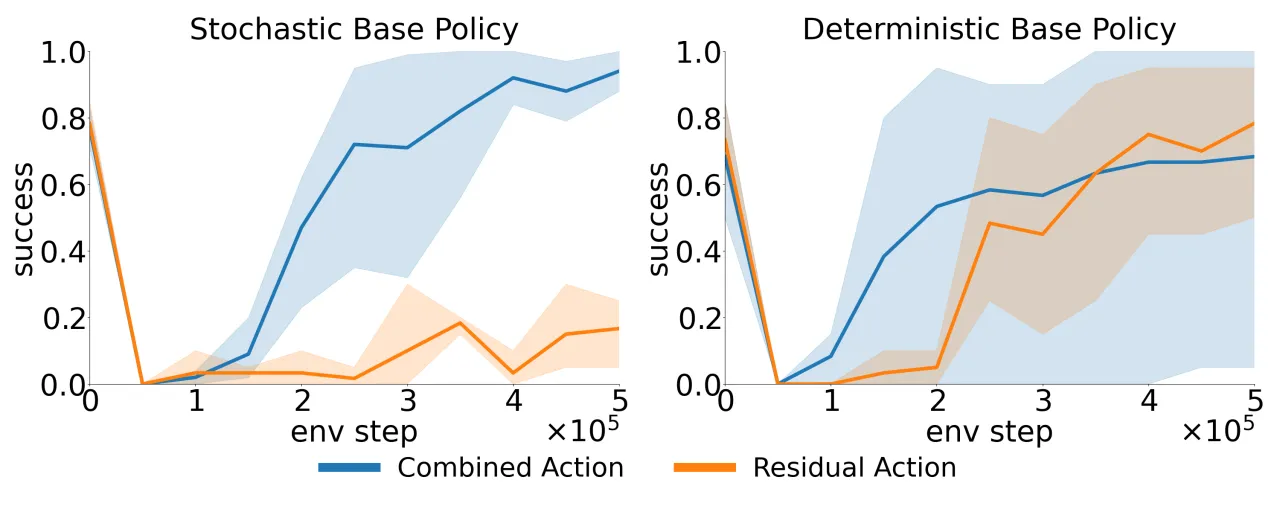
现有 off-policy Residual RL 方法(如 TD3+BC、SAC)假设基础策略是确定性的。对于 GMM 或 Diffusion Policy 等随机基础策略,动作空间的随机性使 Q 函数训练失效。Existing off-policy Residual RL methods (e.g. TD3+BC, SAC) assume a deterministic base policy. For stochastic base policies such as GMM or Diffusion Policy, the randomness of the action space breaks Q-function training.
"Residual RL is a popular approach for adapting pretrained policies by learning a lightweight residual policy that provides corrective actions. While Residual RL is more sample-efficient than finetuning the entire base policy, existing methods struggle with sparse rewards and are designed for deterministic base policies."
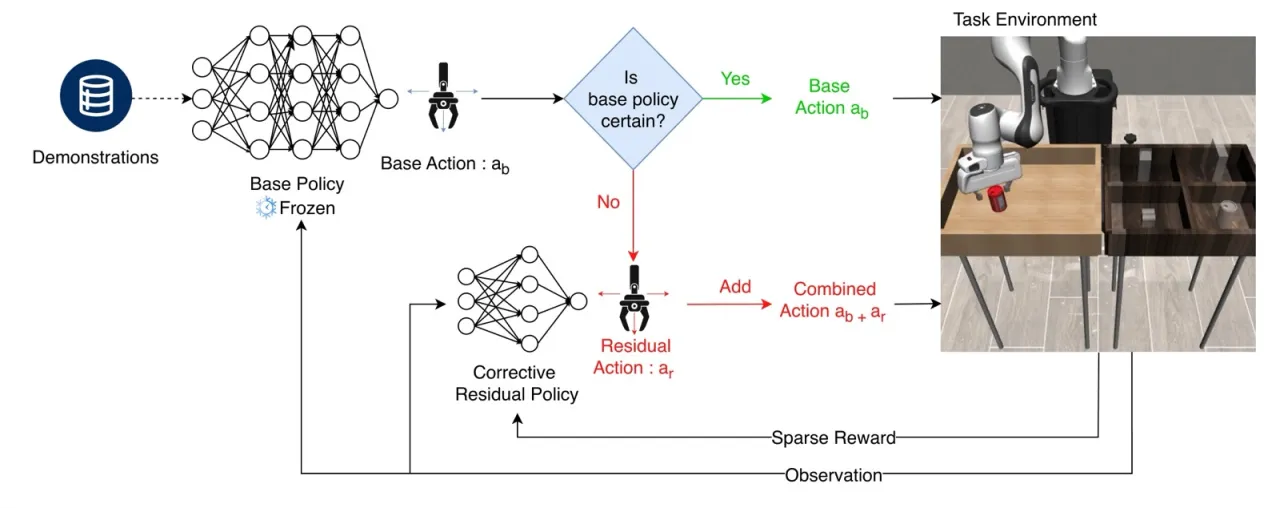
本文的核心思路是让残差策略"知道什么时候该出手":只在基础策略不确定的状态下叠加修正量,其余情况直接沿用基础策略的输出。同时,通过改造 critic 的输入,使整个框架可以处理随机(非确定性)基础策略。The core idea is to let the residual policy "know when to step in": a correction is added only in states where the base policy is uncertain, and otherwise the base policy output is used directly. At the same time, reshaping the critic input lets the whole framework handle stochastic (non-deterministic) base policies.
在每个时间步,先用不确定性估计量 uncertainty(s) 与阈值 τ 比较。若不确定性低(基础策略置信)则直接执行基础策略动作;否则叠加残差修正量:At every time step the uncertainty estimate uncertainty(s) is first compared with a threshold τ. If the uncertainty is low (the base policy is confident), the base policy action is executed directly; otherwise the residual correction is added:
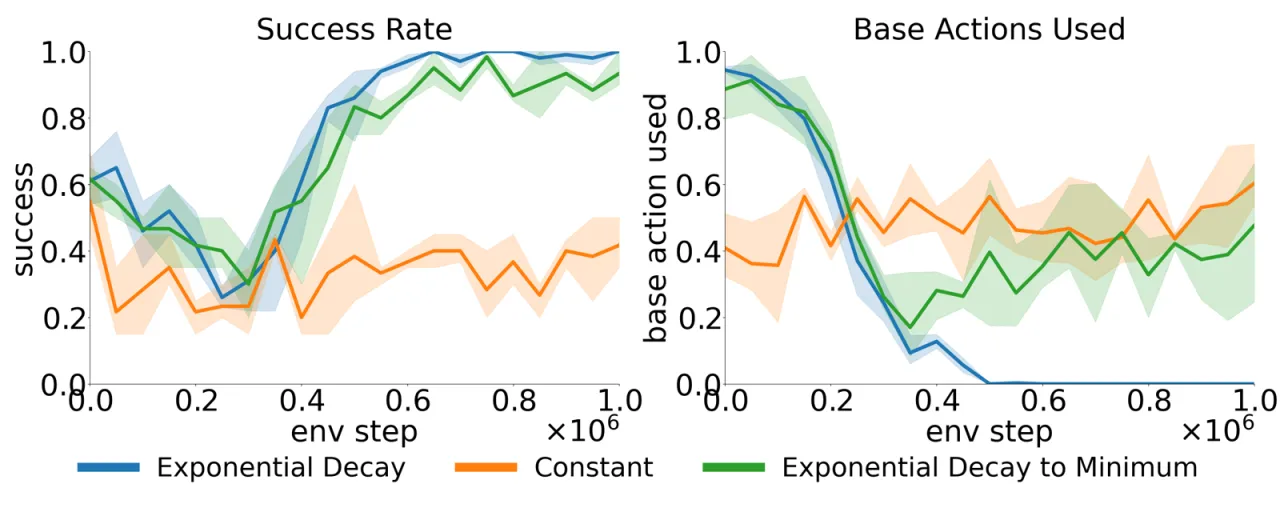
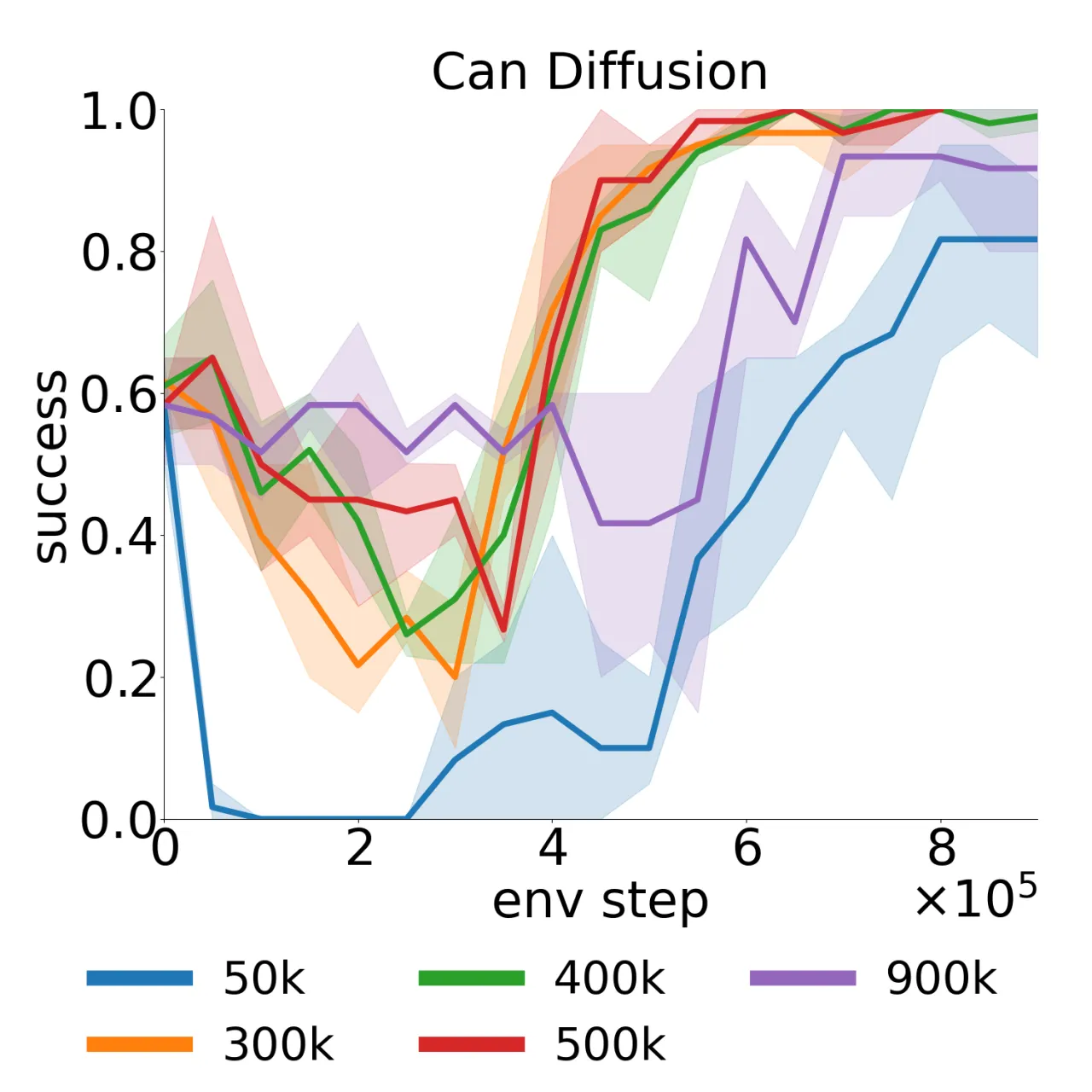
阈值 τ 随训练步数指数衰减,使策略逐渐从"基础策略主导"过渡到"残差策略主导":The threshold τ decays exponentially with the number of training steps, so that the policy gradually shifts from "base-policy dominated" to "residual-policy dominated":
论文比较了两种不确定性度量:The paper compares two uncertainty metrics:
对于 GMM 或 Diffusion Policy 等随机基础策略,每次采样的动作 a_b 不同。若 critic 仅观测残差动作 a_r,则 Q 函数估计偏差严重。本文的解决方案是让 critic 观测完整组合动作(a_b + a_r),而 actor 只预测残差修正量 a_r,形成非对称结构:For stochastic base policies such as GMM or Diffusion Policy, the sampled action a_b differs each time. If the critic observes only the residual action a_r, the Q-function estimate is severely biased. The proposed solution lets the critic observe the full combined action (a_b + a_r) while the actor predicts only the residual correction a_r, forming an asymmetric structure:
这样可以保证 Q 函数接收到随机基础动作的信息,同时保持"动作分离不变性"(action-split invariance),确保优化目标合理。This guarantees that the Q function receives information about the stochastic base action while preserving "action-split invariance", keeping the optimization objective sound.
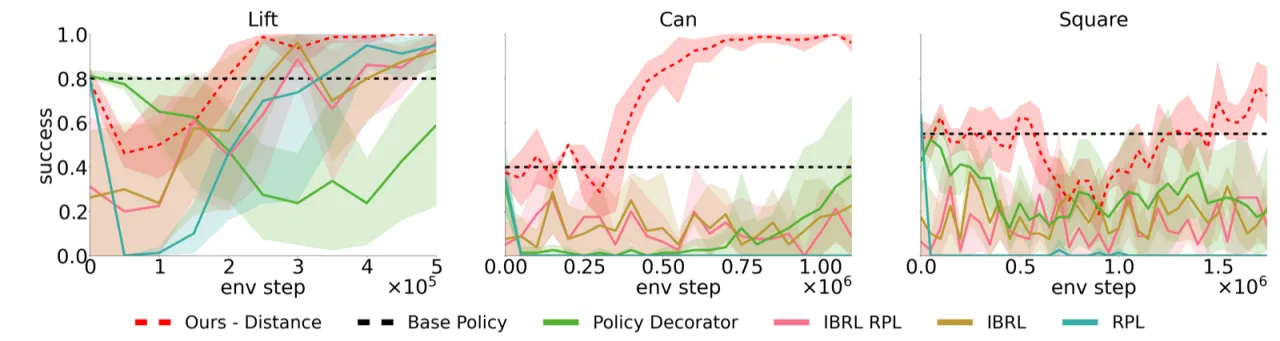
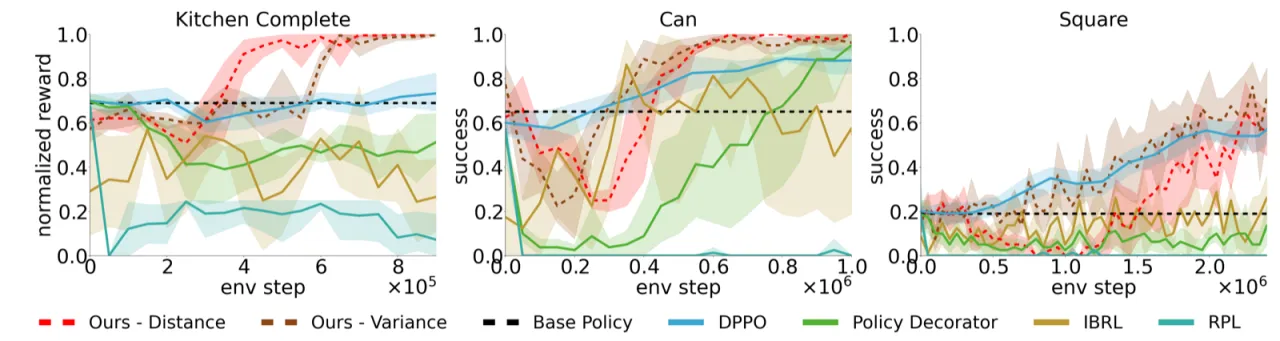
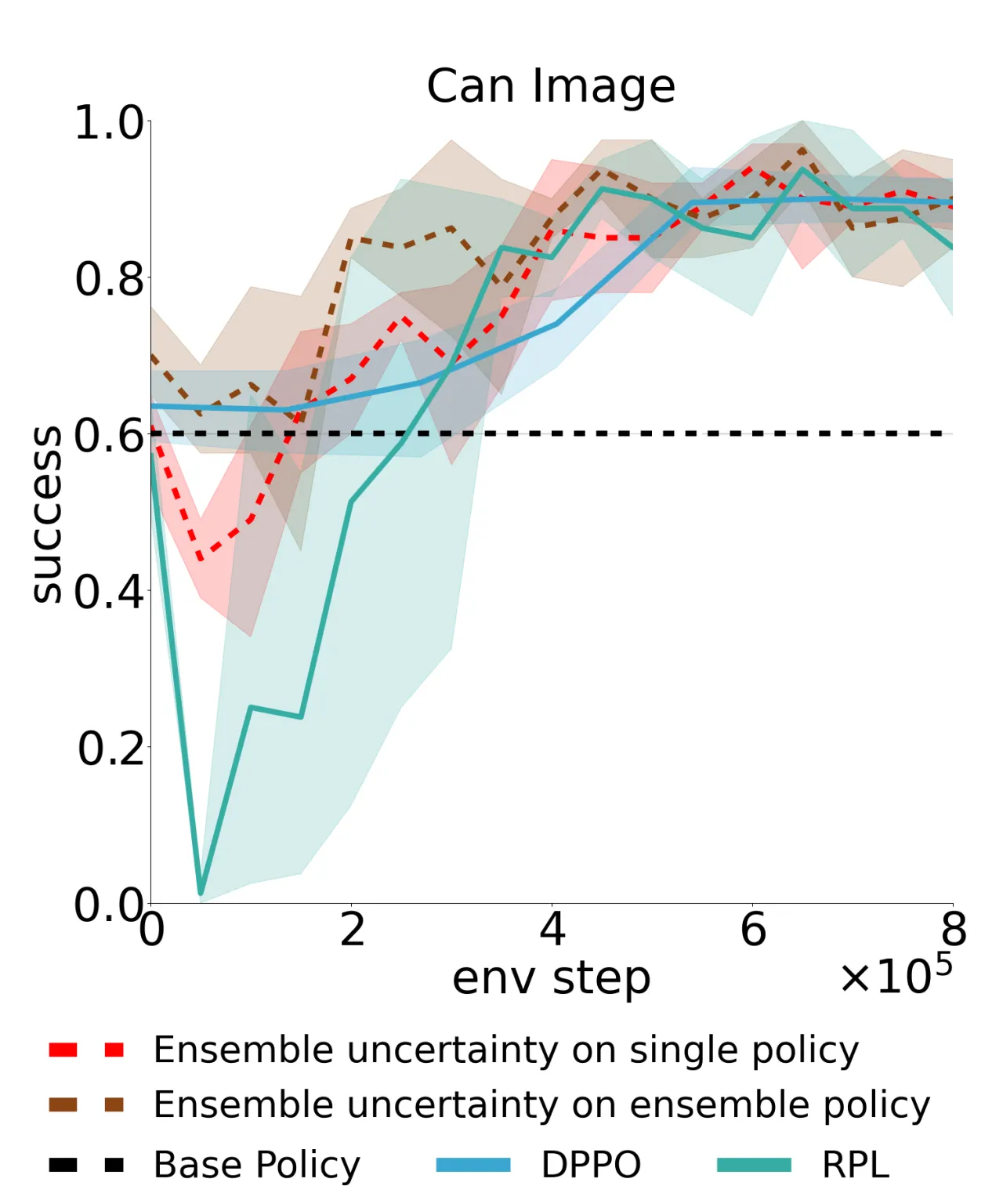
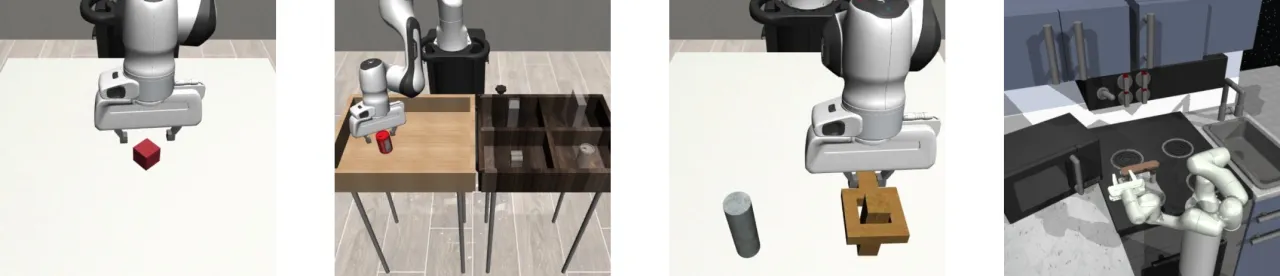
在 Robosuite(Lift、Can、Square)、D4RL Franka Kitchen(Complete、Mixed、Partial)、图像输入 Can 任务以及真实机器人 Can 任务上评估。所有结果均带 95% 置信区间。 基线方法包括:DPPO(Diffusion Policy Policy Optimization)、IBRL(Imitation Bootstrapped RL)、IBRL-RPL、Policy Decorator(均匀探索调度)以及标准 Residual RL。Evaluated on Robosuite (Lift, Can, Square), D4RL Franka Kitchen (Complete, Mixed, Partial), an image-input Can task and a real-robot Can task. All results are reported with 95% confidence intervals. The baselines are DPPO (Diffusion Policy Policy Optimization), IBRL (Imitation Bootstrapped RL), IBRL-RPL, Policy Decorator (uniform exploration schedule) and standard Residual RL.
| 任务 / 场景Task / setting | 主要基线方法Main baselines | 本文方法表现Performance of this method | 备注Notes |
|---|---|---|---|
| Robosuite Lift / Can / Square(GMM)Robosuite Lift / Can / Square (GMM) | IBRL, Policy Decorator | 超越全部基线Outperforms all baselines | 样本效率与最终成功率均更优Better in both sample efficiency and final success rate |
| Kitchen Complete(Diffusion)Kitchen Complete (Diffusion) | DPPO, Policy Decorator | 更高成功率Higher success rate | 支持随机策略的关键场景Key setting for supporting stochastic policies |
| Can 任务(Diffusion)Can task (Diffusion) | DPPO, Policy Decorator | 更高成功率Higher success rate | — |
| Square 任务(Diffusion)Square task (Diffusion) | Policy Decorator, DPPO | 性能持平Comparable performance | 最难任务,无显著差距Hardest task, no significant gap |
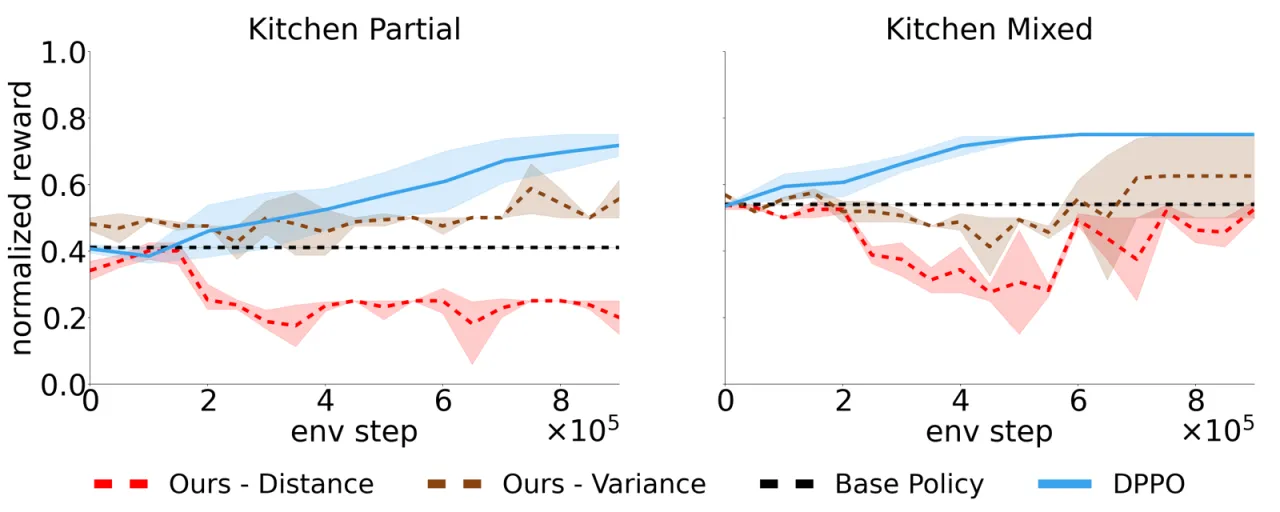
| Kitchen Partial / Mixed | 标准 Residual RLStandard Residual RL | ensemble 有提升;distance 失效ensemble improves; distance fails | 含随机游走数据时 distance 不可靠distance is unreliable when random-play data is included |
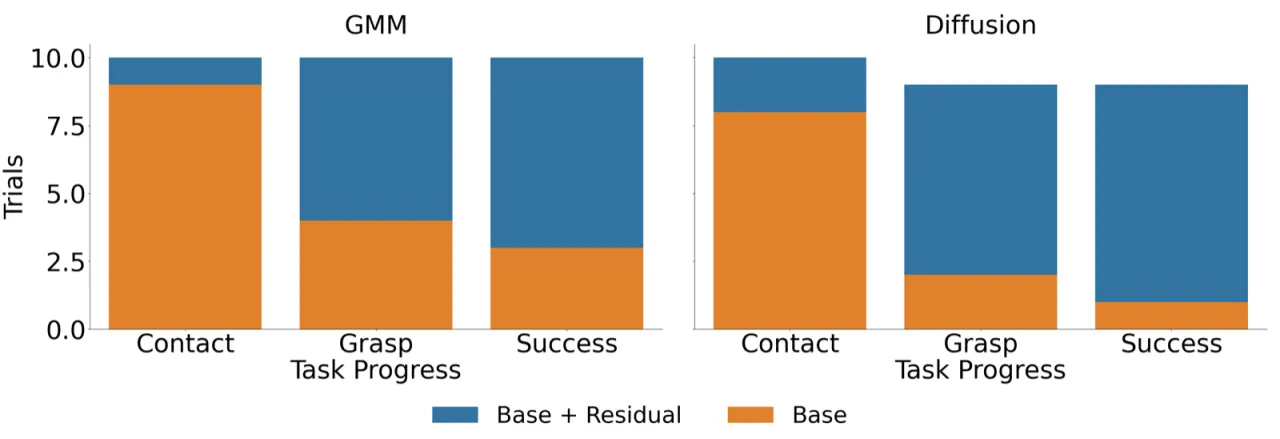
| 真实机器人 Can(Zero-Shot)Real-robot Can (Zero-Shot) | 仿真策略基准Simulation policy reference | 保留近乎全部仿真性能Retains nearly all of its performance in simulation | 无真实环境额外训练No extra training in the real environment |
本文的核心假设是"基础策略置信的地方,它的动作也是正确的"。但当训练数据中包含随机游走(random play)数据时,该假设失效——基础策略可能在许多状态下都显示出"低不确定性"但实际上动作质量差。 作者明确指出:"it would also benefit from a more robust epistemic uncertainty metric." 这导致 distance-to-data 在 Kitchen Mixed 和 Kitchen Partial 等任务上失效,ensemble 方法虽然改善了情况,但并非完美解决方案。The core assumption of this paper is that "wherever the base policy is confident, its actions are also correct". But when the training data contains random play data the assumption fails — the base policy may show "low uncertainty" in many states while its action quality is in fact poor. The authors state explicitly: "it would also benefit from a more robust epistemic uncertainty metric." This causes distance-to-data to fail on tasks such as Kitchen Mixed and Kitchen Partial; the ensemble method mitigates the problem but is not a perfect solution.
在图像输入场景中,distance-to-data 度量在高维像素空间中变得不可靠。论文图像实验中已观测到这一问题,并改用 ensemble variance 方法。 对于更复杂的视觉观测场景(如多物体、复杂背景),不确定性估计的鲁棒性需要进一步研究。In image-input settings the distance-to-data metric becomes unreliable in high-dimensional pixel space. The paper observes this in its image experiments and switches to ensemble variance. For more complex visual observation settings (multiple objects, cluttered backgrounds), the robustness of uncertainty estimation needs further study.
作者指出:"We believe that, with reliable uncertainty metrics, our approach could also be applied to larger models including robot foundation models." 然而目前实验仅限于 GMM 和 Diffusion Policy 等相对小型的基础策略,尚未在大型视觉-语言-动作模型(如 RT-2、OpenVLA 等)上验证。The authors note: "We believe that, with reliable uncertainty metrics, our approach could also be applied to larger models including robot foundation models." Yet the experiments so far are limited to relatively small base policies such as GMM and Diffusion Policy, and have not been verified on large vision-language-action models (such as RT-2 or OpenVLA).
尽管实验表明衰减速率在 300k–500k 步范围内较为稳健,但极低的衰减速率会导致过激探索,而极高的衰减速率则会拖慢收敛。在不同任务难度和数据集规模下,最优超参数仍需一定程度的人工调整。Although the experiments show the decay rate to be fairly robust over the range of 300k–500k steps, a very low decay rate causes overly aggressive exploration while a very high one slows convergence. Across different task difficulties and dataset sizes, the optimal hyperparameters still require a certain amount of manual tuning.