ReconVLA: Reconstructive Vision-Language-Action Model as Effective Robot Perceiver
通过隐式重建凝视区域,让 VLA 模型真正"看见"目标物体Implicitly reconstructing the gaze region so that VLA models truly "see" the target object
Wenxuan Song, Ziyang Zhou, Han Zhao, Jiayi Chen, Pengxiang Ding, Haodong Yan, Yuxin Huang, Feilong Tang, Donglin Wang, Haoang Li
现有 Vision-Language-Action 模型的视觉注意力往往分散,无法聚焦于目标操作区域。ReconVLA 提出隐式 grounding 范式,借助 diffusion transformer 重建图像中的"凝视区域",引导 LLM 骨干将注意力对准目标物体,从而大幅提升精细操作和未见目标的泛化能力。The visual attention of existing Vision-Language-Action models is often dispersed and fails to focus on the target manipulation region. ReconVLA proposes an implicit grounding paradigm that uses a diffusion transformer to reconstruct the "gaze region" of the image, guiding the LLM backbone to align its attention with the target object and thereby greatly improving fine-grained manipulation and generalization to unseen targets.
现有 VLA 模型在视觉感知上存在根本性缺陷——注意力分散,难以精准定位目标操作物体,导致在杂乱场景和精细任务中表现不佳。Existing VLA models have a fundamental flaw in visual perception — attention is dispersed and the target manipulated object is hard to localize precisely, which leads to poor performance in cluttered scenes and fine-grained tasks.
"visual attention is always dispersed" rather than focusing on target objects. Existing visual grounding methods either explicitly input cropped images or output bounding boxes in chain-of-thought fashion, but "do not fundamentally refine the attention allocation."
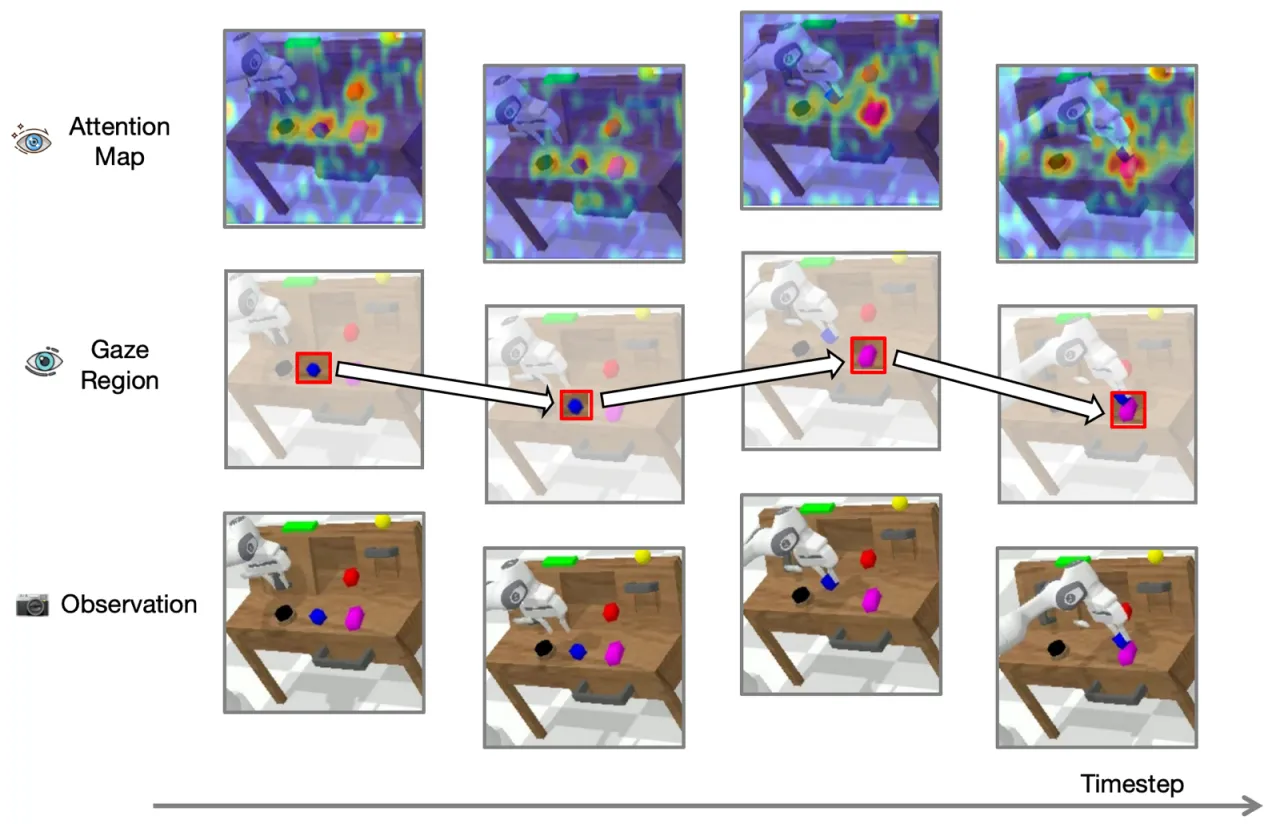
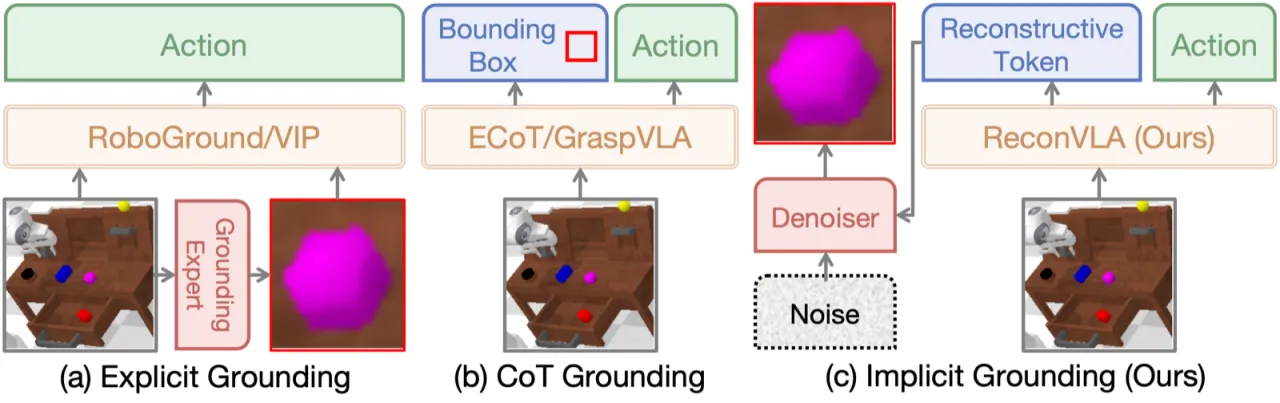
作者观察到,人眼感知的本质是:眼睛对焦的小区域清晰,周围区域模糊。现有 explicit grounding(输入裁剪图像)和 chain-of-thought grounding(输出 bounding box 坐标)两类方法都无法从根本上改变 LLM 内部的注意力分配。ReconVLA 通过隐式重建凝视区域,让模型在特征层面聚焦目标,而非依赖外部后处理。The authors observe that the essence of human visual perception is: the small region the eye focuses on is sharp, while the surrounding area is blurred. Neither existing explicit grounding (feeding in cropped images) nor chain-of-thought grounding (outputting bounding box coordinates) fundamentally changes the attention allocation inside the LLM. By implicitly reconstructing the gaze region, ReconVLA makes the model focus on the target at the feature level instead of relying on external post-processing.
图 1:ReconVLA teaser。左侧:多物体桌面场景("stack blocks" 任务);中间:模型自动定位的"凝视区域"高亮;右侧:ReconVLA 的注意力热图明显集中于目标积木,而 baseline 的注意力则分散在整张图像上。Figure 1: ReconVLA teaser. Left: a multi-object tabletop scene (the "stack blocks" task); middle: the "gaze region" automatically localized by the model, highlighted; right: ReconVLA's attention heatmap concentrates clearly on the target block, whereas the baseline's attention is spread over the whole image.
+20.2%精细 "stack block" 任务 vs. baselineFine-grained "stack block" task vs. baseline
2M+预训练数据量(轨迹样本)Pre-training data scale (trajectory samples)
图 2:三种 grounding 范式对比。(a) Explicit Grounding (EG):将裁剪后的目标区域图像与原图一并输入;(b) Chain-of-Thought Grounding (CG):在动作序列之前先输出 bounding box 坐标;(c) Implicit Grounding (IG,即 ReconVLA):输出 reconstructive tokens,驱动 diffusion transformer 重建凝视区域——无需显式坐标,注意力改变发生在特征空间内部。Figure 2: Comparison of three grounding paradigms. (a) Explicit Grounding (EG): the cropped target-region image is fed in together with the original image; (b) Chain-of-Thought Grounding (CG): bounding box coordinates are emitted before the action sequence; (c) Implicit Grounding (IG, i.e. ReconVLA): reconstructive tokens are emitted to drive a diffusion transformer that reconstructs the gaze region — no explicit coordinates are needed, and the change of attention happens inside the feature space.
02方法Method
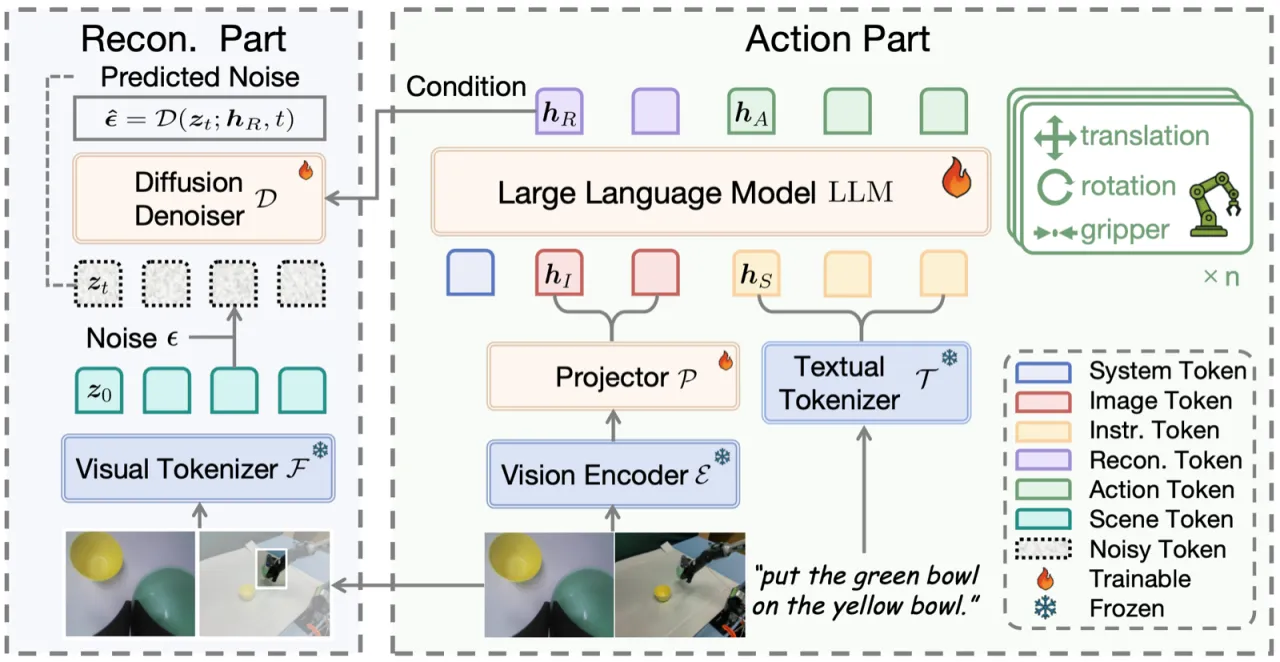
ReconVLA 在标准 VLA 骨干(LLaVA-7b,Qwen2-7B LLM + siglip-so400m-patch14-384 视觉编码器)的基础上,新增一个与动作输出并行的重建分支:LLM 同时输出 action tokens 和 reconstructive tokens,后者驱动一个 diffusion transformer denoiser 从噪声中恢复凝视区域的 latent 特征。On top of a standard VLA backbone (LLaVA-7b, a Qwen2-7B LLM plus a siglip-so400m-patch14-384 vision encoder), ReconVLA adds a reconstruction branch that runs in parallel with the action output: the LLM emits action tokens and reconstructive tokens at the same time, and the latter drive a diffusion transformer denoiser that recovers the latent features of the gaze region from noise.
图 3:ReconVLA 整体架构。输入为多视角图像与文本指令;视觉编码器提取图像特征,LLM 同时自回归生成 action tokens(动作)和 reconstructive tokens(重建引导);diffusion denoiser 以 reconstructive tokens 为条件,从噪声 z_t 恢复凝视区域的 latent z_0;连续 VAE 解码为实际图像像素用于监督。整体损失 = 动作交叉熵损失 + 扩散重建损失。Figure 3: Overall ReconVLA architecture. The inputs are multi-view images and a text instruction; the vision encoder extracts image features, and the LLM autoregressively generates action tokens (actions) and reconstructive tokens (reconstruction guidance) at the same time; conditioned on the reconstructive tokens, the diffusion denoiser recovers the gaze-region latent z_0 from noise z_t; a continuous VAE decodes it into actual image pixels for supervision. Total loss = action cross-entropy loss + diffusion reconstruction loss.
核心损失函数Core Loss Function
总损失同时优化动作预测与视觉重建:The total loss jointly optimizes action prediction and visual reconstruction:
ℒ_ReconVLA = ℒ_VLA^action + ℒ_VLA^visual
其中动作损失为 cross-entropy 监督离散动作 token;视觉重建损失为扩散目标:The action loss is a cross-entropy supervision over discrete action tokens; the visual reconstruction loss is a diffusion objective:
𝒉_R 为 LLM 输出的 reconstructive tokens,I′ 为凝视区域图像,𝒟 为由 Transformer encoder blocks 构成的 denoiser。通过对重建损失和动作损失同时反向传播,两个分支共享并强化相同的特征空间。𝒉_R denotes the reconstructive tokens output by the LLM, I′ the gaze-region image, and 𝒟 a denoiser built from Transformer encoder blocks. By backpropagating the reconstruction loss and the action loss simultaneously, the two branches share and reinforce the same feature space.
凝视区域(Gaze Region)的含义与作用What the Gaze Region Means and What It Does
凝视区域并非简单的 bounding box 裁剪,而是"the target manipulated region",其作用有三:(1) 在多物体杂乱场景中聚焦正确目标;(2) 增强对目标物体的细节感知;(3) 在长时序任务中辅助子任务规划。The gaze region is not a simple bounding box crop but "the target manipulated region". It serves three purposes: (1) focusing on the correct target in cluttered multi-object scenes; (2) sharpening perception of the target object's details; (3) assisting subtask planning in long-horizon tasks.
大规模预训练数据集Large-Scale Pre-training Dataset
作者通过在 BridgeData V2、LIBERO 和 CALVIN 数据集上微调 Grounding DINO 获取凝视区域标注,构建了包含超过 100k 条轨迹、200万个样本的配对数据集(原图 + 凝视区域裁剪图),用于预训练重建能力。预训练后再进行任务特定微调。By fine-tuning Grounding DINO on the BridgeData V2, LIBERO and CALVIN datasets to obtain gaze-region annotations, the authors build a paired dataset (original image + cropped gaze region) containing over 100k trajectories and 2 million samples, used to pre-train the reconstruction capability. Pre-training is followed by task-specific fine-tuning.
03实验Experiments
在 CALVIN 模拟基准(Franka Panda 机器人,34 种任务,4 个场景)和真实机器人平台(AgileX PiPer 6-DoF 机械臂)上进行评测,指标为 500 次 rollout 的逐子任务成功率及平均完成序列长度。Evaluation is carried out on the CALVIN simulation benchmark (a Franka Panda robot, 34 tasks, 4 scenes) and on a real-robot platform (a 6-DoF AgileX PiPer arm), with per-subtask success rate over 500 rollouts and average completed sequence length as metrics.
CoT Grounding "performance is even worse" 因为仅输出 bounding box 坐标不足以提供精细操作所需的精度。ReconVLA 在所有子任务长度上均取得最高成功率。CoT Grounding "performance is even worse", because emitting only bounding box coordinates does not provide the precision that fine-grained manipulation requires. ReconVLA attains the highest success rate at every subtask length.
ReconVLA 在 5/5 子任务上超越 GR-1 超过 20%、超越 OpenVLA 20.6%、超越 UniVLA 7.6%。在 CALVIN ABCD→D 上也取得平均序列长度 4.23,与 GR-1 的 4.21 相当,超越 RoboFlamingo(4.08)和 VLAS(3.70)。ReconVLA surpasses GR-1 by more than 20% on the 5/5 subtask, OpenVLA by 20.6% and UniVLA by 7.6%. On CALVIN ABCD→D it also reaches an average sequence length of 4.23, on par with GR-1's 4.21 and ahead of RoboFlamingo (4.08) and VLAS (3.70).
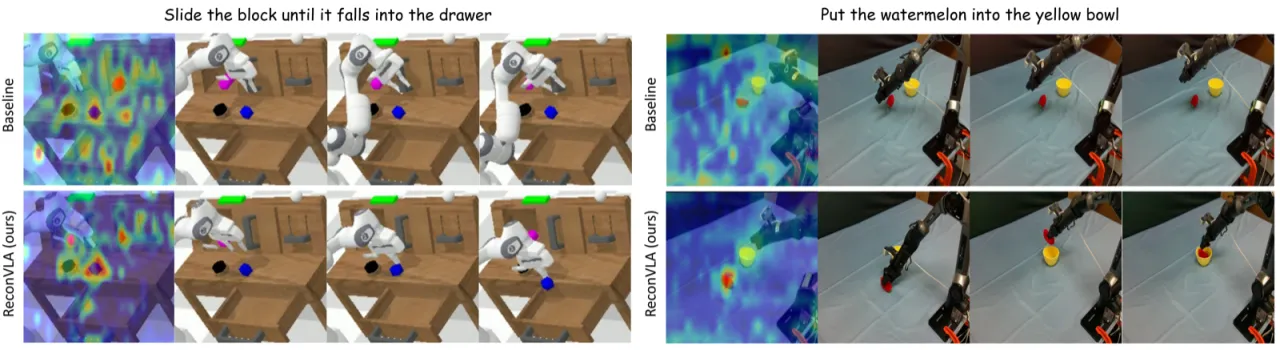
图 4:视觉注意力对比(CALVIN + 真实场景)。上行:baseline 模型注意力"dispersed attention patterns or predominantly attends to incorrect region";下行:ReconVLA 注意力显著集中于目标物体,"forcing the model to focus on specific image contents with higher attention values"。Figure 4: Visual attention comparison (CALVIN + real-world scenes). Top row: the baseline model shows "dispersed attention patterns or predominantly attends to incorrect region"; bottom row: ReconVLA's attention concentrates markedly on the target object, "forcing the model to focus on specific image contents with higher attention values".
消融实验(Table 2)Ablation Study (Table 2)
配置Configuration
1/5
2/5
3/5
4/5
5/5
Avg. Len.
完整 ReconVLAFull ReconVLA
95.6%
87.6%
76.9%
69.3%
64.1%
3.95
无预训练Without pre-training
96.8%
86.9%
76.9%
64.9%
58.2%
3.85
无凝视区域(全图重建)Without gaze region (full-image reconstruction)
89.8%
80.3%
67.7%
56.6%
46.5%
3.42
仅 BaselineBaseline only
88.8%
76.1%
63.7%
57.0%
49.0%
3.36
消融显示:凝视区域(gaze region)是核心贡献,"proves to be more effective" 于全图重建;预训练"substantially enhances generalization"尤其在长序列任务上。精细操作任务 "stack block" 中,ReconVLA 以 79.5% 胜过 baseline 的 59.3%,提升 20.2%。The ablation shows that the gaze region is the core contribution and "proves to be more effective" than full-image reconstruction; pre-training "substantially enhances generalization", especially on long-horizon tasks. On the fine-grained "stack block" task, ReconVLA reaches 79.5% against the baseline's 59.3%, an improvement of 20.2%.
真实机器人实验Real-Robot Experiments
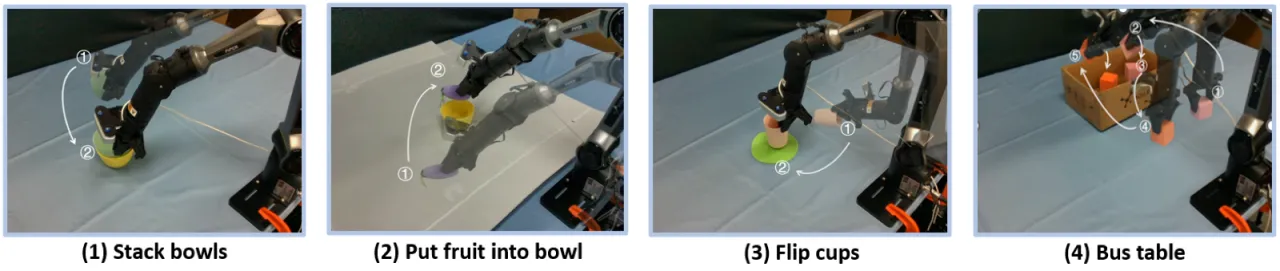
图 5:真实机器人实验平台与四项任务。6-DoF AgileX PiPer 机械臂 + 1-DoF 平行夹爪;RealSense D515(Eye-on-Base)+ ORBBEC Dabai(Eye-on-Hand)双摄像头。四项任务:叠碗(Stack bowls)、将水果放入碗(Put fruit into bowl)、翻杯(Flip cups)、收拾桌面(Bus table),每任务约 150 条训练轨迹,测试 20 次。Figure 5: Real-robot platform and the four tasks. A 6-DoF AgileX PiPer arm + a 1-DoF parallel gripper; two cameras, a RealSense D515 (Eye-on-Base) and an ORBBEC Dabai (Eye-on-Hand). The four tasks are Stack bowls, Put fruit into bowl, Flip cups and Bus table, each with about 150 training trajectories and 20 test trials.
在四项已知任务上,ReconVLA 的成功率均明显优于 OpenVLA 和 PD-VLA(Put Fruit 和 Stack Bowls 约 90%,Flip Cups 约 75%,Bus Table 约 70%)。在未见物体泛化测试中,OpenVLA 和 PD-VLA 成功率接近 0%,而 ReconVLA 仍维持较高成功率,展现出强大的视觉泛化能力。On the four seen tasks ReconVLA's success rate is clearly better than OpenVLA and PD-VLA (about 90% on Put Fruit and Stack Bowls, about 75% on Flip Cups, about 70% on Bus Table). In the unseen-object generalization test, OpenVLA and PD-VLA drop to nearly 0% success, while ReconVLA still maintains a high success rate, showing strong visual generalization ability.
04局限性Limitations
Note:论文正文未设独立 Limitations 章节。以下各点来源说明:标注为 stated 表示论文有明确陈述;标注为 inferred 表示由方法设计推断。Note: The paper itself has no dedicated Limitations section. Provenance of the points below: items marked stated are explicitly stated in the paper; items marked inferred are inferred from the method design.
凝视区域标注依赖 Grounding DINO(inferred)Gaze-region annotation depends on Grounding DINO (inferred)
预训练数据的凝视区域标注来自对 Grounding DINO 的微调。若目标物体描述模糊或视觉特征相近,检测器的准确性将影响重建质量,进而影响 VLA 的注意力引导效果。The gaze-region annotations of the pre-training data come from a fine-tuned Grounding DINO. If the target object description is ambiguous or objects look visually alike, the detector's accuracy will affect reconstruction quality and in turn the attention guidance of the VLA.
相比标准 VLA,ReconVLA 在推理时需要额外运行 diffusion denoiser 来重建凝视区域 latent,增加了计算量和延迟。论文未报告推理速度指标。Compared with a standard VLA, ReconVLA has to run an extra diffusion denoiser at inference time to reconstruct the gaze-region latent, which adds computation and latency. The paper reports no inference-speed metrics.
真实机器人实验规模有限(inferred)Limited scale of the real-robot experiments (inferred)
真实机器人测试仅限于 4 种任务、每任务 20 次 trial,硬件平台也仅为单一型号(AgileX PiPer)。跨平台、跨任务的泛化性有待进一步验证。The real-robot evaluation covers only 4 tasks with 20 trials each, on a single hardware model (AgileX PiPer). Cross-platform and cross-task generalization remains to be verified.
对高速精细操作的适用性未验证(inferred)Applicability to high-speed fine-grained manipulation is unverified (inferred)
论文实验主要集中在桌面抓取与摆放等较低速任务。对于需要高频闭环控制的精细操作(如插销、螺丝拧紧),重建分支能否保持实时性尚未评估。The experiments focus mainly on lower-speed tasks such as tabletop grasping and placing. Whether the reconstruction branch can stay real-time for fine-grained manipulation that needs high-frequency closed-loop control (peg insertion, screw tightening) has not been evaluated.