Qwen-RobotNav:面向智能体导航系统的可扩展导航模型Qwen-RobotNav: A Scalable Navigation Model for an Agentic Navigation System
将多任务导航重新定义为「观测上下文建模」问题的统一导航基础模型A unified navigation foundation model that reframes multi-task navigation as an "observation context modelling" problem
Qwen Team(Jiazhao Zhang, Gengze Zhou, Hale Yin, Yiyang Huang 等) · 2026-06-17Qwen Team (Jiazhao Zhang, Gengze Zhou, Hale Yin, Yiyang Huang et al.) · 2026-06-17
Qwen-RobotNav 基于 Qwen3-VL 构建,通过参数化观测编码接口统一处理指令跟随、目标搜索、目标追踪和自动驾驶等多类导航任务,无需推理时重新训练即可动态切换任务模式与观测策略。
在 15.6M 样本上联合训练后,模型在 VLN-CE、EVT-Bench、HM3D、NAVSIM 等主流基准均达到最新最优水平;
结合上层 LLM Planner 构建的智能体导航系统,在三项 Embodied Question Answering 基准上同样刷新记录。Qwen-RobotNav is built on Qwen3-VL and unifies instruction following, object search, object tracking, autonomous driving and other navigation tasks through a parameterised observation-encoding interface, so that task modes and observation strategies can be switched dynamically at inference time without retraining. After joint training on 15.6M samples, the model reaches state-of-the-art results on mainstream benchmarks including VLN-CE, EVT-Bench, HM3D and NAVSIM; combined with a high-level LLM Planner, the resulting agentic navigation system also sets new records on three Embodied Question Answering benchmarks.
技术报告 · June 2026Technical Report · June 2026模型规模:2B → 8BModel size: 2B → 8B训练数据:15.6M 样本Training data: 15.6M samples博客 / BlogBlogGitHub
具身导航跨越了极为多样的任务家族——指令跟随、目标导航、目标追踪、自动驾驶——它们共享同一套感知-规划骨干,
却对如何消费视觉流有着根本不同的策略需求。
现有统一导航模型(如 NavFoM、ABot-N0)采用固定的观测上下文策略,无法在推理时被外部代理重新配置;
不同任务需要截然不同的时间上下文:指令跟随需要数十步的全局历史以重新参考远端地标,
而目标追踪则几乎只依赖最近几帧。Embodied navigation spans an extremely diverse family of tasks — instruction following, object-goal navigation, object tracking, autonomous driving — which share the same perception-planning backbone yet impose fundamentally different strategic requirements on how the visual stream is consumed. Existing unified navigation models (such as NavFoM and ABot-N0) adopt a fixed observation-context policy that cannot be reconfigured by an external agent at inference time; different tasks demand markedly different temporal context: instruction following needs tens of steps of global history in order to re-reference distant landmarks, whereas object tracking relies almost entirely on the most recent frames.
"We reframe the central challenge of multi-task navigation as observation context modelling rather than architecture design."
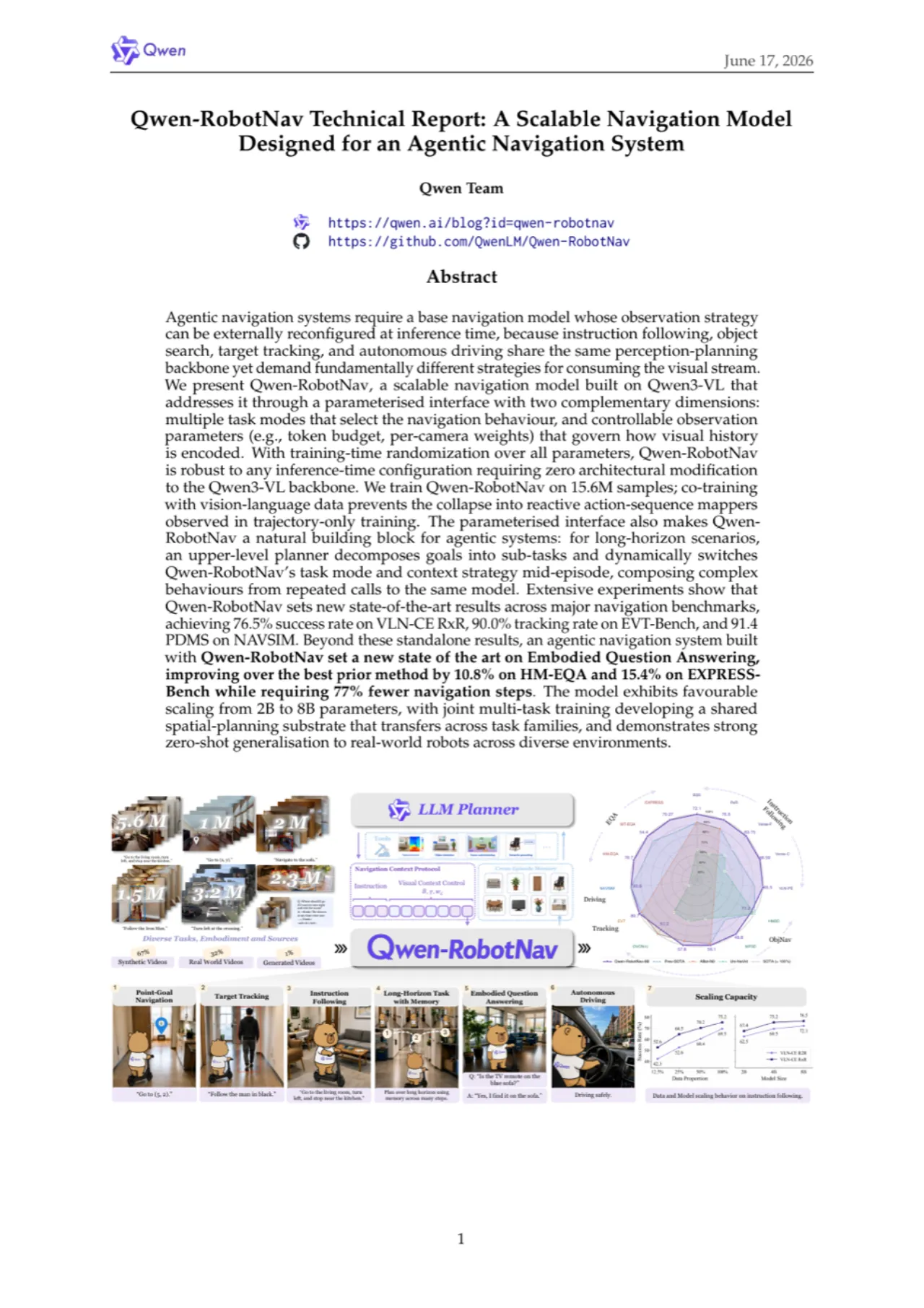
图 1(第 1 页):Qwen-RobotNav 系统全景。左侧展示 15.6M 多样化训练数据来源(合成视频、真实视频、生成视频);
中间为两层架构:上层 LLM Planner(如 Qwen3.6-Plus)通过 Navigation Context Protocol 动态调度任务模式与观测配置,
下层 Qwen-RobotNav 高频输出路径点;右侧雷达图对比多个基准上的性能;
底部展示七项核心能力:点目标导航、目标追踪、指令跟随、带记忆的长时任务、具身问答、自动驾驶和模型规模扩展。Figure 1 (page 1):Overview of the Qwen-RobotNav system. Left: the 15.6M diverse training data sources (synthetic video, real video, generated video); middle: the two-layer architecture, in which a high-level LLM Planner (e.g. Qwen3.6-Plus) dispatches task modes and observation configurations dynamically via the Navigation Context Protocol, while the lower-level Qwen-RobotNav emits waypoints at high frequency; right: radar charts comparing performance across benchmarks; bottom: the seven core capabilities — point-goal navigation, object tracking, instruction following, long-horizon tasks with memory, embodied question answering, autonomous driving and model scaling.
76.5%VLN-CE RxR SR(Val-Unseen 全景)VLN-CE RxR SR (Val-Unseen, panoramic)
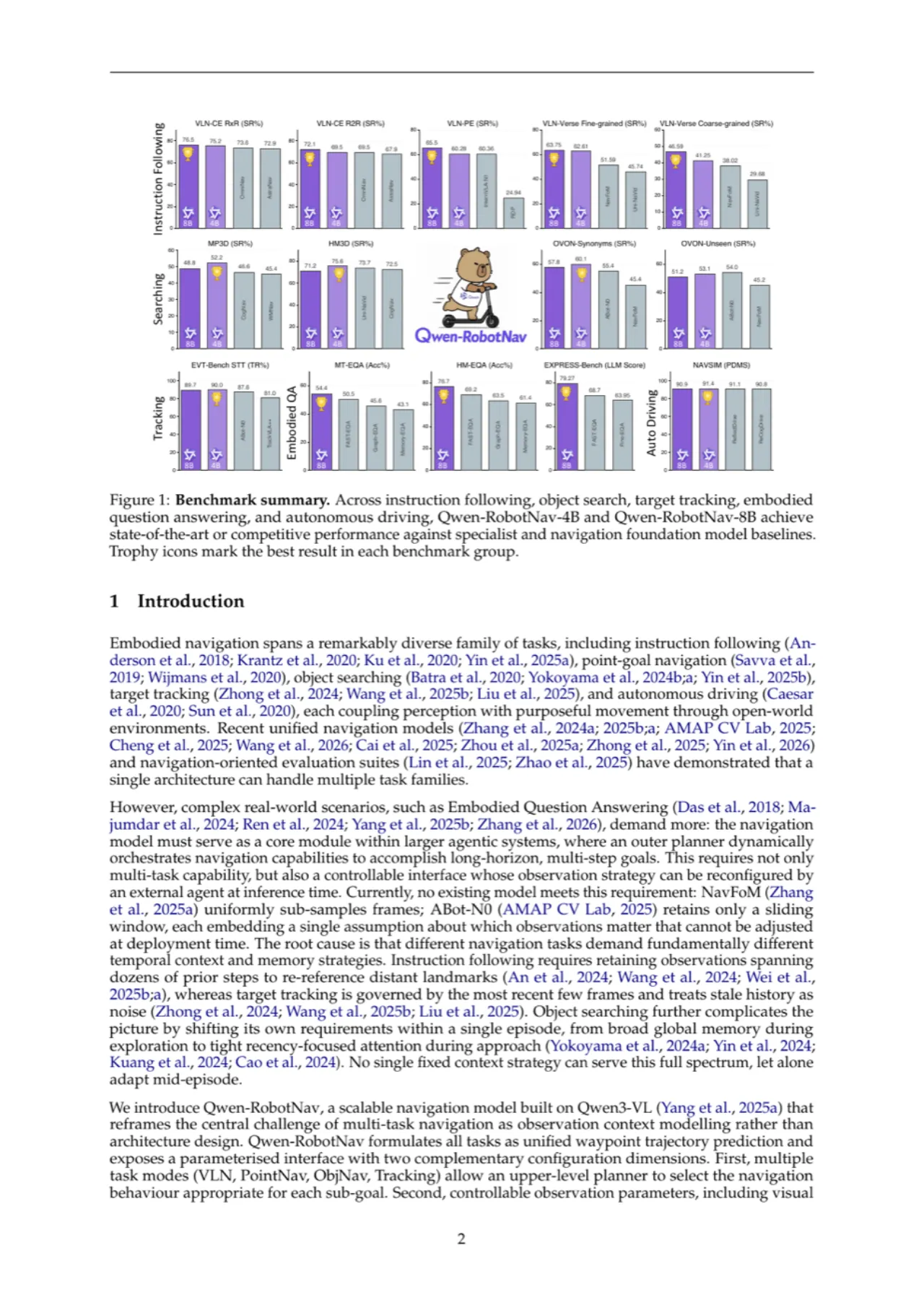
图 2(第 2 页,Figure 1):基准汇总图。Qwen-RobotNav-4B 和 8B 在指令跟随(VLN-CE、VLNVerse)、
目标搜索(MP3D、HM3D-OVON)、目标追踪(EVT-Bench)、具身问答(HM-EQA、MT-EQA、EXPRESS-Bench)和
自动驾驶(NAVSIM)五个维度均达到最优或竞争性性能,奖杯图标标注各组最佳方法。Figure 2 (page 2, Figure 1):Benchmark summary. Qwen-RobotNav-4B and 8B reach the best or competitive performance across five dimensions — instruction following (VLN-CE, VLNVerse), object search (MP3D, HM3D-OVON), object tracking (EVT-Bench), embodied question answering (HM-EQA, MT-EQA, EXPRESS-Bench) and autonomous driving (NAVSIM); trophy icons mark the best method in each group.
02方法Method
Qwen-RobotNav 将所有导航任务统一为路径点轨迹预测,并通过两个正交维度的参数化接口暴露可配置的观测策略:
(1)多任务模式(VLN / PointNav / ObjNav / Tracking)选择导航行为;
(2)可控观测参数(视觉 token 预算 B、时间衰减 γ、per-camera 权重 wc、帧采样模式)
控制视觉历史编码方式。训练时对所有参数进行随机化,确保推理时无需任何架构修改即可适应任意配置。Qwen-RobotNav unifies all navigation tasks as waypoint trajectory prediction and exposes a configurable observation strategy through a parameterised interface along two orthogonal dimensions: (1) the multi-task mode (VLN / PointNav / ObjNav / Tracking) selects the navigation behaviour; (2) the controllable observation parameters (visual token budget B, temporal decay γ, per-camera weight wc, frame sampling mode) control how the visual history is encoded. All parameters are randomised during training, ensuring that any configuration can be adopted at inference time without architectural modification.
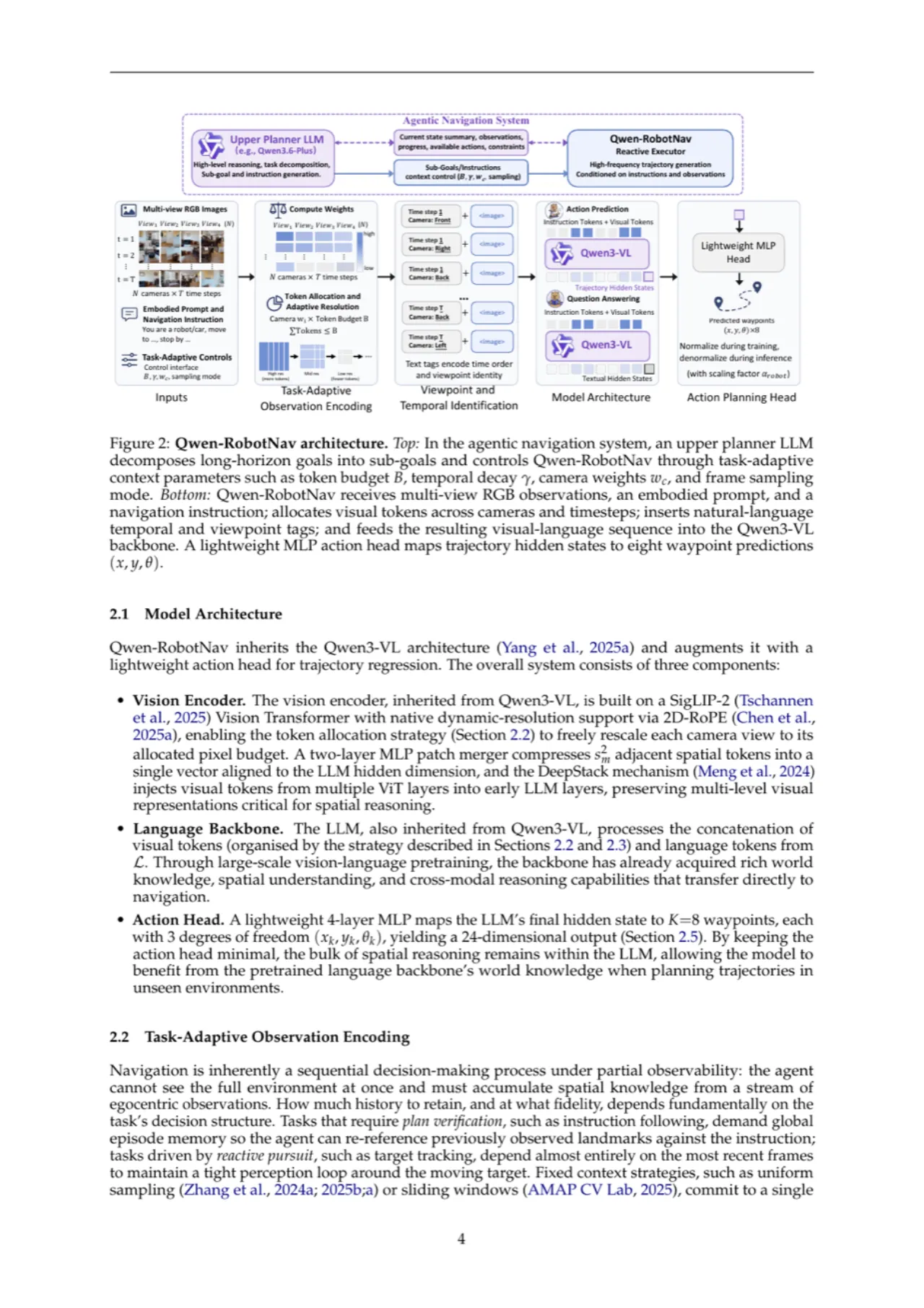
图 3(第 4 页,Figure 2):Qwen-RobotNav 整体架构。
上:智能体导航系统中,上层 LLM Planner 将长时任务分解为子目标,通过任务自适应上下文参数(token 预算 B、时间衰减 γ、相机权重 wc、帧采样模式)控制 Qwen-RobotNav。
下:Qwen-RobotNav 接收多路 RGB 图像、嵌入式提示和导航指令;
Task-Adaptive Observation Encoding 模块跨相机和时间步分配 token;
Viewpoint and Temporal Identification 模块插入自然语言视角与时间戳标签;
Qwen3-VL backbone 处理视觉-语言序列;轻量 MLP Action Head 输出 K=8 个路径点 (x, y, θ)。Figure 3 (page 4, Figure 2):Overall architecture of Qwen-RobotNav. Top: in the agentic navigation system, the high-level LLM Planner decomposes a long-horizon task into subgoals and controls Qwen-RobotNav through task-adaptive context parameters (token budget B, temporal decay γ, camera weight wc, frame sampling mode). Bottom: Qwen-RobotNav takes multi-camera RGB images, embedded prompts and the navigation instruction; the Task-Adaptive Observation Encoding module allocates tokens across cameras and time steps; the Viewpoint and Temporal Identification module inserts natural-language view and timestamp labels; the Qwen3-VL backbone processes the vision-language sequence; a lightweight MLP Action Head outputs K=8 waypoints (x, y, θ).
Task-Adaptive Observation Encoding
导航是部分可观测下的序列决策,不同任务对历史帧的需求截然不同。
Qwen-RobotNav 通过时间权重函数
ωt = exp(γ · t/(T'−1)) 对各帧分配 token,
再结合 per-camera 重要性权重 wc 构建二维权重矩阵 W[t,c],
最后用受约束分配算法在预算 B(2048–4096)内按比例分配每张图片的像素分辨率。
γ=0 对应均匀采样,γ 越大越向最近帧集中——当 γ=2 时,最新帧获得最旧帧约 7.4 倍的 token 预算。
训练时所有参数独立随机采样,令模型对任意推理配置均具鲁棒性。Navigation is sequential decision making under partial observability, and different tasks have drastically different demands on historical frames. Qwen-RobotNav allocates tokens to each frame through the temporal weighting function ωt = exp(γ · t/(T'−1)), then combines it with the per-camera importance weight wc to build a two-dimensional weight matrix W[t,c], and finally uses a constrained allocation algorithm to distribute the pixel resolution of each image proportionally within the budget B (2048–4096). γ=0 corresponds to uniform sampling, and the larger γ is the more the budget concentrates on recent frames — at γ=2 the newest frame receives about 7.4 times the token budget of the oldest frame. During training all parameters are sampled independently at random, making the model robust to any inference configuration.
Viewpoint and Temporal Identification
多相机、多时间步的视觉 token 在输入 LLM 前本质上是不可区分的。
Qwen-RobotNav 在每个时间步组前插入自然语言标签(如 Time step 1 Front View <image> Right View <image> ...),
完全依赖 Qwen3-VL 已有的词汇理解能力,无需额外参数或嵌入,同时保留了开放世界语言先验。Visual tokens from multiple cameras and multiple time steps are inherently indistinguishable before they enter the LLM. Qwen-RobotNav inserts a natural-language label before each time-step group (e.g. Time step 1 Front View <image> Right View <image> ...), relying entirely on the vocabulary understanding Qwen3-VL already possesses, requiring no additional parameters or embeddings while preserving the open-world language prior.
Embodiment-Aware Prompt Design
不同物理平台(室内移动机器人 vs. 自动驾驶汽车)通过系统提示中的自然语言前言区分:
室内机器人以 "Imagine you are a robot programmed for navigation tasks" 开始,
自动驾驶以 "Imagine you are a car programmed for autonomous driving" 开始。
支持新平台仅需定义新提示模板,无需任何架构修改。Different physical platforms (an indoor mobile robot vs. an autonomous car) are distinguished by a natural-language preamble in the system prompt: the indoor robot starts with "Imagine you are a robot programmed for navigation tasks", while autonomous driving starts with "Imagine you are a car programmed for autonomous driving". Supporting a new platform only requires defining a new prompt template, with no architectural modification.
联合训练策略Joint Training Strategy
训练目标为轨迹回归损失与视觉-语言对齐损失的组合:
L = Ltraj + λ LVL(λ=1.0)。
语料库由 85% 导航轨迹数据和 15% 视觉-语言推理数据混合组成,
联合训练防止模型退化为纯反应式动作序列预测器,保持开放世界感知能力。
8B 模型以批量大小 256 共训练 2,816 H100 GPU 小时。The training objective combines a trajectory regression loss with a vision-language alignment loss: L = Ltraj + λ LVL (λ=1.0). The corpus mixes 85% navigation trajectory data with 15% vision-language reasoning data; joint training prevents the model from degenerating into a purely reactive action-sequence predictor and preserves open-world perception. The 8B model was trained with batch size 256 for a total of 2,816 H100 GPU hours.
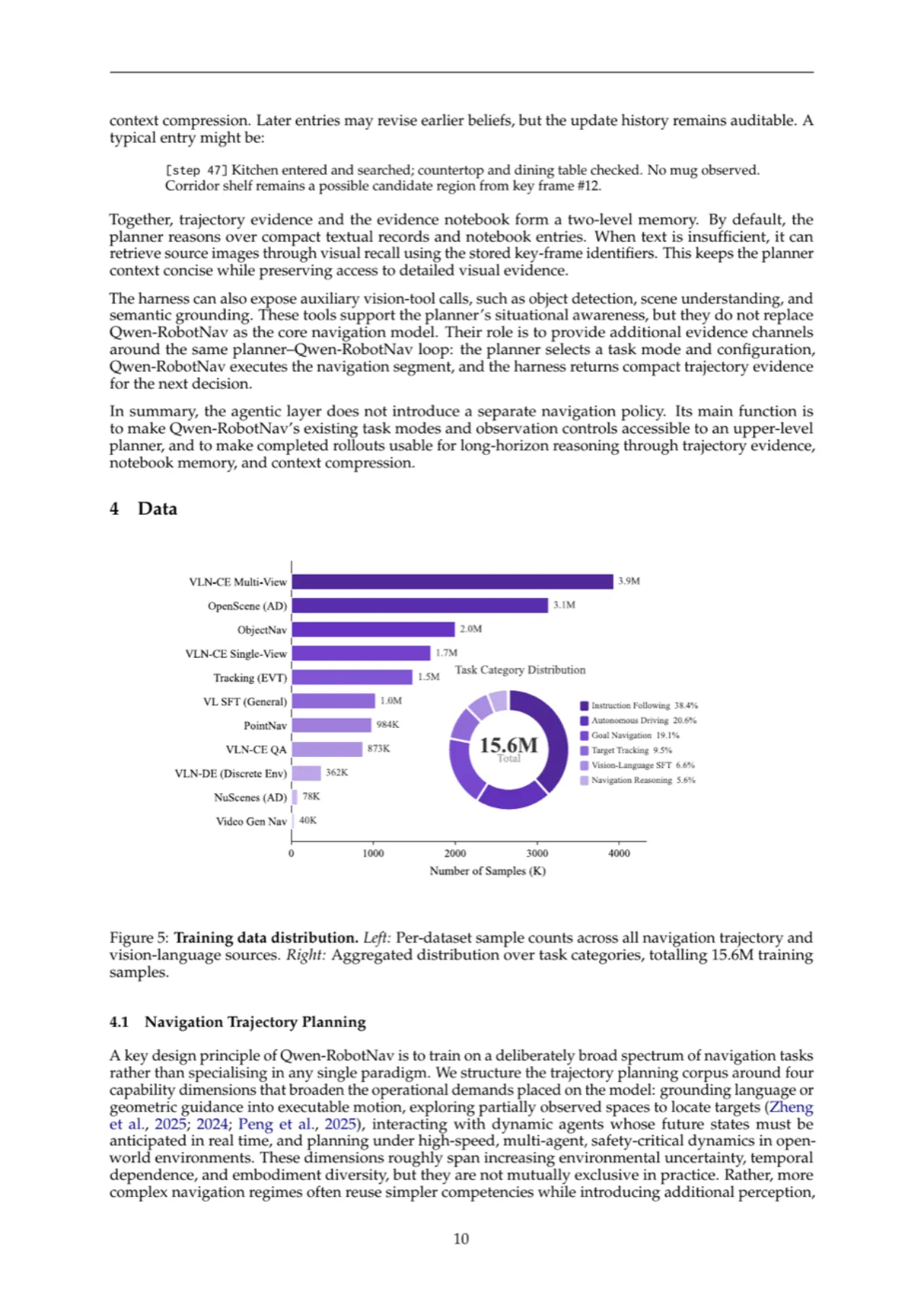
图 4(第 10 页,Figure 5):训练数据分布。左:各数据集样本量,VLN-CE Multi-View(3.9M)最大;
右:按任务类别聚合,共 15.6M 样本——指令跟随占 38.4%,自动驾驶 20.6%,目标导航 19.1%,目标追踪 9.5%,
Vision-Language SFT 6.6%,导航推理 5.6%。Figure 4 (page 10, Figure 5):Training data distribution. Left: sample counts per dataset, with VLN-CE Multi-View (3.9M) the largest; right: aggregated by task category, 15.6M samples in total — instruction following 38.4%, autonomous driving 20.6%, object-goal navigation 19.1%, object tracking 9.5%, Vision-Language SFT 6.6%, navigation reasoning 5.6%.
智能体导航系统(Agentic Navigation)Agentic Navigation System
Qwen-RobotNav 作为可被外部调用的导航执行器暴露工具接口:
Wi = nav_qwennav(Li, τi, Φi),
其中 Li 为子目标指令、τi 为任务模式、Φi 为观测配置。
上层 LLM Planner(Qwen3.6-Plus)将长时任务分解为子目标并动态切换模式和配置;
Navigation Harness 将每次导航执行结果压缩为轨迹证据记录(subgoal、progress、salient landmarks、key_frames),
维护跨回合的证据笔记本,支持长时推理与上下文压缩。Qwen-RobotNav exposes a tool interface as an externally callable navigation executor: Wi = nav_qwennav(Li, τi, Φi), where Li is the subgoal instruction, τi the task mode and Φi the observation configuration. The high-level LLM Planner (Qwen3.6-Plus) decomposes a long-horizon task into subgoals and switches modes and configurations dynamically; the Navigation Harness compresses the outcome of each navigation execution into a trajectory evidence record (subgoal, progress, salient landmarks, key_frames), maintaining an evidence notebook across turns to support long-horizon reasoning and context compression.
03实验Experiments
评测覆盖视觉-语言导航(VLN-CE R2R/RxR、VLNVerse、VLN-PE)、开放词汇目标导航(MP3D、HM3D-OVON)、
主动视觉追踪(EVT-Bench STT)、具身问答(HM-EQA、MT-EQA、EXPRESS-Bench)和自动驾驶(NAVSIM、AlpaSim)五大类别,
与 NavFoM、ABot-N0 等导航基础模型及各专项方法对比。The evaluation covers five categories — vision-and-language navigation (VLN-CE R2R/RxR, VLNVerse, VLN-PE), open-vocabulary object-goal navigation (MP3D, HM3D-OVON), active visual tracking (EVT-Bench STT), embodied question answering (HM-EQA, MT-EQA, EXPRESS-Bench) and autonomous driving (NAVSIM, AlpaSim) — compared against navigation foundation models such as NavFoM and ABot-N0 as well as task-specific methods.
VLN-CE 指令跟随VLN-CE Instruction Following
方法Method
R2R SR↑
R2R SPL↑
RxR SR↑
RxR nDTW↑
NavFoM(全景)NavFoM (panoramic)
72.1
61.7
64.4
65.8
ABot-N0(全景)ABot-N0 (panoramic)
70.8
64.3
69.3
–
AstraNav-World(全景)AstraNav-World (panoramic)
73.9
67.9
72.9
–
Qwen-RobotNav-4B(全景)Qwen-RobotNav-4B (panoramic)
77.2
69.5
75.2
71.9
Qwen-RobotNav-8B(全景)Qwen-RobotNav-8B (panoramic)
78.5
72.1
76.5
72.5
全景设置下,Qwen-RobotNav-8B 在 R2R 达到 72.1% SR 和 76.5% SR(RxR),
分别超越 NavFoM 10.4% SR 和 ABot-N0 5.7% SR(R2R)。
单目设置下,Qwen-RobotNav-4B 在 R2R 达到 66.9% SR 和 60.5% SPL,
超越最强单目基线 DualVLN 2.6% SR 和 2.0% SPL。Under the panoramic setting, Qwen-RobotNav-8B reaches 72.1% SR on R2R and 76.5% SR (RxR), exceeding NavFoM by 10.4% SR and ABot-N0 by 5.7% SR (R2R) respectively. Under the monocular setting, Qwen-RobotNav-4B reaches 66.9% SR and 60.5% SPL on R2R, surpassing the strongest monocular baseline DualVLN by 2.6% SR and 2.0% SPL.
目标导航(ObjNav)Object-Goal Navigation (ObjNav)
方法Method
MP3D SR↑
HM3D v2 SR↑
HM3D-OVON Seen SR↑
HM3D-OVON Unseen SR↑
CogNav
46.6
–
–
–
ABot-N0
–
–
55.4
54.0
NavFoM
–
–
45.4
45.2
Qwen-RobotNav-4B
52.2
75.6
57.7
53.1
Qwen-RobotNav-8B
48.8
71.2
56.1
51.2
HM3D v2 上,Qwen-RobotNav-4B 达到 75.6% SR,距离目标仅 1.72 m,
超越即便是基于 HM3D v1(更简单版本)的所有先前方法。
在 HM3D-OVON(开放词汇),Qwen-RobotNav-4B 仅使用单目前向摄像头便超越使用全景多视图的 ABot-N0,
在 Seen 和 Synonyms 两个划分上分别领先 2.4% 和 4.7% SR。On HM3D v2, Qwen-RobotNav-4B reaches 75.6% SR with a distance to goal of only 1.72 m, surpassing all previous methods, even those based on HM3D v1 (the easier version). On HM3D-OVON (open vocabulary), Qwen-RobotNav-4B uses only a monocular forward-facing camera yet outperforms ABot-N0, which uses panoramic multi-view input, leading by 2.4% and 4.7% SR on the Seen and Synonyms splits respectively.
Qwen-RobotNav-4B 以 90.0% TR 在所有方法中取得最高追踪率,
比 ABot-N0 高 2.4%、比 NavFoM 高 9.5%;
8B 版本碰撞率最低(5.70%)。成功率略低于专项追踪器(ABot-N0 86.9%),
论文认为广泛多任务训练引入了更保守的停止策略——追踪行为与停止判断之间存在权衡。With 90.0% TR, Qwen-RobotNav-4B achieves the highest tracking rate among all methods, 2.4% above ABot-N0 and 9.5% above NavFoM; the 8B version has the lowest collision rate (5.70%). Its success rate is slightly below dedicated trackers (ABot-N0 86.9%), which the paper attributes to a more conservative stopping policy induced by broad multi-task training — a trade-off between following behaviour and success declaration.
具身问答(EQA)Embodied Question Answering (EQA)
方法Method
HM-EQA Acc↑
HM-EQA Steps↓
MT-EQA Acc↑
EXPRESS-Bench LLM Score↑
FAST-EQA
69.2
0.65
50.5
68.7
Qwen3.5-Plus+QwenRobotNav-8B
74.1
0.17
52.1
77.66
Qwen3.6-Plus+QwenRobotNav-8B
76.7
0.15
54.4
79.27
智能体系统在 EQA 三项基准全面超越现有方法。与 FAST-EQA 对比:HM-EQA +7.5 点,MT-EQA +3.9 点,EXPRESS-Bench +10.57 分,
同时导航步数减少 77%(0.65 → 0.15)。The agentic system outperforms existing methods on all three EQA benchmarks. Compared with FAST-EQA: HM-EQA +7.5 points, MT-EQA +3.9 points, EXPRESS-Bench +10.57 points, while reducing the number of navigation steps by 77% (0.65 → 0.15).
自动驾驶(NAVSIM)Autonomous Driving (NAVSIM)
方法Method
NC↑
DAC↑
TTC↑
PDMS↑
NavFoM
97.7
93.5
92.3
84.3
ReCogDrive
97.9
97.3
94.9
90.8
ReflectDrive
97.7
99.3
93.5
91.1
Qwen-RobotNav-4B
99.8
90.9
98.5
91.4
Qwen-RobotNav-8B
99.8
96.9
98.2
90.9
Qwen-RobotNav-4B 在 NAVSIM 达到 91.4 PDMS,超越 NavFoM 7.1 分;
NC(99.8)和 TTC(98.5)均领先所有方法,显示出强安全性约束遵从能力。Qwen-RobotNav-4B reaches 91.4 PDMS on NAVSIM, exceeding NavFoM by 7.1 points; its NC (99.8) and TTC (98.5) lead all methods, showing strong compliance with safety constraints.
数据规模与消融分析Data Scaling and Ablation Analysis
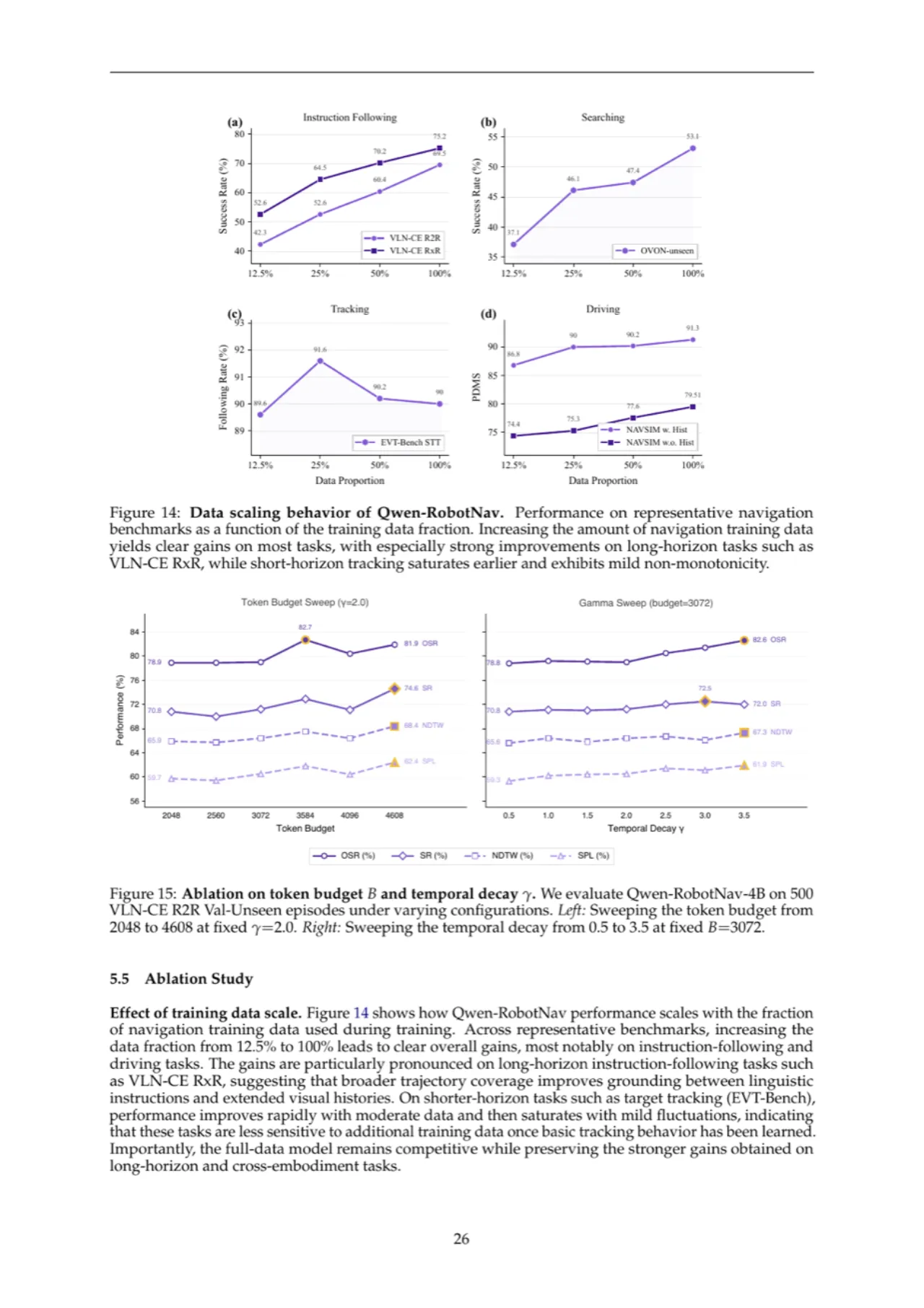
图 5(第 26 页,Figure 14–15):上:数据比例从 12.5% 增至 100%,指令跟随(VLN-CE RxR)和驾驶(NAVSIM)收益最显著;追踪任务(EVT-Bench)在较少数据下即饱和。
下左:固定 γ=2.0 时,token 预算 B 从 2048 增至 4608,SR 从 70.8% 升至 74.6%,OSR 在 B=3584 时达峰值 82.7%;
下右:固定 B=3072 时,γ 从 0.5 增至 3.5,OSR 持续改善(78.8% → 82.6%),SR 在 γ=3.0 时达峰 72.5%。Figure 5 (page 26, Figure 14–15):Top: as the data fraction grows from 12.5% to 100%, instruction following (VLN-CE RxR) and driving (NAVSIM) gain the most, while the tracking task (EVT-Bench) saturates with far less data. Bottom left: with γ=2.0 fixed, raising the token budget B from 2048 to 4608 lifts SR from 70.8% to 74.6%, and OSR peaks at 82.7% for B=3584; Bottom right: with B=3072 fixed, increasing γ from 0.5 to 3.5 steadily improves OSR (78.8% → 82.6%), while SR peaks at 72.5% for γ=3.0.
消融结论:保留更多视觉上下文整体有益,但超出某阈值后分配不当会带来收益递减;
较大 γ 使模型更聚焦近期帧、增强场景解析能力,但代价是丢失早期历史上下文,
对严格依赖全局历史的成功率指标产生轻微负面影响。Ablation conclusion: retaining more visual context is beneficial overall, but beyond a certain threshold improper allocation brings diminishing returns; a larger γ makes the model focus more on recent frames and strengthens scene parsing, at the cost of losing early historical context, which slightly hurts success-rate metrics that strictly depend on global history.
真实机器人部署Real-Robot Deployment
Qwen-RobotNav 在四足机器人(Unitree Go2)上实现零样本迁移:
在真实展览大厅(21.78 m 路程)通过纯自然语言指令完成跨区域导航,
并在接到「倒退」指令时精确沿原路返回起始位置。
在室内公寓场景,模型在卧室、客厅、浴室间多房间穿行,响应精细空间指令。
推理时延:远程服务器 196 ms(5.1 Hz),板端 TensorRT 加速 204 ms(4.9 Hz)。Qwen-RobotNav transfers zero-shot to a quadruped robot (Unitree Go2): in a real exhibition hall (a 21.78 m route) it completes cross-area navigation from purely natural-language instructions, and on receiving a "go backward" instruction it retraces the original path precisely back to the starting position. In an indoor apartment scene the model moves across multiple rooms — bedroom, living room, bathroom — responding to fine-grained spatial instructions. Inference latency: 196 ms (5.1 Hz) on a remote server, and 204 ms (4.9 Hz) on board with TensorRT acceleration.
04局限性Limitations
说明:论文无独立 Limitations 章节。以下第 1 条为作者在实验分析中明确陈述的权衡,第 2–4 条为从设计与实验结果推断的局限(标注「推断」)。Note:The paper has no standalone Limitations section. Item 1 below is a trade-off explicitly stated by the authors in their experimental analysis; items 2–4 are limitations inferred from the design and the experimental results (marked "inferred").
目标追踪的成功率-追踪率权衡(作者明确指出)Success-rate / tracking-rate trade-off in object tracking (explicitly noted by the authors)
EVT-Bench 上追踪率(TR)最高,但成功率(SR)低于专项追踪器 ABot-N0(77.4% vs. 86.9%)和 TrackVLA++(77.4% vs. 86.0%)。
论文原文:"We hypothesise that the broader multi-task training of Qwen-RobotNav introduces a trade-off where the model maintains tighter following behaviour (superior TR) while being more conservative in declaring episode success."On EVT-Bench the tracking rate (TR) is the highest, but the success rate (SR) is below the dedicated trackers ABot-N0 (77.4% vs. 86.9%) and TrackVLA++ (77.4% vs. 86.0%). Quoting the paper: "We hypothesise that the broader multi-task training of Qwen-RobotNav introduces a trade-off where the model maintains tighter following behaviour (superior TR) while being more conservative in declaring episode success."
路径效率(SPL)低于专项探索模型(作者在 ObjNav 分析中指出)Path efficiency (SPL) below dedicated exploration models (noted by the authors in the ObjNav analysis)
HM3D-OVON 上,Qwen-RobotNav 的 SPL 低于 NavFoM 和 ABot-N0,反映骨架探索训练轨迹倾向于逐房间系统性搜索(提高目标发现率),但路径更长。
论文原文:"The lower SPL of Qwen-RobotNav relative to NavFoM and ABot-N0 reflects a reach-first exploration behaviour."On HM3D-OVON the SPL of Qwen-RobotNav is lower than that of NavFoM and ABot-N0, reflecting that the skeleton exploration training trajectories favour a systematic room-by-room search (raising the object discovery rate) at the price of longer paths. Quoting the paper: "The lower SPL of Qwen-RobotNav relative to NavFoM and ABot-N0 reflects a reach-first exploration behaviour."
AlpaSim 封闭循环自动驾驶泛化不足(推断)Insufficient generalisation to AlpaSim closed-loop autonomous driving (inferred)
在 AlpaSim(PhysicalAI-AV NuRec 数据集)零样本评测中,Qwen-RobotNav-4B/8B 的 AlpaSim Score(0.15/0.17)
显著低于专项模型 Alpamayo-R1-10B(0.72),Off-Road Rate 也更高。
这表明跨场景迁移至专用封闭循环自动驾驶仍存在显著差距,需要领域适应。In the zero-shot evaluation on AlpaSim (the PhysicalAI-AV NuRec dataset), the AlpaSim Score of Qwen-RobotNav-4B/8B (0.15/0.17) is markedly lower than that of the dedicated model Alpamayo-R1-10B (0.72), and its Off-Road Rate is also higher. This indicates that a substantial gap remains in transferring across scenes to dedicated closed-loop autonomous driving, and that domain adaptation is needed.
token 分配算法的理论最优性有限(作者注释)Limited theoretical optimality of the token allocation algorithm (author remark)
论文原文:"We believe this strategy could be further improved by a more principled token allocation algorithm."
当前 token 预算分配基于经验启发式,并非最优;消融实验也显示过大预算带来收益递减甚至略有下降。Quoting the paper: "We believe this strategy could be further improved by a more principled token allocation algorithm." The current token budget allocation is based on empirical heuristics and is not optimal; the ablations also show that an overly large budget brings diminishing returns and even a slight drop.