统一相机感知与生成的多模态模型A Unified Multimodal Model for Camera-Centric Understanding and Generation
Kang Liao, Size Wu, Zhonghua Wu, Linyi Jin, Chao Wang, Yikai Wang, Fei Wang, Wei Li, Chen Change Loy · S-Lab NTU · SenseTime Research · University of Michigan · Max-Planck Institute
Puffin 将相机参数视为语言模态,通过"Thinking with Camera"机制,在同一框架内统一实现相机几何理解(calibration)与可控图像生成(novel view synthesis),在 MegaDepth、TartanAir 等多个基准上超越专用方法。Puffin treats camera parameters as a language modality and, through the "Thinking with Camera" mechanism, unifies camera geometry understanding (calibration) and controllable image generation (novel view synthesis) within a single framework, surpassing specialized methods on multiple benchmarks such as MegaDepth and TartanAir.
camera calibration相机理解与生成camera understanding and generation多模态模型multimodal modelthinking with cameradiffusion modelnovel view synthesisspatial intelligencePuffin-4M
01动机Motivation
相机几何理解(从图像估计 roll/pitch/FoV 等参数)与可控图像生成(按指定视角合成场景)是空间智能的两大基石,但长期以来被作为独立任务研究。现有方法将相机参数当作辅助数字标签,忽视了其本身作为模态的语义价值,导致模型在追求语义对齐时忽略精确的空间约束,性能次优。Camera geometry understanding (estimating parameters such as roll/pitch/FoV from an image) and controllable image generation (synthesizing a scene from a specified viewpoint) are two cornerstones of spatial intelligence, yet they have long been studied as separate tasks. Existing methods treat camera parameters as auxiliary numerical labels and overlook their semantic value as a modality in their own right, so models chasing semantic alignment neglect precise spatial constraints and remain suboptimal.
"Camera-centric understanding and generation are two cornerstones of spatial intelligence, yet they are typically studied in isolation."
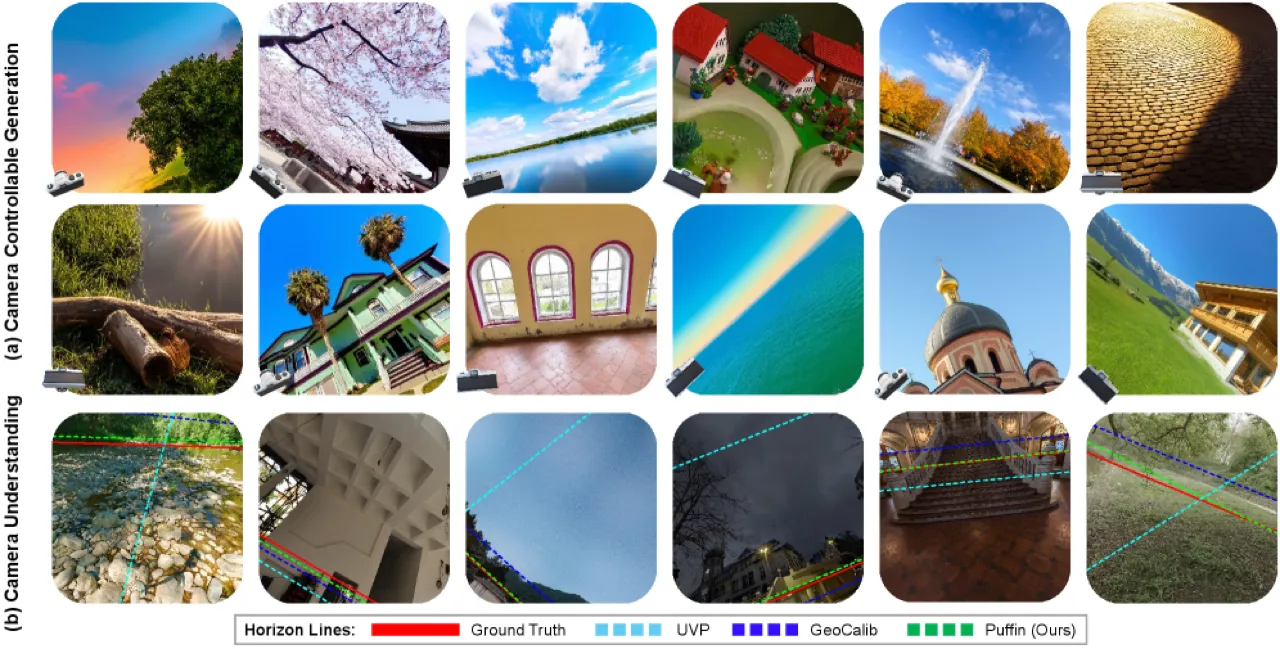
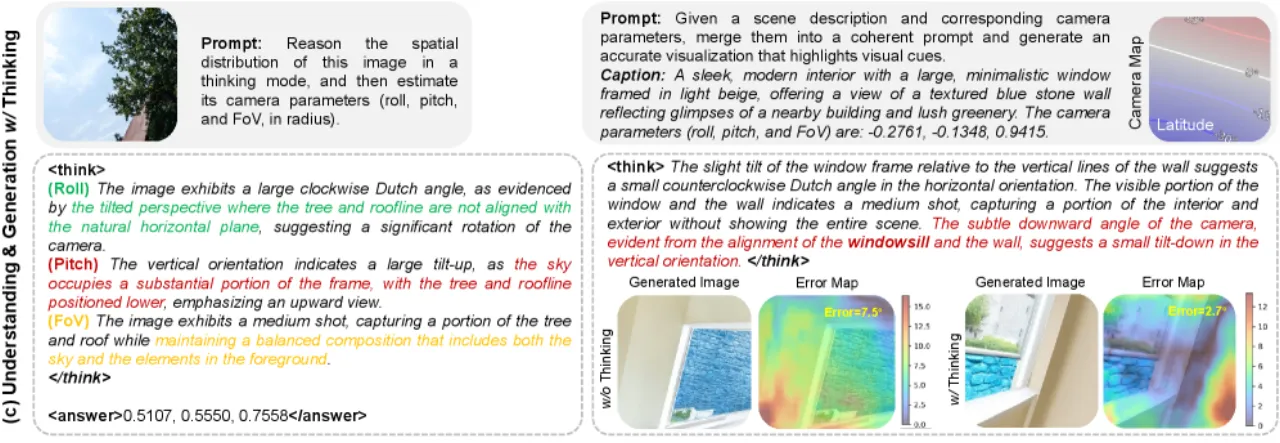
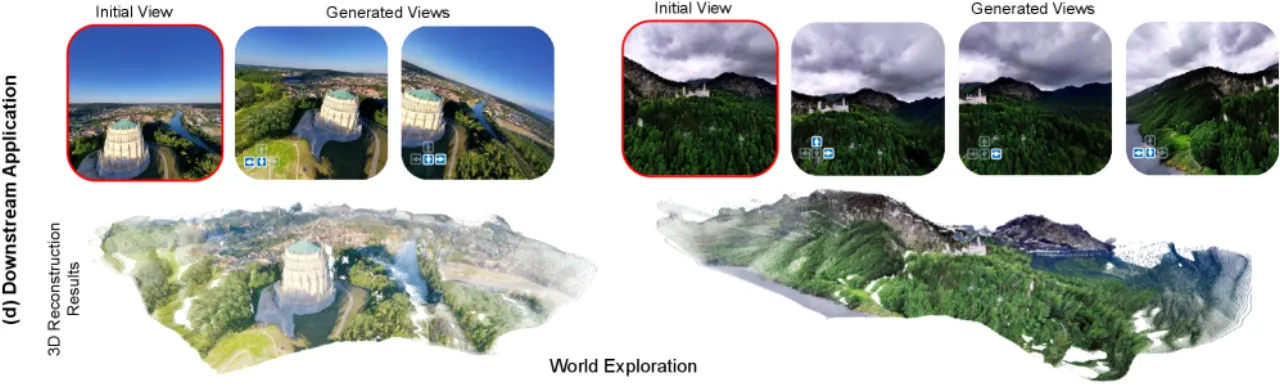
图 1:Puffin 的多样化能力。(a)可控图像生成:根据相机参数合成任意视角图像;(b)相机几何理解:从单张图像回归 roll/pitch/FoV;(c)Thinking with Camera 模式:通过自然语言空间推理辅助几何估计;(d)下游 3D 应用:虚拟物体插入、世界探索等。Figure 1: Puffin's diverse capabilities. (a) Controllable image generation: synthesizing an image from an arbitrary viewpoint given camera parameters; (b) camera geometry understanding: regressing roll/pitch/FoV from a single image; (c) Thinking with Camera mode: assisting geometric estimation through spatial reasoning in natural language; (d) downstream 3D applications: virtual object insertion, world exploration, and more.
核心挑战在于模态鸿沟:相机参数是抽象的数值(如 FoV=72°),缺乏视觉语义,而大型多模态模型(LMM)的训练目标是语义对齐。现有做法要么独立训练专用的几何估计器,要么将参数硬编码为辅助标签,均未能充分利用 LMM 的视觉-语言推理能力。Puffin 提出将相机参数视为一种语言,用摄影专业术语(如 "tilt-up"、"Dutch angle"、"close-up")作为中间表示,弥合数值几何与高层语义之间的差距。The core challenge is the modality gap: camera parameters are abstract numbers (e.g. FoV=72°) that carry no visual semantics, whereas large multimodal models (LMMs) are trained for semantic alignment. Existing practice either trains a dedicated geometry estimator in isolation or hard-codes the parameters as auxiliary labels, and neither fully exploits the vision-language reasoning ability of LMMs. Puffin instead treats camera parameters as a kind of language, using professional photographic terms (such as "tilt-up", "Dutch angle", "close-up") as an intermediate representation that bridges numerical geometry and high-level semantics.
0.32°Roll 误差error (MegaDepth) vs. GeoCalib 0.36°
1.08°Pitch 误差error (MegaDepth) vs. GeoCalib 1.94°
2.42°FoV 误差error (MegaDepth) vs. GeoCalib 4.46°
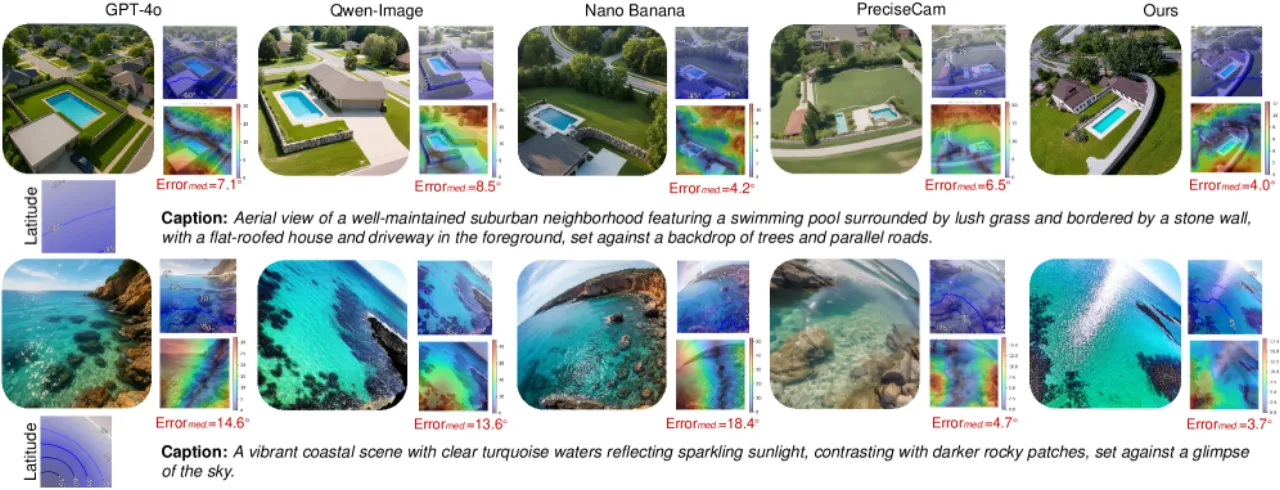
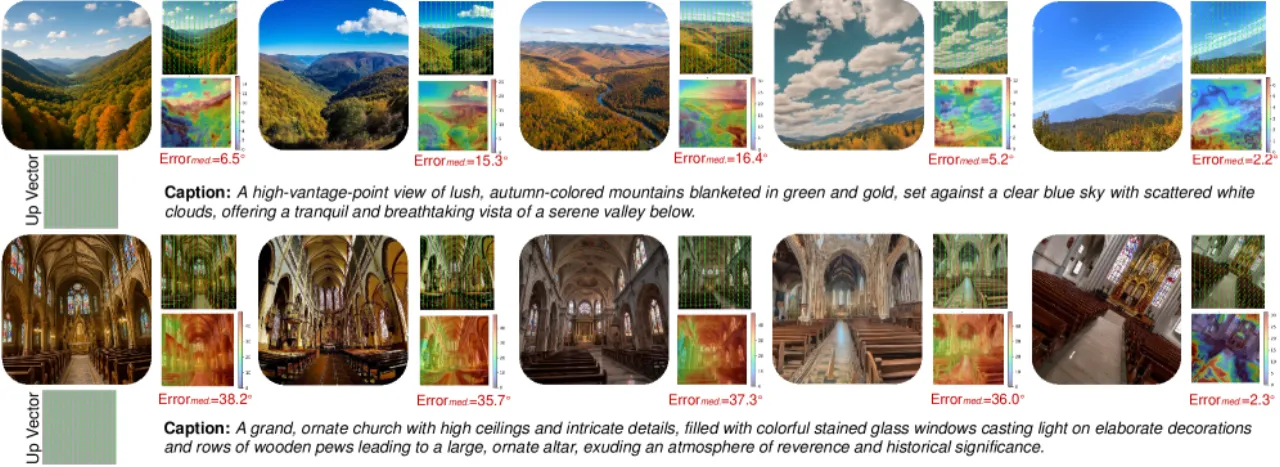
11.94°Up Vector 误差(生成评估)error (generation eval) vs. PreciseCam 18.66°
02方法Method
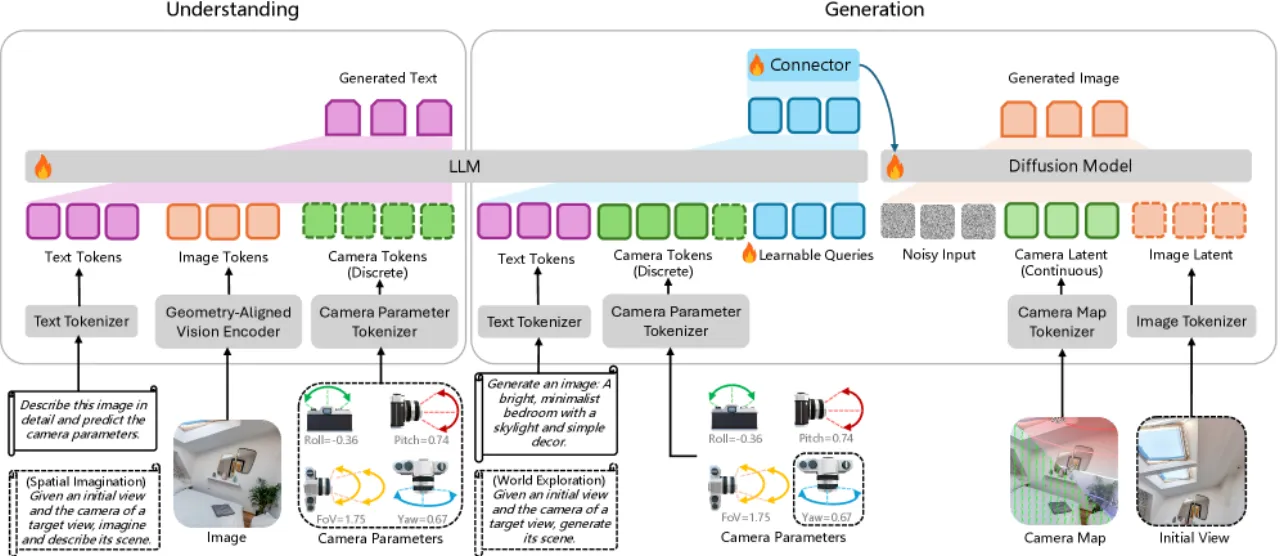
Puffin 以自回归语言回归(camera understanding)和扩散模型生成(camera-controllable generation)为双主干,通过共享的"Thinking with Camera"链式推理将二者统一。整个系统基于四阶段渐进式训练策略,在 Puffin-4M 数据集上训练,共耗时约 4 天(64 A100 GPU)。Puffin rests on two backbones — autoregressive language regression (camera understanding) and diffusion-based generation (camera-controllable generation) — and unifies them through a shared "Thinking with Camera" chain of reasoning. The whole system follows a four-stage progressive training strategy and is trained on the Puffin-4M dataset, taking about 4 days in total (64 A100 GPUs).
图 2:统一框架概览。Puffin 以单张图像为输入,通过语言分支回归相机参数(理解任务),同时以文本描述和相机参数为条件通过扩散分支生成图像(生成任务)。两个分支共享视觉编码器,通过"Thinking with Camera"机制实现联动。Figure 2: Overview of the unified framework. Taking a single image as input, Puffin regresses camera parameters through the language branch (understanding task) while generating images through the diffusion branch conditioned on a text description and camera parameters (generation task). The two branches share the vision encoder and are coupled through the "Thinking with Camera" mechanism.
Thinking with Camera 机制Mechanism
该机制的核心思想是将三类空间先验编码进 chain-of-thought 推理链:The core idea of this mechanism is to encode three kinds of spatial prior into the chain-of-thought reasoning chain:
Spatially Grounded Visual Cues: textureless regions such as sky, ceiling and ground lack local features, yet they carry a strong prior on the vertical direction and are especially critical for pitch estimation. Puffin makes such implicit priors explicit and embeds them into the "thinking caption".
Professional Photographic Terms(摄影专业术语):用 "close-up"、"tilt-up"、"Dutch angle" 等摄影师常用词汇替代裸数值,与 LMM 训练语料中的知识高度对齐,充当几何与语义之间的桥梁。
Professional Photographic Terms: replacing bare numbers with vocabulary commonly used by photographers, such as "close-up", "tilt-up" and "Dutch angle", aligns closely with the knowledge in LMM training corpora and serves as a bridge between geometry and semantics.
Geometric Context: the roll/pitch/FoV dimensions are decoupled, each parameter is anchored to a semantic descriptor, and the result is finally fed into the diffusion model as a continuous latent that supplies a fine-grained spatial prior.
图 3:范式对比。传统方法(左)将相机参数视为纯数值标签;Puffin(右)引入摄影术语作为中间推理步骤,形成"空间线索 → 语言推理 → 精确估计"的完整链路。Figure 3: Paradigm comparison. Conventional methods (left) treat camera parameters as purely numerical labels; Puffin (right) introduces photographic terms as an intermediate reasoning step, forming a complete chain of "spatial cues → language reasoning → precise estimation".
模型架构Model Architecture
Puffin 由四个核心模块构成:Puffin comprises four core modules:
Geometry-aligned Vision Encoder:采用 C-RADIOv3-H,专为几何特征保真设计,避免标准视觉编码器压缩几何信息导致的性能下降。直接 fine-tune InternVL3 或 Qwen2.5-VL 等通用 VLM 的实验表明,其 "underperforms specialized vision-only baselines due to compressed features lacking geometric fidelity"。
Geometry-aligned Vision Encoder: C-RADIOv3-H is adopted, designed for geometric feature fidelity, avoiding the performance drop caused by standard vision encoders that compress geometric information. Experiments that directly fine-tune general-purpose VLMs such as InternVL3 or Qwen2.5-VL show that such a model "underperforms specialized vision-only baselines due to compressed features lacking geometric fidelity".
LLM Backbone: Qwen2.5-1.5B, responsible for language reasoning and parameter regression; it interfaces with the vision encoder through a connector of 64 learnable queries.
Diffusion Backbone:SD3-Medium,负责相机可控图像生成;接受文本条件与 pixel-wise camera map(perspective field)作为空间先验。
Diffusion Backbone: SD3-Medium, responsible for camera-controllable image generation; it accepts text conditions and a pixel-wise camera map (perspective field) as the spatial prior.
Four-stage training: Stage I (Alignment, freeze the base models and train the connector) → Stage II (SFT, unfreeze all modules) → Stage III (Thinking SFT, introduce spatial reasoning captions) → Stage IV (Instruction Tuning, cross-view tasks).
图 4:Puffin 架构细节。视觉编码器(C-RADIOv3-H)提取几何对齐特征,经 connector 送入 LLM(Qwen2.5-1.5B)进行参数回归和语言推理;pixel-wise camera map 以 latent 形式注入 SD3-Medium 扩散模型,实现相机可控生成。Figure 4: Architectural details of Puffin. The vision encoder (C-RADIOv3-H) extracts geometry-aligned features, which are passed through the connector into the LLM (Qwen2.5-1.5B) for parameter regression and language reasoning; the pixel-wise camera map is injected as a latent into the SD3-Medium diffusion model to achieve camera-controllable generation.
Puffin-4M 数据集Dataset
从约 20 万张全景图(panoramic images)出发,通过透视投影裁切构造 400 万个 vision-language-camera 三元组,覆盖室内/室外多样场景,参数范围为 roll/pitch ∈ [−45°, 45°]、FoV ∈ [20°, 105°]、yaw ∈ [0°, 360°]。每个样本包含:精确相机参数、场景文字描述、pixel-wise perspective field map、以及空间推理 caption(用于 Thinking SFT)。Starting from about 200000 panoramic images, perspective-projection cropping is used to construct 4000000 vision-language-camera triplets covering diverse indoor and outdoor scenes, with parameter ranges roll/pitch ∈ [−45°, 45°], FoV ∈ [20°, 105°] and yaw ∈ [0°, 360°]. Each sample contains precise camera parameters, a text description of the scene, a pixel-wise perspective field map, and a spatial reasoning caption (used for Thinking SFT).
03实验Experiments
评估分两大任务:(1)相机几何理解,在 MegaDepth、TartanAir、LaMAR 三个公开数据集及自建 Puffin-Und 基准上评估 roll/pitch/FoV 误差;(2)相机可控图像生成,在自建 Puffin-Gen 基准(650 个 caption-camera 对)上评估空间精度(Up Vector/Latitude/Gravity 误差)与视觉质量(FID)。The evaluation covers two tasks: (1) camera geometry understanding, where roll/pitch/FoV errors are measured on three public datasets — MegaDepth, TartanAir and LaMAR — as well as on the in-house Puffin-Und benchmark; (2) camera-controllable image generation, where spatial accuracy (Up Vector/Latitude/Gravity error) and visual quality (FID) are measured on the in-house Puffin-Gen benchmark (650 caption-camera pairs).
相机理解:与专用方法对比(Table 3)Camera understanding: comparison with specialized methods (Table 3)
数据集Dataset
指标Metric
GeoCalib
Perspective Fields
Puffin (Ours)
MegaDepth
Roll↓
0.36°
0.49°
0.32°
MegaDepth
Pitch↓
1.94°
2.09°
1.08°
MegaDepth
FoV↓
4.46°
—
2.42°
TartanAir
Roll↓
0.73°
0.49°
0.40°
TartanAir
Pitch↓
1.89°
1.36°
0.95°
LaMAR
Roll↓
0.43°
0.62°
0.38°
LaMAR
Pitch↓
1.08°
1.75°
0.71°
相机可控生成:与生成方法对比(Table 4)Camera-controllable generation: comparison with generative methods (Table 4)
方法Method
Up Vector↓
Latitude↓
Gravity↓
FID↓
GPT-4o
34.55°
21.25°
33.48°
95.92
PreciseCam
18.66°
12.49°
18.39°
90.91
Puffin (Ours)
11.94°
6.34°
6.79°
69.46
图 8:相机可控生成定性对比。给定相同的文本描述和目标相机参数(camera map),Puffin 生成的图像在透视角度、水平线位置等几何属性上明显优于 PreciseCam 等对比方法,同时保持更高的视觉质量(FID 69.46 vs. 90.91)。Figure 8: Qualitative comparison of camera-controllable generation. Given the same text description and target camera parameters (camera map), the images generated by Puffin are clearly better than those of competing methods such as PreciseCam in geometric attributes such as perspective angle and horizon position, while retaining higher visual quality (FID 69.46 vs. 90.91).图 9:预测相机参数与 ground truth 对比散点图。Puffin 生成图像的相机参数(通过离线标定反算)与目标参数高度一致,Up Vector 平均误差 11.94°,Latitude 误差 6.34°。Figure 9: Scatter plot of predicted camera parameters against ground truth. The camera parameters of images generated by Puffin (recovered by offline calibration) agree closely with the target parameters, with a mean Up Vector error of 11.94° and a Latitude error of 6.34°.
消融实验(Table 5)Ablation study (Table 5)
消融实验在自建 Puffin-Und 基准上进行,验证 Thinking with Camera 机制及架构选择的重要性:The ablation study is conducted on the in-house Puffin-Und benchmark to verify the importance of the Thinking with Camera mechanism and of the architectural choices:
Puffin(+ Thinking with Camera)Puffin (+ Thinking with Camera)
0.41°
0.74°
1.21°
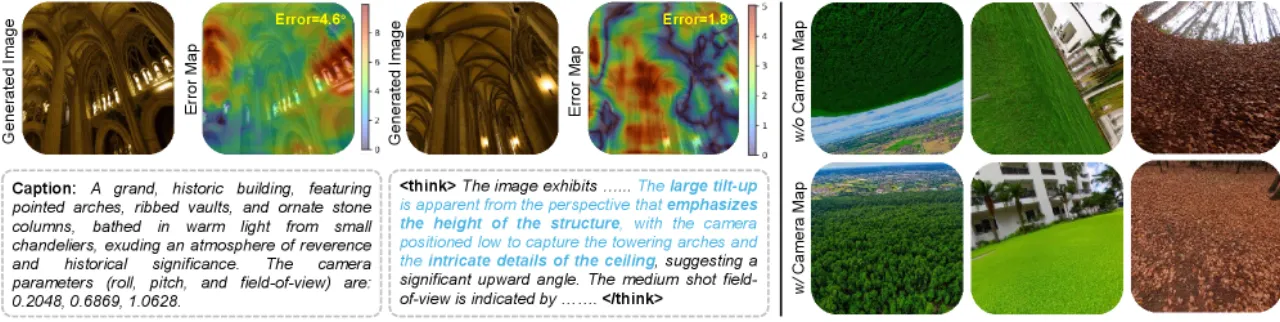
图 11:Thinking with Camera 消融可视化。引入摄影术语推理链后,模型对 roll/pitch/FoV 的估计均有一致改善(Roll: 0.47° → 0.41°,Pitch: 0.91° → 0.74°,FoV: 1.48° → 1.21°)。此外,联合训练(理解+生成)相比单任务训练表现出互促效应。Figure 11: Visualization of the Thinking with Camera ablation. After the photographic-term reasoning chain is introduced, the estimates of roll/pitch/FoV all improve consistently (Roll: 0.47° → 0.41°, Pitch: 0.91° → 0.74°, FoV: 1.48° → 1.21°). In addition, joint training (understanding + generation) exhibits a mutually reinforcing effect compared with single-task training.
消融结论:(1)直接 fine-tune 通用 VLM(InternVL3、Qwen2.5-VL)由于视觉特征经过语义压缩,反而不如专用视觉编码器;(2)Thinking with Camera 机制在所有三个指标上均带来稳定提升;(3)统一训练(理解+生成)相比各自独立训练存在正向互促。Ablation conclusions: (1) directly fine-tuning general-purpose VLMs (InternVL3, Qwen2.5-VL) is in fact worse than a dedicated vision encoder, because their visual features have been semantically compressed; (2) the Thinking with Camera mechanism brings consistent gains on all three metrics; (3) unified training (understanding + generation) is positively mutually reinforcing compared with training each task separately.
04局限性Limitations
Note:以下局限性均为论文作者明确陈述(stated),见 Limitations 小节。All limitations below are explicitly stated by the authors of the paper; see the Limitations subsection.
固定分辨率限制生成尺度Fixed resolution limits the generation scale
"Because our training dataset is constructed at a fixed resolution of 512×512, Puffin's image generation is currently restricted to a single scale."训练数据全部以 512×512 构建,导致生成模块目前只能输出单一分辨率,限制了在需要更高分辨率的场景中的实用性。作者指出可通过构建多尺度训练集解决,"these limitations are orthogonal to our main focus.""Because our training dataset is constructed at a fixed resolution of 512×512, Puffin's image generation is currently restricted to a single scale." The training data is built entirely at 512×512, so the generation module can currently output only a single resolution, which limits its usefulness in scenarios requiring higher resolutions. The authors note that this can be solved by constructing a multi-scale training set, and that "these limitations are orthogonal to our main focus."
中心裁切丢弃有效内容Center cropping discards valid content
对非方形输入,Puffin 采用中心裁切后缩放的策略,当实际图像长宽比与方形差异较大时,边缘内容被丢弃,可能导致几何估计性能下降。For non-square inputs, Puffin adopts a center-crop-then-resize strategy; when the actual aspect ratio deviates substantially from square, peripheral content is discarded, which may degrade geometric estimation performance.
生成评估依赖离线标定,存在歧义Generation evaluation relies on offline calibration and is ambiguous
"The calibration errors it reports can be ambiguous, especially for generated images exhibiting only subtle spatial differences."相机可控生成的定量评估依赖于对生成图像再做离线相机标定(反算参数),这本身存在估计误差,对空间差异细微的生成图像尤为明显,评估结果可能低估实际控制精度。"The calibration errors it reports can be ambiguous, especially for generated images exhibiting only subtle spatial differences." Quantitative evaluation of camera-controllable generation relies on running offline camera calibration on the generated images to recover their parameters, which itself carries estimation error, most notably for generated images with only subtle spatial differences, so the reported results may underestimate the actual control accuracy.
暂不支持径向畸变建模Radial distortion is not yet modeled
当前版本尚未建模镜头径向畸变(radial distortion),对于广角镜头或鱼眼镜头拍摄的图像,几何估计精度会受影响。The current version does not yet model lens radial distortion, so geometric estimation accuracy is affected for images captured with wide-angle or fisheye lenses.