PokeVLA 是一个仅有 1.22B 参数的轻量级 Vision-Language-Action 模型,通过两阶段训练策略——先在 2.4M 多模态样本上预训练具身 VLM,再引入目标感知语义分割与几何对齐的后训练——在 LIBERO-Plus 鲁棒性基准上超越所有同量级方法,并在真实机器人实验中取得 81.25% 的操作成功率。PokeVLA is a lightweight Vision-Language-Action model with only 1.22B parameters. A two-stage training strategy — first pre-training an embodied VLM on 2.4M multimodal samples, then post-training with goal-aware semantic segmentation and geometry alignment — lets it surpass all methods of comparable scale on the LIBERO-Plus robustness benchmark and reach an 81.25% manipulation success rate in real-robot experiments.
VLArobot manipulationembodied AIgoal-aware segmentationgeometry alignmentembodied pre-training机器人操作robot manipulation具身智能embodied AILIBERO轻量化模型lightweight model
01动机 · MotivationMotivation
现有大型 VLA 模型参数量动辄数十亿,难以在算力受限的边缘设备上部署。与此同时,仅靠模仿学习训练的小型模型严重缺乏对空间关系、操作意图和几何结构的理解,在扰动场景下泛化能力尤为不足。如何在保持轻量化的同时,赋予 VLA 模型足够丰富的 world knowledge?Existing large VLA models routinely carry billions of parameters, which makes them hard to deploy on edge devices with limited compute. At the same time, small models trained by imitation learning alone badly lack any understanding of spatial relations, manipulation intent and geometric structure, and generalize especially poorly under perturbation. How can a VLA model be endowed with sufficiently rich world knowledge while staying lightweight?
"We collect and curate a large-scale embodied multimodal dataset of approximately 2.4 million entries to pre-train a tiny-scale embodied vision-language model… introduce a novel method for learning manipulation-relevant representations, featuring multi-view consistent learning of the manipulation targets and geometric alignment."
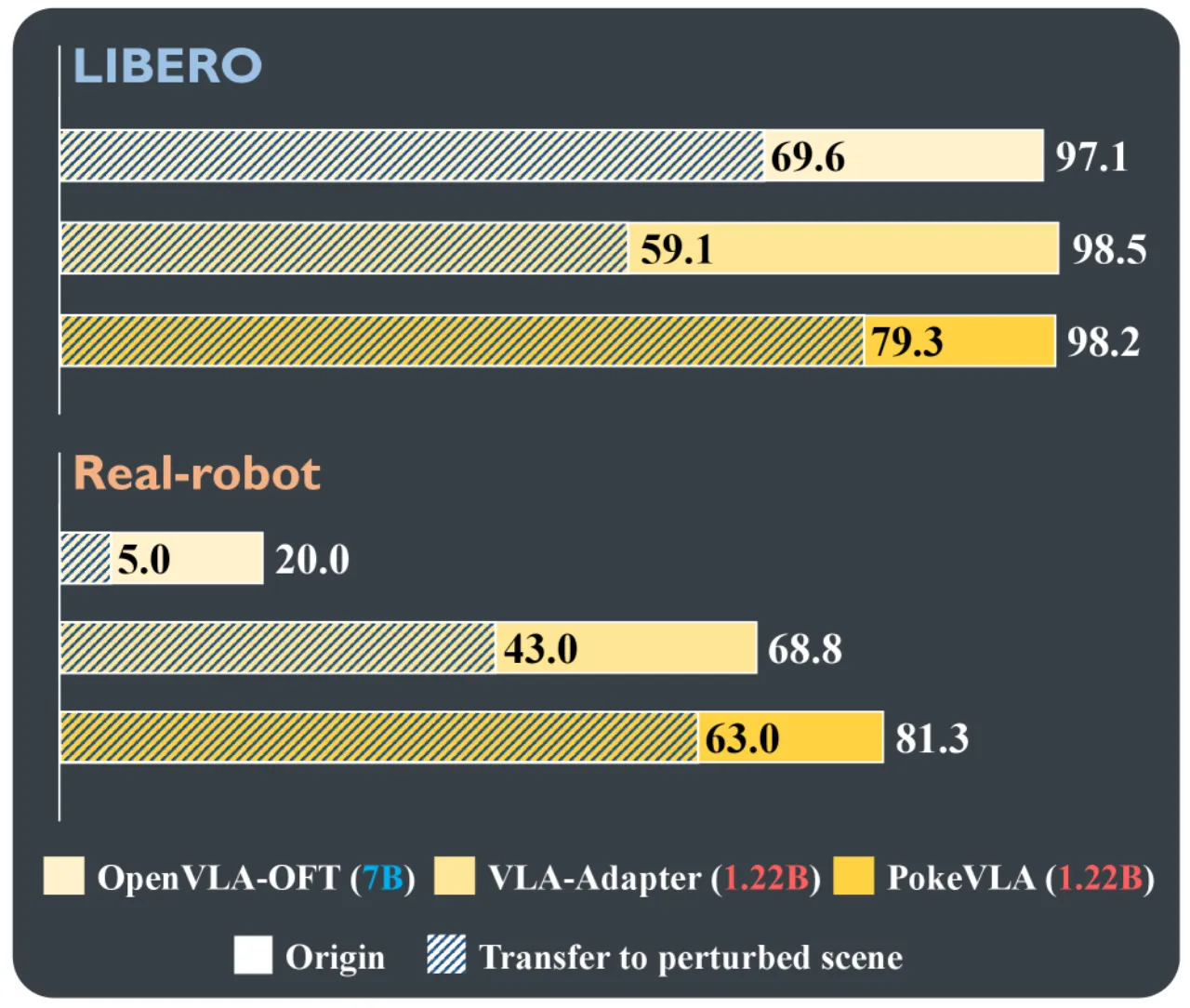
图 1:PokeVLA 在 LIBERO 系列基准与真实机器人任务上的成功率对比。PokeVLA 以 1.22B 参数取得 LIBERO 98.2%、LIBERO-Plus transfer 79.3% 的成绩,并在 8 项真实机器人任务中达到 81.25% 的平均成功率。Figure 1: Success-rate comparison of PokeVLA on the LIBERO benchmark suite and on real-robot tasks. With 1.22B parameters PokeVLA reaches 98.2% on LIBERO and 79.3% on LIBERO-Plus transfer, and attains an average success rate of 81.25% across 8 real-robot tasks.
1.22B模型参数量(轻量)Model parameters (lightweight)
98.2%LIBERO 总成功率LIBERO total success rate
79.3%LIBERO-Plus Transfer 成功率LIBERO-Plus Transfer success rate
81.25%真实机器人平均成功率Real-robot average success rate
传统 VLA 模型要么体量巨大(如 OpenVLA 7B),要么缺乏场景理解能力。PokeVLA 瞄准一个关键问题:即便是 0.5B 语言骨干,只要配合充分的 embodied 先验预训练和精心设计的操作相关表征注入,就能在模拟和真实世界中实现可靠、鲁棒的机器人操作。Conventional VLA models are either enormous (e.g. OpenVLA 7B) or lack scene understanding. PokeVLA targets one key question: even a 0.5B language backbone can achieve reliable, robust robot manipulation in simulation and in the real world, as long as it is combined with sufficient embodied prior pre-training and a carefully designed injection of manipulation-relevant representations.
02方法 · MethodMethod
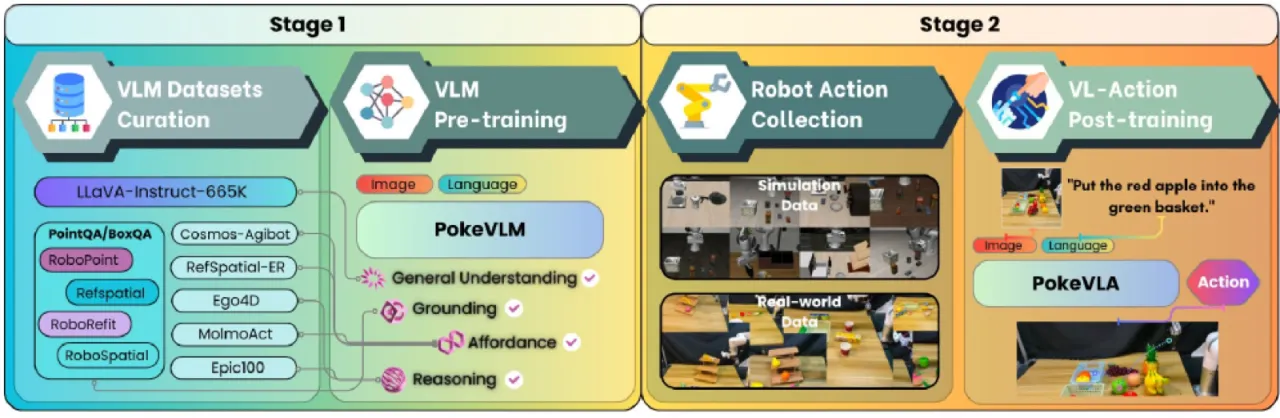
PokeVLA 采用两阶段训练范式:第一阶段在大规模具身多模态数据集上预训练出 PokeVLM;第二阶段通过目标感知语义分割(Goal-Aware Segmentation)与几何对齐(Geometry Alignment)将操作相关的表征注入到动作头中。PokeVLA follows a two-stage training paradigm: the first stage pre-trains PokeVLM on a large-scale embodied multimodal dataset; the second stage injects manipulation-relevant representations into the action head through Goal-Aware Segmentation and Geometry Alignment.
图 2:PokeVLA 系统总览。左图为第一阶段 VLM 预训练(PokeVLM),右图为第二阶段 VL-Action 后训练,引入目标感知分割与几何对齐,并以 cross-attention 动作头生成动作序列。Figure 2: Overview of the PokeVLA system. Left: the first-stage VLM pre-training (PokeVLM). Right: the second-stage VL-Action post-training, which introduces goal-aware segmentation and geometry alignment and generates action sequences with a cross-attention action head.
第一阶段:PokeVLM 预训练Stage 1: PokeVLM Pre-training
以 Prismatic-VLM 为骨架,语言模型选用 Qwen2.5-0.5B,视觉编码器为 SigLIP(语义)+ DinoV2(空间感知)双组件,通过 MLP projector 桥接视觉与语言空间。预训练数据集共约 2.4M 条,覆盖四类具身任务:The backbone is Prismatic-VLM, the language model is Qwen2.5-0.5B, and the vision encoder combines SigLIP (semantics) with DinoV2 (spatial perception), bridged to the language space by an MLP projector. The pre-training dataset holds roughly 2.4M entries and covers four categories of embodied tasks:
General Understanding:665K 条,来自 LLaVA-Instruct-665KGeneral Understanding: 665K entries, from LLaVA-Instruct-665K
Spatial Grounding:694K 条,来自 RoboPoint、RefSpatial、RoboRefit、RoboSpatialSpatial Grounding: 694K entries, from RoboPoint, RefSpatial, RoboRefit and RoboSpatial
Affordance Learning:553K 条,来自 HOVA(Ego4D、Epic100)和 MolmoActAffordance Learning: 553K entries, from HOVA (Ego4D, Epic100) and MolmoAct
Embodied Reasoning:511K 条,来自 RefSpatial 和 Cosmos-Reason1-SFTEmbodied Reasoning: 511K entries, from RefSpatial and Cosmos-Reason1-SFT
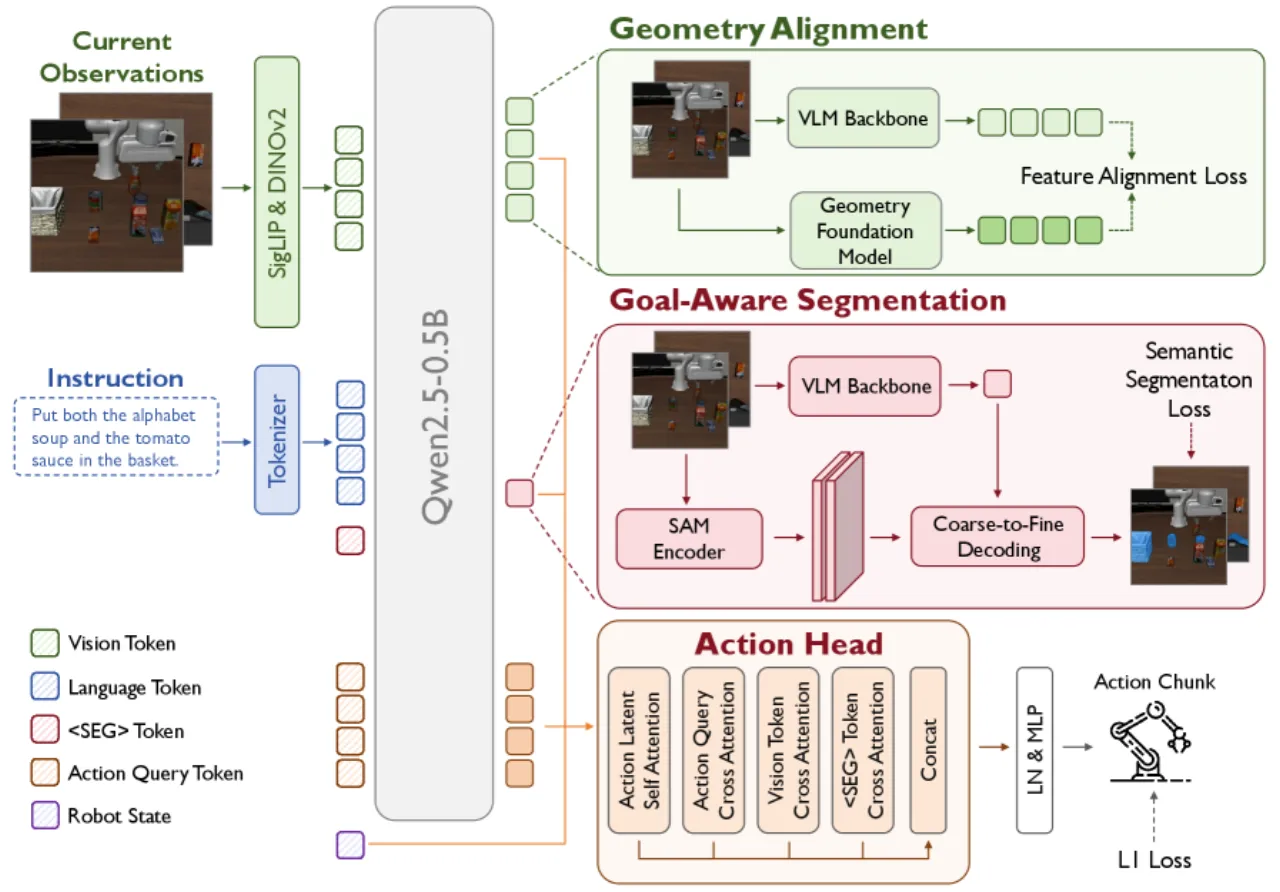
图 3:VL-Action 后训练架构细节。左侧为目标感知分割的 coarse-to-fine 解码流程(基于 SAM),右侧为几何对齐模块(VGGT 特征蒸馏,仅训练时使用),中间的 cross-attention 动作头融合视觉隐状态、<SEG> embedding 与机器人状态。Figure 3: Details of the VL-Action post-training architecture. Left: the coarse-to-fine decoding pipeline of goal-aware segmentation (built on SAM). Right: the geometry alignment module (VGGT feature distillation, used at training time only). Center: the cross-attention action head, which fuses the visual hidden states, the <SEG> embedding and the robot state.
借鉴 LISA 的设计,在语言模型中引入特殊 token <SEG>,其 embedding 整合了场景上下文与目标物体细节。解码采用 coarse-to-fine 两步范式:Following the design of LISA, a special token <SEG> is introduced into the language model, whose embedding integrates the scene context with target-object details. Decoding follows a coarse-to-fine two-step paradigm:
Coarse Decoding:将 <SEG> embedding 通过 SAM prompt encoder,获得 sparse/dense embeddings,经粗粒度 mask decoder 得到初步掩码;Coarse Decoding: the <SEG> embedding is passed through the SAM prompt encoder to obtain sparse/dense embeddings, and a coarse-grained mask decoder yields a preliminary mask;
Fine-Grained Decoding:以粗掩码 logits 作为 mask prompt 输入,结合 <SEG> embedding 进一步细化预测。Fine-Grained Decoding: the coarse mask logits are fed in as a mask prompt and combined with the <SEG> embedding to further refine the prediction.
分割损失为 focal loss 与 KL divergence 之和:Lseg = λfocal FOCAL(M̂,M) + λKLD KLD(M̂,M),其中 λfocal = λKLD = 1。多视角一致性通过跨视角共享 <SEG> embedding 保证,使模型对操作目标形成稳定的跨视角表征。The segmentation loss is the sum of a focal loss and a KL divergence: Lseg = λfocal FOCAL(M̂,M) + λKLD KLD(M̂,M), with λfocal = λKLD = 1. Multi-view consistency is enforced by sharing the <SEG> embedding across views, so that the model forms a stable cross-view representation of the manipulation target.
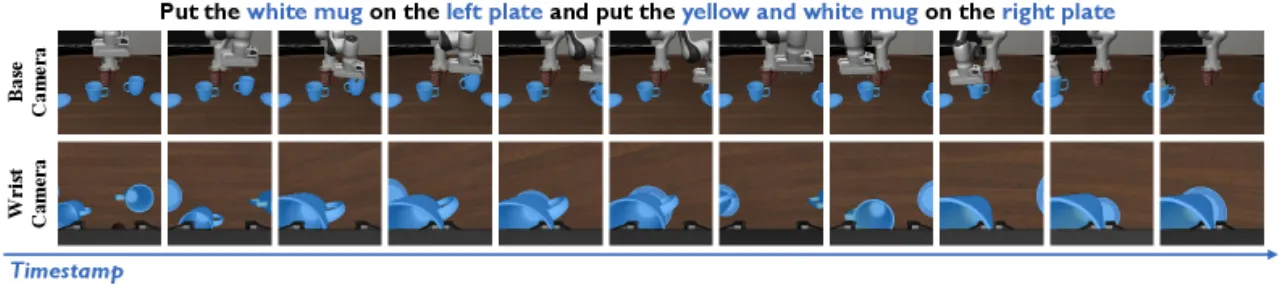
图 4:在长时序任务中,目标感知分割在不同视角之间保持一致性,确保 <SEG> embedding 始终指向正确的操作目标。Figure 4: In long-horizon tasks, goal-aware segmentation stays consistent across viewpoints, ensuring that the <SEG> embedding always points to the correct manipulation target.
几何对齐(Geometry Alignment)Geometry Alignment
利用 VGGT(视觉几何基础模型)在训练阶段提取多视角图像的几何特征,通过余弦相似度损失将语言模型视觉 token 的隐状态对齐到 VGGT 特征空间:VGGT (a visual geometry foundation model) extracts geometric features from multi-view images during training, and a cosine-similarity loss aligns the hidden states of the visual tokens of the language model to the VGGT feature space:
Lgeo = (1/VN) ∑[1 − cos(P(hv), fgeo)]
几何对齐仅在训练阶段使用 VGGT,推理时无额外开销。轻量级 projector 负责维度对齐。整体训练目标为:Geometry alignment uses VGGT during training only, so there is no extra cost at inference. A lightweight projector takes care of the dimension alignment. The overall training objective is:
采用含 L 个 transformer 层的 cross-attention 动作头,依次对动作 latent 进行:自注意力 → 与 query embedding 及机器人状态做 cross-attention → 与视觉隐状态做 cross-attention → 与 <SEG> embedding 做 cross-attention,最终通过 LayerNorm + MLP 输出动作 chunk:The cross-attention action head contains L transformer layers, which process the action latents in turn: self-attention → cross-attention with the query embedding and the robot state → cross-attention with the visual hidden states → cross-attention with the <SEG> embedding, and finally emit an action chunk through LayerNorm + MLP:
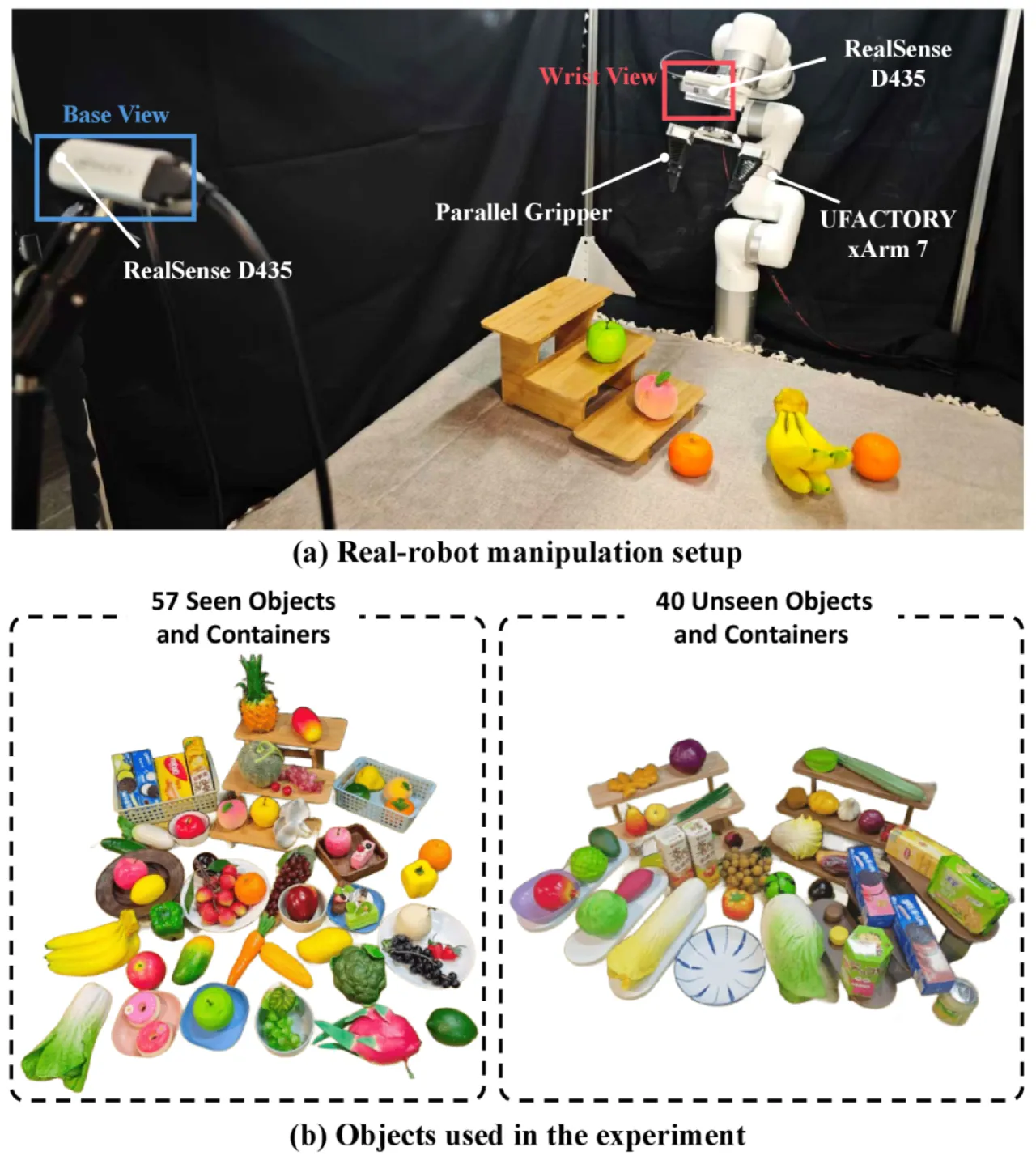
在模拟平台(LIBERO、LIBERO-Plus)和真实机器人(xArm7 + 双 Realsense 相机)上对 PokeVLA 进行全面评估,对比基线为 OpenVLA-OFT 和 VLA-Adapter。PokeVLA is evaluated comprehensively both in simulation (LIBERO, LIBERO-Plus) and on a real robot (xArm7 with two Realsense cameras), with OpenVLA-OFT and VLA-Adapter as baselines.
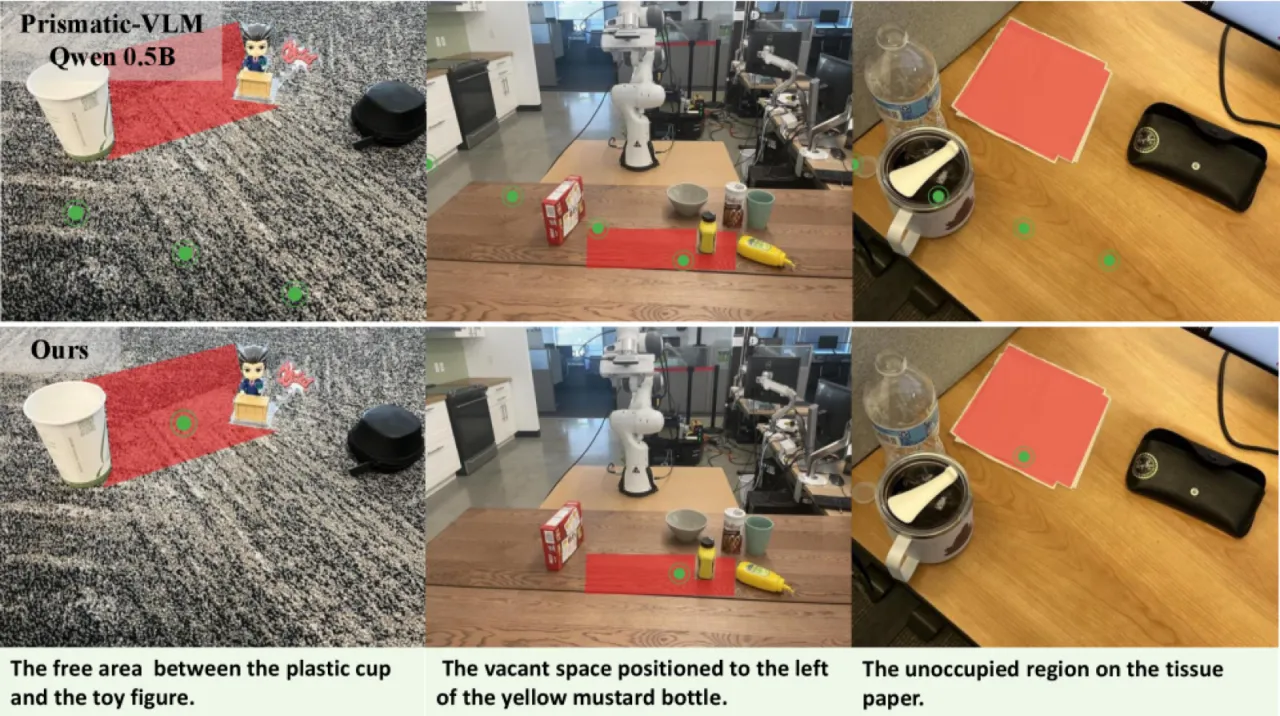
在空间感知、空间推理等具身 VLM 基准上,PokeVLM 大幅超越 Prismatic-VLM 基线:On embodied VLM benchmarks for spatial perception and spatial reasoning, PokeVLM outperforms the Prismatic-VLM baseline by a wide margin:
在迁移设置下(在 LIBERO 上训练,在 LIBERO-Plus 上测试),PokeVLA 超越 OpenVLA-OFT +9.7%,超越 VLA-Adapter +20.2%。在各类扰动下的性能对比:Under the transfer setting (trained on LIBERO, tested on LIBERO-Plus), PokeVLA beats OpenVLA-OFT by +9.7% and VLA-Adapter by +20.2%. Performance under the individual perturbation types:
扰动类型Perturbation Type
OpenVLA-OFT
VLA-Adapter
PokeVLA
Camera Viewpoint
56.4%
52.4%
84.7%
Robot Initialization
55.5%
55.6%
64.3%
Language Variation
79.5%
70.7%
84.8%
Lighting
84.6%
69.5%
95.1%
Sensor Noise
75.8%
65.1%
89.8%
Total(Transfer)Total (Transfer)
69.6%
59.1%
79.3%
图 5:PokeVLM 在 Where2Place 基准上的空间理解可视化,展示模型对物体放置位置的准确定位能力,远优于原始 Prismatic-VLM 基线。Figure 5: Visualization of the spatial understanding of PokeVLM on the Where2Place benchmark, showing how accurately the model localizes object placement positions, far better than the original Prismatic-VLM baseline.
真实机器人实验Real-Robot Experiments
图 6:真实机器人实验设置(xArm7 机械臂 + 平行夹爪 + 双 Realsense 相机),以及 8 项操作任务的场景布置与扰动示例。Figure 6: The real-robot setup (xArm7 arm + parallel gripper + two Realsense cameras), together with the scene layouts of the 8 manipulation tasks and examples of the perturbations.
方法Method
8 任务平均成功率Average success rate over 8 tasks
OpenVLA-OFT
20.0%
VLA-Adapter
68.75%
PokeVLA
81.25%
在真实场景扰动测试(Table X)中,PokeVLA 综合超越 VLA-Adapter +20%(63.0% vs 43.0%),在末端执行器初始位姿扰动(70.0%)、目标物体扰动(60.0%)、光照扰动(75.0%)三类测试中均保持较高成功率。In the real-world perturbation tests (Table X), PokeVLA outperforms VLA-Adapter overall by +20% (63.0% vs 43.0%), keeping a high success rate in all three test categories: end-effector initial-pose perturbation (70.0%), target-object perturbation (60.0%) and lighting perturbation (75.0%).
消融实验(LIBERO-Plus Transfer 设置)Ablation Study (LIBERO-Plus Transfer setting)
配置Configuration
Total
Spatial
Object
Goal
Long
Baseline
78.2%
83.2%
71.2%
75.5%
94.7%
+ Pre-training
82.9%
87.1%
80.5%
78.6%
94.7%
+ Geometry
81.0%
86.4%
70.0%
81.4%
97.5%
+ Goal-Aware
82.5%
83.8%
77.9%
82.9%
98.1%
Full Model
85.3%
88.8%
81.1%
83.0%
97.5%
消融实验表明,预训练、几何对齐和目标感知分割三个模块各自独立带来明显提升,三者结合后整体达到最佳 85.3% 的迁移成功率。The ablations show that pre-training, geometry alignment and goal-aware segmentation each bring a clear gain on their own, and that combining all three reaches the best overall transfer success rate of 85.3%.
04局限性 · LimitationsLimitations
注:原论文未设独立的 Limitations 章节。以下各条均标注其来源:stated = 论文明确提及;inferred = 从实验设计或数据推断。Note: The original paper has no dedicated Limitations section. Each item below is labeled with its source: stated = explicitly mentioned in the paper; inferred = inferred from the experimental design or the data.
真实场景评估规模有限(stated)Limited scale of the real-world evaluation (stated)
真实机器人实验仅限于桌面拾放场景(110×110 cm 工作空间),共 8 项任务,每任务 10 次试验,数据集仅 60 种任务类型、3,000 条轨迹。泛化到更复杂、多样的操作任务尚未验证。The real-robot experiments are confined to tabletop pick-and-place scenarios (a 110×110 cm workspace), covering 8 tasks with 10 trials each, and the dataset holds only 60 task types and 3,000 trajectories. Generalization to more complex and more diverse manipulation tasks has not been verified.
机器人初始化扰动鲁棒性偏低(stated)Low robustness to robot-initialization perturbation (stated)
在 LIBERO-Plus fine-tuned 设置下,Robot Initialization 扰动仅达 52.9%,是所有扰动类型中最低的一项,说明模型对机械臂初始位姿变化的适应能力仍有明显不足。Under the LIBERO-Plus fine-tuned setting, the Robot Initialization perturbation reaches only 52.9%, the lowest of all perturbation types, which shows that the model still adapts poorly to changes in the initial pose of the arm.
VGGT 几何特征提取仅用于训练(inferred)VGGT geometric feature extraction is used for training only (inferred)
几何对齐模块在推理时不引入 VGGT,避免了额外开销,但也意味着推理阶段无法动态更新几何先验,对高度遮挡或新颖几何场景的泛化能力存在潜在瓶颈。The geometry alignment module does not invoke VGGT at inference, which avoids extra cost but also means that the geometric prior cannot be updated dynamically at inference time — a potential bottleneck for generalizing to heavily occluded or novel geometric scenes.
预训练数据以英文指令为主(inferred)Pre-training data is dominated by English instructions (inferred)
2.4M 预训练样本主要来自英文指令数据集,多语言/跨语言操作场景的泛化能力未经验证。The 2.4M pre-training samples come mainly from English-instruction datasets; generalization to multilingual or cross-lingual manipulation settings has not been verified.