PointACT:多尺度点云-动作交互的视觉-语言-动作模型PointACT: Vision-Language-Action Models with Multi-Scale Point-Action Interaction
PointACT: Vision-Language-Action Models with Multi-Scale Point-Action Interaction
Shizhe Chen, Paul Pacaud, Cordelia Schmid · Inria, École normale supérieure, CNRS, PSL Research University
PointACT 将点云(point cloud)三维几何表示深度融合进视觉-语言-动作模型(VLA)的动作解码阶段,通过分层 bottleneck 窗口自注意力机制实现多尺度的"点云特征 ↔ 动作 token"细粒度交互,在 RLBench 和 LIBERO 基准上超越了当前最优的 2D 与 3D 方法,并在真实机器人上验证了其有效性。PointACT deeply integrates 3D geometric representations from point clouds into the action-decoding stage of vision-language-action models (VLA), achieving fine-grained multi-scale interaction between point-cloud features and action tokens through a hierarchical bottleneck window self-attention mechanism. It surpasses state-of-the-art 2D and 3D methods on the RLBench and LIBERO benchmarks, and its effectiveness is validated on real robots.
当前最先进的 VLA 模型几乎全部依赖二维视觉表示,这严重限制了其对精细几何与空间关系的推理能力。State-of-the-art VLA models rely almost entirely on 2D visual representations, which severely limits their ability to reason about fine geometry and spatial relations.
"the physical world is inherently three-dimensional, while most state-of-the-art VLAs rely on 2D image representations."
现有的将三维信息引入 VLA 的尝试存在两类明显不足:Existing attempts to bring 3D information into VLAs suffer from two evident shortcomings:
Monolithic 融合:将点云 embedding 直接注入预训练 VLM,会破坏 VLM 在大规模数据上习得的表示,导致性能严重下滑(实验中 RLBench 仅 18.6%)。Monolithic fusion: injecting point-cloud embeddings directly into a pretrained VLM corrupts the representations the VLM has acquired from large-scale data, causing a severe performance drop (only 18.6% on RLBench in the experiments).
粗粒度全局特征:已有的点云增强 VLA 方法"primarily rely on coarse-grained global geometry features",无法利用点云编码器的预训练优势,忽略了多尺度局部几何线索。Coarse-grained global features: existing point-cloud-augmented VLA methods "primarily rely on coarse-grained global geometry features", cannot exploit the pretraining advantage of point-cloud encoders, and ignore multi-scale local geometric cues.
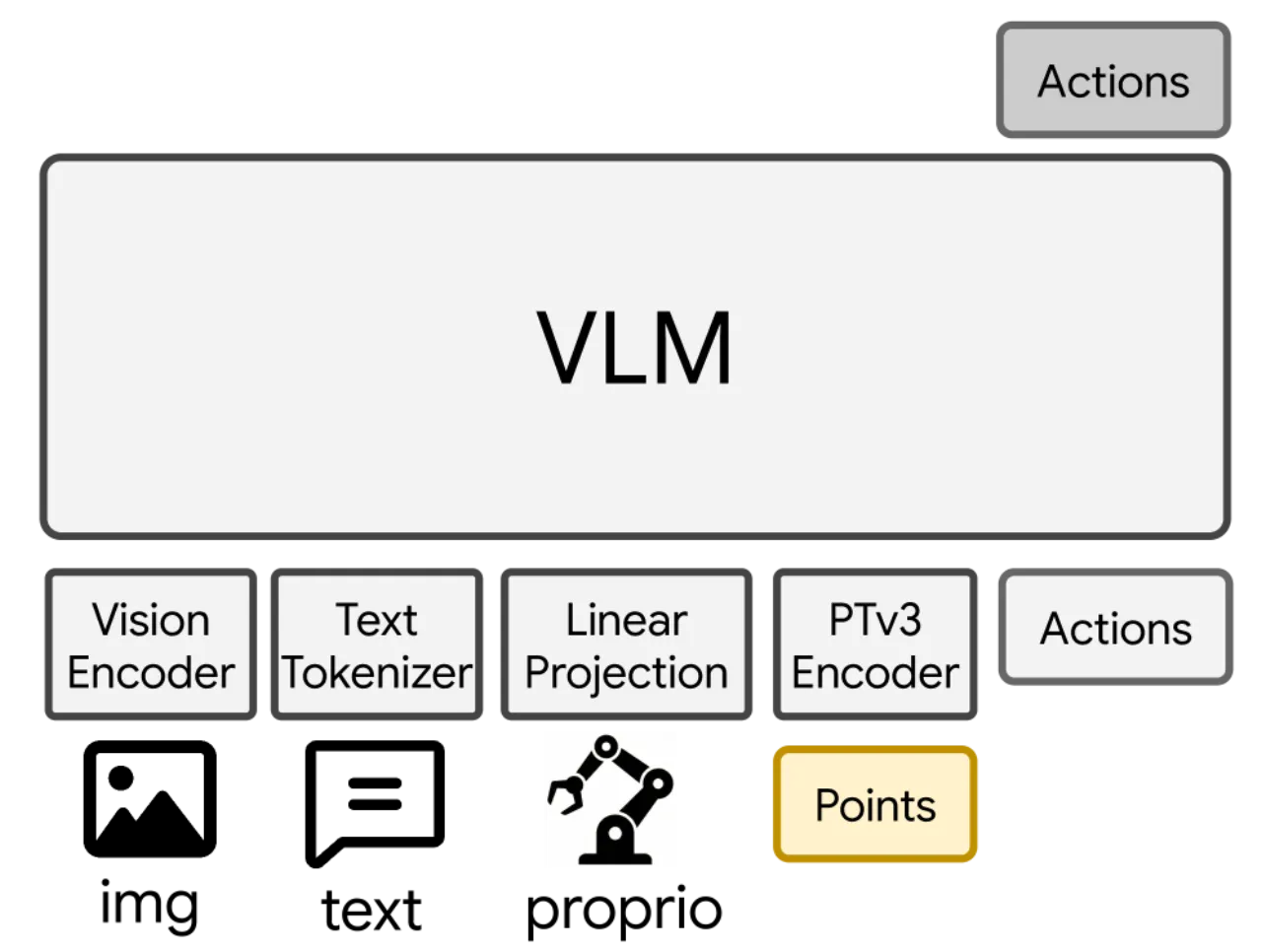
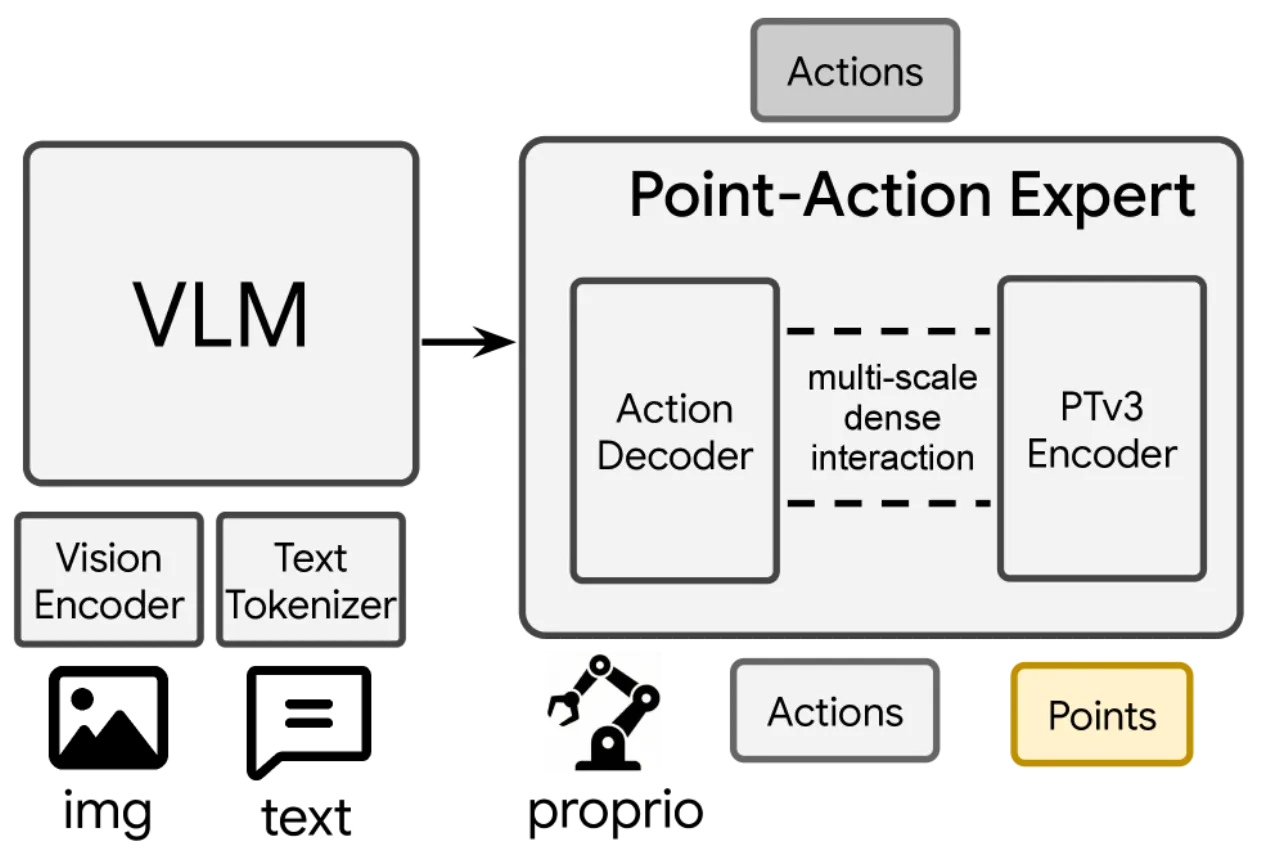
图 1:三种将 3D 点云整合进 VLA 的策略对比:(a) Monolithic 融合将点云 token 直接注入 VLM 上下文;(b) Dual-system 仅使用 PTv3 最终层粗粒度特征;(c) PointACT 通过 Bottleneck Window Self-Attention 在解码各层与点云特征进行多尺度细粒度交互。Figure 1: Comparison of three strategies for integrating 3D point clouds into VLAs: (a) monolithic fusion injects point tokens directly into the VLM context; (b) dual-system uses only the coarse-grained features of the final PTv3 layer; (c) PointACT performs multi-scale fine-grained interaction with point-cloud features at every decoding layer through Bottleneck Window Self-Attention.
82.3%RLBench 10 任务平均成功率Mean success rate over 10 RLBench tasks
96.0%LIBERO 4 套件平均成功率Mean success rate over 4 LIBERO suites
+10%相比最优基线在 RLBench 上的提升Improvement over the best baseline on RLBench
300MPointACT 可训练参数量PointACT trainable parameters
02方法Method
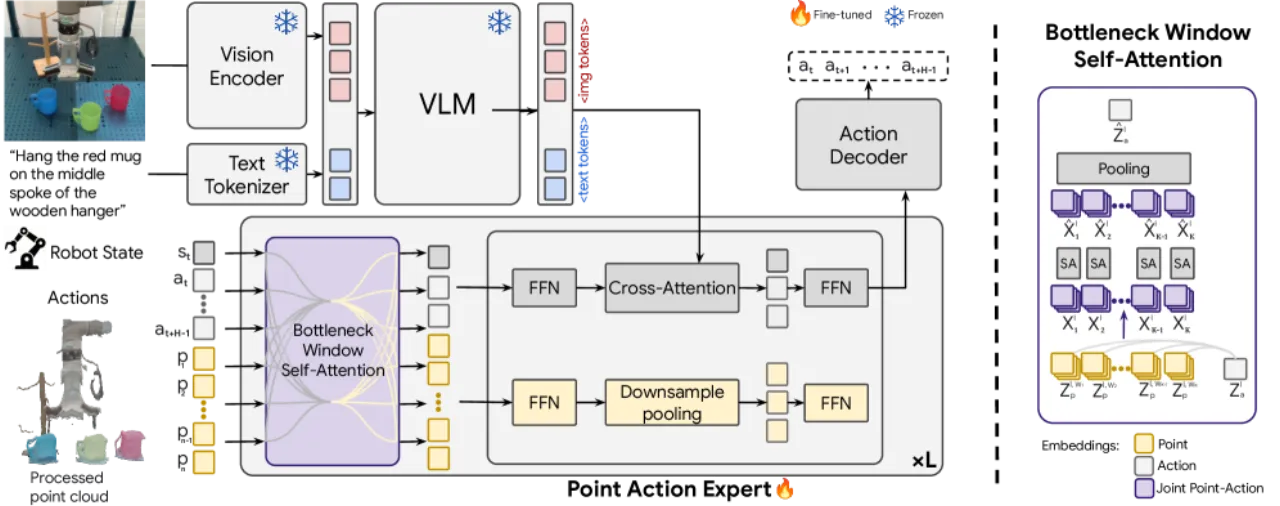
PointACT 采用双系统架构(dual-system):冻结的 VLM(Qwen2.5-VL)负责高层语义理解,可训练的 PointACT 动作专家(action expert)通过多尺度 Bottleneck 窗口自注意力机制将 Point Transformer v3(PTv3)各层的分层几何特征与动作 token 进行深度交互,最终预测机器人动作。PointACT adopts a dual-system architecture: a frozen VLM (Qwen2.5-VL) handles high-level semantic understanding, while a trainable PointACT action expert deeply interacts the hierarchical geometric features of each Point Transformer v3 (PTv3) layer with action tokens through multi-scale bottleneck window self-attention, ultimately predicting robot actions.
图 2:PointACT 整体架构(左)与 Bottleneck 窗口自注意力机制(右)。点云按空间分成 K 个窗口,动作 token 广播至各窗口内的点 token,进行自注意力计算后跨窗口平均聚合,再通过交叉注意力融合 VLM 特征。该过程在 PTv3 各分层阶段重复执行,实现多尺度交互。Figure 2: Overall PointACT architecture (left) and the bottleneck window self-attention mechanism (right). The point cloud is spatially partitioned into K windows; action tokens are broadcast to the point tokens inside each window, self-attention is computed, and the outputs are averaged across windows, after which VLM features are fused in by cross-attention. The process is repeated at each hierarchical stage of PTv3 to realize multi-scale interaction.
问题形式化Problem formulation
策略在多模态观测下预测未来 H 步动作:The policy predicts the next H actions from multimodal observations:
A_t = π_θ(I_t, P_t, s_t, L)
其中 I_t 为多视角 RGB 图像,P_t ∈ ℝ^(N_P×6) 为三维点云(XYZ + RGB),s_t 为本体感受状态,L 为自然语言指令。where I_t is the multi-view RGB image, P_t ∈ ℝ^(N_P×6) is the 3D point cloud (XYZ + RGB), s_t is the proprioceptive state, and L is the natural-language instruction.
将点云划分为 K 个空间窗口。对每个窗口 k,动作 token 广播拼接至该窗口内点 token,进行联合自注意力:The point cloud is divided into K spatial windows. For each window k, action tokens are broadcast and concatenated to the point tokens inside that window, and joint self-attention is applied:
动作 token 跨窗口平均聚合局部上下文:Action tokens aggregate local context by averaging across windows:
Ẑ_a^l = (1/K) Σ_k X̂_{k,a}^l
再通过交叉注意力融合 VLM 嵌入:VLM embeddings are then fused in by cross-attention:
Z̄_a^l = Cross-Attn(Ẑ_a^l, Z_vlm)
该流程在 PTv3 各分层阶段重复,从粗到细提取多尺度几何线索。关键设计:动作 token 充当"bottleneck",既能感知局部几何细节,又保持全局语义一致,避免了将大量点云 token 直接暴露给 VLM 带来的干扰。This procedure is repeated at each hierarchical stage of PTv3, extracting multi-scale geometric cues from coarse to fine. Key design: action tokens act as a "bottleneck", perceiving local geometric detail while maintaining global semantic consistency, which avoids the interference caused by exposing a large number of point tokens directly to the VLM.
动作预测头Action prediction heads
回归头(Regression Head)Regression Head
用于 LIBERO 等连续控制任务,动作 chunk 大小 H=16,使用 L₂ 损失:Used for continuous-control tasks such as LIBERO, with action chunk size H=16 and an L₂ loss:
L_reg = (1/H) Σ ‖a_i − a_i*‖₂²
分类头(Classification Head)Classification Head
用于 RLBench 关键帧预测,工作空间离散化为空间 bin,使用交叉熵损失:Used for RLBench keyframe prediction, with the workspace discretized into spatial bins and a cross-entropy loss:
L_cls = −Σ_k Σ_b y_{k,b} log(ŷ_{k,b})
图 3:PointACT VLA 完整架构图。冻结的 Qwen2.5-VL 处理图像与语言,输出 VLM 特征;Point Transformer v3-Large(PTv3)对点云提取分层特征;PointACT 模块在解码各阶段通过窗口注意力将两路特征与动作 token 深度融合,最终由动作头输出机器人控制指令。Figure 3: Full architecture of the PointACT VLA. The frozen Qwen2.5-VL processes images and language and outputs VLM features; Point Transformer v3-Large (PTv3) extracts hierarchical features from the point cloud; the PointACT module deeply fuses the two feature streams with action tokens through window attention at each decoding stage, and the action head finally outputs robot control commands.
点云编码器:Point Transformer v3-Large(PTv3-Large),在建筑级场景数据上预训练Point-cloud encoder: Point Transformer v3-Large (PTv3-Large), pretrained on building-scale scene data
可训练参数:约 300M(PointACT 模块)Trainable parameters: about 300M (PointACT module)
点云预处理:工作空间 bounding box 裁剪,1cm 体素化,最多 4096 个点Point-cloud preprocessing: workspace bounding-box cropping, 1cm voxelization, at most 4096 points
03实验Experiments
在 RLBench(10 任务)、LIBERO(4 套件)仿真基准及真实机器人平台(SO-100 和 UR5)上与当前最优方法(包括 π₀、GR00T-N1.5、EO1、ACT3D、3DLotus 等)进行全面对比。A comprehensive comparison against state-of-the-art methods (including π₀, GR00T-N1.5, EO1, ACT3D and 3DLotus) on the RLBench (10 tasks) and LIBERO (4 suites) simulation benchmarks and on real robot platforms (SO-100 and UR5).
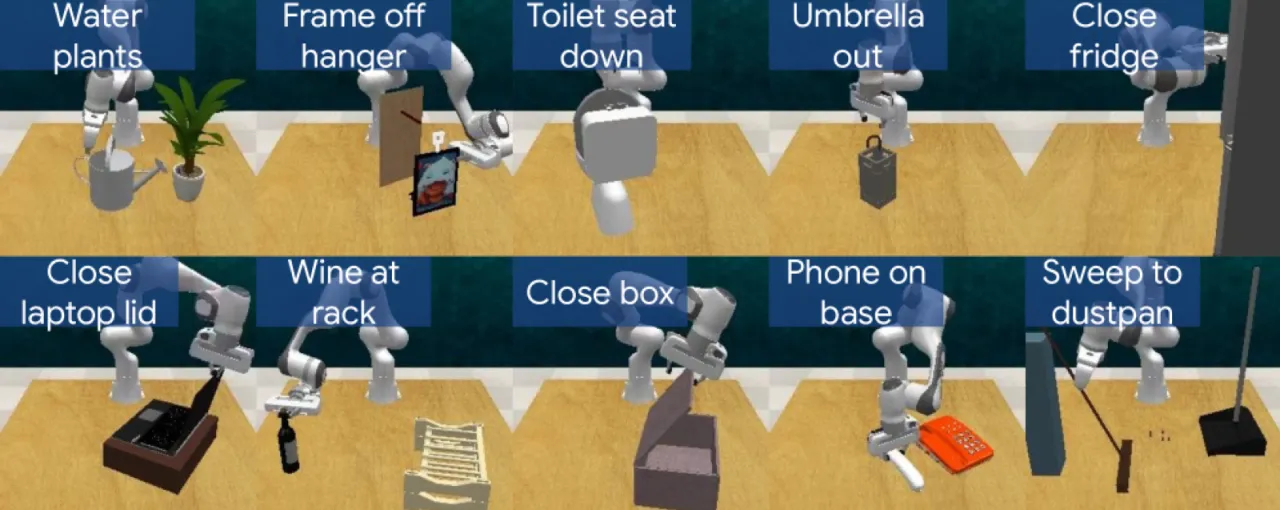
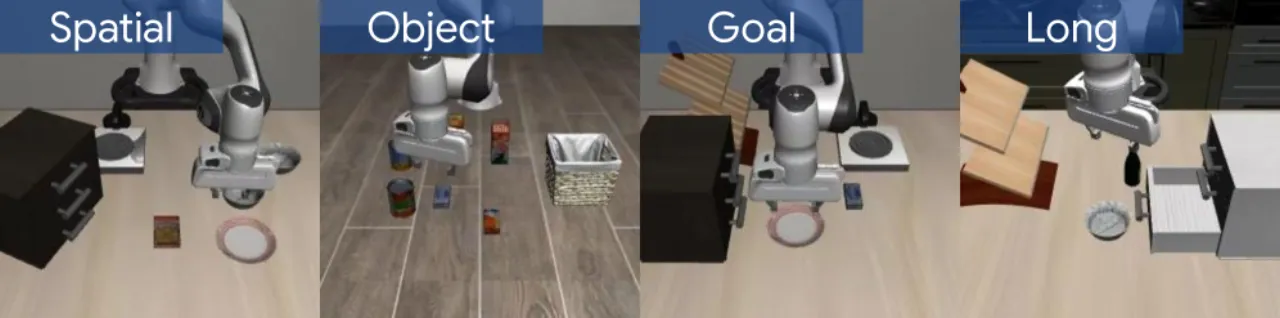
图 4:RLBench 10 个操作任务与 LIBERO 4 个任务套件示意图。RLBench 使用关键帧预测 + RRT 运动规划;LIBERO 使用 delta 末端执行器控制,动作 chunk 大小 H=16。Figure 4: The 10 RLBench manipulation tasks and the 4 LIBERO task suites. RLBench uses keyframe prediction plus RRT motion planning; LIBERO uses delta end-effector control with action chunk size H=16.
仿真基准结果Simulation benchmark results
方法Method
LIBERO-Spatial
LIBERO-Object
LIBERO-Goal
LIBERO-Long
LIBERO 均值LIBERO mean
RLBench 均值RLBench mean
OpenVLA
84.7
88.4
79.2
53.7
—
41.0
π₀
—
—
—
—
—
55.0
ACT3D
—
—
—
—
—
64.5
GR00T(arch) + Point
92.0
—
—
—
—
69.7
EO1(复现)EO1 (reproduced)
91.8
—
—
85.6
93.1
73.2
PointACT(本文)PointACT (ours)
97.4
—
—
90.6
96.0
82.3
RLBench 各任务成功率(部分)Per-task success rates on RLBench (excerpt)
任务Task
EO1
PointACT
Phone on base
—
99
Umbrella out
—
99
Wine at rack
—
90
Sweep to dustpan
—
59
Water plants
—
40
均值Mean
73.2
82.3
消融实验Ablations
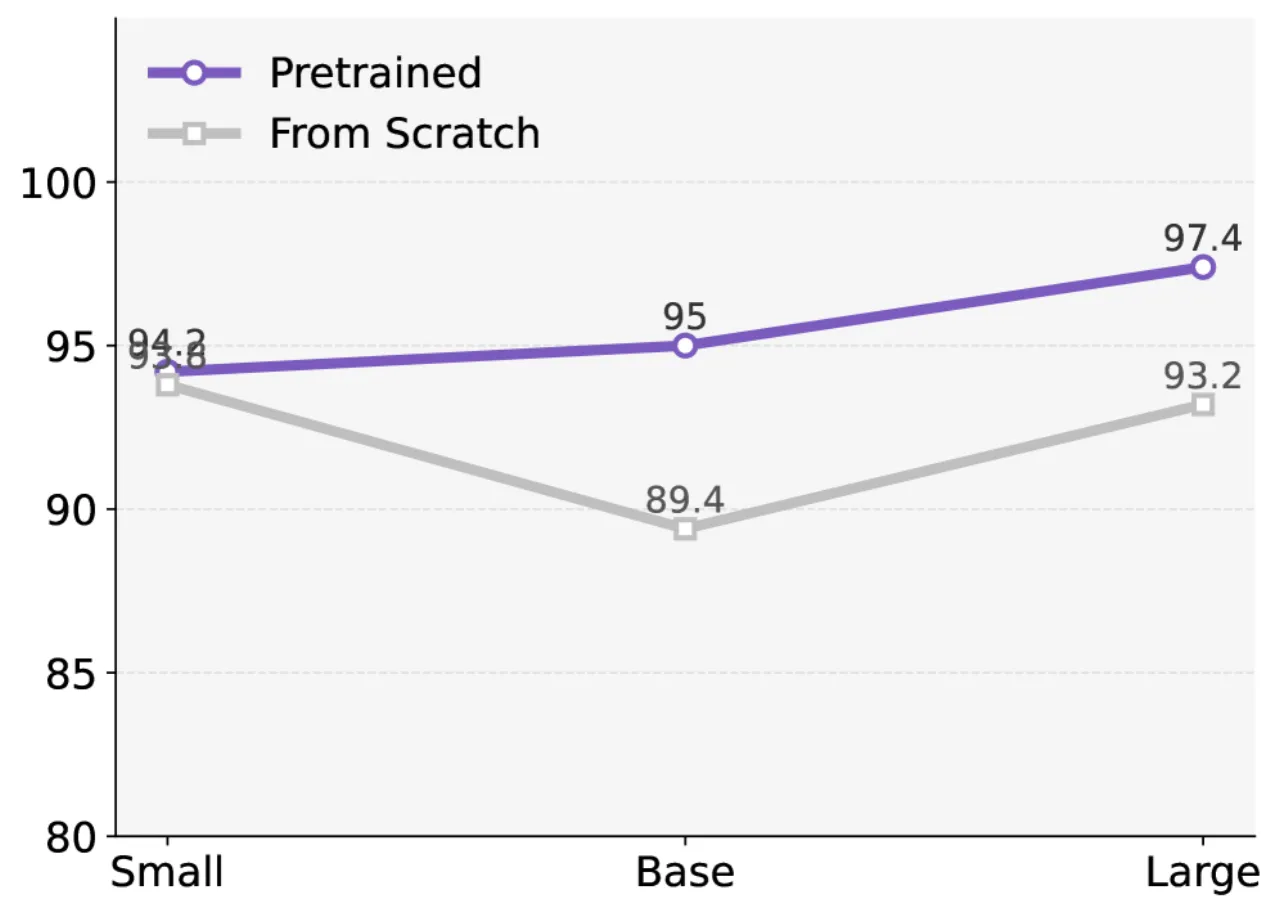
图 5:PointACT 不同规模变体(Small: 59M, Base: 167M, Large: 314M)的性能曲线,以及是否使用 PTv3 预训练权重的对比。更大的模型从预训练中获益更多,表明优化难度随容量增加。Figure 5: Performance curves of PointACT variants at different scales (Small: 59M, Base: 167M, Large: 314M), together with a comparison of using versus not using PTv3 pretrained weights. Larger models benefit more from pretraining, indicating that optimization difficulty grows with capacity.
消融配置Ablation setting
LIBERO-Spatial (%)
RLBench (%)
EO1 baseline
91.8
73.2
EO1 + Point(Monolithic)EO1 + Point (monolithic)
94.0
18.6
GR00T(arch) baseline
87.0
50.8
GR00T(arch) + Point(Dual-system 粗粒度)GR00T(arch) + Point (dual-system, coarse-grained)
92.0
69.7
多尺度直接拼接(K=64, 128 tokens)Multi-scale direct concatenation (K=64, 128 tokens)
Monolithic 融合在 RLBench 上成功率暴跌至 18.6%,表明将点云直接注入预训练 VLM 会严重干扰其已学到的表示。Monolithic fusion collapses to 18.6% success on RLBench, showing that injecting point clouds directly into a pretrained VLM severely disrupts its learned representations.
多尺度直接拼接(不使用窗口注意力)仅达 65.2–65.6%,证明"细粒度交互"是提升的关键,而非单纯引入多尺度特征。Multi-scale direct concatenation (without window attention) reaches only 65.2–65.6%, proving that fine-grained interaction is the key to the gain, rather than merely introducing multi-scale features.
即使移除图像条件,PointACT 也能达 79.8%(RLBench),但加入 2D 图像后进一步提升至 82.3%,说明 2D 语义特征与 3D 几何特征互补。Even with image conditioning removed, PointACT still reaches 79.8% (RLBench), while adding 2D images pushes it further to 82.3%, indicating that 2D semantic features and 3D geometric features are complementary.
真实机器人实验Real-robot experiments
图 6:真实机器人平台设置。左:SO-100(6-DoF 3D 打印机械臂,Intel RealSense D435);右:UR5(6-DoF UR5 + RG6 夹爪,Orbbec Femto Mega RGB-D 相机)。Figure 6: Real robot platform setups. Left: SO-100 (6-DoF 3D-printed arm, Intel RealSense D435); right: UR5 (6-DoF UR5 + RG6 gripper, Orbbec Femto Mega RGB-D camera).
任务Task
π₀
GR00T-N1.5
PointACT
SO-100 机械臂(每任务 10 次试验)SO-100 arm (10 trials per task)
Put Banana In Plate
10/10
8/10
10/10
Put Sock In Drawer
2/10
5/10
9/10
Open Microwave
7/10
5/10
8/10
任务Task
π₀
GR00T-N1.5
3DLotus
PointACT
UR5 机械臂(每任务 10 次试验)UR5 arm (10 trials per task)
Stack Yellow Cup
0/10
0/10
7/10
7/10
Close Drawer
9/10
9/10
2/10
7/10
Put Fruit in Plates
0/10
0/10
0/10
4/10
PointACT 在"Put Sock In Drawer"任务上将成功率从 π₀ 的 2/10 提升至 9/10,充分体现了精细三维感知对复杂操作任务的价值。在 UR5 实验中,PointACT 在杯子堆叠上与 3DLotus(纯几何方法)持平,但在关抽屉任务上大幅优于 3DLotus(7/10 vs 2/10),体现了 2D 语义与 3D 几何混合的鲁棒性。On the "Put Sock In Drawer" task PointACT raises the success rate from 2/10 for π₀ to 9/10, fully demonstrating the value of fine-grained 3D perception for complex manipulation tasks. In the UR5 experiments PointACT matches 3DLotus (a purely geometric method) on cup stacking, yet substantially outperforms it on closing the drawer (7/10 vs 2/10), reflecting the robustness of mixing 2D semantics with 3D geometry.
04局限性Limitations
说明:论文在失败案例分析(Failure Analysis)和结论部分明确指出了以下局限性,已标注为作者陈述(stated);设计层面的推断局限另行注明(推断/inferred)。Note: The paper explicitly states the following limitations in its failure analysis and conclusion; these are marked as stated by the authors, while limitations inferred at the design level are marked separately (inferred).
感知遮挡导致的空间推理失败(stated)Spatial-reasoning failures caused by perceptual occlusion (stated)
部分视角的局限性限制了对空间关系的完整理解,尤其在物体被遮挡时模型难以准确估计目标位置。作者指出此类失败需要多视角图像集成(multi-view integration)来解决。对应案例:Water plants(40% 成功率)任务中浇水壶与植物的位置关系判断困难。The limited viewpoints restrict a complete understanding of spatial relations; when objects are occluded the model struggles to estimate target positions accurately. The authors note that such failures require multi-view integration to be resolved. Corresponding case: judging the relative position of the watering can and the plant in Water plants (40% success rate).
缺乏失败恢复能力(stated)Lack of failure recovery (stated)
"Models lack reactive recovery from execution errors or perturbations."——模型无法从执行错误或外界扰动中主动恢复,一旦中间动作出现偏差,后续动作难以纠正。作者将改进失败恢复能力列为未来工作方向。"Models lack reactive recovery from execution errors or perturbations." — the model cannot actively recover from execution errors or external perturbations; once an intermediate action deviates, subsequent actions are hard to correct. The authors list improving failure recovery as a direction for future work.
当操作需要通过工具间接施力时(如扫把→簸箕的接触几何),模型难以建模精确的接触力学,对应 Sweep to dustpan(59% 成功率)任务表现偏弱。When manipulation requires applying force indirectly through a tool (such as the contact geometry from broom to dustpan), the model struggles to model precise contact mechanics, corresponding to the weak performance on Sweep to dustpan (59% success rate).
点云噪声鲁棒性(推断/inferred)Robustness to point-cloud noise (inferred)
作者在结论中提到"improving robustness under noisy point observations"为未来工作方向,暗示当前模型对传感器噪声(如透明/反光物体的深度缺失)较为敏感。UR5 实验中关闭透明抽屉的案例(Close Drawer)也间接体现了这一挑战,但通过 2D 视觉特征部分弥补了点云缺陷。In the conclusion the authors mention "improving robustness under noisy point observations" as a direction for future work, implying that the current model is sensitive to sensor noise (such as missing depth on transparent or reflective objects). The case of closing a transparent drawer in the UR5 experiments (Close Drawer) also indirectly reflects this challenge, although 2D visual features partly compensate for the point-cloud deficiency.
点云预训练数据与机器人场景不匹配(stated + inferred)Mismatch between point-cloud pretraining data and robot scenes (stated + inferred)
当前使用的 PTv3 预训练权重来自建筑级场景数据,与桌面操作任务存在显著域差异(domain gap)。作者明确将"scaling point-based pretraining on robot datasets"列为重要的未来工作,以提升特征迁移效果,尤其对大容量模型优化帮助更大。The PTv3 pretrained weights currently used come from building-scale scene data, which exhibits a significant domain gap from tabletop manipulation tasks. The authors explicitly list "scaling point-based pretraining on robot datasets" as important future work for improving feature transfer, which helps the optimization of high-capacity models in particular.