像打游戏一样控制视频生成——无监督学习可交互视频Controlling video generation like playing a game — unsupervised learning of playable videos
Willi Menapace · Stéphane Lathuilière · Sergey Tulyakov · Aliaksandr Siarohin · Elisa Ricci | University of Trento · Télécom Paris · Snap Inc. · Fondazione Bruno Kessler
本文提出了一个全新任务——Playable Video Generation (PVG):在完全无标注视频上,自监督地学习一组离散动作,使用户在测试阶段能够逐帧选择动作、像玩游戏一样实时控制生成视频的内容。方法 CADDY 采用编码-解码架构,以预测的动作标签作为信息瓶颈,以重建损失为主要驱动信号,无需任何动作标签监督,在机器人推物、Atari Breakout 和网球三个数据集上均取得最优性能。This paper introduces a brand-new task, Playable Video Generation (PVG): from completely unlabeled videos, a set of discrete actions is learned in a self-supervised way, so that at test time the user can pick an action at every frame and control the content of the generated video in real time, as when playing a video game. The proposed method, CADDY, adopts an encoder-decoder architecture in which the predicted action label acts as an information bottleneck and the reconstruction loss is the main driving signal; without any action-label supervision it reaches state-of-the-art performance on three datasets: robot pushing, Atari Breakout and tennis.
playable video generationunsupervised action learning可交互视频生成interactive video generationdiscrete action spaceCADDYGumbel-Softmaxencoder-decoder深度聚类deep clusteringrecurrent dynamicsvideo generation
01动机 MotivationMotivation
人类从很小就能识别关键物体及其与环境的交互方式——我们能够在从未被明确告知可能动作的情况下,自发地理解和预判视频中的行为。然而,现有视频生成方法要么需要帧级动作标注(限制于游戏或机器人场景),要么仅能用单个标签控制整段视频(无法逐帧实时交互)。From an early age humans can identify the key objects in a scene and how they interact with the environment: we spontaneously understand and anticipate the behaviour in a video without ever being explicitly told which actions are possible. Existing video generation methods, however, either require frame-level action annotations (which restricts them to games or robotic settings) or can only control a whole video with a single label (making frame-by-frame real-time interaction impossible).
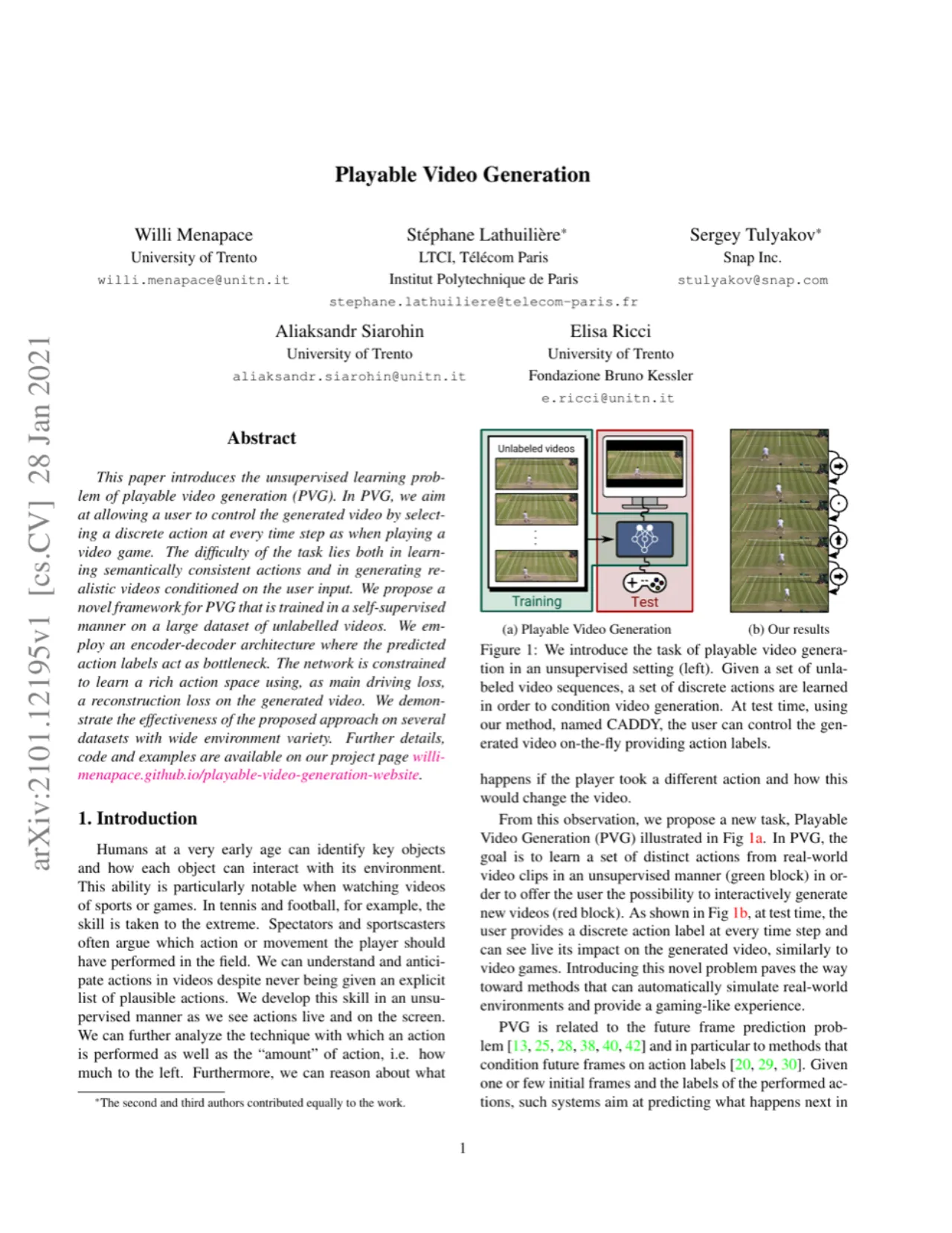
"We aim at allowing a user to control the generated video by selecting a discrete action at every time step as when playing a video game."
图1:PVG 任务概览(左)与 CADDY 生成结果(右)。训练阶段仅使用无标注视频序列,自动学习一组离散动作;测试阶段用户逐帧提供动作标签,即可实时控制生成视频,类似于玩游戏的体验。Figure 1: Overview of the PVG task (left) and results generated by CADDY (right). Training uses only unlabeled video sequences and automatically learns a set of discrete actions; at test time the user provides an action label at every frame and thereby controls the generated video in real time, much like playing a game.
0动作标签监督(全程无需标注)Action-label supervision (no annotation at any stage)
CVPR2021 Oral 论文2021 Oral paper
SOTA三个数据集上均超越所有基线Outperforms every baseline on all three datasets
问题的难点What Makes It Hard
PVG 的核心挑战有两个:(1)动作的语义一致性——在无监督前提下学习到真正有意义的离散动作,而非任意划分;(2)真实视频生成——根据用户提供的离散动作,生成高质量且连贯的视频帧。现实视频中的随机性(如摄像机抖动、光照变化等)进一步增加了用离散标签完整描述帧间过渡的难度。PVG poses two core challenges: (1) semantic consistency of the actions — learning discrete actions that are genuinely meaningful rather than an arbitrary partition, and doing so without supervision; (2) realistic video generation — producing high-quality, coherent frames conditioned on the discrete action supplied by the user. The stochasticity of real-world videos (camera shake, illumination changes, etc.) further increases the difficulty of fully describing frame-to-frame transitions with a discrete label.
02方法 MethodMethod
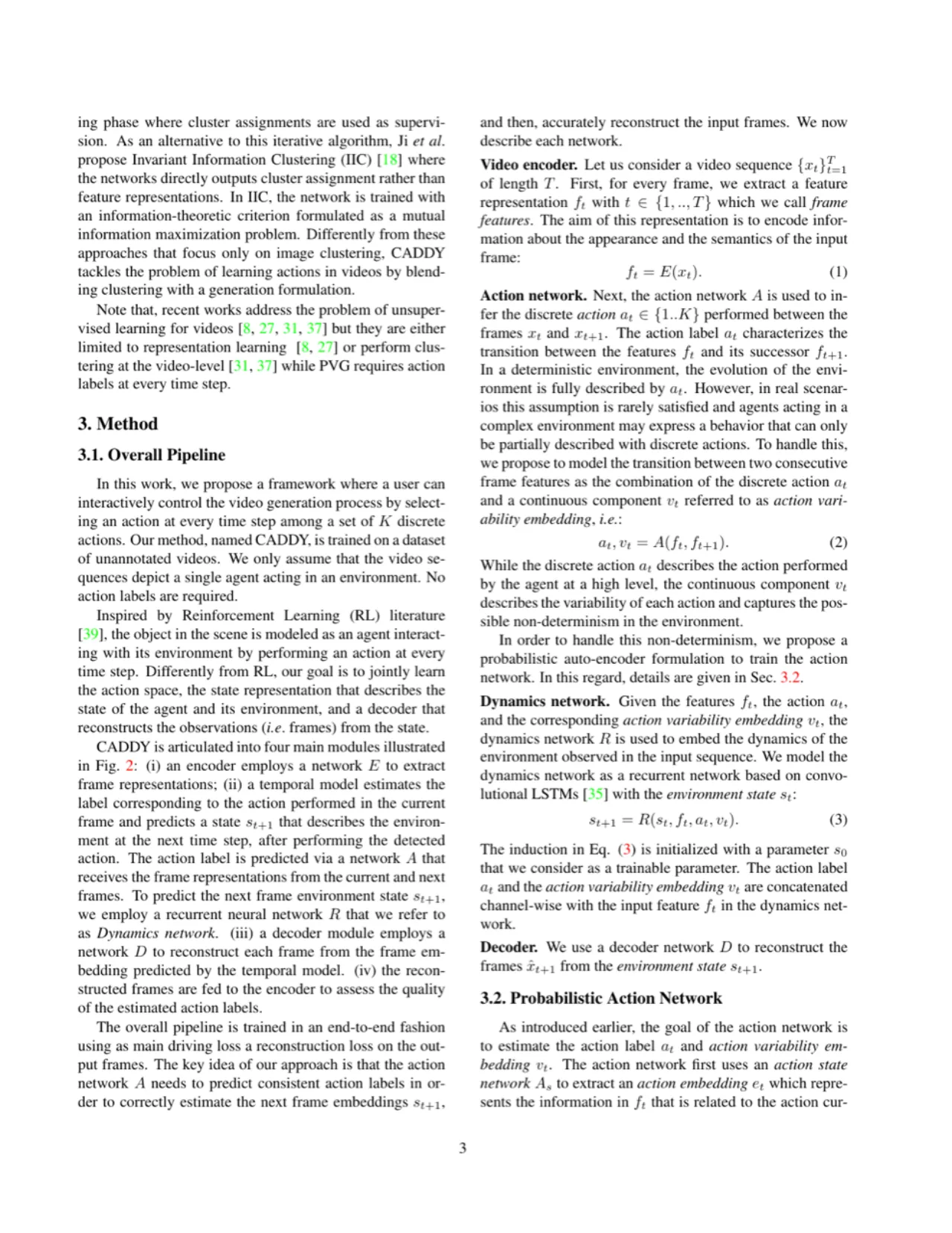
CADDY(Clustering for Action Decomposition and DiscoverY)是一个端到端自监督框架,由四个主模块组成:编码器 E、动作网络 A、循环动力学网络 R、解码器 D。整体以视频帧重建损失为主要驱动,迫使动作网络学到语义一致的离散表示。CADDY (Clustering for Action Decomposition and DiscoverY) is an end-to-end self-supervised framework made of four main modules: the encoder E, the action network A, the recurrent dynamics network R and the decoder D. It is driven mainly by a video-frame reconstruction loss, which forces the action network to learn semantically consistent discrete representations.
图2:CADDY 训练流程。编码器 E 从输入序列中提取帧表示 f_t;动作网络 A 推断相邻帧之间执行的离散动作 a_t 及连续变分嵌入 v_t;循环动力学网络 R(基于 convolutional LSTMs)根据当前状态、帧特征和动作预测下一时刻环境状态 s_{t+1};解码器 D 从状态 s_{t+1} 重建下一帧。重建帧再次送入编码器,计算特征级和动作级辅助损失(绿色模块)。Figure 2: CADDY training pipeline. The encoder E extracts the frame representation f_t from the input sequence; the action network A infers the discrete action a_t performed between adjacent frames together with a continuous variational embedding v_t; the recurrent dynamics network R (based on convolutional LSTMs) predicts the next environment state s_{t+1} from the current state, the frame features and the action; the decoder D reconstructs the next frame from the state s_{t+1}. The reconstructed frame is fed back into the encoder to compute feature-level and action-level auxiliary losses (green modules).
动作网络 A 的目标是将帧间过渡分解为:(1)离散动作标签 a_t(高层语义);(2)连续变分嵌入 v_t(捕捉每个动作执行方式的细节差异)。具体做法是:先用动作状态子网络 A_s 预测当前帧特征 f_t 的动作嵌入 e_t 服从高斯分布;再将前后两帧嵌入之差 d_t = e_{t+1} − e_t 送入分类层;分类层采用 Gumbel-Softmax 实现端到端可微分的离散化,输出动作概率 p_t 及离散标签 a_t。v_t 定义为 d_t 与其对应动作簇质心 c_k 的差,强制 d_t 无法完全从 v_t 中恢复,从而迫使网络学习真正的离散动作。The action network A decomposes a frame-to-frame transition into (1) a discrete action label a_t (high-level semantics) and (2) a continuous variational embedding v_t (capturing the fine-grained differences in how each action is carried out). Concretely, an action-state subnetwork A_s first predicts a Gaussian-distributed action embedding e_t for the current frame feature f_t; the difference between the embeddings of two consecutive frames, d_t = e_{t+1} − e_t, is then fed to a classification layer that uses Gumbel-Softmax for end-to-end differentiable discretisation, yielding the action probabilities p_t and the discrete label a_t. v_t is defined as the difference between d_t and the centroid c_k of its action cluster, so that d_t cannot be fully recovered from v_t and the network is forced to learn genuinely discrete actions.
训练目标Training Objective
总损失函数由五项组成:The total loss consists of five terms:
帧重建损失 L_rec^x:基于 VGG-19 感知损失(perceptual loss),在多分辨率金字塔上计算,辅以 L1 损失;Frame reconstruction loss L_rec^x: a VGG-19 perceptual loss computed over a multi-resolution pyramid, complemented by an L1 loss;
特征重建损失 L_rec^f:最小化输入帧特征与重建帧特征的欧氏距离,保证语义信息保真;Feature reconstruction loss L_rec^f: minimises the Euclidean distance between the features of the input frame and those of the reconstructed frame, so that semantic information is preserved;
动作匹配损失 L_act:最大化原始序列与重建序列所预测动作概率之间的互信息(mutual information),同时防止动作空间退化(所有帧预测同一动作);Action matching loss L_act: maximises the mutual information between the action probabilities predicted for the original and for the reconstructed sequence, while preventing the action space from degenerating (all frames predicting the same action);
动作变分损失 L_rec^a:用 KL 散度约束 v_t 分布的一致性;Action variational loss L_rec^a: uses a KL divergence to enforce the consistency of the distribution of v_t;
KL 正则化 L_KL:将 d_t 的后验对齐到标准高斯先验。KL regularisation L_KL: aligns the posterior of d_t with a standard Gaussian prior.
混合训练(mixed training):前 T_f 帧使用真实帧特征,之后切换为重建帧特征,缓解自回归生成中的分布偏移问题。测试时令 v_t = 0(对应后验分布的众数),仅由用户提供离散动作 a_t。Mixed training: the first T_f frames use ground-truth frame features and the subsequent ones switch to reconstructed frame features, which alleviates the distribution shift of autoregressive generation. At test time v_t = 0 (the mode of the posterior) and only the discrete action a_t is provided by the user.
03实验 ExperimentsExperiments
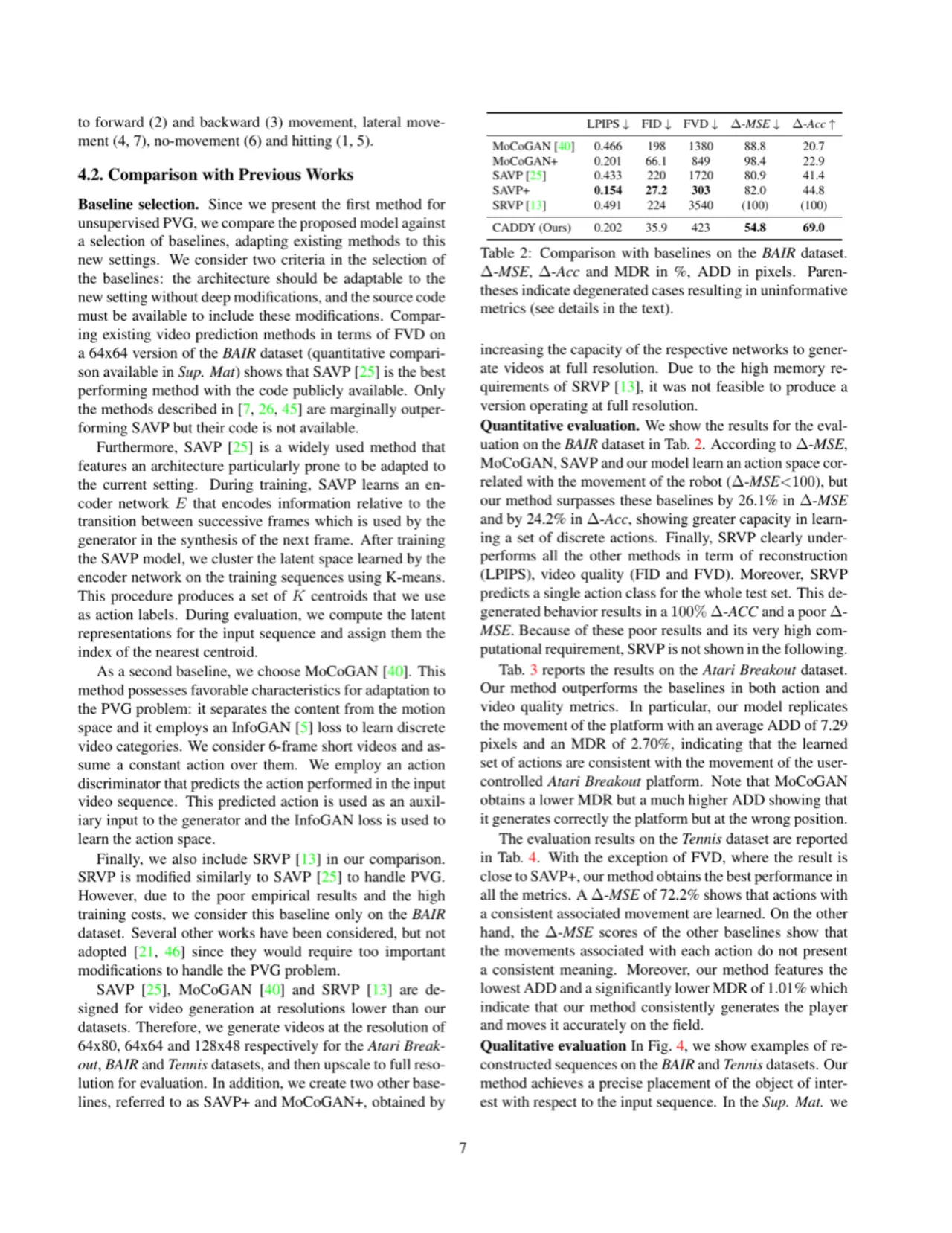
在三个数据集上评测:BAIR(机器人推物,约44K段30帧视频,256×256)、Atari Breakout(Rainbow DQN采集,1407段约32帧,160×210)、Tennis(YouTube网球比赛,约900段,256×96)。基线方法包括 MoCoGAN、MoCoGAN+、SAVP、SAVP+(增容量版)、SRVP。评估指标涵盖视频质量(LPIPS、FID、FVD)、动作空间质量(Δ-MSE、Δ-Acc)和动作条件生成质量(ADD、MDR)。Evaluation is carried out on three datasets: BAIR (robot pushing, about 44K sequences of 30 frames, 256×256), Atari Breakout (collected with a Rainbow DQN agent, 1407 sequences of about 32 frames, 160×210) and Tennis (YouTube tennis matches, about 900 sequences, 256×96). The baselines are MoCoGAN, MoCoGAN+, SAVP, SAVP+ (increased-capacity version) and SRVP. The metrics cover video quality (LPIPS, FID, FVD), action-space quality (Δ-MSE, Δ-Acc) and action-conditioned generation quality (ADD, MDR).
BAIR 数据集对比(Table 2)Comparison on BAIR (Table 2)
方法Method
LPIPS↓
FID↓
FVD↓
Δ-MSE↓ (%)
Δ-Acc↑ (%)
MoCoGAN
0.466
198
1380
88.8
20.7
MoCoGAN+
0.201
66.1
849
98.4
22.9
SAVP
0.433
220
1720
80.9
41.4
SAVP+
0.154
27.2
303
82.0
44.8
SRVP
0.491
224
3540
(100)
(100)
CADDY (Ours)
0.202
35.9
423
54.8
69.0
CADDY 相比最佳基线在 Δ-MSE 上提升 26.1%,在 Δ-Acc 上提升 24.2%,展示出更强的离散动作学习能力。SRVP 因预测整个测试集只有单一动作类别(退化行为),Δ-MSE 和 Δ-Acc 均失去意义。Against the best baseline, CADDY improves Δ-MSE by 26.1% and Δ-Acc by 24.2%, showing a much stronger ability to learn discrete actions. Since SRVP predicts a single action class over the whole test set (degenerate behaviour), its Δ-MSE and Δ-Acc are meaningless.
Atari Breakout 数据集对比(Table 3)Comparison on Atari Breakout (Table 3)
方法Method
LPIPS↓
FID↓
FVD↓
Δ-MSE↓ (%)
Δ-Acc↑ (%)
ADD (px)↓
MDR (%)↓
MoCoGAN
0.234
99.9
447
81.9
—
46.0
0.795
MoCoGAN+
65.8e-3
10.4
103
57.5
—
54.6
17.4
SAVP
0.239
98.4
487
58.1
—
24.7
21.0
SAVP+
39.3e-3
4.84
104
85.6
—
15.8
51.5
CADDY (Ours)
7.66e-3
0.716
5.94
82.7
91.6
7.29
2.70
CADDY 在 Atari Breakout 上取得最优性能:平均 ADD 仅 7.29 像素,MDR 仅 2.70%,说明学到的动作空间与用户控制平台的运动高度一致。CADDY attains the best performance on Atari Breakout: the average ADD is only 7.29 pixels and the MDR only 2.70%, which shows that the learned action space is highly consistent with the motion of the user-controlled platform.
Tennis 数据集对比(Table 4)Comparison on Tennis (Table 4)
方法Method
LPIPS↓
FID↓
FVD↓
Δ-MSE↓ (%)
Δ-Acc↑ (%)
ADD (px)↓
MDR (%)↓
MoCoGAN
0.266
132
3400
101
26.4
28.5
20.2
MoCoGAN+
0.166
56.8
1410
103
28.3
48.2
27.0
SAVP
0.245
156
3270
112
19.6
10.7
19.7
SAVP+
0.104
25.2
223
116
33.1
13.4
19.2
CADDY (Ours)
0.102
13.7
239
72.2
45.5
8.85
1.01
Tennis 数据集上,CADDY 在绝大多数指标取得最优,MDR 仅 1.01%,ADD 仅 8.85 像素,显著优于基线,说明能准确生成并追踪球员位置。On the Tennis dataset CADDY is best on the vast majority of metrics, with an MDR of only 1.01% and an ADD of only 8.85 pixels, clearly outperforming the baselines and indicating that the player position is generated and tracked accurately.
图3:CADDY 在三个数据集上学到的动作空间可视化。对每个动作,以初始帧为起点,重复选取该动作生成序列并展示最终帧;下方为对应参考点位移 Δ 的分布。BAIR 上学到了 x、y、z 轴方向移动及无运动动作;Atari Breakout 上学到了三种平台移动及物理规律;Tennis 上学到了前进、后退、横向移动、无运动和击球。Figure 3: Visualisation of the action spaces learned by CADDY on the three datasets. For each action, a sequence is generated from an initial frame by repeatedly selecting that action and the final frame is shown; below is the distribution of the corresponding reference-point displacement Δ. On BAIR the model learns motions along the x, y and z axes plus a no-motion action; on Atari Breakout it learns three platform movements and the physics of the game; on Tennis it learns moving forward, moving backward, lateral motion, no motion and hitting the ball.
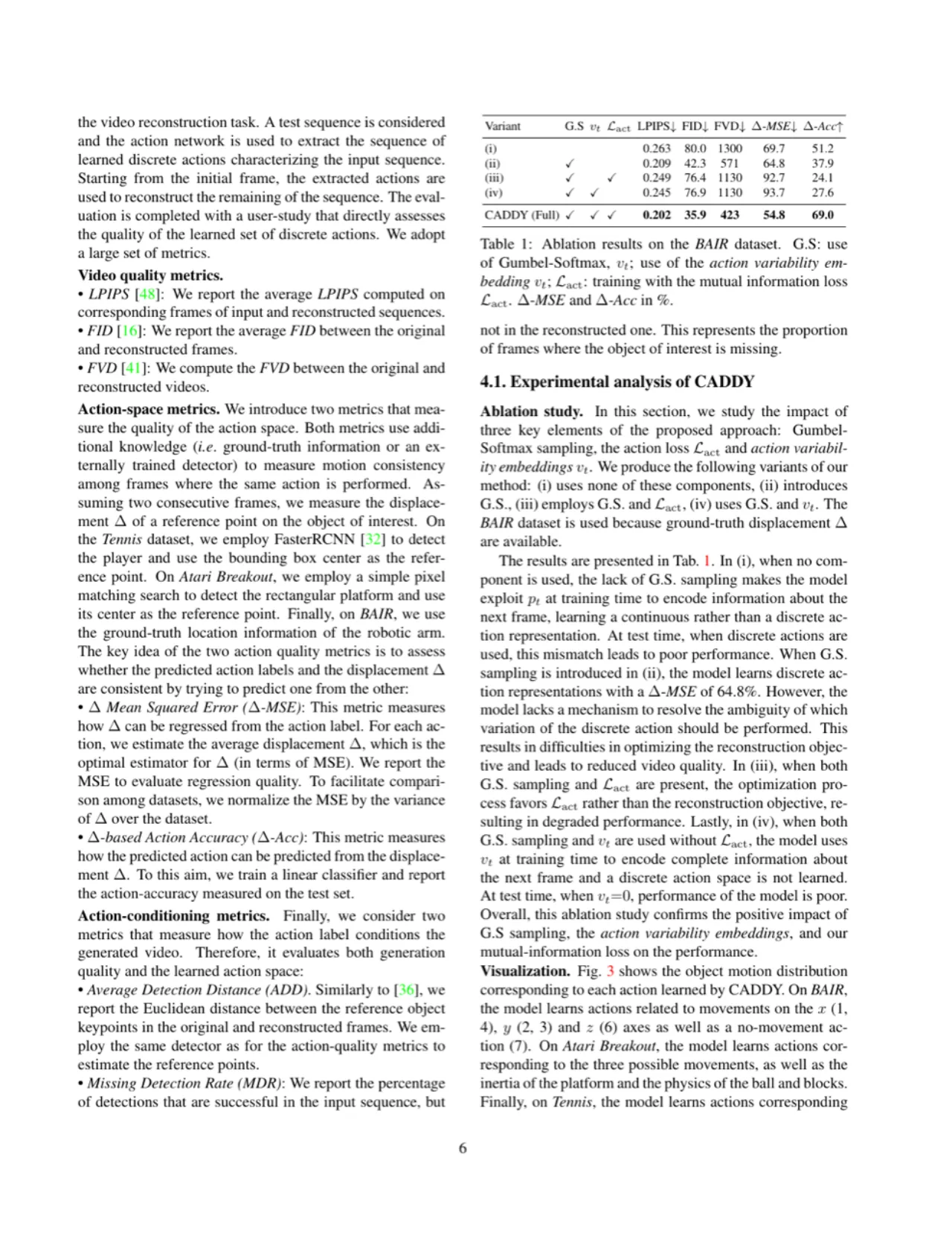
消融实验(Table 1,BAIR 数据集)Ablation Study (Table 1, BAIR)
变体Variant
G.S.
v_t
L_act
LPIPS↓
FID↓
FVD↓
Δ-MSE↓ (%)
Δ-Acc↑ (%)
(i) 无任何组件no component
—
—
—
0.263
80.0
1300
69.7
51.2
(ii) + G.S.
✓
—
—
0.209
42.3
571
64.8
37.9
(iii) + G.S. + L_act
✓
—
✓
0.249
76.4
1130
92.7
24.1
(iv) + G.S. + v_t
✓
✓
—
0.245
76.9
1130
93.7
27.6
CADDY (完整full)
✓
✓
✓
0.202
35.9
423
54.8
69.0
消融实验证明三个核心组件(Gumbel-Softmax、动作变分嵌入 v_t、互信息损失 L_act)缺一不可:去掉 G.S. 则学到连续而非离散动作;单独使用 L_act 优化会与重建目标冲突导致质量下降;v_t 和 L_act 必须配合使用,才能避免网络将所有信息编码进连续变量而忽略离散动作。The ablation shows that the three core components (Gumbel-Softmax, the action variational embedding v_t and the mutual-information loss L_act) are all indispensable: without G.S. the learned actions are continuous rather than discrete; optimising L_act on its own conflicts with the reconstruction objective and degrades quality; v_t and L_act must be used together, otherwise the network encodes all the information in the continuous variable and ignores the discrete actions.
图4 & Tables 2–4:BAIR(左)和 Tennis(右)数据集上的重建结果对比。CADDY 对感兴趣目标的位置估计更为精准,相比基线方法(MoCoGAN+、SAVP+)具有明显优势。Figure 4 & Tables 2–4: Comparison of reconstruction results on BAIR (left) and Tennis (right). CADDY estimates the position of the object of interest far more precisely and has a clear advantage over the baselines (MoCoGAN+, SAVP+).
用户研究(Tennis 数据集)User Study (Tennis)
作者进行了用户研究,要求23名用户从生成序列中辨认出执行的动作(左/右/前进/后退/击球/静止)。CADDY 获得最高的 Fleiss' kappa 一致性(0.469),而基线方法(MoCoGAN: −3.15×10⁻³,MoCoGAN+: −2.84×10⁻³,SAVP: 0.0718,SAVP+: −1.97×10⁻³)均无法达到有意义的一致性,说明 CADDY 学到的动作具有稳定的语义含义。In a user study, 23 users were asked to recognise the action performed in a generated sequence (left / right / forward / backward / hit / stay). CADDY obtains the highest Fleiss’ kappa agreement (0.469), whereas the baselines (MoCoGAN: −3.15×10⁻³, MoCoGAN+: −2.84×10⁻³, SAVP: 0.0718, SAVP+: −1.97×10⁻³) reach no meaningful agreement at all, showing that the actions learned by CADDY carry stable semantics.
04局限性 LimitationsLimitations
Note:论文未设专门的 Limitations 节。以下条目标注来源:stated = 作者明确提及;inferred = 从方法设计推断。The paper has no dedicated Limitations section. Each item below is tagged with its source: stated = explicitly mentioned by the authors; inferred = deduced from the method design.
仅支持单智能体场景(stated)Single-agent scenarios only (stated)
CADDY 假设视频中只有单个智能体在环境中行动。论文在 Conclusions 中明确指出:"As future work, we plan to extend our method to multi-agent environments."——多球员比赛、多机器人协作等场景当前无法处理。CADDY assumes that only a single agent acts in the environment. The Conclusions state explicitly: “As future work, we plan to extend our method to multi-agent environments.” Multi-player matches, multi-robot collaboration and similar settings cannot be handled at present.
动作数量 K 需手动指定(inferred)The number of actions K must be set by hand (inferred)
K 值(动作簇数量)作为超参数在实验前确定,方法本身没有自动选择最优 K 的机制。不同数据集需单独调整,且过小的 K 可能导致语义粒度不足,过大则可能出现冗余动作。K (the number of action clusters) is fixed as a hyper-parameter before each experiment; the method itself has no mechanism for choosing the optimal K. It must be tuned separately for every dataset, and a K that is too small gives insufficient semantic granularity while a K that is too large may produce redundant actions.
视频分辨率受限(inferred)Limited video resolution (inferred)
基线方法(SAVP、MoCoGAN、SRVP)受内存限制仅能在 64×64 或更低分辨率下运行,CADDY 虽在全分辨率下测试,但当分辨率进一步提升时,convolutional LSTM 的计算成本将显著增加。Memory constraints limit the baselines (SAVP, MoCoGAN, SRVP) to a resolution of 64×64 or lower; although CADDY is tested at full resolution, the computational cost of the convolutional LSTM grows substantially as the resolution is pushed further up.
自回归误差积累(stated)Accumulation of autoregressive error (stated)
测试时采用自回归方式(以重建帧作为下一步输入),论文指出这会引入"shift issue"——网络在训练时未完全暴露于自己生成的图像。混合训练策略(mixed training)可部分缓解但无法完全消除该问题。Generation at test time is autoregressive (the reconstructed frame is the input of the next step), which the paper says introduces a “shift issue”: during training the network is not fully exposed to its own generated images. The mixed training strategy alleviates the problem only partially and cannot remove it entirely.