本文提出 Playable Environments (PE) 框架——给定单张初始帧,用户可通过离散动作控制场景中每个玩家的运动、自由操控相机视角,并为任意对象指定外观风格,从而像玩电子游戏一样与真实视频场景交互。系统在单目视频上无监督训练,无需任何动作标注。This paper proposes the Playable Environments (PE) framework: given a single initial frame, the user can control the motion of every player in the scene through discrete actions, freely manipulate the camera viewpoint, and assign an appearance style to any object, thereby interacting with a real video scene much like playing a video game. The system is trained on monocular videos in an unsupervised manner, without any action annotations.
playable environmentsneural radiance fieldsvideo generationcamera controlaction learning可交互视频生成interactive video generation三维场景操控3D scene manipulation非刚性NeRFnon-rigid NeRF
01动机Motivation
视频记录的是静态的事件副本。人们希望能像观看网球比赛时那样,随意改变球员的动作、调整相机角度、切换场地风格——这需要在三维空间中理解并重建场景,同时提供直观的交互界面,如同操控电子游戏。现有方法各有局限:A video is a static copy of an event. One would like to freely change a player's actions, adjust the camera angle and switch the court style while watching a tennis match—which requires understanding and reconstructing the scene in 3D space while offering an intuitive interaction interface, as in a video game. Existing methods each have their limitations:
Novel View Synthesis(如 NeRF):支持静态场景的自由视点渲染,但难以处理动态对象、不支持用户交互。Novel View Synthesis (e.g., NeRF): supports free-viewpoint rendering of static scenes, but struggles with dynamic objects and offers no user interaction.
视频生成方法(如 MoCoGAN、SAVP):可预测未来帧或动画化对象,但通常缺乏相机控制和多对象支持,不考虑三维本质。Video generation methods (e.g., MoCoGAN, SAVP): can predict future frames or animate objects, but usually lack camera control and multi-object support, and disregard the 3D nature of the scene.
Playable Video Generation(PVG,如 CADDY):可学习离散动作控制视频,但仅限于二维、单对象、有限相机运动场景。Playable Video Generation (PVG, e.g., CADDY): learns discrete actions that control video, but is restricted to 2D, single-object scenes with limited camera motion.
"We call these representations Playable Environments (PE)... [they] encapsulate and extend representations built by several prior image or video manipulation methods."
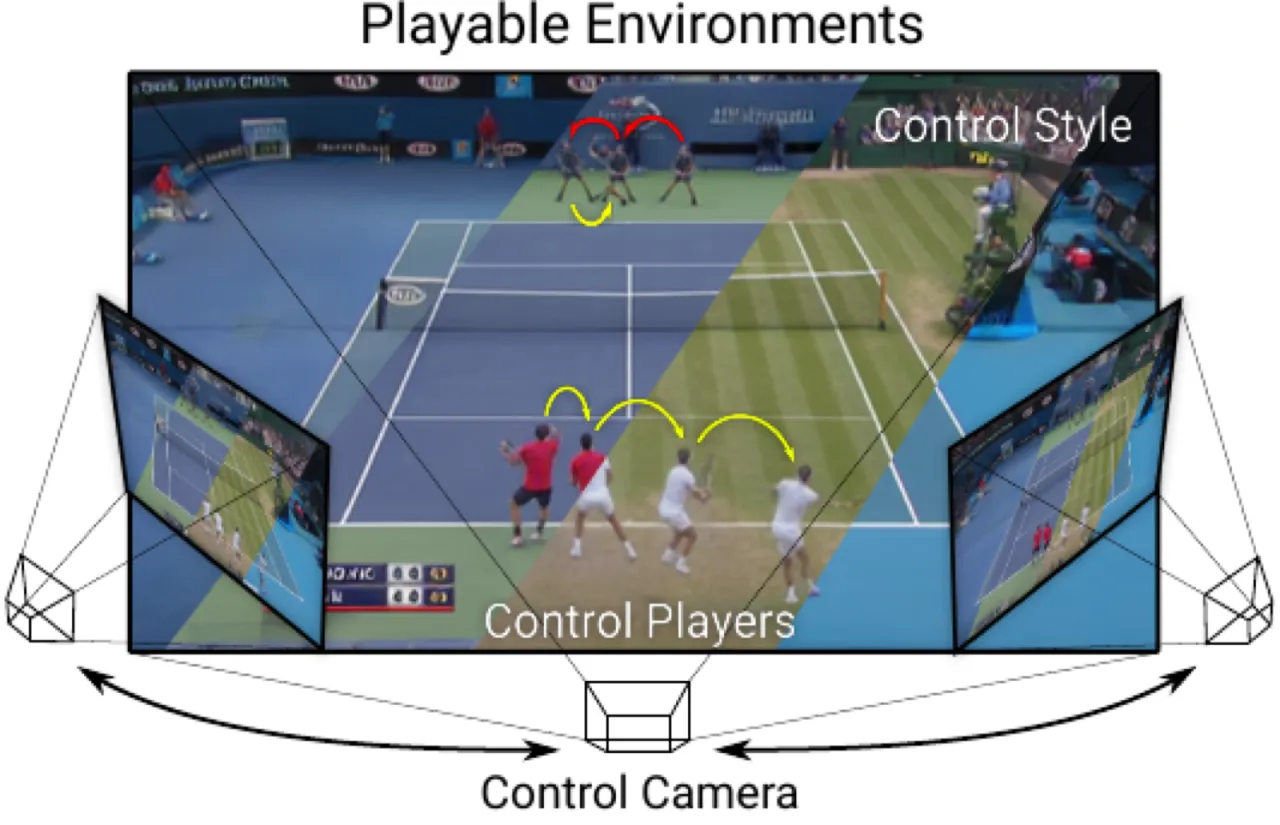
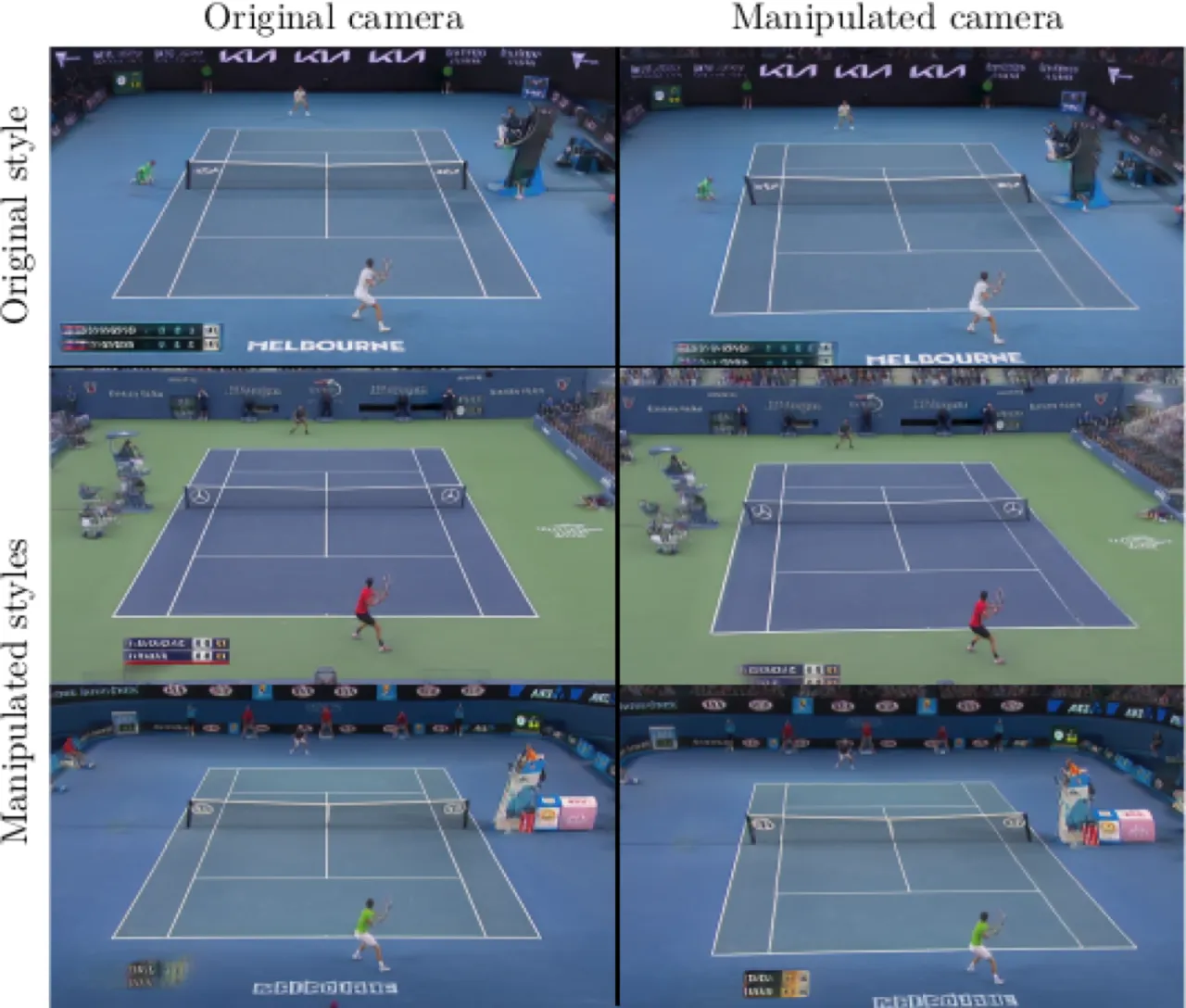
可玩环境示意。给定单张初始帧,用户可通过指定离散动作控制球员移动,操控相机轨迹改变视角,并为球员和球场指定风格——整个过程像玩视频游戏,但场景是真实的。(图源:论文 Figure 1)Playable environment overview. Given a single initial frame, the user controls player movement by specifying discrete actions, changes the viewpoint by manipulating the camera trajectory, and assigns styles to the players and the court—the whole process feels like playing a video game, yet the scene is real. (Source: paper Figure 1)
论文定义了可玩环境需满足的六项核心特性:The paper defines six core properties that a playable environment must satisfy:
⑴Playability:离散动作控制Playability: discrete action control
⑵Camera control:相机位姿显式控制Camera control: explicit control of camera pose
⑶Multi-object:显式建模每个对象Multi-object: every object modeled explicitly
⑹Robustness:对定标/定位误差鲁棒Robustness: robust to calibration/localization error
43场网球比赛(12h 视频)tennis matches (12h of video)
1hMinecraft 合成视频Minecraft synthetic video
02方法Method
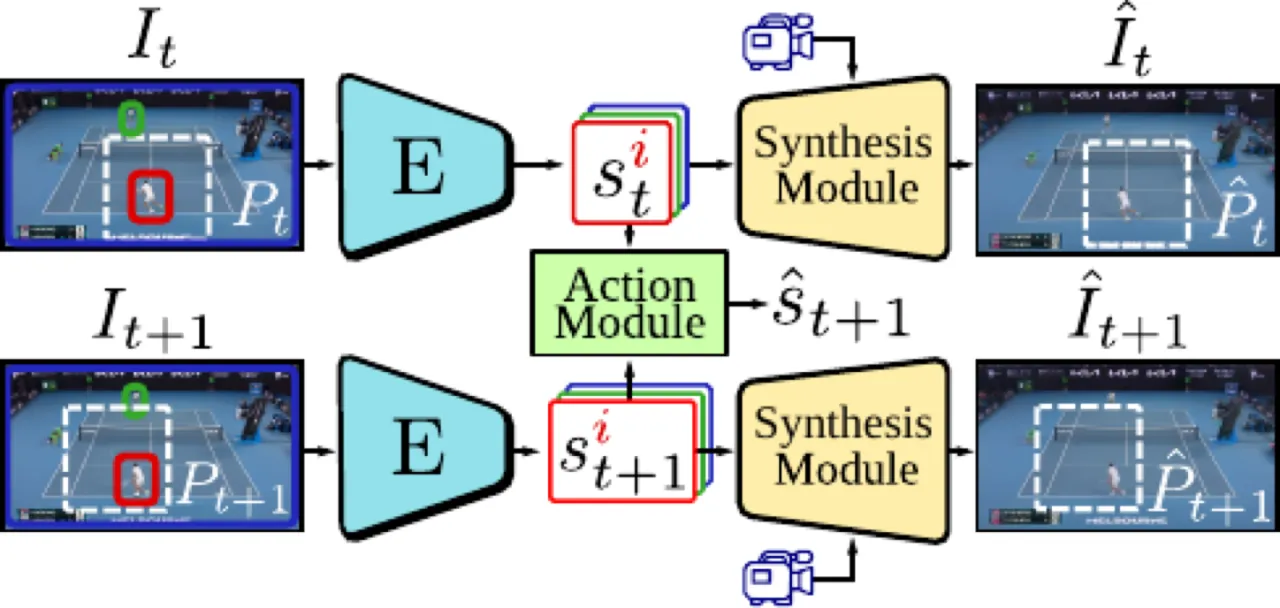
框架采用编码器-解码器结构,核心由两个模块构成:Synthesis Module(合成模块)负责从场景状态渲染图像;Action Module(动作模块)负责在状态空间中学习并预测用户动作。训练分两阶段进行,全程仅依赖重建损失,无需人工动作标注。The framework follows an encoder-decoder design built from two modules: the Synthesis Module renders images from the scene state, while the Action Module learns and predicts user actions in the state space. Training proceeds in two stages and relies on reconstruction losses alone, requiring no manual action labels.
框架总览。编码器 E 为场景中每个对象提取环境状态(位置 x、风格 w、姿态 π);合成模块(NeRF-like)从状态与相机参数重建帧;动作模块在瓶颈层学习离散动作标签,推理时由用户指定动作以控制生成内容。(图源:论文 Figure 2)Framework overview. The encoder E extracts an environment state for every object in the scene (position x, style w, pose π); the synthesis module (NeRF-like) reconstructs the frame from the state and the camera parameters; the action module learns discrete action labels at the bottleneck, and at inference the user specifies the action to control the generated content. (Source: paper Figure 2)
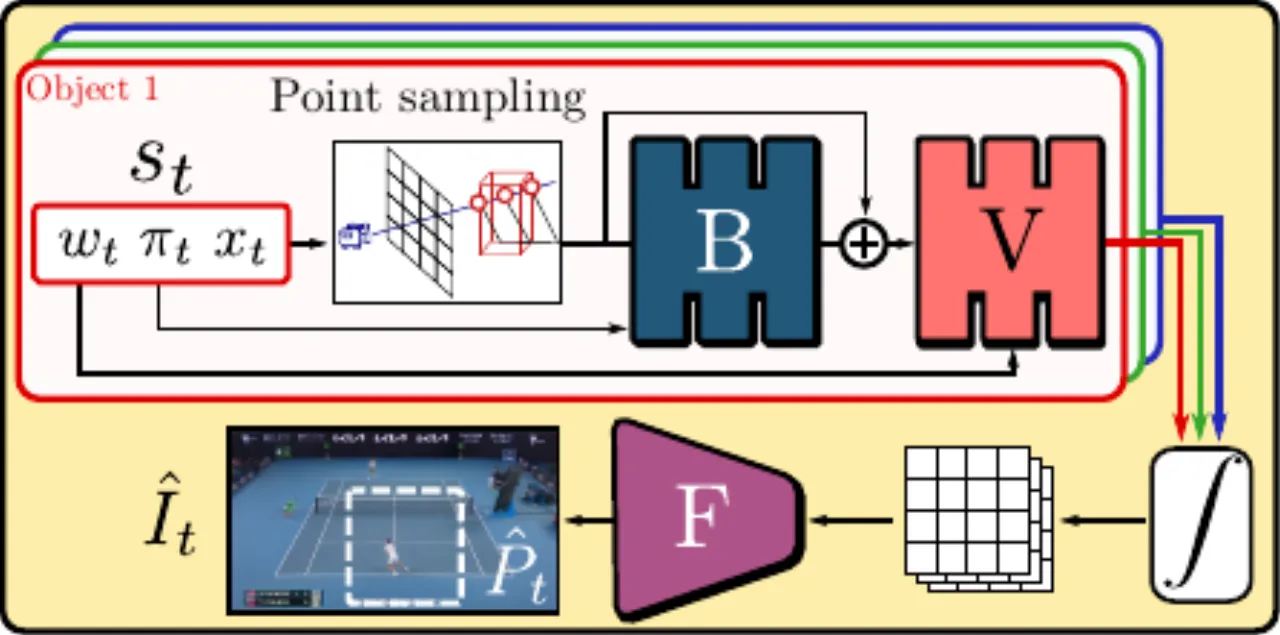
合成模块以 NeRF 为基础架构,实现相机控制 ⑵。每个对象由独立的 MLP V 参数化的 feature field 建模,各 field 以对象位置为中心、受 bounding volume 约束,从而支持多对象建模 ⑶。The synthesis module builds on NeRF as its backbone, which delivers camera control ⑵. Each object is modeled by a feature field parameterized by a separate MLP V; every field is centered on the object position and constrained by a bounding volume, which enables multi-object modeling ⑶.
为处理可变形对象(如人体)⑷,引入 ray bending networkB:给定姿态描述子 π 与采样点 x_p,通过 B 将其映射到正则空间坐标 x̃_p = x_p + B(x_p, π_t),从而在正则空间中编码对象几何。To handle deformable objects such as human bodies ⑷, a ray bending networkB is introduced: given a pose descriptor π and a sample point x_p, B maps it to the canonical-space coordinate x̃_p = x_p + B(x_p, π_t), thereby encoding object geometry in canonical space.
为建模外观多样性 ⑸,受 AdaIN 启发,在 V 的 feature prediction branch 中嵌入风格调制层:h̃_t = γ(w_t) h_t + β(w_t),其中 γ, β 为可训练线性层,风格码 w_t 只调制颜色特征而不影响几何。To model appearance diversity ⑸, and inspired by AdaIN, style modulation layers are embedded in the feature prediction branch of V: h̃_t = γ(w_t) h_t + β(w_t), where γ, β are trainable linear layers and the style code w_t modulates only color features without affecting geometry.
合成模块。两步流程:首先用带 bending network B 的非刚性 NeRF 生成特征图;再将特征图送入 ConvNet F(Feature Renderer)输出最终帧图像。Feature Renderer 通过跨像素建模弥补定标噪声导致的模糊,同时因在低分辨率采样 NeRF 光线而显著降低显存消耗。(图源:论文 Figure 3)Synthesis module. A two-step pipeline: a non-rigid NeRF equipped with the bending network B first produces a feature map; the feature map is then fed to a ConvNet F (Feature Renderer) that outputs the final frame. The Feature Renderer compensates for the blur caused by calibration noise by modeling across pixels, and markedly reduces memory consumption because NeRF rays are sampled at low resolution. (Source: paper Figure 3)
Action Module:状态空间离散动作学习Action Module: Discrete Action Learning in State Space
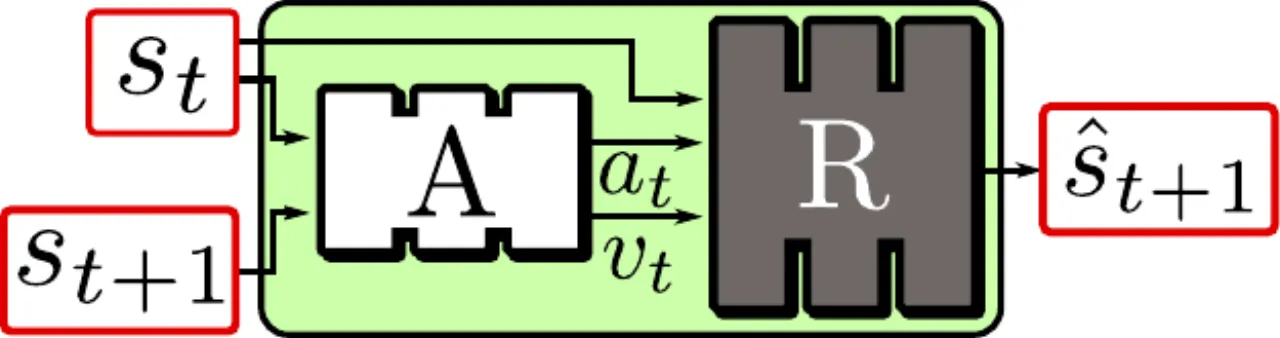
动作模块由 Action Network A 和 Dynamics Network R 组成。A 给定相邻状态 (s_t, s_{t+1}),输出离散动作 a_t ∈ {1,...,K} 与 action variability embedding v_t;R(LSTM)以 (s_t, a_t, v_t) 为输入自回归预测下一状态。The action module consists of an Action Network A and a Dynamics Network R. Given adjacent states (s_t, s_{t+1}), A outputs a discrete action a_t ∈ {1,...,K} together with an action variability embedding v_t; R (an LSTM) takes (s_t, a_t, v_t) as input and autoregressively predicts the next state.
为使动作与相机朝向一致(符合游戏直觉),Dynamics Network 预测相机坐标系下的位移 Δ,再通过旋转矩阵 M 转换:x̂_{t+1} = x_t + MΔ。To keep actions consistent with the camera orientation (matching game intuition), the Dynamics Network predicts the displacement Δ in the camera coordinate system and converts it through a rotation matrix M: x̂_{t+1} = x_t + MΔ.
动作模块。Action Network A 从相邻状态推断离散动作标签 a_t 及 variability v_t;Dynamics Network R 结合 s_t, a_t, v_t 预测 s_{t+1}。推理时由用户指定 a_t,v_t 置零。(图源:论文 Figure 4)Action module. The Action Network A infers the discrete action label a_t and the variability v_t from adjacent states; the Dynamics Network R combines s_t, a_t, v_t to predict s_{t+1}. At inference the user specifies a_t and v_t is set to zero. (Source: paper Figure 4)
训练策略Training Strategy
阶段一(合成模块):用感知损失(VGG perceptual loss)+ L2 像素重建损失训练编码器与合成模块。为避免风格 w 和姿态 π 解耦失败,在每个序列的时间维度上打乱 w 的顺序再送入合成模块。Stage 1 (synthesis module): the encoder and the synthesis module are trained with a perceptual loss (VGG perceptual loss) plus an L2 pixel reconstruction loss. To prevent the style w and the pose π from failing to disentangle, the order of w is shuffled along the temporal dimension of each sequence before it is fed to the synthesis module.
阶段二(动作模块):联合优化四项损失——重建损失 L_rec、信息论动作学习损失 L_act(最大化互信息)、Δ-MSE 软损失 L_Δ(同类动作应对应相似位移)、以及对抗 Temporal Discriminator D(判别真实/重建状态序列,促使动作生成真实肢体动作)。Stage 2 (action module): four losses are optimized jointly—the reconstruction loss L_rec, the information-theoretic action learning loss L_act (maximizing mutual information), the soft Δ-MSE loss L_Δ (identical actions should correspond to similar displacements), and an adversarial Temporal Discriminator D (which tells real from reconstructed state sequences, pushing actions to generate realistic limb motion).
03实验Experiments
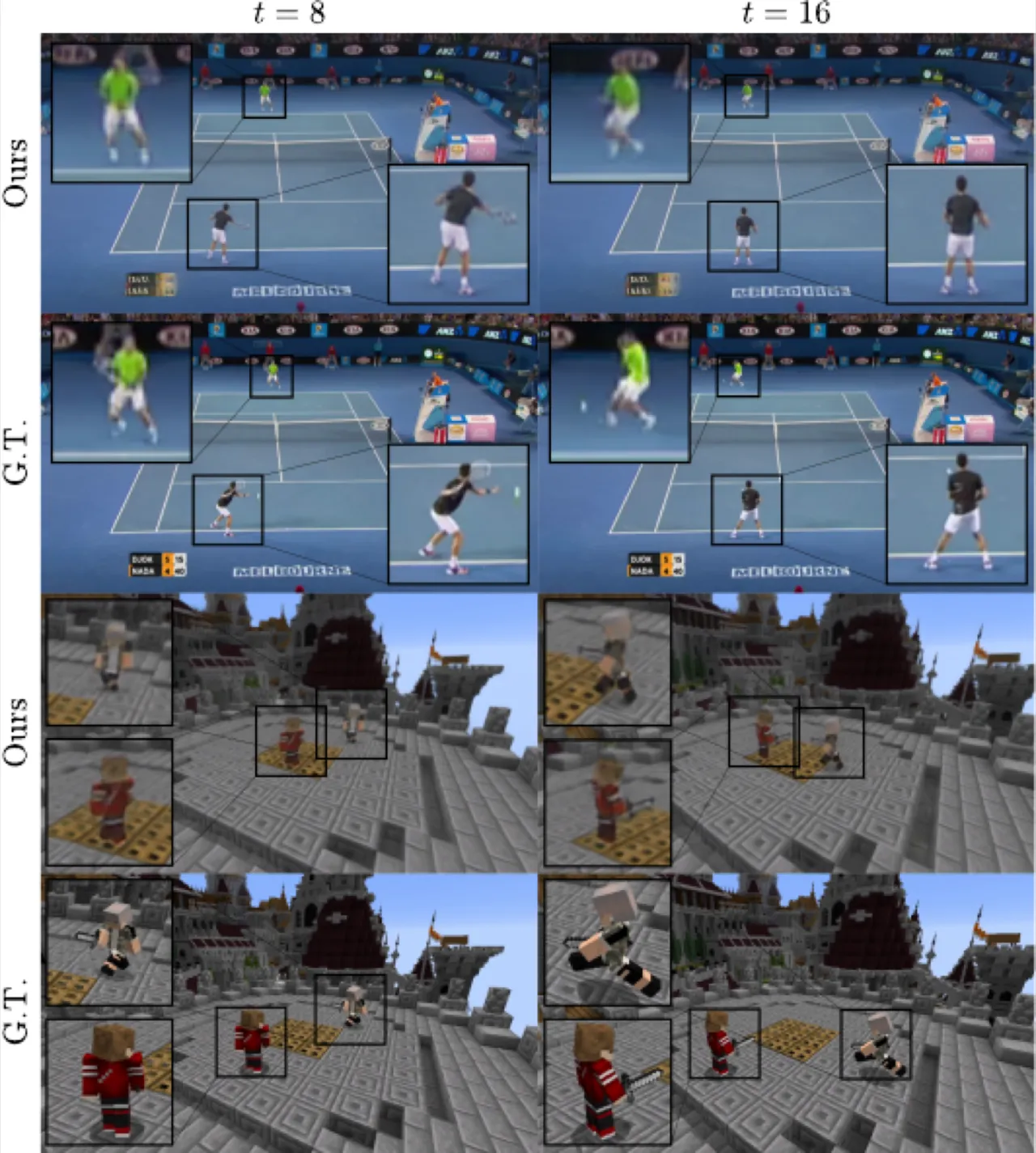
在三个数据集上评估:Tennis(43场网球赛,12h真实视频)、Minecraft(1h合成视频,宽视角运动)、Minecraft Camera(相机运动序列,提供 novel view 真值);另采用 Static Tennis(PVG基准)做方法对比。Evaluation is carried out on three datasets: Tennis (43 tennis matches, 12h of real video), Minecraft (1h of synthetic video with wide-viewpoint motion) and Minecraft Camera (camera motion sequences providing novel view ground truth); Static Tennis (the PVG benchmark) is additionally used for method comparison.
在 playable video generation 设定(无显式相机控制)下,与 MoCoGAN、SAVP、CADDY 等方法对比:Under the playable video generation setting (no explicit camera control), the method is compared against MoCoGAN, SAVP and CADDY:
方法Method
LPIPS ↓
FID ↓
FVD ↓
Δ-MSE ↓ (%)
Δ-Acc ↑ (%)
ADD ↓ (px)
MDR ↓ (%)
MoCoGAN
0.266
132
3400
101
26.4
28.5
20.2
SAVP
0.245
156
3270
112
19.6
10.7
19.7
CADDY
0.102
13.7
239
72.2
45.5
8.85
1.01
Ours
0.089
15.3
237
32.8
68.1
9.47
0.15
本方法在动作质量指标(Δ-MSE、Δ-Acc)和视频重建质量(LPIPS、MDR)上均显著优于 CADDY,动作与球员运动的一致性大幅提升。The proposed method clearly outperforms CADDY on both the action quality metrics (Δ-MSE, Δ-Acc) and the video reconstruction quality (LPIPS, MDR), with a large gain in the consistency between actions and player motion.
在完整 PE 设定下(多对象、真实相机运动),与基于 CADDY 的多种变体比较。本方法在 Tennis 上 LPIPS=0.181、FVD=485、Δ-MSE=0.293%、Δ-Acc=95.7%、MDR=4.84%,全面超越所有基线;在 Minecraft Camera(相机控制)上 LPIPS=0.242、FID=29.2,而最佳基线 FID≥244——本方法能真正从新视角合成场景,而 CADDY 各变体由于缺乏显式相机模型,无法处理 novel view 生成。Under the full PE setting (multiple objects, real camera motion), the method is compared with several CADDY-based variants. It reaches LPIPS=0.181, FVD=485, Δ-MSE=0.293%, Δ-Acc=95.7% and MDR=4.84% on Tennis, surpassing every baseline across the board; on Minecraft Camera (camera control) it reaches LPIPS=0.242 and FID=29.2, whereas the best baseline has FID≥244—the proposed method genuinely synthesizes the scene from novel viewpoints, while the CADDY variants cannot handle novel view generation because they lack an explicit camera model.
方法Method
Tennis LPIPS ↓
Tennis FVD ↓
Tennis Δ-Acc ↑ (%)
Tennis MDR ↓ (%)
MC-Cam LPIPS ↓
MC-Cam FID ↓
CADDY (i)
0.313
877
42.6
36.9
0.747
306
CADDY (iii) best
0.213
727
57.5
11.7
0.669
244
Ours
0.181
485
95.7
4.84
0.242
29.2
用户研究User Study
在 Tennis 数据集上的用户研究中,采用 Fleiss' kappa 衡量动作一致性:本方法 kappa=0.444,最佳基线 kappa=0.353,说明本方法学到的动作空间更清晰、更易于用户一致识别。In a user study on the Tennis dataset, action consistency is measured with Fleiss' kappa: the proposed method reaches kappa=0.444 against kappa=0.353 for the best baseline, indicating that the learned action space is clearer and easier for users to recognize consistently.
定性重建结果(Tennis + Minecraft)。本方法从第一帧出发,通过离散动作序列重建视频,能正确合成两名球员并准确还原运动轨迹;Minecraft 场景下亦能处理大幅相机运动与多样化玩家外观。(图源:论文定性结果图)Qualitative reconstruction results (Tennis + Minecraft). Starting from the first frame, the method reconstructs the video through a sequence of discrete actions, correctly synthesizing both players and faithfully reproducing their trajectories; in Minecraft scenes it also copes with large camera motion and diverse player appearances. (Source: qualitative results figure of the paper)风格与相机操控结果(Tennis)。本方法可从新视角合成场景,并将球员及球场外观切换为目标图像中的风格,两种操控均可独立或联合使用。(图源:论文定性结果图)Style and camera manipulation results (Tennis). The method can synthesize the scene from novel viewpoints and switch the appearance of the players and the court to the style of a target image; the two manipulations can be applied independently or jointly. (Source: qualitative results figure of the paper)
消融实验Ablation Studies
合成模块消融(Minecraft):逐步加入 Multi-object(⑶)、非刚性变形 π(⑷)、风格调制 w(⑸)、Feature Renderer F(⑹)。结果表明:deformation 和 style modulation 对精确合成均不可缺少(⑷⑸),但单独使用会因定标噪声导致模糊;引入 Feature Renderer 后,LPIPS 从 0.350 降至 0.193,FID 从 61.0 降至 16.5,FVD 从 465 降至 289,显著恢复清晰度。Synthesis module ablation (Minecraft): Multi-object (⑶), non-rigid deformation π (⑷), style modulation w (⑸) and the Feature Renderer F (⑹) are added step by step. The results show that deformation and style modulation are both indispensable for accurate synthesis (⑷⑸), yet on their own they yield blur caused by calibration noise; adding the Feature Renderer lowers LPIPS from 0.350 to 0.193, FID from 61.0 to 16.5 and FVD from 465 to 289, restoring sharpness substantially.
变体Variant
Multi ⑶
π ⑷
w ⑸
F ⑹
LPIPS ↓
FID ↓
FVD ↓
(a) NeRF-like
—
—
—
—
0.735
376
2548
(c) +Multi+π
✓
✓
—
—
0.648
301
1818
(e) +Multi+π+w
✓
✓
✓
—
0.350
61.0
465
Full
✓
✓
✓
✓
0.193
16.5
289
动作模块消融:去掉 Temporal Discriminator D 会导致 FVD 显著上升(动作序列中肢体运动不真实);Δ-MSE 损失 L_Δ 对动作空间质量有正向影响;相机相对坐标预测(Rel.)对于生成视角一致的动作效果至关重要。Action module ablation: removing the Temporal Discriminator D raises FVD markedly (limb motion within the action sequences becomes unrealistic); the Δ-MSE loss L_Δ has a positive effect on the quality of the action space; and predicting in camera-relative coordinates (Rel.) is crucial for producing viewpoint-consistent actions.
04局限性Limitations
说明:以下局限性均为论文作者在 Discussion 节中明确阐述(stated limitations)。Note: all limitations below are explicitly stated by the authors in the Discussion section (stated limitations).
几何固定假设:场景几何不可变Fixed-geometry assumption: scene geometry cannot vary
方法假设环境几何在整个训练集中保持不变,因此无法在不同几何的环境中训练(例如在多个不同球场之间)。The method assumes that the environment geometry stays unchanged throughout the training set, so it cannot be trained on environments with differing geometry (for instance across several different courts).
Tennis 数据集的"平坦世界"先验The "flat world" prior of the Tennis dataset
Tennis 数据集中只有相机旋转而无相机平移,导致场地几何恢复不适定。作者为此施加"flat world"先验对几何进行正则化,推理时允许更大范围的相机操控,但代价是当相机位置偏离训练集时背景会被投影到平面上,产生视觉伪影。The Tennis dataset contains camera rotation but no camera translation, which makes recovery of the court geometry ill-posed. The authors therefore impose a "flat world" prior to regularize the geometry, allowing a wider range of camera manipulation at inference; the price is that the background gets projected onto a plane and produces visual artifacts once the camera position departs from the training set.
薄物体与快速运动导致模糊/缺失伪影Thin objects and fast motion cause blur and missing-part artifacts
球员肢体、球拍等薄而快速运动的部件仍存在模糊或部件缺失伪影。Tennis 数据集中频繁的运动模糊、小至几像素的肢体、定标噪声均加剧了这一问题,Feature Renderer 只能部分缓解。Thin, fast-moving parts such as player limbs and rackets still exhibit blur or missing-part artifacts. Frequent motion blur in the Tennis dataset, limbs only a few pixels wide and calibration noise all aggravate the problem, which the Feature Renderer can only partly alleviate.
动作控制粒度有限:位移驱动而非姿态驱动Limited granularity of action control: displacement-driven rather than pose-driven
动作空间以对象位移 Δ 为核心学习目标,与位置变化弱相关的动作(如挥拍动作)难以被显式控制,用户只能间接影响而无法精确指定。The action space takes object displacement Δ as its core learning target, so actions weakly correlated with position change (such as a racket swing) are hard to control explicitly; users can influence them only indirectly and cannot specify them precisely.
多对象独立动画:缺乏对象间交互Independent per-object animation: no interaction between objects
推理时各对象独立动画,无法捕捉对象间交互(如两位球员同时挥拍击球),可能产生不合理的联合动作。At inference each object is animated independently, so interactions between objects (such as two players swinging at the ball at the same time) cannot be captured, which may produce implausible joint actions.