← 论文海报合集← Paper Notes|
cs.RO · cs.LG · Physical Intelligence · arXiv 2025

π₀.₅: a Vision-Language-Action Model with Open-World Generalization

首个在全新家庭中完成长时域灵巧操作的端到端机器人学习系统The first end-to-end robot learning system to perform long-horizon dexterous manipulation in entirely new homes
Kevin Black, Noah Brown, Danny Driess, Chelsea Finn, Karol Hausman, Brian Ichter, Sergey Levine 等 36 位作者 · Physical IntelligenceKevin Black, Noah Brown, Danny Driess, Chelsea Finn, Karol Hausman, Brian Ichter, Sergey Levine and others, 36 authors in total · Physical Intelligence

π₀.₅ 通过在异构数据源(多机器人、网页数据、语义预测等)上进行联合训练(co-training),赋予机器人广泛的开放世界泛化能力,首次在训练数据中从未出现过的全新家庭中,完成清洁厨房、整理卧室等长时域、灵巧的操作任务。By co-training on heterogeneous data sources (multiple robots, web data, semantic prediction and more), π₀.₅ acquires broad open-world generalization, and for the first time completes long-horizon, dexterous manipulation tasks such as cleaning a kitchen or tidying a bedroom in entirely new homes that never appear in the training data.

arXiv: 2025-04-22 两阶段训练:280k + 80k stepsTwo-stage training: 280k + 80k steps Mobile Manipulator · 18-19 DoF 📄 arXiv:2504.16054 PDF
vision-language-action model open-world generalization mobile manipulation co-training flow matching long-horizon tasks 家务机器人household robots 高低层级推理high- and low-level reasoning

01 动机Motivation

当前 VLA 模型在实验室受控场景中表现亮眼,但如何在真实的、从未见过的家庭环境中可靠执行长时域任务,仍是开放性挑战。简单堆砌机器人数据规模是不够的——泛化需要来自多个抽象层次的知识。Current VLA models look impressive in controlled laboratory settings, yet reliably executing long-horizon tasks in real, never-before-seen home environments remains an open challenge. Simply piling up robot data is not enough — generalization requires knowledge from several levels of abstraction.

"In order for robots to be useful, they must perform practically relevant tasks in the real world, outside of the lab... achieving broad coverage of plausible scenarios via brute-force scaling of robot data collection is infeasible."

teaser
图 2:π₀.₅ 在从未出现于训练数据的全新厨房中执行清洁任务。系统接收高层指令(关闭橱柜、将物品放入抽屉、擦拭污渍、将餐具放入水槽),通过预测子任务序列和输出低层动作来完成整个流程。Figure 2: π₀.₅ performing a cleaning task in an entirely new kitchen that never appears in the training data. The system receives high-level instructions (close the cabinet, put items into the drawer, wipe up a spill, place dishes in the sink) and completes the whole process by predicting a sequence of sub-tasks and emitting low-level actions.
3全新真实家庭中完成测试brand-new real homes used for testing
~400h移动操作机器人训练数据of mobile-manipulator training data
~100训练环境(家庭数量)training environments (number of homes)
+71%相对 π₀ 基线的任务进度提升task-progress gain over the π₀ baseline

问题背景Background

Vision-Language-Action (VLA) 模型将大语言模型的语义理解能力与机器人控制相结合,展现了强大的指令跟随能力。然而,现有方法的评测大多在与训练数据分布相近的环境中进行,真正的"野外"泛化能力尚未被验证。Vision-Language-Action (VLA) models combine the semantic understanding of large language models with robot control, and show strong instruction-following ability. However, existing methods are mostly evaluated in environments close to the training distribution, so genuine "in-the-wild" generalization has not yet been demonstrated.

π₀.₅ 的核心主张是:有效的开放世界泛化需要来自多个信息源的知识迁移,包括多机器人平台的数据、网页视觉数据,以及对任务语义结构的显式建模。The core claim of π₀.₅ is that effective open-world generalization requires knowledge transferred from multiple sources of information, including data from multiple robot platforms, web visual data, and explicit modeling of the semantic structure of tasks.
02 方法Method

π₀.₅ 采用两阶段训练框架:首先在异构数据上进行大规模预训练,学习多抽象层次的知识;然后通过后训练阶段专门化为移动操作能力,同时引入 flow matching 实现连续动作的精细控制。π₀.₅ adopts a two-stage training framework: first large-scale pre-training on heterogeneous data to learn knowledge at multiple levels of abstraction, then a post-training stage that specializes the model for mobile manipulation while introducing flow matching for fine-grained control of continuous actions.

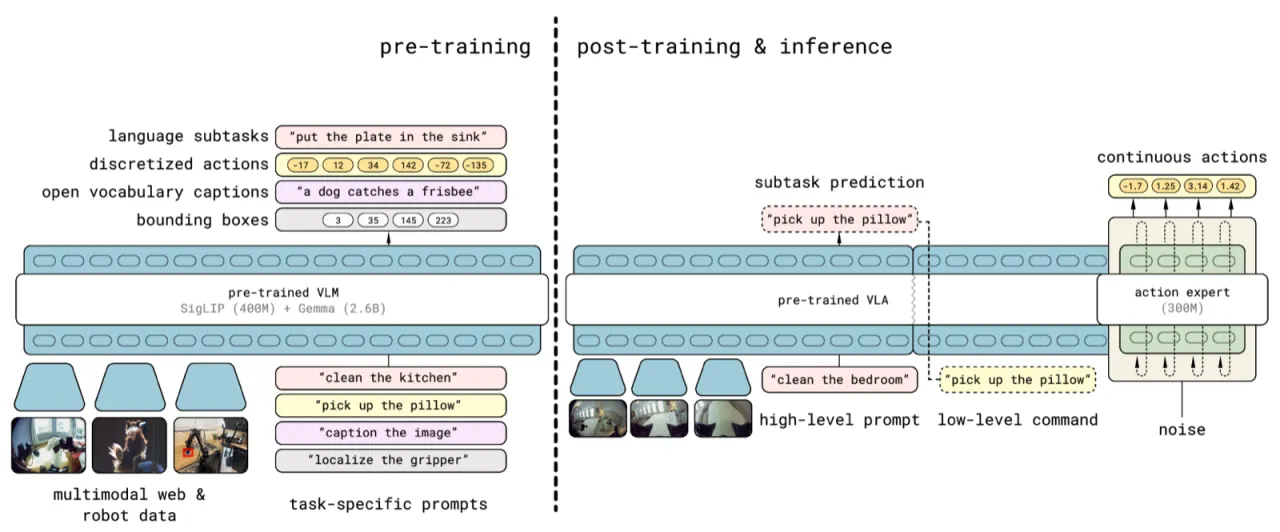
architecture
图 3:模型整体架构与训练流程。第一阶段(预训练)融合来自移动操作机器人(MM)、多场景非移动机器人(ME)、跨平台实验室数据(CE)、高层语义子任务标注(HL)以及网页多模态数据(WD)的五类异构数据,使用 FAST 动作分词器将动作表示为离散 token。第二阶段(后训练)在最相关数据上专门化,加入 action expert 支持 flow matching 连续动作生成,并引入专家语言指令(VI)。Figure 3: overall model architecture and training pipeline. Stage 1 (pre-training) combines five heterogeneous data sources — mobile manipulators (MM), non-mobile robots in diverse scenes (ME), cross-embodiment laboratory data (CE), high-level semantic sub-task annotations (HL) and web multimodal data (WD) — and uses the FAST action tokenizer to represent actions as discrete tokens. Stage 2 (post-training) specializes on the most relevant data, adds an action expert to support flow-matching continuous action generation, and introduces expert verbal instructions (VI).

模型架构:高低层级分解推理Model architecture: decomposed high- and low-level inference

π₀.₅ 将联合分布分解为两个子问题:π₀.₅ decomposes the joint distribution into two sub-problems:

底层架构为多模态 Transformer:图像 patch、文本 token 和连续动作值统一输入;图像/提示词使用双向注意力,动作输出使用因果注意力;本征状态(proprioceptive state)被离散化为文本 token 输入。The backbone is a multimodal Transformer: image patches, text tokens and continuous action values are fed in as one stream; images and prompts use bidirectional attention while action outputs use causal attention; the proprioceptive state is discretized into text tokens.

混合动作表示与训练目标Hybrid action representation and training objective

为了同时支持大规模预训练的效率与推理时动作精度,π₀.₅ 引入混合损失:To support both the efficiency of large-scale pre-training and action precision at inference time, π₀.₅ introduces a hybrid loss:

Loss = Cross-entropy(text tokens) + α · ‖ω − at − faθ(...)‖²

其中第一项为 FAST 离散动作 token 的交叉熵损失,第二项为 flow matching 连续动作的 L2 损失(后训练阶段 α=10.0)。这种设计使模型"既能进行快速可扩展的离散 token 预训练,又能通过 flow matching 实现高效精细的动作推理"。The first term is the cross-entropy loss over FAST discrete action tokens and the second is the L2 loss of flow-matching continuous actions (α=10.0 in the post-training stage). This design lets the model "perform fast, scalable discrete-token pre-training while achieving efficient and fine-grained action inference through flow matching".

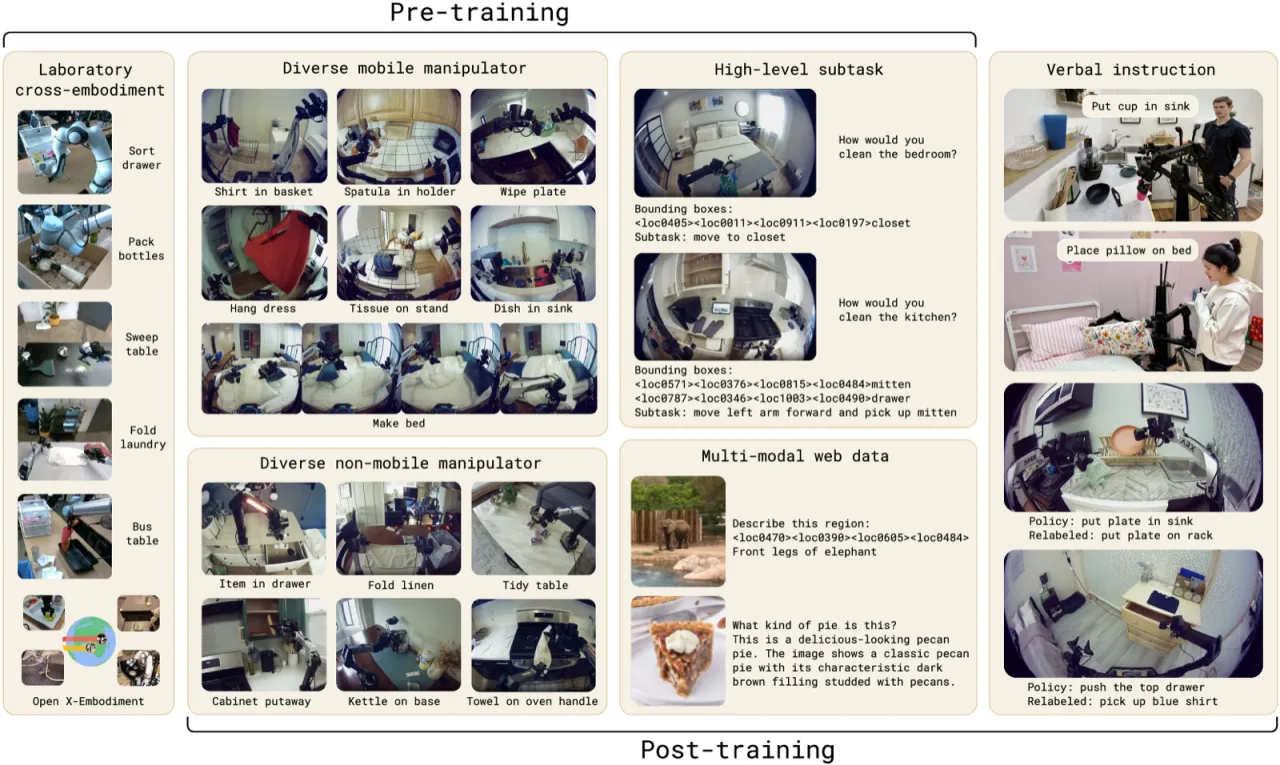
五类异构训练数据Five heterogeneous training data sources

training_data
图 4:预训练与后训练数据示例。五类数据来源:MM(移动操作机器人,~400小时,约100个家庭)、ME(多样家庭场景的非移动机器人)、CE(实验室跨平台数据,含 OXE 数据集)、HL(高层子任务语义标注)、WD(图像描述、VQA、物体定位等网页数据)。后训练阶段额外引入 VI(专家语言指令),并去除 CE 以聚焦移动操作。Figure 4: examples of pre-training and post-training data. Five data sources: MM (mobile manipulators, ~400 hours, about 100 homes), ME (non-mobile robots in diverse home scenes), CE (cross-embodiment laboratory data, including the OXE dataset), HL (high-level sub-task semantic annotations), WD (web data such as image captions, VQA and object localization). The post-training stage additionally introduces VI (expert verbal instructions) and drops CE to focus on mobile manipulation.

第一阶段:预训练(280k steps)Stage 1: pre-training (280k steps)

  • MM:移动操作机器人,~400h,~100个家庭MM: mobile manipulators, ~400h, ~100 homes
  • ME:多样家庭环境中的非移动机器人数据ME: non-mobile robot data in diverse home environments
  • CE:实验室跨平台数据(含 OXE)CE: cross-embodiment laboratory data (including OXE)
  • HL:高层子任务语义预测标注HL: high-level sub-task semantic prediction annotations
  • WD:网页视觉语言数据(VQA、图像描述等)WD: web vision-language data (VQA, image captions, etc.)

第二阶段:后训练(80k steps)Stage 2: post-training (80k steps)

  • 仅使用 MM + ME 数据,聚焦移动操作Uses only MM + ME data, focusing on mobile manipulation
  • 加入 action expert,启用 flow matching 连续动作(10步去噪)Adds an action expert, enabling flow-matching continuous actions (10 denoising steps)
  • 引入 VI(verbal instructions):人类专家对子任务序列的语言演示Introduces VI (verbal instructions): verbal demonstrations of sub-task sequences by human experts
  • 控制频率:50 Hz;状态/动作空间:18-19 DoFControl frequency: 50 Hz; state / action space: 18-19 DoF

03 实验Experiments

评测分为两类:受控的"模拟房间"(mock homes)用于可复现的定量比较,以及全新真实家庭(real homes)进行最终验证。核心指标为任务完成进度(task progress)和语言跟随成功率。Evaluation comes in two kinds: controlled "mock homes" for reproducible quantitative comparison, and entirely new real homes for final validation. The core metrics are task progress and language-following success rate.

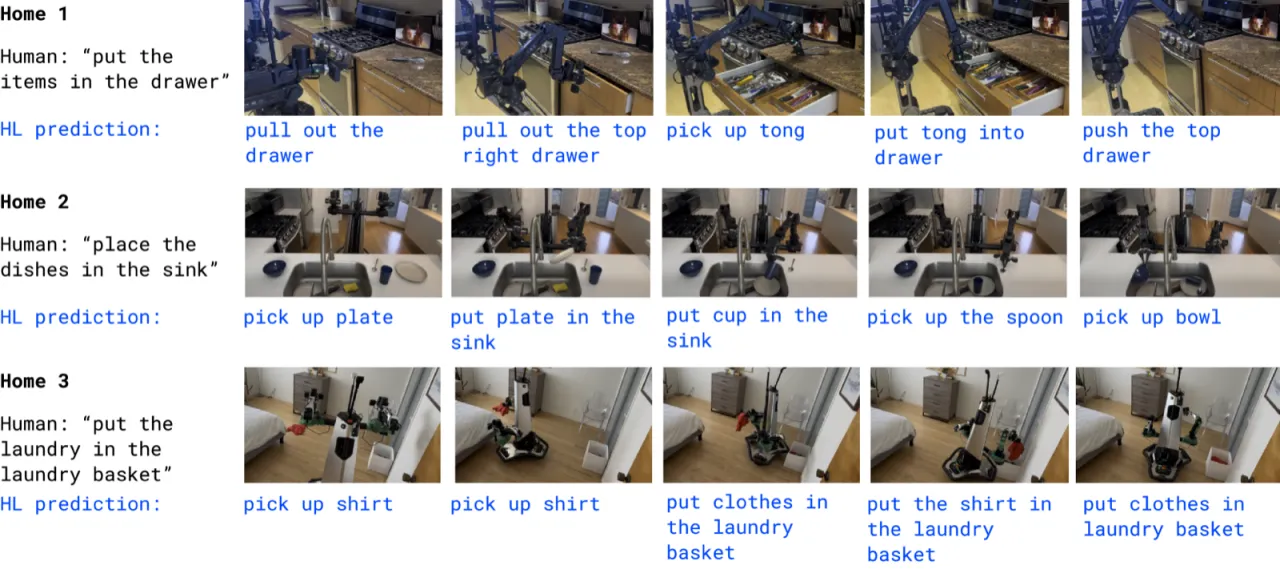
real_home_eval
图 7:真实家庭评测。在三个从未出现于训练数据的全新家庭中测试,包含新奇的厨房和卧室,每个任务进行 10 次 trial。展示了机器人执行过程的关键帧和定量成功率。Figure 7: real-home evaluation. Testing is done in three entirely new homes that never appear in the training data, including unfamiliar kitchens and bedrooms, with 10 trials per task. Key frames of the robot's execution and quantitative success rates are shown.

与基线的对比Comparison with baselines

模型Model平均任务进度Average task progress相对提升Relative gain
π₀(基线)π₀ (baseline)~35%
π₀-FAST+Flow~42%+20%
π₀.₅(本文)π₀.₅ (ours)~60%+71%
在测试环境上训练的模型(上限参考)Model trained on the test environments (upper-bound reference)~62%

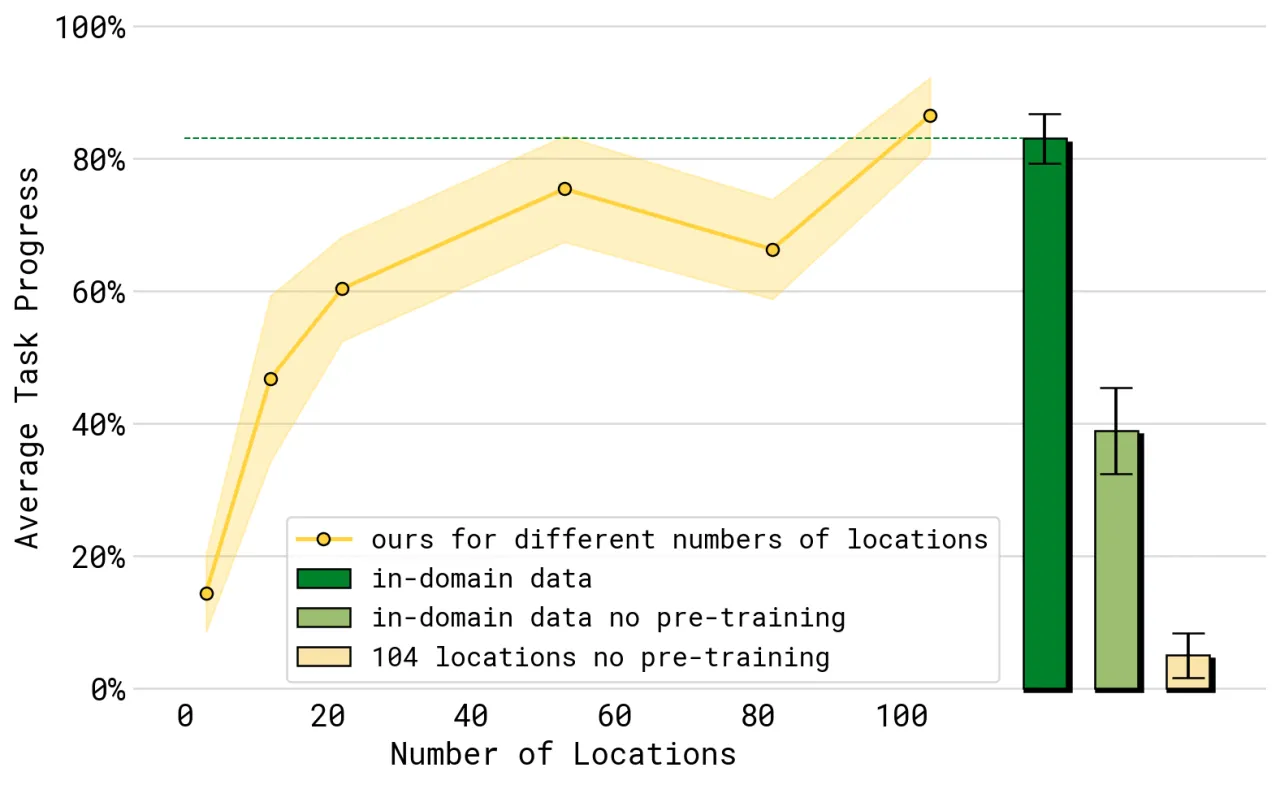
训练环境数量的影响(Scaling)Effect of the number of training environments (scaling)

env_scaling
图 8:随训练场景数量的性能变化曲线。随着训练位置从 3 增加到 104 个,模型平均任务进度从 ~25% 稳步提升到 ~60%,接近在测试环境上直接训练的上限性能(~62%),表明训练环境的多样性是实现泛化的关键。Figure 8: performance as a function of the number of training scenes. As training locations increase from 3 to 104, average task progress rises steadily from ~25% to ~60%, approaching the upper bound of training directly on the test environments (~62%), which shows that the diversity of training environments is the key to generalization.
训练环境数量Number of training environments平均任务进度Average task progress
3 个3~25%
53 个53~45%
104 个104~60%
在测试家庭中训练(参考上限)Trained in the test homes (reference upper bound)~62%

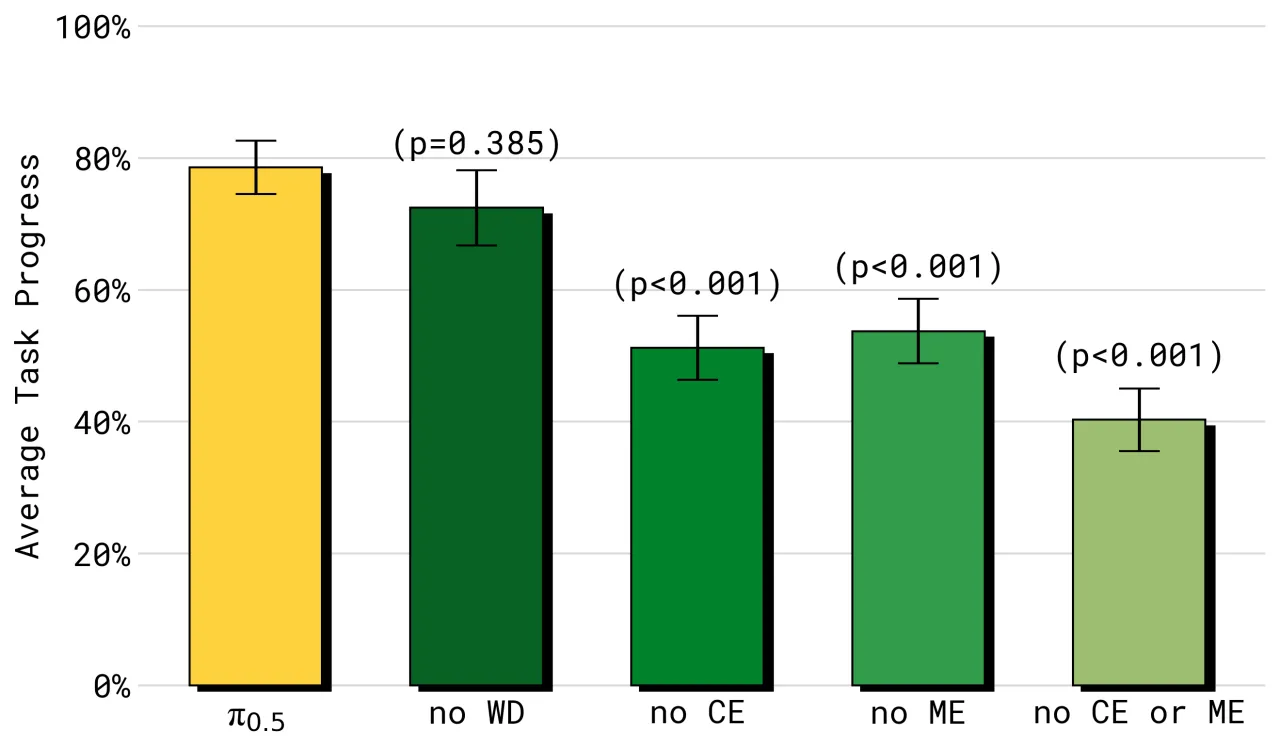
消融实验Ablations

ablation
图 10-11:训练配方消融实验(mock homes)。分别去除不同数据源后,整体任务完成度和语言跟随性能的变化。ME 和 CE 对整体任务性能至关重要,而 WD 对分布外物体的语言跟随泛化能力有显著影响。Figures 10-11: ablations of the training recipe (mock homes). Changes in overall task completion and language-following performance when individual data sources are removed. ME and CE are critical to overall task performance, while WD has a marked effect on language-following generalization to out-of-distribution objects.
配置Configuration平均任务进度Average task progress说明Notes
完整模型Full model~60%所有数据源All data sources
去除 WD(网页数据)Remove WD (web data)~58%对整体任务影响较小Minor effect on the overall task
去除 MERemove ME~45%性能显著下降Marked performance drop
去除 CE(跨平台数据)Remove CE (cross-embodiment data)~40%性能大幅下降Large performance drop
去除 ME + CERemove ME + CE~25%严重退化Severe degradation

高层推理的重要性Why high-level inference matters

实验进一步验证了显式高层推理的价值:The experiments further validate the value of explicit high-level inference:

此外,移除 VI(语言指令,仅占训练数据 11%)会使性能下降到 ~50%,说明少量的专家语言指令对强性能"至关重要"。Moreover, removing VI (verbal instructions, only 11% of the training data) drops performance to ~50%, showing that a small amount of expert verbal instruction is "critical" to strong performance.

04 局限性Limitations

Note: 以下局限性均为论文作者在 Discussion and Future Work 章节中明确陈述的内容(stated)。Note: every limitation below is explicitly stated by the authors in the Discussion and Future Work section.
特定场景中的持续性错误Persistent failures in specific environments

作者指出:"Some environments present persistent challenges (e.g., unfamiliar handles on drawers, or cabinets that are physically hard for the robot to open)." 陌生的物理结构(如特殊把手、难以打开的橱柜)仍会造成机器人持续失败,说明低层操作技能的泛化仍有瓶颈。The authors note: "Some environments present persistent challenges (e.g., unfamiliar handles on drawers, or cabinets that are physically hard for the robot to open)." Unfamiliar physical structures (unusual handles, cabinets that are hard to open) still make the robot fail repeatedly, showing that the generalization of low-level manipulation skills remains a bottleneck.

部分可观测性(Partial Observability)Partial observability

"Some behaviors present challenges with partial observability (e.g., the robot arm occluding a spill that should be wiped)." 当机械臂遮挡了需要处理的区域时,模型难以感知和规划,揭示了视觉输入受限时的决策盲区。"Some behaviors present challenges with partial observability (e.g., the robot arm occluding a spill that should be wiped)." When the arm occludes the region that has to be handled, the model struggles to perceive and plan, revealing a decision blind spot under limited visual input.

高层子任务推理容易被干扰High-level sub-task inference is easily distracted

"In some cases the high-level sub-task inference is easily distracted (e.g., closing and opening a drawer multiple times while putting away items)." 高层语义推理模块在复杂场景下可能出现循环或无效行为,说明长时域规划的稳定性仍需提升。"In some cases the high-level sub-task inference is easily distracted (e.g., closing and opening a drawer multiple times while putting away items)." The high-level semantic reasoning module can fall into loops or ineffective behavior in complex scenes, showing that the stability of long-horizon planning still needs improvement.

提示词复杂度和上下文窗口受限Limited prompt complexity and context window

模型"can accommodate relatively simple prompts",且使用"relatively modest context",限制了其在需要复杂多步骤规划或跨房间任务中的表现。未来工作需要探索更丰富的上下文建模能力。The model "can accommodate relatively simple prompts" and uses a "relatively modest context", which limits its performance on tasks that need complex multi-step planning or that span rooms. Future work needs to explore richer context modeling.