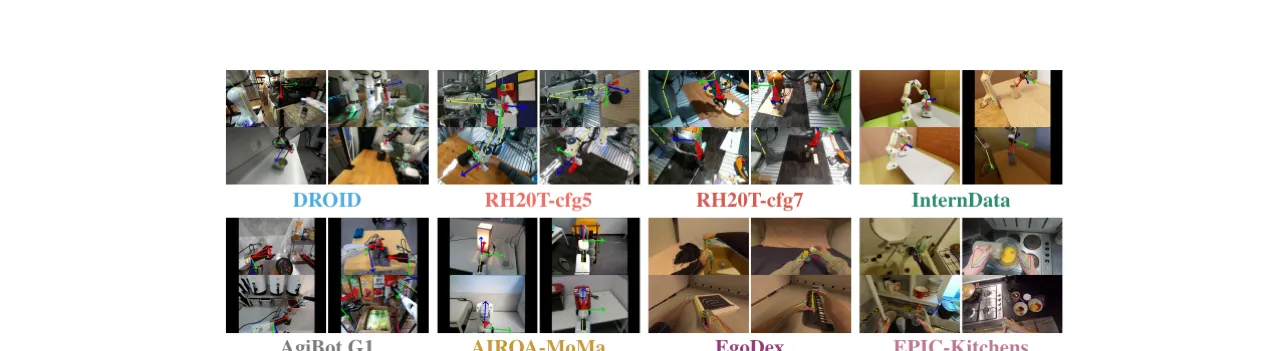
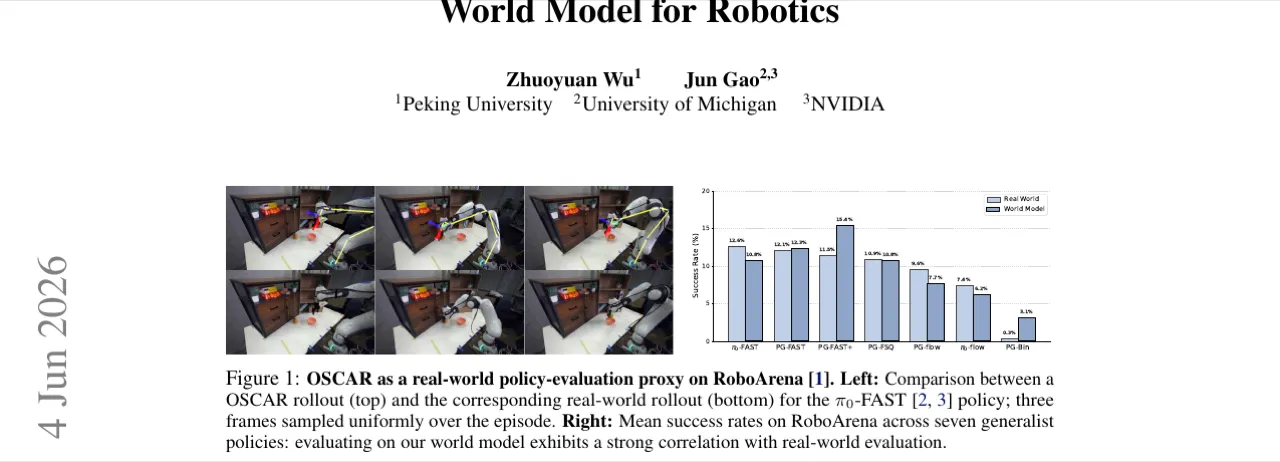
OSCAR 是一个精确的动作条件视频世界模型,可跨不同机器人形态泛化,并支持机器人策略的虚拟评估。它以 2D 运动骨骼渲染为统一条件表示,在大规模多源数据集上微调 Cosmos-Predict2.5-2B,在动作跟随精度、外观质量和运动一致性上全面超越参数量大数倍的基线,并在 RoboArena 上展现出与真实世界评估的强相关性。OSCAR is an accurate action-conditioned video world model that generalizes across robot embodiments and supports virtual evaluation of robot policies. Using 2D motion skeleton rendering as a unified conditioning representation, it fine-tunes Cosmos-Predict2.5-2B on a large-scale multi-source dataset and surpasses baselines several times larger in action-following accuracy, appearance quality and motion consistency, while showing strong correlation with real-world evaluation on RoboArena.
现有视频世界模型在机器人策略真实评估中面临三大核心挑战:训练数据场景多样性不足、动作跟随不精准、以及跨机器人形态泛化能力差。Existing video world models face three core challenges for real-world robot policy evaluation: insufficient scenario diversity in training data, imprecise action following, and poor generalization across robot embodiments.
"Existing video world models face three main challenges for real-world robot evaluation: limited scenario diversity in current robot training datasets, imprecise action following, and poor generalization across embodiments for broad adoption."
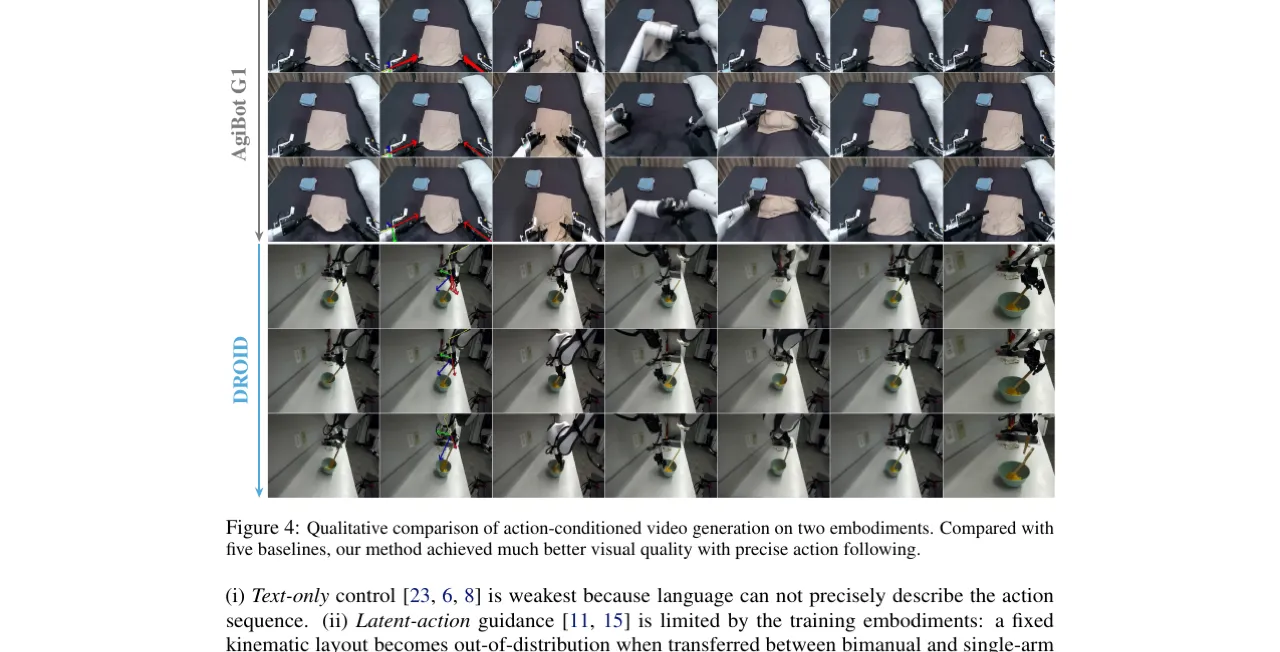
视频需要在帧级别(何时发生)和像素级别(何处发生)精确跟随动作序列,才能为策略评估提供有意义的信号。Latent-action 方法将动作压缩为隐变量,往往无法精确传达空间运动。Videos must follow the action sequence precisely at both the frame level (when something happens) and the pixel level (where it happens) in order to provide a meaningful signal for policy evaluation. Latent-action methods compress actions into latent variables and often fail to convey spatial motion precisely.
策略评估需要覆盖不同任务、环境和动作序列。现有数据集(如 AgiBot)虽有百万条 clip,却集中在同一场景和任务,视觉多样性极低。Policy evaluation must cover diverse tasks, environments and action sequences. Existing datasets such as AgiBot contain millions of clips, yet they concentrate on the same scene and task and offer extremely low visual diversity.
世界模型应能泛化到不同机器人形态(Franka Panda、KUKA iiwa、AgiBot G1 等),而非绑定单一机器人,才能支持广泛的策略评估应用。A world model should generalize to different robot embodiments (Franka Panda, KUKA iiwa, AgiBot G1, etc.) rather than being tied to a single robot, so that it can support a broad range of policy evaluation applications.
(1)大规模标准化数据流水线:跨 4 种机器人和 2 种人手数据源,经过去冗余、质量过滤,构建覆盖广泛的联合训练数据集。(2)2D 骨骼渲染统一条件:仅依赖运动链,无需机器人外观信息,可跨机器人乃至人手泛化。(1) A large-scale standardized data pipeline: spanning 4 robot and 2 human-hand data sources, with deduplication and quality filtering, to build a broadly covering joint training dataset. (2) 2D skeleton rendering as unified conditioning: it relies on the kinematic chain alone, needs no robot appearance information, and generalizes across robots and even to human hands.
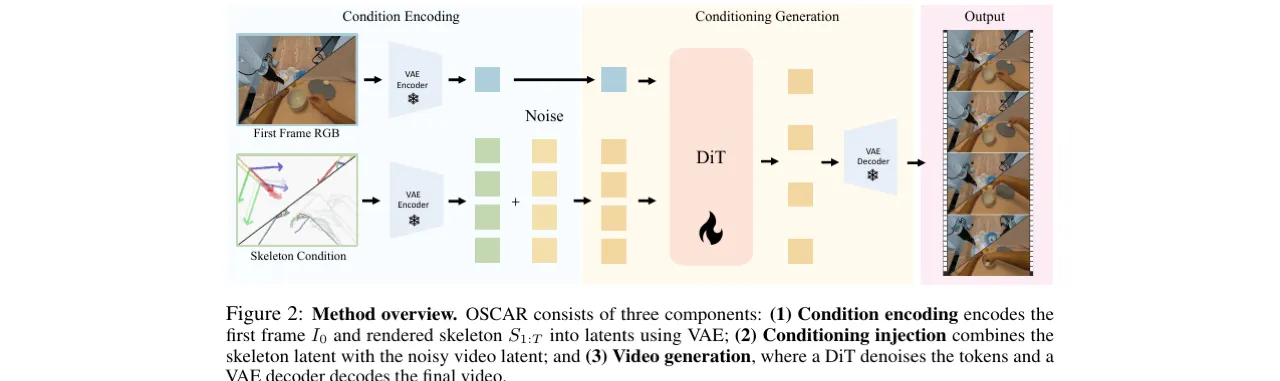
OSCAR 在 Cosmos-Predict2.5-2B(一个 2B 参数的视频 Diffusion Transformer)基础上微调,以第一帧 RGB 图像和 2D 骨骼渲染序列为条件,自回归生成未来视频帧。OSCAR is fine-tuned from Cosmos-Predict2.5-2B, a 2B-parameter video Diffusion Transformer, and autoregressively generates future video frames conditioned on the first RGB frame and a sequence of 2D skeleton renderings.
选择正确的动作表示是动作条件世界模型的核心。OSCAR 采用 2D 运动学骨骼(kinematic skeleton)渲染,在泛化性与精度之间取得平衡:Choosing the right action representation is central to an action-conditioned world model. OSCAR adopts 2D kinematic skeleton rendering, which strikes a balance between generalization and precision:
由于 S₁:T 仅编码 2D 关节投影,同样的条件表示可以无缝扩展到人手。MANO 人手模型的五指拓扑与机械臂运动链用同样的光栅化流程处理,使模型可以联合训练机器人和人体手部的 egocentric 视频,显著增加场景、任务和动作分布的多样性。Because S₁:T encodes only 2D joint projections, the same conditioning representation extends seamlessly to human hands. The five-finger topology of the MANO hand model is handled by the same rasterization pipeline as the robot-arm kinematic chain, letting the model train jointly on robot videos and egocentric human-hand videos, which substantially increases the diversity of scenes, tasks and action distributions.
骨骼序列 S₁:T 经过与目标视频相同的 WAN 2.1 VAE 编码,得到骨骼隐变量 z_s,与带噪视频隐变量通过不同的 patch embedder(PE_v 和 PE_s)嵌入后相加,送入 DiT 进行去噪。训练时以概率 0.2 将 S₁:T 置零,以支持 classifier-free guidance(推理时 guidance scale w=6)。The skeleton sequence S₁:T is encoded by the same WAN 2.1 VAE as the target video, giving skeleton latents z_s, which are embedded by separate patch embedders (PE_v and PE_s), added to the noisy video latents, and fed to the DiT for denoising. During training S₁:T is zeroed out with probability 0.2 to support classifier-free guidance (guidance scale w=6 at inference).
从 2,165,359 条原始视频中清洗出 180,657 条高质量 episode,经过四阶段过滤:From 2,165,359 raw videos, 180,657 high-quality episodes are cleaned out through four filtering stages:
在 200 条机器人操作 clip 组成的自建 benchmark 上评估(来自 Franka Panda、KUKA iiwa、AgiBot G1、Toyota HSR 四种形态),与七个基线对比,指标涵盖 PSNR、SSIM、LPIPS、tLPIPS、FVD、FID、L2_latent 和 FPS,全部在 NVIDIA GH200 GPU 上计时。Evaluation is run on a self-built benchmark of 200 robot manipulation clips (from four embodiments: Franka Panda, KUKA iiwa, AgiBot G1 and Toyota HSR) against seven baselines, with metrics covering PSNR, SSIM, LPIPS, tLPIPS, FVD, FID, L2_latent and FPS, all timed on an NVIDIA GH200 GPU.
| 方法Method | PSNR ↑ | SSIM ↑ | LPIPS ↓ | tLPIPS ↓ | FVD ↓ | FID ↓ | L2_lat ↓ | FPS ↑ |
|---|---|---|---|---|---|---|---|---|
| Cosmos-Predict2.5 | 14.78 | 0.563 | 0.370 | 0.022 | 18.01 | 47.59 | 0.435 | 0.292 |
| TesserAct | 16.26 | 0.730 | 0.277 | 0.055 | 24.50 | 51.90 | 0.364 | 0.343 |
| IRASim | 6.48 | 0.088 | 0.909 | 0.606 | 411.42 | 394.10 | 2.453 | 2.330 |
| Ctrl-World | 19.06 | 0.705 | 0.321 | 0.042 | 28.90 | 53.33 | 0.292 | 1.631 |
| EnerVerse-AC | 20.47 | 0.746 | 0.223 | 0.021 | 33.70 | 38.23 | 0.197 | 1.900 |
| Genie Envisioner | 23.29 | 0.838 | 0.140 | 0.007 | 15.37 | 22.92 | 0.129 | 1.382 |
| Kinema4D | 17.68 | 0.741 | 0.198 | 0.021 | 17.07 | 37.16 | 0.233 | 0.089 |
| OSCAR(本文)OSCAR (ours) | 24.24 | 0.846 | 0.094 | 0.015 | 7.08 | 15.07 | 0.096 | 2.214 |
粗体为最优,下划线为次优。OSCAR 在七项指标中均达到最优或次优,且仅用 2B 参数,远小于 Kinema4D(14B)。Bold marks the best and underline the second best. OSCAR is best or second best on all seven metrics while using only 2B parameters, far fewer than Kinema4D (14B).
消融两个关键因素:条件表示和数据策略。Two key factors are ablated: the conditioning representation and the data strategy.
| 维度Dimension | 变体Variant | PSNR ↑ | SSIM ↑ | LPIPS ↓ | FVD ↓ | FID ↓ |
|---|---|---|---|---|---|---|
| 条件表示Conditioning representation | Latent action | 19.22 | 0.784 | 0.170 | 12.03 | 26.11 |
| Mesh rendering | 23.11 | 0.831 | 0.106 | 7.89 | 16.38 | |
| Skeleton(最终)Skeleton (final) | 23.48 | 0.832 | 0.106 | 7.69 | 16.37 | |
| 数据策略Data strategy | +Human from beginning | 23.87 | 0.842 | 0.097 | 7.65 | 15.72 |
| +Human, warm-start(最终)+Human, warm-start (final) | 24.24 | 0.846 | 0.094 | 7.08 | 15.07 |
关键发现:(i)Latent action 无法精准跟随动作;(ii)Mesh 和 Skeleton 在七项指标上统计上无显著差异,但 Mesh 依赖机器人 URDF 外观资产,无法引入人体数据;(iii)人体数据的引入一致提升所有指标,warm-start 策略(先用机器人数据训练再加入人体数据)优于从头混合训练。Key findings: (i) latent action cannot follow actions precisely; (ii) Mesh and Skeleton show no statistically significant difference across the seven metrics, but Mesh relies on the robot's URDF appearance assets and therefore cannot bring in human data; (iii) introducing human data consistently improves every metric, and the warm-start strategy (training on robot data first and adding human data afterwards) outperforms mixed training from scratch.
将 OSCAR 部署到 RoboArena 公开排行榜,对 7 个通用 DROID 策略(π₀-flow、π₀-FAST、PG-flow、PG-FSQ、PG-FAST、PG-FAST+、PG-Bin)进行评估: 在 65 个 session 上自回归展开 OSCAR,用 GPT-5 评估每条 episode 的成功率,计算 Pearson 相关系数 r 和 Spearman ρ。OSCAR is deployed on the public RoboArena leaderboard to evaluate 7 generalist DROID policies (π₀-flow, π₀-FAST, PG-flow, PG-FSQ, PG-FAST, PG-FAST+, PG-Bin): OSCAR is rolled out autoregressively over 65 sessions, GPT-5 rates the success of every episode, and the Pearson correlation coefficient r and Spearman ρ are computed.
| 条件表示Conditioning representation | MMRV ↓ | ρ ↑ | r ↑ | SISR_Δ (pp) ↓ |
|---|---|---|---|---|
| Latent action | 1.429 | +0.643 | +0.867 | 1.98 |
| Mesh | 0.714 | +0.679 | +0.781 | 3.04 |
| Skeleton(本文)Skeleton (ours) | 0.571 | +0.750 | +0.852 | 1.73 |
骨骼条件与真实世界部署的相关性最强(MMRV=0.571,Pearson r=+0.852),证明 OSCAR 可有效替代真实机器人评估。Skeleton conditioning correlates most strongly with real-world deployment (MMRV=0.571, Pearson r=+0.852), showing that OSCAR can effectively substitute for real-robot evaluation.
"Our current data scale is limited by the availability and quality of per-dataset camera calibration and kinematic annotations: errors in camera intrinsics/extrinsics directly degrade skeleton–RGB alignment, limiting the availability of raw video data that can be reliably converted into usable training dataset." 即相机内外参数的误差会直接导致骨骼与 RGB 图像的对齐偏差,可用训练数据规模因此受限。That is, errors in the camera intrinsics and extrinsics directly cause misalignment between the skeleton and the RGB image, which limits the amount of raw video that can be turned into usable training data.
"Our model only uses a 2B-parameter backbone; scaling to larger backbones may further improve fidelity and generalization but requires more compute." 当前 backbone 为 2B 参数,更大规模的 backbone 可能进一步提升保真度和泛化能力,但计算成本相应增加。The current backbone has 2B parameters; a larger backbone could further improve fidelity and generalization, but at a correspondingly higher compute cost.
数据过滤阶段主动剔除了相机运动的 episode("We mainly focus on the robot action in our paper and defer the camera motion for future work"),因此当前模型不支持移动相机场景,限制了对移动操作任务的策略评估能力。The data filtering stage deliberately discards episodes with camera motion ("We mainly focus on the robot action in our paper and defer the camera motion for future work"), so the current model does not support moving-camera scenes, which limits its ability to evaluate policies for mobile manipulation tasks.