← 论文海报合集← Paper Notes|
RSS 2025 · 机器人学习RSS 2025 · Robot Learning

Fine-Tuning Vision-Language-Action Models: Optimizing Speed and Success

OpenVLA-OFT:让 VLA 微调又快又准的系统性配方OpenVLA-OFT: a systematic recipe that makes VLA fine-tuning both fast and accurate
Moo Jin Kim, Chelsea Finn, Percy Liang  ·  Stanford University

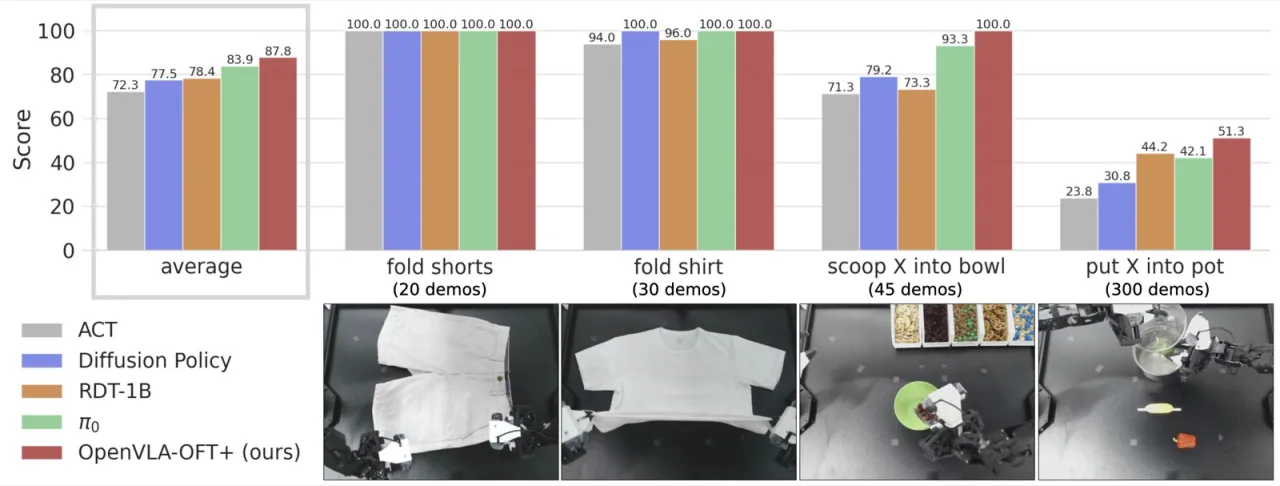
本文系统研究如何将视觉-语言-动作模型(VLA)高效迁移至新型机器人场景。作者提出 Optimized Fine-Tuning (OFT) 配方,将并行解码、动作分块、连续动作表示与 L1 回归四项关键改进融为一体,使 OpenVLA-OFT 在 LIBERO 仿真基准上达到 97.1% 平均成功率(相较于基线 OpenVLA 的 76.5%),推理吞吐量提升 26×,并在双臂 ALOHA 实体机器人上超越 π₀、RDT-1B 等强基线达 15%(absolute)。This paper systematically studies how to efficiently transfer vision-language-action models (VLA) to novel robot setups. The authors propose the Optimized Fine-Tuning (OFT) recipe, which integrates four key improvements — parallel decoding, action chunking, continuous action representations and L1 regression — enabling OpenVLA-OFT to reach a 97.1% average success rate on the LIBERO simulation benchmark (versus 76.5% for the OpenVLA baseline), to raise inference throughput by 26×, and to surpass strong baselines such as π₀ and RDT-1B by 15% (absolute) on the bimanual ALOHA physical robot.

RSS 2025Robotics · VLA Fine-TuningarXiv 2025-02 📄 arXiv:2502.19645 Project Page
VLA fine-tuning parallel decoding action chunking continuous actions L1 regression FiLM language grounding bimanual manipulation ALOHA LIBERO 机器人操作robot manipulation

01 动机Motivation

VLA 模型(如 OpenVLA)将大规模视觉-语言预训练引入机器人操作,但直接迁移到新场景时面临两大瓶颈:推理速度太慢(自回归逐 token 解码)和成功率不足(离散动作表示精度受限)。已有工作倾向于重新设计预训练,而本文聚焦微调阶段,寻找一套通用、高效的系统性配方。VLA models such as OpenVLA bring large-scale vision-language pretraining into robot manipulation, but transferring them directly to new setups faces two major bottlenecks: inference is too slow (autoregressive token-by-token decoding) and success rates are insufficient (the precision of discrete action representations is limited). Prior work tends to redesign pretraining, whereas this paper focuses on the fine-tuning stage and seeks a general, efficient and systematic recipe.

"We investigate optimized fine-tuning (OFT) — a recipe for adapting VLAs to novel robot setups, integrating parallel decoding, action chunking, continuous action representations, and L1 regression."
OpenVLA-OFT teaser
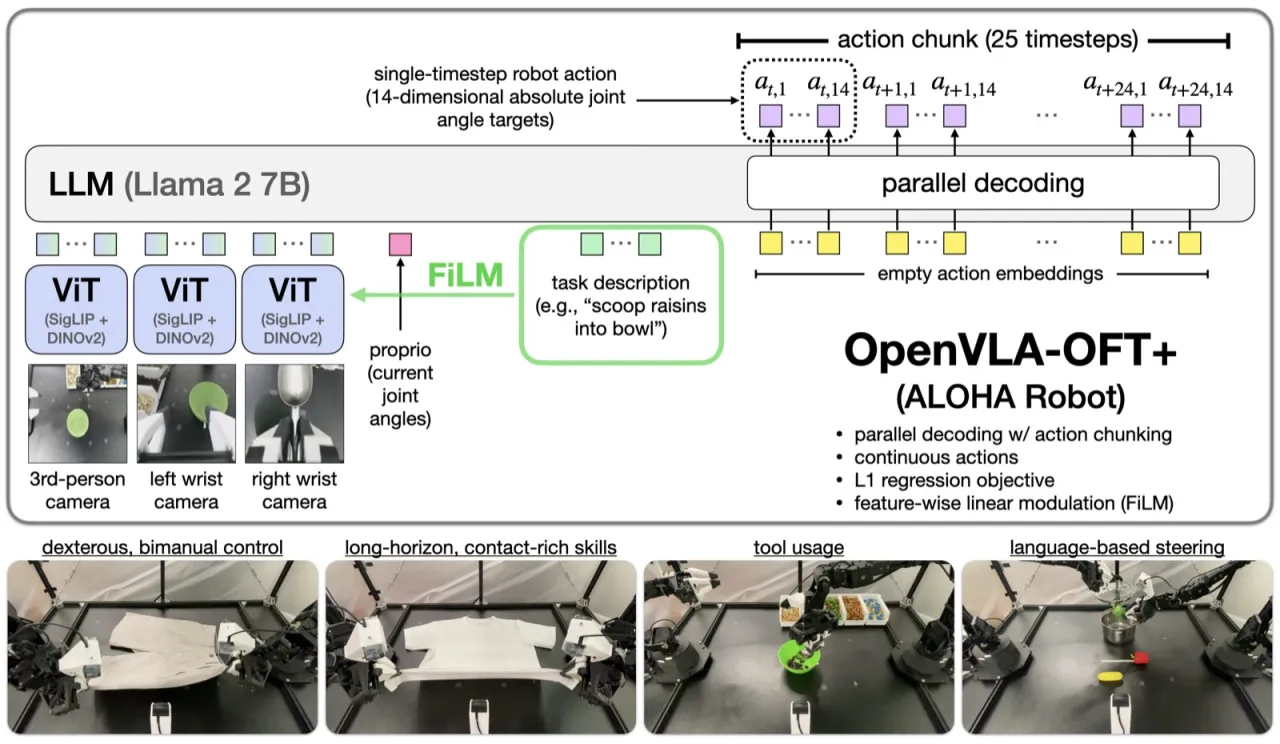
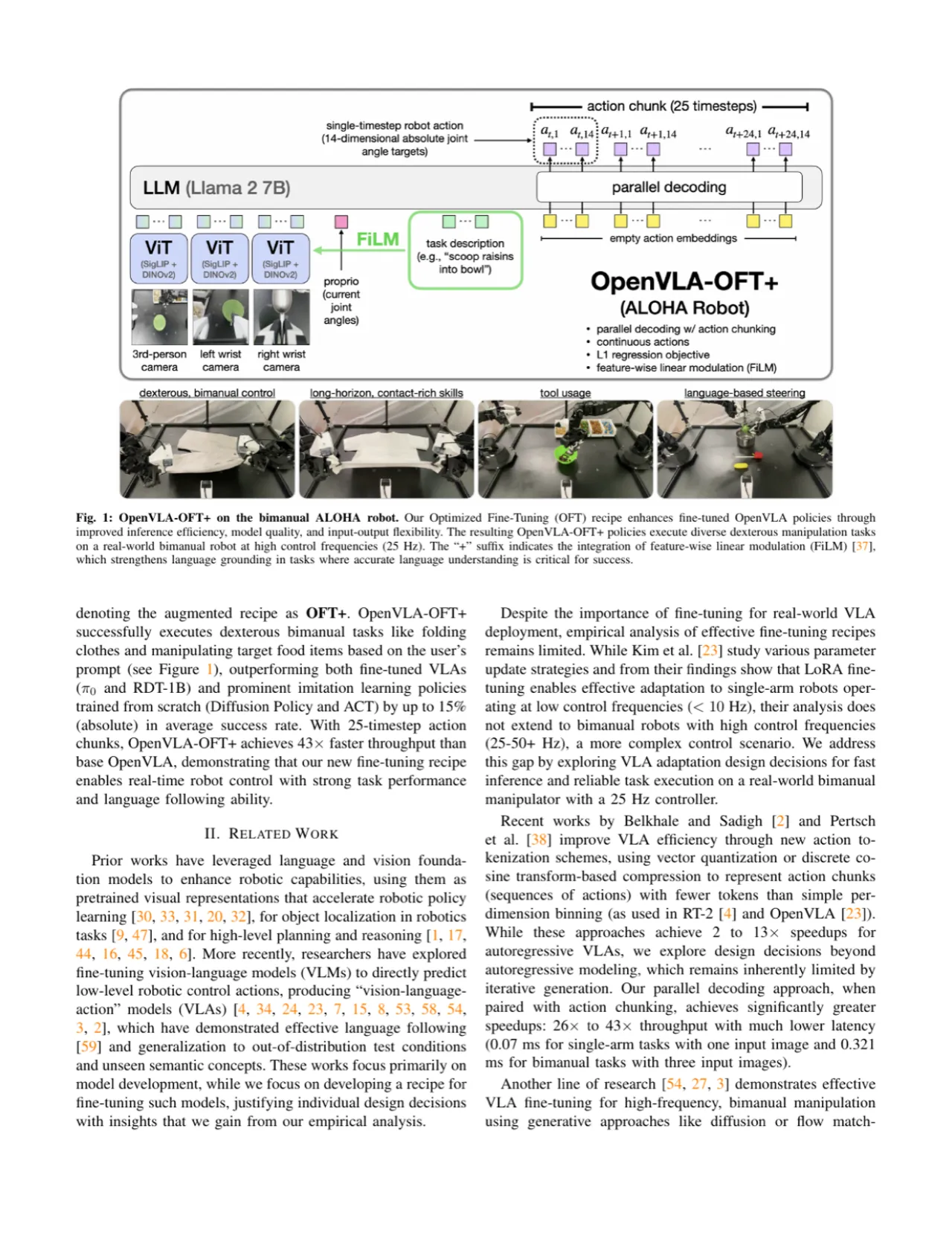
图 1:OpenVLA-OFT 在双臂 ALOHA 机器人上执行折叠衣物、舀取食材、放置物品等高灵巧度任务。相比基线 OpenVLA,吞吐量提升 43×,并在所有任务上超越 π₀ 与 RDT-1B 等同类 VLA 方法。Figure 1: OpenVLA-OFT performing highly dexterous tasks such as folding clothes, scooping ingredients and placing objects on the bimanual ALOHA robot. Compared with the OpenVLA baseline, throughput improves by 43×, and it surpasses comparable VLA methods such as π₀ and RDT-1B on all tasks.
97.1%LIBERO 平均成功率(最高输入配置)LIBERO average success rate (best input configuration)
26×相较于基线 OpenVLA 的吞吐量提升(仿真)Throughput speedup over the OpenVLA baseline (simulation)
+15%真实机器人绝对成功率提升(vs. π₀、RDT-1B)Absolute success-rate gain on the real robot (vs. π₀, RDT-1B)
43×ALOHA 机器人吞吐量提升(K=25 动作分块)ALOHA robot throughput speedup (K=25 action chunk)
02 方法Method

OFT 配方由四个相互协同的改进组成:以并行解码(parallel decoding)替代自回归逐步生成,以动作分块(action chunking)同时预测多步动作,以连续动作表示(continuous action representation)取代 256-bin 离散 tokenization,并采用 L1 回归作为训练目标。针对多视角真实机器人场景,还引入 FiLM 语言调制增强语言接地能力。The OFT recipe consists of four mutually reinforcing improvements: parallel decoding replaces step-by-step autoregressive generation; action chunking predicts multiple action steps at once; a continuous action representation replaces the 256-bin discrete tokenization; and L1 regression is adopted as the training objective. For multi-view real-robot setups, FiLM language modulation is additionally introduced to strengthen language grounding.

设计选择对比:自回归 vs 并行解码,离散 vs 连续动作
论文图 2(从 PDF 第 2 页提取):对比自回归解码(Autoregressive Decoding)与并行解码(Parallel Decoding),以及离散动作表示(Discrete)与连续动作表示(Continuous)的差异。并行解码通过双向 attention 在单次前向传播中生成所有动作,显著降低延迟。Figure 2 of the paper (extracted from page 2 of the PDF): a comparison between Autoregressive Decoding and Parallel Decoding, and between discrete and continuous action representations. Parallel decoding generates all actions in a single forward pass via bidirectional attention, substantially reducing latency.

1 · Parallel Decoding & Action Chunking

标准自回归 VLA 逐 token 顺序生成动作,每步推理都要等待前一步完成。并行解码将语言模型最后的 causal attention 替换为双向 attention,以空的动作嵌入作为输入,在单次前向传播中同时预测所有动作 token,消除自回归的串行依赖。动作分块则进一步将每次生成的动作步数扩展到 K 步(仿真 K=8,真实机器人 K=25),既减少调用次数,又通过时序建模提升任务成功率。两者结合带来约 4× 延迟下降14%(absolute)成功率提升A standard autoregressive VLA generates actions token by token, and every inference step has to wait for the previous one to finish. Parallel decoding replaces the final causal attention of the language model with bidirectional attention and takes empty action embeddings as input, predicting all action tokens simultaneously in a single forward pass, which removes the serial dependency of autoregressive generation. Action chunking further extends the number of action steps produced per call to K steps (K=8 in simulation, K=25 on the real robot), which both reduces the number of calls and improves task success rate through temporal modeling. Combining the two yields roughly a 4× latency reduction and a 14% (absolute) success-rate gain.

2 · Continuous Actions + L1 Regression

原始 OpenVLA 将连续动作离散化为 256 个 bin,以 next-token prediction 方式训练,精度受量化误差限制。本文改用一个轻量 MLP action head 直接输出连续动作值,并以 L1 regression(mean absolute error) 为目标函数。L1 相比扩散目标收敛更快、推理无需迭代采样,同时保持与 Diffusion Policy 相当的任务质量。消融实验显示,Continuous + L1 与 Continuous + Diffusion 性能相近(95.3% vs. 95.4%),但推理更快。The original OpenVLA discretizes continuous actions into 256 bins and trains them with next-token prediction, so its precision is bounded by quantization error. This paper instead uses a lightweight MLP action head that directly outputs continuous action values, with L1 regression (mean absolute error) as the objective function. Compared with diffusion objectives, L1 converges faster and needs no iterative sampling at inference, while retaining task quality comparable to Diffusion Policy. Ablations show that Continuous + L1 and Continuous + Diffusion perform similarly (95.3% vs. 95.4%), yet inference is faster.

3 · FiLM 语言调制(真实机器人)3 · FiLM Language Modulation (Real Robot)

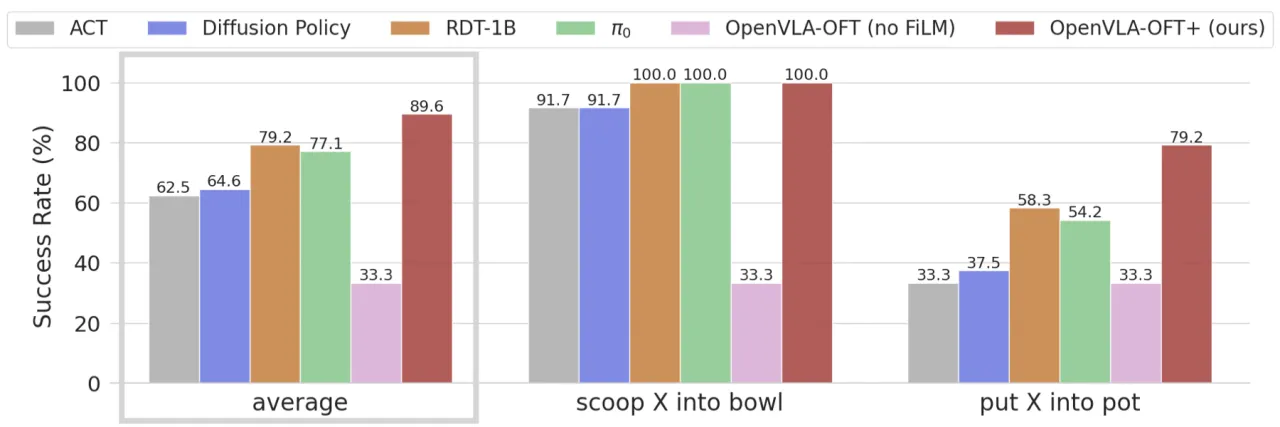
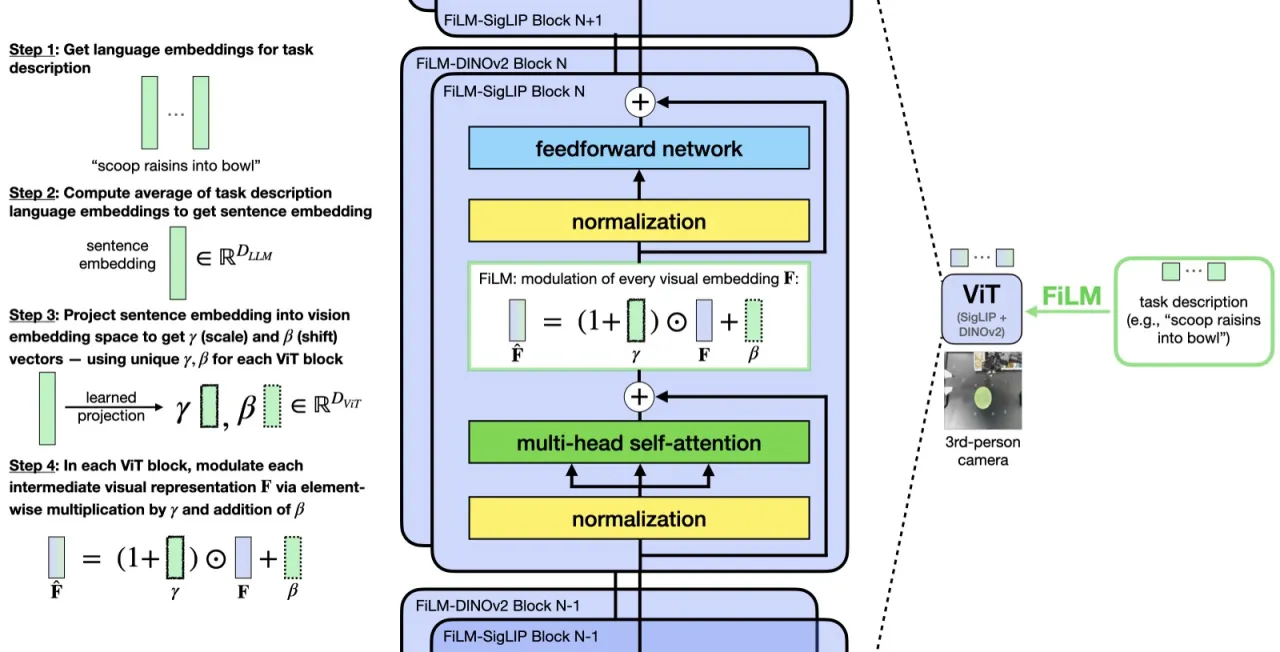
在 LIBERO 仿真中,无 FiLM 也能实现良好的语言接地;但在 ALOHA 双臂机器人(多视角摄像头 + 更复杂任务)上,不加 FiLM 语言接地能力明显下降。Feature-wise Linear Modulation (FiLM) 将语言嵌入通过学习的仿射变换(scaling + shift)注入 Vision Transformer 各层,调制视觉特征,使模型能更有效区分"折叠短裤"与"折叠长袖衬衫"等语义差异任务。In the LIBERO simulation, good language grounding is achieved even without FiLM; on the ALOHA bimanual robot (multi-view cameras plus more complex tasks), however, language grounding degrades markedly without FiLM. Feature-wise Linear Modulation (FiLM) injects the language embedding into every layer of the Vision Transformer through learned affine transformations (scaling + shift), modulating the visual features so that the model can more effectively distinguish semantically differing tasks such as "fold the shorts" and "fold the long-sleeve shirt".

FiLM 语言调制机制
图 8:FiLM 在 Vision Transformer 中的实现示意。任务语言嵌入经 MLP 生成 scale 与 shift 参数,直接调制各 ViT block 的特征图,强化视觉-语言对齐。Figure 8: illustration of how FiLM is implemented inside the Vision Transformer. The task language embedding passes through an MLP to produce scale and shift parameters that directly modulate the feature maps of each ViT block, strengthening vision-language alignment.

03 实验Experiments

实验分为两部分:LIBERO 仿真基准(Franka Panda,4 个任务套件,每套件 500 条专家演示)与ALOHA 真实双臂机器人(ViperX,25 Hz 控制,14 维关节状态,三视角摄像头,4 个灵巧操作任务)。对比方法包括 Diffusion Policy、ACT(从头训练)、Octo、DiT Policy、MDT、Seer(替代方法)以及 RDT-1B、π₀(微调 VLA)。The experiments have two parts: the LIBERO simulation benchmark (Franka Panda, 4 task suites, 500 expert demonstrations per suite) and the ALOHA real bimanual robot (ViperX, 25 Hz control, 14-dimensional joint state, three camera views, 4 dexterous manipulation tasks). The compared methods include Diffusion Policy, ACT (trained from scratch), Octo, DiT Policy, MDT and Seer (alternative approaches), as well as RDT-1B and π₀ (fine-tuned VLAs).

LIBERO 仿真基准(Table I)LIBERO Simulation Benchmark (Table I)

方法MethodSpatialObjectGoalLongAverage
Diffusion Policy78.3%92.5%68.3%50.5%72.4%
Octo78.9%85.7%84.6%51.1%75.1%
DiT Policy84.2%96.3%85.4%63.8%82.4%
OpenVLA(基线)OpenVLA (baseline)84.7%88.4%79.2%53.7%76.5%
OpenVLA + PD&AC91.3%92.7%90.5%86.5%90.2%
π₀(最高输入配置)π₀ (best input configuration)96.8%98.8%95.8%85.2%94.2%
OpenVLA-OFT(最高输入配置)OpenVLA-OFT (best input configuration)97.6%98.4%97.9%94.5%97.1%

推理效率对比(Table II,LIBERO)Inference Efficiency Comparison (Table II, LIBERO)

方法MethodThroughput (Hz)Latency (sec)
OpenVLA(基线)OpenVLA (baseline)4.20.2396
+ Parallel Decoding & Chunking108.80.0735
OpenVLA-OFT(含所有输入)OpenVLA-OFT (with all inputs)71.40.1120
ALOHA 真实机器人任务成功率对比
图 4:ALOHA 双臂机器人上各任务完成度对比(折叠短裤、折叠长袖衬衫、舀取食材、放置物品及 OOD 变体)。OpenVLA-OFT+ 在所有任务上整体领先,平均超越 π₀ 和 RDT-1B 高达 15%(absolute)。Figure 4: comparison of per-task completion on the ALOHA bimanual robot (folding shorts, folding a long-sleeve shirt, scooping ingredients, placing objects and the OOD variants). OpenVLA-OFT+ leads overall on all tasks, surpassing π₀ and RDT-1B by up to 15% (absolute) on average.

ALOHA 真实机器人推理效率(Table III)ALOHA Real-Robot Inference Efficiency (Table III)

方法MethodThroughput (Hz)Latency (sec)
OpenVLA(基线)OpenVLA (baseline)1.80.543
OpenVLA-OFT+77.90.321
RDT-1B84.10.297
π₀291.60.086
ALOHA 语言接地能力对比
图 5:ALOHA 多任务语言接地测试。OpenVLA-OFT+(加入 FiLM)能正确区分"折叠短裤"与"折叠长袖衬衫"等语义相近指令,而去掉 FiLM 后语言接地能力明显下降。Figure 5: multi-task language grounding test on ALOHA. OpenVLA-OFT+ (with FiLM) correctly distinguishes semantically close instructions such as "fold the shorts" and "fold the long-sleeve shirt", whereas language grounding degrades markedly once FiLM is removed.

消融实验Ablation Studies

04 局限性Limitations

Note: 以下局限性由作者在论文末尾明确陈述(stated)。The following limitations are explicitly stated by the authors at the end of the paper.
单峰动作分布假设(L1 regression 的固有限制)Unimodal action distribution assumption (an inherent limitation of L1 regression)

L1 回归假设对给定观测存在单一最优动作。当任务存在真正的多模态动作分布(同一输入对应多种有效行为)时,L1 回归可能退化为对多个峰值取平均,导致动作质量下降。作者指出这一限制,并建议在多模态场景中考虑扩散类目标。L1 regression assumes that a single optimal action exists for a given observation. When a task exhibits a genuinely multimodal action distribution (the same input admits several valid behaviors), L1 regression may degenerate into averaging over multiple modes, degrading action quality. The authors point out this limitation and suggest considering diffusion-style objectives in multimodal settings.

研究范围仅限微调阶段(fine-tuning only)Scope restricted to the fine-tuning stage (fine-tuning only)

本工作专注于研究如何将现有 VLA 模型(OpenVLA)高效适配到新场景,未涉及预训练阶段的优化。OFT 配方能否直接用于大规模预训练、或对其他 VLA 架构(如 π₀)同样有效,目前尚不明确。This work concentrates on how to efficiently adapt an existing VLA model (OpenVLA) to new setups and does not address optimization of the pretraining stage. Whether the OFT recipe can be applied directly to large-scale pretraining, or is equally effective for other VLA architectures (such as π₀), remains unclear.

FiLM 语言接地差异的成因未解释The cause of the FiLM language-grounding difference is unexplained

实验发现 FiLM 在 LIBERO 仿真中作用有限,但在 ALOHA 真实机器人上不可或缺。作者坦承目前无法完全解释这一差异,推测可能与 ALOHA 任务中双臂操作预训练数据的分布偏移有关,但尚未定量验证。The experiments find that FiLM plays a limited role in the LIBERO simulation but is indispensable on the ALOHA real robot. The authors concede that they cannot fully explain this difference and speculate that it may be related to a distribution shift in the bimanual manipulation pretraining data for the ALOHA tasks, though this has not been verified quantitatively.