← 论文海报合集← Paper Notes|
RSS 2026 · 机器人 · RoboticsRSS 2026 · Robotics

OmniXtreme: Breaking the Generality Barrier in High-Dynamic Humanoid Control

先学可扩展统一运动先验,再做 actuation-aware 残差强化精调,打破 fidelity–scalability trade-offLearn a scalable unified motion prior first, then perform actuation-aware residual RL fine-tuning to break the fidelity–scalability trade-off
Yunshen Wang*, Shaohang Zhu*, Peiyuan Zhi, Yuhan Li, Jiaxin Li, Yong-Lu Li, Yuchen Xiao, Xingxing Wang, Baoxiong Jia†, Siyuan Huang† · arXiv 2602.23843 · 2026.02.27

当前 humanoid 运动追踪面临"泛化壁垒":motion library 规模一大,追踪保真度就会崩溃,尤其在高动态动作上。OmniXtreme 将通用运动技能学习与 sim-to-real 物理精调解耦——Phase 1 用 DAgger-based flow matching 聚合多专家先验,Phase 2 用 actuation-aware residual RL 将策略对齐到真机执行约束,在 Unitree G1 上以单一统一策略完成翻跟头、空翻、霹雳舞、武术等极限动作,157 次真机实验综合成功率 91.08%。Current humanoid motion tracking runs into a "generality barrier": once the motion library grows large, tracking fidelity collapses, especially on high-dynamic motions. OmniXtreme decouples general motion-skill learning from sim-to-real physical fine-tuning — Phase 1 aggregates multi-expert priors with DAgger-based flow matching, and Phase 2 uses actuation-aware residual RL to align the policy with real-robot execution constraints. On the Unitree G1, a single unified policy performs extreme motions such as flips, aerials, breakdance and martial arts, reaching an overall success rate of 91.08% over 157 real-robot trials.

cs.RO · RSS 2026 Unitree G1 humanoid 50 Hz 实机控制 · 10 ms 端到端延迟50 Hz real-robot control · 10 ms end-to-end latency 📄 arXiv:2602.23843 🌐 Project page
humanoid whole-body control flow matching residual RL actuation-aware motion tracking fidelity-scalability trade-off sim-to-real 人形机器人运控humanoid motion control

01 动机Motivation

高保真运动追踪是检验 humanoid 运动技能泛化能力的"终极试金石"。但当 motion library 覆盖越来越多样的风格、接触状态与节奏模式时,追踪质量反而系统性下降,高动态动作尤甚。High-fidelity motion tracking is the "ultimate touchstone" for testing how well humanoid motion skills generalize. Yet as the motion library covers ever more diverse styles, contact regimes and timing modes, tracking quality degrades systematically, and high-dynamic motions suffer most.

"when we scale to larger, more heterogeneous motion libraries spanning diverse styles, contact regimes, and timing modes, motion tracking quality tends to degrade. Controllers become conservative and 'average,' break on the hardest motions, or prove brittle to the small deviations that inevitably occur in sim-to-real transfer."

作者将这一"泛化壁垒"归因于两个叠加障碍:The authors attribute this "generality barrier" to two compounding obstacles:

OmniXtreme teaser — pipeline overview
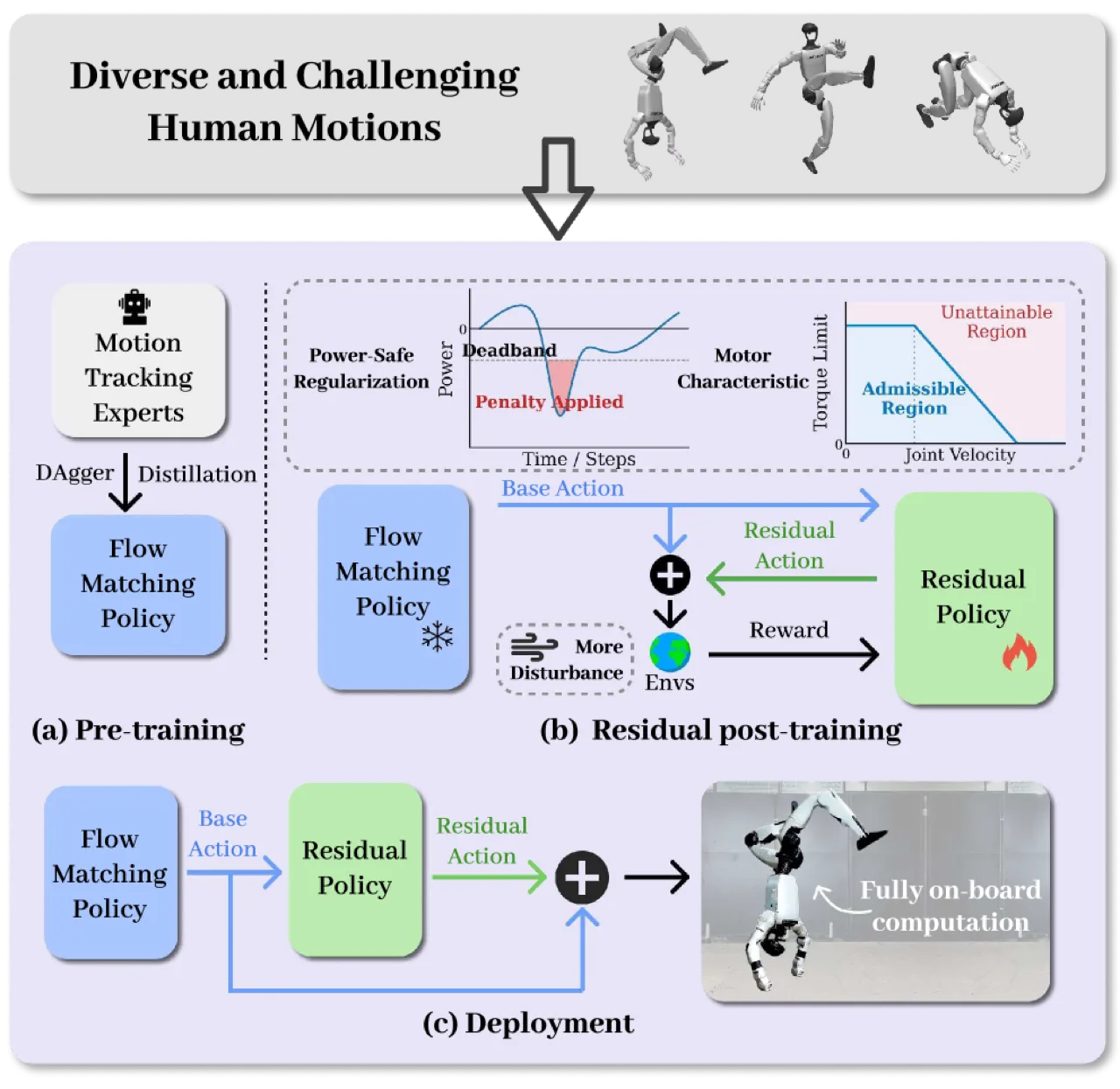
图 1(Figure 2 原文):OmniXtreme 总览。 (a) 预训练阶段:通过 DAgger-based Flow Matching,将多个运动追踪专家的行为聚合进一个统一 base policy; (b) 后训练阶段:冻结 base policy,在严格电机约束、大规模域随机化和 power-safety 正则化下优化残差策略以跨越 sim-to-real gap; (c) 板载部署:整个推理流水线经 TensorRT 加速,完全在机器人板载 Orin NX 上运行,端到端延迟 10 ms,控制频率 50 Hz。Figure 1 (Figure 2 in the paper): OmniXtreme overview. (a) Pre-training stage: DAgger-based Flow Matching aggregates the behaviors of multiple motion-tracking experts into one unified base policy; (b) post-training stage: the base policy is frozen while a residual policy is optimized under strict motor constraints, large-scale domain randomization and power-safety regularization, so as to cross the sim-to-real gap; (c) onboard deployment: the whole inference pipeline is accelerated with TensorRT and runs entirely on the robot’s onboard Orin NX, with 10 ms end-to-end latency at a 50 Hz control frequency.
91.08%真机综合成功率(157 次)Overall real-robot success rate (157 trials)
96.36%翻跟头(Flip)成功率(55 次)Flip success rate (55 trials)
30.93 mm仿真 MPJPE(LaFAN1 + XtremeMotion)Simulation MPJPE (LaFAN1 + XtremeMotion)
10 ms板载推理端到端延迟Onboard inference end-to-end latency
02 方法Method

OmniXtreme 将多运动控制分为两个解耦阶段:Phase 1 以高容量 flow matching 模型建立可扩展的统一运动先验,绕开干扰密集的多运动 RL 优化;Phase 2 冻结 base policy,用轻量级残差策略在 actuation-aware 约束下对齐真机特性。OmniXtreme splits multi-motion control into two decoupled stages: Phase 1 builds a scalable unified motion prior with a high-capacity flow matching model, bypassing interference-heavy multi-motion RL optimization; Phase 2 freezes the base policy and uses a lightweight residual policy to align with real-robot characteristics under actuation-aware constraints.

Phase 1:基于 DAgger 的 Flow Matching 预训练Phase 1: DAgger-based Flow Matching Pre-training

首先对每条运动单独训练 PPO 专家策略(teacher),数据来源涵盖 LAFAN1、AMASS、MimicKit 和 Reallusion,运动重定向至 Unitree G1。随后用 DAgger 从专家处蒸馏出统一 flow matching policy:A PPO expert policy (teacher) is first trained separately for every motion, with data drawn from LAFAN1, AMASS, MimicKit and Reallusion and retargeted to the Unitree G1. A unified flow matching policy is then distilled from the experts with DAgger:

FM(θ) = 𝔼[‖vθ(at, t, o) − (ε − aexpert)‖²]

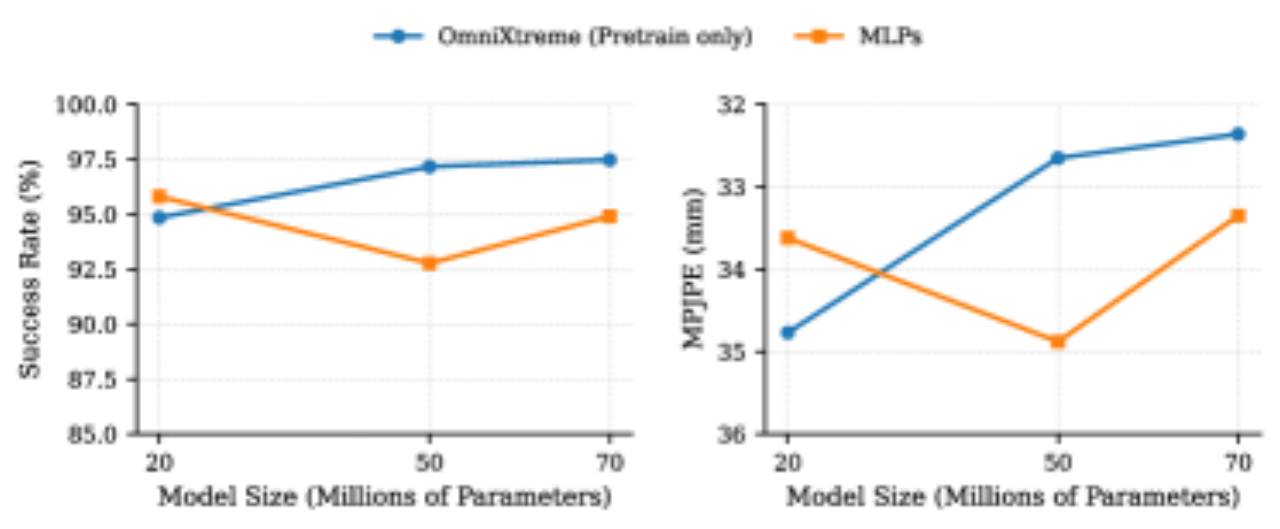
速度场学习目标为 u = ε − aexpert,推理时通过前向 Euler 积分从噪声重建动作。预训练阶段采用"保真度保护型域随机化"(较小噪声水平,如关节位置噪声 ±0.01 rad),以避免对 base policy 的精度造成损害。高容量架构(Transformer/大 MLP)相比普通 MLP 有更强的容量可扩展性。The velocity-field learning target is u = ε − aexpert, and at inference the action is reconstructed from noise by forward Euler integration. Pre-training adopts "fidelity-preserving domain randomization" (small noise levels, e.g. joint position noise of ±0.01 rad) so that the precision of the base policy is not damaged. High-capacity architectures (Transformer / large MLP) offer far stronger capacity scalability than a plain MLP.

Phase 2:Actuation-Aware 残差后训练Phase 2: Actuation-Aware Residual Post-training

冻结 base policy 后,用轻量级 MLP 残差策略叠加修正动作:a = aflow + ares,经 PPO 优化。该阶段引入三项针对真机约束的关键机制:With the base policy frozen, a lightweight MLP residual policy adds a corrective action on top: a = aflow + ares, optimized with PPO. This stage introduces three key mechanisms aimed at real-robot constraints:

Fidelity-scalability trade-off curve
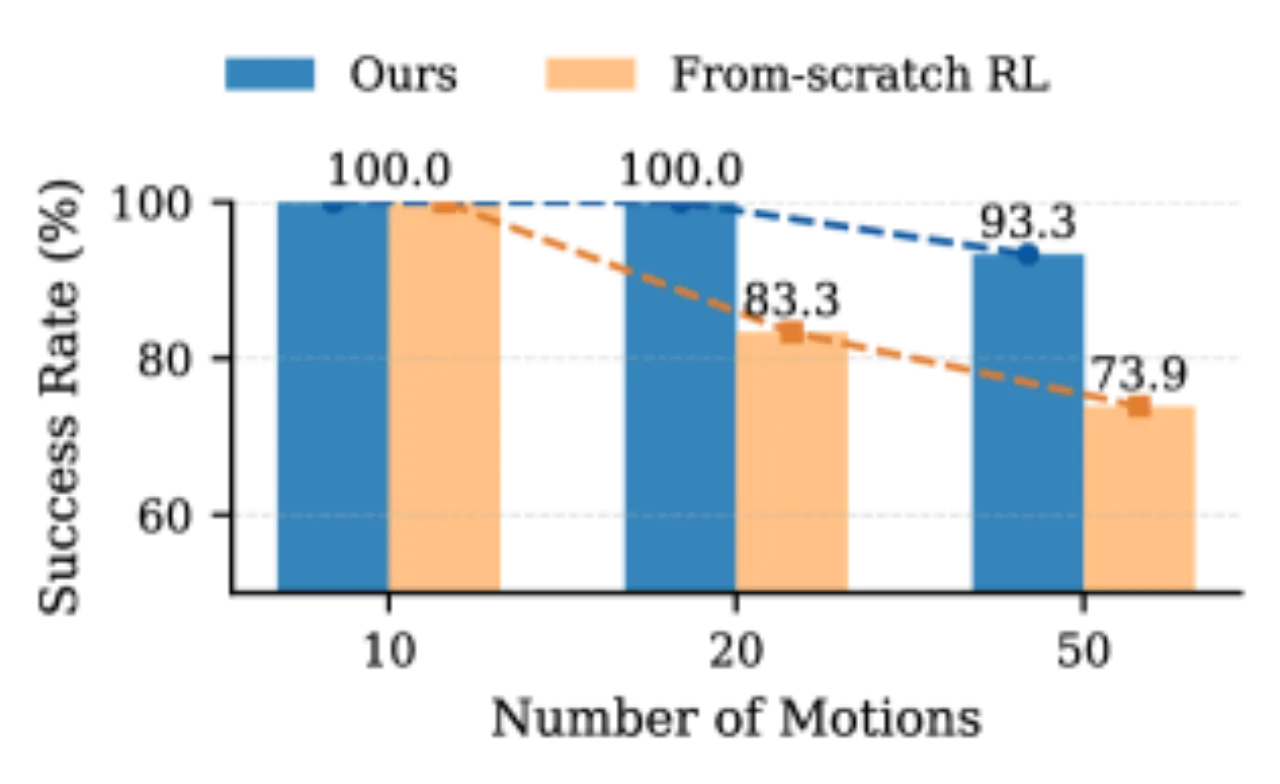
Figure 3:Fidelity–scalability trade-off。 随运动多样性与难度逐步扩大,OmniXtreme 在固定前 10 条运动集上保持较高追踪成功率;从零训练的 RL 在超过某临界规模后出现"急剧鲁棒性崩溃"。Figure 3: Fidelity–scalability trade-off. As motion diversity and difficulty are progressively scaled up, OmniXtreme keeps a high tracking success rate on a fixed set of the first 10 motions, whereas RL trained from scratch shows a "sharp robustness collapse" beyond a critical scale.
Capacity scaling curve
Figure 4:Capacity scaling。 OmniXtreme 随模型容量增加有更强的追踪保真度增益,"而传统 MLP 控制器更早饱和"(原文引用)。Figure 4: Capacity scaling. OmniXtreme gains more tracking fidelity as model capacity grows, "while conventional MLP controllers saturate earlier" (quoted from the paper).

03 实验Experiments

评估在 Unitree G1 humanoid 上进行,仿真使用 LAFAN1 + XtremeMotion(约 60 条高动态运动)数据集,评估指标包括 MPJPE (mm)、Δvel (mm/frame)、Δacc (mm/frame²) 和 成功率(Succ)。真机实验涵盖 157 次试验、5 类技能。Evaluation is carried out on the Unitree G1 humanoid; simulation uses the LAFAN1 + XtremeMotion dataset (about 60 high-dynamic motions), with metrics MPJPE (mm), Δvel (mm/frame), Δacc (mm/frame²) and success rate (Succ). Real-robot experiments cover 157 trials over 5 skill categories.

Table II · 可扩展高保真运动追踪(仿真)Table II · Scalable High-Fidelity Motion Tracking (Simulation)

方法Method LaFAN1+XtremeMotion MPJPE↓ 成功率↑Succ↑ XtremeMotion MPJPE↓ 成功率↑Succ↑
From-scratch RL 47.95 82.95% 54.19 79.45%
Specialist → Unified MLP 33.35 94.91% 43.43 89.22%
OmniXtreme(仅预训练)OmniXtreme (pre-training only) 32.65 97.17% 37.11 95.16%
OmniXtreme(完整)OmniXtreme (full) 30.93 98.54% 36.17 95.64%

另:泛化到未见运动集成功率 89.54%(OmniXtreme 完整版)。Also: success rate when generalizing to the unseen motion set is 89.54% (full OmniXtreme).

Table III · 真机评估(Unitree G1,157 次试验)Table III · Real-Robot Evaluation (Unitree G1, 157 trials)

技能类别Skill category试验次数Trials成功率Success rate
Flip(翻跟头)Flip5596.36%
Handspring(手翻)Handspring3588.57%
Acrobatics(杂技)Acrobatics1580.00%
Breakdance(霹雳舞)Breakdance2286.36%
Martial arts(武术)Martial arts3093.33%
合计Total15791.08%
Qualitative real-world rollouts
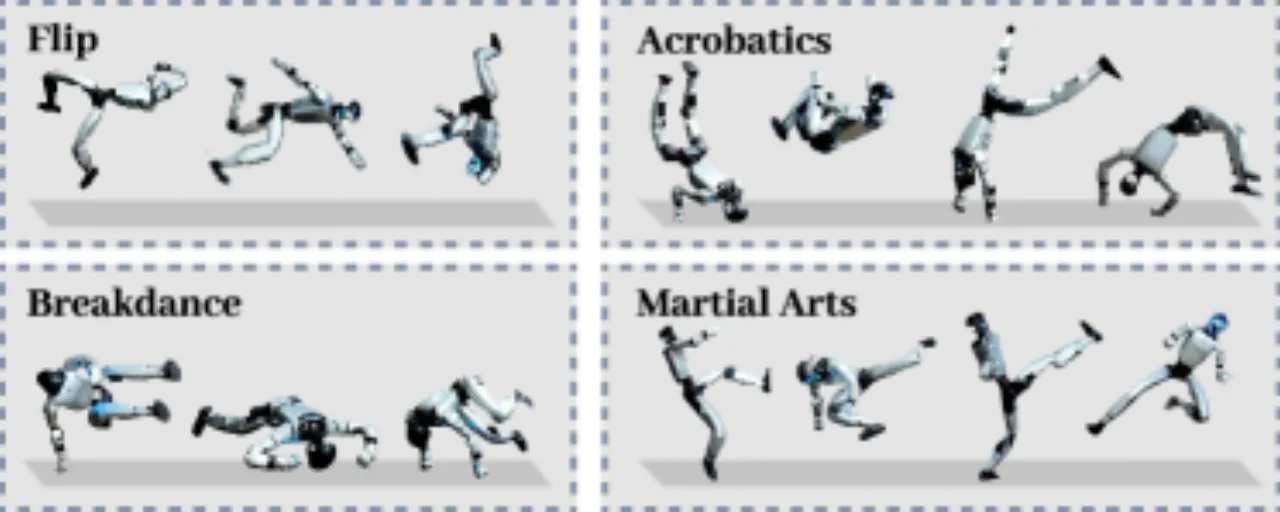
Figure 5:定性结果。 OmniXtreme 在真机上产出的代表性 rollout,涵盖翻跟头、杂技、霹雳舞和武术等定性差异显著的全身动作,"展示了在快速接触切换和时序敏感阶段下的稳定协调执行"(原文)。Figure 5: Qualitative results. Representative rollouts produced by OmniXtreme on the real robot, covering qualitatively very different whole-body motions such as flips, acrobatics, breakdance and martial arts, "showing stable and coordinated execution under rapid contact switching and timing-sensitive phases" (from the paper).

消融实验(Table IV)Ablation Study (Table IV)

对后训练各机制的逐步消融(真机可执行性)显示:A stepwise ablation of the post-training mechanisms (real-robot executability) shows:

结论:"不同类别的高动态动作具有各自独特的失败模式,每种执行导向机制各自解决了互补的方面。"Conclusion: "high-dynamic motions of different categories have their own distinct failure modes, and each execution-oriented mechanism addresses a complementary aspect."

04 局限性Limitations

说明:论文在附录 V-M "Failure Cases and Discussion" 中给出了明确讨论;主论文结论节亦有展望,以下内容均为作者明确陈述Note: the paper gives an explicit discussion in Appendix V-M "Failure Cases and Discussion", and the conclusion of the main paper adds an outlook; everything below is explicitly stated by the authors.
极限着陆阶段的硬件保护触发Hardware protection triggered during extreme landing phases

真机部署中观察到少量失败案例,"主要发生在某些极限动作的高冲量着陆阶段,巨大的瞬态制动载荷触发了硬件保护机制,包括电机过流、功率限制或电池欠压事件"(原文)。这些动作在仿真和 sim-to-sim 中均可稳定执行,表明失败并非追踪精度或平衡丧失所致,而是揭示了"仿真致动模型与极端动态条件下真实硬件能力包络之间的残余差距"(原文)。A small number of failure cases were observed in real-robot deployment, "occurring mainly in the high-impulse landing phases of certain extreme motions, where the large transient braking loads trigger hardware protection mechanisms, including motor overcurrent, power limiting or battery undervoltage events" (from the paper). These motions execute stably both in simulation and in sim-to-sim, indicating that the failures are caused neither by tracking accuracy nor by loss of balance, but instead reveal "a residual gap between the simulated actuation model and the capability envelope of real hardware under extreme dynamic conditions" (from the paper).

残差后训练对 base policy 全容量利用的限制Residual post-training limits full use of the base policy capacity

当前后训练冻结 flow-based base policy,仅训练轻量级残差 MLP。"虽然这种设计提供了稳定性和采样效率,但也可能限制大型 flow-based 模型的全部表示容量被进一步适应到硬件特定约束的程度"(原文)。未来可探索直接微调完整 base policy 的后训练策略。The current post-training freezes the flow-based base policy and trains only a lightweight residual MLP. "While this design offers stability and sample efficiency, it may also limit the extent to which the full representational capacity of the large flow-based model can be further adapted to hardware-specific constraints" (from the paper). Future work could explore post-training strategies that directly fine-tune the complete base policy.

致动器与电源系统建模的不完整性Incomplete modeling of the actuator and power system

作者指出,进一步提升极限动作鲁棒性需要"对真实致动器和电源系统限制进行更全面的建模,包括力矩、速度、电流、功率流和电池电压动态的耦合效应,这些在仿真中仍难以精确捕捉"(原文)。The authors note that further improving robustness on extreme motions calls for "more comprehensive modeling of real actuator and power-system limits, including the coupled effects of torque, speed, current, power flow and battery voltage dynamics, which remain hard to capture accurately in simulation" (from the paper).

数据多样性与模型容量的联合扩展Joint scaling of data diversity and model capacity

结论节指出,"联合扩展数据多样性和模型容量对于增强全身 humanoid 运动技能的泛化能力至关重要"(原文),是未来研究的主要方向。The conclusion states that "jointly scaling data diversity and model capacity is essential for enhancing the generalization of whole-body humanoid motion skills" (from the paper), and names it a main direction for future research.