NORA: A Small Open-Sourced Generalist Vision Language Action Model for Embodied Tasks
3B 参数轻量 VLA,性能超越 7B 量级大模型A lightweight 3B-parameter VLA that outperforms models at the 7B scale
Chia-Yu Hung, Qi Sun, Pengfei Hong, Amir Zadeh, Chuan Li, U-Xuan Tan, Navonil Majumder, Soujanya Poria · Singapore University of Technology and Design & Lambda Labs
现有 VLA 模型动辄超过 7B 参数,部署成本高昂,难以在消费级 GPU 上微调。NORA 以 Qwen-2.5-VL-3B 为骨干,结合 FAST+ 动作分词器,在近 100 万条真实机器人演示上训练,用 3B 参数实现了比 OpenVLA(7B)更高的任务成功率,并在 LIBERO 仿真基准上以 87.9% 平均成功率刷新最优。Existing VLA models routinely exceed 7B parameters, which makes deployment costly and fine-tuning on consumer-grade GPUs impractical. NORA takes Qwen-2.5-VL-3B as its backbone, combines it with the FAST+ action tokenizer, and is trained on nearly 1000000 real-robot demonstrations; with 3B parameters it attains a higher task success rate than OpenVLA (7B) and sets a new state of the art on the LIBERO simulation benchmark with an 87.9% average success rate.
现有的 Vision-Language-Action(VLA)系统在性能上表现出色,但普遍面临计算开销过大的问题:主流模型(OpenVLA、TraceVLA、ECOT 等)参数规模接近甚至超过 7B,导致实时部署困难,且无法在消费级 GPU 上直接微调。另一方面,现有方法在精细操作任务(如目标抓取)中的视觉编码能力仍不足。Existing Vision-Language-Action (VLA) systems perform well, but they generally suffer from excessive computational cost: mainstream models (OpenVLA, TraceVLA, ECOT and others) approach or even exceed 7B parameters, which makes real-time deployment difficult and rules out direct fine-tuning on consumer-grade GPUs. In addition, the visual encoding ability of existing methods is still insufficient for fine-grained manipulation tasks such as targeted grasping.
"Existing VLA models are typically large-scale, with model sizes approaching 7B parameters, such as OpenVLA, and even larger in methods like TraceVLA, ECOT, and EMMA-X."
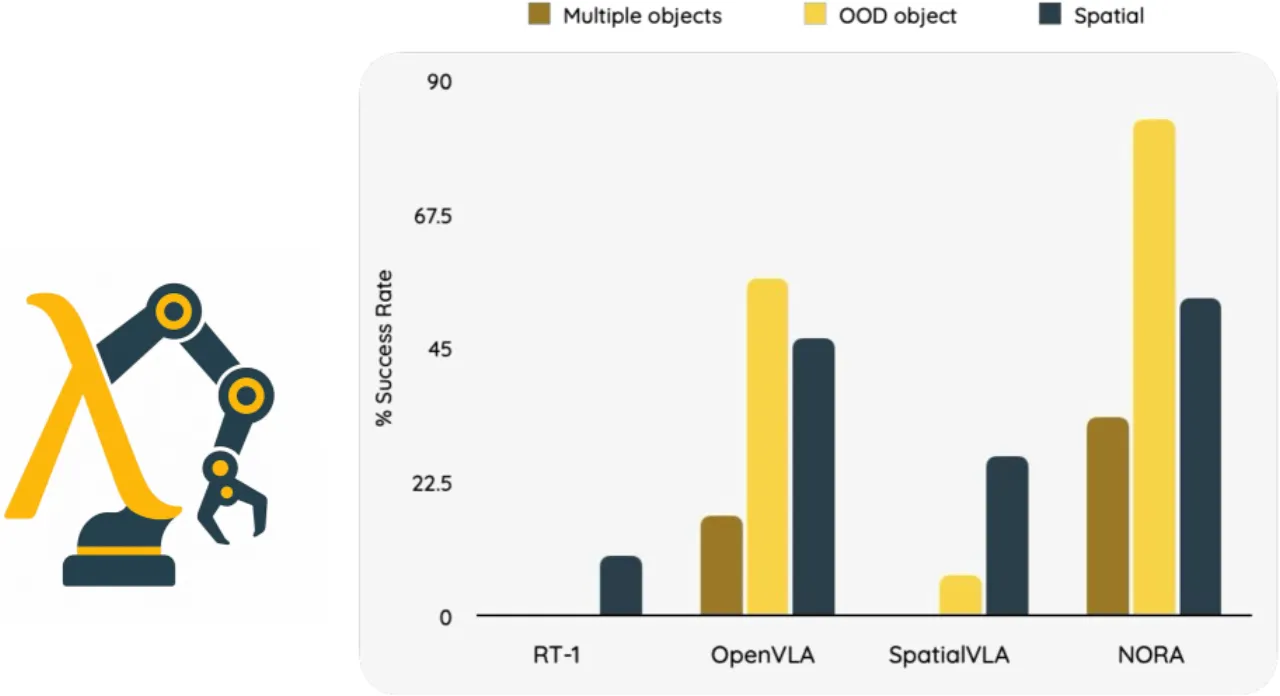
NORA 总览图:以 3B 参数规模,覆盖从自然语言指令到连续控制动作的完整推理链路,支持零样本(zero-shot)和 out-of-domain 对象抓取。Overview of NORA: at a 3B parameter scale it covers the complete reasoning chain from a natural-language instruction to continuous control actions, and supports zero-shot and out-of-domain object grasping.
56.7%真实 WidowX 机器人平均成功率Average success rate on the real WidowX robot
87.9%LIBERO 四套任务平均成功率(NORA-Long)Average success rate over the four LIBERO task suites (NORA-Long)
~1M训练用真实机器人演示数据量Real-robot demonstrations used for training
02方法Method
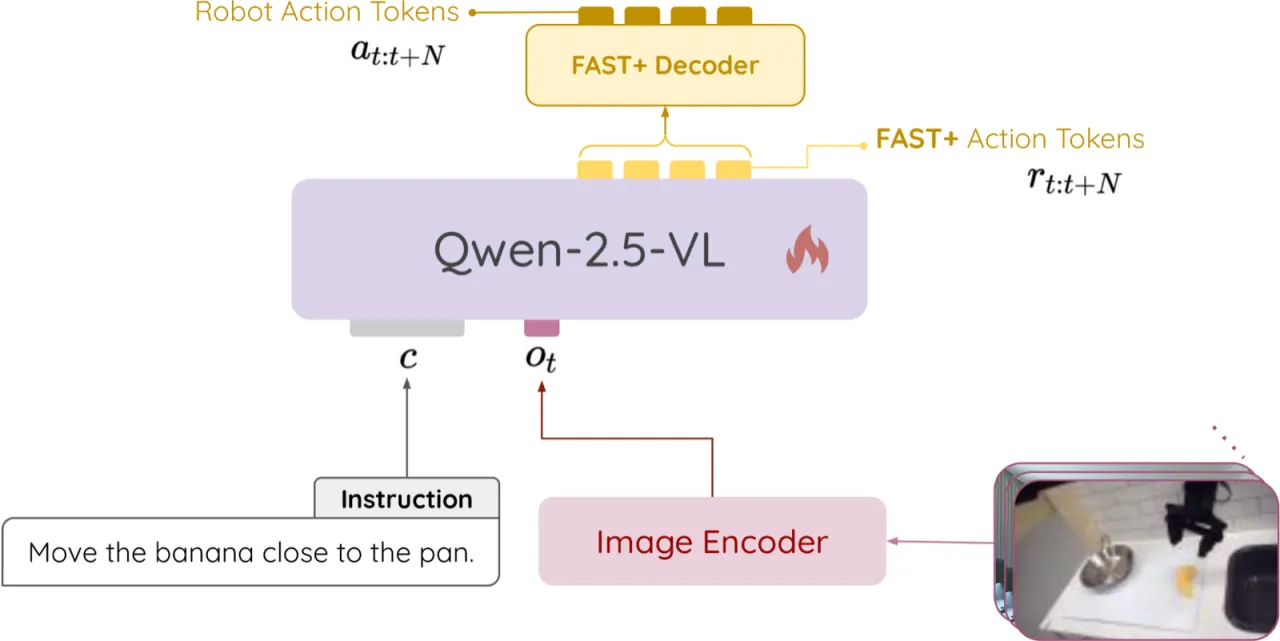
NORA 以 Qwen-2.5-VL-3B 多模态大模型为骨干,引入 FAST+ 动作分词器对连续动作进行高效离散化,并在 Open X-Embodiment(OXE)数据集的近百万条真实机器人演示上预训练,形成通用机器人控制策略。推理时,模型接受视觉观测与自然语言指令,自回归预测动作 token 序列,再解码为连续控制信号。NORA takes the multimodal large model Qwen-2.5-VL-3B as its backbone, introduces the FAST+ action tokenizer to discretize continuous actions efficiently, and is pre-trained on nearly one million real-robot demonstrations from the Open X-Embodiment (OXE) dataset, yielding a general-purpose robot control policy. At inference time the model takes a visual observation and a natural-language instruction, autoregressively predicts a sequence of action tokens, and decodes them into continuous control signals.
图 1:NORA 整体架构与推理流程。视觉帧经 Vision Encoder 编码,与语言指令拼接后输入 Qwen-2.5-VL-3B,输出经 FAST+ 解码器转换为关节空间连续动作。Figure 1: Overall architecture and inference pipeline of NORA. Visual frames are encoded by the Vision Encoder, concatenated with the language instruction and fed into Qwen-2.5-VL-3B; the output is converted by the FAST+ decoder into continuous actions in joint space.
FAST+ 动作分词器FAST+ Action Tokenizer
FAST+ 对每个时间步的动作维度施加离散余弦变换(Discrete Cosine Transform,DCT),对关节动作分量去相关,再使用字节对编码(Byte-Pair Encoding,BPE)将其压缩为更短的 token 序列。相比直接离散化,FAST+ 保留了高度相关动作之间的结构信息,使模型能以更少的 token 精确表达灵巧操作动作。论文中提出了两种推理变体:FAST+ applies a Discrete Cosine Transform (DCT) to the action dimensions at each time step, decorrelating the joint action components, and then uses Byte-Pair Encoding (BPE) to compress them into a shorter token sequence. Compared with direct discretization, FAST+ preserves the structural information among highly correlated actions, allowing the model to express dexterous manipulation actions precisely with fewer tokens. The paper proposes two inference variants:
NORA:chunk size = 1,每步单帧推理,适合需要精细控制的真实机器人任务;NORA: chunk size = 1, single-frame inference at every step, suited to real-robot tasks that require fine-grained control;
NORA-Long:chunk size = 5,一次预测 5 步动作序列(action chunking),适合长时序仿真任务,可在 LIBERO 基准上显著提升性能。NORA-Long: chunk size = 5, predicting a 5-step action sequence at once (action chunking), suited to long-horizon simulation tasks and markedly improving performance on the LIBERO benchmark.
训练配置Training Setup
预训练数据为 Open X-Embodiment(包含 BridgeV2、DROID 等子集),共约 97 万条真实机器人演示。训练使用 8 张 H100 GPU,总计约 4,000 GPU 小时,batch size 256,梯度更新约 110 万步;优化器为 AdamW,配合线性预热和余弦衰减调度;输入分辨率为 224×224。The pre-training data is Open X-Embodiment (including subsets such as BridgeV2 and DROID), about 970000 real-robot demonstrations in total. Training used 8 H100 GPUs for roughly 4,000 GPU hours, with batch size 256 and about 1100000 gradient updates; the optimizer is AdamW with linear warmup and cosine decay scheduling; the input resolution is 224×224.
03实验Experiments
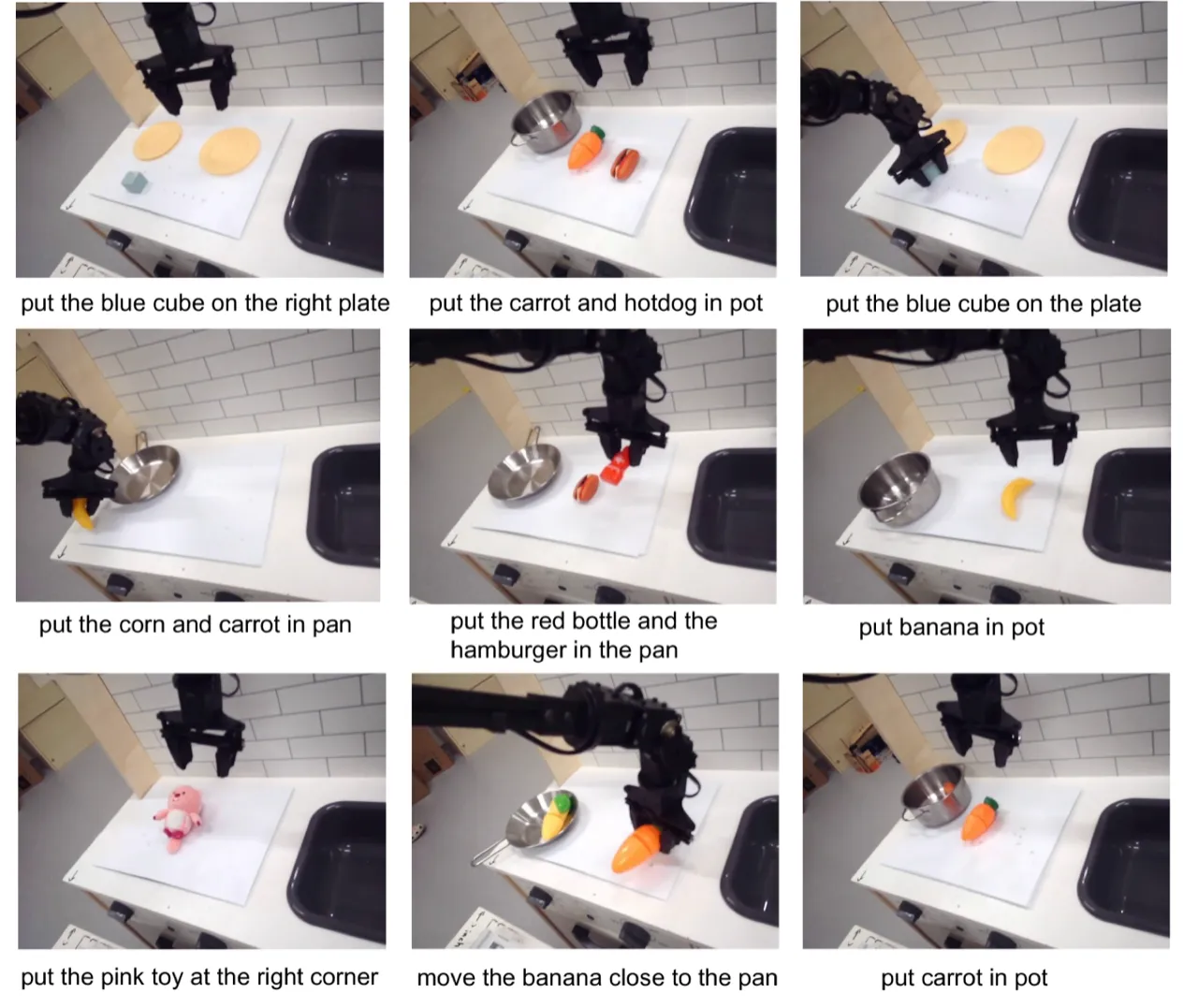
实验分两部分:(1)真实世界 WidowX 机器人上的 9 项多样化操作任务评估;(2)LIBERO 仿真基准(4 个任务套件共 40 个任务)。基线模型包括 RT-1、OpenVLA、SpatialVLA 及其 action chunking 变体(AC)。The experiments have two parts: (1) evaluation on 9 diverse manipulation tasks with a real-world WidowX robot; (2) the LIBERO simulation benchmark (4 task suites, 40 tasks in total). Baselines include RT-1, OpenVLA, SpatialVLA and their action chunking (AC) variants.
NORA 在 out-of-domain 零样本抓取任务上表现尤为突出,例如"put the carrot in pot"和"put banana in pot"的成功率高达 90%,而 OpenVLA 在香蕉任务上仅为 40%。NORA is particularly strong on out-of-domain zero-shot grasping tasks: the success rate reaches 90% on "put the carrot in pot" and "put banana in pot", whereas OpenVLA reaches only 40% on the banana task.
图 3:真实 WidowX 机器人评估环境与 9 项任务设置,涵盖 out-of-domain 对象抓取、空间推理任务和多对象操作任务,全面测试模型的指令理解、空间推理和多任务运动规划能力。Figure 3: The real WidowX robot evaluation environment and the 9 task settings, covering out-of-domain object grasping, spatial reasoning tasks and multi-object manipulation tasks, so as to test instruction understanding, spatial reasoning and multi-task motion planning comprehensively.
LIBERO 仿真基准LIBERO Simulation Benchmark
方法Method
LIBERO-Spatial
LIBERO-Object
LIBERO-Goal
LIBERO-Long
平均Average
OpenVLA fine-tuned
84.7
88.4
79.2
53.7
76.5
TraceVLA fine-tuned
84.6
85.2
75.1
54.1
74.8
NORA fine-tuned
85.6
87.8
77.0
45.0
73.9
SpatialVLA fine-tuned-AC
88.2
89.9
78.6
55.5
78.1
NORA fine-tuned-AC
85.6
89.4
80.0
63.0
79.5
NORA-Long fine-tuned
92.2
95.4
89.4
74.6
87.9
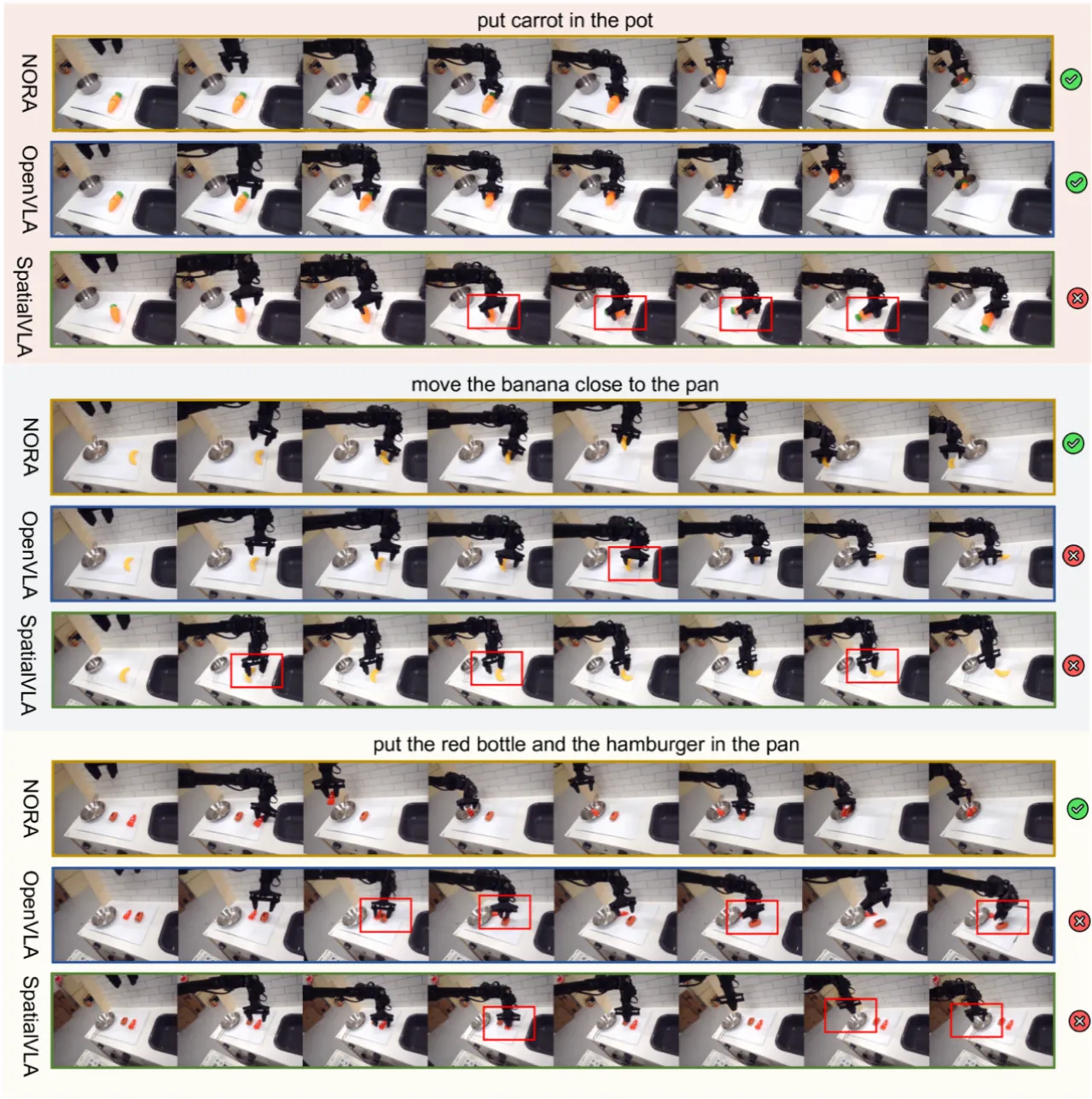
图 7:NORA 与 OpenVLA、SpatialVLA 在真实机器人任务上的案例对比。NORA 能更准确地定位并抓取目标物体,基线方法则频繁失败(无效动作或抓取错误)。Figure 7: Case comparison of NORA against OpenVLA and SpatialVLA on real-robot tasks. NORA localizes and grasps the target object more accurately, while the baselines fail frequently (invalid actions or wrong grasps).
消融实验Ablation Studies
论文对 action chunking(chunk size)和推理变体进行了系统消融。在仿真(LIBERO)中,action chunking(NORA-Long)带来大幅提升,LIBERO-Long 成功率从 45.0%(chunk=1)跃升至 74.6%(NORA-Long),提升了 29.6 个百分点。而在真实机器人上,由于物理误差累积,chunk size 增大反而导致性能下降,NORA(chunk=1)优于 NORA-Long。此外,在有干扰物(distractors)的场景下,两种策略的成功率均有显著下降,说明视觉鲁棒性仍是待解难题。The paper systematically ablates action chunking (chunk size) and the inference variants. In simulation (LIBERO), action chunking (NORA-Long) brings a large gain: the LIBERO-Long success rate jumps from 45.0% (chunk=1) to 74.6% (NORA-Long), an improvement of 29.6 percentage points. On the real robot, however, accumulated physical error makes a larger chunk size hurt performance instead, and NORA (chunk=1) outperforms NORA-Long. Moreover, in scenes with distractors the success rate of both strategies drops significantly, showing that visual robustness remains an open problem.
04局限性Limitations
Note:以下限制均由论文作者明确陈述(stated)。All limitations below are explicitly stated by the authors of the paper.
多目标操作成功率偏低Low success rate on multi-object manipulation
论文指出:"NORA appears much more precarious at below 50% success rate on multi-object tasks, indicating substantial room for improvement in handling multiple objects." 多对象抓取和放置任务中,NORA 成功率不足 50%,表明模型在复杂场景下的泛化能力有限。The paper states: "NORA appears much more precarious at below 50% success rate on multi-object tasks, indicating substantial room for improvement in handling multiple objects." On multi-object pick-and-place tasks NORA achieves less than 50% success, showing that the model generalizes only to a limited extent in complex scenes.
Action Chunking 在真实机器人上的抓取姿态问题Grasp pose problems of action chunking on the real robot
NORA-Long 在真实 WidowX 机器人上存在抓取方向估计不准的问题,论文描述为"consistently attempting to grip objects from the side — specifically around the 2 o'clock direction",即始终从侧面(约 2 点钟方向)尝试抓取,导致小型物体(如香蕉)抓取失败率升高。On the real WidowX robot, NORA-Long estimates the grasp orientation inaccurately; the paper describes it as "consistently attempting to grip objects from the side — specifically around the 2 o'clock direction", that is, it always attempts to grasp from the side (around the 2 o'clock direction), which raises the failure rate on small objects such as the banana.
真实机器人上的长序列动作执行误差Long-horizon action execution error on the real robot
在真实机器人平台上连续执行预测动作序列时,NORA-Long 产生"excessively large movements"(过大的运动幅度),进一步导致任务失败。仿真环境中的优势无法直接迁移到真实物理系统,sim-to-real gap 问题仍待解决。When predicted action sequences are executed continuously on the real robot platform, NORA-Long produces "excessively large movements", which further leads to task failure. The advantage observed in simulation does not transfer directly to a real physical system, and the sim-to-real gap remains unresolved.
视觉鲁棒性不足(干扰物影响)Insufficient visual robustness (impact of distractors)
在引入环境干扰物(distractors)的测试中,NORA 和基线模型的成功率均有显著下降,说明当前模型的视觉语义理解尚未达到在复杂真实场景中稳健运行的水平。In tests that introduce environmental distractors, the success rates of both NORA and the baselines drop significantly, showing that the visual semantic understanding of current models is not yet robust enough to operate reliably in complex real-world scenes.