极简主义视频预测世界模型的最小化实现A Minimalist Implementation of Future Video Prediction
Siqiao Huang · Partha Kaushik · Michael Chen · Hengkai Pan · Kaiwen Geng · Omar Chehab · Fernando Moreno-Pino · Max Simchowitz | Tsinghua University · Carnegie Mellon University · University of Bristol · University of Oxford · Amazon FAR
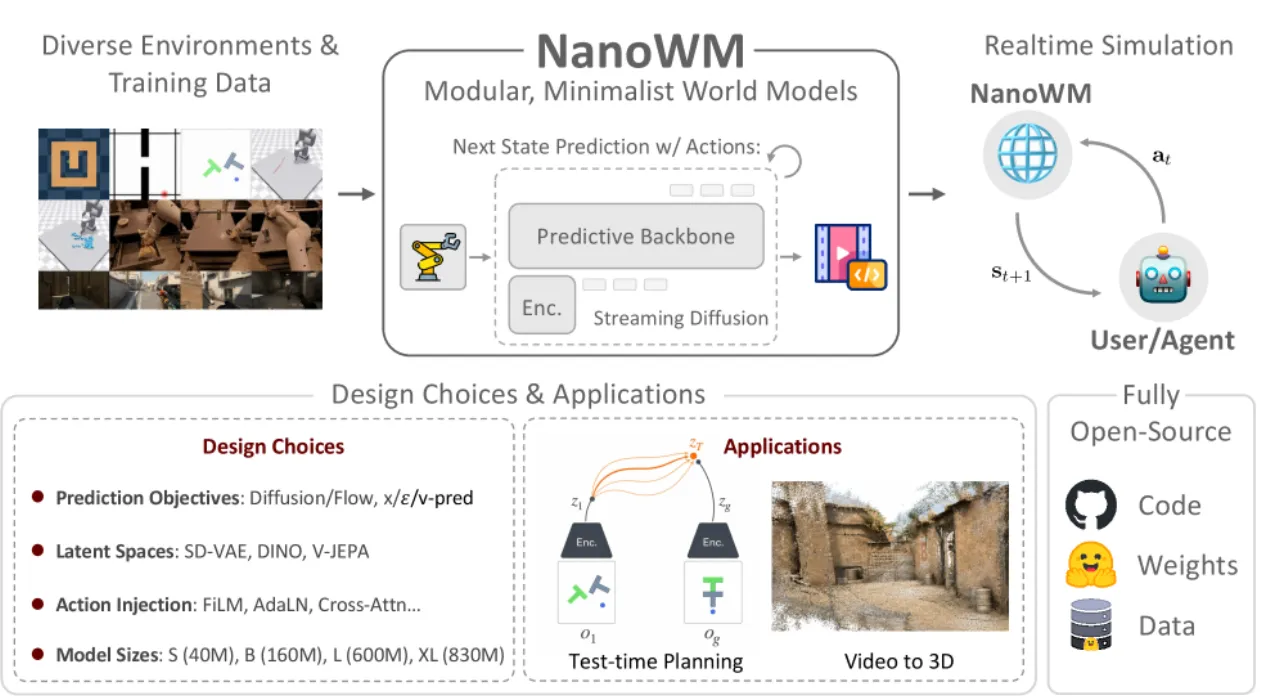
NanoWM 是一个以 diffusion forcing 为核心、模块化、极简的视频预测世界模型框架。它通过统一接口支持多种生成目标、模型规模、动作注入方式与潜在空间,并在控制、游戏和机器人等多领域上系统研究各设计选择对视频预测质量和长程自回归行为的影响。NanoWM is a modular, minimalist framework for video-prediction world models built around diffusion forcing. Through a unified interface it supports multiple generative objectives, model scales, action injection schemes and latent spaces, and it systematically studies how each design choice affects video prediction quality and long-horizon autoregressive behavior across control, game and robotics domains.
视频预测世界模型已成为学习预测模拟器的核心范式,支撑着生成、规划与决策制定。然而,尽管工业界的交互式视频生成取得了快速进展,更广泛的研究社区仍然缺乏紧凑、可复现、易于扩展的实现来研究现代世界模型背后的设计选择。Video-prediction world models have become a core paradigm for learning predictive simulators, underpinning generation, planning and decision making. Yet despite the rapid progress of interactive video generation in industry, the broader research community still lacks compact, reproducible and easily extensible implementations for studying the design choices behind modern world models.
"The broader research community still lacks compact, reproducible, and easily extensible implementations for studying the design choices underlying modern world models."
图 1:NanoWM 框架总览。NanoWM 是一个极简、模块化的未来视频预测与世界建模框架。它支持多样的环境与训练数据,将观测编码到潜在空间,并通过统一的 diffusion-forcing 接口预测未来观测。该接口可容纳不同的生成目标、模型规模和动作注入机制。同一模型接口支持实时仿真、测试时规划和 video-to-3D 应用,同时项目完全开源代码、模型权重和数据,以支持世界模型设计选择的可复现研究。Figure 1: Overview of the NanoWM framework. NanoWM is a minimalist, modular framework for future video prediction and world modeling. It supports diverse environments and training data, encodes observations into a latent space, and predicts future observations through a unified diffusion-forcing interface. That interface accommodates different generative objectives, model scales and action injection mechanisms. The same model interface supports real-time simulation, test-time planning and video-to-3D applications, while the project fully open-sources code, model weights and data to support reproducible research on world model design choices.
现有工业规模的世界模型对研究社区而言难以访问,研究者面临的核心挑战是:视频扩散、diffusion forcing、一致性蒸馏等技术已相当成熟,研究重心应从发明新技术转向理解设计决策。然而当前领域仍高度碎片化——不同论文使用不同数据集、训练方案和评估协议,缺乏"通用语言"。Existing industrial-scale world models are hard for the research community to access. The core challenge researchers face is that techniques such as video diffusion, diffusion forcing and consistency distillation are already fairly mature, so the focus of research should shift from inventing new techniques to understanding design decisions. Yet the field remains highly fragmented — different papers use different datasets, training recipes and evaluation protocols, and lack a common language.
NanoWM 的目标是打造一座"世界模型研究的巴别塔"("a Babel tower for world model research"),让数据集、目标函数、架构和任务能够说同一种语言,从而系统比较各种设计选项。The goal of NanoWM is to build “a Babel tower for world model research”, so that datasets, objectives, architectures and tasks can speak the same language and design options can be compared systematically.
4模型规模 S/B/L/XLModel scales S/B/L/XL
5动作注入方式 FiLM / cross-attn 等Action injection FiLM / cross-attn, etc.
3预测目标 x / ε / v-predictionPrediction targets x / ε / v-prediction
6测试任务域 控制 / 游戏 / 机器人Test domains control / games / robotics
02方法Method
NanoWM 以 diffusion forcing 框架为核心,通过向轨迹中不同帧分配不同噪声指标,在同一模型接口下统一表达 teacher-forced 预测、masked future prediction 和自回归 rollout。NanoWM is built around the diffusion forcing framework: by assigning different noise indices to different frames of a trajectory, it expresses teacher-forced prediction, masked future prediction and autoregressive rollout under a single model interface.
系统对轨迹内每帧分配噪声指标(noise index):上下文帧保持干净,未来帧获得较高噪声指标。仅通过改变噪声调度,同一模型接口便可表达:The system assigns a noise index to every frame of a trajectory: context frames stay clean, while future frames receive higher noise indices. By changing only the noise schedule, the same model interface can express:
Teacher-forced 预测:所有帧独立去噪Teacher-forced prediction: every frame is denoised independently
Masked future prediction:遮蔽部分未来帧Masked future prediction: part of the future frames is masked out
自回归 rollout:将生成帧作为上下文继续预测Autoregressive rollout: generated frames are fed back as context to keep predicting
Transformer 骨干与模型规模Transformer Backbone and Model Scales
使用基于 Transformer 的骨干网络,对潜在视频 token 进行空间 patch 投影,再经过交错的空间-时间注意力块处理。命名规范为 "NanoWM-[规模]/[PatchSize]",例如 NanoWM-B/2 表示 Base 规模、2×2 的 patch 大小。四种规模:A Transformer-based backbone is used: latent video tokens go through a spatial patch projection and are then processed by interleaved spatial-temporal attention blocks. The naming convention is “NanoWM-[scale]/[PatchSize]”; for example NanoWM-B/2 denotes the Base scale with a 2×2 patch size. Four scales:
NanoWM-S:39.8M 参数NanoWM-S: 39.8M parameters
NanoWM-B:158.6M 参数NanoWM-B: 158.6M parameters
NanoWM-L:约 460M 参数NanoWM-L: about 460M parameters
NanoWM-XL:830M 参数NanoWM-XL: 830M parameters
动作注入方式(Action Injection)Action Injection
框架实现了五种将动作信号注入模型的方式:The framework implements five ways of injecting the action signal into the model:
通过在时间轴上应用滑动窗口注意力,模型可生成超越训练长度 4 倍的视频序列。长程生成时将已生成帧作为上下文帧,滑动窗口保证计算效率。By applying sliding-window attention along the temporal axis, the model can generate video sequences four times longer than the training length. During long-horizon generation the already generated frames serve as context frames, and the sliding window keeps computation efficient.
03实验Experiments
实验在 6 个任务域上展开:Point Maze、Wall、Rope、Granular(来自 D4RL、DeepMind Control Suite)、PushT 和 RT-1(机器人操作数据)。评估指标:PSNR(像素保真度)、SSIM(结构相似性)、LPIPS(感知距离)、FID(分布相似性),以及决策任务的 Success Rate。验证集使用 256 个固定 seed=42 的片段。Experiments span 6 task domains: Point Maze, Wall, Rope, Granular (from D4RL and the DeepMind Control Suite), PushT and RT-1 (robot manipulation data). Evaluation metrics: PSNR (pixel fidelity), SSIM (structural similarity), LPIPS (perceptual distance), FID (distributional similarity), plus Success Rate for decision-making tasks. The validation set uses 256 fixed clips with seed=42.
v-prediction 在 FID 上最优;x-prediction 在重建指标(PSNR/SSIM/LPIPS)上最优。两者均大幅优于 ε-prediction。v-prediction is best on FID; x-prediction is best on the reconstruction metrics (PSNR/SSIM/LPIPS). Both are substantially better than ε-prediction.
发现二:模型规模消融(RT-1 Fractal)Finding 2: Model Scale Ablation (RT-1 Fractal)
架构Architecture
参数量Parameters
PSNR ↑
SSIM ↑
LPIPS ↓
FID ↓
NanoWM-S/2
39.8M
22.30
0.739
0.230
54.95
NanoWM-B/2
158.6M
23.07
0.760
0.207
42.27
NanoWM-L/2
~460M
23.62
0.777
0.186
36.31
规模扩大在所有指标上均带来一致提升。Scaling up brings consistent gains on every metric.
动作注入方式的优劣具有任务依赖性:FiLM 在 RT-1 上 FID 最优(40.62);additive 在 PushT 上以最少参数量取得最佳 PSNR 和 FID。Cross-attention 在 RT-1 上表现最差(FID 51.12),尽管参数量最多。Which action injection scheme wins is task dependent: FiLM gives the best FID on RT-1 (40.62); additive achieves the best PSNR and FID on PushT with the fewest parameters. Cross-attention performs worst on RT-1 (FID 51.12), despite having the most parameters.
发现四:潜在空间对比(PushT 目标条件规划)Finding 4: Latent Space Comparison (PushT goal-conditioned planning)
潜在空间Latent space
骨干网络Backbone
Latent Shape
成功率 ↑Success rate
SD-VAE
NanoWM-B/2
[4, 32, 32]
25.0%
Web-DINO
NanoWM-B/1
[1024, 16, 16]
0.0%
V-JEPA 2.1
NanoWM-B/1
[1024, 16, 16]
0.0%
诊断实验(真实动作 rollout 的 Latent MSE)揭示了失败根源:Web-DINO 和 V-JEPA 2.1 的动作嵌入 RMS 量级(分别为 0.00214 和 0.00129)远低于 SD-VAE(0.1119),表明语义潜在空间下模型几乎完全忽略动作信号,成为"动作无关"模型。这暗示扩散目标函数不足以强制语义表征中的动作利用。A diagnostic experiment (latent MSE of rollouts with ground-truth actions) reveals the root cause: the action-embedding RMS magnitudes of Web-DINO and V-JEPA 2.1 (0.00214 and 0.00129 respectively) are far below that of SD-VAE (0.1119), showing that under semantic latent spaces the model almost entirely ignores the action signal and becomes an action-agnostic model. This suggests that the diffusion objective is not enough to enforce action utilization in semantic representations.
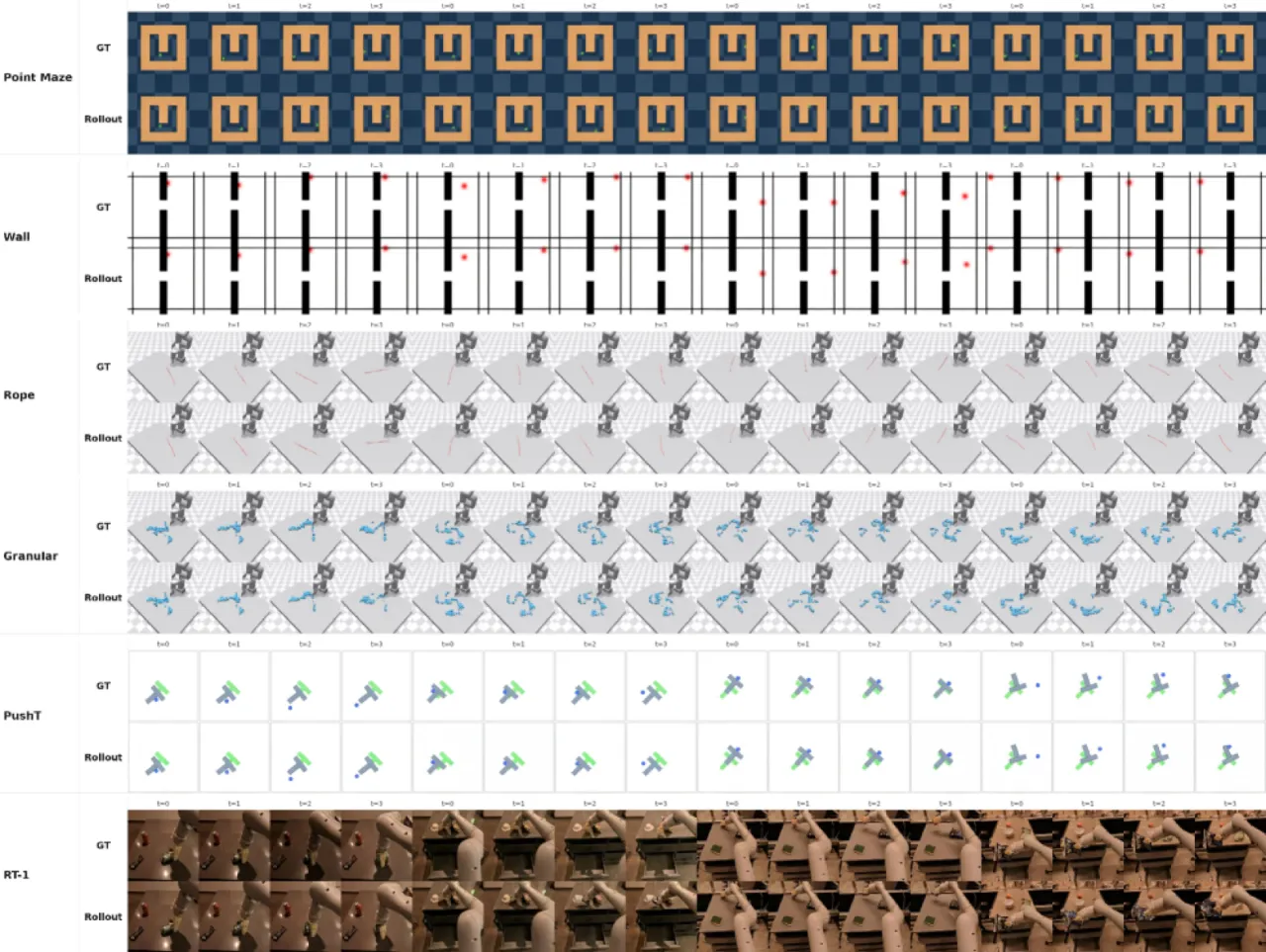
图 2:多域定性 rollout 对比(Qualitative rollouts across domains)。展示 Point Maze、Wall、Rope、Granular、PushT 和 RT-1 的真实帧(GT)与 NanoWM 预测帧对比。统一的数据集与环境接口使网格导航、仿真控制和机器人视频预测在同一 rollout 格式下可比较。Figure 2: Qualitative rollouts across domains. Ground-truth frames (GT) are compared with NanoWM predictions on Point Maze, Wall, Rope, Granular, PushT and RT-1. A unified dataset and environment interface makes grid navigation, simulated control and robot video prediction comparable under the same rollout format.
发现五:跨域性能(统一训练方案)Finding 5: Cross-Domain Performance (unified training recipe)
数据集Dataset
训练步数Training steps
PSNR ↑
SSIM ↑
LPIPS ↓
FID ↓
Point Maze
30K
36.74
0.984
0.019
9.66
Wall
15K
34.05
0.994
0.010
2.64
Rope
15K
31.63
0.953
0.056
35.20
Granular
15K
26.08
0.917
0.073
40.05
PushT
100K
33.19
0.982
0.016
13.63
RT-1
300K
24.36
0.787
0.180
35.08
统一训练方案在所有域上均有效。视觉/动态复杂度越高(如 Granular、RT-1),性能越低;简单仿真环境(Wall、Point Maze)表现最优。The unified training recipe is effective on every domain. The higher the visual / dynamic complexity (e.g. Granular, RT-1), the lower the performance; simple simulated environments (Wall, Point Maze) perform best.
发现六:长程 Rollout 误差累积Finding 6: Error Accumulation in Long-Horizon Rollout
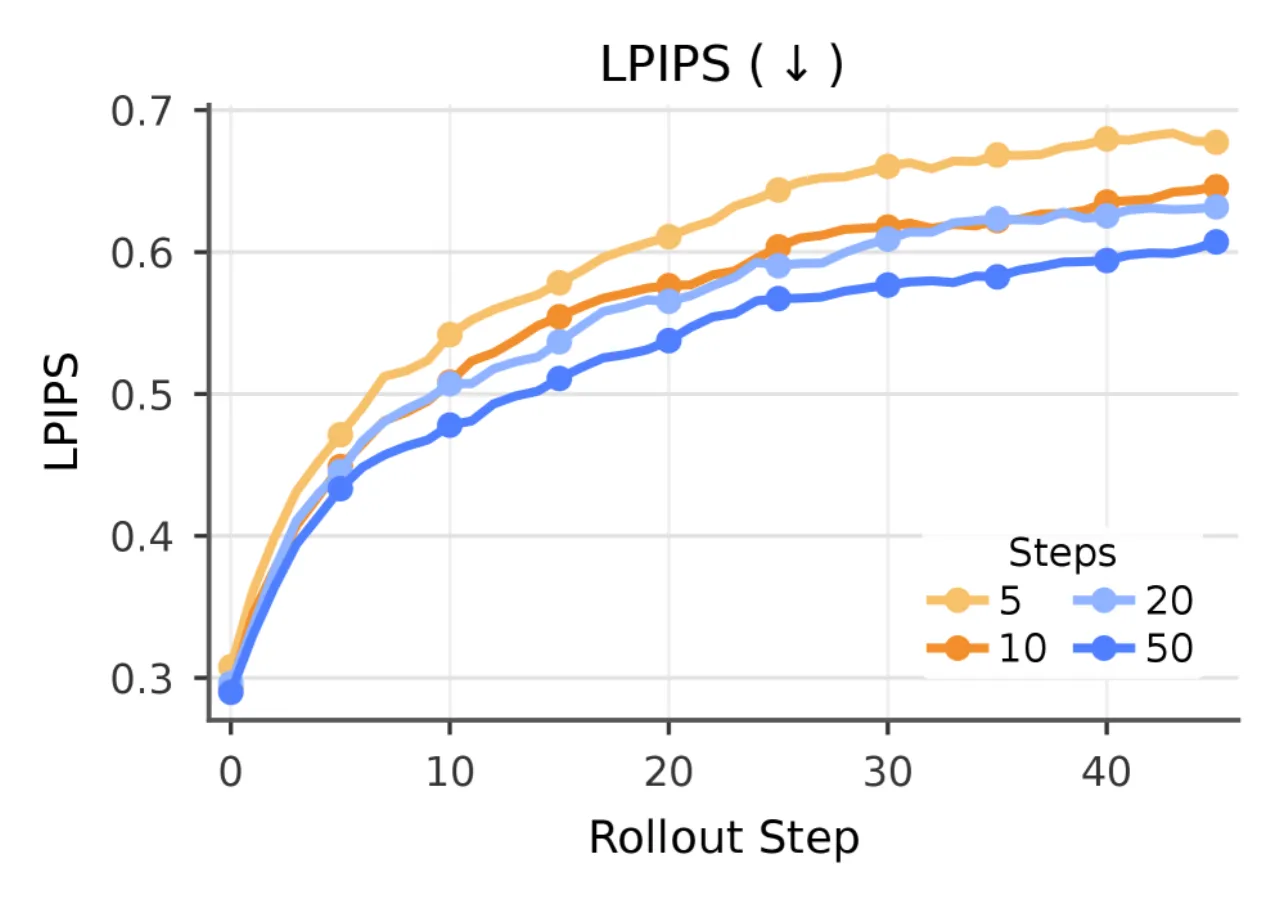
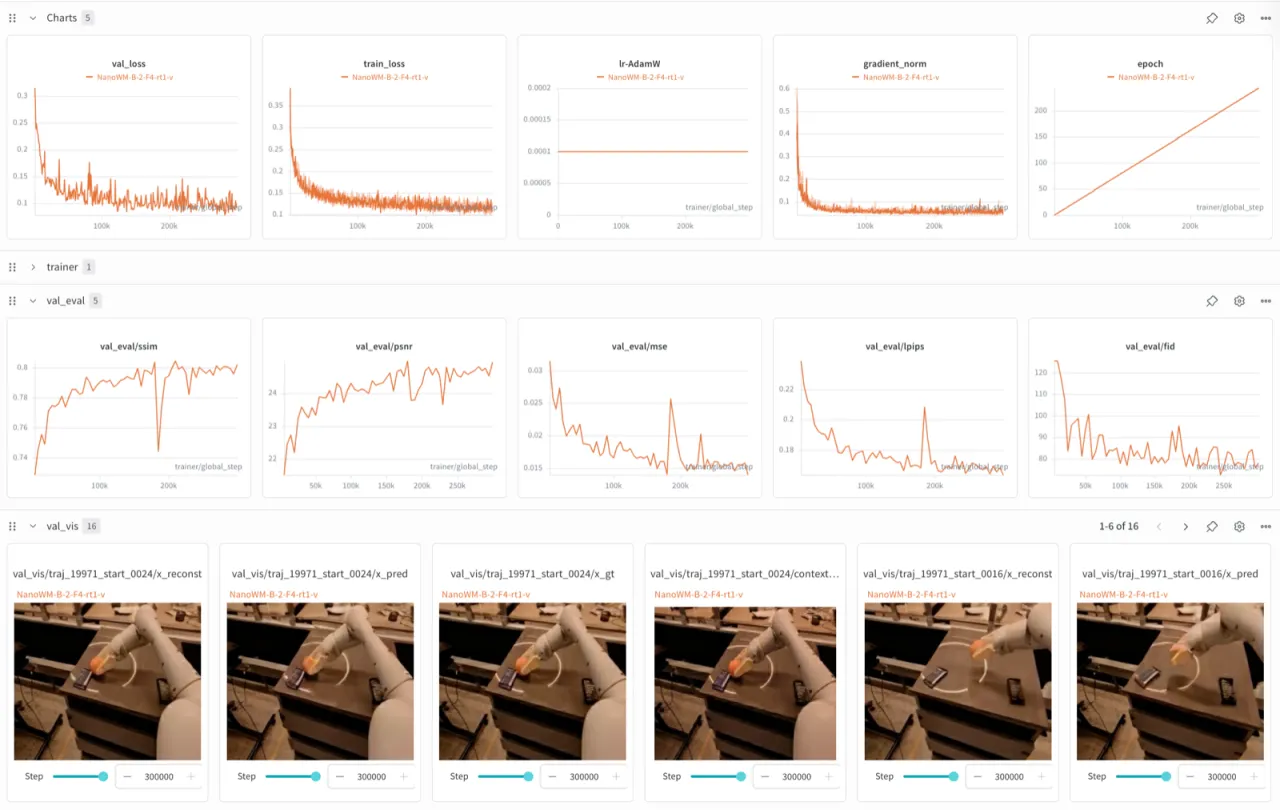
图 6:Error Accumulation(误差累积曲线)。随着 rollout 步数增加,感知误差(LPIPS)持续累积。增加 DDIM 采样步数(50→250)在整个 rollout 范围内一致降低 LPIPS,表明更强的单帧去噪可缓解误差复合。模型在长程序列上能保持粗略的场景几何和摄像机运动,但细节的感知误差不断积累。Figure 6: Error accumulation. As the number of rollout steps grows, perceptual error (LPIPS) keeps accumulating. Increasing the number of DDIM sampling steps (50→250) consistently lowers LPIPS across the whole rollout range, showing that stronger single-frame denoising mitigates error compounding. The model preserves coarse scene geometry and camera motion over long sequences, but perceptual error in fine detail keeps building up.图 3:Weights & Biases 验证指标面板。NanoWM 集成了 Tensorboard 和 W&B 日志,支持 PSNR、SSIM、LPIPS、FID 等指标的实时监控,辅助设计选择的系统比较。Figure 3: Weights & Biases validation metrics dashboard. NanoWM integrates Tensorboard and W&B logging, supporting real-time monitoring of metrics such as PSNR, SSIM, LPIPS and FID to aid systematic comparison of design choices.
消融实验总结Ablation Summary
预测目标:v-prediction 在感知质量(FID)最优;x-prediction 在像素保真度最优;ε-prediction 整体最差,差距显著(FID 差约 6–7 点)。Prediction target: v-prediction is best on perceptual quality (FID); x-prediction is best on pixel fidelity; ε-prediction is worst overall, by a clear margin (about 6–7 FID points).
模型规模:从 S(39.8M) 到 L(~460M) 所有指标单调提升,规模效应清晰。Model scale: from S(39.8M) to L(~460M) every metric improves monotonically, a clear scaling effect.
动作注入:无单一最优方法,任务依赖性强;additive 以最低参数量提供竞争性能。Action injection: there is no single best method and the choice is strongly task dependent; additive delivers competitive performance with the lowest parameter count.
采样预算:增加 DDIM 步数可持续改善 rollout 质量,对长程生成尤为重要。Sampling budget: increasing the number of DDIM steps keeps improving rollout quality, which matters especially for long-horizon generation.
04局限性Limitations
说明:以下局限性部分由作者明确陈述,部分为从设计推断(已注明来源)。Note: Some of the limitations below are stated explicitly by the authors, others are inferred from the design (the source is marked in each case).
长程自回归 rollout 的误差累积(作者明确陈述)Error accumulation in long-horizon autoregressive rollout (stated by the authors)
论文明确指出"autoregressive generation inevitably accumulates perceptual errors over time"。随 rollout 步数增加,感知误差持续累积。增加采样步数可部分缓解,但无法根本解决。模型可保留粗略场景几何与摄像机运动,但精细细节随时间劣化。The paper explicitly states that “autoregressive generation inevitably accumulates perceptual errors over time”. As the number of rollout steps grows, perceptual error keeps accumulating. Increasing the number of sampling steps mitigates it partly, but cannot solve it fundamentally. The model retains coarse scene geometry and camera motion, but fine detail degrades over time.
语义潜在空间与扩散目标不兼容(作者明确陈述)Semantic latent spaces are incompatible with the diffusion objective (stated by the authors)
Web-DINO 和 V-JEPA 2.1 等语义潜在空间在 PushT 目标条件规划任务上成功率为 0%。诊断显示模型学习到几乎与动作无关的预测,动作嵌入量级(RMS 0.00214 / 0.00129)远低于 SD-VAE(0.1119)。论文指出这暗示"扩散目标函数不足以强制语义表征中的动作利用",需要未来工作设计适合非重建型潜在空间的目标函数。Semantic latent spaces such as Web-DINO and V-JEPA 2.1 reach a 0% success rate on the PushT goal-conditioned planning task. Diagnostics show that the model learns predictions that are almost independent of the action, with an action-embedding magnitude (RMS 0.00214 / 0.00129) far below that of SD-VAE (0.1119). The paper notes that this suggests “the diffusion objective is not enough to enforce action utilization in semantic representations”, and that future work needs objectives suited to non-reconstructive latent spaces.
极简范围的刻意限制(从设计推断)Deliberately minimal scope (inferred from the design)
NanoWM 专注于 diffusion-forcing 中心的 RGB 视频预测,刻意排除了面向决策表征的 JEPA 范式和 3D 结构生成范式。这使框架对某些应用(如需要语义表征的规划任务)能力受限。作者将此定位为"极简主义"的刻意选择,而非技术缺陷。NanoWM focuses on diffusion-forcing-centric RGB video prediction and deliberately excludes the JEPA paradigm aimed at decision-oriented representations as well as 3D structure generation paradigms. This limits the framework for certain applications, such as planning tasks that require semantic representations. The authors frame this as a deliberate “minimalist” choice rather than a technical shortcoming.
跨域泛化性能差异大(从实验结果推断)Large gaps in cross-domain generalization (inferred from the experimental results)
在视觉和动态复杂度较高的任务域(Granular: FID 40.05;RT-1: FID 35.08)上表现明显弱于简单仿真环境(Wall: FID 2.64;Point Maze: FID 9.66)。统一训练方案虽然有效,但并未消弭简单与复杂域之间的巨大性能鸿沟。On task domains with higher visual and dynamic complexity (Granular: FID 40.05; RT-1: FID 35.08) performance is clearly weaker than in simple simulated environments (Wall: FID 2.64; Point Maze: FID 9.66). The unified training recipe is effective, but it does not close the large performance gap between simple and complex domains.