将 2GB 动态场景模型压缩至约 3 MB,同时保持实时渲染质量Compressing a 2 GB dynamic scene model down to about 3 MB while preserving real-time rendering quality
Minseo Lee, Byeonghyeon Lee, Lucas Yunkyu Lee, Eunsoo Lee, Sangmin Kim, Seunghyeon Song, Joo Chan Lee, Jong Hwan Ko, Jaesik Park, Eunbyung Park
OMG4 提出了一套针对 4D Gaussian Splatting 的渐进式压缩框架,通过 Gaussian Sampling、Gaussian Pruning、Gaussian Merging 与 Attribute Compression 四个阶段,将动态场景模型的存储开销降低三个数量级,同时在 N3DV 等标准基准上维持与未压缩基线相当的视觉质量。OMG4 proposes a progressive compression framework for 4D Gaussian Splatting. Through the four stages Gaussian Sampling, Gaussian Pruning, Gaussian Merging and Attribute Compression, it reduces the storage cost of dynamic scene models by three orders of magnitude while maintaining visual quality comparable to the uncompressed baseline on standard benchmarks such as N3DV.
关键词Keywords4D Gaussian Splatting动态场景重建Dynamic Scene Reconstruction模型压缩Model CompressionGaussian PruningSub-Vector Quantization实时渲染Real-Time RenderingRate-Distortion动态场景压缩Dynamic Scene CompressionNeural 3D Video
01动机Motivation
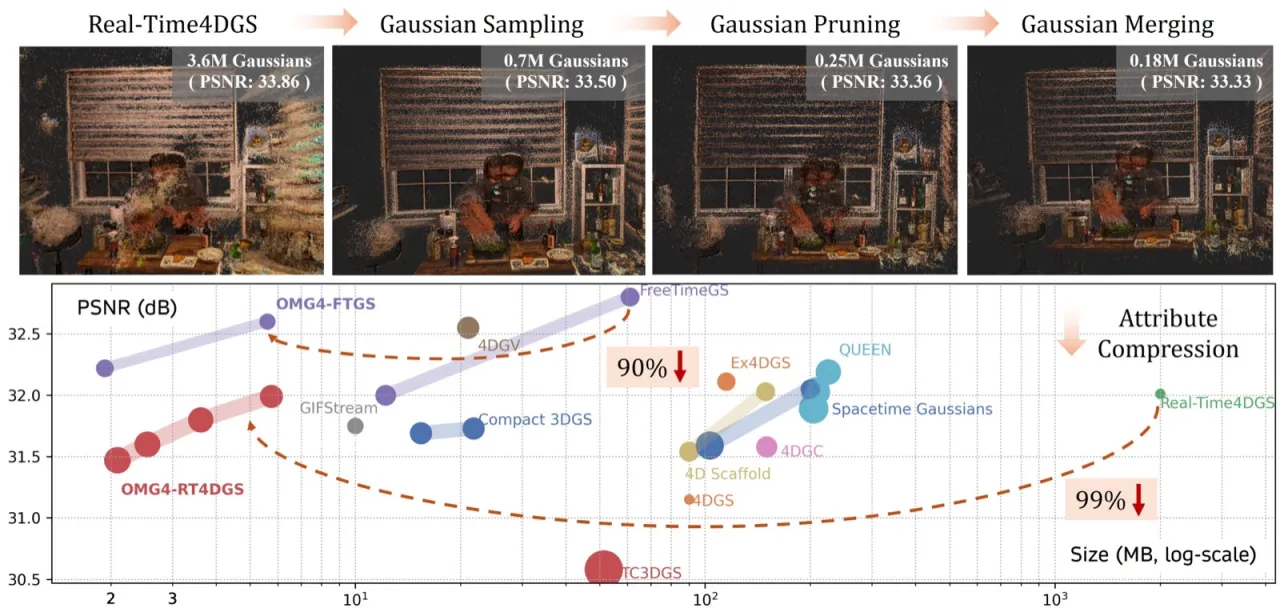
4D Gaussian Splatting 能够实时渲染复杂的动态场景,但其模型体积极为庞大——以 Real-Time4DGS 为例,单条序列的存储占用高达 2 GB 以上,严重制约了在移动端、VR/AR 及带宽受限场景下的实际部署。现有 4D 压缩方案(如 GIFStream)虽有所改善,但仍需 10 MB 量级,且在质量与体积之间难以兼顾。4D Gaussian Splatting can render complex dynamic scenes in real time, but its models are extremely large: for Real-Time4DGS, a single sequence takes more than 2 GB of storage, which severely limits practical deployment on mobile devices, in VR/AR and under bandwidth constraints. Existing 4D compression schemes such as GIFStream improve on this but still require storage on the order of 10 MB, and struggle to balance quality against size.
"OMG4 significantly outperforms recent state-of-the-art methods, reducing model sizes by over 60% while maintaining reconstruction quality."
图 1:OMG4 总体管线与 Rate-Distortion 曲线。左侧展示四阶段压缩流程;右侧曲线显示 OMG4 在 N3DV 数据集上以更低存储占用实现了与最近最优方法相当甚至更好的 PSNR,尤其在极低码率(<5 MB)区间优势显著。Figure 1: Overall OMG4 pipeline and rate-distortion curves. The left side shows the four-stage compression pipeline; the curves on the right show that OMG4 attains PSNR comparable to or better than the most recent state-of-the-art methods at lower storage on the N3DV dataset, with a particularly clear advantage in the extremely low-rate (<5 MB) regime.
~580×相对 Real-Time4DGS 的存储压缩比(2087 MB → 3.61 MB)Storage compression ratio relative to Real-Time4DGS (2087 MB → 3.61 MB)
31.80 dBOMG4-M 在 N3DV 上的 PSNR(GIFStream 为 31.75 dB)PSNR of OMG4-M on N3DV (GIFStream: 31.75 dB)
246 FPSOMG4-M 在 N3DV(1352×1014)上的实时渲染速度Real-time rendering speed of OMG4-M on N3DV (1352×1014)
02方法Method
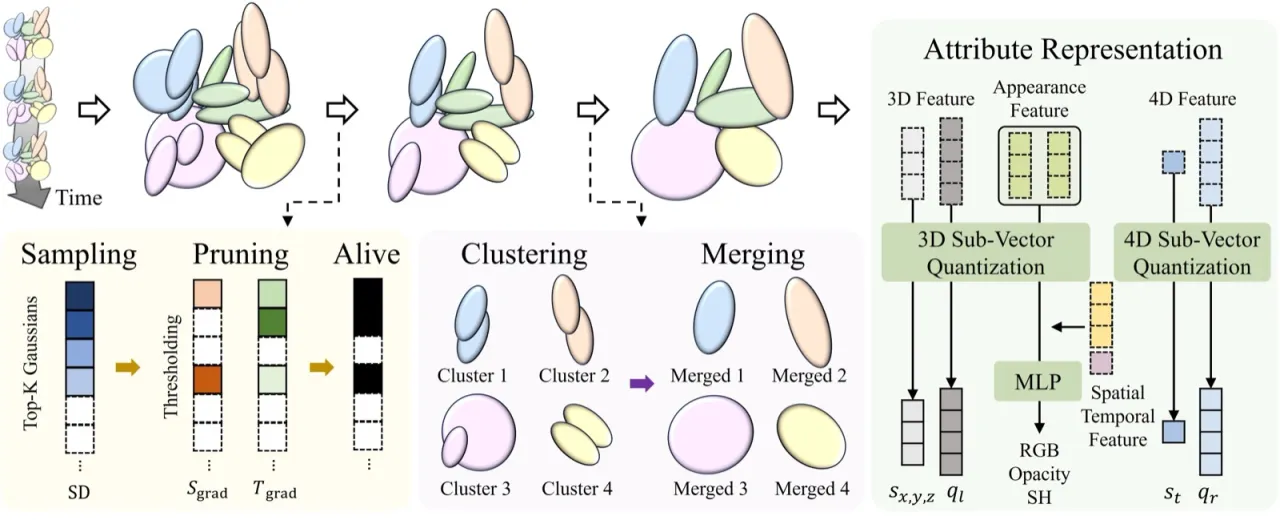
OMG4 采用四阶段渐进压缩流程:首先通过 SD-Score 筛选关键 Gaussian(Sampling),再剔除冗余点(Pruning),随后合并相似点(Merging),最后对属性进行量化编码(Attribute Compression)。每个阶段之间均插入优化步骤,确保损失信息的充分恢复。OMG4 adopts a four-stage progressive compression pipeline: key Gaussians are first selected by SD-Score (Sampling), redundant points are then removed (Pruning), similar points are merged (Merging), and finally the attributes are quantized and encoded (Attribute Compression). An optimization step is inserted between every pair of stages to fully recover the information that was lost.
图 2:OMG4 整体架构。从左至右依次为 Gaussian Sampling(SD-Score 评分与保留 top-20% Gaussian)、Gaussian Pruning(双阈值剔除低分点)、Gaussian Merging(时空聚类与融合)以及 Attribute Compression(4D Sub-Vector Quantization + MLP 外观建模)。各阶段间均有微调优化。Figure 2: Overall OMG4 architecture. From left to right: Gaussian Sampling (SD-Score ranking that keeps the top-20% Gaussians), Gaussian Pruning (dual-threshold removal of low-score points), Gaussian Merging (spatio-temporal clustering and fusion), and Attribute Compression (4D Sub-Vector Quantization + MLP appearance modeling). Every stage is followed by fine-tuning.
Static Score(S_grad):衡量 Gaussian 在多个时刻下的空间渲染灵敏度,在稀疏静态区域得分更高。Static Score (S_grad): measures the spatial rendering sensitivity of a Gaussian across multiple time steps, and is higher in sparse static regions.
Dynamic Score(T_grad):衡量对时间梯度的敏感程度,捕捉动态运动的重要性。Dynamic Score (T_grad): measures sensitivity to the temporal gradient, capturing the importance of dynamic motion.
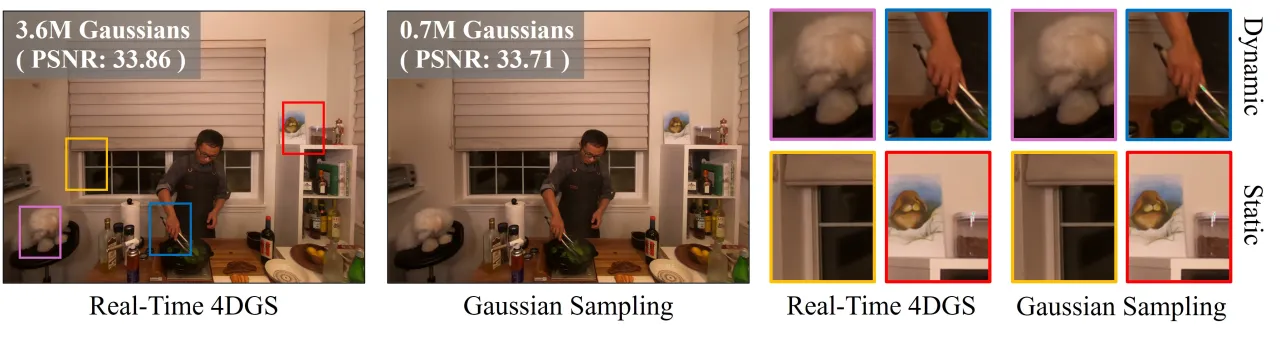
综合分数 SD(i) = S_grad(i) · T_grad(i),仅保留约 20% 的原始 Gaussian 用于后续处理。The combined score is SD(i) = S_grad(i) · T_grad(i), and only about 20% of the original Gaussians are kept for the subsequent stages.
图 3:Gaussian Sampling 效果对比。SD-Score 能够同时保留静态背景中的关键结构点与动态前景中的运动敏感点,相比仅使用静态或动态单维度评分,采样质量更高。Figure 3: Effect of Gaussian Sampling. SD-Score simultaneously keeps the key structural points of the static background and the motion-sensitive points of the dynamic foreground, giving higher sampling quality than a static-only or dynamic-only score.
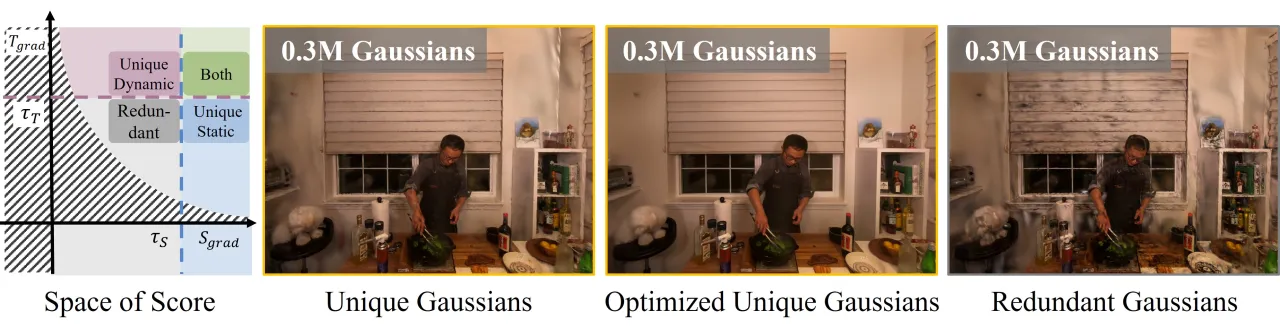
在采样子集上进行进一步精简:对 S_grad 和 T_grad 同时设置 p-分位数阈值 τ_S 和 τ_T,保留满足"至少一个维度高于阈值"条件的 Gaussian:The sampled subset is slimmed down further: p-quantile thresholds τ_S and τ_T are set on S_grad and T_grad at the same time, and the Gaussians kept are those that exceed the threshold in at least one dimension: P_GP = {G_i ∈ P_GS | (S_grad(i) ≥ τ_S) ∨ (T_grad(i) ≥ τ_T)} 这一"OR"逻辑确保静态或动态显著的 Gaussian 均不被误剪。This OR logic ensures that Gaussians which are salient in either the static or the dynamic dimension are never pruned by mistake.
图 4:Gaussian Pruning 可视化。双阈值策略有效去除了两个维度均不显著的冗余 Gaussian,在大幅减少点数的同时保持了关键结构的完整性。Figure 4: Visualization of Gaussian Pruning. The dual-threshold strategy effectively removes redundant Gaussians that are insignificant in both dimensions, greatly reducing the number of points while keeping key structures intact.
Gaussian Merging(时空聚类与融合)Gaussian Merging (spatio-temporal clustering and fusion)
对剩余 Gaussian 在时空网格中进行聚类,利用空间邻近性与外观相似性计算相似分数,将相似度高的点通过可学习的权重进行融合。该过程以渐进方式重复(网格尺寸递增),逐步减少 Gaussian 总数。The remaining Gaussians are clustered on a spatio-temporal grid; a similarity score is computed from spatial proximity and appearance similarity, and highly similar points are fused with learnable weights. The procedure is repeated progressively (with increasing grid size), gradually reducing the total number of Gaussians.
Attribute Compression(4D Sub-Vector Quantization)
将 OMG(3D GS 压缩方法)中的 Sub-Vector Quantization(SVQ)扩展至 4D:采用 MLP 对时间条件下的外观与不透明度进行隐式建模,属性向量被切分为多个子向量分别量化;压缩分两阶段进行(先 3D 属性,再 4D 属性),确保优化稳定性。The Sub-Vector Quantization (SVQ) of OMG, a 3D GS compression method, is extended to 4D: an MLP implicitly models time-conditioned appearance and opacity, and each attribute vector is split into several sub-vectors that are quantized separately. Compression proceeds in two phases (3D attributes first, then 4D attributes) to keep the optimization stable.
03实验Experiments
在 N3DV(Neural 3D Video,多视角动态场景)和 MPEG(Bartender,复杂运动场景)两个标准数据集上与当前最优方法进行对比。指标包括 PSNR、SSIM、LPIPS 和存储大小(MB)。Comparisons against current state-of-the-art methods are carried out on two standard datasets: N3DV (Neural 3D Video, multi-view dynamic scenes) and MPEG (Bartender, complex motion). Metrics include PSNR, SSIM, LPIPS and storage size (MB).
N3DV 数据集(1352×1014 分辨率)主要对比Main comparison on the N3DV dataset (1352×1014 resolution)
FreeTimeGS 泛化性验证Generalization check on FreeTimeGS
配置Configuration
PSNR (dB) ↑
SSIM ↑
LPIPS ↓
存储 (MB) ↓Size (MB) ↓
FTGS-L(原始)FTGS-L (original)
32.80
0.9579
0.0398
61.04
OMG4 (FTGS-L)
32.62
0.9562
0.0411
5.60
OMG4 (FTGS-S)
32.22
0.9516
0.0491
1.92
OMG4 应用于 FreeTimeGS 后,存储从 61.04 MB 降至 5.60 MB,实现约 90% 的压缩率,验证了方法的泛化能力。Applying OMG4 to FreeTimeGS reduces storage from 61.04 MB to 5.60 MB, an about 90% compression rate, which confirms that the method generalizes.
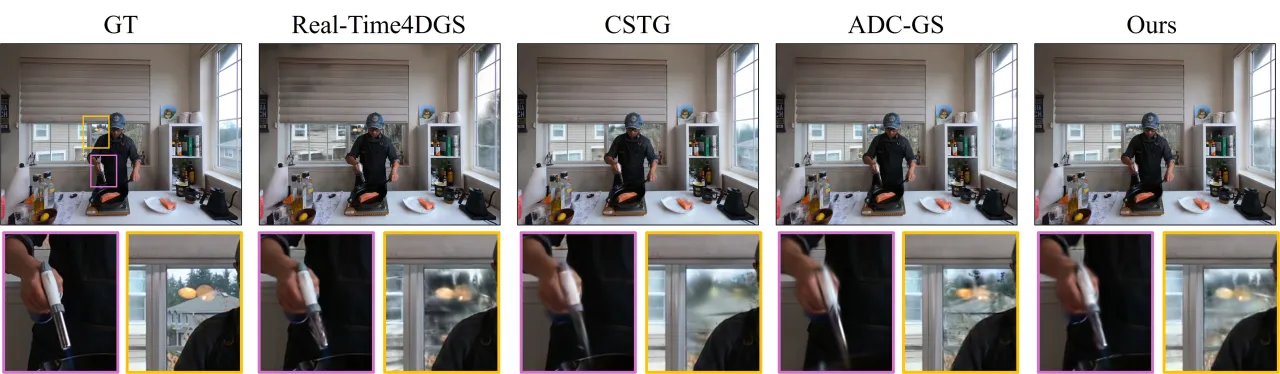
图 5:N3DV 数据集定性对比。OMG4-M 在极低存储(3.61 MB)下,视觉效果与未压缩的 Real-Time4DGS(2087 MB)高度相似,细节纹理和运动边缘均得到良好保留。Figure 5: Qualitative comparison on the N3DV dataset. At extremely low storage (3.61 MB), OMG4-M is visually very close to the uncompressed Real-Time4DGS (2087 MB), and fine textures as well as motion edges are well preserved.
消融实验(Ablation Study)Ablation Study
在 N3DV 数据集上逐步添加各组件的对比结果如下:Results of progressively adding each component on the N3DV dataset are as follows:
配置Configuration
PSNR (dB) ↑
SSIM ↑
LPIPS ↓
Gaussian 数量Number of Gaussians
存储 (MB) ↓Size (MB) ↓
Baseline(仅 GS)Baseline (GS only)
32.07
0.9454
0.0518
679,502
13.26
GS + GP
31.89
0.9429
0.0559
235,027
4.83
GS + GP + GM
31.68
0.9407
0.0606
171,214
3.61
GS + GP + GM + AC(完整)GS + GP + GM + AC (full)
31.80
0.9414
0.0594
171,136
3.61
属性压缩(AC)在不增加存储的前提下,将 PSNR 从 31.68 dB 提升至 31.80 dB(+0.12 dB),验证了 MLP 隐式外观建模的有效性。同时,Sampling 与 Pruning 的分离设计(而非联合优化)是取得最佳结果的关键。Attribute compression (AC) raises PSNR from 31.68 dB to 31.80 dB (+0.12 dB) without increasing storage, confirming the effectiveness of the implicit MLP appearance model. Keeping Sampling and Pruning as separate designs, rather than optimizing them jointly, is also key to obtaining the best results.
04局限性Limitations
说明:原文没有单独的 Limitations 章节。以下各条均为从论文设计与实验现象中 推断(inferred) 得出,并非作者明确表述。Note: the paper has no separate Limitations section. All points below are inferred from its design and experimental observations, and are not stated explicitly by the authors.
与顶线方法仍存在质量差距(推断)A quality gap to the top-line method remains (inferred)
OMG4-M 在 N3DV(1352×1014)上的 PSNR 为 31.80 dB,略低于未压缩基线 Real-Time4DGS 的 31.96 dB(-0.16 dB),SSIM 从 0.946 下降至 0.941,LPIPS 从 0.051 上升至 0.059。在对视觉保真度要求极高的应用场景中,这一差距可能不可忽视。OMG4-M reaches a PSNR of 31.80 dB on N3DV (1352×1014), slightly below the 31.96 dB of the uncompressed Real-Time4DGS baseline (-0.16 dB); SSIM drops from 0.946 to 0.941 and LPIPS rises from 0.051 to 0.059. In applications with very high demands on visual fidelity this gap may not be negligible.
训练流程复杂,多阶段优化成本较高(推断)Complex training pipeline with costly multi-stage optimization (inferred)
OMG4 包含四个串行压缩阶段,且每个阶段之间均需额外的微调优化。相较于端到端方法,整体训练时间和超参数调优复杂度较高,在实际工程应用中可能增加部署难度。OMG4 contains four sequential compression stages, and additional fine-tuning is required between every pair of stages. Compared with end-to-end methods, the overall training time and the complexity of hyper-parameter tuning are higher, which may make deployment in real engineering settings harder.
仅在特定 4D GS 基线(Real-Time4DGS)上系统评估(推断)Systematically evaluated only on one specific 4D GS baseline (Real-Time4DGS) (inferred)
大部分核心实验以 Real-Time4DGS 为压缩对象。FreeTimeGS 的泛化实验虽有涉及,但未对更多 4D GS 变体(如基于变形场的方法)进行系统性评估,方法的普适性有待进一步验证。Most of the core experiments compress Real-Time4DGS. Generalization experiments on FreeTimeGS are included, but further 4D GS variants (such as deformation-field-based methods) are not systematically evaluated, so the generality of the method awaits further verification.
极端压缩档位(OMG4-T)质量下降明显(推断)Clear quality drop at the most extreme compression setting (OMG4-T) (inferred)
最小配置 OMG4-T 在 N3DV(1352×1014)上 PSNR 降至 31.47 dB,存储仅 2.09 MB。虽实现了更高压缩比,但质量下降已较为明显,极低码率场景的率失真性能有进一步优化空间。The smallest configuration, OMG4-T, drops to a PSNR of 31.47 dB on N3DV (1352×1014) with only 2.09 MB of storage. It reaches a higher compression ratio, but the quality loss is already fairly noticeable, leaving room to improve rate-distortion performance in extremely low-rate settings.