← 论文海报合集← Paper Notes|
理论与优化 · World Models  ·  arXiv 2026Theory & Optimization · World Models  ·  arXiv 2026

Looped World Models (LoopWM)

Stable Parameter-Shared Recurrent Transformer for Long-Horizon World Modeling
Hongyuan Adam Lu*、Z.L. Victor Wei* 等 31 位作者    FaceMind Research AsiaHongyuan Adam Lu*, Z.L. Victor Wei* and 31 authors in total    FaceMind Research Asia

LoopWM 是首个将 looped transformer(跨层共享参数的循环式架构)用于世界模型的工作。它把单步状态转移建模为对一个共享 transformer block 的 T 次迭代刷新,并通过谱范数约束保证隐状态更新可证明稳定;配合训练时的随机深度采样与推理时的自适应早退(adaptive early exit),使计算深度按转移复杂度自动伸缩。论文提出迭代隐层深度(iterative latent depth)是与模型规模、数据量正交的第三条世界模型 scaling 轴。LoopWM is the first work to bring the looped transformer (a recurrent architecture that shares parameters across layers) to world models. It casts a single-step state transition as T iterative refreshes of one shared transformer block, and a spectral-norm constraint makes the hidden-state update provably stable; together with stochastic depth sampling at training time and adaptive early exit at inference time, the computational depth scales automatically with the complexity of the transition. The paper proposes iterative latent depth as a third scaling axis for world models, orthogonal to model size and data volume.

~1B 参数~1B parameters ScienceWorld / AlfWorld 文本世界建模任务ScienceWorld / AlfWorld text-based world-modelling tasks 最高 100× 参数效率Up to 100× parameter efficiency 📄 arXiv:2606.18208 论文原文 / PaperOriginal paper / Paper
looped transformer world model parameter sharing adaptive computation spectral stability deferred decoding ScienceWorld AlfWorld recurrent depth

01 动机Motivation

世界模型(world model)要做忠实的长时程模拟,往往需要很深的计算;但更深的模型部署代价高,且容易在长 rollout 中出现误差累积。论文认为,物理动力学本身就是"同一条(近似)稳定规律的反复施加",这与 looped transformer(跨层共享参数、循环施加同一个 block)的计算图天然同构——但此前所有 looped 架构工作都只在语言建模场景中验证过。For a world model to deliver faithful long-horizon simulation it usually needs very deep computation; but deeper models are costly to deploy and prone to compounding error over long rollouts. The paper argues that physical dynamics is itself "the repeated application of one and the same (approximately) stable law", which is naturally isomorphic to the computation graph of a looped transformer (parameters shared across layers, the same block applied over and over) — yet all prior looped-architecture work had been validated only in language modelling.

"Current world models face a fundamental tension: faithful long-horizon simulation demands deep computation, but deeper models are expensive to deploy and prone to compounding errors... However, all of the above looped-architecture works have been developed and evaluated exclusively in the context of language modelling. Looped World Models (LoopWM) remain entirely unexplored."
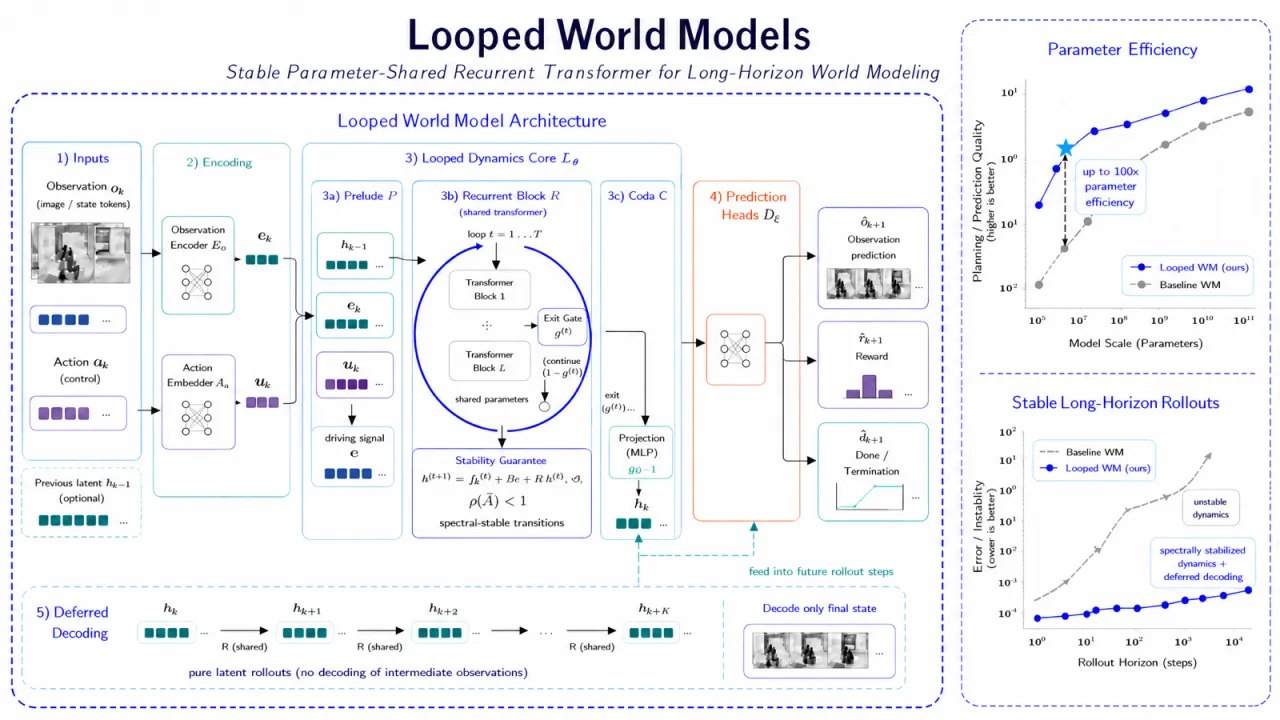
LoopWM overall framework
图 1:LoopWM 整体框架(论文原图,标题为 "The overall framework of our proposed Looped World Models (LoopWM)")。 左侧为架构总览:输入编码 → Prelude → 共享参数的 Recurrent Block(内层循环 T 次,附带 Exit Gate)→ Coda → 预测头,底部展示 Deferred Decoding 的跨步纯隐空间 rollout。右侧两幅示意图为论文用来说明设计动机的概念性插图——"Parameter Efficiency"(同等预测质量下参数量远低于基线)与"Stable Long-Horizon Rollouts"(误差随 rollout 步数增长更慢),并非独立的实测结果图表。Figure 1: the overall framework of LoopWM (original figure from the paper, captioned "The overall framework of our proposed Looped World Models (LoopWM)"). On the left is the architecture overview: input encoding → Prelude → the parameter-shared Recurrent Block (looped T times internally, with an Exit Gate) → Coda → prediction heads, with the cross-step, purely latent rollout of Deferred Decoding shown at the bottom. The two panels on the right are conceptual illustrations the paper uses to convey its design motivation — "Parameter Efficiency" (far fewer parameters than the baselines at comparable prediction quality) and "Stable Long-Horizon Rollouts" (error grows more slowly with the number of rollout steps); they are not standalone measured-result charts.
100×论文摘要给出的最高参数效率提升("up to 100× parameter efficiency")Highest parameter-efficiency gain stated in the paper's abstract ("up to 100× parameter efficiency")
~1BLoopWM 参数量LoopWM parameter count
68.4%ScienceWorld world-modelling 任务 Overall EM(本文模型)Overall EM on the ScienceWorld world-modelling task (this paper's model)
T·KDeferred Decoding 下"内层迭代 × 外层动作步"的嵌套循环有效深度Effective depth of the nested loop under Deferred Decoding: "inner iterations × outer action steps"

02 方法Method

LoopWM 由四个模块组成:观测编码器 $\mathcal{E}_\phi$、动作嵌入器 $\mathcal{A}_\psi$、作为核心贡献的循环动力学核(Looped Dynamics Core) $\mathcal{L}_\theta$,以及轻量预测头 $\mathcal{D}_\xi$(解码观测重建、奖励、终止信号)。整个前向过程为 $e_k=\mathcal{E}_\phi(o_k),\ u_k=\mathcal{A}_\psi(a_k),\ h_k=\mathcal{L}_\theta(h_{k-1},e_k,u_k),\ (\hat o_{k+1},\hat r_k,\hat c_k)=\mathcal{D}_\xi(h_k)$。LoopWM comprises four modules: the observation encoder $\mathcal{E}_\phi$, the action embedder $\mathcal{A}_\psi$, the Looped Dynamics Core $\mathcal{L}_\theta$ that constitutes the core contribution, and a lightweight prediction head $\mathcal{D}_\xi$ (decoding observation reconstruction, reward and termination signals). The whole forward pass is $e_k=\mathcal{E}_\phi(o_k),\ u_k=\mathcal{A}_\psi(a_k),\ h_k=\mathcal{L}_\theta(h_{k-1},e_k,u_k),\ (\hat o_{k+1},\hat r_k,\hat c_k)=\mathcal{D}_\xi(h_k)$.

循环动力学核:Prelude → 共享 Recurrent Block → CodaLooped Dynamics Core: Prelude → shared Recurrent Block → Coda

核心把动力学核拆成三段:Prelude(少量层,融合 $[h_{k-1};e_k;u_k]$ 并做 LayerNorm 得到条件信号 $e$);Recurrent Block(参数共享的一叠 transformer 层,循环 $T$ 次,更新规则为 $h^{(t+1)}=\bar A h^{(t)}+\bar B e+\bar{\mathcal{R}}(h^{(t)},e)$,其中 $\bar{\mathcal{R}}$ 是 transformer 的非线性部分);Coda(独立参数的收尾层,将终态 $h^{(T)}$ 投影为下一步的隐状态 $h_k$)。关键点是"$\mathcal{R}$ 的参数在全部 $T$ 次迭代间共享",因此计算深度与参数量解耦。终态 $h^{(T)}$ 还可以作为下一环境步的初始隐状态 $h^{(0)}$,形成"内层迭代 refine 单步转移、外层跨时间步传播"的双层循环结构。The core splits the dynamics core into three stages: Prelude (a few layers that fuse $[h_{k-1};e_k;u_k]$ and apply LayerNorm to obtain the conditioning signal $e$); Recurrent Block (a parameter-shared stack of transformer layers, looped $T$ times, with update rule $h^{(t+1)}=\bar A h^{(t)}+\bar B e+\bar{\mathcal{R}}(h^{(t)},e)$, where $\bar{\mathcal{R}}$ is the nonlinear part of the transformer); Coda (a closing layer with its own parameters that projects the final state $h^{(T)}$ into the next-step hidden state $h_k$). The key point is that "the parameters of $\mathcal{R}$ are shared across all $T$ iterations", so computational depth is decoupled from parameter count. The final state $h^{(T)}$ can further serve as the initial hidden state $h^{(0)}$ of the next environment step, forming a two-level loop in which the inner iterations refine a single-step transition while the outer loop propagates across time steps.

谱稳定性约束(Spectral Stability Constraint)Spectral Stability Constraint

为保证隐状态不随循环次数 $T$ 增大而爆炸,作者把状态保留矩阵 $\bar A$ 参数化为连续时间负对角矩阵的离散化:$A:=\mathrm{diag}(-\exp(\mathbf a))$,再零阶保持离散化 $\bar A=\exp(\Delta A)$。因为 $A$ 的对角元恒为负,指数映射后 $\bar A$ 的所有特征值都落在 $(0,1)$ 区间,"guaranteeing $\rho(\bar A) < 1$... This constraint holds by construction throughout training; no gradient clipping, post-hoc normalisation, or sensitive hyperparameter tuning is required."To keep the hidden state from blowing up as the number of loops $T$ grows, the authors parameterise the state-retention matrix $\bar A$ as the discretisation of a continuous-time negative diagonal matrix, $A:=\mathrm{diag}(-\exp(\mathbf a))$, followed by zero-order-hold discretisation $\bar A=\exp(\Delta A)$. Because the diagonal entries of $A$ are always negative, after the exponential map every eigenvalue of $\bar A$ falls in the interval $(0,1)$, "guaranteeing $\rho(\bar A) < 1$... This constraint holds by construction throughout training; no gradient clipping, post-hoc normalisation, or sensitive hyperparameter tuning is required."

训练目标:随机深度 + 熵正则Training objective: stochastic depth + entropy regularisation

训练时每个样本独立地从 $T\sim\mathrm{Poisson}(\mu_{\mathrm{rec}})$ 采样循环次数(而非按 micro-batch 采样,作者称这能"reduces variance in the training objective and empirically eliminates most loss spikes"),总损失为观测/奖励/终止预测损失之和;若启用自适应早退,再加一个熵正则项防止退出门坍缩到"总在第一次退出"或"永不退出"两个极端。反向传播只回传到 $\mu_{\mathrm{bwd}}=\lceil\mu_{\mathrm{rec}}/2\rceil$ 步以控制显存。During training each sample independently draws its loop count from $T\sim\mathrm{Poisson}(\mu_{\mathrm{rec}})$ (rather than sampling per micro-batch; the authors say this "reduces variance in the training objective and empirically eliminates most loss spikes"), and the total loss is the sum of the observation, reward and termination prediction losses; when adaptive early exit is enabled, an entropy regularisation term is added to stop the exit gate collapsing to either extreme of "always exiting on the first iteration" or "never exiting". Backpropagation is carried back only $\mu_{\mathrm{bwd}}=\lceil\mu_{\mathrm{rec}}/2\rceil$ steps in order to bound memory.

推理时自适应早退(Adaptive Early Exit)Adaptive Early Exit at inference time

推理阶段用一个单层 MLP + sigmoid 的退出门 $g^{(t)}=\sigma(\mathbf w_g^\top h^{(t)}+b_g)$,一旦 $g^{(t)}$ 超过阈值 $\tau$ 就提前终止内层循环。论文给出一个量级估计:对 100 层的定深基线,简单的自由飞行片段若 LoopWM 只需 1 次循环(如 4 层)即可退出,"reducing inference FLOPs by a factor of ∼25× for that step";把简单/复杂转移混合在一条长 rollout 里,"the aggregate FLOPs reduction can reach up to two orders of magnitude"。推理时的最大循环数 $T_{\max}$ 还可以超过训练时的均值 $\mu_{\mathrm{rec}}$,从而支持 test-time compute scaling。At inference an exit gate made of a single-layer MLP plus sigmoid, $g^{(t)}=\sigma(\mathbf w_g^\top h^{(t)}+b_g)$, terminates the inner loop early as soon as $g^{(t)}$ exceeds the threshold $\tau$. The paper offers an order-of-magnitude estimate: against a fixed-depth baseline of 100 layers, if LoopWM can exit on an easy free-flight segment after only 1 loop (say 4 layers), this is "reducing inference FLOPs by a factor of ∼25× for that step"; mixing easy and hard transitions along one long rollout, "the aggregate FLOPs reduction can reach up to two orders of magnitude". The maximum loop count $T_{\max}$ at inference may also exceed the training-time mean $\mu_{\mathrm{rec}}$, which is what enables test-time compute scaling.

Deferred Decoding:只在终点解码Deferred Decoding: decode only at the end point

标准世界模型在每个环境步都调用一次预测头。LoopWM 提出"encode, think, then decode"式的 Deferred Decoding:给定 $K$ 步动作序列,模型只在隐空间里连续推进 $K$ 次(每步内部仍是 $T$ 次内层循环),中间不产生任何观测/奖励/终止预测,只在第 $K$ 步才调用一次解码器。训练上用终态预测损失 + 隐一致性正则(用冻结编码器对中间真实观测编码作为软监督目标)+ 谱收缩预算(限制 $\sum_k\|h_{k+1}-h_k\|_2$ 的累计量),并配合"K 从 1 逐步增大"的课程学习,因为直接用大 $K$ 训练要反传 $K\times T$ 次共享参数应用,容易不稳定。规划模式下,一次 decode-free rollout 只需调用解码器 1 次而不是 $K$ 次,"saving approximately $(K-1)\times\text{cost}(\mathcal{D}_\xi)$ FLOPs per candidate sequence"。A standard world model calls the prediction head at every environment step. LoopWM proposes an "encode, think, then decode" style of Deferred Decoding: given a $K$-step action sequence, the model advances $K$ times consecutively inside the latent space (each step still running $T$ inner loops), produces no observation, reward or termination prediction in between, and calls the decoder only once, at step $K$. Training uses a terminal-state prediction loss + a latent consistency regulariser (a frozen encoder encodes the intermediate ground-truth observations as a soft supervision target) + a spectral contraction budget (bounding the cumulative $\sum_k\|h_{k+1}-h_k\|_2$), together with a curriculum that grows $K$ from 1 upwards, because training directly with a large $K$ means backpropagating through $K\times T$ applications of the shared parameters and is prone to instability. In planning mode, one decode-free rollout calls the decoder once rather than $K$ times, "saving approximately $(K-1)\times\text{cost}(\mathcal{D}_\xi)$ FLOPs per candidate sequence".
03 实验Experiments

论文在两个文本化的具身环境世界建模任务上评测:ScienceWorld(连续喂入 5 个动作,预测世界建模结果)和 AlfWorld(同样的 5-动作 world-modelling 设定)。对比对象是三个闭源/开源 LLM 基线:claude-opus-4-6-max、qwen-3.5-flash、gemini-3-flash-preview-thinking;指标为 EM(exact match)、Token F1、BLEU-4、Entity F1。LoopWM 本身约 1B 参数,比这些闭源 API 模型"more than 100x"小。The paper evaluates on two textual embodied-environment world-modelling tasks: ScienceWorld (5 actions fed in consecutively, predicting the world-modelling outcome) and AlfWorld (the same 5-action world-modelling setting). The comparisons are three closed-source / open-source LLM baselines: claude-opus-4-6-max, qwen-3.5-flash, gemini-3-flash-preview-thinking; the metrics are EM (exact match), Token F1, BLEU-4 and Entity F1. LoopWM itself has about 1B parameters, "more than 100x" smaller than these closed-source API models.

ScienceWorld:Overall 结果(Table 1 & 2,逐字摘录)ScienceWorld: overall results (Tables 1 & 2, quoted verbatim)

模型ModelEMToken F1BLEU-4Entity参数量Params
LoopWM(本文)LoopWM (ours)68.4%85.3%80.7%83.9%~1B
claude-opus-4-6-max47.2%72.8%64.4%72.3%闭源,远大于 1BClosed-source, far larger than 1B
gemini-3-flash-preview-thinking30.8%68.9%51.1%73.8%闭源Closed-source
qwen-3.5-flash10.0%46.9%26.7%63.0%闭源Closed-source

按任务细分(14 个 ScienceWorld 子任务),LoopWM 在 Lifespan 上从 claude-opus-4-6-max 的 0% EM 提升到 100% EM;论文原文:"it is clear that our model surpasses the strong claude-opus-4-6-max... On average, our model shows a promising capability, clearly surpassing the baseline by 21.2% on EM."Broken down by task (14 ScienceWorld subtasks), on Lifespan LoopWM lifts EM from claude-opus-4-6-max's 0% to 100%; from the paper: "it is clear that our model surpasses the strong claude-opus-4-6-max... On average, our model shows a promising capability, clearly surpassing the baseline by 21.2% on EM."

AlfWorld:Overall 结果(Table 3,逐字摘录)AlfWorld: overall results (Table 3, quoted verbatim)

模型ModelEMToken F1BLEU-4Entity
LoopWM(本文)LoopWM (ours)51.6%80.4%71.6%81.1%
claude-opus-4-6-max53.0%72.6%66.8%77.0%
gemini-3-flash-preview-thinking50.0%83.5%71.0%90.2%
qwen-3.5-flash26.0%67.3%47.7%88.4%

这是一处论文如实呈现的不利结果:在 AlfWorld 上 LoopWM 的 EM(51.6%)略低于 claude-opus-4-6-max(53.0%),Token F1 与 Entity 也都被 gemini-3-flash-preview-thinking 超过。论文原文承认:"our model seems to have low entity scores, and it seems valid for most action categories. Such an error analysis indicates that future optimization can focus on the entity scores to further enhance the model."(仅 BLEU-4 在四个模型中最优,EM/Token F1 排第二)。This is a place where the paper reports an unfavourable result faithfully: on AlfWorld LoopWM's EM (51.6%) is slightly below claude-opus-4-6-max (53.0%), and both Token F1 and Entity are overtaken by gemini-3-flash-preview-thinking. The paper admits: "our model seems to have low entity scores, and it seems valid for most action categories. Such an error analysis indicates that future optimization can focus on the entity scores to further enhance the model." (Only BLEU-4 is the best among the four models; EM and Token F1 rank second.)

消融:Deferred Decoding 的作用(附录 Table,ScienceWorld 平均,逐字摘录)Ablation: what Deferred Decoding contributes (appendix table, ScienceWorld average, quoted verbatim)

论文在附录中给出 LoopWM 自身随"延迟解码步数 Step"变化的绝对指标(Step = 单次 deferred rollout 覆盖的动作步数):In the appendix the paper reports LoopWM's own absolute metrics as the "number of deferred decoding steps, Step" varies (Step = the number of action steps covered by a single deferred rollout):

StepEMToken F1BLEU-4Entity
Step 167.2%78.0%72.3%77.9%
Step 268.6%86.2%80.9%86.4%
Step 368.0%87.5%82.0%87.1%
Step 468.4%87.1%82.1%85.6%
Step 568.4%85.3%80.7%83.9%

从 Step 1 到 Step 2/3,F1、BLEU-4、Entity 都明显上升,说明"多步隐空间推进再解码"确有增益;但增益在 Step 3-4 附近见顶,Step 5 时 F1/BLEU-4/Entity 反而略降——这一"边际收益递减甚至轻微回落"的趋势是论文表格自身呈现的,未在正文中被特别强调。From Step 1 to Step 2/3, F1, BLEU-4 and Entity all rise markedly, showing that "advancing several steps in latent space before decoding" does bring a gain; but the gain tops out around Step 3-4, and at Step 5 F1/BLEU-4/Entity slip back slightly instead — this pattern of "diminishing and even mildly negative marginal returns" is what the paper's own table shows, and is not specifically highlighted in the main text.

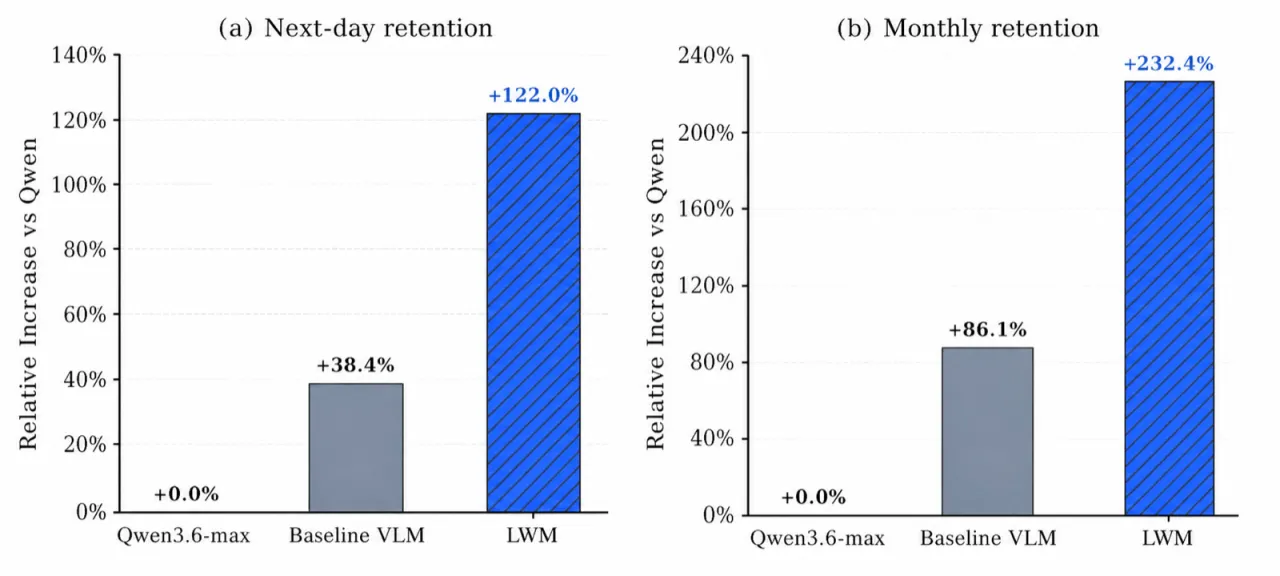
附加结果:论文附带的 "Danmaku" 产品化评测(与上述基准的关系未在正文说明)Additional results: the "Danmaku" productisation evaluation shipped with the paper (its relation to the benchmarks above is not explained in the main text)

Relative increase over Qwen3.6/3.7-max on retention metrics
图 2(论文原图,紧跟在结果章节之后)。 原图说明逐字摘录:"Relative increase over Qwen3.7-max on automatic online performance, compared against baselines. Note that the results are obtained via online estimation, with the tasks of danmaku generation. LWM denotes LoopWM." 图中显示 LWM 相对 Qwen3.6-max 的次日留存提升 +122.0%、月留存提升 +232.4%,均高于 "Baseline VLM"(+38.4% / +86.1%)。Figure 2 (original figure from the paper, immediately following the results section). The original caption, quoted verbatim: "Relative increase over Qwen3.7-max on automatic online performance, compared against baselines. Note that the results are obtained via online estimation, with the tasks of danmaku generation. LWM denotes LoopWM." The figure shows LWM improving next-day retention by +122.0% and monthly retention by +232.4% relative to Qwen3.6-max, both higher than "Baseline VLM" (+38.4% / +86.1%).
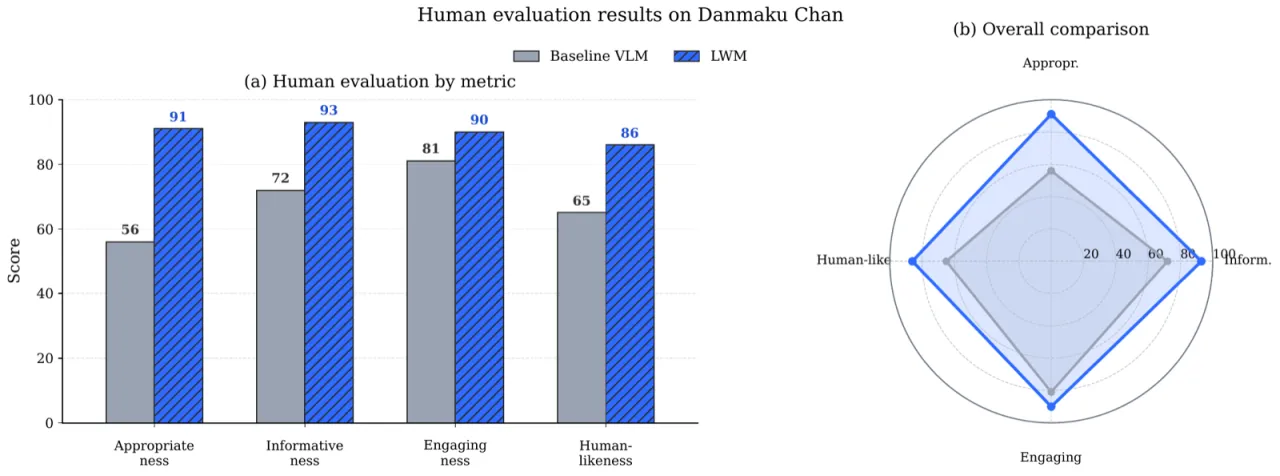
Human evaluation on Danmaku Chan
图 3(论文原图)。 标题为 "Human evaluation results on Danmaku Chan";LWM 在 Appropriateness / Informativeness / Engagingness / Human-likeness 四项人评指标上均高于 "Baseline VLM"(如 91 vs 56、93 vs 72)。Figure 3 (original figure from the paper). Its caption reads "Human evaluation results on Danmaku Chan"; LWM scores higher than "Baseline VLM" on all four human-evaluation metrics — Appropriateness / Informativeness / Engagingness / Human-likeness (e.g. 91 vs 56, 93 vs 72).
提示: 这两幅图及其说明文字("danmaku generation"、"Danmaku Chan"、对比对象为 "Qwen3.6/3.7-max" 与 "Baseline VLM")出现在论文的 Results 章节之后,但正文中关于 ScienceWorld / AlfWorld 的实验描述从未提及 danmaku(弹幕)生成任务或这两个基线名称——这是从论文源文件本身观察到的一处内容不一致,此处按论文原图与原文说明如实呈现,不代表本海报对其与主实验的关联做出任何推断。Note: These two figures and their caption text ("danmaku generation", "Danmaku Chan", with "Qwen3.6/3.7-max" and "Baseline VLM" as the comparison targets) appear after the Results section of the paper, yet the main text's description of the ScienceWorld / AlfWorld experiments never mentions a danmaku (bullet-comment) generation task or either of those baseline names — this is a content inconsistency observed in the paper's source files themselves. It is presented here faithfully, following the original figures and their captions, and does not imply any inference by this poster about how they relate to the main experiments.

04 局限性Limitations

说明: 论文没有单独的 "Limitations" 小节,但在 "Broader Impacts" 一节中作者明确以"披露范围有限(intentionally selective in disclosure scope)"为主线自陈局限——以下前四条均为论文原文陈述(stated);最后一条基于实验表格数据与论文源文件本身观察到的内容不一致,标注为推断(inferred)Note: The paper has no separate "Limitations" section, but in "Broader Impacts" the authors explicitly state their own limitations along the line of being "intentionally selective in disclosure scope" — the first four items below are all statements from the paper (stated); the last one rests on the experimental tables together with a content inconsistency observed in the paper's source files themselves, and is labelled (inferred).
披露范围有限,非详尽披露(stated)Disclosure scope is deliberately limited, not exhaustive (stated)

论文原文:"the current manuscript is intentionally selective in disclosure scope. In this version, our goal is to establish the core architectural thesis... rather than to exhaustively present every supporting result we have already obtained."From the paper: "the current manuscript is intentionally selective in disclosure scope. In this version, our goal is to establish the core architectural thesis... rather than to exhaustively present every supporting result we have already obtained."

连续视觉环境的验证尚未展开(stated)Validation in continuous visual environments is not yet laid out (stated)

作者称已在连续视觉环境中验证了优化可行性,但论文未充分展示:"we have also verified in continuous visual environments that optimization is feasible and that the training loss is consistently reducible... the manuscript does not yet fully expose the breadth of validation already completed."The authors state that they have already verified optimisation feasibility in continuous visual environments, but the paper does not show it fully: "we have also verified in continuous visual environments that optimization is feasible and that the training loss is consistently reducible... the manuscript does not yet fully expose the breadth of validation already completed."

缺少跨家族的系统定位分析(stated)No systematic positioning analysis across model families (stated)

论文承认尚未与 RSSM 类、自回归视频 token 类、diffusion 类世界模型做更明确的对比定位:"A more explicit positioning analysis would further sharpen this distinction... we see clear value in more directly situating LoopWM among these families."The paper concedes that it has not yet drawn a clearer comparative positioning against RSSM-style, autoregressive video-token and diffusion world models: "A more explicit positioning analysis would further sharpen this distinction... we see clear value in more directly situating LoopWM among these families."

缺少完整的 scaling law 刻画,训练依赖课程式技巧(stated)No complete scaling-law characterisation; training leans on curriculum-style tricks (stated)

论文原文:"the present paper stops short of providing a more complete scaling law characterization across broader task and compute ranges... training can benefit from curriculum like engineering strategies that progressively unlock the architecture's capability."From the paper: "the present paper stops short of providing a more complete scaling law characterization across broader task and compute ranges... training can benefit from curriculum like engineering strategies that progressively unlock the architecture's capability."

AlfWorld 上并非全面领先,且存在图文不一致(inferred)Not ahead across the board on AlfWorld, plus a figure-text inconsistency (inferred)

从 Table 3 的数字看,LoopWM 的 EM(51.6%)低于 claude-opus-4-6-max(53.0%),Token F1 与 Entity 均低于 gemini-3-flash-preview-thinking——论文正文也承认 entity 分数偏低,指出这是未来优化方向。此外,本海报在核对图片来源时发现:LaTeX 源码中的两幅图(图 2/3,标题涉及 "danmaku generation"、"Danmaku Chan"、"Qwen3.6/3.7-max")与正文描述的 ScienceWorld/AlfWorld 实验设定没有交叉引用或说明,这是从论文源文件观察到的内容不一致,供读者知悉,不构成对模型能力的额外结论。Judging from the numbers in Table 3, LoopWM's EM (51.6%) is below claude-opus-4-6-max (53.0%), and both Token F1 and Entity are below gemini-3-flash-preview-thinking — the main text likewise admits that the entity scores are on the low side and points to this as a direction for future optimisation. In addition, while checking the image sources this poster found that the two figures in the LaTeX source (Figures 2/3, whose captions involve "danmaku generation", "Danmaku Chan" and "Qwen3.6/3.7-max") carry no cross-reference to, or explanation of, the ScienceWorld/AlfWorld experimental setting described in the main text; this is a content inconsistency observed in the paper's source files, noted for the reader's awareness and not an additional conclusion about the model's capability.