← 论文海报合集← Paper Notes|
机器人 · Robotics · arXiv 2026Robotics · arXiv 2026

A Pragmatic VLA Foundation Model

LingBot-VLA:大规模真实数据驱动的双臂机器人 VLA 基础模型LingBot-VLA: a dual-arm robot VLA foundation model driven by large-scale real-world data
Wei Wu, Fan Lu, Yunnan Wang, Shuai Yang, Shi Liu, Fangjing Wang, Qian Zhu, He Sun, Yong Wang, Shuailei Ma, Yiyu Ren, Kejia Zhang, Hui Yu, Jingmei Zhao, Shuai Zhou, Zhenqi Qiu, Houlong Xiong, Ziyu Wang, Zechen Wang, Ran Cheng, Yong-Lu Li, Yongtao Huang, Xing Zhu, Yujun Shen, Kecheng Zheng

LingBot-VLA 在约 2 万小时来自 9 种双臂机器人配置的真实世界遥操作数据上预训练,采用 Mixture-of-Transformers 架构与 Flow Matching 动作预测,在 GM-100 百任务真实基准上以 17.30% SR / 35.41% PS 超越 π₀.₅,同时训练吞吐量提升 1.5–2.8 倍。LingBot-VLA is pre-trained on around 20000 hours of real-world teleoperation data from 9 dual-arm robot configurations. It adopts a Mixture-of-Transformers architecture with Flow Matching action prediction, and surpasses π₀.₅ on the GM-100 hundred-task real-world benchmark with 17.30% SR / 35.41% PS, while improving training throughput by 1.5–2.8 times.

双臂机器人 · 9 平台Dual-arm robots · 9 platforms ~20,000 小时真实数据~20,000 hours of real-world data GM-100 百任务基准GM-100 hundred-task benchmark 📄 arXiv:2601.18692 PDF
VLA vision-language-action 双臂机器人dual-arm robots imitation learning flow matching scaling law 基础模型foundation model 机器人操作robot manipulation Mixture-of-Transformers 数据扩展data scaling

01 动机Motivation

当前 VLA 模型面临两大核心挑战:数据规模不足训练效率低下。大多数方法仅在数千小时数据上训练,且缺乏能在海量数据上高效扩展的训练框架,难以验证真正意义上的 scaling law。LingBot-VLA 的目标是构建一个务实可用的 VLA 基础模型——覆盖 9 种真实双臂机器人、2 万小时遥操作数据,并在 100 项任务的标准化基准上与主流方法直接对比。Current VLA models face two core challenges: insufficient data scale and low training efficiency. Most methods are trained on only a few thousand hours of data and lack a training framework that scales efficiently to massive data, so a genuine scaling law is hard to verify. LingBot-VLA aims to build a pragmatic VLA foundation model — covering 9 real dual-arm robots and 20000 hours of teleoperation data, and compared directly with mainstream methods on a standardized benchmark of 100 tasks.

"We present LingBot-VLA, a vision-language-action system trained on around 20,000 hours of real-world data from 9 popular dual-arm robot configurations."
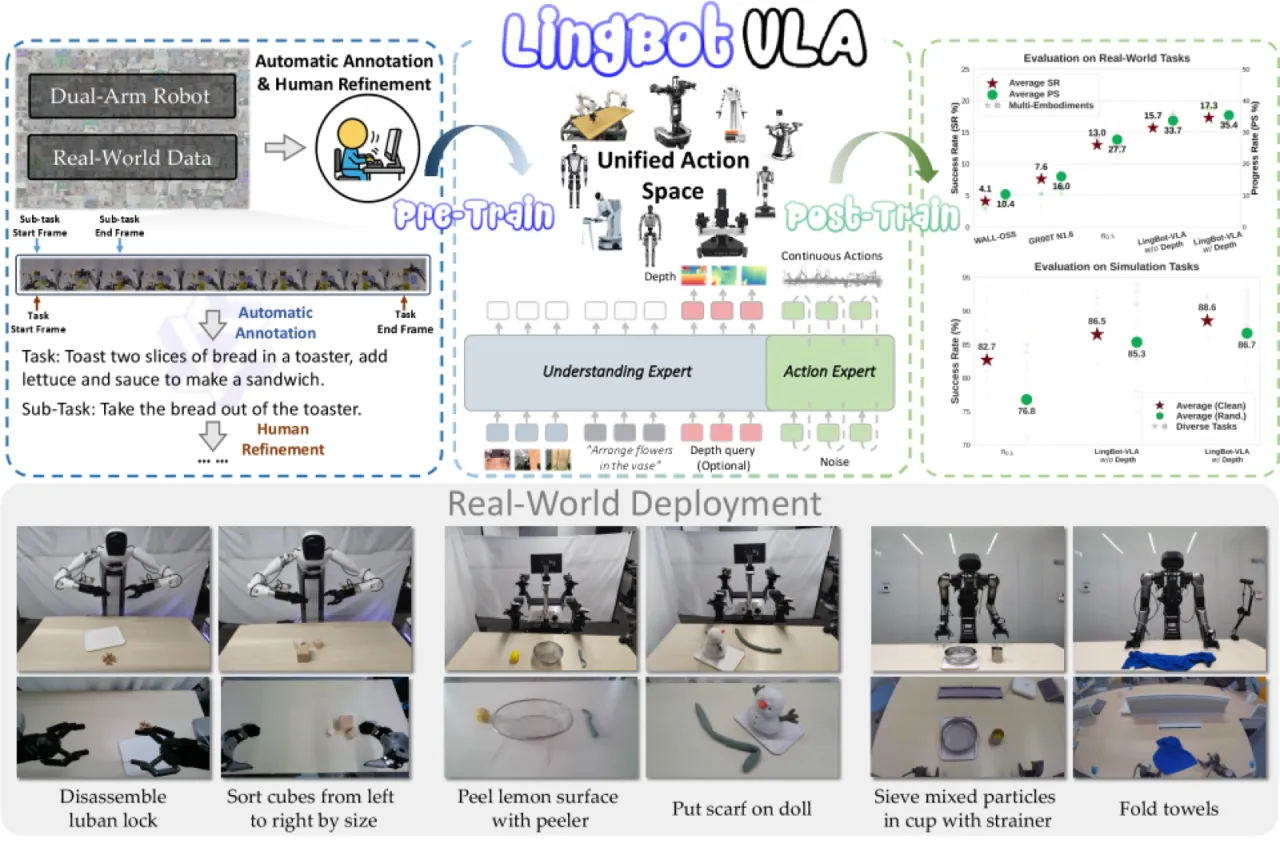
LingBot-VLA overview
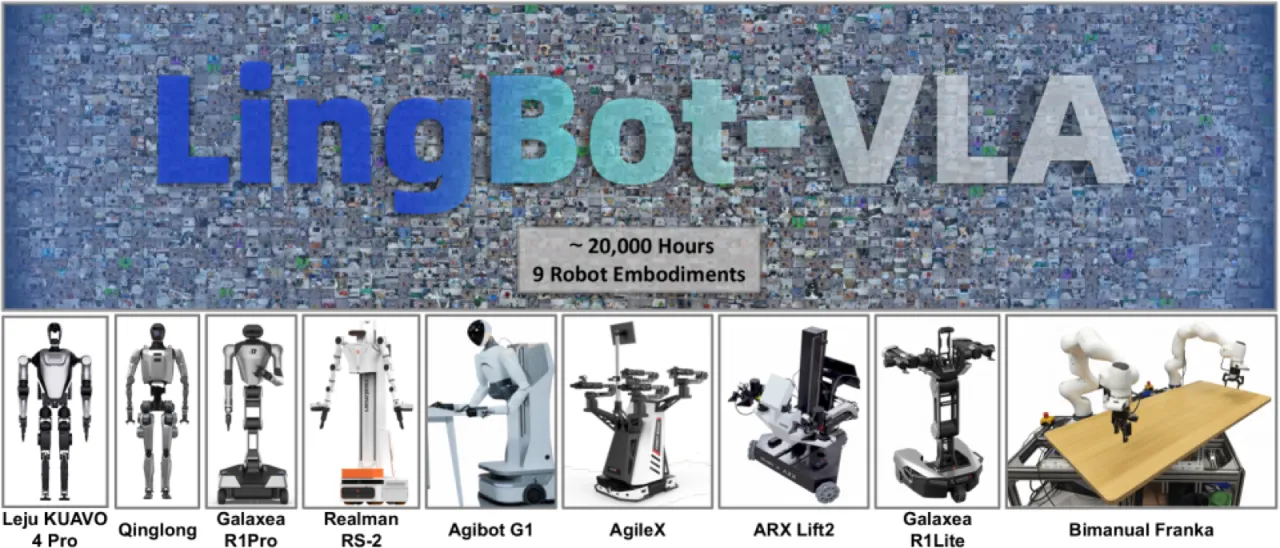
图1:LingBot-VLA 总览。左侧展示数据采集所用的 9 种双臂机器人平台(共约 2 万小时),中间为 Mixture-of-Transformers 模型架构,右侧为跨平台的 GM-100 百任务实体评测结果。Figure 1: Overview of LingBot-VLA. Left: the 9 dual-arm robot platforms used for data collection (around 20000 hours in total); middle: the Mixture-of-Transformers model architecture; right: cross-platform real-robot evaluation on the GM-100 hundred-task benchmark.
~20,000h真实遥操作预训练数据real teleoperation pre-training data
9种双臂机器人平台dual-arm robot platforms
+4.28%平均 SR 超越 π₀.₅(GM-100)average SR over π₀.₅ (GM-100)
261samples/s(8-GPU 训练吞吐)samples/s (8-GPU training throughput)
02 方法Method

LingBot-VLA 以 Qwen2.5-VL 为视觉语言骨干,引入独立的"action expert"模块,通过 Mixture-of-Transformers (MoT) 框架将视觉语言与动作两条通路解耦,再经共享 self-attention 机制耦合;动作输出采用 Flow Matching 预测 50-token 动作块;深度信息通过 vision distillation 蒸馏融入,进一步提升空间感知能力。LingBot-VLA takes Qwen2.5-VL as its vision-language backbone and introduces a separate "action expert" module. A Mixture-of-Transformers (MoT) framework decouples the vision-language and action pathways, which are then coupled through a shared self-attention mechanism; the action output uses Flow Matching to predict 50-token action chunks; depth information is fused in through vision distillation, further improving spatial perception.

Pre-training dataset visualization
图2:LingBot-VLA 预训练数据集可视化。9 种机器人平台的视觉观测示例,涵盖多样化的操作场景与任务类型;标注流程先由人工标注员将视频分解为原子动作,再由 Qwen3-VL-235B 自动生成语言指令。Figure 2: Visualization of the LingBot-VLA pre-training dataset. Visual observations from 9 robot platforms cover diverse manipulation scenes and task types; in the annotation pipeline, human annotators first decompose the videos into atomic actions, and Qwen3-VL-235B then generates the language instructions automatically.

Mixture-of-Transformers (MoT) 架构Mixture-of-Transformers (MoT) architecture

视觉语言路径与动作路径各自拥有独立的 Transformer 层(MLP、layer norm 等),通过 blockwise causal attention 实现模态间解耦:观测块与动作 token 分别处理,避免跨模态梯度干扰。共享的 self-attention 则保证两条路径能够互通信息,实现高效的跨模态对齐。输入观测包含三视角 RGB-D 图像、自然语言任务指令和机器人本体感知状态。The vision-language pathway and the action pathway each own separate Transformer layers (MLP, layer norm, etc.), and blockwise causal attention decouples the two modalities: observation blocks and action tokens are processed separately, avoiding cross-modal gradient interference. The shared self-attention still lets the two pathways exchange information, achieving efficient cross-modal alignment. The input observation contains three-view RGB-D images, a natural-language task instruction and the robot proprioceptive state.

Flow Matching 动作预测 + Vision DistillationFlow Matching action prediction + Vision Distillation

动作头采用 Flow Matching 对连续动作分布建模,每次预测 50-token 的动作序列块,支持快速推理。深度感知模块以可学习 query 与深度 token 对齐,并引入蒸馏损失(distillation loss)将专用深度模型的空间感知能力迁移至视觉骨干,无需推理时额外调用独立深度模型。训练效率优化包括:Fully Sharded Data Parallel (FSDP)、针对 action expert 的 shard 分组(减少通信开销)、bfloat16 存储 + float32 规约的混合精度策略、FlexAttention 稀疏多模态注意力,以及 torch.compile 算子融合——最终实现 GPU 数量从 8 到 256 的近线性吞吐扩展。The action head models the continuous action distribution with Flow Matching, predicting a 50-token action chunk at a time and supporting fast inference. The depth-perception module aligns learnable queries with depth tokens and adds a distillation loss that transfers the spatial perception of a dedicated depth model into the vision backbone, so no separate depth model has to be called at inference. Training-efficiency optimizations include Fully Sharded Data Parallel (FSDP), shard grouping for the action expert (reducing communication overhead), a mixed-precision strategy of bfloat16 storage plus float32 reduction, FlexAttention sparse multimodal attention, and torch.compile operator fusion — finally achieving near-linear throughput scaling from 8 to 256 GPUs.

03 实验Experiments

实验分为三部分:(1) GM-100 大规模真实世界基准——在 3 种机器人平台上各评测 100 项任务,指标为 Success Rate (SR) 和 Progress Score (PS);(2) RoboTwin 2.0 仿真基准——干净场景与随机化场景;(3) 训练吞吐量分析。基线方法包括 WALL-OSS、GR00T N1.6 和 π₀.₅。The experiments have three parts: (1) the GM-100 large-scale real-world benchmark, evaluating 100 tasks on each of 3 robot platforms, with Success Rate (SR) and Progress Score (PS) as metrics; (2) the RoboTwin 2.0 simulation benchmark, with clean and randomized scenes; (3) training-throughput analysis. The baselines include WALL-OSS, GR00T N1.6 and π₀.₅.

GM-100 真实世界基准(Table 1)GM-100 real-world benchmark (Table 1)

平台Platform方法MethodSR (%)PS (%)
Agibot G1WALL-OSS2.998.75
Agibot G1GR00T N1.65.2312.63
Agibot G1π₀.₅7.7721.98
Agibot G1LingBot w/o depth12.8230.04
Agibot G1LingBot w/ depth11.9830.47
AgileXWALL-OSS2.268.16
AgileXGR00T N1.63.2610.52
AgileXπ₀.₅17.2034.82
AgileXLingBot w/o depth15.5036.31
AgileXLingBot w/ depth18.9340.36
Galaxea R1ProWALL-OSS6.8914.13
Galaxea R1ProGR00T N1.614.2924.83
Galaxea R1Proπ₀.₅14.1026.14
Galaxea R1ProLingBot w/o depth18.8934.71
Galaxea R1ProLingBot w/ depth20.9835.40
平均AverageLingBot w/ depth17.3035.41

LingBot-VLA 平均 SR 超越 π₀.₅ 4.28%,平均 PS 超越 7.76%LingBot-VLA exceeds π₀.₅ by 4.28% in average SR and by 7.76% in average PS.

RoboTwin 2.0 仿真基准(Table 2)RoboTwin 2.0 simulation benchmark (Table 2)

场景Settingπ₀.₅ SR (%)LingBot w/o depth SR (%)LingBot w/ depth SR (%)
干净场景 (Clean)Clean82.7486.5088.56
随机化场景 (Randomized)Randomized76.7685.3486.68

Scaling Law 与数据效率Scaling law and data efficiency

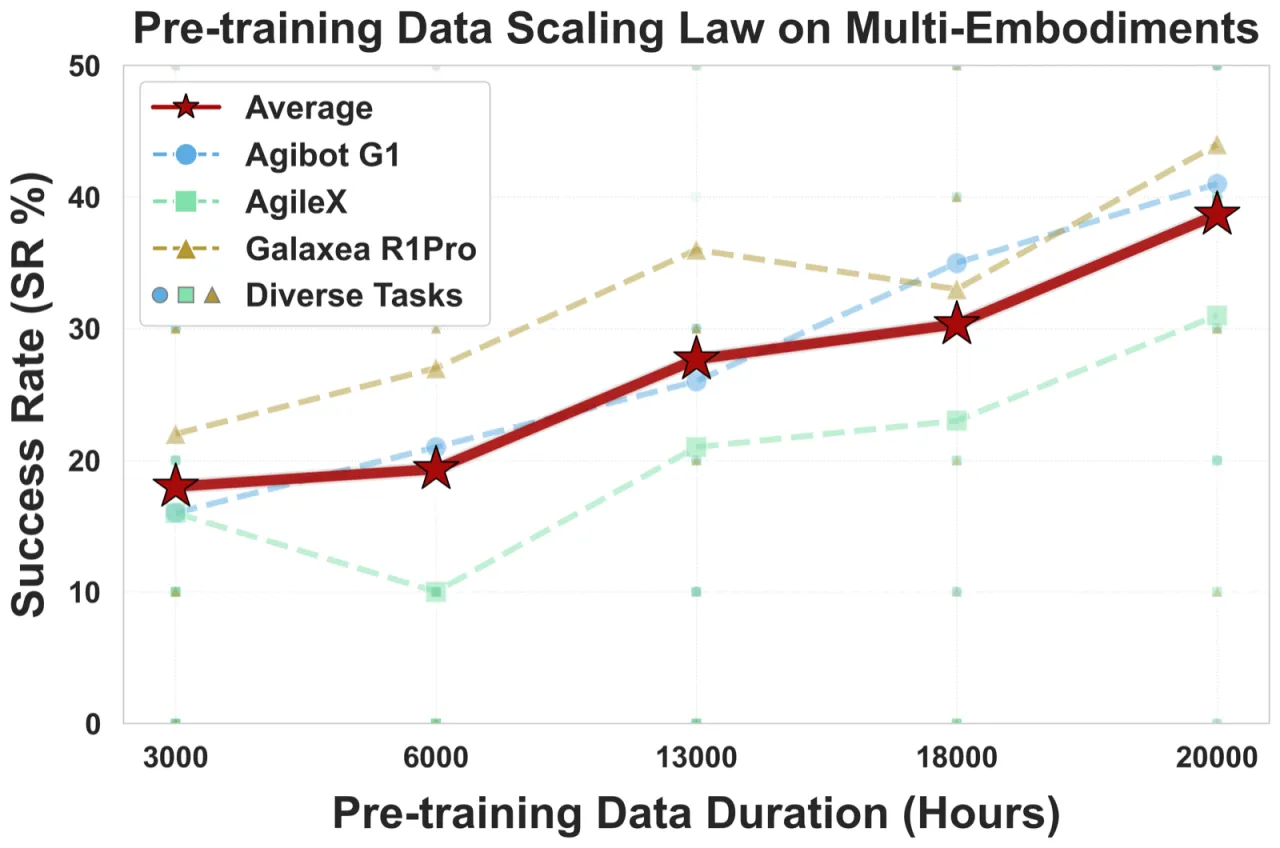
Pre-training data scaling law
图5:预训练数据规模扩展实验。从 3,000 小时到 20,000 小时,Success Rate 和 Progress Rate 均呈现持续上升趋势,且"no signs of saturation"——说明更多数据仍有提升空间,scaling law 在多个平台上均成立。Figure 5: Pre-training data scaling experiment. From 3,000 hours to 20,000 hours, both Success Rate and Progress Rate keep rising and show "no signs of saturation" — indicating that more data still brings gains, and that the scaling law holds across multiple platforms.
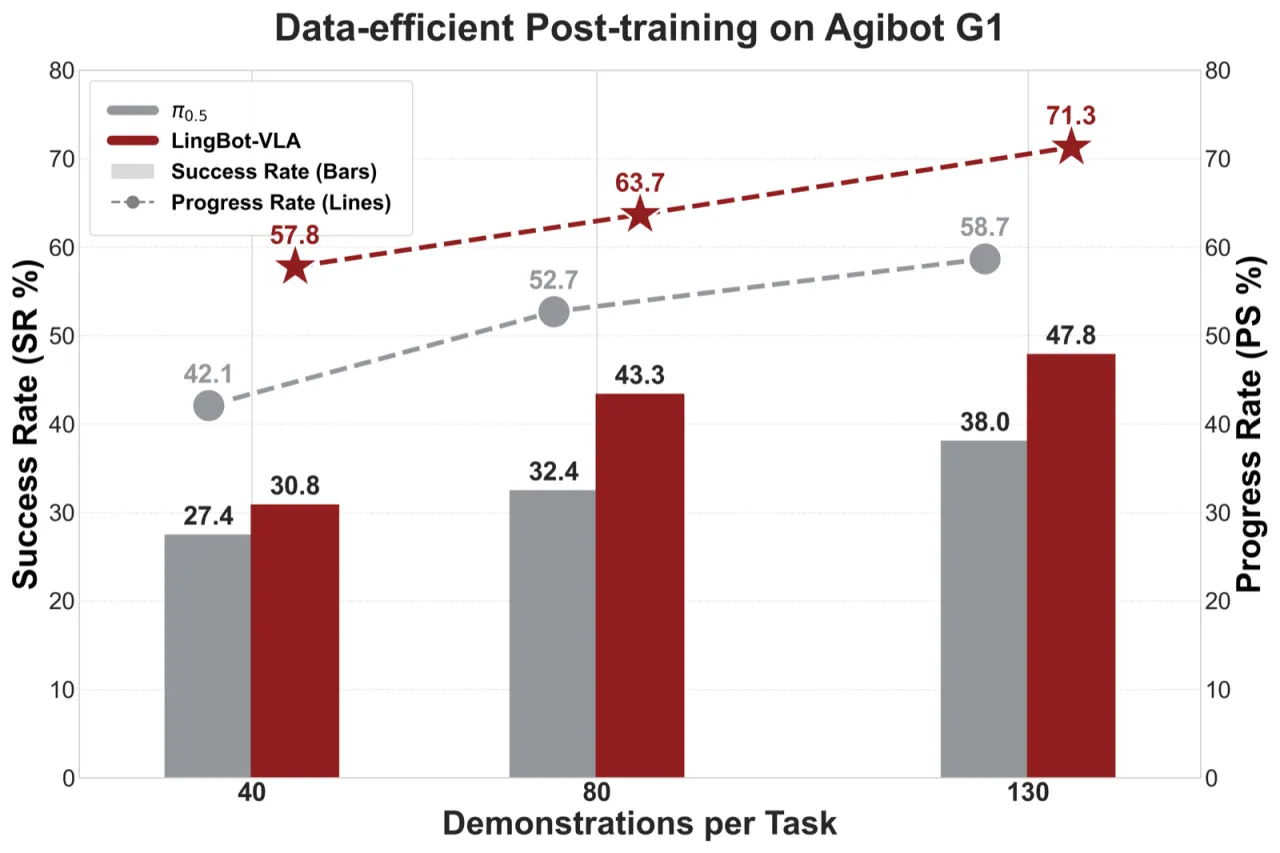
Post-training data efficiency
图6:后训练数据效率分析。仅用 80 个 demonstrations(相比 π₀.₅ 的完整 130 个)时,LingBot-VLA 在 SR 和 PS 上均超越使用全部数据的 π₀.₅,且两者性能差距随后训练数据量增加而显著拉大。Figure 6: Post-training data-efficiency analysis. With only 80 demonstrations (against the full 130 used by π₀.₅), LingBot-VLA already surpasses π₀.₅ trained on all the data in both SR and PS, and the performance gap widens markedly as the amount of post-training data grows.

训练吞吐量(Ablation)Training throughput (ablation)

基于 Qwen2.5-VL-3B-π 骨干,优化后的训练框架在 8-GPU 配置下达到 261 samples/second,较现有 VLA 专用代码库实现 1.5∼2.8× 提速。GPU 从 8 到 256 扩展时吞吐量近线性增长,验证了框架的大规模训练可行性。关键优化手段包括 FSDP 分布式训练、FlexAttention 稀疏注意力、torch.compile 算子融合及 bfloat16 混合精度。With the Qwen2.5-VL-3B-π backbone, the optimized training framework reaches 261 samples/second on an 8-GPU configuration, a 1.5∼2.8× speedup over existing VLA-specific codebases. Throughput grows near-linearly when scaling from 8 to 256 GPUs, confirming that the framework is viable for large-scale training. Key optimizations include FSDP distributed training, FlexAttention sparse attention, torch.compile operator fusion and bfloat16 mixed precision.

04 局限性Limitations

Note:论文未设专门的 Limitations 节;以下第 1 条为作者在正文中明确指出的问题,第 2、3 条为基于设计推断(inferred from the design)。Note: The paper has no dedicated Limitations section; item 1 below is a problem the authors state explicitly in the text, while items 2 and 3 are inferred from the design.
仅覆盖双臂机器人,平台多样性有限Covers dual-arm robots only; limited platform diversity

作者明确表示,未来工作将聚焦于"scaling the model versatility by integrating single-arm and mobile robotic data"——当前版本仅在 9 种双臂配置上训练,单臂与移动机器人场景尚未覆盖。(stated)The authors state explicitly that future work will focus on "scaling the model versatility by integrating single-arm and mobile robotic data" — the current version is trained on 9 dual-arm configurations only, and single-arm and mobile-robot scenarios are not yet covered. (stated)

仿真与真实环境的 sim-to-real gapThe sim-to-real gap between simulation and the real world

论文指出"simulation environments typically employ idealized physical models",真实部署中摩擦、光照、传感器噪声等因素可能导致性能下降。(stated)The paper points out that "simulation environments typically employ idealized physical models"; in real deployment, friction, lighting, sensor noise and similar factors may degrade performance. (stated)

绝对成功率仍较低,泛化到长视野任务存在挑战Absolute success rates are still low, and generalizing to long-horizon tasks remains challenging

GM-100 最高平均 SR 仅为 17.30%,说明在百任务规模的开放式评测下模型仍有较大提升空间;测试集约 50% 的原子动作未出现在训练集 top-100 中,泛化难度较高。(inferred)The highest average SR on GM-100 is only 17.30%, showing that the model still has plenty of headroom under open-ended evaluation at hundred-task scale; about 50% of the atomic actions in the test set never appear in the training set top-100, which makes generalization harder. (inferred)