LIBERO: Benchmarking Knowledge Transfer for Lifelong Robot Learning
机器人终身学习中知识迁移的系统性基准A systematic benchmark for knowledge transfer in lifelong robot learning
Bo Liu, Yifeng Zhu, Chongkai Gao, Yihao Feng, Qiang Liu, Yuke Zhu, Peter Stone · UT Austin / PKU
LIBERO 是首个专注于机器人操作领域终身学习的综合性基准,包含 130 个跨越四个任务套件的操作任务,系统研究陈述性知识(概念)与程序性知识(动作)的迁移效率,并附有高质量人类遥操作演示数据。LIBERO is the first comprehensive benchmark focused on lifelong learning for robot manipulation. It contains 130 manipulation tasks spanning four task suites, systematically studies the transfer efficiency of declarative knowledge (concepts) versus procedural knowledge (actions), and comes with high-quality human teleoperation demonstrations.
终身学习(Lifelong Learning)的目标是构建一个能够随时间持续学习、不断从新任务中积累并迁移知识的智能体。然而,现有研究几乎全部集中在视觉和语言领域,对机器人决策场景的专注极度缺乏,导致缺少系统性评测手段来衡量不同知识类型的迁移效率与算法性能。Lifelong learning aims to build an agent that keeps learning over time, continually accumulating and transferring knowledge from new tasks. Existing work, however, is concentrated almost entirely on vision and language and pays extremely little attention to robotic decision-making settings, leaving no systematic means of evaluating the transfer efficiency of different knowledge types or the performance of algorithms.
"How can a robot agent effectively transfer knowledge across its lifespan in decision-making tasks?"
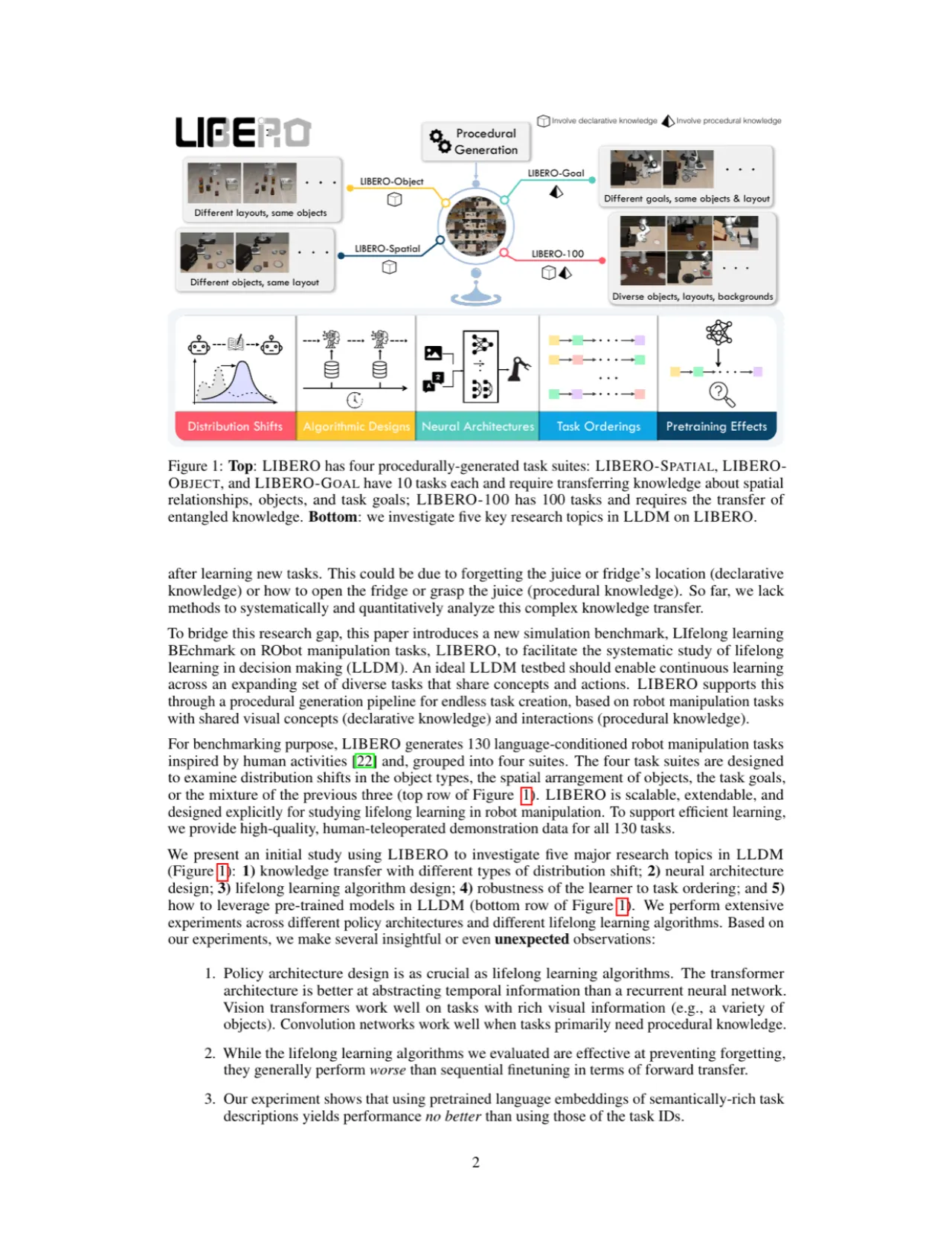
LIBERO 提出了机器人操作终身学习基准,针对陈述性知识、程序性知识及混合知识迁移设计了四个任务套件,研究五个核心问题:迁移效率、策略架构、算法有效性、任务顺序鲁棒性与预训练影响。LIBERO proposes a lifelong learning benchmark for robot manipulation, designing four task suites that target declarative, procedural and mixed knowledge transfer, and studies five core questions: transfer efficiency, policy architecture, algorithm effectiveness, robustness to task ordering, and the impact of pretraining.
130操作任务总数(4 个套件)Manipulation tasks in total (4 suites)
50每个任务的人类遥操作演示Human teleoperation demonstrations per task
5核心研究问题(Knowledge Transfer / Architecture / Algorithm / Task Ordering / Pretraining)Core research questions (Knowledge Transfer / Architecture / Algorithm / Task Ordering / Pretraining)
∞程序化生成流程可创建无限任务The procedural generation pipeline can create unlimited tasks
为什么需要 LIBERO?Why is LIBERO needed?
机器人终身学习面临独特挑战:与视觉分类不同,操作任务需要同时处理陈述性知识(识别物体、场景等概念)和程序性知识(如何操作、抓取等动作序列)。例如,一个机器人曾学会"把苹果放进篮子",在学习新任务时,它既要记住物体概念(陈述性),又要保留操作技能(程序性)。现有终身学习基准均无法捕捉这一二元知识结构。Lifelong learning in robotics faces a distinctive challenge: unlike visual classification, manipulation tasks must handle both declarative knowledge (concepts such as recognizing objects and scenes) and procedural knowledge (action sequences such as how to manipulate and grasp). For example, a robot that once learned to “put the apple in the basket” must, when learning a new task, both remember the object concepts (declarative) and retain the manipulation skill (procedural). No existing lifelong learning benchmark captures this dual knowledge structure.
LIBERO 的四个任务套件(Figure 1)。从左至右:LIBERO-Spatial(空间关系变化,考察陈述性知识)、LIBERO-Object(物体种类变化)、LIBERO-Goal(目标变化,混合知识)、LIBERO-Long(长序列任务,考察程序性知识)。底部展示了不同分布偏移类型及 LIBERO-GOAL 的任务顺序变化实验。The four task suites of LIBERO (Figure 1). From left to right: LIBERO-Spatial (varying spatial relations, probing declarative knowledge), LIBERO-Object (varying object types), LIBERO-Goal (varying goals, mixed knowledge), LIBERO-Long (long-horizon tasks, probing procedural knowledge). The bottom shows the different types of distribution shift and the task-ordering experiment on LIBERO-GOAL.
02方法Method
LIBERO 提供了完整的基准框架:程序化任务生成流程(保证任务多样性与可扩展性)、高质量演示数据、统一的评测指标体系(FWT / NBT / AUC),以及三种主流神经网络架构的全面对比。LIBERO provides a complete benchmark framework: a procedural task generation pipeline (ensuring task diversity and scalability), high-quality demonstration data, a unified evaluation metric system (FWT / NBT / AUC), and a comprehensive comparison of three mainstream neural network architectures.
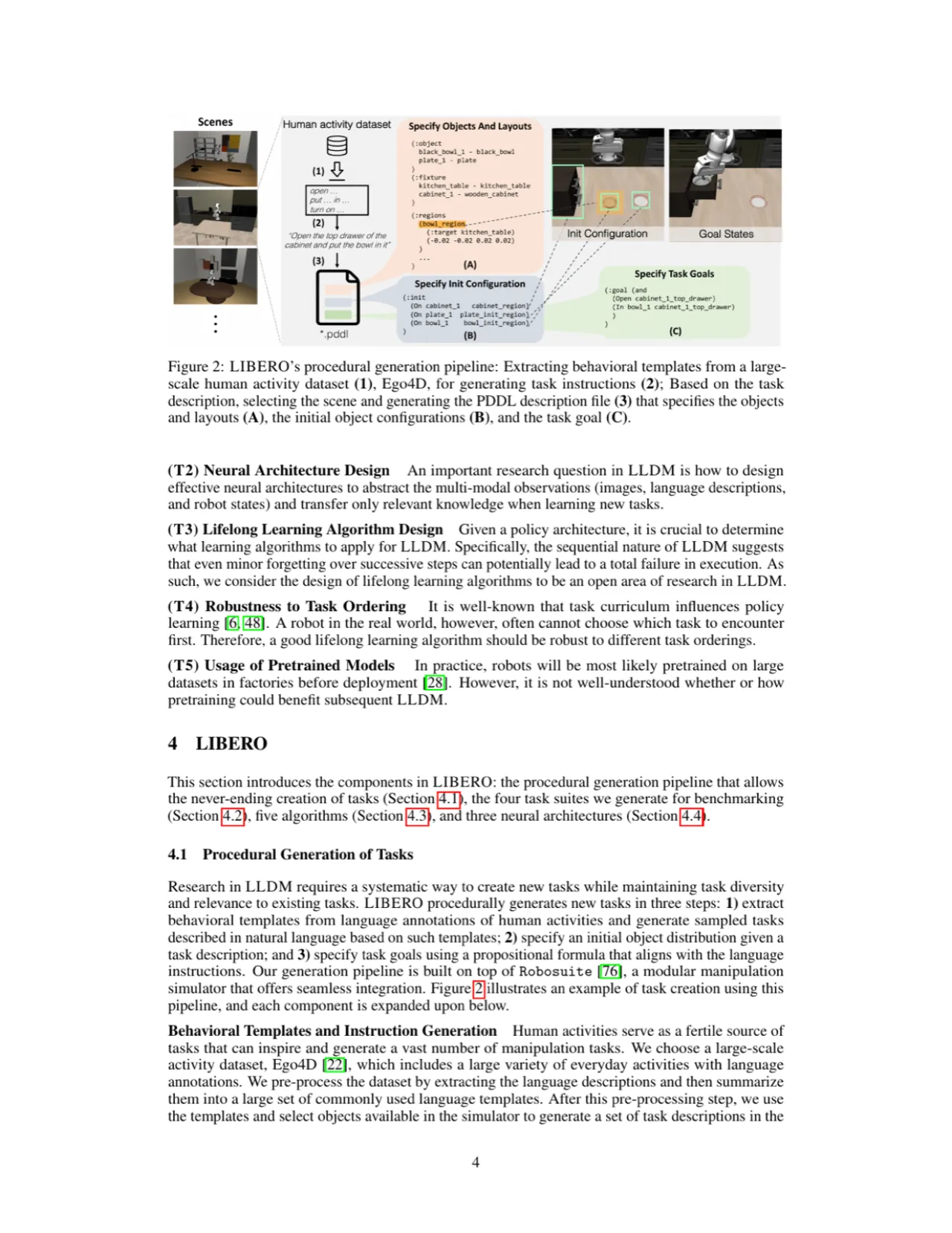
Figure 2:LIBERO 的程序化生成流程。① 从大型行为数据集(EgoMimic)提取 Behavioral Template,② 基于 PDDL 语言描述的任务说明(task predicates、goal specifications),③ 利用模板生成无限行为变体,④ MuJoCo 仿真环境渲染,⑤ 人工遥操作录制高质量演示数据。Figure 2: the procedural generation pipeline of LIBERO. ① Extract Behavioral Templates from a large behavioral dataset (EgoMimic), ② describe task specifications in the PDDL language (task predicates, goal specifications), ③ use the templates to generate unlimited behavioral variants, ④ render in the MuJoCo simulation environment, ⑤ record high-quality demonstrations by human teleoperation.
四个任务套件(Task Suites)Four Task Suites
LIBERO-Spatial
10 个任务,固定物体种类,改变空间关系(如"碗在架子的左/右侧")。主要挑战:陈述性知识迁移——智能体需记住物体位置概念。10 tasks with fixed object types, varying the spatial relations (e.g. “the bowl on the left/right side of the shelf”). Main challenge: declarative knowledge transfer — the agent must remember object-location concepts.
LIBERO-Object
10 个任务,固定空间布局,改变物体种类(如不同食物)。主要挑战:陈述性知识迁移——智能体需识别新物体而不遗忘旧物体。10 tasks with a fixed spatial layout, varying the object types (e.g. different foods). Main challenge: declarative knowledge transfer — the agent must recognize new objects without forgetting old ones.
LIBERO-Goal
10 个任务,同一场景执行不同目标动作(如打开/关闭抽屉)。主要挑战:混合知识迁移——既需更新目标概念,又需习得新动作策略。10 tasks performing different goal actions in the same scene (e.g. opening/closing a drawer). Main challenge: mixed knowledge transfer — the agent must both update goal concepts and acquire new action policies.
LIBERO-Long
10 个任务,每个任务包含多个子目标的长序列操作(平均约 90 步)。主要挑战:程序性知识迁移——习得并保留复杂动作序列。10 tasks, each containing long-horizon manipulation over multiple subgoals (about 90 steps on average). Main challenge: procedural knowledge transfer — acquiring and retaining complex action sequences.
评测指标体系Evaluation Metrics
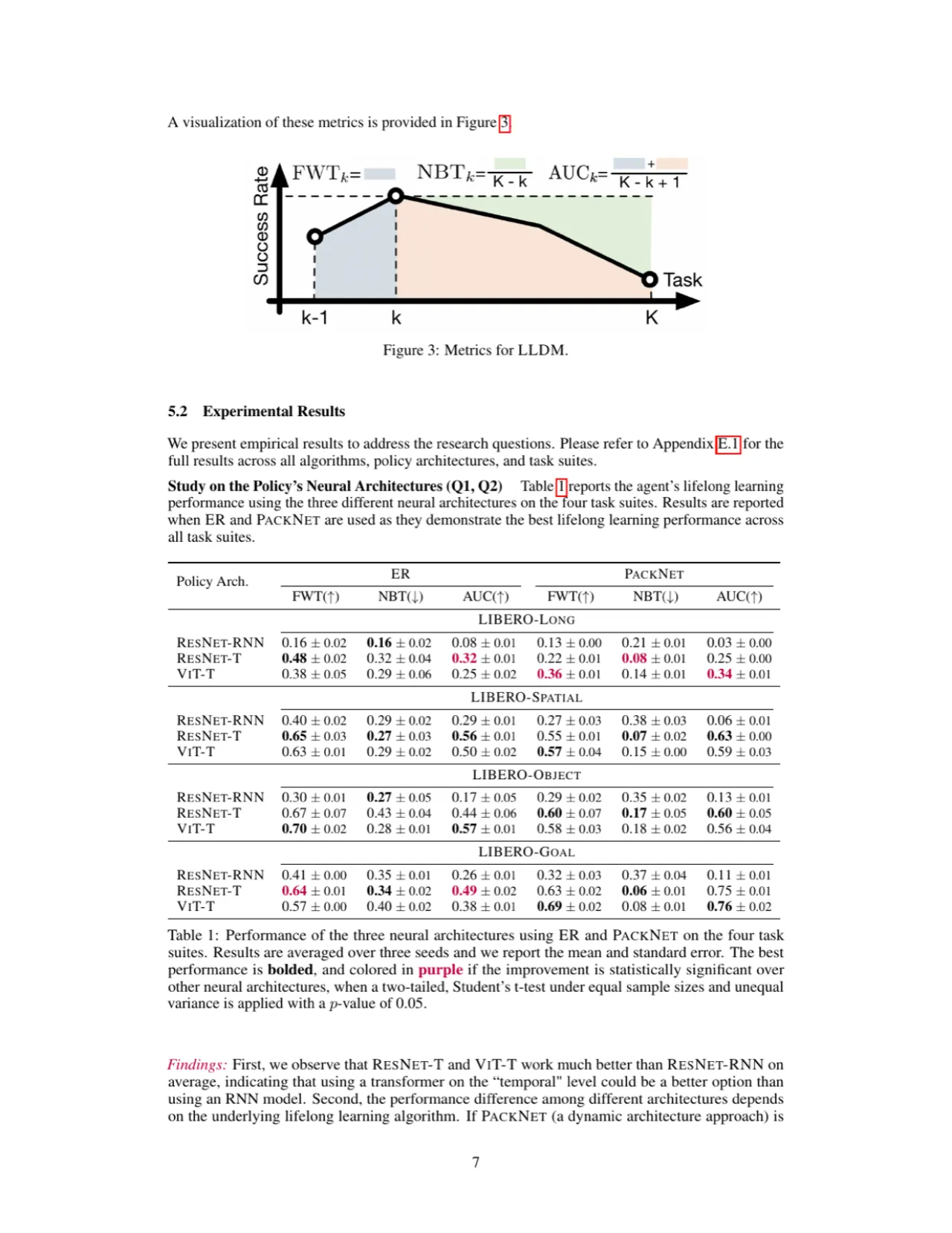
Figure 3:LIBERO 的三个核心评测指标定义示意图。FWT(Forward Transfer)= 前向迁移效率,衡量学习新任务的速度;NBT(Negative Backward Transfer)= 负向后向迁移,衡量遗忘程度(越低越好);AUC@k = 学习曲线面积,综合衡量整体终身学习性能。Figure 3: illustration of the three core evaluation metrics of LIBERO. FWT (Forward Transfer) = forward transfer efficiency, measuring how fast a new task is learned; NBT (Negative Backward Transfer) = negative backward transfer, measuring how much is forgotten (lower is better); AUC@k = area under the learning curve, an overall measure of lifelong learning performance.
神经网络架构(Policy Architectures)Policy Architectures
LIBERO 基准中对比的三种策略网络架构:RNN(循环神经网络,使用隐藏状态建模时序依赖)、ResNet+RNN(图像编码器 + 循环解码器)、ViT-T(Vision Transformer,使用 self-attention 处理视觉-时序信息)。语言任务描述通过 BERT 或 GPT-2 编码后注入策略网络。The three policy network architectures compared in the LIBERO benchmark: RNN (recurrent neural network, modeling temporal dependencies with hidden states), ResNet+RNN (image encoder + recurrent decoder), and ViT-T (Vision Transformer, using self-attention over visual-temporal information). The language task description is encoded by BERT or GPT-2 and then injected into the policy network.
Task Identifier 嵌入Task Identifier Embeddings
实验系统性对比了四种 Task Identifier 嵌入方式:BERT(通用预训练语言模型)、GPT-2(自回归语言模型)、Task ID(one-hot 任务编号)、以及 Sentence Transformer。这些嵌入被用于将任务语义信息注入策略,帮助网络区分不同任务。The experiments systematically compare four Task Identifier embeddings: BERT (a general pretrained language model), GPT-2 (an autoregressive language model), Task ID (a one-hot task index), and Sentence Transformer. These embeddings inject task semantics into the policy and help the network distinguish between tasks.
03实验Experiments
在 LIBERO 的四个任务套件上,对比 Sequential Finetuning(ER / 无回放)、PackNet、以及多任务学习(MTL)等算法,结合 ResNet+RNN 与 PackNet 两种主要架构,系统评估 FWT、NBT 和 AUC@7 三项指标。On the four task suites of LIBERO, algorithms such as Sequential Finetuning (ER / no replay), PackNet and multi-task learning (MTL) are compared, together with the two main architectures ResNet+RNN and PackNet, systematically evaluating the three metrics FWT, NBT and AUC@7.
Q1:策略架构对不同知识迁移类型的影响Q1: How policy architecture affects different types of knowledge transfer
主要发现:"No single visual encoder architecture excels across all knowledge transfer types." ResNet 在大多数任务套件中优于 ViT-T,但对于以程序性知识迁移为主的 LIBERO-Long,ViT-T 表现更佳,体现了其对长序列时序建模的优势。Main finding: “No single visual encoder architecture excels across all knowledge transfer types.” ResNet outperforms ViT-T on most task suites, but on LIBERO-Long, which is dominated by procedural knowledge transfer, ViT-T performs better, reflecting its advantage in modeling long temporal sequences.
Policy Arch.
LIBERO-Spatial (AUC@7)
LIBERO-Object (AUC@7)
LIBERO-Goal (AUC@7)
LIBERO-Long (AUC@7)
ResNet+RNN (ER)
0.84 ± 0.01
0.60 ± 0.02
0.41 ± 0.02
0.15 ± 0.01
ViT-T (ER)
0.78 ± 0.01
0.48 ± 0.02
0.29 ± 0.01
0.29 ± 0.02
ResNet+RNN (MTL)
0.88 ± 0.00
0.66 ± 0.01
0.52 ± 0.02
0.16 ± 0.01
ViT-T (MTL)
0.80 ± 0.01
0.54 ± 0.02
0.36 ± 0.02
0.38 ± 0.03
Q2:终身学习算法对比Q2: Comparison of lifelong learning algorithms
核心发现:"Sequential finetuning outperforms existing lifelong learning methods in forward transfer." 在 FWT 指标上,简单的 Sequential Finetuning(顺序微调)普遍优于 PackNet 等专门的终身学习算法,而 PackNet 通过网络二值化压缩有效抑制了遗忘(较低的 NBT),但以牺牲前向迁移能力为代价。Core finding: “Sequential finetuning outperforms existing lifelong learning methods in forward transfer.” On the FWT metric, plain Sequential Finetuning generally outperforms dedicated lifelong learning algorithms such as PackNet, while PackNet effectively suppresses forgetting through binary network compression (a lower NBT), at the cost of forward transfer capability.
Q4:任务顺序的鲁棒性Q4: Robustness to task ordering
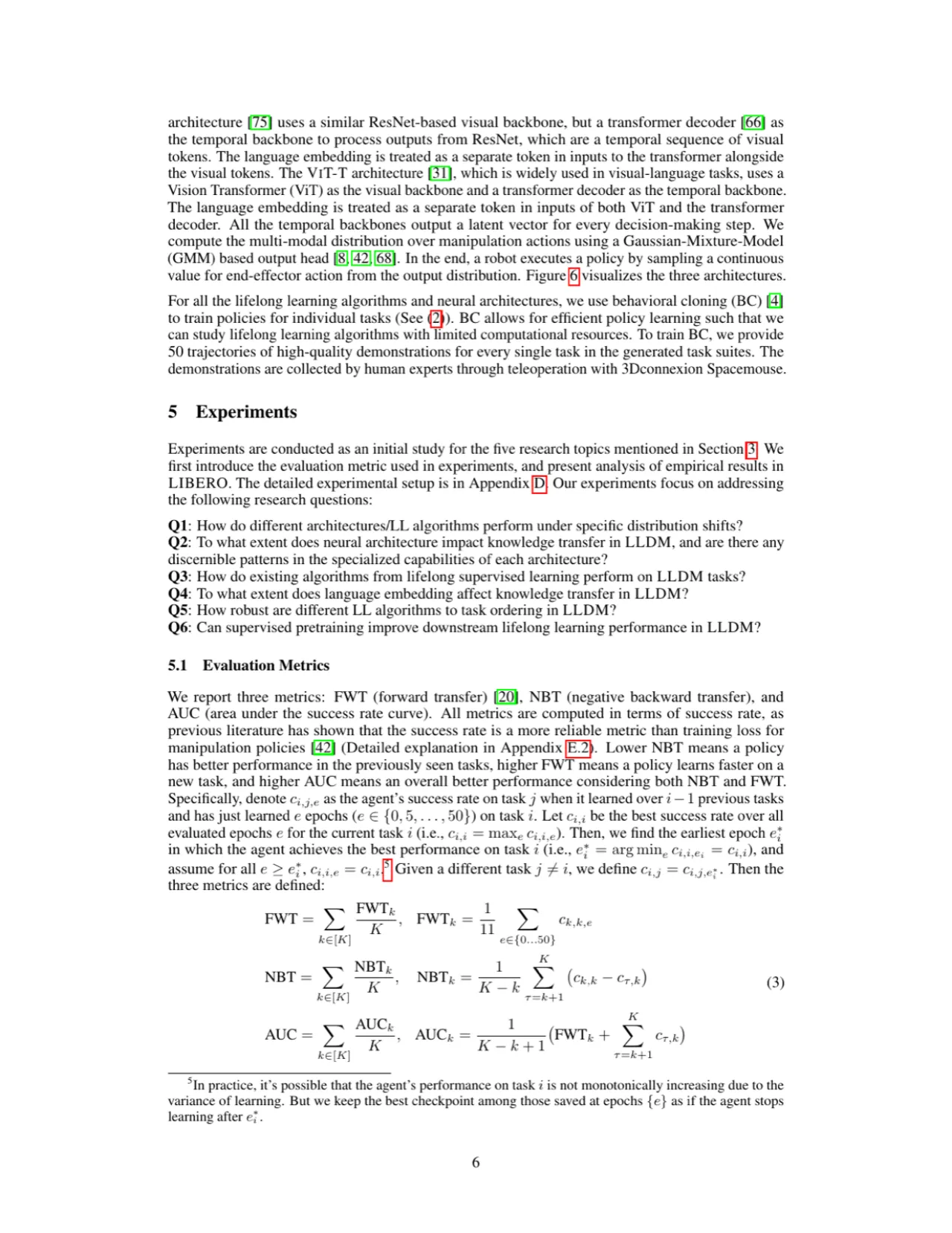
Figure 4(左):ER 与 PackNet 在 LIBERO-LONG 的 50 种随机任务顺序下的 AUC@7 分布。ER 在不同顺序下波动显著大于 PackNet,说明 ER 对任务顺序更为敏感。(右):LIBERO-GOAL 下两种算法的成功率随任务序号 k 的变化,PackNet 维持相对稳定而 ER 振荡更大。Figure 4 (left): the AUC@7 distribution of ER and PackNet under 50 random task orderings on LIBERO-LONG. ER fluctuates markedly more than PackNet across orderings, showing that ER is far more sensitive to task order. (Right): the success rate of the two algorithms on LIBERO-GOAL as a function of the task index k; PackNet stays relatively stable while ER oscillates more.
Q5:预训练对终身学习的影响Q5: The effect of pretraining on lifelong learning
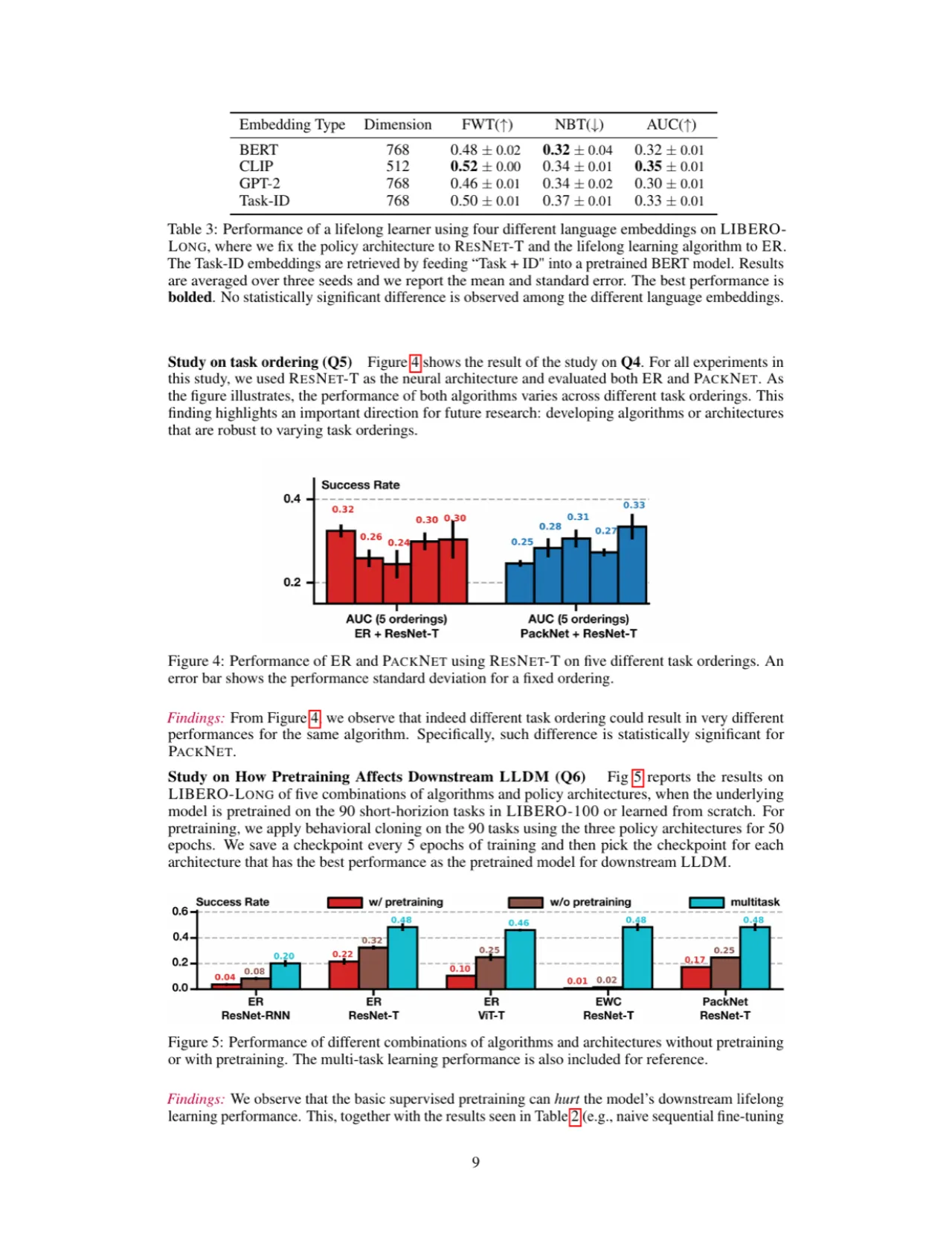
实验表明:"Naive supervised pretraining can hinder agents' performance in the subsequent LLDM." 在大规模离线数据集上进行监督式预训练后,智能体在后续 LLDM(Lifelong Learning for Decision-Making)阶段的表现反而下降,说明纯监督预训练会干扰策略在终身学习场景下的适应能力,这是一个出人意料的负面迁移现象。The experiments show: “Naive supervised pretraining can hinder agents' performance in the subsequent LLDM.” After supervised pretraining on a large-scale offline dataset, the agent instead performs worse in the subsequent LLDM (Lifelong Learning for Decision-Making) stage, indicating that purely supervised pretraining interferes with the policy's ability to adapt in lifelong learning settings — a surprising negative transfer phenomenon.
Task Identifier 嵌入对比Comparison of Task Identifier Embeddings
实验对比了四种任务标识符嵌入方式(BERT / GPT-2 / Task ID / Sentence Transformer)。结果表明 BERT 和 Task ID 嵌入在大多数任务套件上表现相当甚至更优,而 Sentence Transformer 嵌入表现出对语义任务描述的更好利用,尤其是在 LIBERO-Goal 中。The experiments compare four task identifier embeddings (BERT / GPT-2 / Task ID / Sentence Transformer). The results show that BERT and Task ID embeddings perform comparably or even better on most task suites, while the Sentence Transformer embedding makes better use of semantic task descriptions, especially on LIBERO-Goal.
04局限性Limitations
Note:以下局限性部分来自论文第 7 章的明确陈述(stated),部分为基于设计分析的推断(inferred)。Some of the limitations below are explicitly stated in Section 7 of the paper (stated), while others are inferred from an analysis of the design (inferred).
仿真与真实世界的差距(Sim-to-Real Gap)【inferred】Sim-to-Real Gap [inferred]
LIBERO 完全基于 MuJoCo 仿真环境,所有任务和演示均在仿真中完成。尽管提供了高质量的视觉渲染,但仿真物理特性与真实机器人操作存在显著差距(接触力学、物体材质变形等),所得结论是否可直接迁移到真实硬件仍是未解问题。LIBERO is built entirely on the MuJoCo simulator, and all tasks and demonstrations are produced in simulation. Although the visual rendering is of high quality, a significant gap remains between simulated physics and real robot manipulation (contact mechanics, deformation of object materials, and so on), so whether the conclusions transfer directly to real hardware remains an open question.
当前每个套件仅包含 10 个任务,总计 130 个任务。尽管程序化生成流程理论上可创建无限任务,但实际基准中的任务多样性和规模与真实终身学习场景(可能涉及数百至数千个任务)仍有差距。论文指出可通过扩展模板库来缓解此问题。Each suite currently contains only 10 tasks, 130 in total. Although the procedural generation pipeline can in principle create unlimited tasks, the diversity and scale of the tasks in the actual benchmark still fall short of real lifelong learning scenarios (which may involve hundreds to thousands of tasks). The paper notes that this can be alleviated by expanding the template library.
预训练负迁移的机制尚未明确【stated】The mechanism behind the negative transfer from pretraining is not yet clear [stated]
实验发现监督式预训练会降低后续终身学习性能,这一反直觉现象论文仅记录了结果("naive supervised pretraining can hinder agents' performance"),但未深入分析其内在机制——究竟是特征分布偏移、优化景观改变还是其他原因导致了这一负迁移,有待进一步研究。The experiments find that supervised pretraining degrades subsequent lifelong learning performance. The paper only records this counterintuitive result (“naive supervised pretraining can hinder agents' performance”) without analyzing the underlying mechanism — whether the negative transfer is caused by a shift in the feature distribution, a change in the optimization landscape, or some other reason remains to be studied.
算法评测范围局限于确定性策略【inferred】Algorithm evaluation is limited to deterministic policies [inferred]
LIBERO 当前评测的算法(ER、EWC、PackNet、AGEM 等)主要为判别式确定性策略,未涵盖基于扩散模型(Diffusion Policy)或能量模型的概率性策略,也未评测近年兴起的 VLA(Vision-Language-Action)大模型在终身学习设定下的表现。The algorithms currently evaluated in LIBERO (ER, EWC, PackNet, AGEM, etc.) are mainly discriminative deterministic policies; they do not cover probabilistic policies based on diffusion models (Diffusion Policy) or energy-based models, nor do they evaluate the recently emerging VLA (Vision-Language-Action) large models under the lifelong learning setting.