Learning while Deploying: Fleet-Scale Reinforcement Learning for Generalist Robot Policies
让部署本身成为训练数据源:16 台机器人车队的 offline-to-online 强化学习,持续后训练同一个 VLA 通才策略Turning deployment itself into a source of training data: offline-to-online reinforcement learning on a fleet of 16 robots, continually post-training one and the same generalist VLA policy
Yi Wang, Xinchen Li, Pengwei Xie, Pu Yang, Buqing Nie, Yunuo Cai, Qinglin Zhang, Chendi Qu, Jeffrey Wu, Jianheng Song, Xinlin Ren, Jingshun Huang, Mingjie Pan, Siyuan Feng, Zhi Chen, Jianlan Luo · Shanghai Innovation Institute / AGIBOT Finch / Columbia University
论文提出 Learning While Deploying (LWD):一个车队级(fleet-scale)offline-to-online 强化学习框架,用来持续后训练预训练好的通才 Vision-Language-Action (VLA) 策略。它把自主 rollout 与人工干预汇聚成共享经验,用 Distributional Implicit Value Learning (DIVL) 做稀疏奖励下的稳健价值估计,用 Q-learning via Adjoint Matching (QAM) 把价值信号安全地传给 flow-based 动作生成器。在 16 台双臂机器人、8 项真实任务上,同一个通才策略随车队经验积累持续变强,最终平均成功率达到 95%,长时序任务上的提升最为显著。The paper proposes Learning While Deploying (LWD): a fleet-scale offline-to-online reinforcement learning framework for continually post-training a pretrained generalist Vision-Language-Action (VLA) policy. It pools autonomous rollouts and human interventions into shared experience, uses Distributional Implicit Value Learning (DIVL) for robust value estimation under sparse rewards, and uses Q-learning via Adjoint Matching (QAM) to pass the value signal safely to a flow-based action generator. Across 16 bimanual robots and 8 real-world tasks, the same generalist policy keeps getting stronger as fleet experience accumulates, ultimately reaching an average success rate of 95%, with the most pronounced gains on long-horizon tasks.
近年的 VLA 策略(RT-1/RT-2、Octo、OpenVLA、π0、π0.5 等)靠大规模离线预训练获得广泛能力,但离线数据本身不足以支撑稳健的真实世界部署。论文指出:"offline pretraining alone does not make a policy deployment-ready" —— 部署环境不是固定的测试分布,机器人会不断遇到分布偏移、长尾失败、任务变体,以及人工纠正的机会,而固定的示教数据集无法覆盖这些情况。单台机器人只能采样部署分布的很小一部分,而一个车队能覆盖多样的任务、环境、物体和用户指令,产生包含成功、失败、恢复、部分进展和人工干预的异质经验。Recent VLA policies (RT-1/RT-2, Octo, OpenVLA, π0, π0.5 and others) gain broad capabilities from large-scale offline pretraining, but offline data alone is not enough to support robust real-world deployment. The paper argues: "offline pretraining alone does not make a policy deployment-ready" — a deployment environment is not a fixed test distribution; a robot keeps running into distribution shift, long-tail failures, task variants and opportunities for human correction, none of which a fixed demonstration dataset can cover. A single robot can only sample a tiny slice of the deployment distribution, whereas a fleet covers diverse tasks, environments, objects and user instructions, producing heterogeneous experience that contains successes, failures, recoveries, partial progress and human interventions.
"We refer to this setting as Learning While Deploying (LWD): continual policy improvement driven by the accumulated real-world autonomous experience of a deployed robot fleet."
此前的交互式模仿学习方法(如 HG-DAgger)只把部署数据当作监督学习的动作标签来源,无法利用包含成功/失败/部分进展/任务奖励的完整自主试错经验;而现有机器人 RL 方法大多局限于小规模、短时序或单任务场景,很少能在保持通才能力的同时,从车队部署经验里对端到端 VLA 策略做规模化后训练——这正是 LWD 要填补的空白。Earlier interactive imitation learning methods (such as HG-DAgger) treat deployment data only as a source of action labels for supervised learning, and cannot exploit the full autonomous trial-and-error experience that contains successes, failures, partial progress and task rewards; existing robot RL methods, meanwhile, are mostly confined to small-scale, short-horizon or single-task settings, and rarely manage scalable post-training of an end-to-end VLA policy from fleet deployment experience while preserving generalist capability — exactly the gap LWD sets out to fill.
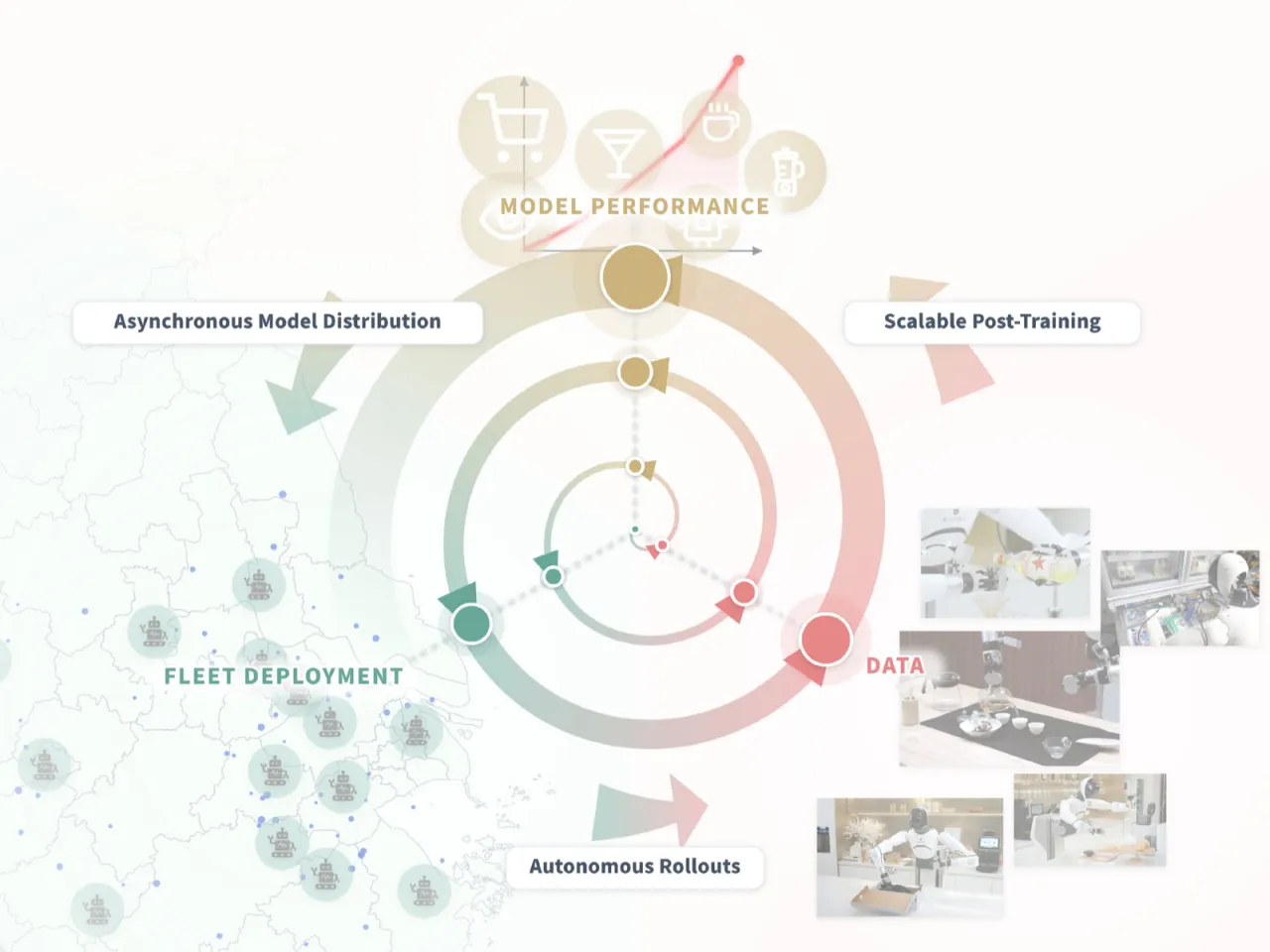
论文教师图:LWD 的车队部署 - 数据汇聚 - 策略改进 - 重新部署闭环(data flywheel)示意。Teaser figure from the paper: an illustration of the LWD closed loop of fleet deployment - data aggregation - policy improvement - redeployment (the data flywheel).
0.95LWD (Online) 8 任务平均成功分数LWD (Online) average success score over the 8 tasks
0.91LWD (Online) 长时序任务平均分(vs SFT 0.68)LWD (Online) average score on long-horizon tasks (vs SFT 0.68)
16台双臂机器人组成在线训练车队bimanual robots make up the online training fleet
−23.75s长时序任务平均 cycle time 相对参考策略的降幅Drop in average cycle time on long-horizon tasks relative to the reference policy
02 Method
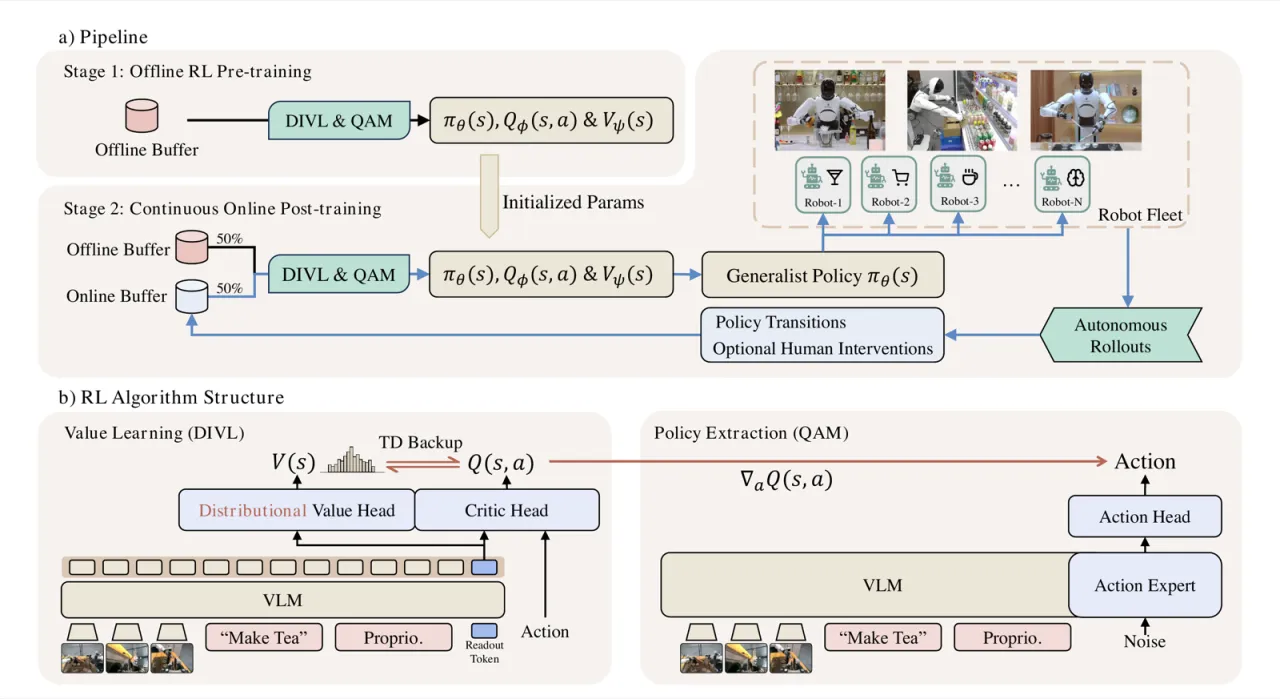
LWD 分两个阶段:Stage 1 离线预训练在静态离线缓冲区 B_off(示教 + 历史策略 rollout + 人工引导的失败探索 play data)上训练策略、critic 和分布式价值模型,为部署提供强初始化;Stage 2 在线后训练把当前策略部署到机器人车队做自主 rollout,把 policy transition 与人工干预汇入不断更新的在线缓冲区 B_on,learner 在 B_off ∪ B_on 混合回放上持续更新价值函数与策略,并周期性把新 checkpoint 重新分发给车队——形成一个数据飞轮。两个阶段共用同一套 RL 目标,缓解了 offline-to-online 常见的价值失配问题。LWD proceeds in two stages. Stage 1, offline pretraining, trains the policy, the critic and the distributional value model on a static offline buffer B_off (demonstrations + rollouts of earlier policies + human-guided failure-exploration play data), providing a strong initialization for deployment. Stage 2, online post-training, deploys the current policy on the robot fleet for autonomous rollouts, funnels policy transitions and human interventions into a continually updated online buffer B_on, and has the learner keep updating the value functions and the policy on mixed replay over B_off ∪ B_on, periodically redistributing new checkpoints to the fleet — forming a data flywheel. Both stages share the same RL objective, which alleviates the value-mismatch problem that commonly afflicts offline-to-online transitions.
LWD overview. (a) Pipeline:Stage 1 在离线缓冲区上做离线 RL 预训练,Stage 2 用离线 + 持续更新的在线缓冲区做混合回放在线后训练,车队自主部署在多样真实任务上收集在线数据。(b) Algorithm structure:VLM-based 策略 π_θ(s) 把状态映射为动作 chunk,用 QAM loss 做策略抽取;同时 critic Q_φ(s,a) 与分布式价值 V_ψ(s) 用 TD loss 做价值学习。LWD overview. (a) Pipeline: Stage 1 performs offline RL pretraining on the offline buffer; Stage 2 performs online post-training with mixed replay over the offline buffer plus a continually updated online buffer, with the fleet deployed autonomously on diverse real-world tasks to collect online data. (b) Algorithm structure: the VLM-based policy π_θ(s) maps states to action chunks and is extracted with the QAM loss; meanwhile the critic Q_φ(s,a) and the distributional value V_ψ(s) are learned with a TD loss.
Distributional Implicit Value Learning (DIVL)
DIVL 是 Implicit Q-Learning (IQL) 的分布式改造:IQL 用标量 expectile 回归把价值向数据集中较高价值的动作偏置,从而在不做显式 max_a Q(s,a) backup 的情况下给出隐式的策略提升目标;但车队异步采集数据下,同一 state-action 对应的回报可能是多峰、重尾的,标量 critic 会把这些结果压成一个平均值,抹掉罕见但可复现的高回报模式。DIVL 转而学习一个 categorical 分布式价值模型 p_ψ(v∣s_t),用其 τ-quantile 作为 TD bootstrap 目标;论文证明(Proposition 1)对同一族非对称损失,直接标量回归与"先拟合分布再取分位数"这一两步过程收敛到相同的最优标量价值。此外,τ 会依据价值分布的归一化熵自适应调整:分布越发散(越不确定),τ 越保守,反之越乐观。DIVL is a distributional reworking of Implicit Q-Learning (IQL). IQL uses scalar expectile regression to bias the value toward the higher-value actions in the dataset, yielding an implicit policy-improvement target without an explicit max_a Q(s,a) backup; but when data is collected asynchronously by a fleet, the returns for one and the same state-action pair can be multi-modal and heavy-tailed, and a scalar critic squashes those outcomes into a single mean, erasing rare but reproducible high-return modes. DIVL instead learns a categorical distributional value model p_ψ(v∣s_t) and uses its τ-quantile as the TD bootstrap target; the paper proves (Proposition 1) that for the same family of asymmetric losses, direct scalar regression and the two-step procedure of "fit the distribution first, then take the quantile" converge to the same optimal scalar value. In addition, τ adapts to the normalized entropy of the value distribution: the more dispersed (the more uncertain) the distribution, the more conservative τ becomes, and the other way round the more optimistic.
Q-learning via Adjoint Matching (QAM) 策略抽取Policy extraction via Q-learning through Adjoint Matching (QAM)
Critic 的动作梯度 ∇_a Q_φ(s,a) 本可直接指导策略改进,但 flow-based VLA 的动作生成是多步去噪过程,直接对整条去噪轨迹反传梯度"is computationally expensive and numerically unstable"。QAM 把轨迹级的 KL 正则化策略提升目标,转化为沿参考 flow 轨迹的局部回归目标:用 DIVL critic 在去噪终点的梯度设定 adjoint 终端条件,再逐步反解 adjoint 动态,逼近参考策略 f_β 与待优化策略 f_θ 之间的局部差异。整个训练中 f_β 固定为离线 RL 前的行为克隆策略,f_θ 在离线和在线阶段都持续优化。The critic's action gradient ∇_a Q_φ(s,a) could in principle guide policy improvement directly, but action generation in a flow-based VLA is a multi-step denoising process, and backpropagating gradients through the entire denoising trajectory "is computationally expensive and numerically unstable". QAM turns the trajectory-level KL-regularized policy-improvement objective into a local regression objective along the reference flow trajectory: the gradient of the DIVL critic at the denoising endpoint sets the adjoint terminal condition, the adjoint dynamics are then solved backwards step by step, approximating the local difference between the reference policy f_β and the policy being optimized f_θ. Throughout training f_β stays fixed to the behavior-cloning policy from before offline RL, while f_θ keeps being optimized in both the offline and the online stage.
网络架构Network architecture
价值/critic 网络与策略网络分离:actor 采用 π0.5 flow-based VLA 架构(PaliGemma 视觉语言骨干 + Gemma-2B 语言模型 + SigLIP 视觉编码器 + Gemma-300M action expert);价值 V_ψ 与 critic Q_φ 共享一个 Gemma3-SigLIP 骨干(Gemma 3-270M-IT + SigLIP-So400M 初始化),critic 采用 clipped double-Q 设计以缓解高估。只有策略 checkpoint 会异步分发到车队用于推理,价值/critic 网络始终留在中心 learner 上。在线 QAM 更新时,策略的 VLM 骨干被冻结、只更新 action expert,以兼顾更新效率与预训练视觉语言表征的稳定性。The value/critic networks are kept separate from the policy network: the actor uses the π0.5 flow-based VLA architecture (PaliGemma vision-language backbone + Gemma-2B language model + SigLIP vision encoder + Gemma-300M action expert); the value V_ψ and the critic Q_φ share a Gemma3-SigLIP backbone (initialized from Gemma 3-270M-IT + SigLIP-So400M), and the critic adopts a clipped double-Q design to mitigate overestimation. Only policy checkpoints are distributed asynchronously to the fleet for inference; the value/critic networks always stay on the central learner. During online QAM updates the policy's VLM backbone is frozen and only the action expert is updated, balancing update efficiency against the stability of the pretrained vision-language representations.
03 Experiments
实验平台为 Agibot G1 双臂机器人(两条 7-DoF 手臂 + 平行夹爪 + 3 路 RGB 相机,30 Hz 关节位控),在线训练时部署 16 台机器人车队(4 台跑生鲜/超市补货任务,其余每个长时序任务各配 3 台)。8 项真实任务分两组:4 项超市补货任务(flat-shelf restocking、misplaced-item correction、freezer restocking、open-cooler restocking,二值成功率);4 项 3–5 分钟长时序任务(Gongfu Tea、Fruit Juice、Cocktail、Shoebox,按 5–8 个标注子步骤打分,1/0.5/0 三档评分取平均)。对比对象:reference 策略、SFT、以及两个代表性后训练基线 RECAP 和 HG-DAgger。每个在线实验分配 4 小时墙钟预算,对应车队约 60 小时在线数据;learner 每 50 个训练步向车队广播一次新策略。The experimental platform is the Agibot G1 bimanual robot (two 7-DoF arms + parallel grippers + 3 RGB cameras, 30 Hz joint position control); online training deploys a fleet of 16 robots (4 running the grocery/supermarket restocking tasks, with 3 assigned to each of the remaining long-horizon tasks). The 8 real-world tasks split into two groups: 4 supermarket restocking tasks (flat-shelf restocking, misplaced-item correction, freezer restocking, open-cooler restocking, scored by binary success); and 4 long-horizon tasks of 3–5 minutes (Gongfu Tea, Fruit Juice, Cocktail, Shoebox, scored over 5–8 annotated sub-steps on a 1/0.5/0 three-level scale and averaged). The comparisons are the reference policy, SFT, and two representative post-training baselines, RECAP and HG-DAgger. Each online experiment is granted a 4-hour wall-clock budget, corresponding to roughly 60 hours of online fleet data; the learner broadcasts a new policy to the fleet every 50 training steps.
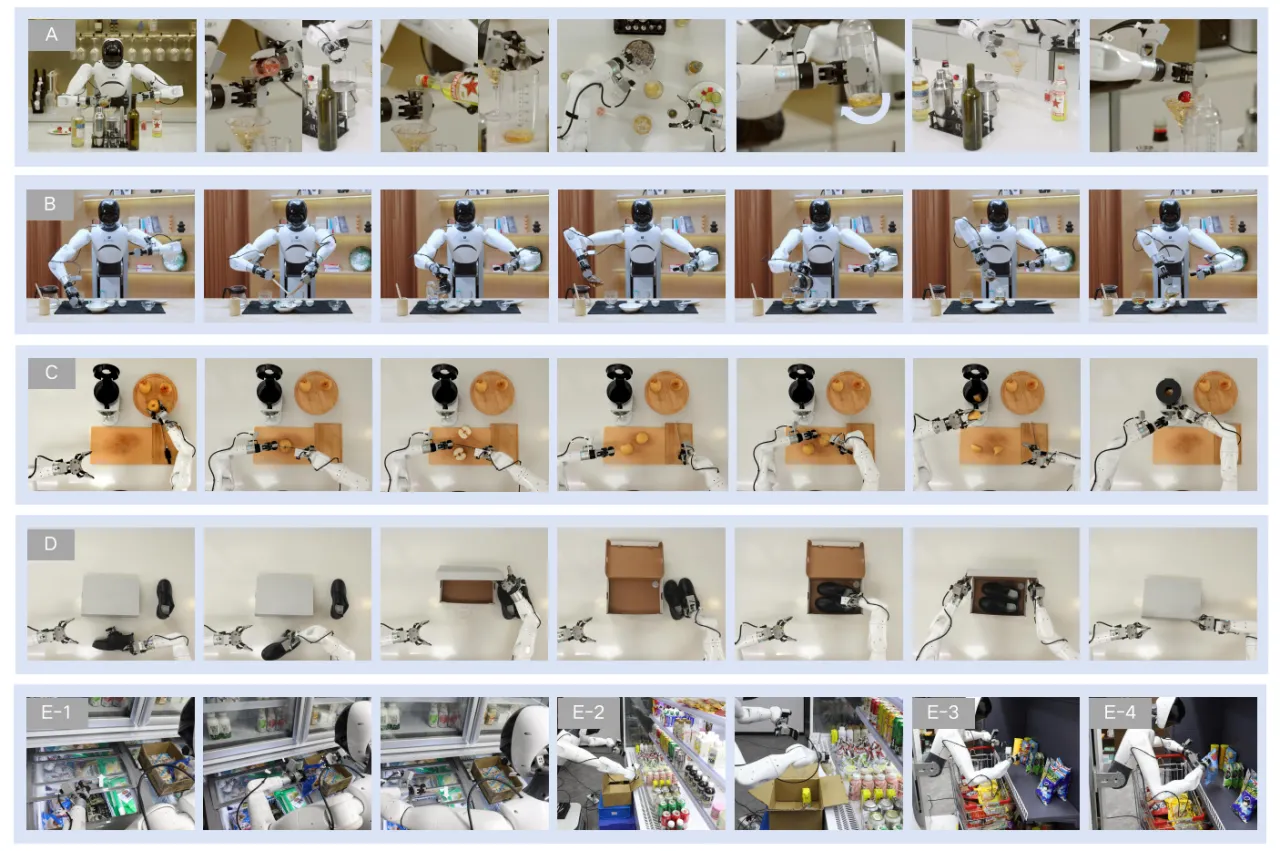
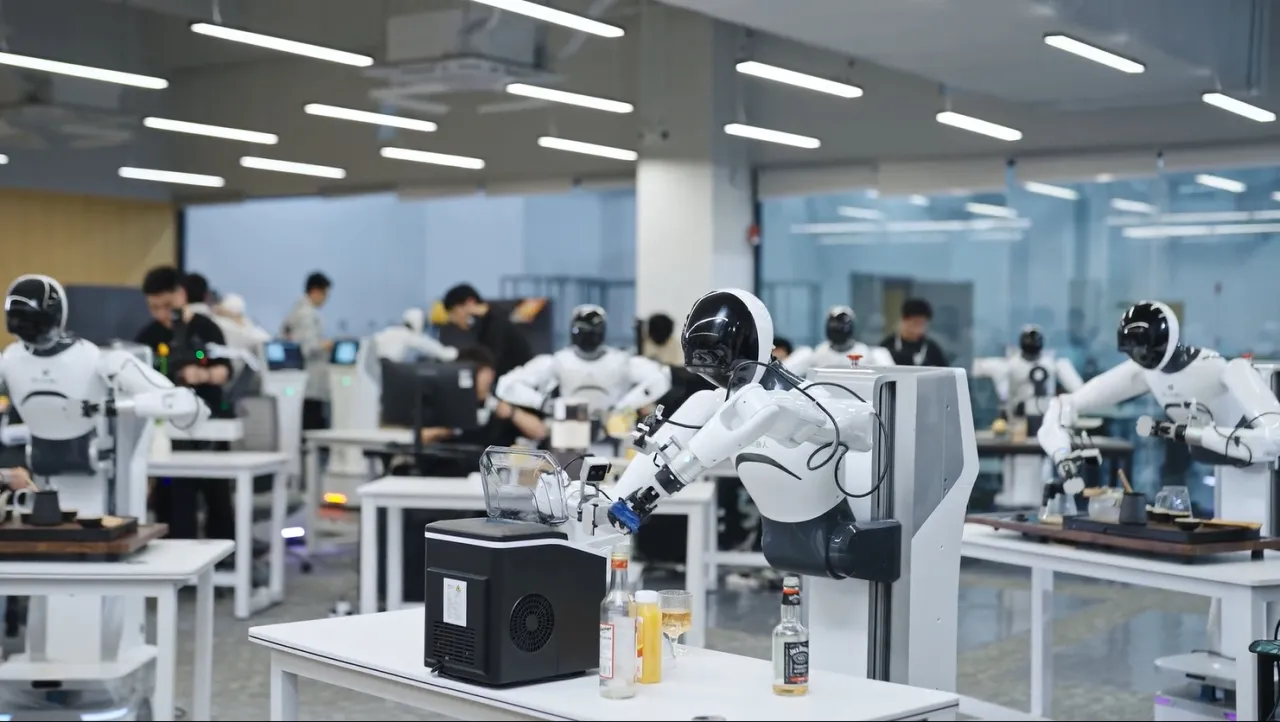
评测任务图示。Panel A–D 为四项长时序任务(Cocktail、Gongfu Tea、Fruit Juice、Shoebox),Panel E 汇总四项超市补货任务(含冰柜开门、纸箱搬运、错放纠正等场景),整套任务覆盖语义定位、接触密集操控、长时序执行与错误恢复。Illustration of the evaluation tasks. Panels A–D are the four long-horizon tasks (Cocktail, Gongfu Tea, Fruit Juice, Shoebox); Panel E gathers the four supermarket restocking tasks (including opening a freezer door, carrying cartons and correcting misplaced items). Together the suite covers semantic grounding, contact-rich manipulation, long-horizon execution and error recovery.Fleet of robots. LWD 在 16 台机器人车队上做在线训练,持续改进同一个多任务通才策略。Fleet of robots. LWD runs online training on a fleet of 16 robots, continually improving one and the same multi-task generalist policy.
Main Results
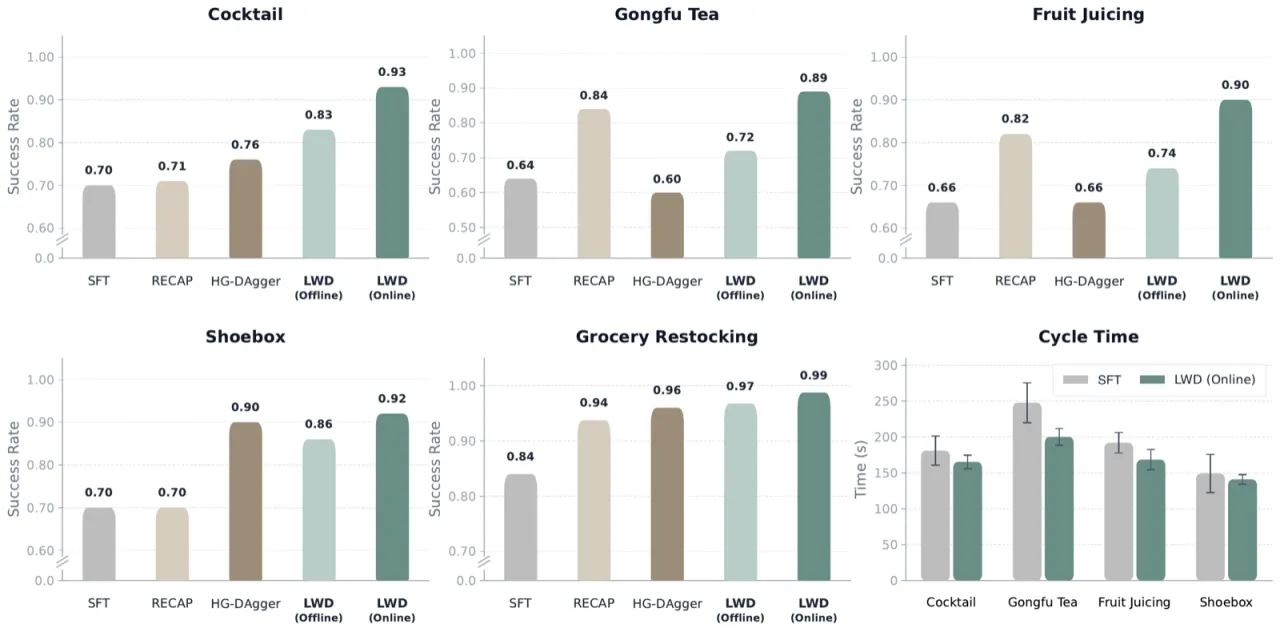
LWD (Online) 在全部 8 项任务上取得最优平均分 0.95,全面超过所有基线,且在四项长时序任务上均拿到最高分。LWD (Online) attains the best average score, 0.95, across all 8 tasks, surpassing every baseline, and takes the top score on each of the four long-horizon tasks.
Method
Restocking
Correction
Freezer
Open-Cooler
Gongfu Tea
Fruit Juice
Cocktail
Shoebox
Average
SFT
0.70
0.88
0.83
0.95
0.64
0.66
0.70
0.70
0.76
RECAP
0.95
0.96
0.94
0.95
0.84
0.82
0.71
0.70
0.85
HG-DAgger
1.00
0.92
0.92
1.00
0.60
0.66
0.76
0.90
0.85
LWD (Offline)
1.00
1.00
0.92
0.95
0.72
0.74
0.83
0.86
0.88
LWD (Online)
1.00
1.00
0.97
0.98
0.89
0.90
0.93
0.92
0.95
长时序任务上的优势最明显:LWD (Online) 长时序平均分 0.91,高于 SFT (0.68)、RECAP (0.77)、HG-DAgger (0.73) 和 LWD (Offline) (0.79)。论文分析 HG-DAgger 在长时序任务上收益有限、有时甚至掉分,原因可能是"DAgger-style training relies on human correction data, whose variability can introduce inconsistencies and provide limited exploration of the broader state space";而 RL 能通过 TD backup 把终端成功信号传播到更早的决策步骤,为长时序任务提供更强的学习信号。在已经趋于饱和的超市补货任务上,LWD (Online) 依然保持在最优或接近最优水平,说明它在带来长时序收益的同时没有牺牲通才行为。The advantage is clearest on long-horizon tasks: LWD (Online) reaches a long-horizon average of 0.91, above SFT (0.68), RECAP (0.77), HG-DAgger (0.73) and LWD (Offline) (0.79). The paper suggests that HG-DAgger gains little on long-horizon tasks and sometimes even loses ground because "DAgger-style training relies on human correction data, whose variability can introduce inconsistencies and provide limited exploration of the broader state space"; RL, by contrast, can propagate the terminal success signal to much earlier decision steps through TD backup, providing a stronger learning signal for long-horizon tasks. On the already near-saturated supermarket restocking tasks LWD (Online) still stays at or close to the best level, showing that its long-horizon gains do not come at the cost of generalist behavior.
Success scores 与 cycle-time 对比:LWD 相对静态 SFT 参考策略同时提升成功分数并降低平均 cycle time;论文报告 LWD 相较参考策略把长时序任务平均 cycle time 降低了 23.75 秒。Success scores and cycle time compared: relative to the static SFT reference policy, LWD raises success scores and lowers average cycle time at the same time; the paper reports that LWD cuts the average cycle time of long-horizon tasks by 23.75 seconds relative to the reference policy.
Ablations
价值学习设计(DIVL vs 标量 expectile 回归):在保持其他组件不变的情况下,DIVL 在全部任务上优于标量基线,长时序任务上收益更大——离线阶段 +9.7%,在线阶段 +16.7%。Value learning design (DIVL vs scalar expectile regression): with all other components held fixed, DIVL beats the scalar baseline on every task, with larger gains on long-horizon tasks — +9.7% in the offline stage and +16.7% in the online stage.
Method
Short-Horizon (Offline)
Short-Horizon (Online)
Long-Horizon (Offline)
Long-Horizon (Online)
Expectile Regression
0.96
0.97
0.72
0.78
DIVL (Ours)
0.97 (+1.0%)
0.99 (+2.1%)
0.79 (+9.7%)
0.91 (+16.7%)
自适应 τ 策略:相较把 τ 固定为训练统计平均值(τ=0.52)的常量基线,自适应 τ 把离线平均分从 0.84 提升到 0.88,在 Restocking、Correction、Cocktail 等任务上收益更一致——这说明基于分布熵调节 bootstrap 乐观程度确实有帮助:不确定性高时更保守,价值估计确信时更乐观。Adaptive τ schedule: compared with a constant baseline that fixes τ at the mean of the training statistics (τ=0.52), adaptive τ lifts the offline average score from 0.84 to 0.88, with more consistent gains on tasks such as Restocking, Correction and Cocktail — evidence that modulating bootstrap optimism by the entropy of the distribution really does help: more conservative when uncertainty is high, more optimistic when the value estimate is confident.
论文还可视化了 Gongfu Tea 成功/失败两条 episode 的价值曲线(Fig. 5,未收录本页):成功轨迹中价值随子步骤完成逐步上升,失败轨迹中价值在停止推进后维持在较低水平——作者将其定性描述为"the learned value estimate tracking task-progress differences in these examples",用于诊断稀疏奖励下价值函数是否捕捉到了任务进展信号,而非作为额外的定量结果。The paper also visualizes the value curves of a successful and a failed Gongfu Tea episode (Fig. 5, not reproduced on this page): on the successful trajectory the value rises step by step as sub-steps are completed, while on the failed trajectory it stays at a low level once progress halts — the authors describe this qualitatively as "the learned value estimate tracking task-progress differences in these examples", using it to diagnose whether the value function captures the task-progress signal under sparse rewards, rather than as an additional quantitative result.
04 Limitations
Note: 以下三点均为论文 Conclusion 中作者明确列出的局限(stated by authors),并非本页推测。Note: All three points below are limitations explicitly listed by the authors in the paper's Conclusion (stated by authors), not speculation by this page.
在线更新调度过于朴素The online update schedule is overly naive
"the current online learning pipeline updates with a straightforward real-time schedule. This design may not be optimal for larger-scale deployment or long-term continual improvement." 更高效、更稳定的更新策略仍是未来方向。"the current online learning pipeline updates with a straightforward real-time schedule. This design may not be optimal for larger-scale deployment or long-term continual improvement." More efficient and more stable update strategies remain a direction for future work.
长时序任务依赖单一简短指令Long-horizon tasks rely on a single short instruction
论文长时序实验中每个任务只用一句简短的语言指令;但复杂任务需要更强的视觉-语言推理去做任务分解,也需要更细粒度的提示来支持闭环执行和错误恢复。In the paper's long-horizon experiments each task uses only one short language instruction; complex tasks, however, call for stronger vision-language reasoning to decompose the task, and for finer-grained prompting to support closed-loop execution and error recovery.
未显式建模执行安全Execution safety is not explicitly modeled
"our current policy learning framework does not explicitly model execution safety." 作者指出,面向可靠的真实世界部署,引入安全感知的学习与控制机制将是重要方向。"our current policy learning framework does not explicitly model execution safety." The authors point out that, for reliable real-world deployment, introducing safety-aware learning and control mechanisms will be an important direction.